Design for læring på tværs med digital teknologi – i en EUD-kontekst

Så er det seneste nummer af tidsskriftet LearningTech med fokus på digitale teknologier i undervisningen netop udkommet. Jeg bidrager med en forskningsartikel om, hvordan man didaktisk kan designe for læring på tværs af kontekster, og hvordan digitale teknologier kan spille en rolle.

Jeg anvender begrebet grænsekrydsning til at beskrive den form for transformation af viden og praksisser, som elever og studerende, især i vekseluddannelser, skal kunne håndtere. I artiklen har jeg specifikt fokus på, hvordan dette kan foregå i erhvervsuddannelser. Og jeg kommer med et bud på seks didaktiske designprincipper, der kan støtte lærere, elever og evt. oplærere i arbejdet med at skabe meningsfulde sammenhænge og koblinger mellem især skole- og oplæringsperioder.

Grænsekrydsning er en særlig måde at forstå og italesætte transferfænomenet på. Det, der adskiller sig fra mere traditionelle transfertilgange er, at man i grænsekrydsning har fokus på de forskelle som eleverne intentionelt og uundgåeligt oplever i deres vekslen mellem skole- og oplæringsperioderne. Jeg berører også – relativt kort – hvordan digitale teknologier i denne forbindelse kan anvendes som grænseobjekter, der har til formål at skabe koblingspunkter, hvorom der kan faciliteres dialog og meningsforhandling mellem fx elever, lærere og oplærere undervejs i uddannelsesforløbet. De to hovedpointer i artiklen er dels:

  1. at grænsekrydsning ikke sker af sig selv – processerne skal derimod designes og stilladseres, og
  2. at digital teknologi kan spille en afgørende rolle i det didaktiske arbejde med grænsekrydsning, idet teknologierne kan udvide både elever, lærere og oplæreres handlemuligheder i forsøget på at skabe sammenhæng og mening på tværs

Men digitale teknologier er ikke neutrale – via deres design tilbyder teknologierne forskellige handlemuligheder, der kan være mere eller mindre velegnede ift. lærerens didaktiske intentioner. Det betyder også, at digitale teknologier, der tages i anvendelse i undervisnings- og læreprocesser, faktisk kan være uhensigtsmæssige – fx fordi de reelt ikke giver de handlemuligheder, der er nødvendige for at nå i mål med den didaktiske intention. Derfor stiller anvendelse af digitale teknologier store krav til lærernes viden om, hvordan teknologierne fungerer og kan gå ind og på- eller ligefrem modvirke det, der var tanken med undervisningen. Og det gør sig selvfølgelig også gældende, når lærere ønsker at anvende digitale teknologier til grænsekrydsningsprocesser.

Alle mulige digitale teknologier har potentiale til at fungere som grænseobjekter, men potentialet bliver kun indfriet, hvis teknologierne faktisk bliver anvendt som sådan. Det er ikke nødvendigvis nogen let didaktisk opgave, men de seks didaktiske designprincipper, som præsenteres i artiklen, er bud på, hvordan denne spændende og nødvendige opgave kan gribes an.

Der er fem andre spændende artikler i temanummeret, som alle har fokus på forskellige aspekter af inddragelse af digitale teknologier i undervisnings- og læreprocesser. Her vil jeg fremhæve min kollega, Bjarke Lindsø Andersens bidrag, der med artiklen Lærerautoritet er medieret af digital teknologi, tilbyder en ny forståelse af, hvordan digital teknologi, som en aktiv med- og modspiller, påvirker lærerens autoritet. Et meget interessant eksempel på, hvordan digitale teknologier ikke er neutrale.

/Marianne
Grænsekrydsning, transformation af viden, handling og praksis medieret af ikt i EUD – Networked Learning 2020 præsentation

Networked Learning konferencen 2020, præsenterede jeg mandag d. 18. maj ganske kort udvalgte resultater fra et forskningsprojekt om grænsekrydsning medieret gennem brug af informations- og kommunikationsteknologi (ikt) i erhvervsuddannelser. Præsentationen er baseret på et forskningsprojekt, som jeg afsluttede i 2019 sammen med mine tidligere kolleger fra Nationalt Center for Erhvervspædagogik på Københavns Professionshøjskole, hhv. Carsten Lund Rasmussen og Anna Brodersen.

Til præsentationen hører også en kort forskningsartikel (engelsk), der kan ses her – og selve forskningsrapporten (dansk) kan ses her. Selv om vi ikke længere er kolleger, er Carsten, Anna og jeg i dialog om, hvordan vi får resultaterne formidlet på en mere praktikervenlig måde – ikke mindst fordi vi har erfaringer med, at det teoretiske grundlag og vores forskellige modeller giver god mening på Diplomuddannelsen i Erhvervspædagogik (DEP). Så mere om dette vil følge fremadrettet.

'Grænsekrydsning' er et perspektiv på transformation af viden, handling og praksis mellem kontekster (fx mellem skole og praktik), som vi har fundet mere anvendeligt og meningsfuldt end det traditionelle transfer-begreb - det kan du læse mere om her.

/Marianne

Challenges in designing for horizontal learning

Even though, my colleagues and I’ve presented our preliminary research results on several occasions, so far we’ve only presented in English once. In May 2016, I had the opportunity of presenting a short paper at the Designs for Learning conference in Copenhagen at AAU-CPH:


Our short paper can be found here (pp. 97-101)

/Mariis

For those readers who understand Danish, I’ve written a more detailed post about the conference on our Danish research blog.

ICT, transfer, and boundary crossing in VET – part 3

For the time being, this will be the third and final post describing our research project. In the first post, I wrote about the background for initiating the project, and in the the second post I zoomed in on our research questions. In this post, I focus on the design of our study.

According to Mackenzie & Knipe (2006), in the social and applied science, the exact nature of how research is defined will depend on the researcher’s personal and professional beliefs. Therefore, it is important to discern such assumptions before embarking in any research endeavour, because:

All research is interpretive: it is guided by a set of beliefs and feelings about the world and how it should be understood and studied. Some beliefs may be taken for granted, invisible, or only assumed, whereas others are highly problematic and controversial. (Denzin & Lincoln, 2011, p. 13)

Mackenzie & Knipe (2006) suggest four sets of underlying assumptions or paradigms: 1) Positivist/postpositivist, 2) Interpretivist/constructivist, 3) Transformative, and 4) Pragmatic. It is the choice of paradigm that sets down the intent, motivation and expectation for the research,  and I would say that our project mainly is situated within an interpretivist line of thinking in which the intention of the research is to understand the world by trying to make sense of the experiences and attributed meanings others have about the world. Researchers focus on the processes of interaction among individuals and on the specific contexts in which individuals live and work. Further, proponents of this paradigm recognize that the researchers’ own background impact the research and their interpretation hereof. Initially we wanted to design our project as a transformative study building on a Design based Research approach, but our local research leader advised against this assuming the VET schools would be too busy to get involved in a significant manner.

Consequently, we ended up designing our project as a multiple case study (Yin, 2009) with interviews and observations as primary methods to generate and collect data in different phases of the project.

In the preliminary research phase of the project we conducted six ethnographic interviews with VET teachers, which we have written about in a short paper presented at the Designs for Learning 2016 conference (Riis et al, 2016). Building on Spradley’s (1979) ideas of descriptive questioning, and questions loosely structured around the elements in a third generation activity system, we interviewed six vocational teachers from the three dominant strands of the Danish VET system (technical, business and social- and health schools). As stated by Spradley (1979), descriptive questioning aims at uncovering the informant’s personal experience with the practice and phenomenon under study by way of having the informant elaborate through thick descriptions and examples, often times by repeating and rephrasing questions. The data generated in this initial phase was mainly targeted at answering our first sub-question regarding VET teachers’ understanding and practice concerning the concepts of boundary crossing and continuity. In brief, we found that the interviewed VET teachers predominantly think in terms of vertical learning processes and one-time and one-directional transfer, rather than horizontal processes, continuity, and boundary crossing.

In the second phase of the project (Spring 2016), we conducted classroom observations combined with further interviews (with VET students and trainers as well), and we are still in the process of analyzing the data.

Due to organizational changes in our department, which led to a reduction from five to three people in the research group (with one being a newcomer to the project), we decided not to interact directly with VET schools this fall. Instead we have focused on analyzing data and on field validating some of our pedagogic-didactic materials that we have developed, and this we have done in our teaching at the Diploma for VET teachers.

Based on our findings so far, it has become obvious that we need to focus on observing teachers and students acting with technology in the future in order to better understand the phenomenon of ICT-based artefacts and their role in boundary crossing. When looking at the different types of ICT that participants in our study actually use, it seems fruitful to focus on the use of video and learning management systems, and we are hoping to interact with VET schools in this regard beginning 2017.

/Mariis

References

Denzin, N.K. & Lincoln, Y.S. (2011). The SAGE Handbook of Qualitative Research. SAGE

Mackenzie, N. & Knipe, S. (2006). Research dilemmas: Paradigms, methods and methodologyIssues In Educational Research, Vol 16, 2006.

Riis, M., Bergstedt, P., Jørgensen, C.B., Koch, H.H. & Rasmussen, C.L. (2016). Challenges in designing for horizontal learning – in the Danish VET system. Short paper accepted for Designs for Learning conference, May 18.-20., 2016 in Copenhagen, Denmark at Aalborg University, http://www.designsforlearning2016.aau.dk/

Spradley, J.P. (1979). The Ethnographic Interview. Wadsworth, Cengage Learning.

Yin, R. K. (2009). Case Study Research. Design and methods. 4th edition. SAGE.

Interesting study on Boundary Objects and virtual collaboration

In our research project we are highly influenced by the Dutch researcher Sanne F. Akkerman and her colleagues and their research on boundary crossing and boundary objects in (vocational) education. Like many others in the field, we have benefited greatly from Akkerman & Bakker’s (2011) excellent review entitled Boundary Crossing and Boundary Objects, and I’ll return to this in future posts.

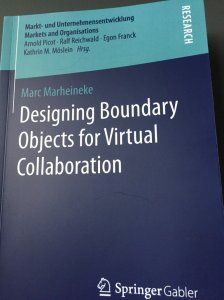
marheineke2016Nonetheless, other researchers have been studying these concepts from other perspectives, and I recently came across what turns out to be a PhD study (Marheineke, 2016) on the use of boundary objects in virtual collaboration, which seems very promising in relation to our current focus on ICT-mediated boundary objects.

In this study, Marheineke provides an interesting literature review on the use of different types of virtual boundary objects. In his work, Marheineke is inspired by Carlile’s (2004, 2002) typology, which we have been studying as well. However, as Marheineke states “emerging interest in the phenomenon of boundary object(s) has led to many definitions in the literature” (p. 80).

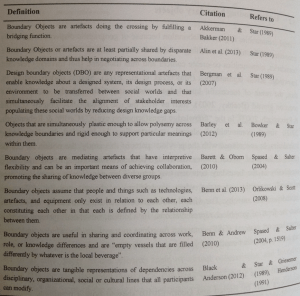
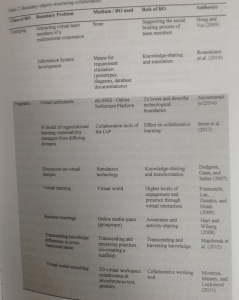
I have yet to study Marheineke’s research in detail, but so far I’m delighted to find many interesting and relevant tables e.g.:

marheineke2016_table3

Part of table 3: Selected definitions on the term “boundary object”
(Marheineke, 2016, p. 80-81)

marheineke2016_table7

Part of table 7: Boundary objects structuring collaboration
(Marheineke, 2016, p. 95-96)

/Mariis

References

Carlile, P.R. (2004). Transferring, Translating, and Transforming: An Integrative Framework for Managing Knowledge Across Boundaries.

Carlile, P.R. (2002). A Pragmatic View of Knowledge and Boundaries: Boundary Objects in New Product Development.