Myths and research on ways of learning

In this week’s newsletter George Siemens questions the use of visuals in communication and refers to a poorly researched article on this:

As I’ve stated, I’m trying to make greater use of visuals. Hard to make sense of the value of visuals with poorly presented articles like this: Why communicate visually. Some sloppy research on the old “10% hear, 20% read, 80% do” – this time attributed to Bruner. Will Thalheimer  debunks/questions the validity of this claim. This automatically calls into question related statements in the article (not cited properly) about the prominence of visuals in learning and retention. I don’t trust the author. But then I have to ask myself, why I want to use images/visuals. To increase effectiveness of learners who take a course I teach? To improve my ability to communicate? What can visuals do that text can’t? And where is the research that supports that claim?

Though relevant, I don’t want to address all Siemens’ questions in this post. Instead I spent some time on looking closer into the Will Thalheimer post on one of the major myths in learning, namely that people remember 10% of what they read, 20% of what they see, 30% of what they hear, etc. indicating that “learning by doing” always is the best way of learning.

Apparently the percentages have often been attributed the work of American educator Edgar Dale (1900-1985) and his book “Audiovisual Methods in Teaching” (1946, 1954 & 1969). In this book Dale presented The Cone of Experience, which depicts various types of audio-visual experiences that can be classified in terms of greater or lesser concreteness and abstractness, but it includes no percentages at all! In numerous posts Thalheimer has exposed the misuse/misinterpretations of Dale’s original work – including a fresh example from a conference in the workplace learning field in January 2009.

Back in 2002 Tony Betrus & Al Januszewski gave a presentation at the Association of Educational Communications and Technology (AECT) conference entitled “For the Record: The Misinterpretation of Edgar Dale’s Cone of Experience”. Betrus & Januszewski present 14 examples of misinterpretations – all exposing sloppy research, and as Donald H. Taylor comments:

The very worst of it? Some of these diagrams are produced by people who really should know better. Academic bodies such as North Caroline State University, services for educators such as Video4learning.com, and one individual – working for the good of others – who put a lot of work into producing two different pyramids, with the specific aim of making the diagrams available for free, general use, under creative commons.

A part from the disturbing fact that certain academic researchers continue to misuse and misinterpret Dale’s model and combine it with bogus data, this example raises a fundamental question of what we actually know – based on valid research! – about effective ways of learning.  Depending on how you define learning, I think many answers could be given to that question. However, in a recent study on the effectiveness of multimodal learning by Cisco Head of Education, Charles Fadel writes the following in the foreword of the report:

There is a lot of misinformation circulating about the effectiveness of multimodal learning, some of it seemingly fabricated for convenience. As curriculum designers embrace multimedia and technology wholeheartedly, we considered it important to set the record straight, in the interest of the most effective teaching and learning.

This report is the 3rd in a series that addresses “what research say” and it also refers to the many misinterpretations of Dale’s model and concludes:

The person(s) who added percentages to the cone of learning were looking for a silver bullet, a simplistic approach to a complex issue. A closer look now reveals that one size does not fit all learners. As it turns out, doing is not always more efficient than seeing, and seeing is not always more effective than reading. (p.8)

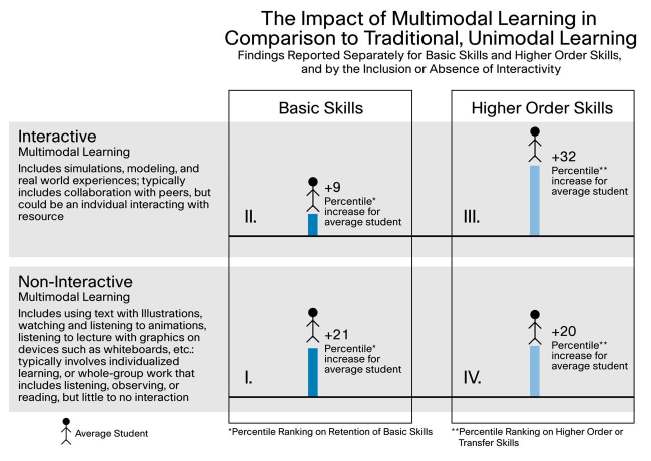
The report then explores the effectiveness on multimodal learning in comparison to traditional learning based on meta-analysis and experimental and quasi-experimental design studies published from 1997 to 2007, and comes up with this interesting figure:
cisco-8

  • Quadrants I and II: The average student’s scores on basic skills assessments increase by 21 percentiles when engaged in non-interactive, multimodal learning (includes using text with visuals, text with audio, watching and listening to animations or lectures that effectively use visuals, etc.) in comparison to traditional, single-mode learning. When that situation shifts from non-interactive to interactive, multimedia learning (such as engagement in simulations, modeling, and real-world experiences – most often in collaborative teams or groups), results are not quite as high, with average gains at 9 percentiles. While not statistically significant, these results are still positive. (p. 13)
  • Quadrants III and IV: When the average student is engaged in higher-order thinking using multimedia in interactive situations, on average, their percentage ranking on higher-order or transfer skills increases by 32 percentile points over what that student would have accomplished with traditional learning. When the context shifts from interactive to noninteractive multimodal learning, the result is somewhat diminished, but is still significant at 20 percentile points over traditional means. (p.14)

This report actually provides some substantiated evidence of the effectiveness of multimodal learning, but wisely cautions the reader:

This analysis provides a clear rationale for using multimedia in learning. That said, the reader should be cautioned that the research in this field is evolving, with recent articles suggesting that efficacy, motivation, and volition of learners, as well as the type of learning task and the level of instructional scaffolding, can weigh heavily on the learning outcomes from the use of multimedia. (p.14)

It’s an interesting report well worth reading, but you can also watch Charles Fadel discuss it with Elliott Masie at the Learning 2008 conference here.

/Mariis

Special thanks to Carsten Storgaard for the video link :-)
Iterative thinking, teaching and learning in SL

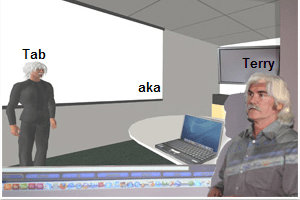
One of my favorite SL friends, Terry Beaubois has been interviewed about his use of  SL by Heather Livingston from the AIArchitect.

terry

Terry is a RL architect and has been teaching especially, but not exclusively architectural students in-world for four years now, so the interview quite naturally focuses on architecture, but I do think the interview is worth reading even if you don’t teach architecture.  Terry elaborates on the following questions:

  1. Why did you begin teaching in Second Life?
  2. How does the class work?
  3. What’s the benefit of using the virtual environment of Second Life versus a 3D modeling program?
  4. What lessons from Second Life can be translated into architecture practice?
  5. How have your students responded to the experiences?
  6. What advice would you offer young architects?
  7. Final thoughts?

Terry is a wise man which truly shows from the interview. What I especially appreciate about Terry is his positive and open-minded attitude. For sure there are constraints in using SL, but Terry has an important point about SL/VW’s:

I would continue to encourage a relationship with virtual environments. We don’t have to make all the conclusions now. We don’t have to judge it based on its current level of capabilities. It’s going to get better in the future. It’s not the be-all, end-all for everything, but it’s also not to be disregarded as a contributing technology to architecture.

I agree totally, and I think this applies for any subject matter and any emerging technology :-)

/Mariis

Read the full interview here

Lublin – in-world and out …

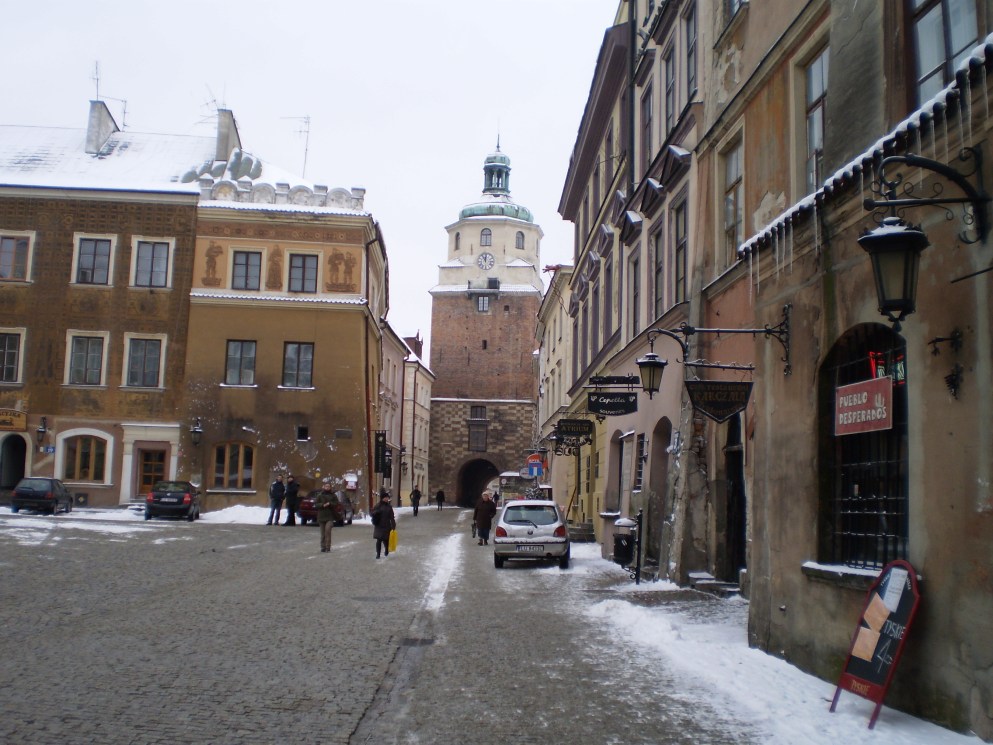
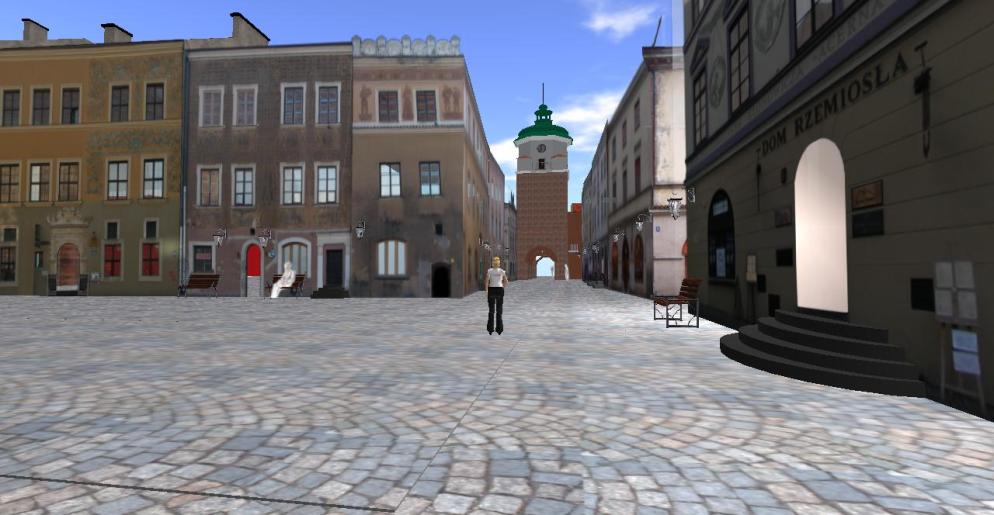
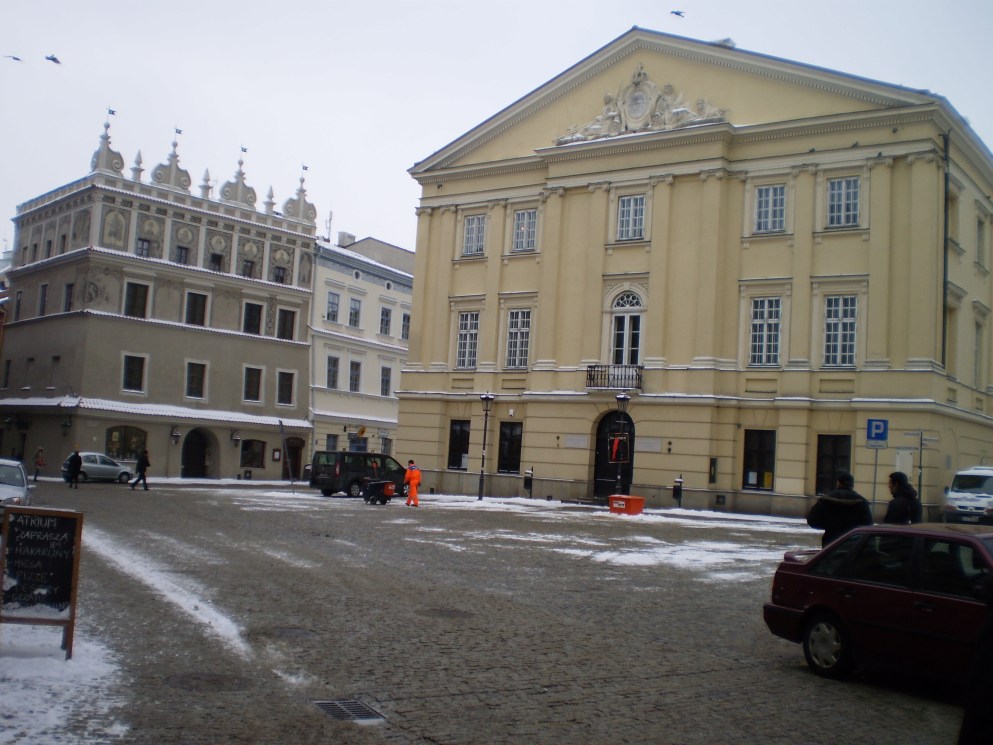
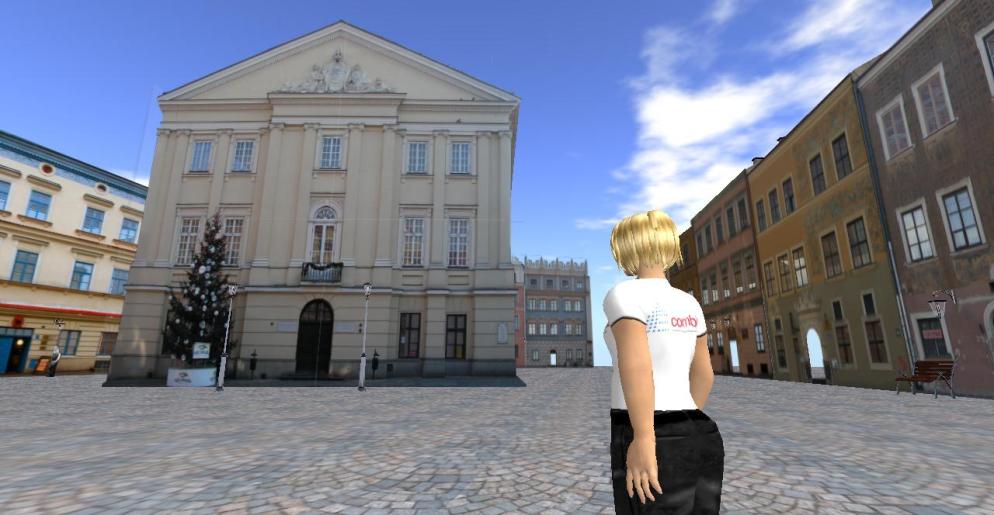
The COMBLE meeting my colleague, Heilyn and I just attended in Poland was held in the town Lublin.  What was especially interesting for me was that I actually recognized the Old town of Lublin from my visists to this part of Lublin in SL – quite a surreal experience: “Wow, I’ve been here before :-)”

Evidently the weather RL was not as good as in-world, but I do think the resemblance still is quite easy to see …

cracows-gate
Cracow’s Gate – RL

cracows-gate-sl
Cracow’s Gate – in-world

royal-court
Royal Court of Justice – RL

royal-court-sl
Royal Court of Justice – in-world

Heilyn and I did find time to explore the city a bit, and I must say that it was worth visiting – despite the somewhat unfriendly weather!

/Mariis

COMBLE meeting in Poland

Tomorrow my ELL colleague, Heilyn Camacho and I will be going to Poland to meet our partners from the COMBLE project. As part of the COMBLE project Heilyn and I are responsible for developing, implementing and testing a course that aims at educating future trainers in blended learning, and we will be giving a stat on our work and ideas:

We’ve chosen Problem Based Learning (PBL) as the overall pedagogical strategy for the course, and this is by no means a coincidence. When Aalborg University was founded in 1974 it was based on ideas of learning-by-doing and experiential learning that has evolved into a  strategy called Problem Oriented Project Pedagogy (POPP), which can be seen as a particular branch of PBL. The strategy is fundamentally based on group work, and it will be especially interesting to watch how this strategy works in a pure online course. This is also one of the main reasons for using SL in the course, because we hope SL will give the participants a strong sense of presence and co-presence in the learning environment that also consists of Moodle and different web 2.0 technologies.

The course is set to kick-off mid April and Heilyn and I will be working on setting up the Moodle environment and finding relevant places/people to visit in SL. It has not yet been decided where the main teaching and learning activites in SL will take place, but our Polish partners own an island, which we might use.

This course is the second case in my PhD, and in contrast to the MIL course I will not be the only teacher, since we’ve planned that some of my ELL colleagues, incl. Heilyn will teach in-world. This will give me an opportunity to get some feedback and different perspectives on teaching in-world, which I think will be very valuable for my PhD work, so I’m really looking forward to running this course :-)

/Mariis

Kolb’s Experiential Learning revisited

I’ve been a supporter, yet a critical one, of David A. Kolb‘s theory of Experiential Learning for many years, and almost like a recursive cycle I seem to return to Kolb’s ideas, whenever I’m looking for a theoretical framework to illustrate pedagogical activities. As I’ve recently started to process and reflect upon the many different teaching and learning activities in the MIL course (my 2. MIL research cycle), I’ve found it interesting to revisit Kolb’s ideas to study their “applicability” with my current project.

Teaching and learning environment
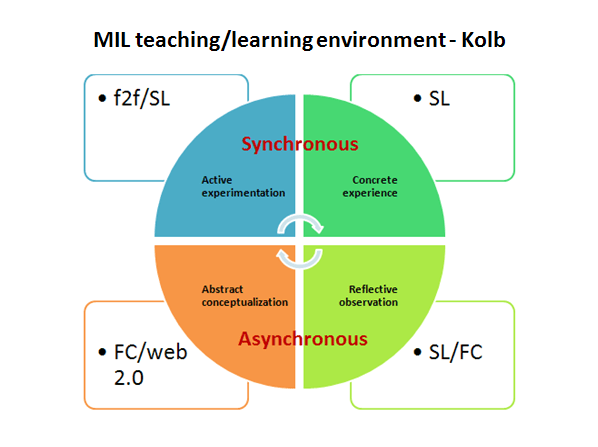
In order to better understand the different activities it’s necessary to get an overview of the teaching and learning environment, which is depicted below.

el-1

Home – given that MIL is a distance education with only four 2 1/2 day f2f-seminar pr. year the majority of the teaching and learning activities took place in the participants’ homes/workplaces.  All synchronous teacher initiated activities took place in the evenings/afternoons on weekends.

f2f seminar – the MIL course started on November 1st and ended on December 15th 2008. Mid November we had a f2f seminar, where the students were introduced to the general theme of the module (ICT and Didactic Design). I had 3 hours to lecture on “Remediation and redidactization in SL” combined with a hands-on workshop on some basic features of SL.

SL – was used for all the synchronous activities, both teacher and learner initiated.

FC (FirstClass) – was used for general information (incl. literature and other resources)/communication regarding the course, and more importantly as setting for the students’ asynchronous discussions/reflections. See this post for reflections on the quantitative outcome of the course.

Web 2.0 – various tools/technologies  supported the information provided in FC. Interestingly, and quite unusual for MIL students in other courses, the blogshpere and video and presentation repositories (like YouTube and Slideshare) were intensely explored in order to find additional information to support the students’ own findings and reflections.

A different perspective on Kolb’s model
Together with colleague Roger Fry, David A. Kolb started exploring the potentials of experiential learning in the 1970’ies, and Kolb further developed their ideas in his 1984 book “Experiential Learning: Experience as Source of Learning and development”. Besides exploring foundations (Dewey, Lewin and Piaget in particular) for experiential learning Kolb presented a model of 4 particular elements, which together constitute an optimal learning process. The elements are:

  • Active experimentation
  • Concrete experience
  • Reflective observation
  • Abstract conceptualization

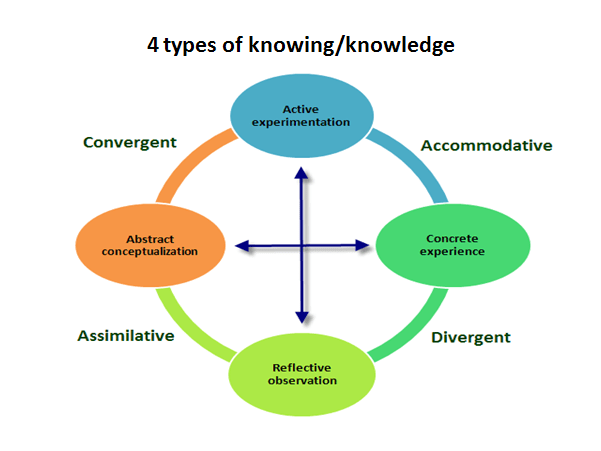
The model is widely known (and depicted) as a learning cycle and Kolb also used its elements to identify 4 learning styles, each corresponding to the spectrum between 2 elements – e.g. The Diverger, who supposedly prefers to learn through concrete experience and reflective observation. In this post I don’t want to address the otherwise relevant epistemological question of a) the probability of (universal) learning styles (incl. the number issue) or b) the question of how the learning process best can be understood (cycle, spiral, steps, continuum etc.).  Instead I want to return to the 4 core elements and use them to illustrate and discuss activities in different contexts of the MIL course’s teaching and learning environment.

el-2

Active experimentation and concrete experiences were mainly conducted synchronously at the f2f hands-on workshop and in SL. There was a total of 25 teacher initiated in-world activities that included:

  • Get-off-to-a-good-start – meetings where I as the main teacher instructed the newcomers in using different features and took them on tours to designated educational locations.
  • Building Class – 3 1 ½ hrs. sessions where guest teachers, Dr. Asp & Heidi Ballinger, showed the students the in-world building craft and assisted the students in their own building experiments.
  • Didactic Design Discussions – four 2 hrs. sessions, where I lectured on mandatory topics based on the course literature, but also on topics raised by the students in their asynchronous discussions. Due to the use of simultane voice and text communication, these sessions engaged the students more actively, when compared to traditional f2f lectures.
  • Visits – typically 1-2 hrs. sessions where the students and I visited both Danish and International colleagues involved in either in-world education and/or business.
  • Your Tour – 2 1 ½ hrs. sessions where 2 students showed the rest of us two locations of choice (one location of professional interest build by others, one location of professional interest build by the student’s employer).
  • X-Mas celebration – the last in-world meeting with focus on social activity. The students had asynchronously rewritten a well known Christmas song, so that it fit the class’ experiences from the course.
  • Friday Bar – a phenomenon well known from Danish on-campus life. In-world located as part of MIL’s Holodeck classroom. None of the students showed up for these events.

Reflective observation and abstract conceptualization were mainly conducted asynchronously in SL, FC and by the use of different web 2.0 technologies. In-world note cards and pictures were stored and utilized to support the students’ reflections that were expressed in the FC discussions. These reflections were also supported by course literature, and additional information found on the Internet.

The above distinction between synchronous and asynchronous activities is particular to this specific course design, should not be regarded too rigidly and could have been designed otherwise. If Kolb’s model is taken literally reflection happens at a certain stage in the process, whereas other theorists (incl. Kolb’s own inspiration Dewey. 1933) argue for reflection as an ongoing activity and especially Schön. 1983 has contributed with his concepts reflection-in-action and reflection-on-action.  The MIL students were clearly able to reflect-in-action, which became evident in many of the synchronous activities, especially in the didactic design discussions and during the visits. Another interesting comment could be made regarding the abstract conceptualization, which usually is associated with the ability to understand, evaluate and conclude on general principles derived from the previous experiences. The MIL students did this outside SL (mainly in written and graphic formats), but it could possibly have been done in-world as either processes (e.g. teach each other xx) and/or as products (e.g. build a model of xx). This is something I need to consider when planning the next MIL research cycle (Fall 2009) .

The 4 different activities also correspond to 4 different types of knowing/knowledge, which I’ll try to exemplify with empirical data in future studies.

el-4

Teaching-Learning relations in the environment
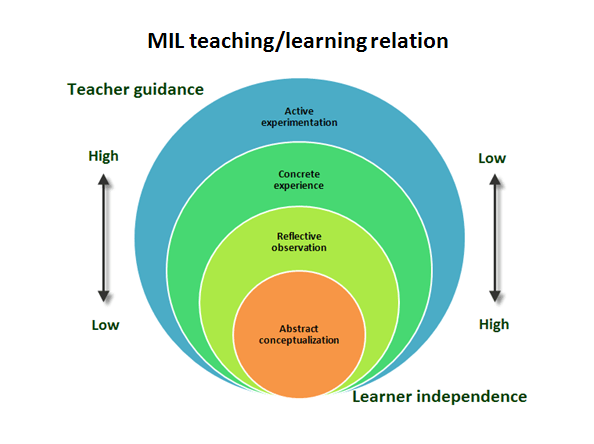
Staying within the framework of Kolb the 4 activities were dominant in the MIL course, and in reviewing these the role/influence of the teacher may be illustrated as below.

el-3

In general MIL students are tech-savvy, used to learning on their own and in their study groups, but SL proved to be an atypical experience, and my impression (also based on the 1. MIL research cycle) was that the students needed much more instruction/facilitation than usual.  Several reasons such as SL’s infamous steep learning curve, the course design, the length of the course period and the rather abstract nature of the subject matter may have contributed to this, but it’s certainly something I need to investigate further. It’s not necessarily a bad thing that the students needed more teacher guidance that usual, but coming from an education that has learner-independence as a goal (as part of a life-long learning perspective) it does bring about some reflections.

Anyways, in reviewing the “applicability” of Kolb’s ideas to my PhD project this preliminary inquiry shows some potential  that need further exploration …

/Mariis

References

Kolb, D. A. (1984): Experiential Learning: Experience as Source of Learning and Development. Englewood Cliffs, NJ.: Prentice Hall

Dewey, J. (1933): How We Think, New York: Heath.

Schön, D. A. (1983): The Reflective Practitioner. How professionals think in action, London: Temple Smith.