Case MIL09: Didactic Design Discussion – 1

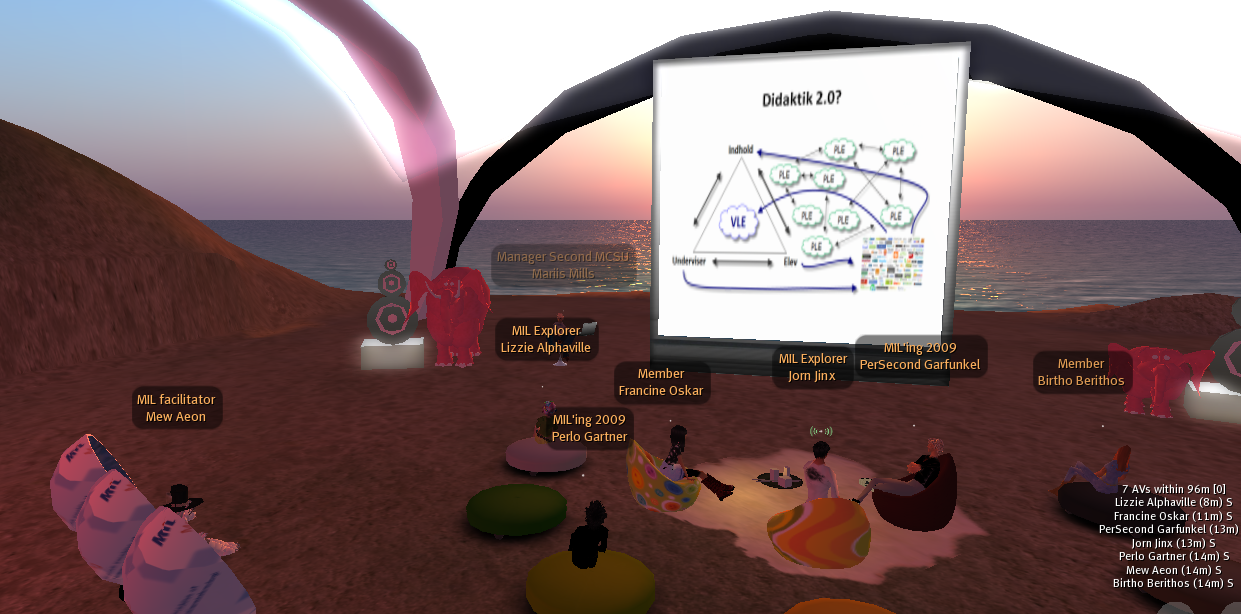
In the MIL course my co-facilitator Mew Aeon and I currently are running in SL the students are expected to analyze SL as teaching and learning environment, and in order to stimulate the students’ critical reflections we have prepared 4 discussions on different topics related to ICT-based Didactic Design. Last night we had the first discussion and for this I had prepared some slides (in Danish) focusing on two main topics; the field of Didactics and target groups.

8 students are enrolled in the course and since 3 of them did not have the possibility to participate in our recent f2f kick-off introductions  I had decided to repeat some central points. First of all there is the term ICT-based Didactic Design, which my colleague, Professor Birgitte Holm Sørensen from the Danish School of Education defines like this:

The process by which the purpose, the goals and the content is determined, and where the planning, the organization and the arena for teaching and learning is shaped based on theories and in relation to ICT-based practice in a context.

Via course readings the students are introduced to various didactic theories and models – one of the latter being the so called Didactic Triangle (usually attributed to German Pedagogical Philosopher Johann Friedrich Herbart 1776-1841) that depicts the basic relationships between teacher – content – student. Though all of us can agree that the field of Didactics includes more elements than the relationships in the Didactic Triangle it does, in my opinion, highlight the fundamentals and creates an excellent starting point for discussions on some of the key issues in Didactics.


Key issues in Didactics: content and actors

Now, what I find particularly interesting when you combine ICT with Didactic Design is that ICT not only serve as materials but also as arena or “room” for teaching and learning –an aspect which clearly is amplified when using 3D virtual technology like SL.  Most MIL students can be characterized as being tech-savvy educators/trainers for whom it is relevant to further enhance their competencies in integrating ICT in their practice and we naturally ended up discussing what impact especially web 2.0 tools/services will have on the way we think and practice didactics.

As I see it Web 2.0 tools/services have the potential of changing our perspectives and thus practices regarding:

  • Users – both the students and the teachers with regard to relations/roles/responsibilities
  • Participation – as we shift from consumption to (co-)production
  • Multimodality – new possibilities to design for teaching and learning processes
  • Networks and connections – from local to global citizenship
  • Knowledge management – both from an information and communication perspective and with regard to security and ethics


How does web 2.0 change the way we think and practice didactics?

For the last decade the Danish pedagogical debate has been focusing on learning and learners (in opposition to teaching and teachers) – and this shift in perspective has been highly welcome and much needed. On the other hand this shift seems to have placed the role of the teacher in some sort of vacuum (are teachers obsolete in the future as polemically stated by David Gelernter ?) making the challenges related to especially ICT integration more difficult and complex than necessary. When discussing target groups we therefore also encourage the MIL students to carefully consider the roles of the teachers. Much as anticipated we did not reach any solid conclusions on any of the topics, but I do believe the discussions inspired the students and I’m looking forward to the next session later this week.

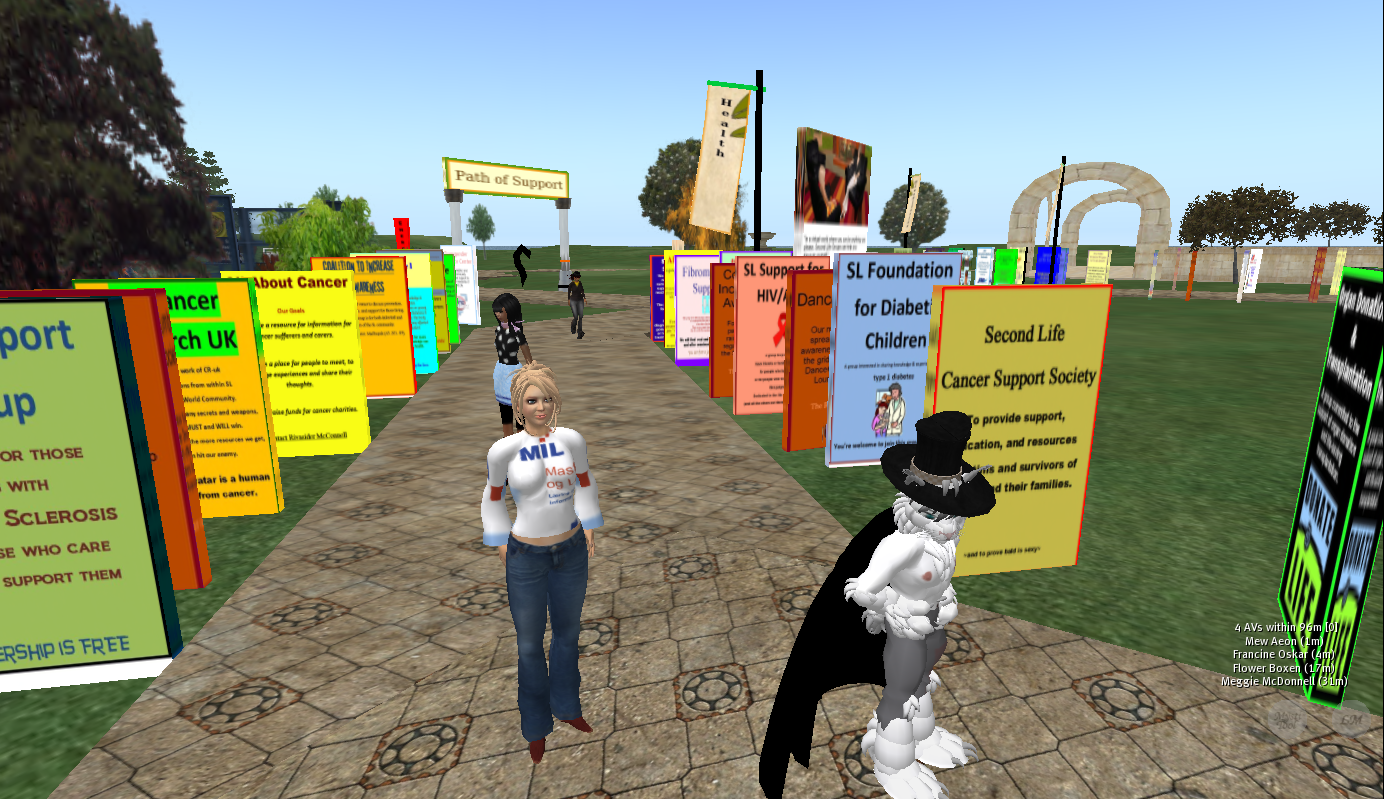
As part of our focus on target groups who could benefit from an environment like SL, we ended the night by visiting Health Info Island, including The Path of Support and finished off by investigating the Virtual Guide Dog.

/Mariis

More observations from the PBBL course

So we’re approaching the final week of the PBBL course and it is time to reflect a bit. My colleague Heilyn and I have managed to reflect on the course activities for every week and we have posted these reflections in Moodle, so that the participants could get an idea of why we have designed course elements in certain ways and what we have thought of the outcome. These meta-reflections  (on which the participants have commented) have proved to be very valuable in both our and the participants’ learning experience and it is definitely a course component I want to further develop in my next course. In this post I’ll highlight some of our reflections.

In the first SLecture the text and voice check took almost 45 min. and Heilyn and I agreed that this was unacceptable, so in the second SLecture we reduced the scheduled time to 15 min. and we put out further information on voice settings etc.  It worked for the majority of the participants, but there still seems to be 1-2 participants in every session struggling with technical problems. We actually asked everybody to check out if they could access especially SL before enrolling in this course, but in future courses this should be stressed, since we cannot help/ do anything about local problems e.g. firewall problems, inadequate graphics cards, poor internet connections and lack of headset etc. In designing this course we had planned a preparation week where participants were expected to solve a newbie assignment aimed at learning the basic skills in SL. These activities were optional and unfortunately very few participants decided to make use of this offer. For future courses we would recommend making newbie assignments/activities mandatory.
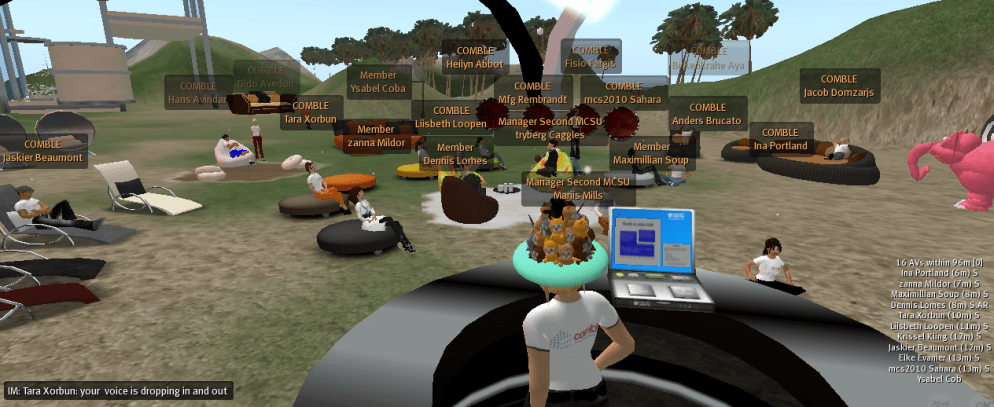
SLecture2
SLecture 2 in session …

In this course the participants are expected to work in Teams and Heilyn and I decided to form the teams based on nationality. The argument for this type of division was quite pragmatic. We knew that all participants would have difficulties in finding time to participate, so we figured it would ease their process if they were able to work in their own languages  for some of the activities (mainly the Mini-project work), and in the second SLecture these Learning Teams met for the first time.  Whether this has been a good decision we’ll know more about in the final course evaluation …
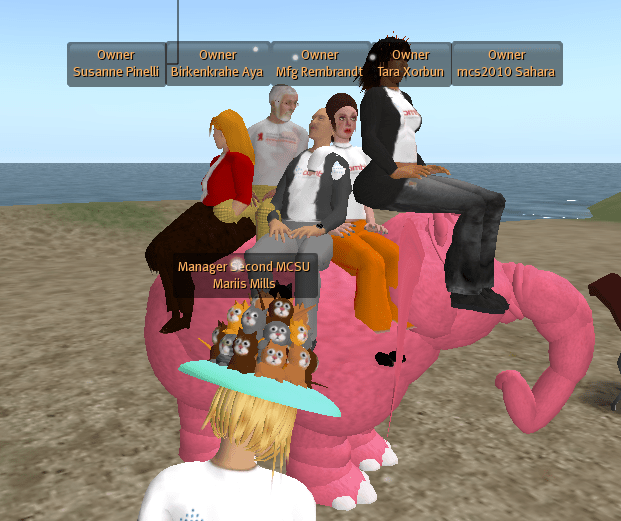
Germany
Learning Team Germany decided to meet on one of the Pink Elephants …

The third SLecture was Heilyn’s first real teaching experience in SL, and I think she did a great job. Her presentation was about Action Learning and by the end of the SLecture the Learning Teams were asked to go shopping for Team mascots.  I asked Heilyn about her experience and she pointed out two things. First of all she did not consider doing a presentation a creative way of teaching. I agree, but I do believe presentations are necessary when the participants have little or no prior experience with the subject matter, come from very different pedagogical cultures, speak different languages and in general have very different prerequisites. Lecturing then serves the purpose of trying to establish common ground, common language, common terminology and as a means to clarify questions. I also believe that the participants’ general SL skills should be taken into consideration before planning more difficult activities. Besides this, I do believe that lectures in SL are quite different from conventional f2f lectures due to the possibility of using simultaneous voice and text.

Heilyn-SL3
SLecture 3 in session …

Another point Heilyn made was that she felt somewhat alone during the SLecture, in the beginning she felt worried because she couldn’t see the participants’ reactions. It felt like talking to an empty space, but then the comments started to appear in the chats. By the end she was more tired than usual after a 2 hr lesson. Before the SLecture, we discussed if she should ask the participants to wait with their questions till after the presentation, but I recommended her to allow for questions during exactly because I thought she might otherwise feel quite alone – and it is also more interesting for the participants if they are allowed to contribute to the discussion. But lecturing this way and in a foreign language certainly is something you need to learn and especially when there are many questions/comments it can be difficult to stay focused. I’ve logged both local and group chat from all the lectures and as an example there were a total of 33 pages in the second SLecture – that is a lot of information you need to attend to while lecturing …
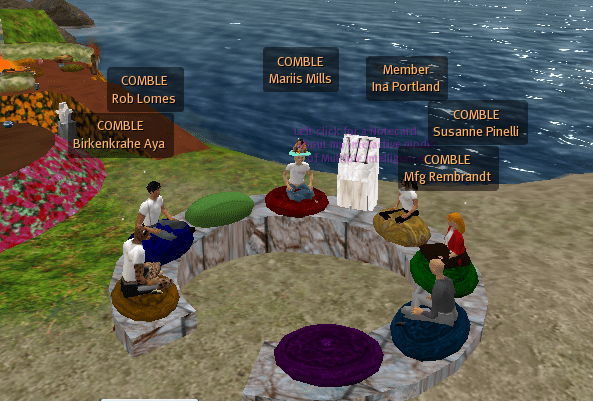
Optional-MI
Discussion on the MI theory …

Recognizing that participation in lectures is not the most interesting way to get to know SL, we have also included Optional visits, and in the first visit I showed the participants Zotarah Shepherd’s MI design and Thursday Xu’s designs of Bloom’s taxonomy and Wenger’s CoP.  Touring, exploring and trying out things together in an informal way combined with discussion on topics that are somewhat peripheral to the subject matter is in my opinion a very nice activity, and judging from the feedback the participants also appreciate this kind of activity.
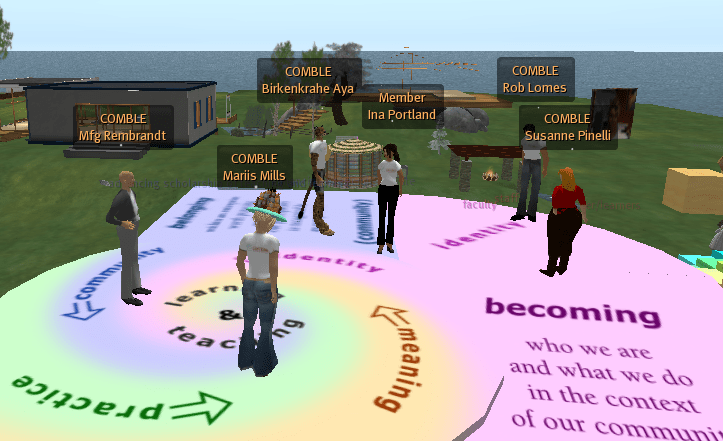
Wenger060909
Discussion on the CoP theory …

The fifth SLecture was on PBL, networked learning and web 2.0 technologies conducted by my other colleague, Thomas. I was not able to attend, but judging by the comments in Moodle the participants enjoyed the lecture. At this point in the course Heilyn and I decided to make part of the lectures more interactive, since the participants now seemed more at ease in SL. For the 6th SLecture we prepared 5 statements on PBL/AL and used them together with the Opinionater tool. This turned out to be a very interesting exercise. We had not anticipated that the participants would disagree to the extent that they actually did.

Statement3
No consensus on problem types in PBL/AL …

The Opinionater is a quite simple tool, but highly effective. We managed to have some interesting discussions on different aspects of PBL/AL and in that sense the tool also served as a formative evaluation tool giving us educators some hints on the participants’ perceptions. After this exercise I took some of the participants to U21 Global Island where we tried out the Metaphor Tour.
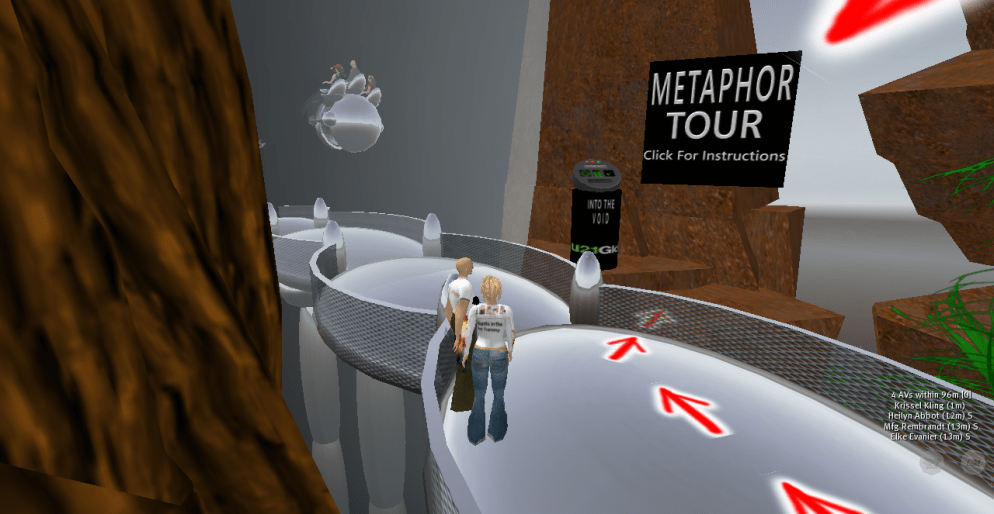
160909_014

The Metaphor Tour … a trip focusing on constructivist learning  …

In the second optional visit we met my friend, Inge Qunhua who is a Danish educator and SL designer. Inge has a lot of creative ideas and has made several small displays of her designs on her island.

130909_011
Investigating one of Inge’s designs …
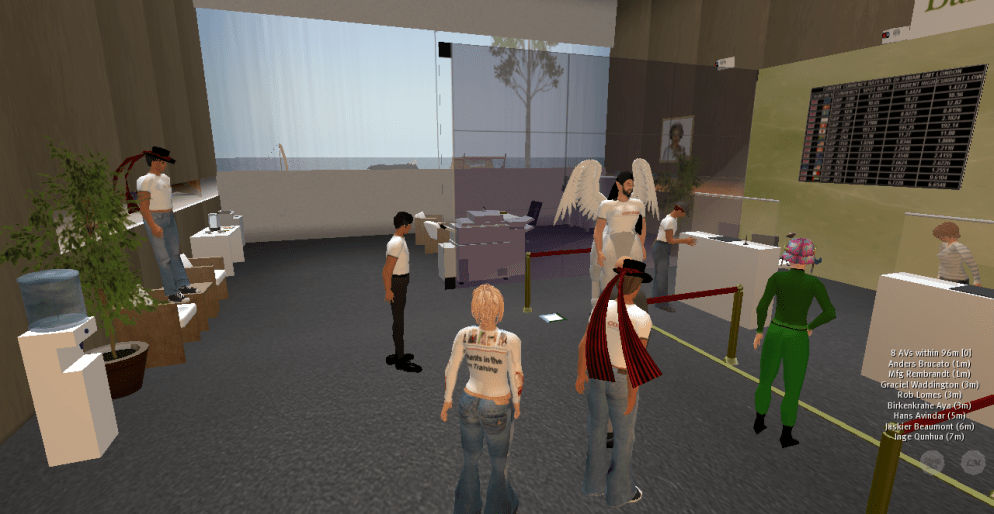
130909_017
The Bank setting in Inge’s holodeck …
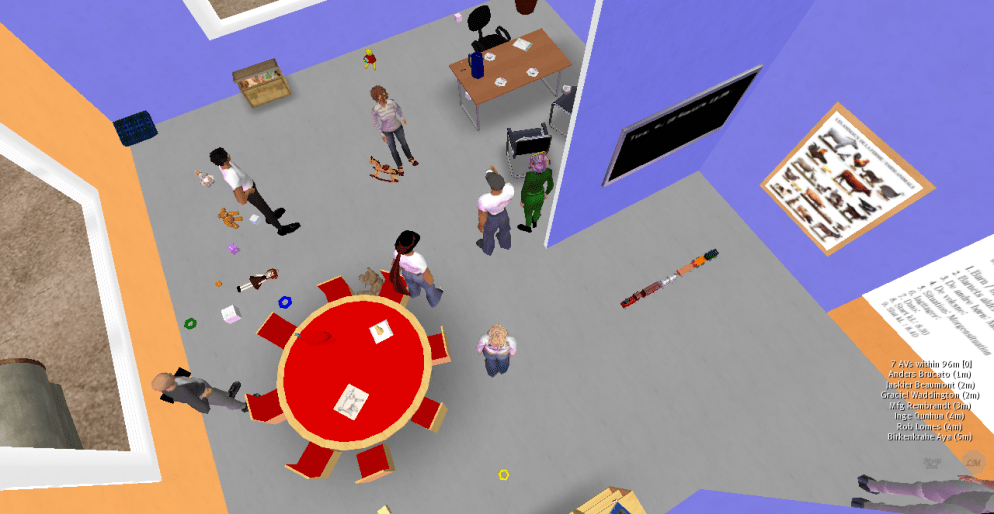
130909_022
The Kindergarden …

In the seventh SLecture this week we experimented with video display, but it did not turn out quite as we had hoped it would. However, we have not yet reflected on this experience, so I’ll return to that in a future post. This week the participants were expected to hand in their Mini-projects on Friday. Only 3 out of 6 teams did so, and this in my opinion is not satisfactory.  For the last 10 years I’ve been using project work in my teaching and I’ve never before had the experience of only half of the students/participants handing in projects. One team has asked for an extension of the deadline, whereas the two other teams haven’t given us any indication of what’s going on.

Mascot display
Learning teams displaying their mascots in the sandbox …

This course has been designed as a test course with the aim of finding out whether this certain design is sustainable and even though we all have learned a lot, I’m not convinced that this particular design is suitable for the general learning objectives.  Learning about PBL – especially the way we see this at Aalborg University, where we combine PBL with project organization – is a process that needs a lot of time. I’ve been skeptical of the very short course period (6 weeks, incl. preparation) from the beginning. We actually wanted to design a 10 week course, but preliminary investigations among our project partners indicated that a 10 week period would be too long. I can think of several reasons as to why only half of the teams managed to hand in their projects on time, but I’ll wait with further conclusions till we have done both project and course evaluation next week….

/Mariis

It’s a Dogs life … or is it?

Exploring the world just for fun is a favourite habit of mine – fortunately I have good in-world friends, who’ll help me out in doing so ..

Chimera encouraged me to visit her new place at Jokaydia .. little did I know that she would turn up as a dog!

dog_0031
Chimera barking at a giant cat … didn’t seem to have any impact though … Cats just are Cool!

We went on exploring the many islands – and I have to say that Jo Kay aka Jokay Wollongong‘s experience in building really shows … what a pleasure finally to be on islands build for avatars!

We also managed to have fun trying to take pictures while swinging :-)

dog_009

Anyway, the Jokaydia community really looks like an intereting educational place and I definately need to visit some more …

/Mariis

In-world course next 5 weeks

From November 1st – December 15th I’ll be facilitating a blended course using SL at The Danish Master programme in ICT and Learning. This course serves a primary case in my PhD-project, and I did a pilot study using the same course last fall together with 22 students. This is a brief description of the course as I’ve planned it this fall.

Educational setting – Master programme on ICT and Learning
The Master programme in ICT and Learning (MIL) was established in 2000 as a shared educational enterprise on equal terms between five Danish Universities, as an attempt to enhance collaboration between universities and working life within further and continued education.The Master programme is research based; teachers come from the five different research environments at the collaborating universities, and all participants (teachers, students and administration) are comfortable with participation in both small and large scale research projects. Hence, characteristic for MIL is that the education continuously tries to reflect and change its own activity by combining research and practice.

The Master programme is blended by a combination of virtual periods and 4 face-to-face seminars pr. study year. Between seminars the teaching and learning processes are conducted in the conventional 2D virtual learning environment, FirstClass combined with various web 2.0 technologies. Despite the fact that the five universities traditionally have represented different pedagogical cultures, MIL was from the beginning build fundamentally on the pedagogical philosophy of Problem Oriented Project Pedagogy, which is a Danish version of Problem Based Learning.

MIL consists of four course modules, a module on ICT tools and two long project periods. Each course module covers a theoretical and practical approach to its field of study combining ICT with

1) Learning

2) Interaction Design

3) Organizational Learning

4) Educational Design

The progression of the programme evolves in interplay between theory, practice and experiences of the participants.

Student profile
The goal of MIL is to upgrade people working with ICT and/or learning, both in the public and in the private sector. An internal investigation conducted in 2004 gave the following profile; a typical MIL student has an average age of 45, and is married with two children in the teens. The majority of the students work fulltime. Their educational background usually stems from the humanities, and all our students have bachelor degrees or equivalent, and about 75% have higher level educations. For most of our students their primary education is more than ten years old, which often means that is has been a while since they last were students and many of them have no or little experience with blended learning. All of them are quite competent regarding general ICT-skills, and nearly 20% are highly competent technicians. About 5% of the latter have never been professionally engaged in teaching and learning. When it comes to working experience almost all of our students (95%) are experienced teachers at different levels in the educational system and in the private sector, and it is not unusual to meet students with more than ten years of teaching experience. Nearly all the participants come with a background from leadership in organization or project groups.

Main motivation for entering the MIL programme is to increase competencies regarding ICT and learning and create intersections between the two. Another strong motivation for entering the MIL programme is the wish to connect with new networks in the field.

Course setting – ICT and Educational Design
The 4th module of the MIL programme “ICT and Educational Design” consists of 2 courses, and it is in the first course that we use SL:

  1. Educational design, ICT based learning products and virtual learning environments; theory and analysis
  2. Educational design, ICT based learning products and virtual learning environments; concept and implementation

Though separate, the two courses should be regarded as connected, in the sense that the learning outcome of the first course should be more or less applied in the second course. In the first course the students usually are provided with 2-3 optional virtual learning environments between which they are asked to choose one as analytical object. Throughout the MIL programme the students are introduced to different virtual learning environments covering a wide range of mainly conventional 2D asynchronous and synchronous examples. Therefore the learning environments chosen for this course always represent the more unconventional trends, since it is our experience that these often provide more rich and radical settings, which can stimulate reflections. This study year the students can choose either the 3D virtual game Global Conflicts Palestine or SL as their analytical object. Regardless of choice, the students are expected to discuss and analyze the learning environment on the basis of the 5 following mandatory topics:

Pedagogical design and target groups
Orientation and navigation
Interaction
Learning processes
Audio-visuals

SL setting and activities
MIL does not own land in-world, but we rent 2 locations on the island, Wonderful Denmark, but these locations are mainly used as meeting places. As mentioned above the students are expected to explore and analyze SL form a pedagogical point of view. In order to show the students the rich potential, I arrange tours to different locations where we meet with the owner/designer, have a tour and discuss pedagogical topics. Afterwards the students are expected to reflect on the locations, and document their findings in the asynchronous platform, FirstClass. Naturally the students can tour on their own, locate interesting design and share these experiences.

Besides touring, I’ve planned the following activities:

  • Get off to a good start – meetings where we focus on basic in-world skills
  • A building class running for 3 days with guest teachers Doctor Asp & Heidi Ballinger
  • Didactic Design Discussions – 4 sessions where we’ll focus on course litterature related to the students findings
  • Friday Bar – social meetings just for fun
  • Students Tour – students plan a tour based on their discoveries
  • Christmas celebrations and course finalization

And based on my experiences from last year we’ll have a lot ad hoc meetings, whenever the students need a helping hand :-)

“Without friends no one would choose to live, though he had all other goods”
By quoting Aristotle from Nichomachean Ethics I want to take this opportunity to express my gratitude to my in-world colleagues and friends both from Denmark and the rest of the world for helping me out in showing the potentials of SL – I couldn’t do it without you guys!

As the course progresses I’ll return with posts on our experiences ..

/Mariis

In the Sweet Bye and Bye

Due to a vicious flu which makes me unable to read or write for more than half an hour in a row, I’ve turned to my favorite relaxation; touring the world :-)

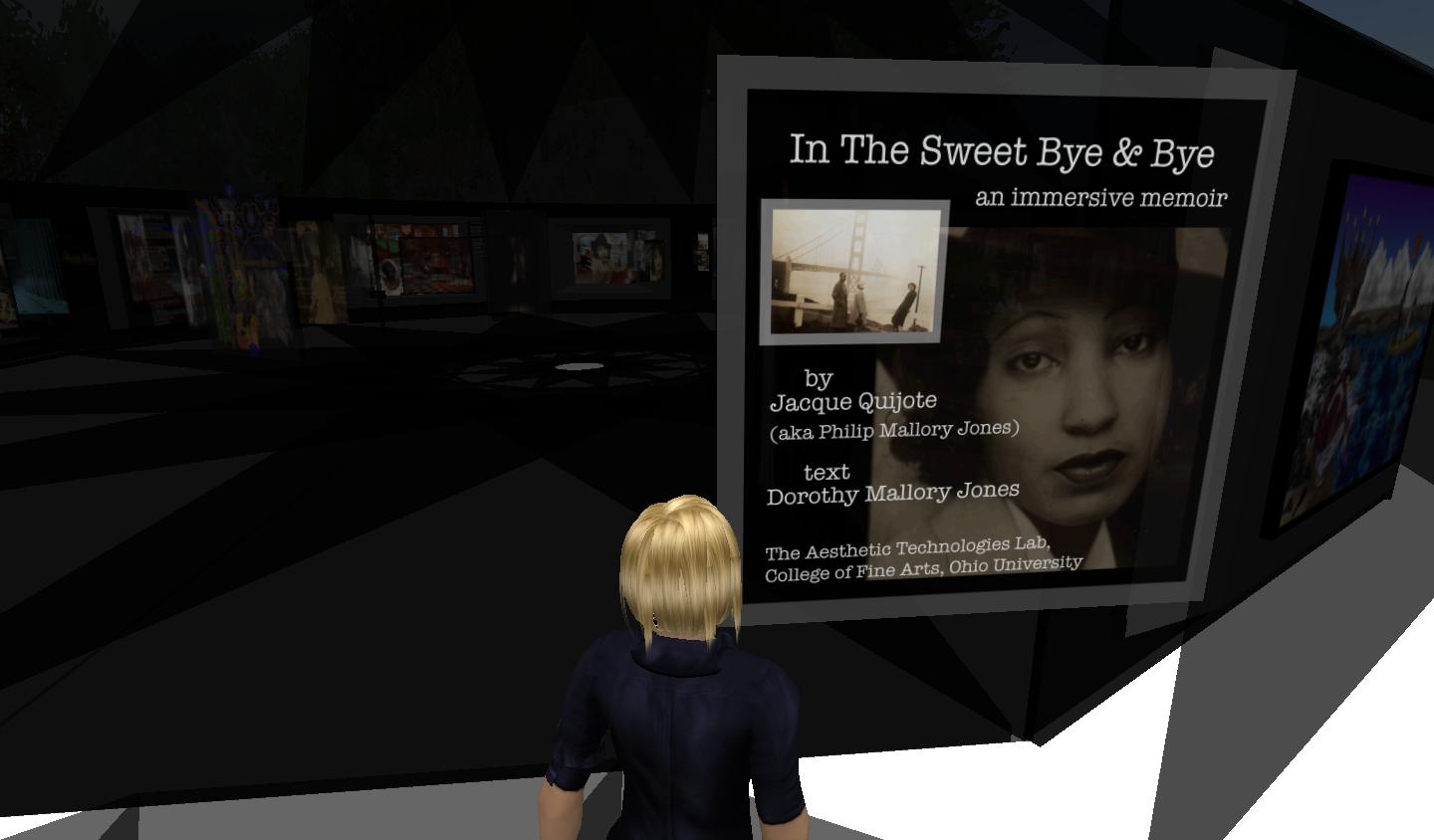
One of my SLCC friends, Jacque Quijote has created a wonderful 3D narrative or immersive memoir called IN THE SWEET BYE & BYE.

Quijote describes it this way:

A fusion of traditional and avant garde genres that can only be realized in the synthetic world. It is designed to be “read” in three dimensions. The narrative threads and paths are discovered in the overlap of images and texts, and in the compositions of planes and angles that form/transform as the avatar pov shifts. The narratives are on three levels – personal/family anecdote, communal lore, and allegory.

RL Quijote is, Phillip Mallory Jones , Lead Design Artist at The Aesthetics Technologies Lab, College of Fine Arts, Ohio University.

In this video Jones explains his art and research which is based on strong collaboration with several family members representing different art domains. At the end of the video Jones describes the unique process of bulding in SL.

Great place for a Sunday trip!

/Mariis