Book release: ICT and Learning – reflected practice

Together with colleagues Ulla Konnerup, Søren Skøtt Andreasen & Lone Dirckinck-Holmfeld I’ve co-edited an anthology entitled “ICT and Learning – reflected practice”.  What makes this anthology unique is that all the authors are alumni from the Masterprogramme in ICT and Learning (MIL).  Through 7 articles the authors discuss and reflect upon the use and purpose of ICT in different learning contexts covering the educational sector and one public hospital. The anthology is in Danish – and so will the rest of this post be …


Front cover by Helle Fibiger

Ikt og læring – reflekteret praksis er en antologi, der er blevet til på baggrund af masterprojekter udarbejdet i forbindelse med afslutning af Masteruddannelsen i Ikt og læring (MIL). Ideen til antologien kom fra alumner, som fandt det relevant at sætte fokus på den iderigdom, kreativitet og nye viden, der skabes i udarbejdelsen af disse afgangsprojekter.

Gennem antologiens syv artikler fremlægger, diskuterer og reflekterer de 13 forfattere en række vidt forskellige cases, som dog alle har koblingen af ikt og læring til fælles. Forfatternes meget forskellige teoretiske inspirationskilder, metodiske fremgangsmåder og brug af diverse typer af ikt viser bredden inden for dette spændende felt som er i konstant udvikling.

Antologien henvender sig derfor også bredt til alle, som interesserer sig for ikt og læring, hvad enten der er tale om teoretikere, praktikere, undervisere, studerende, arbejdsgivere og ansatte, for hvem reflekteret brug af ikt er en del af den daglige praksis i et samfund, hvor livslang læring om noget er på dagsordenen.

Emneord: Ikt, livslang læring, pædagogik, design, praksis, refleksion

Antologien’ s pris er kr. 198,- og den kan bestilles via Aalborg Universitetsforlag.

/Mariis

Life is all about stories

… and fortunately there are some great storytellers out there – here’s an amazing video from Sound’r:

While I’m not an artist, I do believe that storytelling plays an important role in my line of work too – or as Gordon Wells puts it:

Constructing stories in the mind or storying, as it has been called is one of the most fundamental means of making meaning; as such it is an activity that pervades all aspects of learning  . . . Through the exchange of stories, teachers and students can share their understandings of a topic and bring their mental models of the world into closer alignment. In this sense, stories, and storytelling are relevant in all areas of the curriculum. (Wells.1986:194)

Tomorrow, November 2nd I’ll be starting yet another in-world course. This time around, my friend and former MIL student, Mew Aeon will join me as co-facilitator.

Mew
What’s Mew’s story?

I’m truly delighted and grateful that Mew has accepted to join me in the course. I’m sure we’ll co-create some great teaching and learning stories together with the participants :-)

/Mariis

Reference

Wells, G. (1986). The Meaning Makers: Children Learning Language and Using Language to Learn.Portsmouth, NH: Heinemann.

SLecture 1 – observations from the PBBL course

In the PBBL course we have planned 10 lectures in SL and a number of optional informal meetings. Last night we had the first lecture and in this post I’ll reflect a bit on some of my observations. We have 23 participants from 5 countries and an unknown number of Danish on-campus students enrolled. As one of the requirements to pass the course we have asked the participants to attend a minimum of 5 lectures of their own choice (for the students the requirements are different) – so first of all it was interesting to see how many participants/students would actually show up. I’m using the MystiTool to keep track of this and at a certain point in time I counted 22, incl. my colleagues Heilyn, Thomas and Jacob, but some attendees did unfortunately have technical problems so my estimate is that 17 is the most reliable number.

SLecture1_a
SLecture 1 in session …

Based on my experience from the two other courses I’ve run in SL and our preparation meetings last week, I anticipated some voice and text chat problems, so I had posted the following program and guidelines for in-world communication in our Moodle platform prior to the SLecture and of course had these slides on the CZ presenter:

Program010909

Commnunication010909

My overall impression is that the SLecture went well, not least since those who managed to get voice and text working engaged in eager questioning and commenting on the different topics for this SLecture; BL, PBL and the various course elements. But there were also challenges and some serious technical problems:

·         The voice and chat check lasted 45 min. which was longer than anticipated. I did point out in the beginning of the SLecture that it should be regarded as a test lecture, but I’m still somewhat surprised it took that long. There were, however, completely new faces in this SLecture and there are still some participants struggling with general voice settings, use of headset and unstable Internet connections.
·         There are still a few of the enrolled participants who have not yet joined our in-world COMBLE group, and a few who do not know how to change their Active Title. The course preparation week was optional and I expected people would join the activities based on their own judgments. This is something I would seriously consider revising in a future course …
·         Since none of the participants or us as facilitators are native English speakers we all struggle with the language. It’s the first time I’ve personally run a course in English and I must say I find it very time consuming and challenging.  With 7 open chat windows, lots of new names, and the language barrier I did find it rather difficult to stay 100 % focused on my presentation. But this is just a matter of experience, so I do not worry too much about it. According to the feedback my main points came across reasonably clear.
·         When we sent out the initial materials for the course, I had made a tutorial for creating the SL account, and in this I recommended that they created their first names so that they would be easy to say/write in English. But I don’t think this message came across clear enough. At least there are a few names I find very difficult to say/write. This could also be a cultural thing and for sure my Polish, Estonian, German and Argentinean pronunciation needs work ;-) I also suspect that for some of the participants the fact that I address them by their first avatar names takes some getting used to – most likely many of them do not identify with those names (yet) and some seem surprised when they discover that I’m actually speaking/writing to them. This probably will change in time. In a future course I would try to explain the name issue more detailed, though.
·         It was the first time I used the CZ presenter and it worked fine. Nonetheless, I will try to find some sort of podium to place the laptop on, so that its position is fixed and I can return to it more smoothly without having to adjust its position.
·         In the two previous courses I’ve run in-world I’ve been the only facilitator and I must say I enjoy having my colleagues with me this time. Not only are they able to help and answer some of the questions (that I might miss!) in the chat, but it is also very beneficial to be able to get their immediate feedback on these SLectures afterwards.

tryberg
After the SLecture my colleague, tryberg and I stayed and reflected a bit on the event…

Next SLecture is tomorrow and I’m really looking forward to that, because this has turned out to be a great learning experience :-)

/Mariis

Amplifying student engagement through design

To date I’ve completed two research cycles in my PhD, and both cycles were conducted within a specific course at The Masterprogramme on Ict and Learning (MIL). The course is entitled “Ict and Didactic Design” and basically the students are asked to analyze, assess and reflect upon the teaching and learning potential of SL. In order to do so, we ask the students to focus on five mandatory topics; Didactics and target groups, Orientation and navigation, Interactivity, Learning processes and Audio-visual elements.

The students are expected to discuss these topics asynchronously in our main virtual teaching and learning environment, FirstClass® (FC) and during synchronous in-world activities (typically lasting between 1-3 hrs.). So far I’ve spent most of my time reflecting on the use of SL, but since I’m investigating SL as a supplement and not as stand-alone environment in my PhD, I’ve now been looking a bit at the use of FC in the two research cycles. I’ll start with a brief description of the two cycles.
FirstCycle

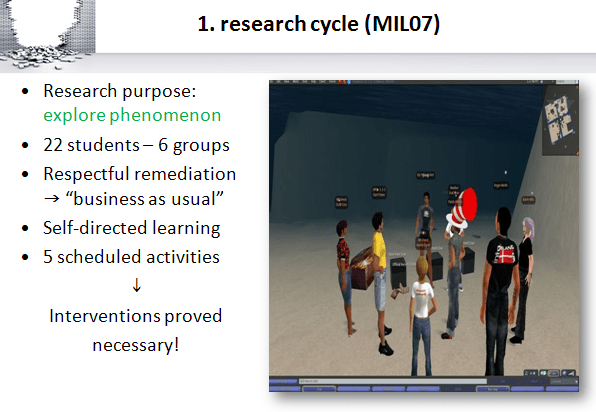
I was rezzed as Mariis Mills in March 2007, and I conducted the first research cycle about half a year later. The main purpose of the first cycle was to explore SL as phenomenon in order to understand this media’s potential as teaching and learning environment.  Several studies conducted at MIL (Dircknink-Holmfeld.2002; Dirckinck-Holmfeld et al. 2004; Sorensen & Takle. 2005) indicate that the majority of our students participate in one or several communities of practice, CoP (Wenger. 1998) during the masterprogramme, and I also wanted to observe what would happen to these CoP’s as a consequence of remediating into SL.
SecondCycle

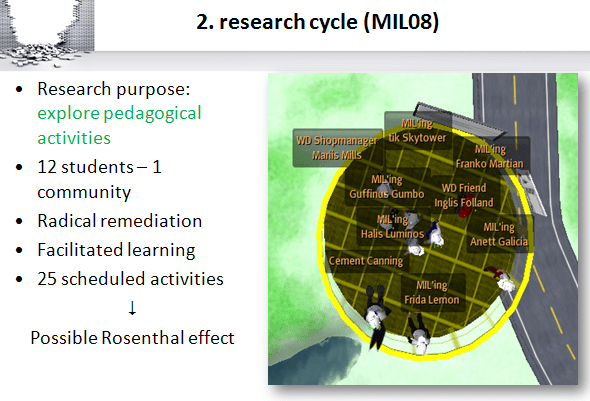
The second research cycle was conducted in the Fall 2008. Based on the findings from the first cycle and additional experience and research the course was redesigned in several ways.  Even though the first cycle confirmed the presence of CoP’s, I decided to try to enhance the community creation and feeling by asking the students to work as one entity instead of working in their usual smaller study groups. I also changed my own role from being a somewhat distant observer to a fully engaged participant and facilitator. In the first research cycle there were only 5 scheduled activities, but in the second cycle I decided to focus on many different pedagogical activities resulting in a total of 25 (this post further elaborates on these activities).

Apart from the changes mentioned above, I also decided to change the design (and thus expected use) of the FC setting. As stated by Nyvang, Tolsby & Dirckinck-Holmfeld (2004) VLEs/LMS’ and other systems we use for teaching and learning are never neutral in the sense that they always convey some underpinning pedagogical philosophy. And like physical buildings these systems can be designed more or less optimal to support different types of teaching and learning processes.  In FC the user is able to see a tree structure of the way we’ve organized the many conferences in the left side of the screen, and for many users this tree structure provides an overview. The picture below shows the tree structure as it appeared in the two cycles:

MIL07-08_TreeStructures

The SL course is part of the first course (m4c1) in the 4th module and as such it would be found below the main conference for that module. In this first course the students can choose either SL (3D world) or Global Conflicts (3D game) as analytical objects. Traditionally the students work in small study groups (K-gruppe). In the MIL07 case the conferences for the students’ groups were placed directly below the main course conference (used by all students and the teachers for communication regarding the course in general), while the two conferences for more specific communication regarding the analytical objects were placed in the bottom of the tree structure. A tentative interpretation of this structure would put emphasis on the study groups, which for many students probably made perfect sense, since it was in these group conferences their main activities were supposed to take place. At a glance this structure did not however indicate which groups were working with SL respectively GC. Though working in separate groups many MIL students appreciated following the work of their fellow students and they proposed that we designed for a better overview over the groups’ interests in the future.

So in the MIL08 case we decided to place the study group conferences below the two conferences for the analytical objects, which also meant that the GC and SL conferences moved up in the hierarchical tree structure – perhaps putting more emphasis on the subject matter? There was another major difference, namely that I decided that the students who chose SL should work in one large group/as a community meaning that the 12 SL students were not assigned separate group conferences. In ‘07 there was only one conference dedicated to SL and this proved to be inappropriate since we used that one conference for all SL related communication including meeting information, literature upload, small talk etc. making it very difficult to locate specific information as the course progressed. Thus in the MIL08 case I created several sub-conferences each dedicated to specific topics and types of information. I also utilized different icons to indicate the differences between these conferences and when the student clicked on the main SL conference he/she would get an overview of all these affiliated conferences as show in the right side of the picture above.

As mentioned before the tree structure in FC is shown in the left side of the user’s screen. In the right side the same information is presented in a different way/view. In the MIL07 case the right side could look like this:

MIL07_FCactivity_area

and in the MIL08 case it could look like this:

MIL08_FCactivity_area

Apart from the aesthetic perspective which I’ll leave for the reader to assess, I do think that the MIL08 design provides a much better overview. The red circles point to the main activity areas  – in MIL07 in the study groups, in MIL08 in the topic conferences. The ’08 students did not place any of their postings in the “Interactivity” conference. Nonetheless they did discuss interactivity quite vividly, but as they explained, they often found the separation of topics somewhat artificial, and this may be something I need to design differently in the next research cycle (Fall 2009).

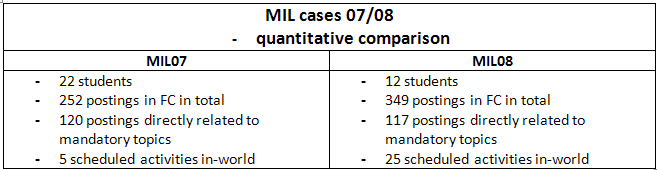
Anyway, my purpose in this post is to investigate whether the design made a difference in the way the students used FC. In both cycles the students were asked to post a minimum of 3 postings in order to pass the course. The majority of MIL students are part-time students, full-time employed and actively engaged in other life activities. Even so MIL students are renowned for their very high engagement and activity level. In the table below I’ve compared some data from the two cycles:
MILcasesQD

My involvement in the topics discussions was quite similar in the two cycles, and already back in 2007 I was highly impressed by the students’ engagement and level of activity, but as you can see the engagement of the MIL08 students was extraordinary in all aspects. Bear in mind that besides participation in numerous online activities the students also need to find time to study the mandatory course literature!  All students passed both courses, but in each cycle 1-2 students were asked to elaborate on their findings/reflections in order to pass. The quality of the students’ discussions was high in both courses, but it was quite clear that the MIL08 students’ postings were more informed with regards to SL.

I’m quite confident that the amplified engagement, level of activity and quality in the MIL08 case stems from a combination of redesigns, but as FC is part of the collected teaching and learning environment, I do believe that careful consideration and design of the FC structure is an important part of the whole design puzzle and as such should be given appropriate attention.

/Mariis

References

Dirckinck-Holmfeld, L. (2002): CSCL – Computer Supported Collaborative Learning – Projektpædagogiske læringsformer i virtuelle omgivelser. IN: Uddannelse, læring og It. 26 forskere og praktikere gør status på området. IN: Undervisningsministeriet. http://pub.uvm.dk/2002/uddannelse/5.html

Dirckinck-Holmfeld, L., Sorensen, E.K., Ryberg, T., Buus, L. (2004). A Theoretical Framework for Designing Online Master Communities of Practice. IN: Proceedings of the 4th Networked Learning Conference.

Nyvang, T., Tolsby, H. & Dirckinck-Holmfeld, L. (2004): E-læringssystemer og projektpædagogik – pædagogikkens krav til systemdesign og funktionalitet. IN: Georgsen, M. & Bennedsen, J. (ed.): Fleksibel læring og undervisning – erfaringer, konsekvenser og muligheder med ikt, s. 207-238. Aalborg Universitetsforlag.

Sorensen, E.K. & Takle, E.S. (2005). Investigating knowledge building dialogues in networked communities of practice. A collaborative learning endeavour across cultures. IN: Interactive Educational Multimedia, No.10.

Wenger, E. (1998). Communities of Practice. Learning, Meaning, and Identity. Cambridge University Press.


“Dialogic Spaces” – Dialogic Education and Research Group

On Monday June 22nd I had the pleasure of participating in the first meeting in a study group “Dialogic Spaces” aimed at exploring dialogue from various perspectives within educational research and practice. The group was initiated by Assistant Professor, PhD Thorkild Hanghøj and several of his colleagues all from Dept. of Curriculum research at the Danish School of Education. Thorkild specializes in educational gaming and will incidentially join me at the Master in ICT and Learning (MIL) in the fall in our ICT and Educational Design module. Coming from Aalborg University’s Dept. of Communication I’m very happy to get the opportunity to collaborate with this group of researchers who all have such very strong foci on educational research. Besides Thorkild the following people are part of the group:

  • Lars Birch AndreasenE-learning; netbased education; virtual learning environments, Netmediated communication and collaboration.
  • Lisbeth FrølundeMultimodality theory and visual culture, Design and development of digital learning and play materials.
  • Jeppe BundsgaardEducational Theory and Curriculum in relation to the Danish Subject and Information Technology, Critical Discourse Analysis.
  • Mads HaugstedMother tongue and didactics; verbal communication, colloquial language, speech skill.
  • Christian Brund – just started as a PhD Candidate with a project on the role of the teacher in relation to educational gaming … no link yet

Together we cover a wide range of research interests but with the concept Dialogic we have found a common denominator.  Dialogic is most commonly attributed to the work of the Russian philosopher, literary critic and scholar, Mikhail Mikhailovich Bakhtin and though his work will play an important role in our endeavors it isn’t an exclusive Bakhtinian group.  We spent our first meeting stating our interests in using Dialogic perspectives, defined the organization and goals of the group and finally discussed a couple of papers (Dysthe. 2006 & Wegerif. 2006) both focusing on the use of Bakhtin in educational research. So far we’ve decided to meet f2f once a month in the fall primarily to discuss literature hoping that these dialogues! will inspire all of us in our future work. Further down the line we hope to be able to hold public seminars and finally write an anthology covering especially, but not exclusively  Scandinavian Dialogic perspectives within educational research and practice which also means that we will invite international colleagues to come join us.

I was first introduced to Bakhtin in the early 90’ies when I studied literature for three years, but it has been years since I actually used his ideas and concepts more explicitly. In spite of this, I do find the Dialogic perspective interesting on multiple levels in relation to my current PhD research:

  • Ontological level – according to Bakhtin living is participating in an ongoing dialogue and I couldn’t agree more. Accepting dialogue as ontological premise naturally influences the main purpose and the main processes of education; empowerment as preparation for and – as it is the case in HE/FE –  continuation of democratic, participatory citizenship. This way of thinking and practicing education very much aligns with a Scandinavian approach to both education and research in general and with exploration of new social media in particular (e.g. Rheingold. 2008 on Participative Pedagogy for a Literacy of Literacies).
  • Epistemological level – as a consequence of the ontology it is through dialogue with both ourselves and the surrounding world that we’re able to create meaning. Thus, as educators we need to focus on teaching students how to engage in the dialogues through which knowledge is constantly being constructed, deconstructed and reconstructed (Wegerif. 2006:60). It’s also worth noticing that if we accept the dialogic premise, the main mechanism for learning is taking the perspective of another in a dialogue (ibid:64)!
  • Methodological level– up until now I’ve been reluctant to coin my methodological approach, usually just stating that I’m applying some sort of Action Research. However, I recently decided to try to apply and further develop a methodology called Dialogue Design which was developed by three of my colleagues from the MIL steering committee, Janni Nielsen, Lone Dirckinck-Holmfeld and Oluf Danielsen (2003) back in the late 90’ies in relation to a large European research and development project on Multimedia and Network in Co-operative Research and Learning (MANICORAL). This particular methodology, based on different types of Action Research, puts forward dialogue and mutual learning as guiding principles.  Dirckinck-Holmfeld and Nielsen are also my PhD supervisors, and I will be spending most of the fall with Nielsen at Copenhagen Business School focusing on this part of my PhD work.
  • Didactic/pedagogical level – as teaching and learning space SL offers many possibilities of engaging in dialogic activities. Communicating simultaneously via both text and voice, incl. via avatar (as embodiment) and context are probably the affordances I currently find most interesting and I anticipate Bakhtin’s polyphony concept and his ideas on intertextuality (both in multimodal variations) will be useful in my attempt to theorize/analyze and design for such phenomena.

In applying a Dialogic perspective on my PhD I’ve got a sense of coming full circle and I’m really looking forward to an inspiring fall with extended readings and lots of dialogue … yeah :-) It also means that I’m in the process of editing my PhD page here on the blog … it’ll be back sometime during the summer.

/Mariis

References

Dysthe, O. (2006): Bakhtin og pedagogikken – Kva ein tidlegare ukjend artikkel fortel om Bakhtins pedagogiske praksis. IN: Norsk Pedagogisk Tidsskrift. 06/2006

Nielsen, J.; Dirckinck-Holmfeld, L. & Danielsen, O. (2003): Dialogue Design – with Mutual Learning as Guiding Principle. IN: International Journal of Human-Computer-Interaction. 15(1)

Wegerif, R. (2006): Dialogic education: what it is and why do we need it? IN: Education Review, vol. 19, no 2.

BTW

Stephen Downes recently directed my attention to a post on Streams vs. Blogs written by Jay Cross. In this post Cross reflects on blogs stating that:

Blogs are author-centric in a world that’s increasingly about relationships. Blogs are slanted toward me, me, me, me, me; the net is inexorably moving to us, us, us, us, us. Dialog trumps monolog.

While I do agree that some blogs tend to be very author-centric the few blogs/bloggers I chose to follow on a regular basis are highly Dialogic in my point of view. Adapting a Bakhtinian view engaging in dialogue with oneself can be very fruitful and furthermore the very nature of blogs (the intertextuality and the multiple voices coming forward through extensive linking) exemplifies a connected perspective on relationships and dialogue in a networked world.  The mere fact that I learned about Cross’ post via Downes shows my point. Granted that the premises for dialogue have changed dramatically, it still is dialogue to me … Nonetheless, I do agree with Cross that new services gradually will change the way we communicate, but like Downes I will not stop blogging any time soon – it’s just one way of communicating among others ;-)