My first presentation at UCB’s Center for New Media

Today I did my first presentation of my PhD project at UCB. Sadly only a few people turned up, but they seemed engaged and asked a lot of questions, so that was good. It was the first time I presented some of my recent ideas on remediation, so that was quite interesting for me personally. I clearly need to refine my thoughts and the lack of proper English vocabulary, when I want to make a specific point, is really, really frustrating, but it is all part the learning process and I feel confident that it will become easier as time passes.

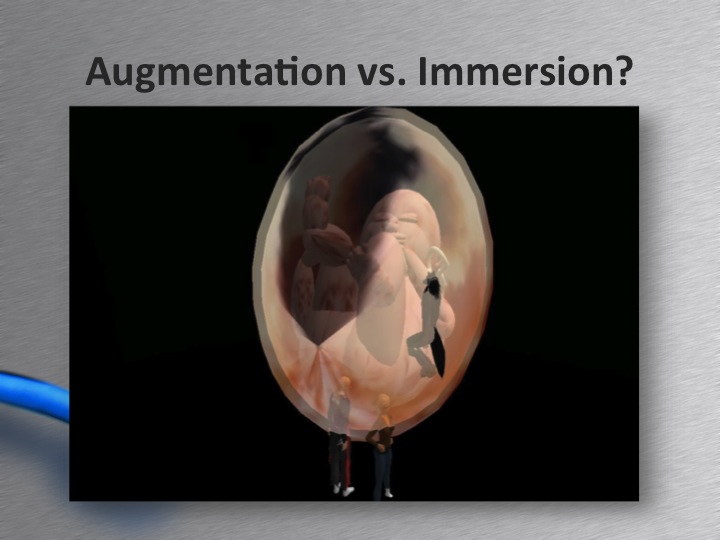
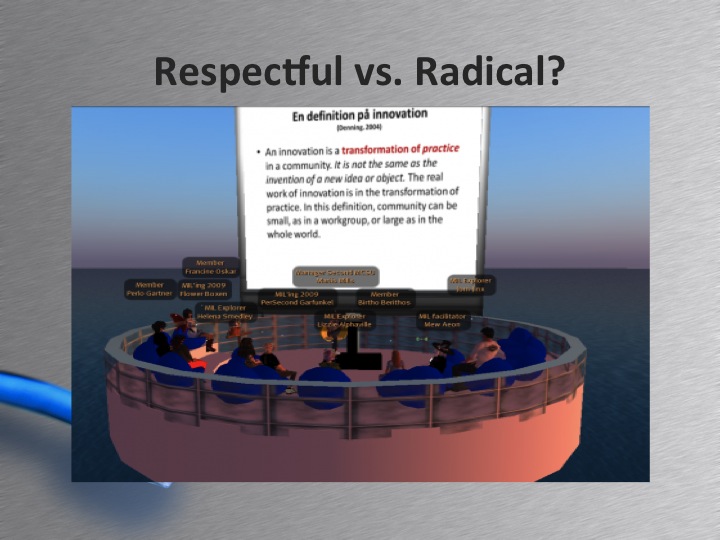
Among other things I addressed one of the challenges I currently have in relation to my thoughts on remediation. I’ve incorporated several dichotomies in my models for remediation, but I only see them as theoretical/analytical tools – reality (in whatever shape it represents itself) is much more complex and I don’t necessarily consider them to be mutually exclusive. Another problem is that some of the concepts I’m using are ambiguous, so I have a lot of work ahead of me in determining how I will define these concepts, and as examples of this uncertainty I presented the following three slides:

BTW, for the presentation I’d found a nice template displaying an Ethernet cable, which I thought suited the topic very well – only later I realized that as part of the terms of use I’m not allowed to upload them to any sort of file sharing site and this is why they can only be found here in pdf format … and so I will not use that type of template again!

/Mariis

The Double Logic of Remediation via Alberti windows

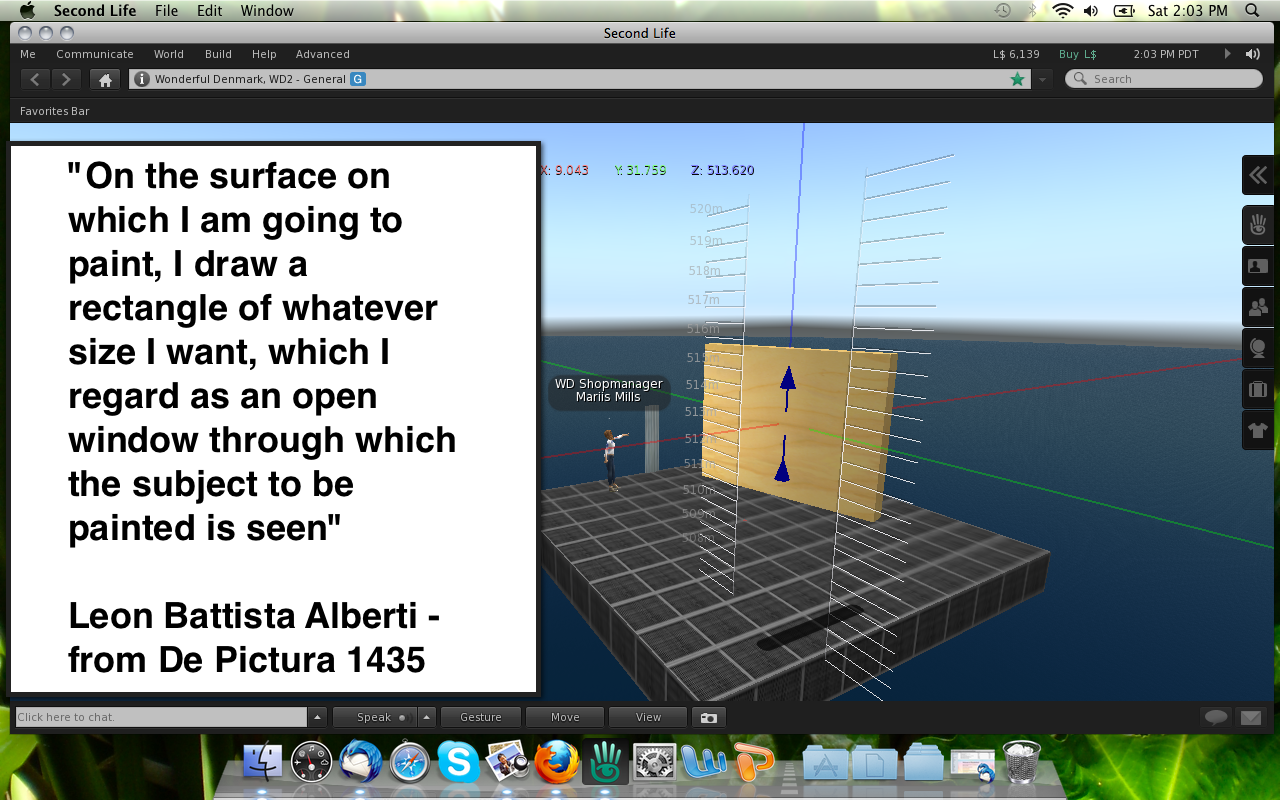
Based on the above quote the “Alberti window” is frequently used as a metaphor to describe the sense of immediacy, and for some immersion, that users experience in especially virtual reality and virtual worlds as it points to the idea that it is possible – at least in a psychological sense – to “step through” the window and enter the space depicted.  Here I’ve taken the quote from Bolter & Grusin’s book “Remediation – Understanding New Media” p. 24-25. As part of my research on remediation I’ve spent the last couple of days studying their book in detail and this post will be the first in a series of trying to make sense of my notes combined with my experience in and examples from SL. But before getting to the point I wanted to make about Alberti’s window and the new shared media function in SL, let me just make some quick remarks on some of the key concepts in the book.

In the glossary Bolter & Grusin explain remediation this way:

Defined by Paul Levenson as the “anthropotropic” process by which new media technologies improve upon or remedy prior technologies. We define the term differently, using it to mean the formal logic by which new media refashion prior media forms.
Bolter & Grusin. 1999:273

Throughout the book Bolter & Grusin continue to elaborate on the concept, and an apparent distinction from Levenson’s definition is that they see remediation as a process that also can go the reverse way, meaning that older media also can remediate new media – i.e. Television incorporating social media like Twitter streams or text-message polls via cellular phones in live shows to enhance interactivity. Another important point for Bolter & Grusin is that there are a number of ways in which especially digital media remediate their predecessor – a spectrum that goes from respectful to radical remediation (ibid. p. 200). These ways can be divided into two main strategies depending on their foundational logic, something Bolter & Grusin call the Double logic of Remediation, which can be based primarily on

  • either immediacy (aimed at diminishing the users awareness the medium/mediation)
  • or hypermediacy (aimed at enhancing the users awareness of the medium/mediation)

It is, however, important to notice that the authors do not see these two forms of logic as contradicting, but rather as mutually dependent. According to Bolter & Grusin the underlying premise of all remediation is our “insatiable desire for immediacy” (ibid. p.5), which leads to the following paradox of the double logic:

Our culture wants both to multiply its media and to erase all traces of mediation: ideally it wants to erase its media in the very act of multiplying them. (ibid.p. 5)

Even though the book was conceived and published long before 3D virtual (and interactive!) media became mainstream (they do cover early “computer games”), I do find the concepts rather useful in explaining some of the phenomena I’ve experienced in SL. I agree that we strive for authenticity understood as quality in our interaction with new, digital media, and with the present changes in the SL viewer and most notably the shared media function, I think it is possible to give a contemporary example of the double logic paradox …

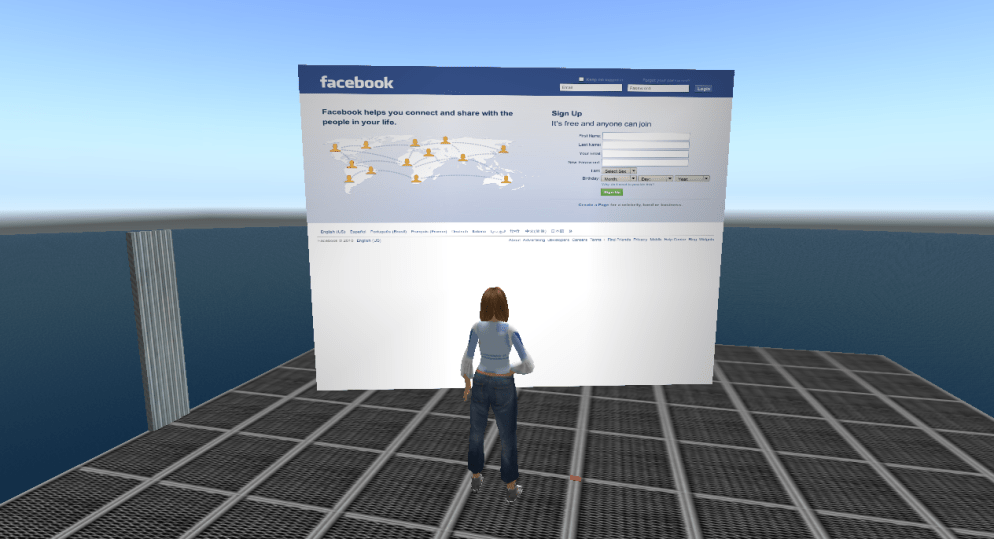
In short the SL Shared Media (SLSM) allows a wide range of web pages, including Flash and YouTube videos to be displayed on any surface of any prim (building block), among which  some also allow for real time collaboration such as my student PerSecond and I previously demonstrated with Google docs and Etherpad. Now, in my context of Distance Education this new function offers many interesting possibilities. A major argument for me as a distance educator to research SL stems from this particular media’s ability to provide the user with a sense of being embodied in a palpable place – mainly in opposition to conventional teaching and learning platforms, where the user typically finds himself disembodied in impalpable space. In the pictures below I’m represented as my avatar standing on my holodeck looking at a shared media prim displaying Facebook.


Looking at Facebook via a window in SL


Interacting with Facebook via a window in SL

These pictures were deliberately taken from within SL, and they illustrate how I – literally by opening a window and “stepping through” it – am able to not only look at, but also interact with “the space depicted”, which in this case is the world outside SL.  In doing so, it is my argument that I’ve been able to enhance the sense of immediacy through hypermediacy or to put it in other words: by multiplying the media I’ve been able to “erase” the sense of mediation in so far as interaction with the outside world can be regarded as a means to enhance the authenticity of my experience. But that’s not all. I’m able to add yet another dimension to my experience by changing my perspective as shown below:

By zooming out and taking a screen shot I’m able to show another reality of the experience; by watching myself as avatar looking and interacting in SL, I’m able to “step back or out of the window” and reflect on the experience from a meta perspective. This actually doesn’t depend on the SLSM function, but is one of the great affordances of SL as medium in general. There is, however, no doubt in my mind that the SLSM function via windows to the other worlds/parts of reality can contribute to the authenticity and quality of user experience in especially education and business, where our need for immediacy apparently is insatiable …

/Mariis

Visiting Scholar at UC Berkeley

This is just a brief post to explain that I’m currently a visiting scholar at UC Berkeley (UCB). I arrived on March 29th and have been spending the past two weeks getting accustomed to my new environment. I’m here on a four month grant offered by the Center for Information Technology Research in the Interest of Society (CITRIS) at UCB and the Danish Agency for Science, Technology and Innovation (DASTI), which is an institution under the Danish Ministry of Science, Technology and Innovation.

Professor Ruth Tringham from the Dept. of Anthropology is my faculty host and besides working at UCB I hope to also visit other universities in the area. I’ll be working on the concept of remediation in an effort to refine and most likely reform my model(s) for remediating people, places and practices – and needless to say future posts on this topic will follow…

I first discovered Professor Tringham back in 2008 when I read an article she had written together with colleagues Ashley and Mills on remediating places, and I had the opportunity of meeting her f2f in SF last August when I was attending the SLCC’09.  Tringham and colleagues also have been using SL and meet regularly with their students on their research island, Okapi.


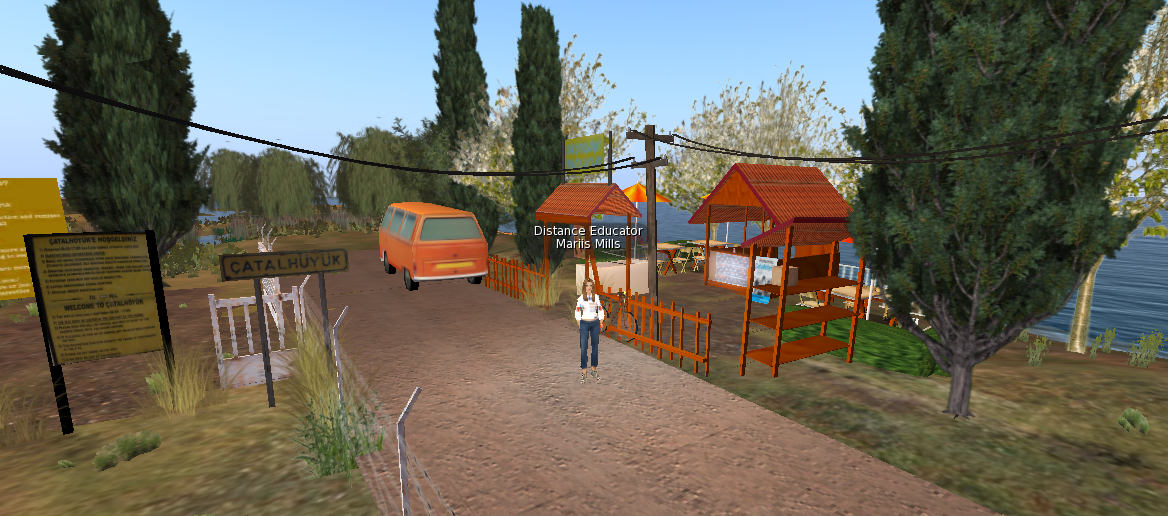
Mariis on Okapi Island – a remediation of  Çatalhöyük, a 9000 year-old Neolithic village located in present-day central Turkey

I’ll end this post by expressing my personal gratitude to three people in particular:

:-)))

/Mariis

#vwbpe 2010 – 2nd day impressions (part two’ish)

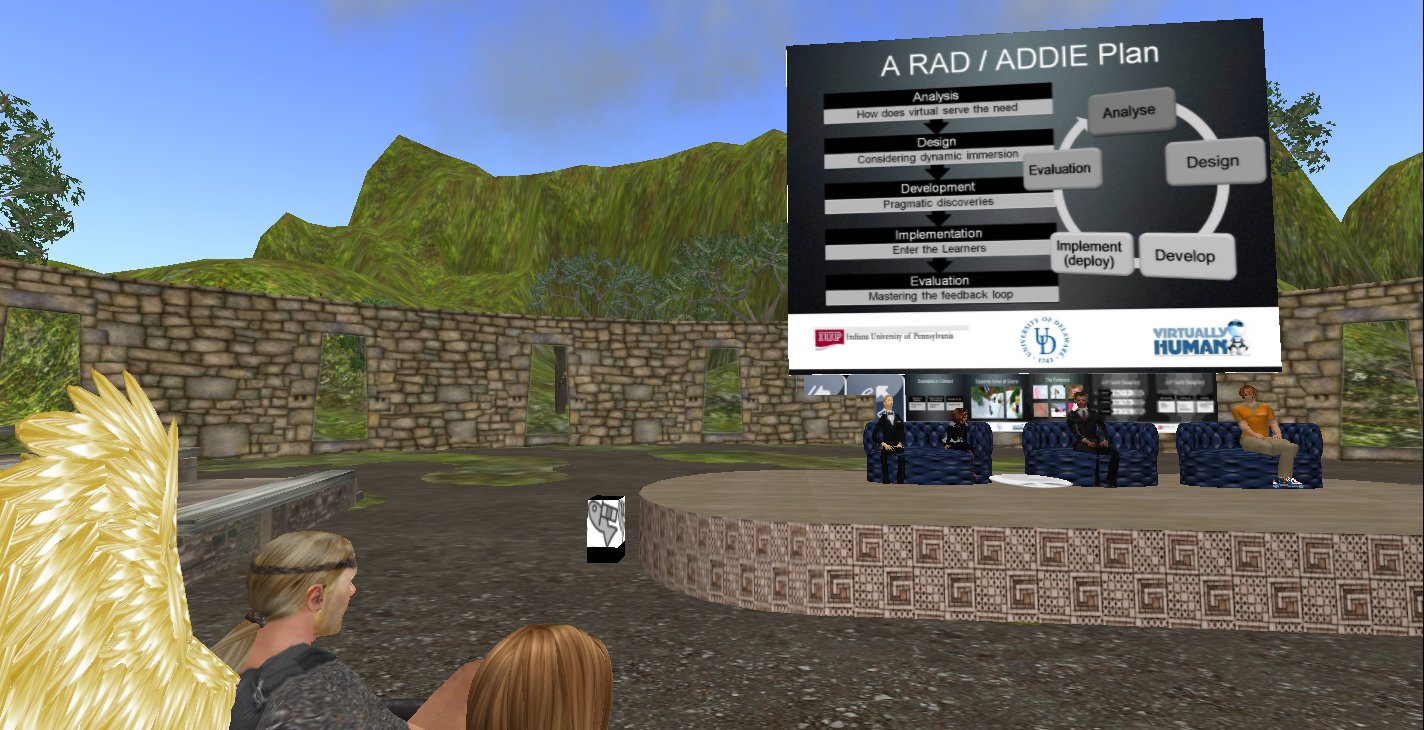
Continuing my reflections on the 2nd day of the VWBPE-conference the next session I participated in was on “Rapid Development of Interactive Educational Content in Virtual Worlds: From Analysis to Evaluation”– a panel consisting of DoctorPartridge AllenFirery Broome, Quincy Solo Sherman Gustafson, who shared their experiences with content development. The panel spoke of their work with “Immersive Learning Simulations” (ILS) and the premise was stated in the abstract, which can be found here in the programme;

Emerging technologies in Immersive learning, like Second Life, afford us significant opportunities to explore new mechanisms for educational interaction, but they also present us with a wealth of new challenges. A common theme with the adoption of such technologies is that we are recycling older technologies rather than genuinely leveraging the tools and resources exposed by the new technology. This panel is composed of people who have been confronting this challenge, and working diligently to embrace both the new immersive learning technology and to fully utilize the new features and facilities inherent in those technologies.

I always find it highly inspirational to hear other instructional designers talk about their approach and their theoretical foundations, and a couple of things struck me in this. First of all there seems to be growing consensus on using the term “immersive” to describe the main affordance of technology/media like Second Life. I understand the need to distinguish Second Life from other types of virtual teaching and learning environments, but I find the use of “immersive” somewhat problematic. If by “immersive” we simply refer to a sense of “being in a place” as opposed to the less concrete “space” concept, I agree that virtual worlds like Second Life can promote this sense, but it is only a potential, not a given. I’ve had students in all my in-world courses that didn’t feel immersed at all, but this is also a matter of how you define “immersive” and something I’ll return to in later posts. Secondly, I agree with the panel that there are two major strategies for the technology/media adoption namely “recycling” and “genuine leveraging the new affordances” – two strategies that I refer to as respectful vs. radical remediation and have incorporated in my model for 3D-remediation of people, places and practices.
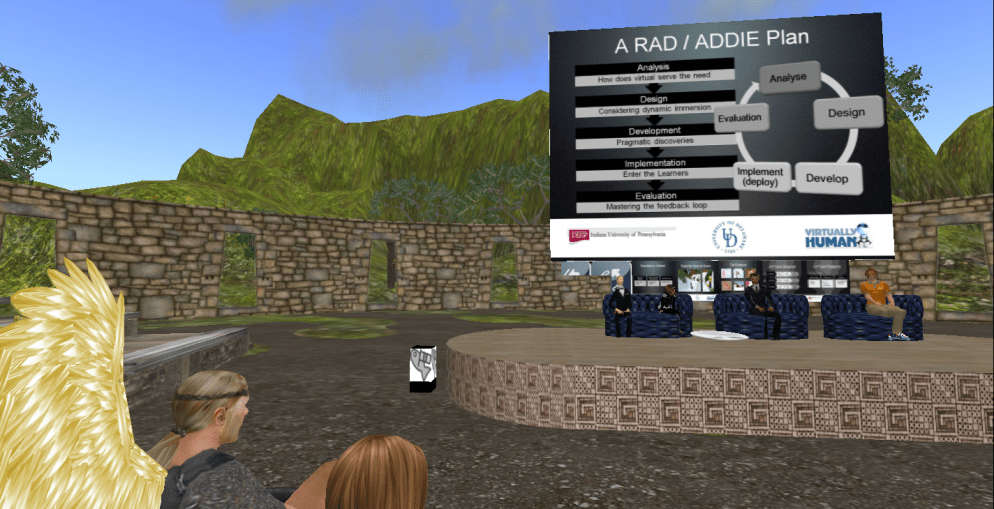
When describing their work the panel referred to the ADDIE model, one of the most common instructional design models that resembles the classic Action Research cycle of planning, acting, observing and reflecting – especially if continual feedback is applied i.e. through the use of RAD.

After I started writing this post my Mac broke down again – this time apparently for good – and sadly I hadn’t taken any backup of my vwbpe-photos or notes, so the rest of this will be based on memory (hence the ‘ish in the title).

The next event “Learning in 3D: A New Educational Dimension” with Abbott Bundy & Wada Trip was something I had been really looking forward to. When I did my first lecture on SL back in the fall 2007 I relied heavily on the work – primarily blog postings – of both Abbott & Wada and I’ve been following them on a regular basis ever since. Based on the abstract for the session it was clear that they would talk about their book “Learning in 3D. Adding a New Dimension to Enterprise Learning and Collaboration”, and since I haven’t read it, I found it quite interesting – the session is archived here on Treet.tv.

Afterwards Abbott wrote a post on his experience stating that he had seen the future of conferencing – in many ways I tend to agree that participation through 3D Virtual worlds can replace RL participation, but I think it’ll be quite some time before the larger part of at least the academic society will follow and it also requires a whole new outlook on identity validation. So many people I meet tell me they would never take an avatar serious. Essentially Abbott & Wada talked about instructional design, principles and practices and demonstrated a model they’ve come up with and I definitely need to have a closer look at that. They also mentioned Light Sequent, who also contributed to the book and who wrote a Masters Thesis on “Learning archetypes as tools of Cybergogy for a 3D educational landscape: a structure for eTeaching in Second Life.” It is worth noticing that they use the word archetype in a non-jungian way, and more as some sort of  characteristic traits of pedagogical practice (building blocks i.e. instructional strategies, methods for facilitating learning) – a bit confusing, I think, but I need to read the book to learn more…

Another much anticipated session was conducted by my two friends Chimera Cosmos & Spiral Theas, who presented their work with “Learning in a Virtual World: Using SL for Medical Education” – slides can be found here. There’s also a recording of the session here, but as you can hear the sound wasn’t terrific, especially Spiral’s voice was breaking up. Based on a pilot study on Continuing Medical Education, that they did together with colleagues and 14 participant family practice physicians (described in an article here) Chimera & Spiral presented some interesting results and also showed us how they had been experimenting with the use of mock avatars in role-playing. At a certain point Chimera logged in (via another computer) as the diabetic patient, Mariana Hexicola and started communicating with the audience. From the post Spiral wrote afterwards it was evident that they deliberately wanted to show, not just talk about, the things they had implemented in the pilot study.
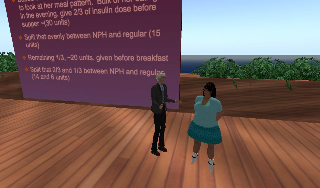
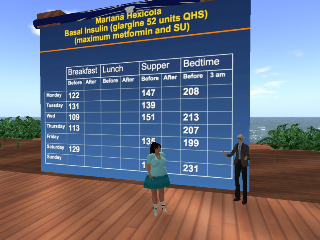
Pictures kindly provided by Spiral show the overweight, diabetic patient, Mariana interacting with the Professor as part of the pilot study.

The study proved some highly interesting results with participant improvement in clinical skills, but what also was fascinating, was the participants’ rating of the experience in SL as they all agreed that the experience was superior to other online methods, and the majority felt that the SL method was as good as, if not better than, f2f methods. Having read the above mentioned article, I’m quite sure that the success stems from a very deliberate instructional design strategy, which addressed the participants’ needs not only as learners of a particular subject matter, but also as users of SL. Even though it is a small study, I think it supports the growing body of studies done by especially natural scientists in virtual worlds very nicely, and the article is well worth a read even for educators in other fields.

After this, the next session I wanted to attend was on “Creating a Positive First Hour Experience“, which of course is highly relevant, but as the presenter decided to do his session in text only, I decided to skip it. SL simply doesn’t appeal to me without voice … I might as well read a regular text in my own pace. Instead I decided to get some sleep before attending the last session (at 5 am in Denmark), which was by another friend of mine, Tab Scott who has been actively teaching and researching in SL since 2005.

RL Tab is Director of Creative Research Lab at Montana State University and Tab presented some of the many projects the lab has been involved in since 2005 and also gave some hints as to where they are heading in the future – there’s a recording of the session here. A central keyword of the CRLab is collaboration, and when Tab first entered SL is was to investigate whether SL could be used as an environment to support collaboration, and well they’ve been using it in teaching architecture and arts classes successfully ever since. One of the many things I appreciate about Tab’s philosophy and approach to using SL is that he doesn’t see it as a stand-alone technology. Now, first of all there’s a very pragmatic reason for that, namely the stability of the environment. As Tab mentioned using SL back in 2005 (and even when I entered in 2007) could be really frustrating due to technical issues, constant updates of the viewer, maintenance etc. The stability of SL has improved a lot, but there still is a risk that you or your students will have technical problems, so a backup plan is highly recommendable. (i.e. Chimera and Spiral had Skype as backup as part of their instructional design). But I think a more appealing reason for not using SL alone stems from the fact that even though the core of the environment is 3D, the more interesting uses (naturally depending on your goals) often come when combing it with other 2D technologies such as SNS, shared documents and streamed media and at the CRLab they work with the concept of PLE’s thus trying to ensure that the students become media literate in a broader sense. Given that most new users find the learning curve in SL pretty steep, I think it makes perfect sense to include some more familiar technologies that also can help reduce the alienation some new users experience.

At the CRLab collaboration goes way beyond university and even state and county boarders, and another of Tab’s points was that we as in-world educators need to help each other validate the use of SL. I agree and I think that even though educators have been tirelessly using SL for many years now, it still is an emerging technology and in my point of view we have yet to pass the early adopter phase. Someone in the audience, who had been using SL for three years, mentioned that his problem wasn’t to get the students to use SL, but rather the rest of the faculty – and this is definitely something I can relate to.

Having a conference like this vwbpe – with proceedings expected in May 2010 – certainly is a good way of spreading the message and thus hopefully convincing more educators to at least have a go at using SL. I spent two great, inspirational and meaningful days participating in this, and my only regret – just like at RL conferences – is that I missed so many other interesting sessions. But unlike most RL conferences, many of the sessions were recorded:

All sessions on Treet.tv
All sessions on Metaworld

/Mariis
#vwbpe 2010 – 2nd day impressions (part one)

On the 2nd day of the Virtual Worlds Best Practice in Education (vwbpe) I started out by participating in a session by Graham Mills entitled “TBinSL – Thinking Big about the Very Small”. Graham spoke of the use of SL for visualization of especially molecules,  gene data and cells and what was particularly interesting was that he rezzed various objects to support his slides such as the TB genome illustrated below.

Afterwards Graham blogged about his experience mentioning a couple of the challenges a presenter may face. First of all he forgot to lock the slide viewer, which meant that people in the audience could change the slides – for those who have not attended a presentation in-world it may seem rude or strange that the anyone in the audience would do this, but in my experience many SL users spend time running their cursors over objects to see if any are interactive – in spite of this, it was not a problem I was disturbed by during Graham’s presentation.

As I understand it, vwbpe-presenters had been encouraged to use the so-called SpeakEasy-tool by the conference organizers. The SpeakEasy-tool enables the presenter to deliver pre-typed text into local chat, while presenting thus allowing the hearing impaired or anyone else to get the information in the form of text too.  I have not tried out the SpeakEasy-tool, but judging from Graham’s post it adds yet another element to the many issues an in-world presenter needs to be aware of. Graham wisely chose to react instantly to the comments and questions in the local chat during his presentation. This local chat phenomenon is in my point of view one of the major strengths of SL because it has the potential of opening the dialogue between the presenter and the audience. Having run 4 course in-world I do however also know how complex the communication becomes, especially if you have no one to help moderate, and I can fully relate to Graham’s description of the situation.

Note that on the University of Liverpool Island it is possible to check out some of the amazing visualizations Graham and his colleagues have been working on. Graham has also started to explore some of the new features in the SLV2 such as Shared Media and shadow effects, and on his blog,  you’ll find some interesting posts on this.

The next session I attended was a presentation by Kattan Hurnung, who spoke of her experiences with “Design to develop Virtual Wolds”. In this post you’ll find both Kattan’s slides and a recording of her presentation.

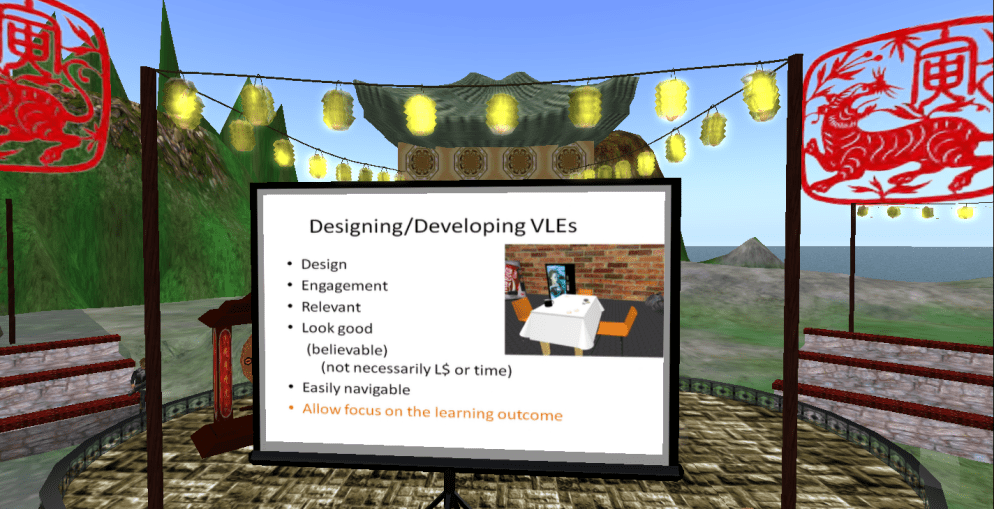
Via 5 examples of designing respectively a café, a canteen, a dwelling, an office and an operating theatre Kattan presented a very interesting grid that depicted the relations between information provided if forms of text, images and/or scenarios and the expected learning outcome given by teachers prior to the start of the process of designing these different types of learning spaces.

I thought there were many interesting points in Kattan’s presentation and one of the things I took special notice of was her questioning the level of details in designs. Building in-world surely can be very time consuming and perhaps it isn’t necessary to aim for photo-realistic builds – less may suffice as long as the design appears believable.

Next up was a presentation by Kristy Handrick; “Revealing the didactic character of imagery in Second Life.” Unfortunately the technical problems I’d had the day before continued, everything rezzed incredibly slow and I had problems with adjusting the camera, so I gave up and took a break. Kristy also blogged about here experience as an in-world presenter and made an important point on how the SpeakEasy-tool can be helpful to ESL presenters, and since I’m also struggling with the English language, I think I may just try out the tool for my next presentations.

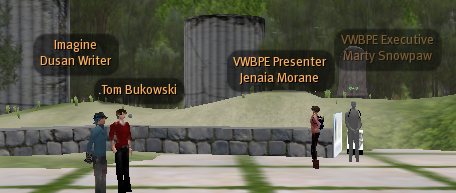
The last session I want to write about in this post was a fascinating conversation between Dusan Writer and Tom Bukowski (author of the book “Coming of Age in Second Life: An Anthropologist explores the Virtually Human”).

My computer still acted out, but the sound was good and I was really glad to participate in this since it raised a lot of questions/comments I need to look further into – here merely presented as points, but for those interested in seeing/hearing the conversation a recording can be found here.

  • SL is a site of culture and cultures are constantly changing, though some things remain permanent.
  • On AFK Tom discussed the difference between presence (to be present) and immersion (to be in a place) and how virtual worlds enables us to be immersed without being present.
  • Tom was fascinated by the way “friendship has become the new default mode of social relations”, and questioned 1) how friending presumes a relation that is based on choice, and 2) the apparent egalitarian nature of such a relation. And how does this affect teaching – should we as educators friend our students, is it a cool egalitarian thing or is it just a way of masking the fact that we’ll be grading them?
  • Tom studied SL in its own terms meaning he didn’t try to track down SL users in “actual” or “physical” world. This methodological approach naturally depends on one’s research question(s), but he draws the line with the common idea that no research project can be legit unless it also involves studying people in the actual world. It’s sort of a slap in the face of virtual worlds and it’s misunderstanding that what happens in virtual worlds is real, it is culture.
  • There is more and more evidence of SL users identifying with their virtual personas/life – e.g. writing your avatar name on a receipt or wondering how many prims an actual building represents. We have just scratched the surface of ways in which virtual worlds are going to affect our actual lives.
  • Technologies are neutral – the blow back could be positive or negative – that’s up to us, the users, the creators.
  • There is a lag between the technology being invented and us realizing what we can do with it.
  • “Techne within techne” – e.g. the ability for a group to collaboratively change the world that they’re in real time. The number one thing about a virtual world is that it is a place – techne makes the world; you can have techne inside the world, which is a new possibility.

I personally don’t agree that technology is neutral and I was a bit confused when hearing Tom at the end speak of different levels of user-control in different types of virtual worlds (to me the level of user-control indicates foundational ideas forced upon the users by the system developers), but other than that I really found this conversation highly inspirational!

Uh, and another observation I made by watching the recording of the conversation was how boring or non-interactive it appears because we don’t see the backchat on the screen. This was a very interactive event with many, many questions/comments from the audience and that is not the impression you get from just watching the recording. Both Dusan and Tom made several references to the audience, but I think it goes to prove the point that SL is a place and to get the full experience, you really had to have been THERE ;-)

/Mariis