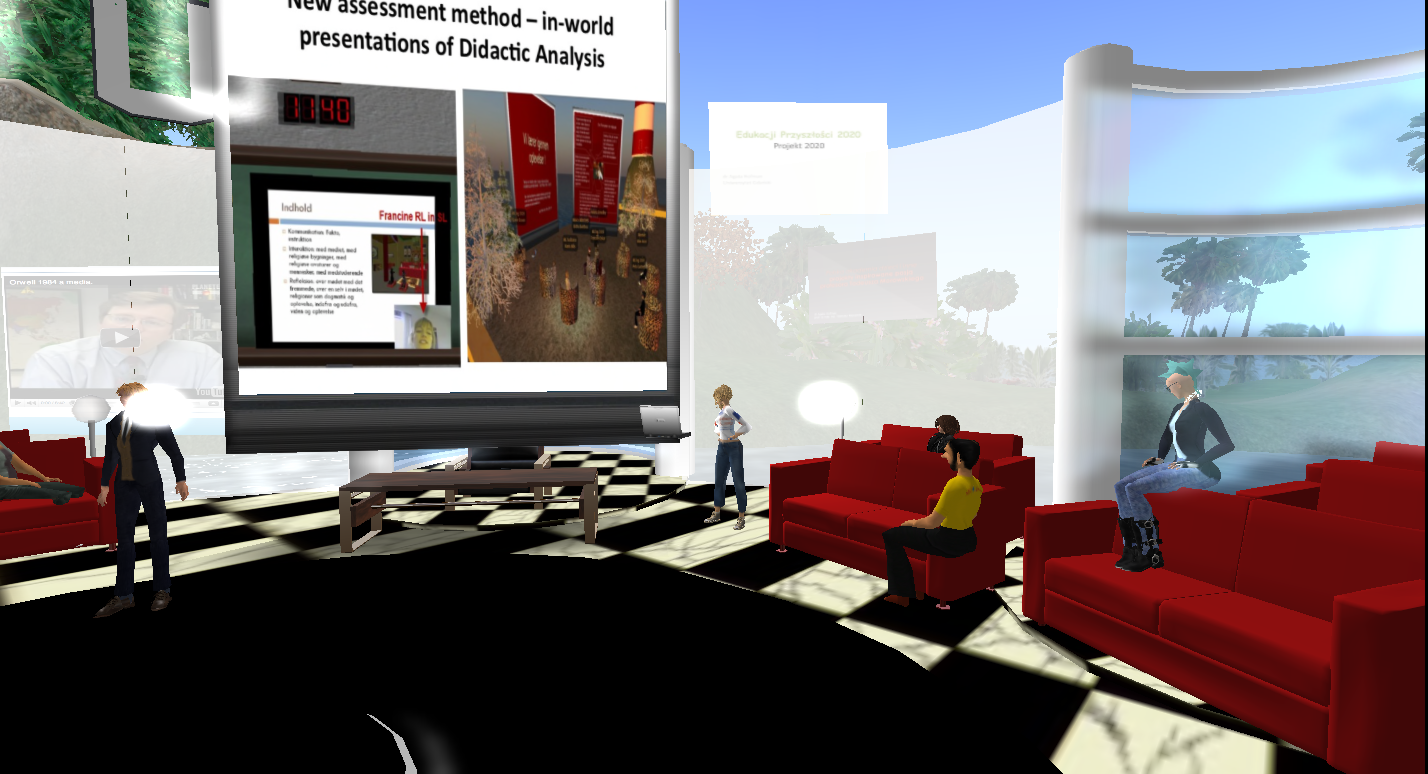
In-world presentation @ “Internet – New Media – Culture 2.0” conference

Friday November 5th, I was invited to speak at a Polish organized in-world conference about “Internet – New Media – Culture 2.0“.


Conference site at the Second UMCS island

The conference was organized by colleagues from different departments of Uniwersytet Marii Curie-Skłodowskie – some of whom I’ve previously worked with in the EU funded research project COMBLE. I was very pleased to get the opportunity to talk about some of my findings, and there were some great questions and comments on especially immersion and media convergence.


Talk about the new assessment method I implemented in my 3rd research cycle.

As promised to the participants, I’m hereby uploading my presentation.

Special thanks to Raf Moczadlo for inviting me :-)

/Mariis

Toward a strategy for remediation of pedagogical practice in SL

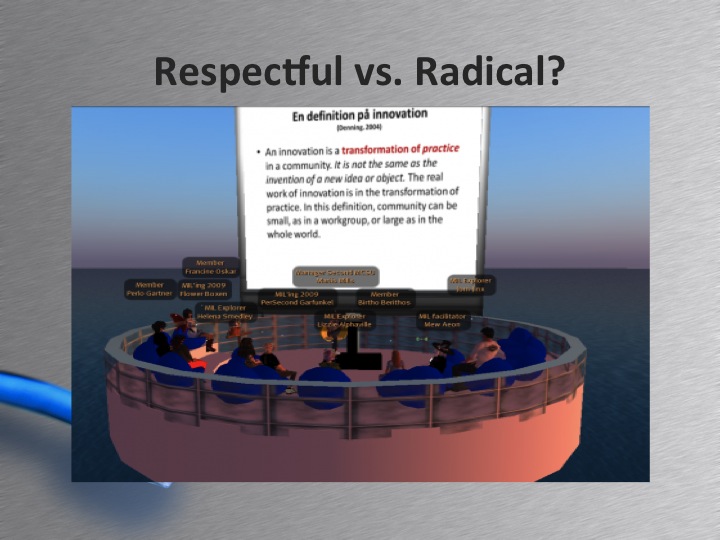
I’ve recently reviewed findings from three completed research cycles based on the primary case (MIL) and SL in my PhD-project. The case study was conducted at the Danish online Masters program on ICT and Learning (MIL) at Aalborg University and consisted of remediating a course in three consecutive research cycles spanning from 2007-2009. Based on the findings I’ve started to outline a strategy for remediation of pedagogical practice in SL. In a newly published article Hunsinger & Krotoski (2010:94) state that “trying to reproduce experiences that exist in our physical world is often not the best strategy for designing learning and research experiences in virtual environments”, and they call for strategies that go beyond replicating and reconstructing physical environments. Combining my own findings with ideas from Vygotsky (1978), Wenger (1998) and especially Bolter & Grusin’s “Remediation. Understanding New Media” (1999), I’ve found that it is possible to identify two different strategies;

  • Respectful remediation. Main objective is to reproduce prior practice with no apparent critique – often focusing on a quantitative outcome. Other media are represented without manipulation in the mediation. In general, this type of remediation enhances the authenticity and enforces the authority of the original media and practice. Tradition, familiarity, and certainty are keywords in this strategy. Changes are experienced as minor, evolutionary modifications and typically only involve change in modality, not specific activities.
  • Radical remediation. Main objective is to reinvent prior practice based on critical review – often focusing on a qualitative outcome. Other media are represented manipulatively in the mediation. In general, this type of remediation challenges both authenticity and authority of the original media and practice. Innovation, alienation, and uncertainty are keywords in this strategy. Changes are experienced as major, revolutionary transformations, and typically involve change in both modality and activities.

Given the technologic, pedagogic, and not least ontological complexity of a rich medium like SL, I’ve found that an overall respectful remediation strategy isn’t a viable choice, but it is also possible to distinguish between respectful and radical remediation at the tactic level, and here I’ve found that a combination is fruitful. Furthermore, since SL not a an abstract space for interaction, but a remediated world, also the participants (remediated as avatars) and the teaching and learning environment (remediated as places) can be remediated either respectfully or radically.

In “Learning in 3D – adding a new dimension to enterprise learning and collaboration” Kapp & O’Driscoll claim that the first step to escape Flatland and avoid routinization is to “distance oneself from existing processes and practices and examine a newly emerging technology on its own merits“, and they speak of right and wrong ways of dealing with teaching and learning in 3D:

Done right, 3DLEs provide the opportunity for instructional designers to overcome their captivation with the classroom and move in a direction that is more congruent with the needs of the increasingly digitized and virtualized enterprise. Done wrong, 3DLEs will remain the domain of digital avatars in digital classrooms discussing content on digitally rendered PowerPoint slides. (Kapp & O’Driscoll. 2010:56).

While I do agree that any technology/medium should be examined in its own right, I do find it a bit hasty to dismiss prior experience and practice, and I find the dichotomy of right/wrong inappropriate. Naturally, it is possible to talk about more or less suitable ways of designing and using media, but it’s a very complex issue and should involve consideration of all elements of the practice. In my case study, I experimented with the use of slideshows in the two last research cycles, and found that this kind of respectfully remediated practice could have the same benefits and pitfalls as in the world outside SL. However, I also found that the build-in backchannel made it possible to draw use of the mediums more unique affordances by combining simultaneous use of text-chat and voice. By encouraging the students to comment and post questions during a presentation, an otherwise inactive one-way presentation can turn into quite an engaging teaching and learning activity. Nonetheless, by adding this component to the activity, the “rules of engagement” changed, as far as both the teachers and students needed to learn new roles and communication skills. Learning to deal with this kind of multi-voiced communication takes time, but it has the potential to open up and democratize the dialogue. My point here is that a seemingly respectful remediation in SL actually can result in radical changes, and another important aspect is that I don’t see respectful and radical remediation as a dichotomy, but as a dualism. Further, whether or not something is perceived as being respectful or radical will differ between individuals, communities, and cultures.

I’m not arguing that we should cease from experimenting with completely new ways of doing things, but my findings clearly show that an element of respectful remediation is important – at least until the participants have reached a certain level of experience and mastery of the medium. As an educator, I find that one of the advantages of respectful remediation is that it’s based on recognition and familiarity enabling the user to build on prior experience, and changes are experienced as minor, evolutionary modifications, which potentially leaves more energy for the participants to focus on the task at hand, rather than on the medium and the mediation. I’m currently working on designing a model to illustrate the complexity of different remediation strategies, so more on this will follow …

/Mariis

References

Hunsinger, J. & Krotoski, A. (2010): Learning and researching in virtual worlds. In: Learning, Media and Technology, 35:2, p. 93-97

Vygotsky, L.S. (1978): Mind in society. The development of higher psychological processes. (trans. M. Cole). Cambridge, MA: Harvard University Press.

Wenger, E. (1998): Communities of Practice. Learning, Meaning and Identity. Cambridge, MA: Harvard University Press.

Bolter, J. & Grusin, R. (1999): Remediation. Understanding New Media. Cambridge, MA: MIT Press.

Kapp, K. & O’Driscoll, T. (2010): Learning in 3D. Adding a new dimension to enterprise learning and collaboration. Pfeiffer.

Second Life Community Convention 2010

For the third year in a row I’m hoping to participate in the annual Second Life Community Convention (SLCC10). This year the convention will be held in Boston, August 13-15.

As usual the convention will be organized by SL users, bringing together new and old residents in a mixture of business, education, non-profit and not least the music and art scene.

This year I’ve submitted a proposal for the educational track entitled “Contradictions that make perfect sense – remediation strategies for problem based blended learning in SL”, and so I hope to get the opportunity to present and discuss some of the ideas I’ve been working on as part of my recent stay at UC Berkeley.

In any case the convention is a definite must-go, a unique opportunity to connect with old and new friends. If there’s any one event that has influenced my PhD work, this is definitely it! Given that research in 3D virtual worlds still is a rather limited research field it is always a pleasure to connect with other educators and innovative thinkers from various parts of the SL community :-)

/Mariis

UPDATE
Much to my surprise (and regret) my PhD-supervisor has instructed me not to participate in any activities as I should focus on writing my dissertation. I therefore had to withdraw my proposal and will not be attending this year’s SLCC :-(

3D VW remediation – square peg in a round hole?

As part of my research on remediation and especially the Place concept I will be visiting Professor of Architecture, Yehuda Kalay of UCB. I’ve been invited to participate in a course wrap-up where his students will display how they have designed, implemented and tested their ideas in regard to building a museum in SL.  In preparation for this event I’ve just finished reading a fascinating article by Professor Kalay (2006) on “The impact of information technology on design methods, products and practices”, where Kalay describes two different ways of appropriating new tools in architecture, namely the “square peg in a round hole” and the “horseless carriage” paradigms.

The first is that of forcing a square peg into a round hole implying that the use of the new tool is misdirected, or at least poorly fits the processes that have traditionally been part of architectural design. (…) The ‘square peg in a round hole’ paradigm describes tool making as a problem of adapting a new technology to current practices. As a new technology is introduced into practice, a dysfunctional relationship can develop between the tools and a task, either because the task is poorly understood or because the process of displacing a traditional technology is largely one of the substitution of habitual tools with new ones that have the wrong affordances. Such inappropriate use of the technology results in a poorer practice. (Kalay. 2006:377)

The second paradigm describes a state of transformation, where the new technology is viewed through the lens of the practice in obsolete and ‘backward’ terms, much like the automobile that was viewed as a horseless carriage in the early days of the 20th century. It implies a lack of appreciation for the emerging potentials of technology to change the task to which it is applied. (…) The ‘horseless carriage’ paradigm views technology as a means to alter the perception of a practice about itself, as it is transformed by a new technology. In using the term a ‘horseless carriage’ at the turn of the 20th century, the task of transportation has been described through the lens of a previous technology, not realizing that the practice of travel had dramatically changed. (Kalay. 2006: 377-378)

Even though Professor Kalay and colleagues* use these “paradigms” to describe the use of new tools/media in architecture in particular, I do believe that they resonate with a more general use in many other research fields. As a researcher on educational use of new media I do see parallels to both practice I’ve experienced and especially to Bolter & Grusin’s ideas of different ways of remediation, so this is for sure something I’ll return to …

/Mariis

Uh, and BIG thx to Terry Beaubois for introducing me to Professor Kalay :-)

*) Chastain, T, Kalay, Y E and Peri, C (2002) Square peg in a round hole or horseless carriage? Reflections on the use of computing in architecture Automation in Construction Vol 11 No 2 pp 237e248

My first presentation at UCB’s Center for New Media

Today I did my first presentation of my PhD project at UCB. Sadly only a few people turned up, but they seemed engaged and asked a lot of questions, so that was good. It was the first time I presented some of my recent ideas on remediation, so that was quite interesting for me personally. I clearly need to refine my thoughts and the lack of proper English vocabulary, when I want to make a specific point, is really, really frustrating, but it is all part the learning process and I feel confident that it will become easier as time passes.

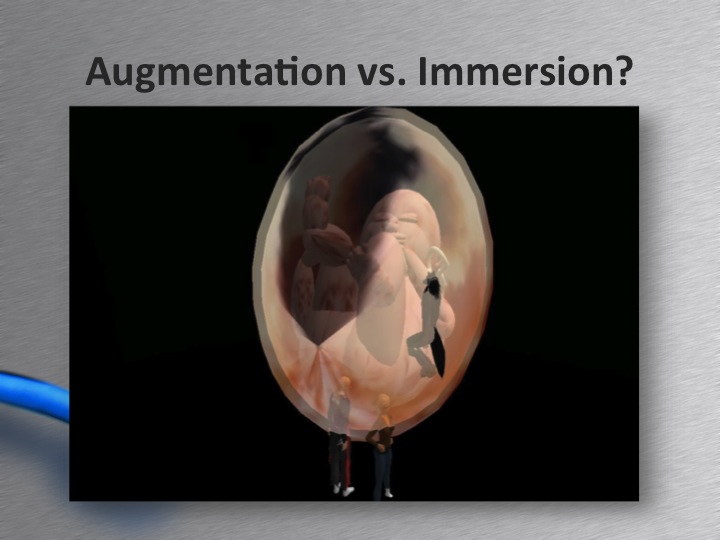
Among other things I addressed one of the challenges I currently have in relation to my thoughts on remediation. I’ve incorporated several dichotomies in my models for remediation, but I only see them as theoretical/analytical tools – reality (in whatever shape it represents itself) is much more complex and I don’t necessarily consider them to be mutually exclusive. Another problem is that some of the concepts I’m using are ambiguous, so I have a lot of work ahead of me in determining how I will define these concepts, and as examples of this uncertainty I presented the following three slides:

BTW, for the presentation I’d found a nice template displaying an Ethernet cable, which I thought suited the topic very well – only later I realized that as part of the terms of use I’m not allowed to upload them to any sort of file sharing site and this is why they can only be found here in pdf format … and so I will not use that type of template again!

/Mariis