Lessons learned from presenting SL via SL

UNINETT2009

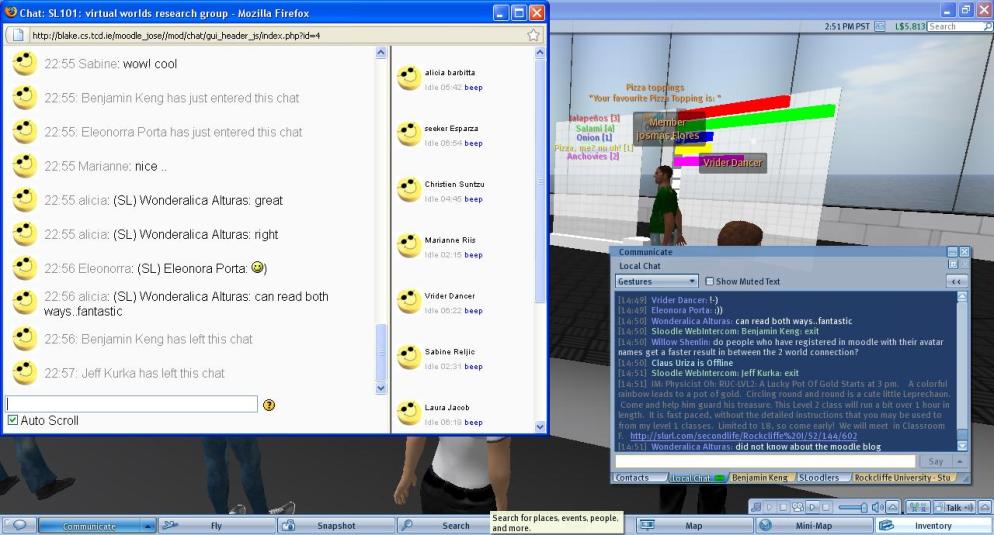
Thursday June 11th  a former MIL student, Cecilie Aurvoll had invited me to present my SL project at the UNINETT 2009 conference in Norway. Unfortunately I was unable to attend IRL, so we decided that I should do my presentation from within SL.

Obviously to make such a presentation you need an on-site mediator who’ll be able to log in-world and interact/communicate so that the audience gets an impression of the real time possibilities and challenges.  It was the second time I presented SL at a conference in this way and even though I think it it’s a good idea, I also think it’s easier said than done – at least I’ve learned a few valuable lessons.

The first time I did this kind of presentation one of my students, who together with the rest of his group had been studying SL for several months and therefore had quite a lot experience with SL and its functionality, acted as mediator. During this session we had an ongoing voice conversation and I knew that I could easily direct/instruct him (e.g. ask him to interact with objects) and just in general ask him to show the audience different things on his screen. The in-world locations we visited were places where the student and I had been before and he instinctively knew where to place his avatar and how to use his camera for the audience to get the best view.  From the feedback we got on this session it was evident that especially the ongoing voice conversation and the interaction between our avatars and in-world objects left the audience with a reasonable impression of SL.

The scenario for the second presentation at the UNINETT conference was somewhat different. The mediator was a local technician whom I didn’t know but only met shortly in-world the day before where he told me that his experience with SL was limited. This is by no means a critique of his work during the session – I actually thought he did very well, but there were some differences compared to the first session.  During the session we were accompanied by Cecilie and one of her friends, and since they both were located in different RL locations I hope we managed to show how SL can be used as an alternative to more conventional meeting tools. However, because I was unsure of the mediators ability to use different functionalities I hardly asked him to do anything, which in hindsight made his interaction (projected to the audience) rather passive. Ideally the session could have been rehearsed in real time beforehand but how often is that realistic? I’d made a manuscript, including landmarks and points to be aware of for both sessions, and for future presentations it probably would be a good idea to share this with the mediator in advance instead of just verbally expressing my intentions.

Another difference was related to the communication. Not entirely certain that I would be able to understand all their Norwegian I’d recommended that they communicated mainly by text, while I used voice. I also thought it would be interesting to show how the voice-text combination usually works very well. Voice presentations with texting audience are common in-world, I’ve attended many such sessions and so far I’ve found it to be both satisfactory and engaging.  I did forget one crucial point though; the difference in perception when you’re immersed respectively nonimmersed. When I watch the recording of the session it strikes me as being pretty boring listening to my avatar talking, while text pops up occasionally on the screen. From the view of the outsider it almost comes across as traditional one-way communication – at least that’s my sentiment and even though I don’t know how the audience perceived it, I would recommend mutual voice in the future.

Despite these challenges I do find this way of presenting SL to be a viable alternative when RL presentation isn’t an option – I still just have a lot to learn ;-)  In fact I think presenting SL via SL often is better than flat 2D presentations, but it depends on the purpose and it is a different story …

/Mariis

BTW; for those who understand Norwegian, Cecilie and her colleague, Kristine Sevik wrote an interesting article on the educational potential of Virtual Worlds for the conference.
SLoodle hands-on workshop

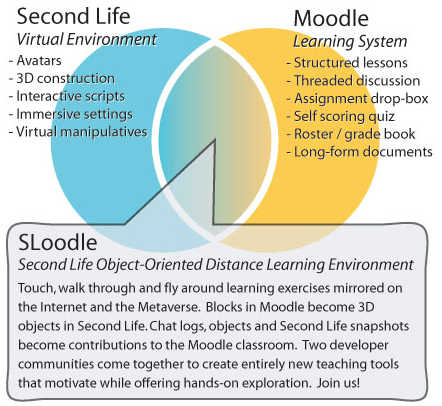
Yesterday I attended a hands-on workshop on SLoodle led by Josmas Flores as part of the weekly meetings of the Virtual Worlds Research Group Discussions. SLoodle (Simulation Linked Object Oriented Dynamic Learning Environment) is an Open Source project which integrates SL with Moodle.

sloodle-wiki
SLoodle figure from the SLoodle wiki

According to the SLoodle website, some of the key features of SLoodle are:

  • Web-intercom. A chat-room that brings Moodle chatroom and Second Life chats together. Students can participate in chats in Second Life using the accessible Moodle chatroom. Discussions can be archived securely in a Moodle database.
  • Registration booth. Identity management for Second Life and Moodle. Link students’ avatars to their Moodle user accounts.
  • Quiz tool and 3D Drop Box. Assess in Second Life – grade in Moodle. Set quizzes or 3D modelling tasks in an engaging 3D environment. Review grades quickly and easily in the standard Moodle gradebook.
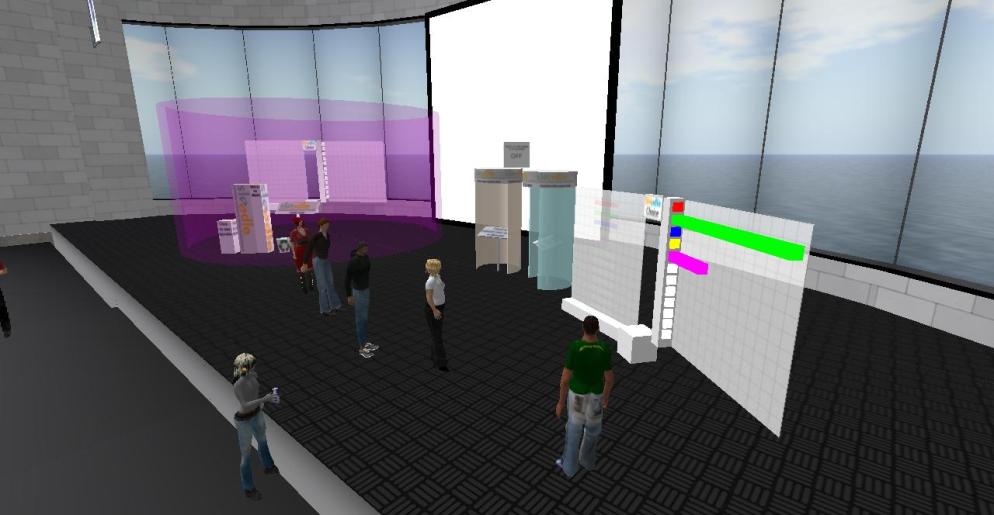
  • Choice tool. Allow students to vote (and see results) in Second Life as well as in Moodle.
  • Multi-function SLOODLE Toolbar. Enhances the Second Life user interface. Use a range of classroom gestures, quickly get a list of the Moodle user names of the avatars around or write notes directly into to your Moodle blog from Second Life.
  • Presenter (in development). Quickly author Second Life presentations of slides and/or web-pages on Moodle. Present in Second Life without having go through lengthy processes to convert or upload images.
  • … and more. More tools are being prototyped on a regular basis.

In the workshop we tried – quite successfully I might add (Thx, Josmas!) – most of the features, and it is for sure something I will look further into. In the COMBLE course my colleagues and I will run in April/May we will be using both SL and Moodle, so I’m hoping we can find the resources to experiment with SLoodle.

sloodle_005
Watching Josmas demonstrating some of the features …

sloodle-1a
Checking chat feature in both sites …

I don’t think all of the above mentioned features would be relevant in my courses – we never vote and I find it hard to see how I could use such a tool in assessing the students (I wouldn’t use this feature in Moodle either), but I do see potential in both the chat and the blog features. As one of the participants, Grog Waydelich, said an interesting question could also be what kind of gestures are needed for classroom attendance?

One of the MIL students from my 1. MIL research cycle in 2007 experimented with SLoodle and attended some of the in-world SLoodle meetings, and he was very positive about the possibilities and especially the helpful community surrounding the project.

kryger1
Kryger meeting with other SLoodlers in 2007

The SLoodle project was founded by Daniel Livingstone & Jeremy Kemp with fundation from EduServ. In this paper Livingstone & Kemp (2008) describe the project and the importance of the SLoodle community.

UPDATE March 6th – from Willow Shenlin:

This coming week’s meeting is hosted by Jeremy Kemp at 1400SLT. He will discuss the research and issues behind the SLoodle Project.

We will meet him directly at SJSU SLIS 128/128/0, in the new student orientation site.

Also, as usual, I am asking for educators and/or developers who have an in-world tool that they wish to demonstrate and promote to the research, teaching and learning community. Let me know and I’ll schedule you on http://socialpresence3d.wikispaces.com/SpeakerSchedule

Cheers,
Willow

UPDATE March 10th
In yesterdays session Kemp told us how Linden Lab had forced them to change the project’s name from Second Life Object Oriented Learning Environment to Simulation Linked Object Oriented Learning Environment.

/Mariis

Theoretical bricolage

This week a vicious feverish flu has influenced my research stay at The Danish School of Education. Nonetheless – or perhaps because of the fever ! – I’ve been able to make some important decisions regarding the use of theory in my PhD. Yesterday I presented my PhD project and SL (hands-on) to a bunch of colleagues from the Research Programme, Media and ICT in a Learning Perspective. It was really nice to be among colleagues who were interested in my findings and had fun exploring SL :-)

In my presentation I focused mainly on theory of remediation, PBL , Experiential learning and the Community of Inquiry-model.  However, I’ve also decided to investigate another meta-theory (or Didactic theory as we would say in Northern Europe); The Theory of Interactive Constructivism. This theory stems from Germany and the work of especially Kersten Reich. Reich founded his thoughts back in the 1990’ies when he called this particular branch of constructivism Systemisch-konstruktivistische Didaktik.  It’s not a theory that I’m particularly familiar with but from readings this week it shows potentials!

Reich and his colleagues at the Cologne Dewey Center have published most of their ideas in German, but have recently started to write in English too (luckily, since my German is a bit rusty!).  Reich and colleague Stephan Neubert have set up a site for their work on Interactive Constructivism, and from a text by Neubert (2008) I quote these theoretical perspectives that demonstrate the foundations of the theory:

  • observers-participants-agents in cultural practices, routines, and institutions
  • processes of communication with particular focus on the dimension of lived relationships
  • the interplay between the symbolic resources of a life-world, the imaginative desire of subjects, and the occurrence of real events
  • the connections between processes of construction, reconstruction, and deconstruction in the cultural production of realities,
  • involvements of discourse and power,
  • cultural diversity, otherness, and incommensurability in multicultural contexts. (p.1)

There seems to be many interesting and relevant perspectives for my PhD work, but what I found especially interesting is their thoughts on reality de-/re-/construction.  Since my object of study embrace 3D virtuality I’m always on the lookout for theories that might be able to include what I call a mixed reality perspective. I don’t think Reich and Neubert have 3D virtuality in mind, when they discuss “the limits of reality constructions”, but I have a feeling that it might be possible to expand their ideas.

I was also delighted to learn that they speak of “imaginative desire” and the social aspect;

According to interactive constructivism, furthermore, these imaginative constructions cannot be separated from contexts of social interaction. That is to say, imaginative desire is always involved in mutual mirror experiences between self and others (…). (p. 9)

By bringing in this theory, I’m hoping to be able to focus more explicitly on the social aspect of teaching and learning – an aspect which Kolb often has been (wrongly in my opinion though!) criticized of neglecting.

In any case, what lies ahead of me is extensive reading and work on trying to create a coherent and relevant theory bricolage, and I’m quite positive, since all of the above theories claim to have found their inspiration in the great work of John Dewey.

More on this will follow for sure …

/Mariis

Research stay at the Danish School of Education

Next week I’ll be visiting Professor, PhD Birgitte Holm Sørensen, Director of the Research Programme, Media and ICT in a Learning Perspective at the Danish School of Education.

bhs1

Both Birgitte  and I are members of the steering committee of The Masterprogramme in ICT and Learning (MIL), and we’ve known each other for years now. Birgitte’s areas of expertise include;  ICT/New media in combination with children, young people, teaching and learning and curriculum/ educational design. Birgitte is also responsible for the 4th module in the MIL education – the module where my SL course (my primary PhD case) is based.

Besides giving a presentation on the teaching and learning potential of SL to the members of Birgitte’s research programme, I intend to use this opportunity to discuss and further develop some of the central findings and concepts in my PhD, so I’m really looking forward to this stay :-)

/Mariis

COMBLE meeting in Poland

Tomorrow my ELL colleague, Heilyn Camacho and I will be going to Poland to meet our partners from the COMBLE project. As part of the COMBLE project Heilyn and I are responsible for developing, implementing and testing a course that aims at educating future trainers in blended learning, and we will be giving a stat on our work and ideas:

We’ve chosen Problem Based Learning (PBL) as the overall pedagogical strategy for the course, and this is by no means a coincidence. When Aalborg University was founded in 1974 it was based on ideas of learning-by-doing and experiential learning that has evolved into a  strategy called Problem Oriented Project Pedagogy (POPP), which can be seen as a particular branch of PBL. The strategy is fundamentally based on group work, and it will be especially interesting to watch how this strategy works in a pure online course. This is also one of the main reasons for using SL in the course, because we hope SL will give the participants a strong sense of presence and co-presence in the learning environment that also consists of Moodle and different web 2.0 technologies.

The course is set to kick-off mid April and Heilyn and I will be working on setting up the Moodle environment and finding relevant places/people to visit in SL. It has not yet been decided where the main teaching and learning activites in SL will take place, but our Polish partners own an island, which we might use.

This course is the second case in my PhD, and in contrast to the MIL course I will not be the only teacher, since we’ve planned that some of my ELL colleagues, incl. Heilyn will teach in-world. This will give me an opportunity to get some feedback and different perspectives on teaching in-world, which I think will be very valuable for my PhD work, so I’m really looking forward to running this course :-)

/Mariis