Handbook of Emerging Technologies for Learning

George Siemens & Peter Tittenberger (unfortunately his personal website is currently unavailable)  just released their number 1 version of “Handbook of Emerging Technologies for Learning”. A wiki, which will continue to be updated is available, but it’s also possible to view it as a pfd-file.

handbook

Siemens & Tittenberger encourage everyone to comment, discuss and react – so enjoy studying it :-)

/Mariis

Myths and research on ways of learning

In this week’s newsletter George Siemens questions the use of visuals in communication and refers to a poorly researched article on this:

As I’ve stated, I’m trying to make greater use of visuals. Hard to make sense of the value of visuals with poorly presented articles like this: Why communicate visually. Some sloppy research on the old “10% hear, 20% read, 80% do” – this time attributed to Bruner. Will Thalheimer  debunks/questions the validity of this claim. This automatically calls into question related statements in the article (not cited properly) about the prominence of visuals in learning and retention. I don’t trust the author. But then I have to ask myself, why I want to use images/visuals. To increase effectiveness of learners who take a course I teach? To improve my ability to communicate? What can visuals do that text can’t? And where is the research that supports that claim?

Though relevant, I don’t want to address all Siemens’ questions in this post. Instead I spent some time on looking closer into the Will Thalheimer post on one of the major myths in learning, namely that people remember 10% of what they read, 20% of what they see, 30% of what they hear, etc. indicating that “learning by doing” always is the best way of learning.

Apparently the percentages have often been attributed the work of American educator Edgar Dale (1900-1985) and his book “Audiovisual Methods in Teaching” (1946, 1954 & 1969). In this book Dale presented The Cone of Experience, which depicts various types of audio-visual experiences that can be classified in terms of greater or lesser concreteness and abstractness, but it includes no percentages at all! In numerous posts Thalheimer has exposed the misuse/misinterpretations of Dale’s original work – including a fresh example from a conference in the workplace learning field in January 2009.

Back in 2002 Tony Betrus & Al Januszewski gave a presentation at the Association of Educational Communications and Technology (AECT) conference entitled “For the Record: The Misinterpretation of Edgar Dale’s Cone of Experience”. Betrus & Januszewski present 14 examples of misinterpretations – all exposing sloppy research, and as Donald H. Taylor comments:

The very worst of it? Some of these diagrams are produced by people who really should know better. Academic bodies such as North Caroline State University, services for educators such as Video4learning.com, and one individual – working for the good of others – who put a lot of work into producing two different pyramids, with the specific aim of making the diagrams available for free, general use, under creative commons.

A part from the disturbing fact that certain academic researchers continue to misuse and misinterpret Dale’s model and combine it with bogus data, this example raises a fundamental question of what we actually know – based on valid research! – about effective ways of learning.  Depending on how you define learning, I think many answers could be given to that question. However, in a recent study on the effectiveness of multimodal learning by Cisco Head of Education, Charles Fadel writes the following in the foreword of the report:

There is a lot of misinformation circulating about the effectiveness of multimodal learning, some of it seemingly fabricated for convenience. As curriculum designers embrace multimedia and technology wholeheartedly, we considered it important to set the record straight, in the interest of the most effective teaching and learning.

This report is the 3rd in a series that addresses “what research say” and it also refers to the many misinterpretations of Dale’s model and concludes:

The person(s) who added percentages to the cone of learning were looking for a silver bullet, a simplistic approach to a complex issue. A closer look now reveals that one size does not fit all learners. As it turns out, doing is not always more efficient than seeing, and seeing is not always more effective than reading. (p.8)

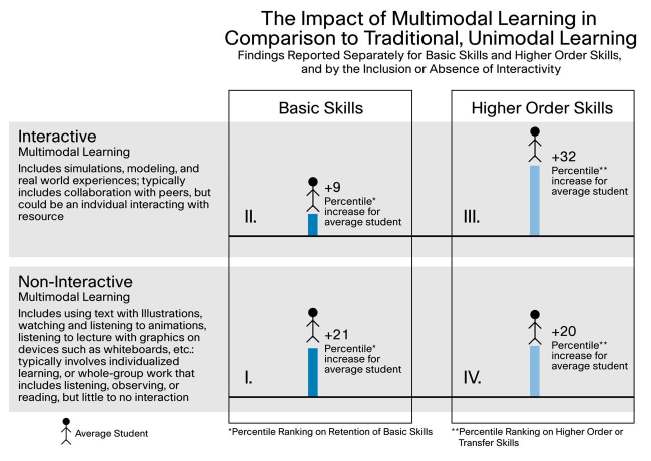
The report then explores the effectiveness on multimodal learning in comparison to traditional learning based on meta-analysis and experimental and quasi-experimental design studies published from 1997 to 2007, and comes up with this interesting figure:

cisco-8

  • Quadrants I and II: The average student’s scores on basic skills assessments increase by 21 percentiles when engaged in non-interactive, multimodal learning (includes using text with visuals, text with audio, watching and listening to animations or lectures that effectively use visuals, etc.) in comparison to traditional, single-mode learning. When that situation shifts from non-interactive to interactive, multimedia learning (such as engagement in simulations, modeling, and real-world experiences – most often in collaborative teams or groups), results are not quite as high, with average gains at 9 percentiles. While not statistically significant, these results are still positive. (p. 13)
  • Quadrants III and IV: When the average student is engaged in higher-order thinking using multimedia in interactive situations, on average, their percentage ranking on higher-order or transfer skills increases by 32 percentile points over what that student would have accomplished with traditional learning. When the context shifts from interactive to noninteractive multimodal learning, the result is somewhat diminished, but is still significant at 20 percentile points over traditional means. (p.14)

This report actually provides some substantiated evidence of the effectiveness of multimodal learning, but wisely cautions the reader:

This analysis provides a clear rationale for using multimedia in learning. That said, the reader should be cautioned that the research in this field is evolving, with recent articles suggesting that efficacy, motivation, and volition of learners, as well as the type of learning task and the level of instructional scaffolding, can weigh heavily on the learning outcomes from the use of multimedia. (p.14)

It’s an interesting report well worth reading, but you can also watch Charles Fadel discuss it with Elliott Masie at the Learning 2008 conference here.

/Mariis

Special thanks to Carsten Storgaard for the video link :-)

Iterative thinking, teaching and learning in SL

One of my favorite SL friends, Terry Beaubois has been interviewed about his use of  SL by Heather Livingston from the AIArchitect.

terry

Terry is a RL architect and has been teaching especially, but not exclusively architectural students in-world for four years now, so the interview quite naturally focuses on architecture, but I do think the interview is worth reading even if you don’t teach architecture.  Terry elaborates on the following questions:

  1. Why did you begin teaching in Second Life?
  2. How does the class work?
  3. What’s the benefit of using the virtual environment of Second Life versus a 3D modeling program?
  4. What lessons from Second Life can be translated into architecture practice?
  5. How have your students responded to the experiences?
  6. What advice would you offer young architects?
  7. Final thoughts?

Terry is a wise man which truly shows from the interview. What I especially appreciate about Terry is his positive and open-minded attitude. For sure there are constraints in using SL, but Terry has an important point about SL/VW’s:

I would continue to encourage a relationship with virtual environments. We don’t have to make all the conclusions now. We don’t have to judge it based on its current level of capabilities. It’s going to get better in the future. It’s not the be-all, end-all for everything, but it’s also not to be disregarded as a contributing technology to architecture.

I agree totally, and I think this applies for any subject matter and any emerging technology :-)

/Mariis

Read the full interview here

Research strategies and SL as Knowledge Medium

On Wednesday, January 21st I participated in a Master Class on Learning 2.0 and Knowledge Media at Aarhus University.Terry Anderson (Athabasca University) and Simon Heilesen (Roskilde University) were guest lecturers, while my MIL colleagues Christian Dalsgaard, Jørgen Bang and Elsebeth K. Sorensen (Aarhus University) served as moderators. Six Master- and PhD Candidates from different Danish Universities besides me participated, four of us giving short presentations of our projects.

Anderson gave an interesting presentation entitled “Overview of Research Methodologies for Social Software Research”, which initiated quite a discussion on research methodologies especially within educational research. Anderson was critical of educational research asking what results in fact had been able to instigate real change in educational practices. This lead to a critical overview of three dominant research paradigms respectively Quantitative, Qualitative and Critical. Anderson quoted a study by Mary M. Kennedy (1999):

The findings from this study cast doubt on virtually every argument for the superiority of any particular research genre, whether the criterion for superiority is persuasiveness, relevance, or ability to influence practitioners’ thinking. (from Anderson’s presentation above)

According to Anderson, who also is the director of Canadian Institute of Distance Education Research (CIDER), there is a need for development of new research strategies emphasizing possibilities for innovation and change. Anderson pointed to Design Based Research (DBR) as a potential strategy. At ELL we have a strong tradition of employing Action Research (AR) based strategies, including DBR, which in my point of view is a variant of AR. Both strategies are:

  • Iterative
  • Process and utility oriented
  • Intervention driven
  • Collaborative
  • Multileveled
  • Theory generating

However, there are at least two major differences between AR and DBR, namely the role of the researcher and the role of theory. In DBR the researcher works closely together with the practitioners, whereas in AR – especially in educational research – the researcher quite often also is the practitioner studying his/her own practice as a participant/insider. In DBR the role of theory is clearly defined as the point of departure of the research process:

Design-based researchers’ innovations embody specific theoretical claims about teaching and learning, and help us understand the relationships among educational theory, designed artifact, and practice. (DBRC.2003:5)

In AR theory isn’t necessarily applied from the beginning of the research process but to a higher degree grounded by the practice in the different research cycles, thus making it a more open strategy. Still, in claiming this I want to stress that there are many different takes on AR strategies. See Raelin (1999) for a good overview of different action based strategies.

Heilesen proceeded with another interesting presentation on “Learning 2.0 – Conditions and potentials of the social web”. There are so many comments to be made on this topic, but one of the issues Heilesen addressed was the potential of using new digital social technologies as means to change conventional conference participation from a typical closed and time limited event to a more open and continuous activity – exemplified by the MetaverseU conference at Stanford, February 2008 (where both Heilesen and I participated ;-). Anyone who has participated in RL conferences knows that it can be a somewhat dreary experience based mainly on one-to-many communication, and in my personal experience it can also be quite difficult to expand the effect/outcome afterwards. This issue of “frustrating conferences” is currently being addressed by George Siemens and colleagues. Note the upcoming open, online conference on this topic and see Siemens, Tittenberger & Anderson (2008) for a really interesting perspective on this.

After the lunch break, I and three other candidates were asked to present our projects. Presenting a PhD project in 15 min. really is an ungrateful task making it quite difficult to convey a coherent and comprehensible impression. On the other hand, I have to admit that at this stage in my PhD research many of my ideas and thoughts still need to be qualified by further research and a Master Class can be a really good opportunity to discuss this kind of “work-in-progress”. In my presentation, I chose to focus on the possibility of using SL as a knowledge medium – primarily based on the preliminary findings of my 2. research cycle, which was conducted in November/December 2008.

One of the things, which were critiqued as being unclear in my presentation, was my use of the concepts respectful and radical remediation. Initially I was inspired by Tringham, Mills  & Ashley (2007) and their experiences from the Remediated Places Project, where they used these two concepts (elaborating on Bolter & Grusin.1999) as a way of describing different ways of remediating. Based on my own experiences from remediating a specific course via SL I do find these two concepts very useful in describing not only different ways of remediating places, but also people and practices. There is, however, no doubt that I need to further develop and qualify my work on this, so that I can convey a more coherent, and thus convincing argument on this.

All in all, it was a very inspiring learning experience to participate in this Master Class, so my concluding words will be thanking all the participants :-)

/Mariis

References

Bolter, J. & Grusin, R. (1999): Remediation. Understanding New Media. The MIT Press

Kennedy, M. M. (1999) The problem of evidence in teacher education. In: Roth, R. (Ed). The Role of the University in the Preparation of Teachers. (pgs 87-107). London: Falmer Press.

Raelin, J. (1999) Preface. In: Management Learning. Vol. 30(2): 115-125. Sage Publications


Example of my ELL colleagues using DBR in current research

Coto, M. & Dirckinck-Holmfeld, L (2008): Facilitating Communities of Practice in Teacher Professional Development. Networked Learning Conference Proceedings 2008.

Other relevant resources

CIDER’s SIG on DBR

Smith, M.K. (1996, 2001, 2007): Action Research. The encyclopedia of informal education.

Center for Collaborative Action Research

Action Research Resources

Exploring Knowledge Media

Next week I’ll be attending a conference and a Master Class on “Knowledge Media” at Aarhus University.

knowledge-media2

The purpose of the Knowledge Media Conference is to discuss the role of new digital media within education in the knowledge society. What are the potentials of digital media in relation to learning, knowledge sharing and knowledge construction? The conference will focus on use of digital media for learning and knowledge acquisition in both formal and informal situations. The conference includes presentations from invited keynote speakers. Further, the conference will present the results of a research project at the Centre for IT & Learning on Knowledge media, 2007-2008.

Themes

  • Education for all?
  • New learning environments: Web 2.0 and Social Software
  • Knowledge media
  • Formal and informal learning

Keynotes

  • Terry Anderson, Athabasca University, Canada
  • Friedrich Hesse, Knowledge Media Research Center, Tübingen, Germany
  • Lars Qvortrup, School of Education, Aarhus University, Denmark
  • Jørgen Bang, Institute of Information and Media Studies, Aarhus University, Denmark
  • Lynne Schrum, George Mason University, USA

I’m especially interested in hearing Anderson’s talk on “Learning and Teaching beyond the Course Into Networks and Collectives”. The idea that social media, knowledge media or whatever you wish to call new digital media, slowly will dissolve our notion of courses (understood as fixed, teacher-driven activities) as a means of learning seems to gain more and more recognition and attention, and it’ll be interesting to hear Anderson’s thoughts on this in my own area (distance education) – not least since my PhD fundamentally is about course design, hmmm …

The Master Class, with Terry Anderson and Simon Heilesen (senior researcher at the Virtual Worlds Research, Roskilde University) as speakers, will also adress the potentials of digital media in relation to learning, knowledge sharing and knowledge construction. I’ll do a short presentation of Second Life as Knowledge Medium in Distance Education based on my experiences with the MIL course in the 2 research cycles so far. I think it’s a really good idea to hold the Master Class the day after the conference, because I’m quite sure many questions and ideas will come to me, so it’s nice to get an opportunity to discuss more informally.

/Mariis