Case MIL09: Student analysis of SL – part 2

Lizzie & Jorn

Lizzie & Jorn, who were in charge of the second didactic analysis in the MIL course, had decided that we should start out by exploring a particular design which then would form the basis for their discussion and reflections, so we went to Teaching 4 – Iowa State University, CELT, where Thursday Xu has created a model of Wenger’s Community of Practice (CoP):
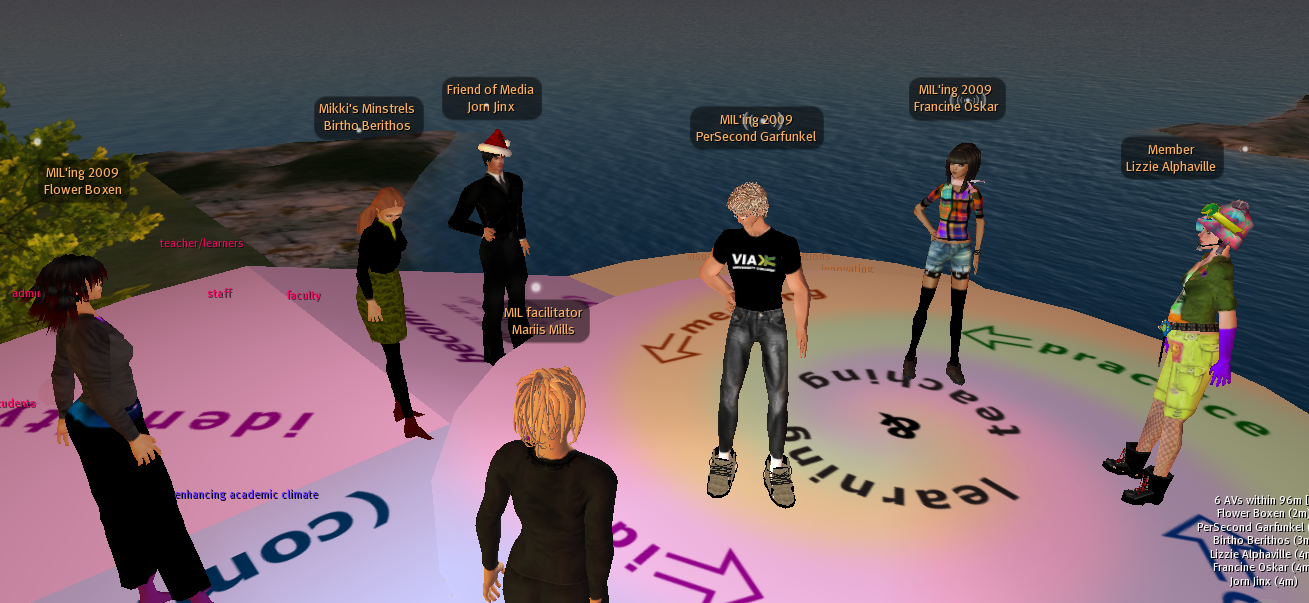
The model has been created as a kind of spiral shaped staircase and as you move up floating text with key concepts central to the theory appears. Other than that there seems to be no apparent interaction possibilities with the model.

After exploring the model we all went to Media Learning, where Lizzie & Jorn had been able to make use of a presentation setting owned by another (first year) MIL student, Inge Qunhua, who is an experienced and award winning SL teacher.

As part of their presentation Lizzie & Jorn started by analyzing the CoP model and I think it is safe to say that none of them or any of the other students was impressed by the model – above all due to the lacking interaction possibilities. My role in these discussions was mainly to listen and observe and it was quite interesting in this case because I did not agree with the students. During the MIL course we have visited other theoretical designs that are based more on interaction between the design and the avatar. Right next to the Cop model, Thursday Xu has created a build of Bloom’s taxonomy, where questions regarding the theory are posed in the local chat as you move your avatar around in the model and we have also been exploring Zotarah Shepherd’s MI build where the avatar can play instruments or solve a mathematical puzzle as examples of the different intelligences and the MIL students clearly preferred these more interactive designs.

In my opinion interaction doesn’t necessarily equal learning. I don’t think my understanding of musical intelligence is enhanced solely because my avatar can be animated to play drums though I recognize that the fun engagement and activity may play an important role in the memorizing process, but there is so much more to learning than just memorizing. In line with Wenger, I believe that negotiation as part of the creation of meaning is essential to the learning process and in this sense my pedagogical foundation obviously is dialogic and I tend to agree with Wegerif. 2006 who finds that one of the goals of education, perhaps even the most important goal, should be dialogue as an end in itself.

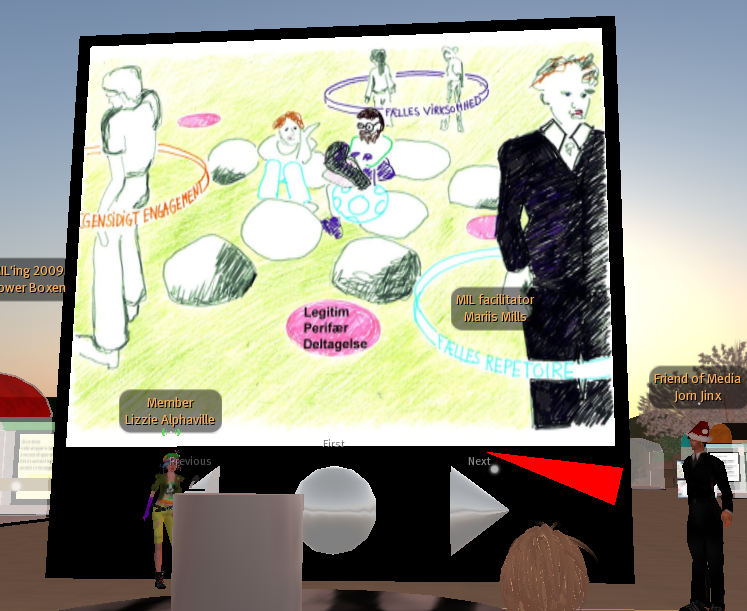
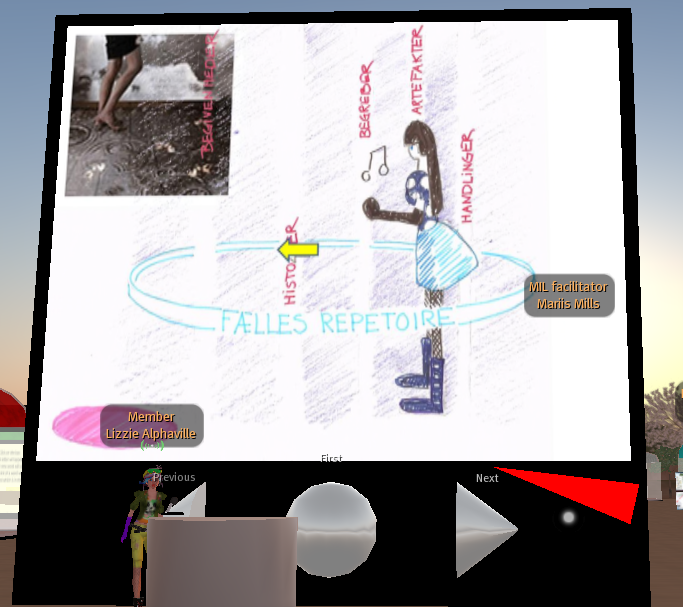
Judging the quality of designs for teaching and learning is however very complex and I think that one of the first things you need to clarify is whether the design is intended for single- or multiple-user purposes. In the case of the latter you of course also need to consider the role of other participants and e.g. a facilitator. Lizzie & Jorn found that the CoP model was a “stand-alone” model and therefore they didn’t find it interesting, but as part of their analysis they had also created a suggestion for an alternate CoP model to be used with their particular target group; dental hygienists. This imaginary model was presented as sketches drawn by Lizzie and put emphasis on 3 of the core concepts from the CoP theory;  mutual engagement, shared repertoire and joint enterprise:
By the end of their presentation Lizzie & Jorn also invited us to join them in trying to place the two CoP models within a third model, namely the model created by former MIL student Carsten Storgaard as I’ve referred to earlier in this post. It turned out to be quite difficult, but started an interesting discussion on models and their usability in general.

Afterwards in their reflections in FirstClass, Lizzie & Jorn, mentioned how difficult it is to teach when you’re unable to see the facial expressions and body language in general – the chat (text/voice) becomes crucial in environments like SL in order to get the sense of not talking to an empty space. One of the things Lizzie & Jorn also criticized about the CoP model was the lack of a place for discussion in the model if you’re in a lager group, but in hindsight they concluded that the need to gather (f2f) in order to discuss is more psychological stemming from our RL habits than practical, since there is no other reason to do so in SL where you always can communicate via group chat regardless of distance. They also felt that their presentation had raised more questions than answers, which for someone who believes in the value of unfinished dialogue was good to hear …

Besides the fact that I was really surprised by all of the students’ lacking recognition of dialogue as main means of learning, I do think Lizzie & Jorn did a great job and we all had a very interesting experience. It is, nonetheless difficult not to mention the irony of the situation; the students really criticized the CoP model and its apparent disability to promote learning, but judging from the discussions and the comments during the session it turned out to be an event with both challenging and meaningful negotiation of several of the topics in the course ;-)

/Mariis
Case MIL09: Didactic Design Discussion – 4

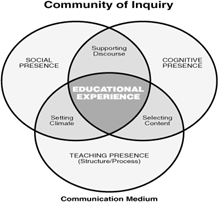
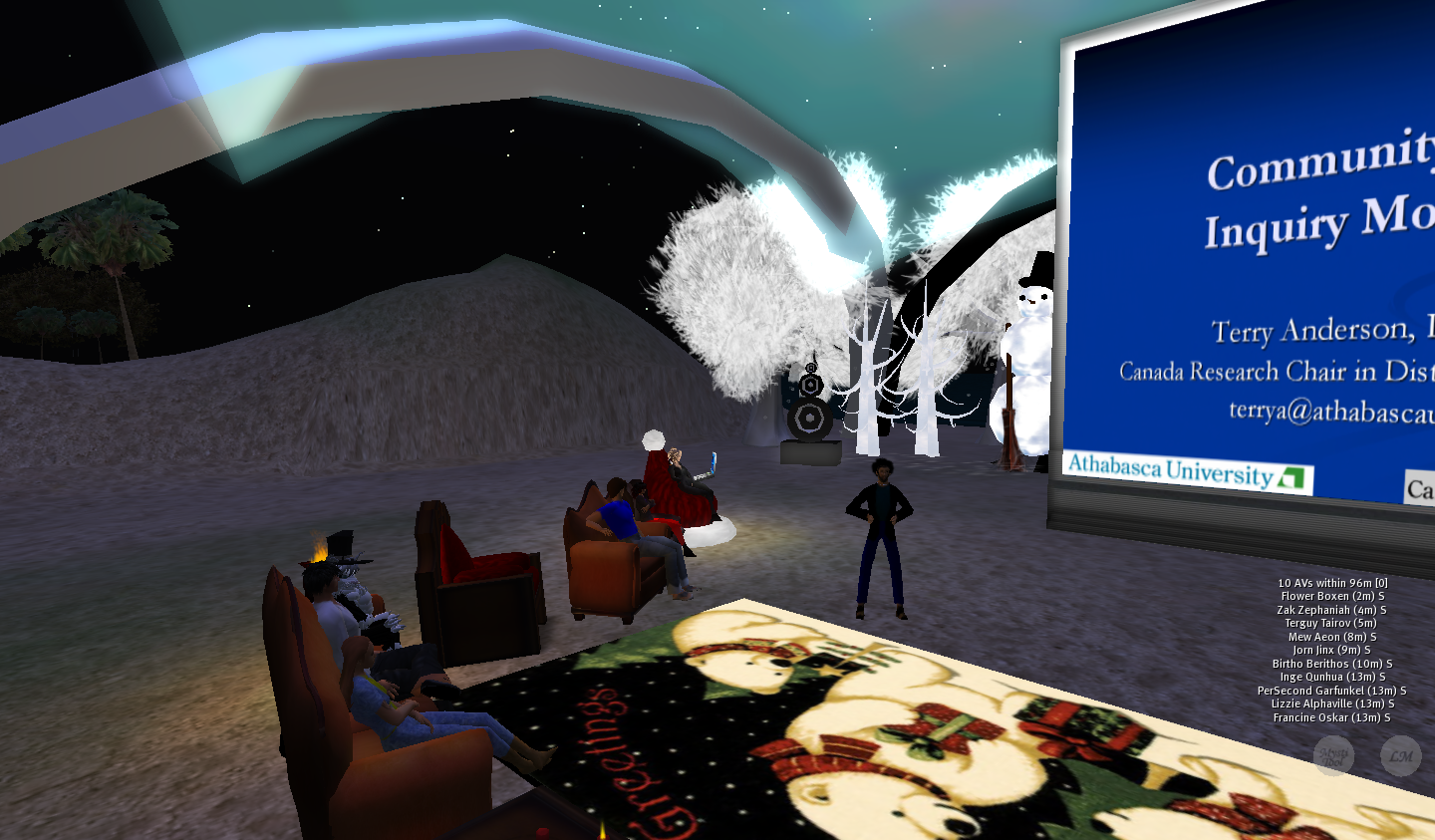
On December 3rd we had a special edition of the Didactic Design Discussion in the MIL course, since both Terry Anderson and Ross McKerlich visited us to talk about the Community of Inquiry (COI) model. The COI model was developed in the late 1990’ies as framework for evaluating educational experience in text-based online environments by D. Randy Garrison, Terry Anderson and Walther Archer. Given the COI model’s wide spread use in different educational settings it is by no means coincidental that one of the original founders, Terry Anderson, has found it important to explore the applicability of the model in new online environments such as the 3D virtual world, Second Life (SL). Together with McKerlich Anderson conducted a preliminary, qualitative exploratory study in SL in 2007 and basically confirmed that the model also can be used in assessing educational experience in 3D virtual environments (McKerlich & Anderson. 2007). Anderson and McKerlich later invited Brad Eastmann and I to participate in the continued study of COI in 3D virtual worlds and as part of this study we record different educational experiences in SL to be used for later analysis.


Terry presenting COI to the MIL students

Besides being an excellent tool with regard to analyzing interaction and communication the COI model, which consists of 3 different  types of presence indicators (cognitive, social and teaching), can also be used as a heuristic tool for designing online educational experiences. The MIL students in this year’s course are all educators involved in course designing within blended learning and they all seemed to find the COI model interesting and relevant to their current work. What I appreciate about the model is the fact that it deals with presence and not immersion which otherwise seems to be the buzz word when studying 3D virtual worlds. Even though both presence and immersion have to do with the user experience, I do find there is an important difference between the two concepts. Based on the four research cycles I’ve completed in my PhD project so far, my experience is that all users achieve a sense of presence when they enter a virtual environment like SL, which I think above all has to do with the avatar and its ability to move around and meet other avatars, communicate and interact in real time. It is, however not my impression that all users in these types of environments achieve the sense of immersion – at least not if immersion is defined by a sense of “willing suspension of disbelief” as proposed by Dede. 2005 among others.  An important part of this discussion is of course how one chooses to define the concepts and since I intend to use both presence and immersion in my own model this is something I’ll return to.

After the presentation, McKerlich introduced to our survey related to the COI study and we went on to use The Opinionater, which once again proved its worth as a great tool for initiating discussions.

/Mariis

Book release: ICT and Learning – reflected practice

Together with colleagues Ulla Konnerup, Søren Skøtt Andreasen & Lone Dirckinck-Holmfeld I’ve co-edited an anthology entitled “ICT and Learning – reflected practice”.  What makes this anthology unique is that all the authors are alumni from the Masterprogramme in ICT and Learning (MIL).  Through 7 articles the authors discuss and reflect upon the use and purpose of ICT in different learning contexts covering the educational sector and one public hospital. The anthology is in Danish – and so will the rest of this post be …


Front cover by Helle Fibiger

Ikt og læring – reflekteret praksis er en antologi, der er blevet til på baggrund af masterprojekter udarbejdet i forbindelse med afslutning af Masteruddannelsen i Ikt og læring (MIL). Ideen til antologien kom fra alumner, som fandt det relevant at sætte fokus på den iderigdom, kreativitet og nye viden, der skabes i udarbejdelsen af disse afgangsprojekter.

Gennem antologiens syv artikler fremlægger, diskuterer og reflekterer de 13 forfattere en række vidt forskellige cases, som dog alle har koblingen af ikt og læring til fælles. Forfatternes meget forskellige teoretiske inspirationskilder, metodiske fremgangsmåder og brug af diverse typer af ikt viser bredden inden for dette spændende felt som er i konstant udvikling.

Antologien henvender sig derfor også bredt til alle, som interesserer sig for ikt og læring, hvad enten der er tale om teoretikere, praktikere, undervisere, studerende, arbejdsgivere og ansatte, for hvem reflekteret brug af ikt er en del af den daglige praksis i et samfund, hvor livslang læring om noget er på dagsordenen.

Emneord: Ikt, livslang læring, pædagogik, design, praksis, refleksion

Antologien’ s pris er kr. 198,- og den kan bestilles via Aalborg Universitetsforlag.

/Mariis

“Dialogic Spaces” – Dialogic Education and Research Group

On Monday June 22nd I had the pleasure of participating in the first meeting in a study group “Dialogic Spaces” aimed at exploring dialogue from various perspectives within educational research and practice. The group was initiated by Assistant Professor, PhD Thorkild Hanghøj and several of his colleagues all from Dept. of Curriculum research at the Danish School of Education. Thorkild specializes in educational gaming and will incidentially join me at the Master in ICT and Learning (MIL) in the fall in our ICT and Educational Design module. Coming from Aalborg University’s Dept. of Communication I’m very happy to get the opportunity to collaborate with this group of researchers who all have such very strong foci on educational research. Besides Thorkild the following people are part of the group:

  • Lars Birch AndreasenE-learning; netbased education; virtual learning environments, Netmediated communication and collaboration.
  • Lisbeth FrølundeMultimodality theory and visual culture, Design and development of digital learning and play materials.
  • Jeppe BundsgaardEducational Theory and Curriculum in relation to the Danish Subject and Information Technology, Critical Discourse Analysis.
  • Mads HaugstedMother tongue and didactics; verbal communication, colloquial language, speech skill.
  • Christian Brund – just started as a PhD Candidate with a project on the role of the teacher in relation to educational gaming … no link yet

Together we cover a wide range of research interests but with the concept Dialogic we have found a common denominator.  Dialogic is most commonly attributed to the work of the Russian philosopher, literary critic and scholar, Mikhail Mikhailovich Bakhtin and though his work will play an important role in our endeavors it isn’t an exclusive Bakhtinian group.  We spent our first meeting stating our interests in using Dialogic perspectives, defined the organization and goals of the group and finally discussed a couple of papers (Dysthe. 2006 & Wegerif. 2006) both focusing on the use of Bakhtin in educational research. So far we’ve decided to meet f2f once a month in the fall primarily to discuss literature hoping that these dialogues! will inspire all of us in our future work. Further down the line we hope to be able to hold public seminars and finally write an anthology covering especially, but not exclusively  Scandinavian Dialogic perspectives within educational research and practice which also means that we will invite international colleagues to come join us.

I was first introduced to Bakhtin in the early 90’ies when I studied literature for three years, but it has been years since I actually used his ideas and concepts more explicitly. In spite of this, I do find the Dialogic perspective interesting on multiple levels in relation to my current PhD research:

  • Ontological level – according to Bakhtin living is participating in an ongoing dialogue and I couldn’t agree more. Accepting dialogue as ontological premise naturally influences the main purpose and the main processes of education; empowerment as preparation for and – as it is the case in HE/FE –  continuation of democratic, participatory citizenship. This way of thinking and practicing education very much aligns with a Scandinavian approach to both education and research in general and with exploration of new social media in particular (e.g. Rheingold. 2008 on Participative Pedagogy for a Literacy of Literacies).
  • Epistemological level – as a consequence of the ontology it is through dialogue with both ourselves and the surrounding world that we’re able to create meaning. Thus, as educators we need to focus on teaching students how to engage in the dialogues through which knowledge is constantly being constructed, deconstructed and reconstructed (Wegerif. 2006:60). It’s also worth noticing that if we accept the dialogic premise, the main mechanism for learning is taking the perspective of another in a dialogue (ibid:64)!
  • Methodological level– up until now I’ve been reluctant to coin my methodological approach, usually just stating that I’m applying some sort of Action Research. However, I recently decided to try to apply and further develop a methodology called Dialogue Design which was developed by three of my colleagues from the MIL steering committee, Janni Nielsen, Lone Dirckinck-Holmfeld and Oluf Danielsen (2003) back in the late 90’ies in relation to a large European research and development project on Multimedia and Network in Co-operative Research and Learning (MANICORAL). This particular methodology, based on different types of Action Research, puts forward dialogue and mutual learning as guiding principles.  Dirckinck-Holmfeld and Nielsen are also my PhD supervisors, and I will be spending most of the fall with Nielsen at Copenhagen Business School focusing on this part of my PhD work.
  • Didactic/pedagogical level – as teaching and learning space SL offers many possibilities of engaging in dialogic activities. Communicating simultaneously via both text and voice, incl. via avatar (as embodiment) and context are probably the affordances I currently find most interesting and I anticipate Bakhtin’s polyphony concept and his ideas on intertextuality (both in multimodal variations) will be useful in my attempt to theorize/analyze and design for such phenomena.

In applying a Dialogic perspective on my PhD I’ve got a sense of coming full circle and I’m really looking forward to an inspiring fall with extended readings and lots of dialogue … yeah :-) It also means that I’m in the process of editing my PhD page here on the blog … it’ll be back sometime during the summer.

/Mariis

References

Dysthe, O. (2006): Bakhtin og pedagogikken – Kva ein tidlegare ukjend artikkel fortel om Bakhtins pedagogiske praksis. IN: Norsk Pedagogisk Tidsskrift. 06/2006

Nielsen, J.; Dirckinck-Holmfeld, L. & Danielsen, O. (2003): Dialogue Design – with Mutual Learning as Guiding Principle. IN: International Journal of Human-Computer-Interaction. 15(1)

Wegerif, R. (2006): Dialogic education: what it is and why do we need it? IN: Education Review, vol. 19, no 2.

BTW

Stephen Downes recently directed my attention to a post on Streams vs. Blogs written by Jay Cross. In this post Cross reflects on blogs stating that:

Blogs are author-centric in a world that’s increasingly about relationships. Blogs are slanted toward me, me, me, me, me; the net is inexorably moving to us, us, us, us, us. Dialog trumps monolog.

While I do agree that some blogs tend to be very author-centric the few blogs/bloggers I chose to follow on a regular basis are highly Dialogic in my point of view. Adapting a Bakhtinian view engaging in dialogue with oneself can be very fruitful and furthermore the very nature of blogs (the intertextuality and the multiple voices coming forward through extensive linking) exemplifies a connected perspective on relationships and dialogue in a networked world.  The mere fact that I learned about Cross’ post via Downes shows my point. Granted that the premises for dialogue have changed dramatically, it still is dialogue to me … Nonetheless, I do agree with Cross that new services gradually will change the way we communicate, but like Downes I will not stop blogging any time soon – it’s just one way of communicating among others ;-)

Community of Inquiry (COI) in Virtual Worlds study

Early this spring Ross McKerlich, Terry Anderson & Brad Eastman invited me to participate in a research study on the usefulness of the Community of Inquiry (COI) model as evaluation tool in virtual worlds. Originally the COI model was developed in the late 1990’ies as framework for evaluating educational experience in text-based online environments by D. Randy Garrison, Terry Anderson and Walther Archer:

Central to the study introduced here is a model of community inquiry that constitutes three elements essential to an educational transaction – cognitive presence, social presence, and teaching presence. Indicators (key words/phrases) for each of the three elements emerged from the analysis of computer conferencing transcripts. The indicators described represent a template or tool for researchers to analyze written transcripts as well as a guide to educators for the optimal use of computer conferencing as a medium to facilitate an educational transaction.

communitymodel_small(COI website)

The COI model was developed as part of a Canadian Social Sciences and Humanities research funded project entitled “A Study of the Characteristics and Qualities of Text-Based Computer Conferencing for Educational Purposes”. Further details on that project, including papers describing the theoretical and methodological underpinnings of the model can be found on the COI website.

Given the COI model’s wide spread use in different educational settings it is by no means coincidental that one of the original founders, Terry Anderson, has found it important to explore the applicability of the model in new immersive environments such as the 3D virtual world, Second Life (SL). Together with McKerlich Anderson conducted a preliminary, qualitative exploratory study in SL in 2007 and basically confirmed that the model also can be used in assessing educational experience in immersive environments (McKerlich & Anderson. 2007).  Not unexpectedly, they did however also find that some adjustments would be appropriate – e.g. extending categories demonstrating social presence. This 2007 study did not allow for the authors to examine methodological issues such as validation deeply. Furthermore McKerlich and Anderson found the phenomenological experience of both learners and teachers would be worth further investigation.

Based on these preliminary findings, McKerlich and Anderson now together with Brad Eastman have initiated a new more quantitative oriented study – and this is also the study I’ve been invited to participate in. Unfortunately, I’ve not been able to contribute with very much so far due to a longer personal leave of absence from my work in general.  Nevertheless, during my absence they have successfully finished the work on developing an evaluation tool – in the shape of a survey intended for students with educational experience in immersive environments – based on original and new indicators of respectively social, cognitive and teaching presence.  The tool was publicly launched last week on several mailing lists relevant for educators using immersive worlds and the data have started to accumulate. We would of course like as many answers as possible though, so if this has caught your interest please have a look at the survey here.

Further down the line we’ll start processing the data and evaluate the tool – also by conducting in-world observations. Participation in this kind of study is quite exciting but also very challenging for me coming from a highly qualitative oriented research background. But I’m also pretty sure that I’ll learn a lot and that we’ll have some interesting discussions :-)

/Mariis