Enjoy award-winning machinimator Draxtor Despres’ great introduction to the teaching and learning potentials of SL:
/Mariis
Enjoy award-winning machinimator Draxtor Despres’ great introduction to the teaching and learning potentials of SL:
/Mariis
This semester I have the pleasure of supervising, PerSecond a Master student from The Master programme on ICT and Learning (MIL). In his Master thesis PerSecond will investigate the possibility of using SL as platform in a Danish-Chinese PBL collaboration he and his colleagues at VIA University College are involved in. PerSecond and I are meeting in-world for our sessions and today I went in to set up for a test of the new Shared Media feature in SLV2.
For unclear reasons* SLV2 really runs slowly on my machine, so for a while there I had to work as a cloud – and let me tell you; that’s a bit distracting!

Anyways, I did mange to set up for a test of google.docs … though I seem to have a recurring “bad-hair-day” ;-)
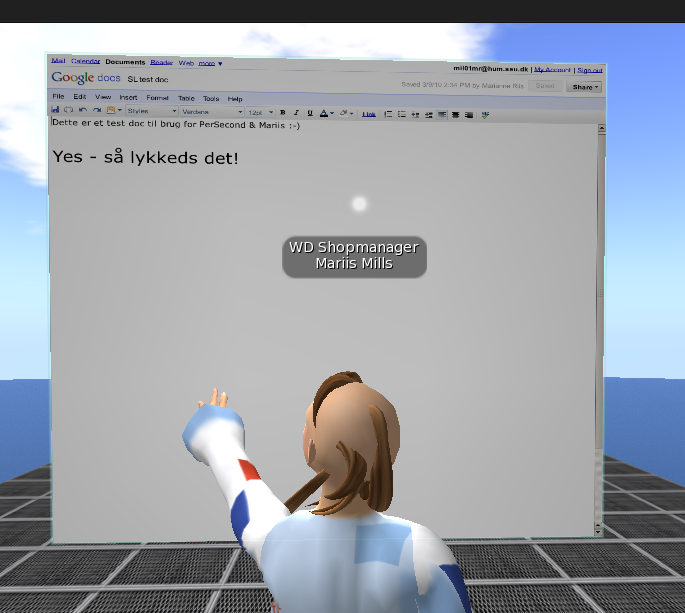
I’m hoping the problems I experience won’t influence our test later tonight, so that I can get back to our experimentation in a future post …
/Mariis
*) I did read Gwyneth’s excellent post on improving Mac performance, but I can’t force Texture Memory beyond 128, and GL tot stays at 67/192 … so I’m thinking it may be a) a PICNIC error or b) my (still) malfunctioning Mac :-(
After more than a month of computer problems, incl. malfunctioning OS, lack of permissions, ruined logic board, slow support and lots of frustration I’ve been reinstalling programmes, applications and services, incl. Twitter. I’ve actually had a Twitter profile for quite some time, but I’ve been reluctant to use it – not sure why, when and how? But yesterday, as I logged in to check my account, I noticed a lot of buzz concerning a live-streamed event – TEDxNYED – and since the list of speakers seemed interesting, I decided to hang around. As it turned out to be a very interesting learning experience, I thought I’d use this post to reflect a bit on my newbie impressions …
Why use Twitter?
Well, the jury is still out on that question. My main concern is whether I really need more information? It may seem a bit strange, but I’m already experiencing some information overload from existing mail lists, the blogsphere and my other networks. At this point in time in my PhD-project I really should be aiming at convergence, but on the other hand the constant drawback of living in a connected, digital world is the fear of missing out on important information. As always information management is key and I’ll return to that. Even though I’m a newbie, I have of course been listening in on colleagues’ discussions and research, comments in the media and especially in the blogsphere etc., but I have to admit that it wasn’t until yesterday’s experience that the use of Twitter became valuable to me, which leads to the next question.
When to use Twitter?
In yesterday’s event it was possible to use Twitter and Facebook as backchannels during the live-steamed presentations. Despite newbie problems trying to figure out exactly “how to” and also some language constraints (Twitter and general Anglo-American idioms and lingo), I did find the Twitter chat valuable. I’m familiar with the backchannel phenomenon from SL, where especially the Metanomics show makes really good use of the backchat (via the so-called chatbridge) to democratize and expand the discussions, and in my PhD I’m focusing on promoting this particular way of communicating in my in-world teaching sessions. Now, I’m not sure if yesterday’s speakers actually followed the Twitter chat real time (they seemed to focus on the local f2f audience), but after the presentations several of the speakers continued discussing and elaborating, and as I understood from experienced Tweeters this is common practice. George Siemens (one of yesterdays speakers) wrote an interesting piece on “frustrating (= non-participative, non-sustainable) conferences” and together with Tittenberger and Anderson, he wrote an article on how to improve live participation and sustainability of conferences – and yesterday was the first time I had a really good experience with this (outside SL) thanks to Twitter. There can of course also be disadvantages to this backchannel phenomenon as expressed and experienced by Danah Boyd in this much debated post, but I did see an interesting potential and I’m sure I’ll be logging in to Twitter for future events.
However, I’m not so sure that I’ll start using Twitter on a daily basis – at least not for now. I definitely need to learn more about the many possibilities, so for a while I’ll settle for being a lurking participant in the periphery until I get a better feel for the many accompanying tools one can choose to use in relation to Twitter, and that leads to the final question.
How to use Twitter?
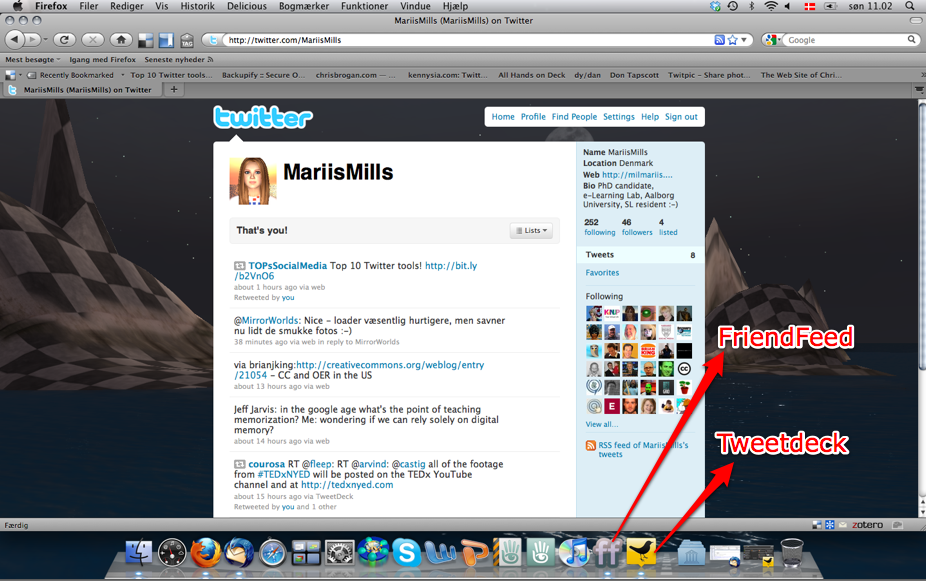
Evidently writing a max. of 140 characters is not complicated – it’s the management/storage of information that can be a little tricky, not least because there are so many different accompanying tools to choose from. When I started out yesterday, I already had FriendFeed installed and I like that probably because I’m used to pop-ups from my Thunderbird mail.
During the event I started following more people, and when my SL/FB friend BevanWhitfield noticed me, she quickly recommended Tweetdeck, but also mentioned that I should be careful in joining too many groups. And so I installed Tweetdeck, but it’s a much more complex tool than FriendFeed. I had a look at SIGs related to e-learning and there were soo many! And which one do you choose then? Another friend of mine made a “mention” in Tweetdeck and I wasn’t sure how to reply. A nice feature was the ability to synchronize with other accounts such as FB, but here I’m wondering if that’s really what I want to do. There’s bound to be a lot of redundancy, and I need to figure out how to handle that.
In sorting the information hashtags (#) seem to be part of the solution, but this is also something I need to learn more about. My SL/FB friend, ldinstl_chimera, pointed my attention to Backupify, which may turn out to be a great service for storage and management, whereas Arielion Clawtooth, mentioned Twapperkeeper, so there are plenty of new things to figure out. Incidentally, today TOPsSocialMedia tweeted a list of top 10 Twitter tools.
So to summarize my first impressions; it was fun, engaging and somewhat confusing and overwhelming – just as one would expect a newbie experience to be :-)
/Mariis
As previously described I’ll be using my Connective Model for ICT-remediated Didactic Design for the general analysis of my PhD data. A first step in this process is working with the 9 basic elements in the model and in this post I’ll focus on some preliminary work I’ve done on the element of Evaluation as depicted in the model below.

Given that definitions shape the way we think about and practice particular phenomena the very act of defining something should not be done without prudence. I’m quite confident that working with the different elements in the model will refine the way I’ll end up describing them, so for now I settle for working definitions and as such I’ve found inspiration in UNESCO’s definition of Evaluation and after modifying it so that it fits better into my study field of Didactic Design it would read as follows:
Evaluation means arriving at a value judgment on the basis of measures (qualitative or quantitative) considered to be valid and reliable, which compare the actual results of a Didactic Design with its anticipated results.
The element of Evaluation is to some degree connected to all the other elements, but according to the working definition there is a particular strong connection to the element of Goals, since this is where we can derive the criteria for evaluating the results. When dealing with Didactic Design there will always be a least two major perspectives from which we can look upon certain elements, namely the teaching perspective and the learning perspective, and in what follows I’ll present some initial reflections on the particular part of evaluation that concerns the evaluation of learning outcome/results. To do so I want to dwell a bit on the concept of Literacy, which I consider to be vital when discussing the purpose and goals of especially formal education.
In its most narrow sense literacy refers to the ability to read and write, but used as a more general concept literacy refers to being knowledgeable or educated within a particular field. In an interesting UNESCO report on the plurality of literacy and the concept’s connection to the right to education as stated in article 26 of The Universal Declaration of Human Rights of 1948, the evolving notion of literacy is discussed and defined: “Literacy is the ability to identify, understand, interpret, create, communicate and compute, using printed and written materials associated with varying contexts. Literacy involves a continuum of learning in enabling individuals to achieve their goals, to develop their knowledge and potential, and to participate fully in their community and wider society.” (UNESCO.2004:13). Above all the plurality of literacy refers to the many fields in which literacy can be employed – specific literacies denominated by prefixes such as information, computer or media to name a few.
In my research on literacy I recently came across a very interesting article in First Monday that explores the concept of Transliteracy, which the authors Thomas; Joseph; Laccetti; Manson; Mills; Perril & Pullinger. 2007 define like this:
Transliteracy is the ability to read, write and interact across a range of platforms, tools and media from signing and orality through handwriting, print, TV, radio and film, to digital social networks. (Thomas et al. 2007)
What interests me the most is actually not the definition, but rather the idea and purpose of developing some sort of meta-literacy concept. According to the authors Transliteracy can be characterized as:
Based on these characteristics I would interpret Transliteracy as a meta-literacy and I do find the characteristics both relevant and much needed in trying to define some sort of unifying literacy. The authors describe their work with the concept as a work in progress and “a good example of open source thinking between diverse collaborators” and they encourage further discussion and development of the concept. First author, Sue Thomas and her co-writers are all involved in the Production and Research in Transliteracy (PART) Group at the Institute of Creative Technologies (IOCT) at De Montfort University, UK and they’ll be hosting a conference on Transliteracy on February 9th 2010, which can be followed via several social media. In the video lecture below Sue Thomas explains the concept of Transliteracy based on the above mentioned article:
Returning to my interest in Literacy and especially new forms of literacy, I believe that there is a strong need to consider and develop new ways/methods of evaluation of learning outcome – not least when the learning processes and products have been facilitated by ICT-remediated Didactic Design. In this process of developing new evaluation methods, I think concepts like Transliteracy can prove quite valuable in giving indications of what criteria to focus on. Especially in Academia we seem to be stuck in using evaluation criteria and methods based on traditional literacy giving primacy to old media and modalities. Quoting Yancey. 2004: 90 “we use the frameworks and processes of one medium to assign value and to interpret work in a different medium”, which obviously is not the most appropriate way of accommodating the use of multiple and/or new media. In my third research cycle in the MIL case, I experimented with both criteria and methods of evaluation, and the results from this experiment will form the basis of a forthcoming post on evaluation of new media productions/compositions…
/Mariis
 Mariis' digitale refleksioner