Amplifying student engagement through design

To date I’ve completed two research cycles in my PhD, and both cycles were conducted within a specific course at The Masterprogramme on Ict and Learning (MIL). The course is entitled “Ict and Didactic Design” and basically the students are asked to analyze, assess and reflect upon the teaching and learning potential of SL. In order to do so, we ask the students to focus on five mandatory topics; Didactics and target groups, Orientation and navigation, Interactivity, Learning processes and Audio-visual elements.

The students are expected to discuss these topics asynchronously in our main virtual teaching and learning environment, FirstClass® (FC) and during synchronous in-world activities (typically lasting between 1-3 hrs.). So far I’ve spent most of my time reflecting on the use of SL, but since I’m investigating SL as a supplement and not as stand-alone environment in my PhD, I’ve now been looking a bit at the use of FC in the two research cycles. I’ll start with a brief description of the two cycles.
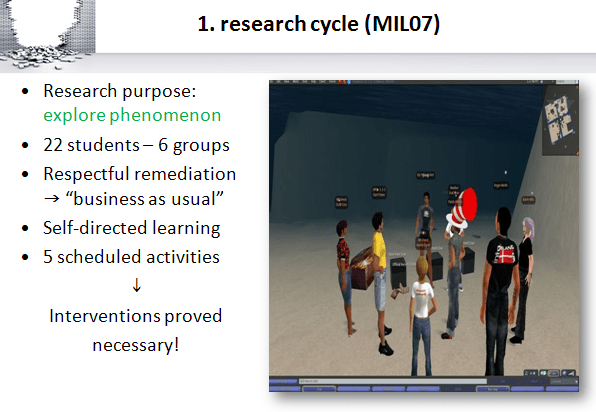
FirstCycle

I was rezzed as Mariis Mills in March 2007, and I conducted the first research cycle about half a year later. The main purpose of the first cycle was to explore SL as phenomenon in order to understand this media’s potential as teaching and learning environment.  Several studies conducted at MIL (Dircknink-Holmfeld.2002; Dirckinck-Holmfeld et al. 2004; Sorensen & Takle. 2005) indicate that the majority of our students participate in one or several communities of practice, CoP (Wenger. 1998) during the masterprogramme, and I also wanted to observe what would happen to these CoP’s as a consequence of remediating into SL.
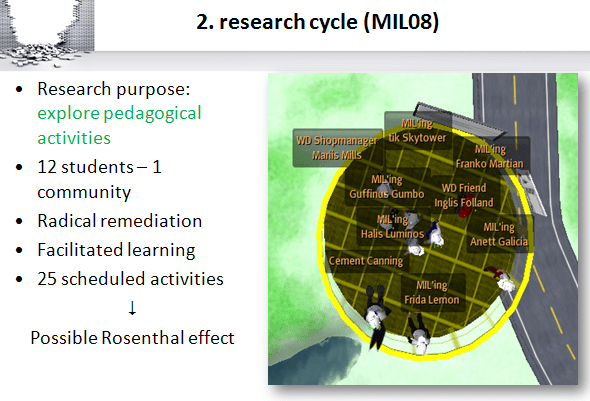
SecondCycle

The second research cycle was conducted in the Fall 2008. Based on the findings from the first cycle and additional experience and research the course was redesigned in several ways.  Even though the first cycle confirmed the presence of CoP’s, I decided to try to enhance the community creation and feeling by asking the students to work as one entity instead of working in their usual smaller study groups. I also changed my own role from being a somewhat distant observer to a fully engaged participant and facilitator. In the first research cycle there were only 5 scheduled activities, but in the second cycle I decided to focus on many different pedagogical activities resulting in a total of 25 (this post further elaborates on these activities).

Apart from the changes mentioned above, I also decided to change the design (and thus expected use) of the FC setting. As stated by Nyvang, Tolsby & Dirckinck-Holmfeld (2004) VLEs/LMS’ and other systems we use for teaching and learning are never neutral in the sense that they always convey some underpinning pedagogical philosophy. And like physical buildings these systems can be designed more or less optimal to support different types of teaching and learning processes.  In FC the user is able to see a tree structure of the way we’ve organized the many conferences in the left side of the screen, and for many users this tree structure provides an overview. The picture below shows the tree structure as it appeared in the two cycles:

MIL07-08_TreeStructures

The SL course is part of the first course (m4c1) in the 4th module and as such it would be found below the main conference for that module. In this first course the students can choose either SL (3D world) or Global Conflicts (3D game) as analytical objects. Traditionally the students work in small study groups (K-gruppe). In the MIL07 case the conferences for the students’ groups were placed directly below the main course conference (used by all students and the teachers for communication regarding the course in general), while the two conferences for more specific communication regarding the analytical objects were placed in the bottom of the tree structure. A tentative interpretation of this structure would put emphasis on the study groups, which for many students probably made perfect sense, since it was in these group conferences their main activities were supposed to take place. At a glance this structure did not however indicate which groups were working with SL respectively GC. Though working in separate groups many MIL students appreciated following the work of their fellow students and they proposed that we designed for a better overview over the groups’ interests in the future.

So in the MIL08 case we decided to place the study group conferences below the two conferences for the analytical objects, which also meant that the GC and SL conferences moved up in the hierarchical tree structure – perhaps putting more emphasis on the subject matter? There was another major difference, namely that I decided that the students who chose SL should work in one large group/as a community meaning that the 12 SL students were not assigned separate group conferences. In ‘07 there was only one conference dedicated to SL and this proved to be inappropriate since we used that one conference for all SL related communication including meeting information, literature upload, small talk etc. making it very difficult to locate specific information as the course progressed. Thus in the MIL08 case I created several sub-conferences each dedicated to specific topics and types of information. I also utilized different icons to indicate the differences between these conferences and when the student clicked on the main SL conference he/she would get an overview of all these affiliated conferences as show in the right side of the picture above.

As mentioned before the tree structure in FC is shown in the left side of the user’s screen. In the right side the same information is presented in a different way/view. In the MIL07 case the right side could look like this:

MIL07_FCactivity_area

and in the MIL08 case it could look like this:

MIL08_FCactivity_area

Apart from the aesthetic perspective which I’ll leave for the reader to assess, I do think that the MIL08 design provides a much better overview. The red circles point to the main activity areas  – in MIL07 in the study groups, in MIL08 in the topic conferences. The ’08 students did not place any of their postings in the “Interactivity” conference. Nonetheless they did discuss interactivity quite vividly, but as they explained, they often found the separation of topics somewhat artificial, and this may be something I need to design differently in the next research cycle (Fall 2009).

Anyway, my purpose in this post is to investigate whether the design made a difference in the way the students used FC. In both cycles the students were asked to post a minimum of 3 postings in order to pass the course. The majority of MIL students are part-time students, full-time employed and actively engaged in other life activities. Even so MIL students are renowned for their very high engagement and activity level. In the table below I’ve compared some data from the two cycles:
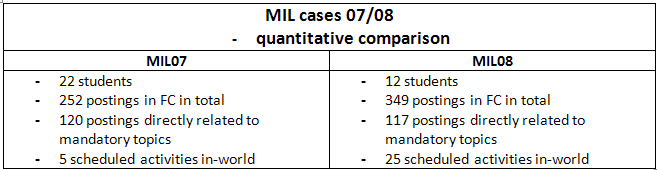
MILcasesQD

My involvement in the topics discussions was quite similar in the two cycles, and already back in 2007 I was highly impressed by the students’ engagement and level of activity, but as you can see the engagement of the MIL08 students was extraordinary in all aspects. Bear in mind that besides participation in numerous online activities the students also need to find time to study the mandatory course literature!  All students passed both courses, but in each cycle 1-2 students were asked to elaborate on their findings/reflections in order to pass. The quality of the students’ discussions was high in both courses, but it was quite clear that the MIL08 students’ postings were more informed with regards to SL.

I’m quite confident that the amplified engagement, level of activity and quality in the MIL08 case stems from a combination of redesigns, but as FC is part of the collected teaching and learning environment, I do believe that careful consideration and design of the FC structure is an important part of the whole design puzzle and as such should be given appropriate attention.

/Mariis

References

Dirckinck-Holmfeld, L. (2002): CSCL – Computer Supported Collaborative Learning – Projektpædagogiske læringsformer i virtuelle omgivelser. IN: Uddannelse, læring og It. 26 forskere og praktikere gør status på området. IN: Undervisningsministeriet. http://pub.uvm.dk/2002/uddannelse/5.html

Dirckinck-Holmfeld, L., Sorensen, E.K., Ryberg, T., Buus, L. (2004). A Theoretical Framework for Designing Online Master Communities of Practice. IN: Proceedings of the 4th Networked Learning Conference.

Nyvang, T., Tolsby, H. & Dirckinck-Holmfeld, L. (2004): E-læringssystemer og projektpædagogik – pædagogikkens krav til systemdesign og funktionalitet. IN: Georgsen, M. & Bennedsen, J. (ed.): Fleksibel læring og undervisning – erfaringer, konsekvenser og muligheder med ikt, s. 207-238. Aalborg Universitetsforlag.

Sorensen, E.K. & Takle, E.S. (2005). Investigating knowledge building dialogues in networked communities of practice. A collaborative learning endeavour across cultures. IN: Interactive Educational Multimedia, No.10.

Wenger, E. (1998). Communities of Practice. Learning, Meaning, and Identity. Cambridge University Press.
“Dialogic Spaces” – Dialogic Education and Research Group

On Monday June 22nd I had the pleasure of participating in the first meeting in a study group “Dialogic Spaces” aimed at exploring dialogue from various perspectives within educational research and practice. The group was initiated by Assistant Professor, PhD Thorkild Hanghøj and several of his colleagues all from Dept. of Curriculum research at the Danish School of Education. Thorkild specializes in educational gaming and will incidentially join me at the Master in ICT and Learning (MIL) in the fall in our ICT and Educational Design module. Coming from Aalborg University’s Dept. of Communication I’m very happy to get the opportunity to collaborate with this group of researchers who all have such very strong foci on educational research. Besides Thorkild the following people are part of the group:

  • Lars Birch AndreasenE-learning; netbased education; virtual learning environments, Netmediated communication and collaboration.
  • Lisbeth FrølundeMultimodality theory and visual culture, Design and development of digital learning and play materials.
  • Jeppe BundsgaardEducational Theory and Curriculum in relation to the Danish Subject and Information Technology, Critical Discourse Analysis.
  • Mads HaugstedMother tongue and didactics; verbal communication, colloquial language, speech skill.
  • Christian Brund – just started as a PhD Candidate with a project on the role of the teacher in relation to educational gaming … no link yet

Together we cover a wide range of research interests but with the concept Dialogic we have found a common denominator.  Dialogic is most commonly attributed to the work of the Russian philosopher, literary critic and scholar, Mikhail Mikhailovich Bakhtin and though his work will play an important role in our endeavors it isn’t an exclusive Bakhtinian group.  We spent our first meeting stating our interests in using Dialogic perspectives, defined the organization and goals of the group and finally discussed a couple of papers (Dysthe. 2006 & Wegerif. 2006) both focusing on the use of Bakhtin in educational research. So far we’ve decided to meet f2f once a month in the fall primarily to discuss literature hoping that these dialogues! will inspire all of us in our future work. Further down the line we hope to be able to hold public seminars and finally write an anthology covering especially, but not exclusively  Scandinavian Dialogic perspectives within educational research and practice which also means that we will invite international colleagues to come join us.

I was first introduced to Bakhtin in the early 90’ies when I studied literature for three years, but it has been years since I actually used his ideas and concepts more explicitly. In spite of this, I do find the Dialogic perspective interesting on multiple levels in relation to my current PhD research:

  • Ontological level – according to Bakhtin living is participating in an ongoing dialogue and I couldn’t agree more. Accepting dialogue as ontological premise naturally influences the main purpose and the main processes of education; empowerment as preparation for and – as it is the case in HE/FE –  continuation of democratic, participatory citizenship. This way of thinking and practicing education very much aligns with a Scandinavian approach to both education and research in general and with exploration of new social media in particular (e.g. Rheingold. 2008 on Participative Pedagogy for a Literacy of Literacies).
  • Epistemological level – as a consequence of the ontology it is through dialogue with both ourselves and the surrounding world that we’re able to create meaning. Thus, as educators we need to focus on teaching students how to engage in the dialogues through which knowledge is constantly being constructed, deconstructed and reconstructed (Wegerif. 2006:60). It’s also worth noticing that if we accept the dialogic premise, the main mechanism for learning is taking the perspective of another in a dialogue (ibid:64)!
  • Methodological level– up until now I’ve been reluctant to coin my methodological approach, usually just stating that I’m applying some sort of Action Research. However, I recently decided to try to apply and further develop a methodology called Dialogue Design which was developed by three of my colleagues from the MIL steering committee, Janni Nielsen, Lone Dirckinck-Holmfeld and Oluf Danielsen (2003) back in the late 90’ies in relation to a large European research and development project on Multimedia and Network in Co-operative Research and Learning (MANICORAL). This particular methodology, based on different types of Action Research, puts forward dialogue and mutual learning as guiding principles.  Dirckinck-Holmfeld and Nielsen are also my PhD supervisors, and I will be spending most of the fall with Nielsen at Copenhagen Business School focusing on this part of my PhD work.
  • Didactic/pedagogical level – as teaching and learning space SL offers many possibilities of engaging in dialogic activities. Communicating simultaneously via both text and voice, incl. via avatar (as embodiment) and context are probably the affordances I currently find most interesting and I anticipate Bakhtin’s polyphony concept and his ideas on intertextuality (both in multimodal variations) will be useful in my attempt to theorize/analyze and design for such phenomena.

In applying a Dialogic perspective on my PhD I’ve got a sense of coming full circle and I’m really looking forward to an inspiring fall with extended readings and lots of dialogue … yeah :-) It also means that I’m in the process of editing my PhD page here on the blog … it’ll be back sometime during the summer.

/Mariis

References

Dysthe, O. (2006): Bakhtin og pedagogikken – Kva ein tidlegare ukjend artikkel fortel om Bakhtins pedagogiske praksis. IN: Norsk Pedagogisk Tidsskrift. 06/2006

Nielsen, J.; Dirckinck-Holmfeld, L. & Danielsen, O. (2003): Dialogue Design – with Mutual Learning as Guiding Principle. IN: International Journal of Human-Computer-Interaction. 15(1)

Wegerif, R. (2006): Dialogic education: what it is and why do we need it? IN: Education Review, vol. 19, no 2.

BTW

Stephen Downes recently directed my attention to a post on Streams vs. Blogs written by Jay Cross. In this post Cross reflects on blogs stating that:

Blogs are author-centric in a world that’s increasingly about relationships. Blogs are slanted toward me, me, me, me, me; the net is inexorably moving to us, us, us, us, us. Dialog trumps monolog.

While I do agree that some blogs tend to be very author-centric the few blogs/bloggers I chose to follow on a regular basis are highly Dialogic in my point of view. Adapting a Bakhtinian view engaging in dialogue with oneself can be very fruitful and furthermore the very nature of blogs (the intertextuality and the multiple voices coming forward through extensive linking) exemplifies a connected perspective on relationships and dialogue in a networked world.  The mere fact that I learned about Cross’ post via Downes shows my point. Granted that the premises for dialogue have changed dramatically, it still is dialogue to me … Nonetheless, I do agree with Cross that new services gradually will change the way we communicate, but like Downes I will not stop blogging any time soon – it’s just one way of communicating among others ;-)

Community of Inquiry (COI) in Virtual Worlds study

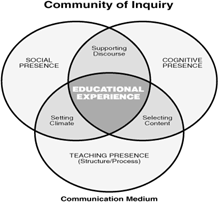
Early this spring Ross McKerlich, Terry Anderson & Brad Eastman invited me to participate in a research study on the usefulness of the Community of Inquiry (COI) model as evaluation tool in virtual worlds. Originally the COI model was developed in the late 1990’ies as framework for evaluating educational experience in text-based online environments by D. Randy Garrison, Terry Anderson and Walther Archer:

Central to the study introduced here is a model of community inquiry that constitutes three elements essential to an educational transaction – cognitive presence, social presence, and teaching presence. Indicators (key words/phrases) for each of the three elements emerged from the analysis of computer conferencing transcripts. The indicators described represent a template or tool for researchers to analyze written transcripts as well as a guide to educators for the optimal use of computer conferencing as a medium to facilitate an educational transaction.

communitymodel_small(COI website)

The COI model was developed as part of a Canadian Social Sciences and Humanities research funded project entitled “A Study of the Characteristics and Qualities of Text-Based Computer Conferencing for Educational Purposes”. Further details on that project, including papers describing the theoretical and methodological underpinnings of the model can be found on the COI website.

Given the COI model’s wide spread use in different educational settings it is by no means coincidental that one of the original founders, Terry Anderson, has found it important to explore the applicability of the model in new immersive environments such as the 3D virtual world, Second Life (SL). Together with McKerlich Anderson conducted a preliminary, qualitative exploratory study in SL in 2007 and basically confirmed that the model also can be used in assessing educational experience in immersive environments (McKerlich & Anderson. 2007).  Not unexpectedly, they did however also find that some adjustments would be appropriate – e.g. extending categories demonstrating social presence. This 2007 study did not allow for the authors to examine methodological issues such as validation deeply. Furthermore McKerlich and Anderson found the phenomenological experience of both learners and teachers would be worth further investigation.

Based on these preliminary findings, McKerlich and Anderson now together with Brad Eastman have initiated a new more quantitative oriented study – and this is also the study I’ve been invited to participate in. Unfortunately, I’ve not been able to contribute with very much so far due to a longer personal leave of absence from my work in general.  Nevertheless, during my absence they have successfully finished the work on developing an evaluation tool – in the shape of a survey intended for students with educational experience in immersive environments – based on original and new indicators of respectively social, cognitive and teaching presence.  The tool was publicly launched last week on several mailing lists relevant for educators using immersive worlds and the data have started to accumulate. We would of course like as many answers as possible though, so if this has caught your interest please have a look at the survey here.

Further down the line we’ll start processing the data and evaluate the tool – also by conducting in-world observations. Participation in this kind of study is quite exciting but also very challenging for me coming from a highly qualitative oriented research background. But I’m also pretty sure that I’ll learn a lot and that we’ll have some interesting discussions :-)

/Mariis

Lessons learned from presenting SL via SL

UNINETT2009

Thursday June 11th  a former MIL student, Cecilie Aurvoll had invited me to present my SL project at the UNINETT 2009 conference in Norway. Unfortunately I was unable to attend IRL, so we decided that I should do my presentation from within SL.

Obviously to make such a presentation you need an on-site mediator who’ll be able to log in-world and interact/communicate so that the audience gets an impression of the real time possibilities and challenges.  It was the second time I presented SL at a conference in this way and even though I think it it’s a good idea, I also think it’s easier said than done – at least I’ve learned a few valuable lessons.

The first time I did this kind of presentation one of my students, who together with the rest of his group had been studying SL for several months and therefore had quite a lot experience with SL and its functionality, acted as mediator. During this session we had an ongoing voice conversation and I knew that I could easily direct/instruct him (e.g. ask him to interact with objects) and just in general ask him to show the audience different things on his screen. The in-world locations we visited were places where the student and I had been before and he instinctively knew where to place his avatar and how to use his camera for the audience to get the best view.  From the feedback we got on this session it was evident that especially the ongoing voice conversation and the interaction between our avatars and in-world objects left the audience with a reasonable impression of SL.

The scenario for the second presentation at the UNINETT conference was somewhat different. The mediator was a local technician whom I didn’t know but only met shortly in-world the day before where he told me that his experience with SL was limited. This is by no means a critique of his work during the session – I actually thought he did very well, but there were some differences compared to the first session.  During the session we were accompanied by Cecilie and one of her friends, and since they both were located in different RL locations I hope we managed to show how SL can be used as an alternative to more conventional meeting tools. However, because I was unsure of the mediators ability to use different functionalities I hardly asked him to do anything, which in hindsight made his interaction (projected to the audience) rather passive. Ideally the session could have been rehearsed in real time beforehand but how often is that realistic? I’d made a manuscript, including landmarks and points to be aware of for both sessions, and for future presentations it probably would be a good idea to share this with the mediator in advance instead of just verbally expressing my intentions.

Another difference was related to the communication. Not entirely certain that I would be able to understand all their Norwegian I’d recommended that they communicated mainly by text, while I used voice. I also thought it would be interesting to show how the voice-text combination usually works very well. Voice presentations with texting audience are common in-world, I’ve attended many such sessions and so far I’ve found it to be both satisfactory and engaging.  I did forget one crucial point though; the difference in perception when you’re immersed respectively nonimmersed. When I watch the recording of the session it strikes me as being pretty boring listening to my avatar talking, while text pops up occasionally on the screen. From the view of the outsider it almost comes across as traditional one-way communication – at least that’s my sentiment and even though I don’t know how the audience perceived it, I would recommend mutual voice in the future.

Despite these challenges I do find this way of presenting SL to be a viable alternative when RL presentation isn’t an option – I still just have a lot to learn ;-)  In fact I think presenting SL via SL often is better than flat 2D presentations, but it depends on the purpose and it is a different story …

/Mariis

BTW; for those who understand Norwegian, Cecilie and her colleague, Kristine Sevik wrote an interesting article on the educational potential of Virtual Worlds for the conference.

April Blog-o-the-Month nominee :-)

During the night I received the following message from fellow SL resident, Scottmerrick Oh:

Hey Mariis, congrats on your nomination for the April Blog-o-the-Month at the ISTE Island Blogger’s Hut! There’s voting all the merry month of March there so encourage all your virtual pals to go vote! Also feel free to grab the “Nominated” graphic at Oh!VirtualLearning! (http://scottsecondlife.blogspot.com) and post it if you will, or just sit back and see how the masses vote! Cheers, and thanks for the wonderful blog!

I’ve absolutely no idea who nominated my blog, but I think it’s a honor to be nominated by peers, and whoever it is; TY – at this point in time this kind of appreciation was really welcome :-)

You can check out April month’s other nominees at Scott’s blog – and if you wish to participate in the vote follow this link to The Blogger’s Hut on ISTE Island.

iste-blog-hut

/Mariis