3D remediation – people

As I continue my work with the model for 3D remediation strategies, I’ve decided to replace the numbers in the four quadrants with indicators of the four corners of the world thinking they don’t imply a fixed sequence in the same way as numbers or letters tend to do. Having done this, I’ve also abandoned the idea of merging my model with Kolb’s learning cycle. Though I do believe that Kolb’s model has been subject to misinterpretations over the years, I’m not interested in forcing one specific learning theory upon my model. Indeed, I think one of the major affordances of 3D user generated VW, as compared to conventional proprietary 2D CMS/LMS/VLE, is the fact that you can design for teaching and learning based on any theoretical foundation. Diversity and countless possibilities are keywords in platforms like SL and with my model I aim at showing this diversity. When you first enter SL it appears to be pretty uniform with lots of beautiful Barbie-Ken-avatars and by and large respectfully remediated places, which unfortunately also is the way the official Linden Lab prefers to promote SL, but there is so much more to this wonderful world …

In connection with my analytical unit, People I’ve identified four archetypical ways of customizing the avatar:

  • Avatar as Real Life-human – respectfully remediated based on an augmented approach.
  • Avatar as Non-human – respectfully remediated based on an immersive approach.
  • Avatar as Pseudo-human – radically remediated based on an augmented approach.
  • Avatar as Sentient object – radically remediated based on an immersive approach.

I’ve also identified a number of seeming dichotomies that one should be aware of when contemplating using SL for teaching and learning. With the addition of these elements in the red People’s sphere the model now look like this:
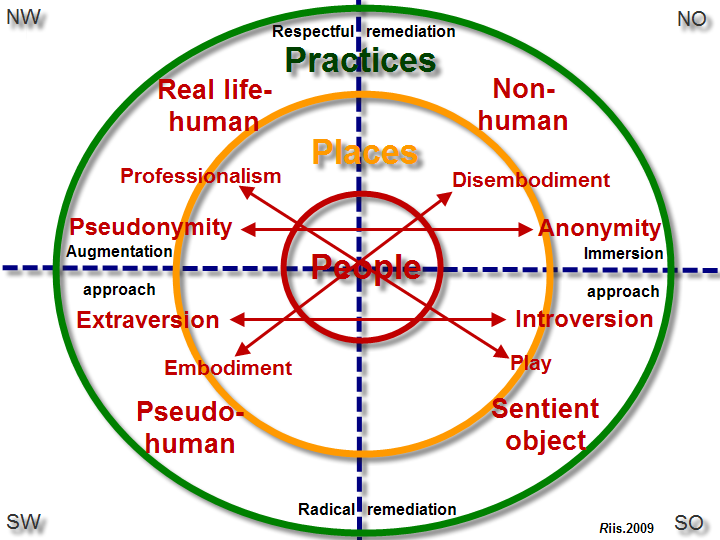
I don’t mean to imply that the possible tension between e.g. professionalism and play only occurs between the NW-SO corners – I believe this tension (as well as the other tensions) can be identified within the whole sphere. Being a work in progress I’m currently settling for identifying key elements  and placing them in the model, but if thorough investigations prove these elements to be relevant and viable I will improve the graphics.

As a preliminary demonstration of how the model can be used, I’ve identified four examples of the avatar types within my current research cycle, the MIL09 case:
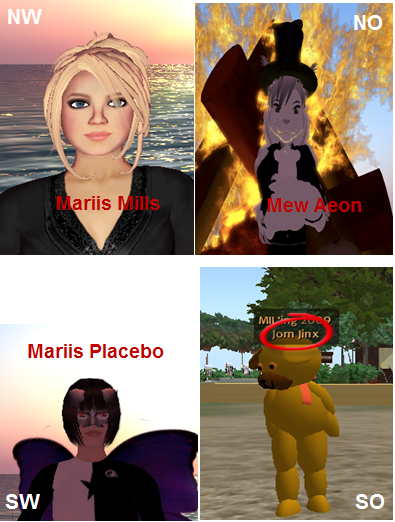
NW: Mariis Mills, my main avatar who is a respectful remediation of my real life person. Though I have to admit, that she looks both younger and cuter, I do sense that my students recognize her as a reflection of me.

NO: Mew Aeon
, my co-facilitator who at present chooses to represent himself as a cat because it goes well with his first name and playful nature.

SW: Mariis Placebo
, my main alt who is currently a humanoid super heroine with butterfly wings and special powers. I use her when I need to work undisturbed in-world and she’s also member of a number of groups that are only peripherally connected to my field of study.

SO: At a certain point MIL student, Jorn Jinx showed up as the – in Denmark – very famous teddy bear, Bamse. Though Bamse clearly is an object, it is usually referred to as a male persona and associated with the ability to feel and perceive subjectively.

I think the avatars above represent the more moderate examples of the four achetypes, but it will certainly be possible to identify more extreme cases as in this excellent interview moderated by Hydra Shaftoe (a wolf) for Nokia on the topic of Perceptions of Non-human avatars or as in this Orange Island Identity Summit, where e.g. qDot Bunnyhug is represented as a sentient rectangular box.

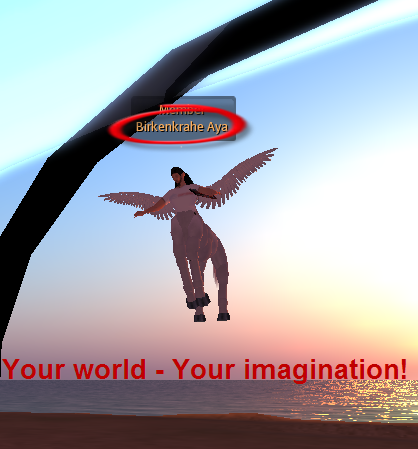
By definition a model is a simplified summary of reality designed to aid further study, and I really do not perceive the world of SL to be as simple, clear-cut and uncomplicated as the model may give the impression of. I do, however find it useful in trying to identify different aspects of possible remediation strategies. With a final example of an avatar remediation that fluctuates between Real life-human and Non-human I’ll finish this post with a photo of my centaur friend, Birkenkrahe:
/Mariis

Case MIL09: Didactic Design Discussion – 2

In the 2. Didactic Design Discussion in the MIL course I’d chosen to focus on some of the central points from my own PhD-project since it also deals with analysis of SL as teaching and learning environment. Discussing some of my own ideas with the students naturally is very inspiring and rewarding for me personally, but I’m also hoping (and sensing) that the students benefit from seeing my approach to the problem, and judging from the vivid discussion I do believe, I managed to challenge some of their presumptions. I’m not able to reproduce all of it, but I will try to highlight a few issues.

Essentially my PhD-project is aimed at improving Blended Learning within Higher and Further Education through remediation and redidactization. Through a process of designing and redesigning two specific Blended Learning courses within 6 research cycles the aim is to enhance learner experience and learning outcome by using new augmented/immersive 3D media and a learner centered Problem Based pedagogical approach. In both cases the target group is adult teachers/ trainers from the educational and the private/industrial sector from different countries.


PhD-project overview – Fall 2009

The concept remediation (in relation to new media) was coined by Jay David Bolter and Richard Grusin (2000), but there was no explicit value or quality identified with different ways of remediating in the original concept. However, Tringham, Mills and Ashley (2007) further developed the remediation concept in their Remediated Places Project and came up with two distinct strategies for remediation, respectively respectful and radical. In my point of view these two strategies can be extended to include pedagogical considerations and thus inform more general implementation strategies for blended teaching and learning using new media.

I first introduced the MIL students to the concepts of respectful and radical remediation in the course last fall and like this year’s students they immediately adopted the terminology. If you’ve ever been in SL you’d know why – it makes perfect sense to distinguish between the two both with regard to people, places and practices. The interesting question nonetheless is whether remediation changes anything in the way we think and practice teaching and learning …


Is a slide show presentation in SL an innovation?

According to Peter Denning an innovation can be defined as a transformation of practice in a group, community or culture – it is not enough just to come up with a brilliant idea or create a new artifact. Surely there are many different definitions of innovation, but I agree with Denning and it aligns very well with Wenger’s 1998 social theory on Communities of Practice, which is one of my core inspirations. Changing practice is easier said than done and Steven Warburton has identified 7 barriers to innovation in 3D environments like SL:

  • Technical – machine and human related [and standards related]
  • Identity – the tension between playfulness and professionalism
  • Culture – reading the codes and etiquette of SL
  • Collaboration – building trust
  • Time – even simple things take time 
  • Economic – nothing is for free
  • Design – perhaps this is a meta-barrier but SL does offer up very particular design challenges

Besides these I would add another meta-barrier, namely the inherent paradox between (re-)production and innovation that all participants in education are facing. This is what I call the didactic double bind. In general double bind is described as dilemmas in communication, and SL seems to be filled with conflicting messages. After the session one of the students posted this photo as her take on a in-world double bind:

The text for that photo could read: ”SL is an open environment. Join us if you can”. Naturally, the experienced SL resident would know that the dilemma in this particular situation is metaphorical – a shift in camera angle and you’d be there… the perspective on the situation would change and shifting perspective, looking at dilemmas at a higher level of abstraction is one way of solving double bind situations and would according to Bateson. 1972 mean learning at level III. And this is actually one of the reasons why I find SL so interesting – if we assume that the learner overcomes the initial difficulties and gets accustomed to the environment it provides rich opportunities for learning at higher levels, because SL inevitable challenges the learner both ontologically and epistemologically due to the whole meta-cognitive nature of the in-world experience.

After this we moved on to discuss the concepts of immersion and augmentation and what these two apparently conflicting ways of engaging in an environment like SL could mean – not least when it comes to teaching and learning practice. Again the students were eager to discuss and we covered a lot of important points on which I will return in a later posting. Suffice to say that we all agree with Tateru Nino on this:

It’s not all black and white.
The whole immersion versus augmentation debate is clouded by one trivial little detail. One is not the opposite of the other. The two aren’t even mutually exclusive.

We ended the session by trying out the Opinionater – it really is a very efficient and fun tool for stimulating discussions :-)

/Mariis

Experiments with Classroom settings

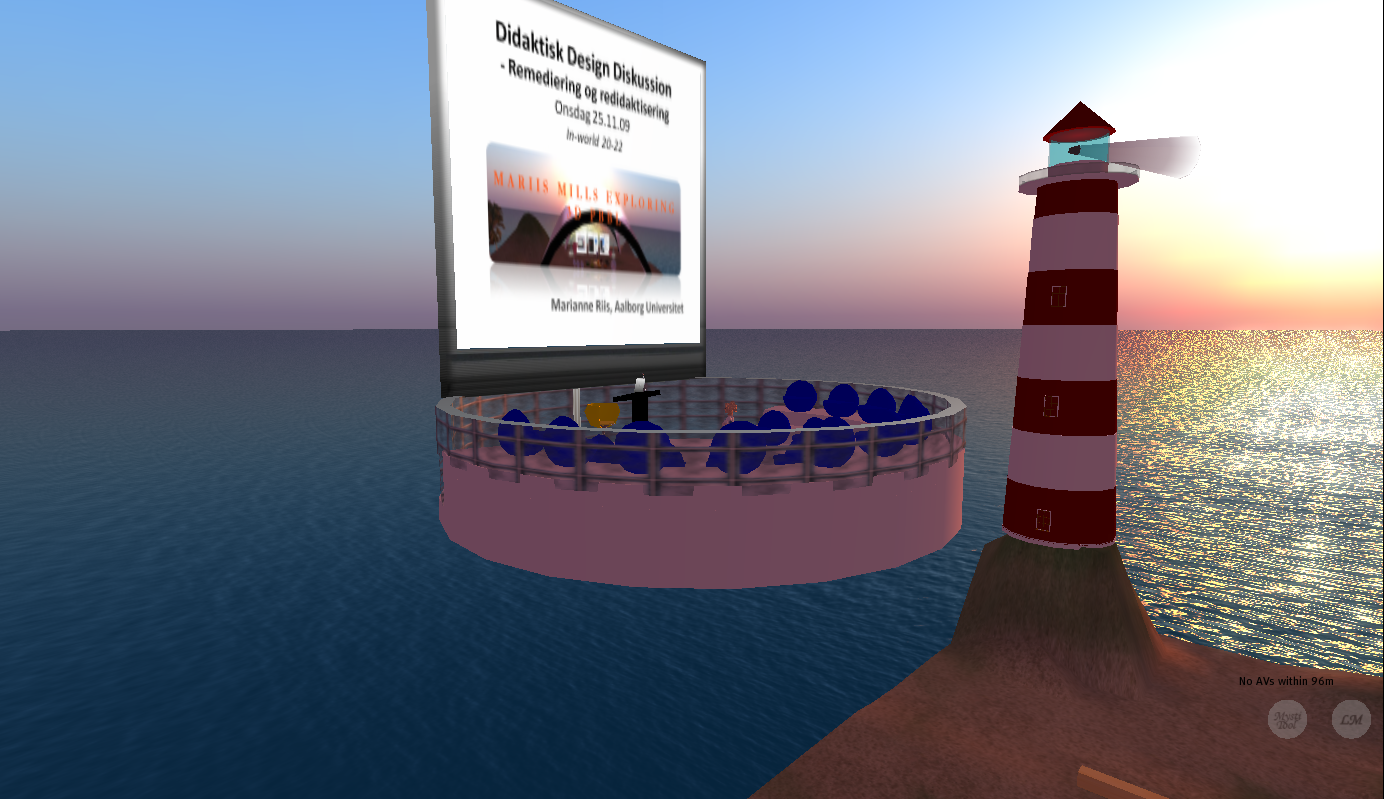
Due to technical difficulties on Wednesday, I decided to postpone our 2nd in-world Didactic Design Discussion to Sunday.  My co-facilitator, Mew is in charge of the 3rd discussion set for Monday, and since we’re both using the Zebra presenter and he has already set up our teaching and learning area for this, I decided to experiment with an alternative classroom setting up in the air over our sandbox.

Now, who would want to go to class RL or “in” a conventional web-conferencing system, when instead you can be in a beautiful place like this??


We’ll also experiment a bit with The Opinionater on Sunday, but I’ll wait with setting up that, since it does seem to steal the attention of the participants once it has been rezzed :-)

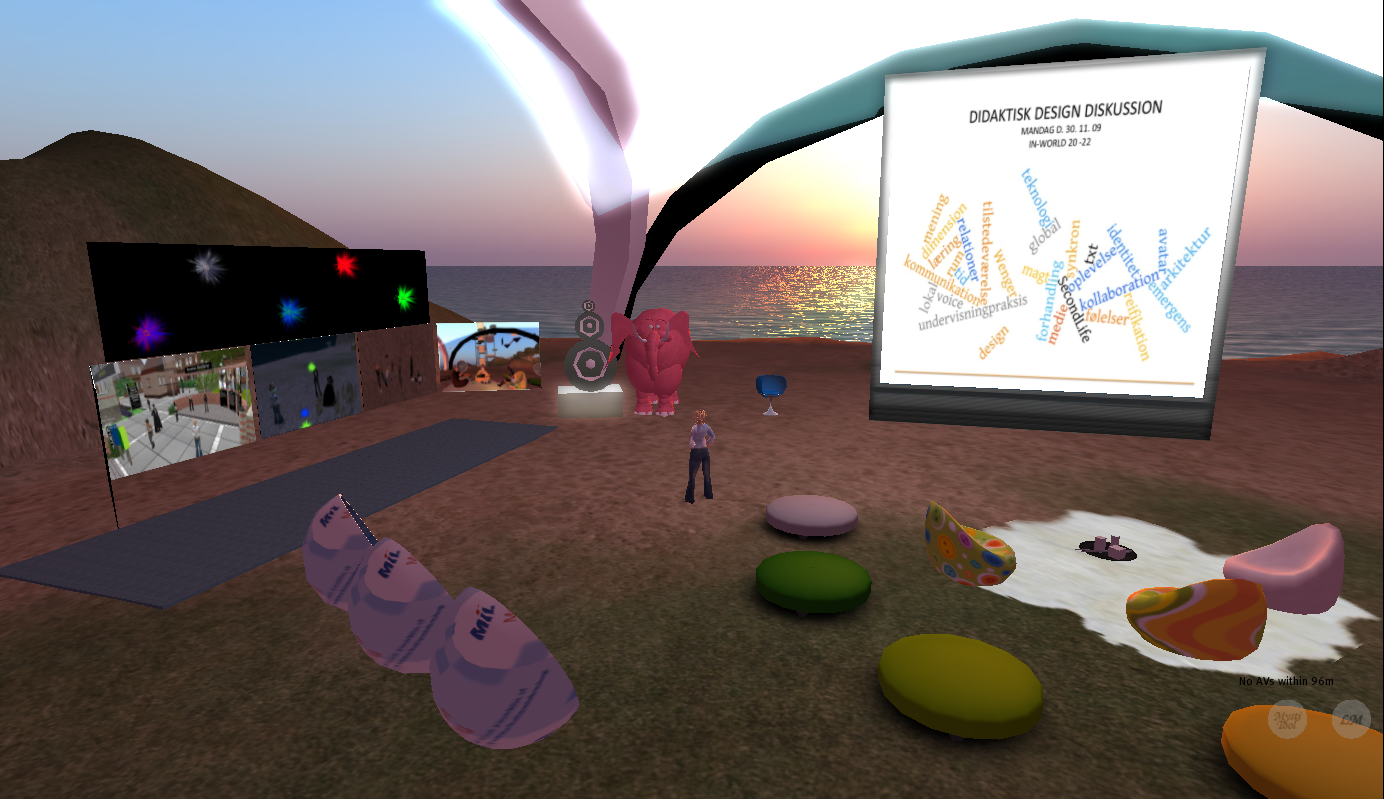
Mew likes to build and script and he has set up an interesting display for his discussion combining a conventional presentation with … well, something else :-) I’m not sure exactly what it is, but I’m looking forward to seeing it “in action” on Monday …

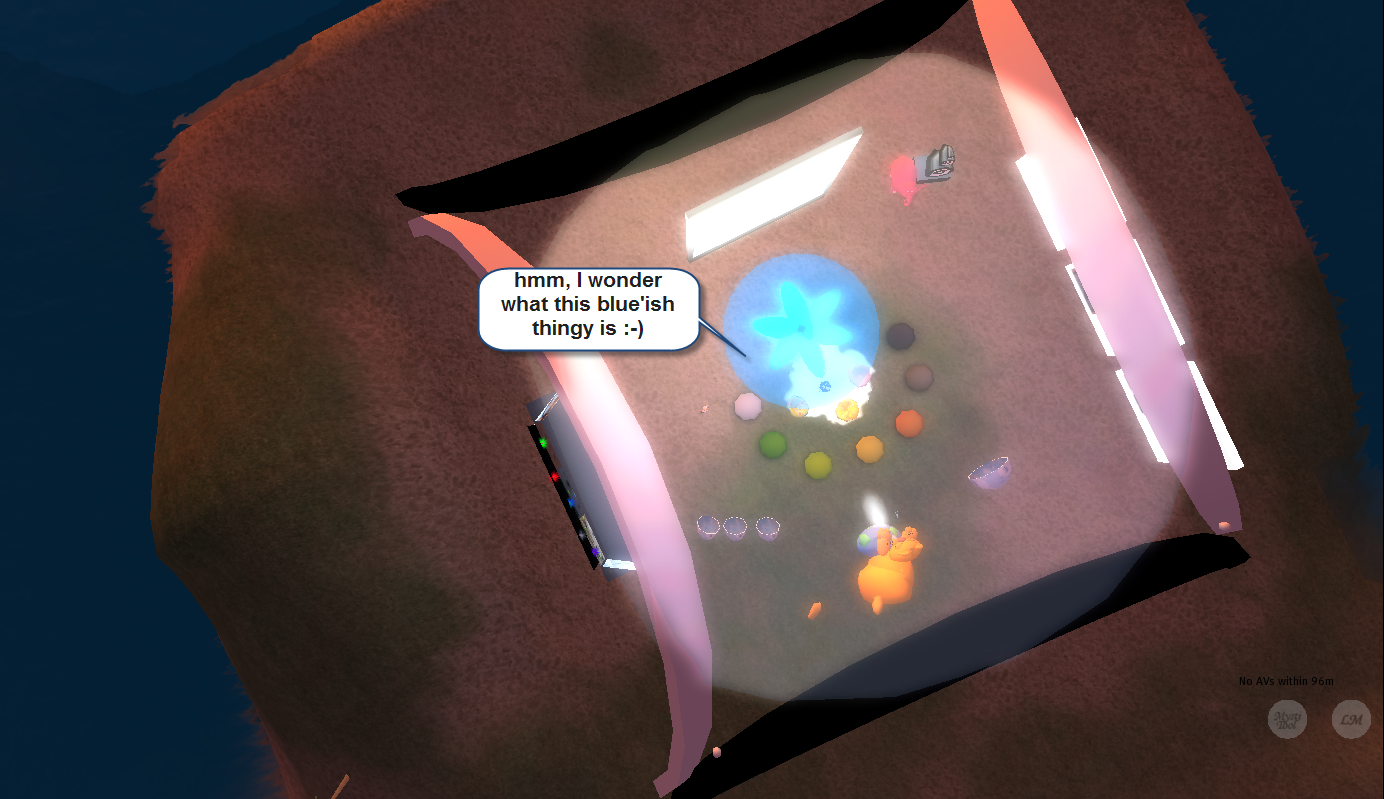
Mew also has some sort of a surprise in store for us up under the roof … very exciting!

More to come on this for sure …

/Mariis

Machinima seminar at Roskilde University

Thursday November 26th I participated in a seminar on Machinima organized by Professor, Sisse Siggaard Jensen and her research team in the Virtual Worlds Research Project.

Webmaster of Mirror World, Speedmaster Bing aka Jimmy Hansen RL started off by introducing to the phenomenon and showed us various examples of different genres of Machinima. It was the first time I met Speedmaster RL and it was great fun! Among the videos Speedmaster presented this was my absolute favorite – I have no idea who Pengin is, but I have to say that I’m a fan :-)

Vodpod videos no longer available.

Following Speemaster’s presentation we went in-word – via Doctor Asp‘s avatar – to meet Britta Pollmüller (Pigment Pye in-world), who is a Machinima artist and teaches in-world machinima classes at the Open University’s Schome Initiative. BTW Dianne Carr from Learning From Online Worlds; Teaching In Second Life – a research project at the London Knowledge Lab, Institute of Education, University of London funded by the Eduserv Foundation – did an interesting interview with Pollmüller.

After lunch we were joined by Hugh Hancock – Machinima pioneer and apparently the man who – by spelling accident when ordering a domain address – coined the term Machinima.

Hancock spoke of the (short) history of Machinima and also presented various examples – with this one getting the most laughs ;-)

Hancock ended the afternoon by showing us how to create Machinima via Moviestorm. It was a day filled with strong audio-visual impressions, and the most important lesson I learned, was that I’ve got a lot to learn before engaging in attempts to do Macinima on my own – but it sure does seem worth the effort!

/Mariis