A model for 3D remediation – version 2’ish

The creation of my model for 3D remediation is clearly a work in progress…

As I’m starting to assemble literature and other resources that have influenced my thinking and may be relevant for the theoretical foundation of the model I’ve been reviewing the so called Metaverse Roadmap Overview (MVR 2007). Back in February 2008 I had the fortune of participating in the first MetaverseU conference organized by Henrik Bennetsen and others from Stanford Humanities Lab, and this was the first time I was introduced to the MVR.

The MVR focuses on defining and exploring potential pathways to the 3D web by creating a roadmap consisting of 4 Metaverse scenarios. As a starting point the MVR defines metaverse as follows:

the convergence of 1) virtually-enhanced physical reality and 2) physically persistent virtual space. It is a fusion of both, while allowing users to experience it as either.

There is no single, unified entity called the Metaverse—rather, there are multiple mutually-reinforcing ways in which virtualization and 3D web tools and objects are being embedded everywhere in our environment and becoming persistent features of our lives. (…). In sum, for the best view of the changes ahead, we suggest thinking of the Metaverse not as virtual space but as the junction or nexus of our physical and virtual worlds.

Derived from multiple inputs, enabling trends, constants and a survey among other things, the group of authors behind the MVR came up with 4 scenarios based on “two key continua that are likely to influence the ways in which the Metaverse unfolds: the spectrum of technologies and applications ranging from augmentation to simulation; and the spectrum ranging from intimate (identity-focused) to external (world-focused).” In the MVR augmentation refers to “technologies that add new capabilities to existing real systems; in the Metaverse context, this means technologies that layer new control systems and information onto our perception of the physical environment.”, whereas simulation refers to “technologies that model reality (or parallel realities), offering wholly new environments; in the Metaverse context, this means technologies that provide simulated worlds as the locus for interaction.”. The combination of these continua leads to 4 different types of Metaverse technologies; 1) Virtual worlds, 2) Mirror worlds, 3) Augmented reality and 4) Life Logging as depicted below:
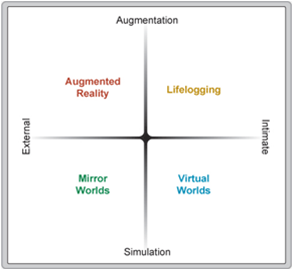

4 Metaverse scenarios by MVR 2007

Though I find these 4 scenarios very interesting, I’m somewhat puzzled by the augmentation-simulation continuum – mainly because I don’t see them as two opposite conditions which usually is the definition of a continuum. A flight simulator would for instance draw on both conditions in trying to simulate the experience of flying, but doing it as realistically as possible and sometimes with the use of HUDs. Now, my puzzlement may stem from poor understanding of the English language and native connotations of which I’m not aware, and the authors behind the MVR do state that the scenarios are partly-overlapping.

In any case, it makes more sense to me to place augmentation on a continuum with immersion. It should also be noted that my model aims at illustrating 4 possible strategies for remediation within 3D virtual worlds which means my focus is narrower only concerned with one of the four technologies in the MVR. The second continuum in the MVR between external and intimate makes a bit more sense to me, though again I would prefer a different terminology inspired by Jung (1920)’s psychological concepts of extraversion and introversion. The reference to Jung is by no means incidental but leads to another theoretical inspiration, namely the Theory of Experiential Learning by David A. Kolb (1984) by which I have previously been inspired in my PhD workings. In relation to his classic “Learning cycle” Kolb argues for a transformation dimension of learning consisting of two polar modes, respectively extension and intention. At this point Kolb is clearly inspired by, but chooses to go beyond, Jung’s extraversion-introversion concept, and even though I often find myself highly inspired by Kolb’s work, I’ve decided to maintain Jung’s original terminology in my own model … for now. I have, however also started to investigate the possibility of including Kolb’s 4 ways of knowing which would result in a 2. version of my model looking like this:
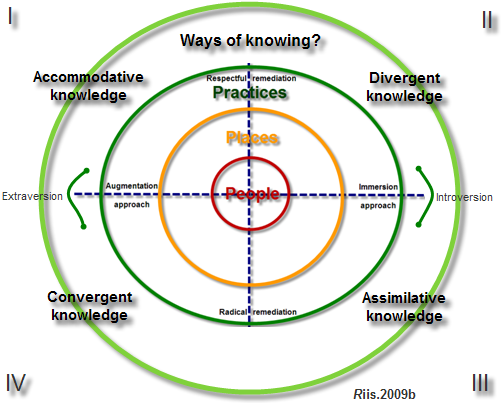
… um!? As tempting as it is trying to make the “whole world” fit into one little neat model, I have to say that I’m not sure about this at all – is it feasible to merge the two models? And perhaps even more important; is it desirable? This experiment is primarily based on intuition and I will need to further investigate this as part of my theoretical work and subsequent data analysis, but as part of my own learning and research process, I needed to get this version out of my head …

/Mariis
A model for 3D remediation – in colors

… because the seeming dichotomy between augmentation and immersion approaches to remediation in 3D virtual worlds like SL isn’t real and the world isn’t black and white ;-)

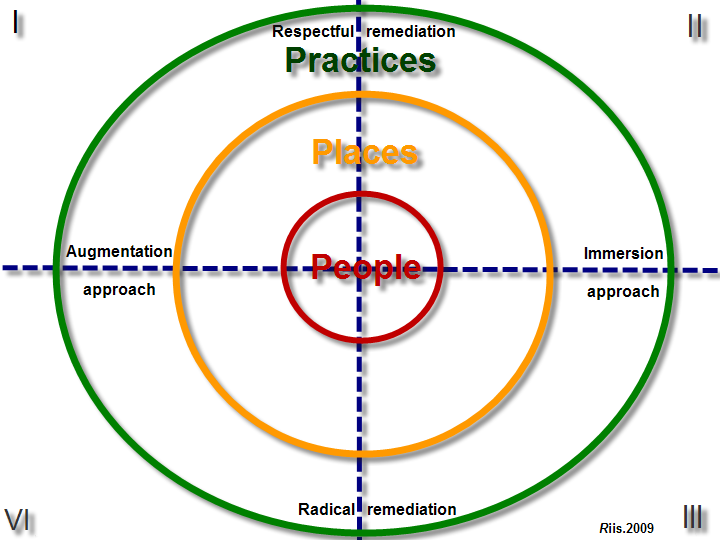
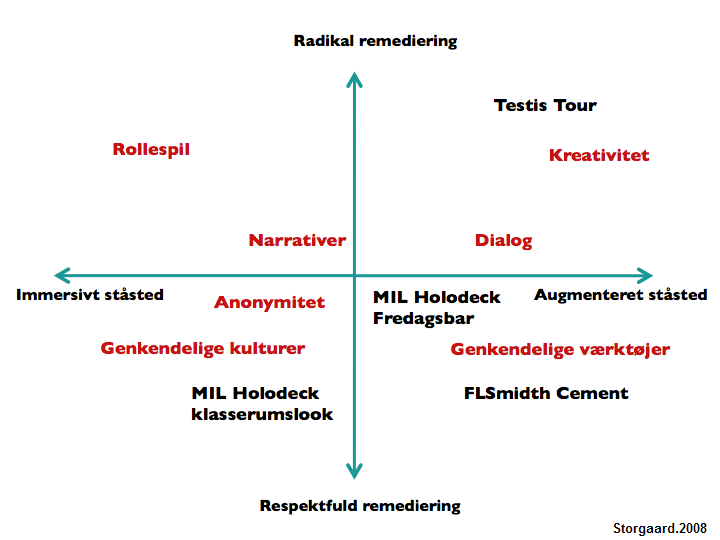
As mentioned in my previous post we had a great discussion on augmentation vs. immersion in the MIL course in relation to our 2. Didactic Design Discussion. Even though I personally do not consider the two approaches to be mutually exclusive (as it would seem in this post), I do think the discussion is worth having, since it highlights some difference there can be in different users’ perception of and engagement in 3D virtual worlds. Remediation is a core concept in my PhD, and last year one of the students, Carsten Storgaard created this model to show the relations between augmentation-immersion and respectful-radical remediation, including different types of activities and places:

While I do find the basics of the model quite useful, I do not necessarily agree with Storgaard´s suggestions to activities and places in the four quadrants, but it has inspired me to create a new model where I’ve made some changes and added more foci points from my PhD.

First of all, I decided to flip augmentation and immersion, so that augmentation now is placed in the left side of the model and immersion in the right side in an attempt to relate to the two brain hemispheres each representing different qualities and approaches to the world. Secondly, I decided to make the borders between the quadrants permeable thinking they can influence each other and that it will only be in rare cases that one would find “pure” examples – at least in my educational context. Finally, I added three other foci points from my PhD – my analytical units; people, places and practices.

For now I’ve decided to leave out examples of people, places and practices, because I need to analyze my data thoroughly and further develop the theoretical foundation for the model. In regard to the remediation concept I’m highly inspired by the work of Professor Tringham of UC Berkeley, and as it happens I just received a scholarship to go work with her for four months in the spring 2010. In the original remediation concept Bolter & Grusin (2000) made a distinction between immediacy and hypermediacy as ways of describing different remediation strategies. Interestingly, Professor Tringham and colleagues decided to place respectful and radical remediation in relation to hypermediacy only. I’m not sure I agree with that decision and this is just one of many reasons as to why I’m really looking forward to my Berkeley stay – I’m quite sure I’ll learn a lot and that we’ll have some highly inspirational discussions :-)

/Mariis

Case MIL09: Didactic Design Discussion – 2

In the 2. Didactic Design Discussion in the MIL course I’d chosen to focus on some of the central points from my own PhD-project since it also deals with analysis of SL as teaching and learning environment. Discussing some of my own ideas with the students naturally is very inspiring and rewarding for me personally, but I’m also hoping (and sensing) that the students benefit from seeing my approach to the problem, and judging from the vivid discussion I do believe, I managed to challenge some of their presumptions. I’m not able to reproduce all of it, but I will try to highlight a few issues.

Essentially my PhD-project is aimed at improving Blended Learning within Higher and Further Education through remediation and redidactization. Through a process of designing and redesigning two specific Blended Learning courses within 6 research cycles the aim is to enhance learner experience and learning outcome by using new augmented/immersive 3D media and a learner centered Problem Based pedagogical approach. In both cases the target group is adult teachers/ trainers from the educational and the private/industrial sector from different countries.


PhD-project overview – Fall 2009

The concept remediation (in relation to new media) was coined by Jay David Bolter and Richard Grusin (2000), but there was no explicit value or quality identified with different ways of remediating in the original concept. However, Tringham, Mills and Ashley (2007) further developed the remediation concept in their Remediated Places Project and came up with two distinct strategies for remediation, respectively respectful and radical. In my point of view these two strategies can be extended to include pedagogical considerations and thus inform more general implementation strategies for blended teaching and learning using new media.

I first introduced the MIL students to the concepts of respectful and radical remediation in the course last fall and like this year’s students they immediately adopted the terminology. If you’ve ever been in SL you’d know why – it makes perfect sense to distinguish between the two both with regard to people, places and practices. The interesting question nonetheless is whether remediation changes anything in the way we think and practice teaching and learning …


Is a slide show presentation in SL an innovation?

According to Peter Denning an innovation can be defined as a transformation of practice in a group, community or culture – it is not enough just to come up with a brilliant idea or create a new artifact. Surely there are many different definitions of innovation, but I agree with Denning and it aligns very well with Wenger’s 1998 social theory on Communities of Practice, which is one of my core inspirations. Changing practice is easier said than done and Steven Warburton has identified 7 barriers to innovation in 3D environments like SL:

  • Technical – machine and human related [and standards related]
  • Identity – the tension between playfulness and professionalism
  • Culture – reading the codes and etiquette of SL
  • Collaboration – building trust
  • Time – even simple things take time 
  • Economic – nothing is for free
  • Design – perhaps this is a meta-barrier but SL does offer up very particular design challenges

Besides these I would add another meta-barrier, namely the inherent paradox between (re-)production and innovation that all participants in education are facing. This is what I call the didactic double bind. In general double bind is described as dilemmas in communication, and SL seems to be filled with conflicting messages. After the session one of the students posted this photo as her take on a in-world double bind:

The text for that photo could read: ”SL is an open environment. Join us if you can”. Naturally, the experienced SL resident would know that the dilemma in this particular situation is metaphorical – a shift in camera angle and you’d be there… the perspective on the situation would change and shifting perspective, looking at dilemmas at a higher level of abstraction is one way of solving double bind situations and would according to Bateson. 1972 mean learning at level III. And this is actually one of the reasons why I find SL so interesting – if we assume that the learner overcomes the initial difficulties and gets accustomed to the environment it provides rich opportunities for learning at higher levels, because SL inevitable challenges the learner both ontologically and epistemologically due to the whole meta-cognitive nature of the in-world experience.

After this we moved on to discuss the concepts of immersion and augmentation and what these two apparently conflicting ways of engaging in an environment like SL could mean – not least when it comes to teaching and learning practice. Again the students were eager to discuss and we covered a lot of important points on which I will return in a later posting. Suffice to say that we all agree with Tateru Nino on this:

It’s not all black and white.
The whole immersion versus augmentation debate is clouded by one trivial little detail. One is not the opposite of the other. The two aren’t even mutually exclusive.

We ended the session by trying out the Opinionater – it really is a very efficient and fun tool for stimulating discussions :-)

/Mariis

Machinima seminar at Roskilde University

Thursday November 26th I participated in a seminar on Machinima organized by Professor, Sisse Siggaard Jensen and her research team in the Virtual Worlds Research Project.

Webmaster of Mirror World, Speedmaster Bing aka Jimmy Hansen RL started off by introducing to the phenomenon and showed us various examples of different genres of Machinima. It was the first time I met Speedmaster RL and it was great fun! Among the videos Speedmaster presented this was my absolute favorite – I have no idea who Pengin is, but I have to say that I’m a fan :-)

Vodpod videos no longer available.

Following Speemaster’s presentation we went in-word – via Doctor Asp‘s avatar – to meet Britta Pollmüller (Pigment Pye in-world), who is a Machinima artist and teaches in-world machinima classes at the Open University’s Schome Initiative. BTW Dianne Carr from Learning From Online Worlds; Teaching In Second Life – a research project at the London Knowledge Lab, Institute of Education, University of London funded by the Eduserv Foundation – did an interesting interview with Pollmüller.

After lunch we were joined by Hugh Hancock – Machinima pioneer and apparently the man who – by spelling accident when ordering a domain address – coined the term Machinima.

Hancock spoke of the (short) history of Machinima and also presented various examples – with this one getting the most laughs ;-)

Hancock ended the afternoon by showing us how to create Machinima via Moviestorm. It was a day filled with strong audio-visual impressions, and the most important lesson I learned, was that I’ve got a lot to learn before engaging in attempts to do Macinima on my own – but it sure does seem worth the effort!

/Mariis

My first SL screencast

MIL alumni, Carsten Storgaard, recently pointed my attention to Screenr – a nice little tool for creating screencasts. So yesterday, when I was preparing to talk about immersion vs. augmentation in SL as part of the next Didactic Design Discussion in the MIL course, I decided to try it.

One of the best examples of in-world immersion to me was the Tunnel of Light build by Spiral Walcher, but unfortunately that place does no longer exist. Instead I had a look at Spiral’s pics and found myself ending up at his Vision Store where I did my first attempt at in-world sceencasting:

Vodpod videos no longer available.

Obviously I have a lot to learn about camera angles, movement etc. and I’m not convinced that Screenr is the best tool for in-world productions.

Nonetheless, I do recommend that you explore this beautiful place first hand – also have a look at Spiral’s Glow Show at Ball State University ll – it’s absolutely breathtaking!

Incidentally, I will be participating in a workshop on Machinima tomorrow at Roskilde University, so look out .. I may just be returning with more machinima-wanna-be-attempts in the future ;-)

/Mariis