Case MIL09: Student analysis of SL – part 3

PerSecond

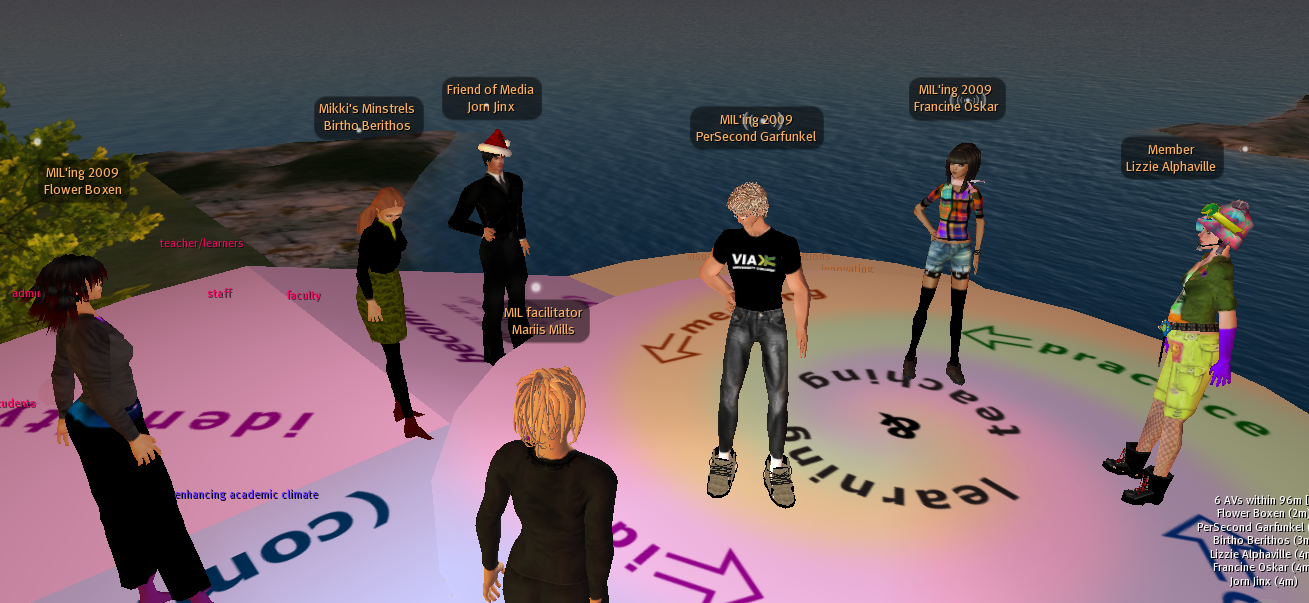
The third student analysis of SL was conducted by PerSecond and he had asked us to meet him at our regular meeting place in front of the fireplace on MIL’s island, but was otherwise very secretive about his presentation. As we were waiting for the other students to turn up we small talked about our avatars’ clothes – a topic that seems quite popular for both gender in-world. While it doesn’t make much sense to discuss the in-world weather, I do think the interest in the avatar appearance stems from a deeper need to figure out and find your way with the new identity.
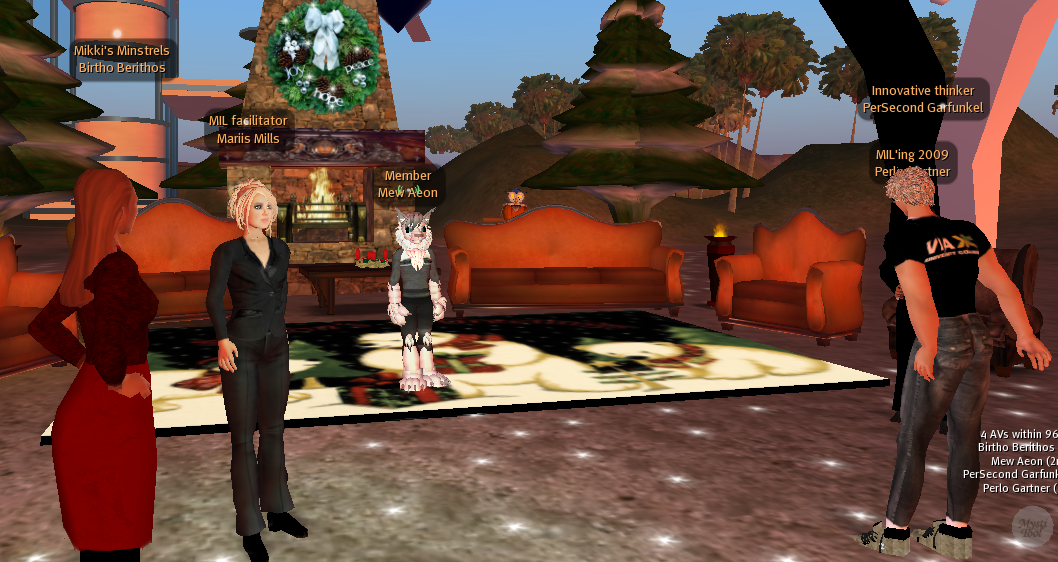
PerSecond was actually reluctant to change his appearance from the default look, when he first entered SL, because he didn’t want to put emphasis on that part, but as he learned that caring for your avatar’s appearance signals that you care for the world and are willing to make an effort to learn how to master the medium, he changed his mind. PerSecond told us that had recently received a t-shirt with his company logo, which enabled him to identify more with his otherwise estranged avatar, and as we shall see identity was part of the theme for PerSecond’s presentation. We then headed off to what turned out to be PerSecond’s own home on the Innovative Learning Island.  RL PerSecond works at VIA University College that offers a combination of vocational, higher and further education and they’ve had a presence in SL for quite some time, but it wasn’t until PerSecond entered the MIL course and thus was forced to spend time in-world that he became convinced of the teaching and learning potential of virtual worlds. For his presentation PerSecond had prepared an interesting set-up with a video screen on one wall and a slide presenter on another – a challenging set-up if you don’t master the camera:
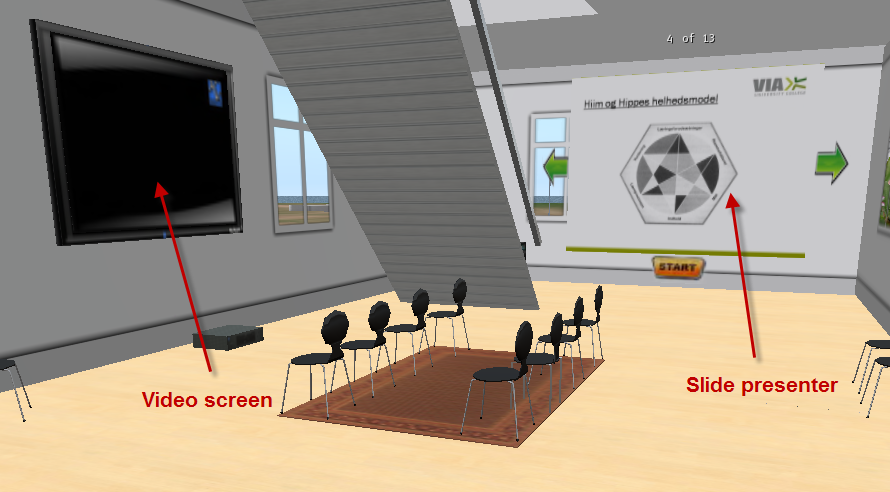
Like Perlo & Francine, PerSecond also chose to use the Didactic Relation Model (showed above on the slide presenter) as basis for his presentation and analysis, but he also pointed to other relevant models and theoretical foundations and combined it with video clippings from a couple of other worlds most notably Blue Mars and Hipihi. PerSecond’s primary target group would be building construction students, and one of the main reasons as to why he has been hesitant with the use of SL, is the lack of possibility to integrate other 3D modeling apps in SL – something which Blue Mars offers e.g. through support of content creation tools like 3DSMax.
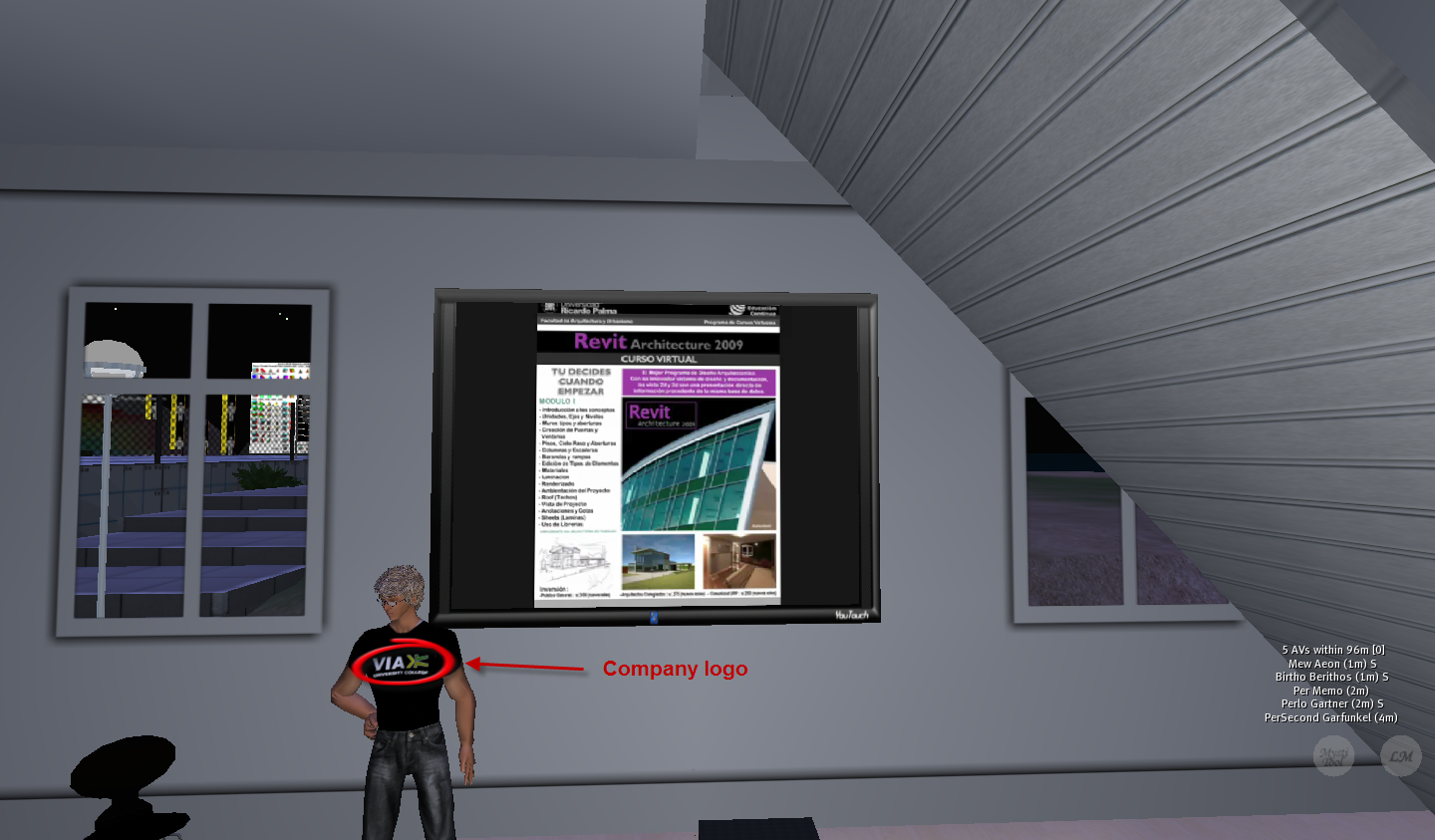

PerSecond showing another important tool: Revit

As part of the presentation we also went on a short tour to see part of the construction site that recently won the annual Danish e-learning award. It is one of the rare sites that also make use of relevant audio – as you enter the building you hear a lot of very loud background noise that would be normal at a construction site.


Be careful not to step on any of the dangerous cords on the floor!

Using SL for work place training is obviously what appealed to PerSecond and he also envisioned different types of role play to enhance the professional identity of the students.  There are already different outfits for the avatars to wear near the construction site, so that the students could enact different professional roles, but as another example of role playing PerSecond had prepared a little surprise for us in the shape of a second avatar, Per Memo. Per shifted between the two avatars and we were asked to comment on the presentation on IM with Memo.

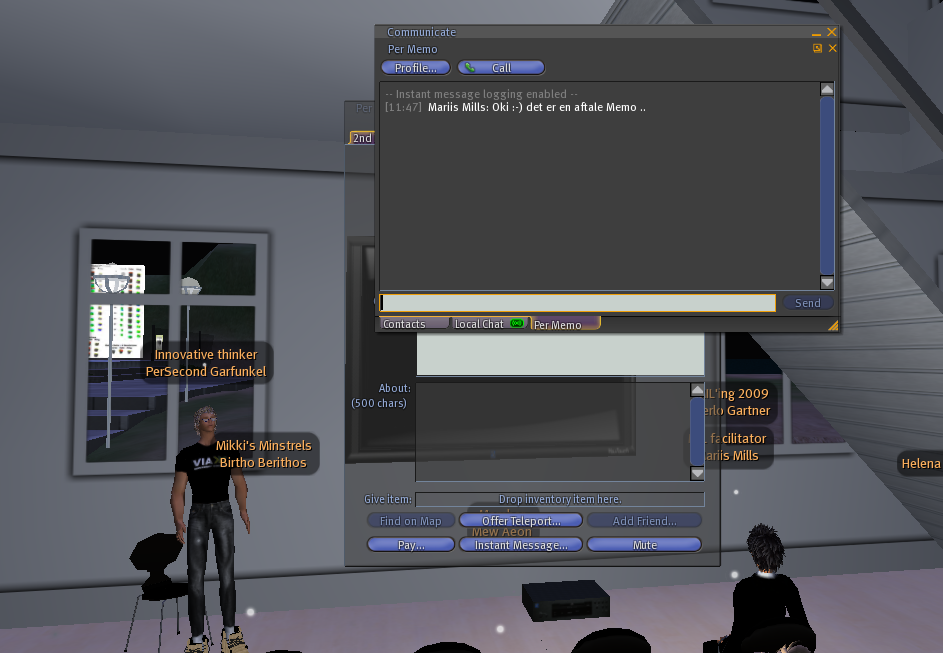
PerSecond pointed to another interesting advantage of using SL as part of this training which had to do with time and flexibility. Here in Denmark it is unfortunately often difficult to find sufficient internships for our students in the vocational sector and SL could provide an excellent supplement and enable the “school part” of the education to be closer to RL practice – something which most students undoubtedly would appreciate. The ability to leave the setting and return at any time convenient for the students also would provide more flexibility.

Given the fact that PerSecond was reluctant to use SL just a few weeks ago, I was quite impressed by his presentation and not least his willingness to explore and try out the many affordances of the medium. Per will continue his work with SL as part of his Master Thesis in the spring where he may be looking into the possibility of using SL as platform for work they are doing at VIA with Chinese collaborators.

/Mariis

Case MIL09: Student analysis of SL – part 2

Lizzie & Jorn

Lizzie & Jorn, who were in charge of the second didactic analysis in the MIL course, had decided that we should start out by exploring a particular design which then would form the basis for their discussion and reflections, so we went to Teaching 4 – Iowa State University, CELT, where Thursday Xu has created a model of Wenger’s Community of Practice (CoP):

The model has been created as a kind of spiral shaped staircase and as you move up floating text with key concepts central to the theory appears. Other than that there seems to be no apparent interaction possibilities with the model.

After exploring the model we all went to Media Learning, where Lizzie & Jorn had been able to make use of a presentation setting owned by another (first year) MIL student, Inge Qunhua, who is an experienced and award winning SL teacher.

As part of their presentation Lizzie & Jorn started by analyzing the CoP model and I think it is safe to say that none of them or any of the other students was impressed by the model – above all due to the lacking interaction possibilities. My role in these discussions was mainly to listen and observe and it was quite interesting in this case because I did not agree with the students. During the MIL course we have visited other theoretical designs that are based more on interaction between the design and the avatar. Right next to the Cop model, Thursday Xu has created a build of Bloom’s taxonomy, where questions regarding the theory are posed in the local chat as you move your avatar around in the model and we have also been exploring Zotarah Shepherd’s MI build where the avatar can play instruments or solve a mathematical puzzle as examples of the different intelligences and the MIL students clearly preferred these more interactive designs.

In my opinion interaction doesn’t necessarily equal learning. I don’t think my understanding of musical intelligence is enhanced solely because my avatar can be animated to play drums though I recognize that the fun engagement and activity may play an important role in the memorizing process, but there is so much more to learning than just memorizing. In line with Wenger, I believe that negotiation as part of the creation of meaning is essential to the learning process and in this sense my pedagogical foundation obviously is dialogic and I tend to agree with Wegerif. 2006 who finds that one of the goals of education, perhaps even the most important goal, should be dialogue as an end in itself.

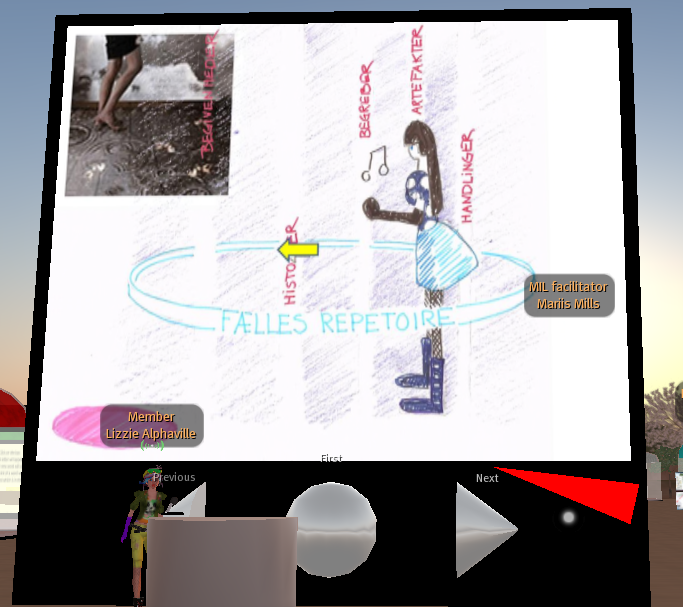
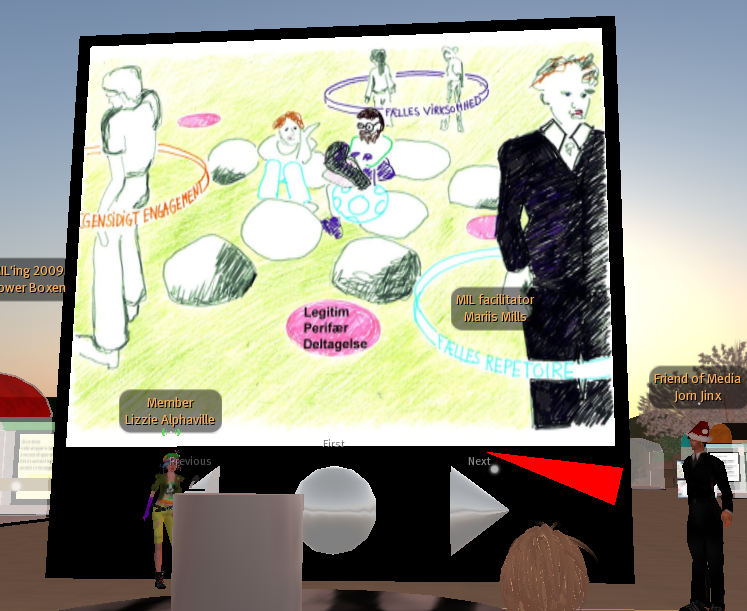
Judging the quality of designs for teaching and learning is however very complex and I think that one of the first things you need to clarify is whether the design is intended for single- or multiple-user purposes. In the case of the latter you of course also need to consider the role of other participants and e.g. a facilitator. Lizzie & Jorn found that the CoP model was a “stand-alone” model and therefore they didn’t find it interesting, but as part of their analysis they had also created a suggestion for an alternate CoP model to be used with their particular target group; dental hygienists. This imaginary model was presented as sketches drawn by Lizzie and put emphasis on 3 of the core concepts from the CoP theory;  mutual engagement, shared repertoire and joint enterprise:

By the end of their presentation Lizzie & Jorn also invited us to join them in trying to place the two CoP models within a third model, namely the model created by former MIL student Carsten Storgaard as I’ve referred to earlier in this post. It turned out to be quite difficult, but started an interesting discussion on models and their usability in general.

Afterwards in their reflections in FirstClass, Lizzie & Jorn, mentioned how difficult it is to teach when you’re unable to see the facial expressions and body language in general – the chat (text/voice) becomes crucial in environments like SL in order to get the sense of not talking to an empty space. One of the things Lizzie & Jorn also criticized about the CoP model was the lack of a place for discussion in the model if you’re in a lager group, but in hindsight they concluded that the need to gather (f2f) in order to discuss is more psychological stemming from our RL habits than practical, since there is no other reason to do so in SL where you always can communicate via group chat regardless of distance. They also felt that their presentation had raised more questions than answers, which for someone who believes in the value of unfinished dialogue was good to hear …

Besides the fact that I was really surprised by all of the students’ lacking recognition of dialogue as main means of learning, I do think Lizzie & Jorn did a great job and we all had a very interesting experience. It is, nonetheless difficult not to mention the irony of the situation; the students really criticized the CoP model and its apparent disability to promote learning, but judging from the discussions and the comments during the session it turned out to be an event with both challenging and meaningful negotiation of several of the topics in the course ;-)

/Mariis

Case MIL09: Student analysis of SL – part 1

As part of the MIL course this year the students could choose to do their didactic analysis of SL either asynchronously in FirstClass or synchronously in SL, and 6 out 8 students chose the latter. Regardless of mode the students were asked to investigate 5 elements of particular importance when dealing with didactic analysis; Didactics (understood as theoretical foundation) and target groups, Orientation and navigation, Interaction, Learning processes and Audio-visuals. All of the students received the Zebra presenter and could use the sandbox to arrange the setting for their presentations, but they were also encouraged to find tools and places on their own. Each presentation was set to last approx. 2 hrs. and judging by the comments from all the students who chose the SL format, the analysis thus ended up feeling like an oral exam. In this and upcoming posts I’ll present some of the students’ findings and reflections.

Perlo & Francine


EduIsland 4: Practice classroom

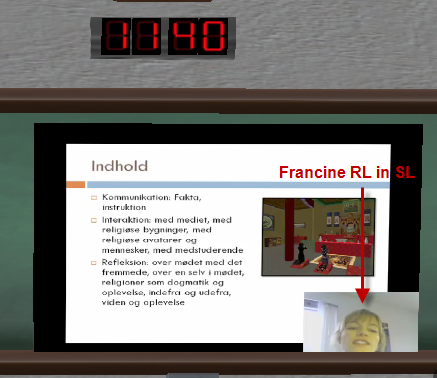
First up were Perlo & Francine who had found a free practice classroom for trainee teachers at one of the EduIslands. Perlo & Francine had chosen to prepare their analysis as a streamed video which we were able to watch via the presenter in the classroom. As foundation for their analysis they had chosen the Didactic Relation model and the target group was adult students at a Teacher College studying religion. The purpose of using SL should be to conduct field studies that would otherwise be impossible to do in real life within the given college settings. Perlo & Francine envisioned using SL as part of a blended learning environment where they would include a wiki for the students’ asynchronous reflections and also f2f activities e.g. workshops aimed at teaching the students how to use SL.

One of the advantages Perlo & Francine pointed out about SL is the way the medium allows the user to change perspective, not only via camera controls, but rather because of the avatar phenomenon that enables the user to have a detached, 3rd person view on him-/herself and the activities/interactions in the environment. Conversely they also pointed to the other pole in the participation-observation continuum, where – provided you feel immersed or attached to your avatar – you would be able to participate (almost) like a native in different cultures. This change of perspective and the ontologically challenging question of being present or not was underlined by the way Perlo & Francine chose to present their thoughts as themselves in the video, but displayed on a screen and discussed in-world as avatars.

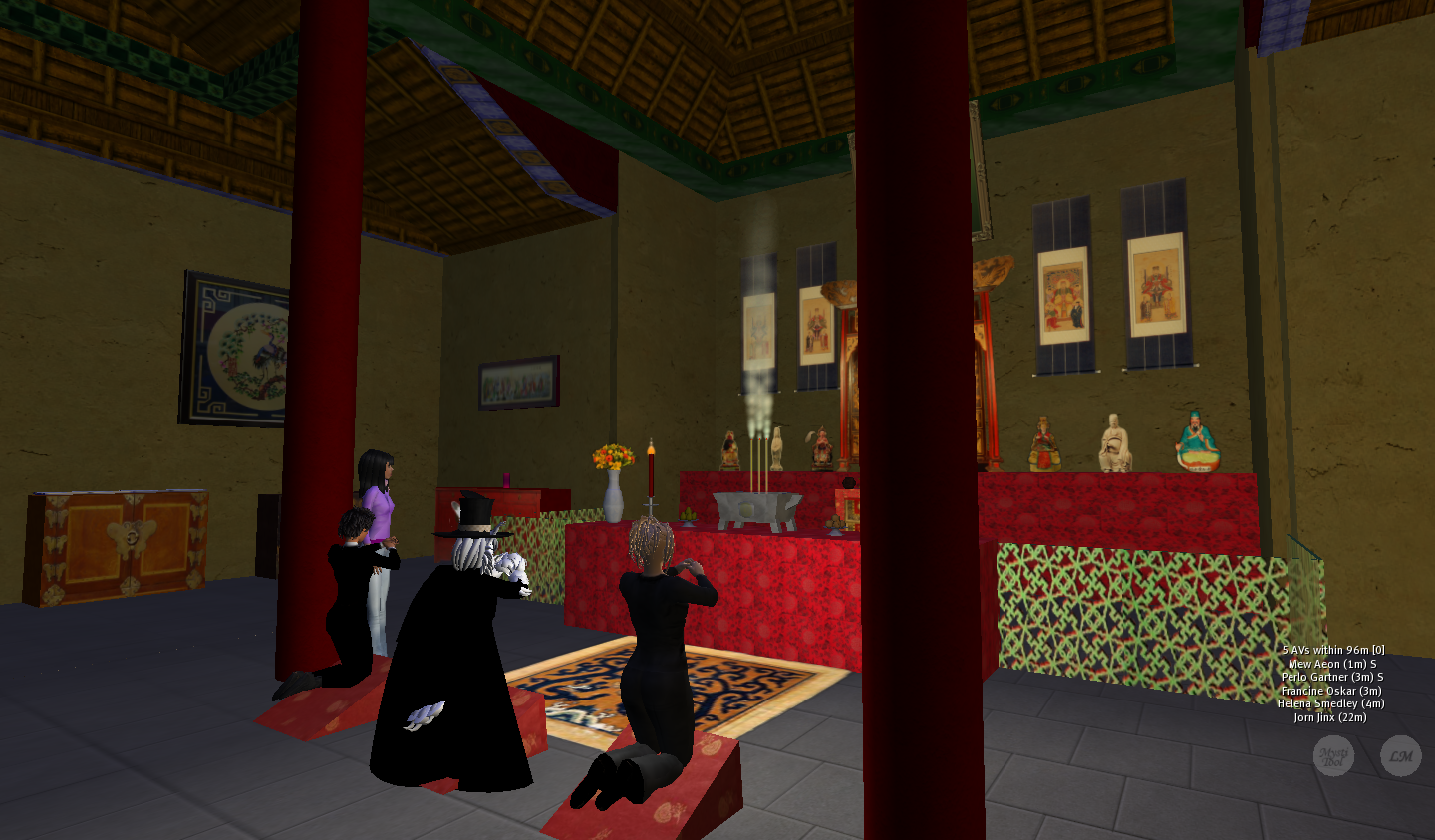
Despite their enthusiasm about SL as teaching and learning medium, they also worried about especially technical challenges, the fact that most communication in SL is in English and the rather vast amount of time that is needed to get to know SL sufficiently so that the students actually would be able to use SL as intended. Nonetheless, they did find the possibility to do field studies via SL to be really appealing and worth trying out, and they are currently preparing a course that’ll be running in the beginning of 2010. After the presentation we visited a couple of the religious places that would be relevant in their course:


The Kaaba at IslamOnline


Looking at The Black Stone – something NpIRL for non-muslims …


Praying at The Cijian Temple

Afterwards Perlo & Francine reflected on the experience in FirstClass and they both focused on the many things – especially technological – that you need to pay attention to when teaching in-world. Compared to f2f they found it more difficult to control and mange the activities, make sure everybody understood their instructions and when touring making sure nobody got lost. These are quite typical impressions from initial teaching experience in-world – but don’t worry –  it does get easier in time :-)

/Mariis

Case MIL09: Didactic Design Discussion – 4

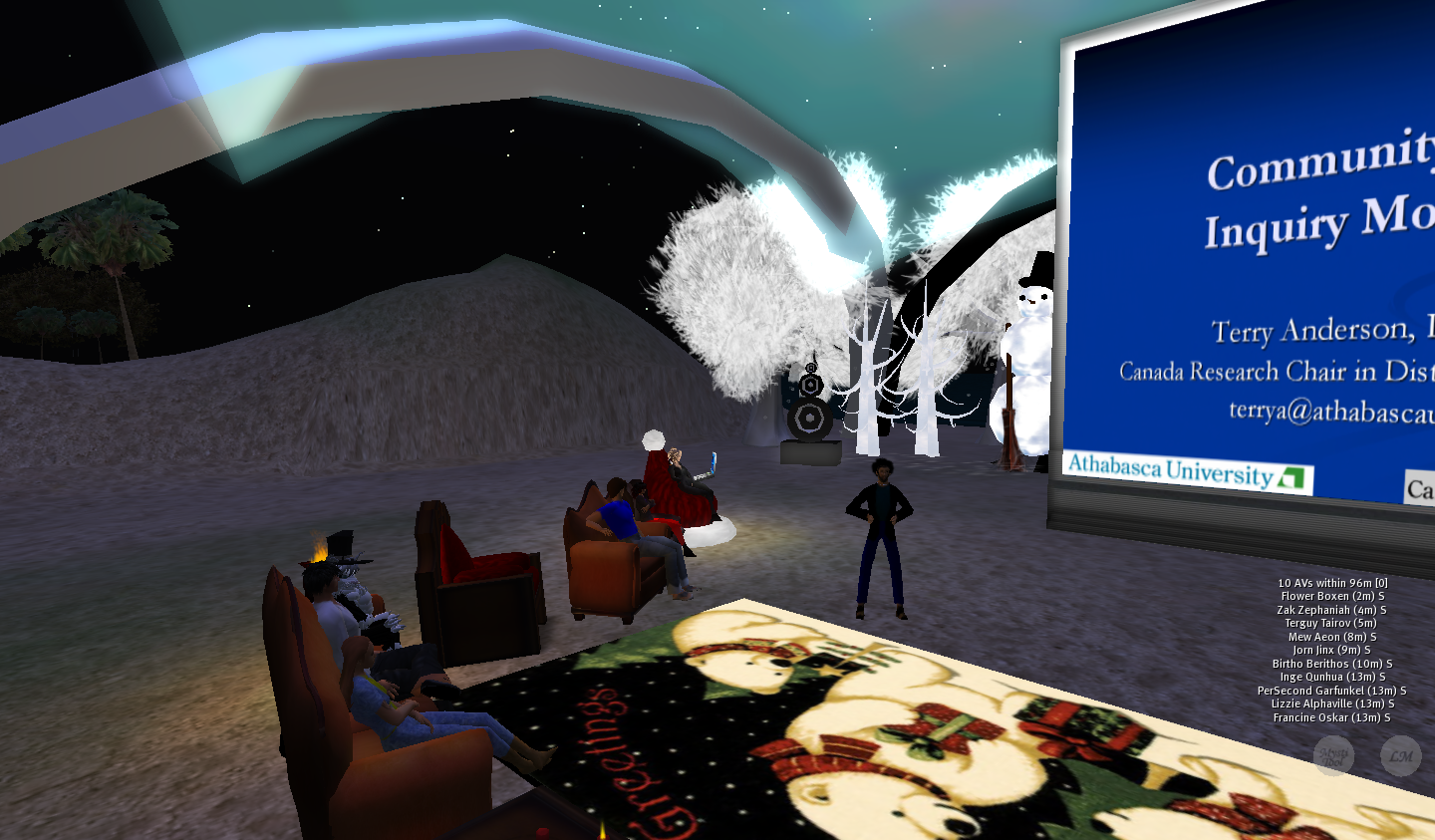
On December 3rd we had a special edition of the Didactic Design Discussion in the MIL course, since both Terry Anderson and Ross McKerlich visited us to talk about the Community of Inquiry (COI) model. The COI model was developed in the late 1990’ies as framework for evaluating educational experience in text-based online environments by D. Randy Garrison, Terry Anderson and Walther Archer. Given the COI model’s wide spread use in different educational settings it is by no means coincidental that one of the original founders, Terry Anderson, has found it important to explore the applicability of the model in new online environments such as the 3D virtual world, Second Life (SL). Together with McKerlich Anderson conducted a preliminary, qualitative exploratory study in SL in 2007 and basically confirmed that the model also can be used in assessing educational experience in 3D virtual environments (McKerlich & Anderson. 2007). Anderson and McKerlich later invited Brad Eastmann and I to participate in the continued study of COI in 3D virtual worlds and as part of this study we record different educational experiences in SL to be used for later analysis.


Terry presenting COI to the MIL students

Besides being an excellent tool with regard to analyzing interaction and communication the COI model, which consists of 3 different  types of presence indicators (cognitive, social and teaching), can also be used as a heuristic tool for designing online educational experiences. The MIL students in this year’s course are all educators involved in course designing within blended learning and they all seemed to find the COI model interesting and relevant to their current work. What I appreciate about the model is the fact that it deals with presence and not immersion which otherwise seems to be the buzz word when studying 3D virtual worlds. Even though both presence and immersion have to do with the user experience, I do find there is an important difference between the two concepts. Based on the four research cycles I’ve completed in my PhD project so far, my experience is that all users achieve a sense of presence when they enter a virtual environment like SL, which I think above all has to do with the avatar and its ability to move around and meet other avatars, communicate and interact in real time. It is, however not my impression that all users in these types of environments achieve the sense of immersion – at least not if immersion is defined by a sense of “willing suspension of disbelief” as proposed by Dede. 2005 among others.  An important part of this discussion is of course how one chooses to define the concepts and since I intend to use both presence and immersion in my own model this is something I’ll return to.

After the presentation, McKerlich introduced to our survey related to the COI study and we went on to use The Opinionater, which once again proved its worth as a great tool for initiating discussions.

/Mariis

Case MIL09: Didactic Design Discussion – 3

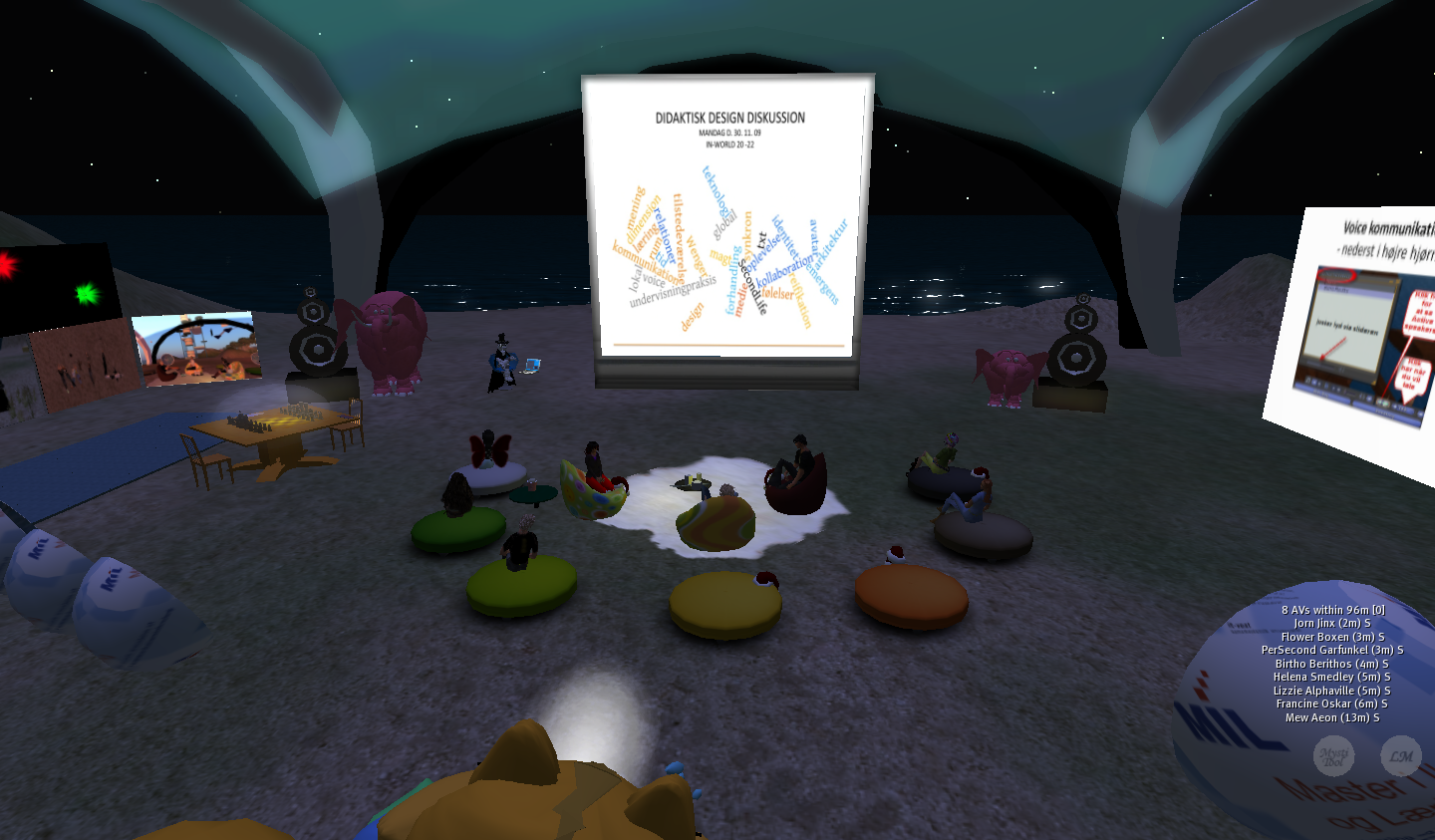
On Monday November 30th my co-facilitator, Mew Aeon was in charge of the 3rd Didactic Design Discussion in the MIL course. Unfortunately it was one of those nights where the technology really became an obstacle for me, since I was logged out of SL several times, but judging from what I did experience and the students’ comments they enjoyed the discussion very much.

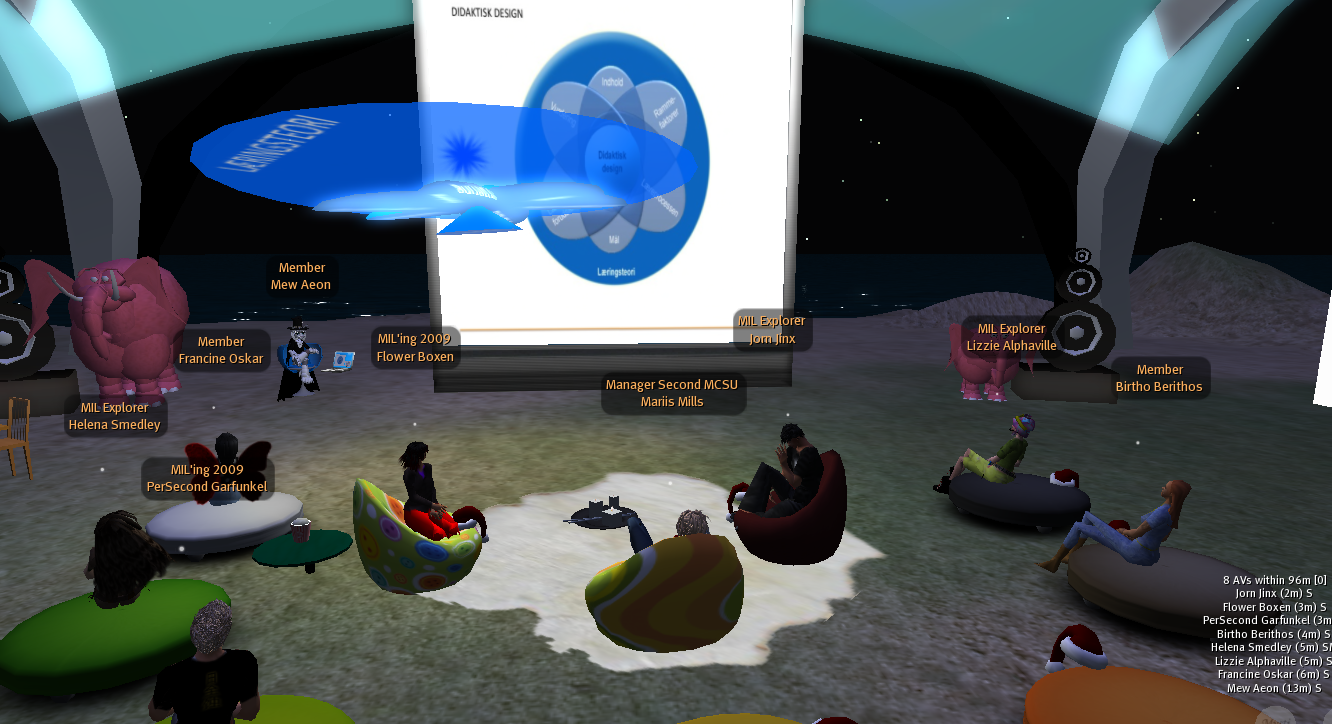
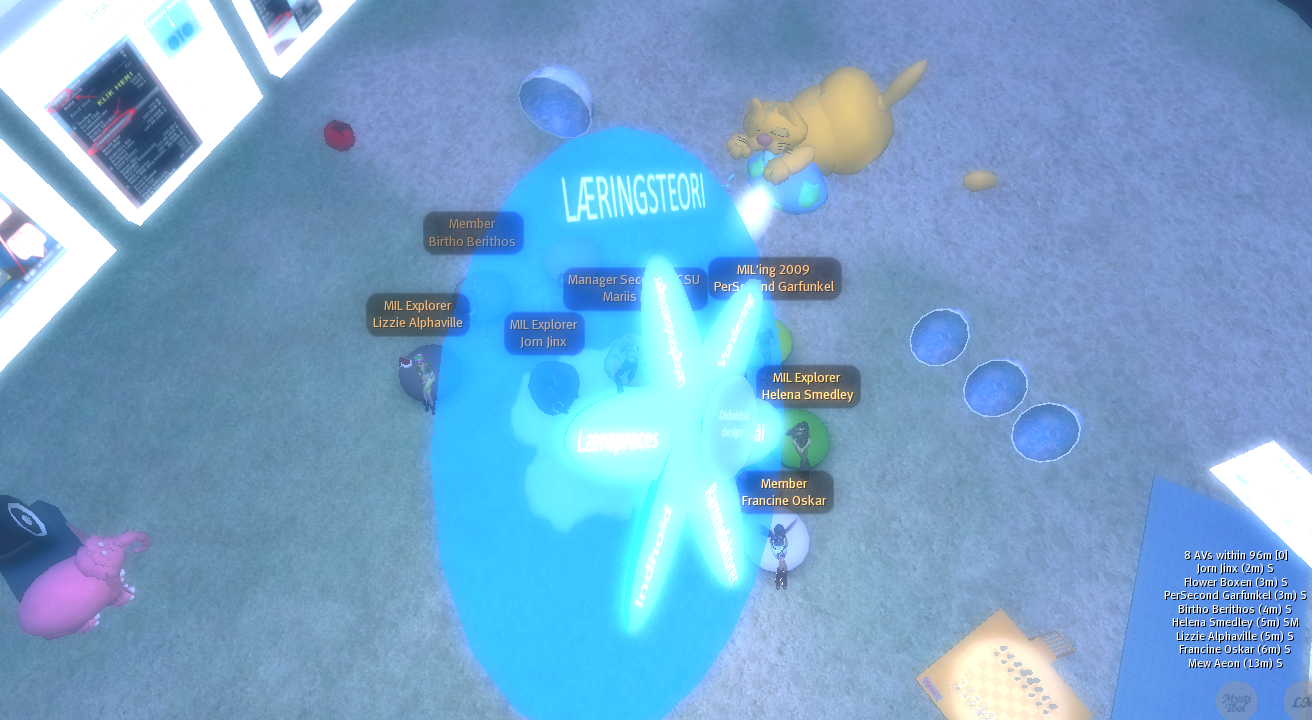
The purpose of these discussions is to stimulate the students’ critical thinking and didactic-pedagogical imagination and Mew chose to present two different models for Didactic Design. The first one, the so called Didactic Relation Model, originally developed by Norwegian educational researchers Bjørndal & Lieberg (1978) and further developed by 2 other Norwegians Hiim & Hippe (1998), is intended as a planning tool for teachers and is widely used in Scandinavia. The Didactic Relation Model illustrates the relations between learning conditions, external factors, goals, content, learning processes and assessment. In Mew’s version he added a learning theoretical layer and included Didactic Design as explicit goal for the use of the model. For the discussion Mew had prepared the model in a 3D version:

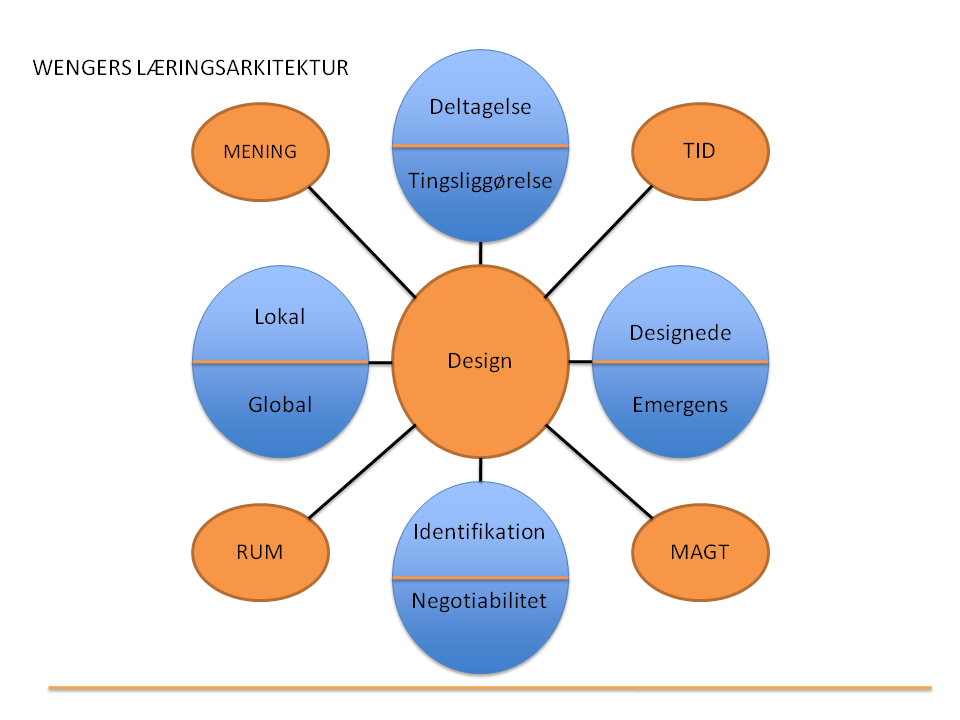
The second model Mew presented was a revised version of Wenger’s (1998) model of Four dimensions of design for learning that shows four dualities between which one will find inherent tensions that need to be  addressed in the designing process. Besides these dualities Mew had added 4 more elements (meaning, time, power and space) that he found valuable to focus on when he originally redesigned Wenger’s model as part of his Master Thesis  work – the report (in Danish) can be downloaded here.

For each of the elements Mew gave examples from SL and since both Wenger’s CoP theory and the concept of Legitimate Peripheral Participation are highly popular among MIL students it seemed to promote a vibrant discussion. After the theoretical discussion Mew took us on tour to three different locations based on design ranging from very respectful remediation to radical, NpIRL remediation:


Sistine Chapel


Exploratorium


Organica


After the session Mew and I stayed a bit to discuss his impressions, since this was his first formal lecture in-world. The keywords were riotous or unmanageable compared to real life, because there were so many simultaneous things going on; the text and voice chat, activity and movement of the avatars while trying to focus on the content of the presentation, looking at notes and managing the slides and steering the 3D model. I clearly recognize these sentiments from my first in-world teaching experience, but the good news are that it gets better – and even though it was different from teaching in real life, Mew definitely got “hocked”, so despite my technical problems, I believe it was a very good night :-)

/Mariis