Design Thinking and Informatics

Next week I’ll participate in a 2 day PhD course on”Design Thinking and Informatics” at HCCI-Doctoral research programme in Human Centered Communication and Informatics, Aalborg University. Course lecturers are Judith Gregory, Institute of Design, Illinois Institute of Technology & Anne Marie Kanstrup, Department of Communication and Psychology, Aalborg University.

Day one focuses on design thinking (vs. construction). Introductions will be made to the history of design thinking in general and current trends in design thinking in informatics in particular. Socio-technical, theoretical perspectives will be introduced and used in discussions of what this way of thinking means for students’ doctoral research projects.
Day two focuses on methodological practices and consequences of design thinking. Case examples will be presented for how selected methods have been employed and students will work on how to integrate design thinking into their research projects.

In order to enroll in this course I had to prepare 1-3 questions related to design within my PhD project. In my view design is an ambiguous term. I do use the term in my project, but depending on what area of my project it concerns, I use the term with different meanings. I tend to regard my whole project as a design, and in Danish I would use the term didactic design to strengthen that I’m concerned with design aimed at a pedagogical practice. However, when I speak with non-Scandinavians the term didactic doesn’t seem to make much sense, and I usually resolve to say educational design instead, but this doesn’t cover my project either. When I explain in further detail what my project entails people – especially Americans – often respond by saying “oh, you mean instructional design”. But instructional design is in my opinion related to a certain pedagogical epistemology on which I don’t agree. It has been suggested that I might use the term curriculum design, but that doesn’t really cover my project either … This uncertainty about how I should coin my design is the main reason for me to participate in the PhD course as I’m hoping it will inspire me to clarify not only the prefix but also the design concept in itself. I therefore have posed the following questions:

  1. How can I define (think of) Design? According to Owen.2004:3 design can be described as “a profession that is concerned with the creation of products, systems, communications and services that satisfy human needs, improve people’s lives and do all of this with respect for the welfare of the natural environment (…) Design involves problem finding, problem solving, analysis, invention and evaluation guided by a deep sensitivity to environmental concerns and human-centered aesthetic, cultural and functional needs.” However, this is not an adequate description of my design concept …
  2. How can I coin my design concept so that it includes pedagogical, participatory and technological aspects?

Rheingold. 2008 advocates for the need of Participative Pedagogy as a strategy for designing social media. Participation is already a keyword in my project – both with regards to my overall Action Research inspired approach and with regards to my pedagogical foundation within PBL and POPP. In spite of this, I’m not really sure how to include that particular keyword in describing my project. So as you can imagine, I’m in desperate need of the course ;-) Below I have placed some of my project’s keywords in Wordle, which seems as an appropriate way of illustrating my current state of mind – one big mess!
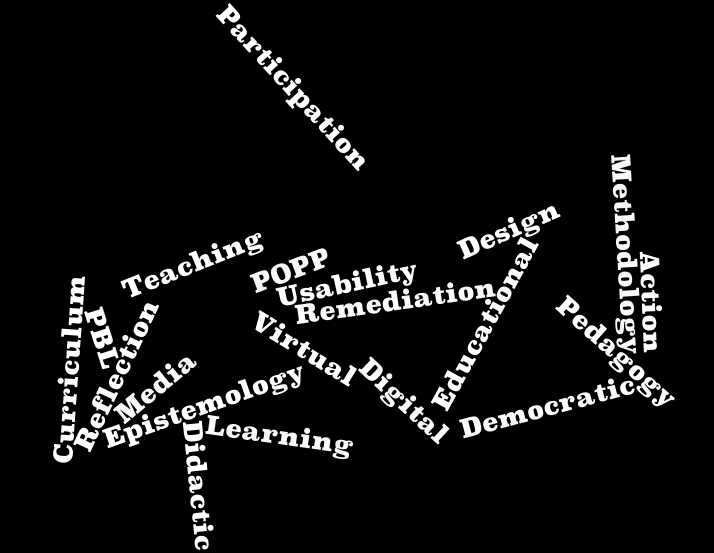
wordle109

Another interesting part of this PhD course will be for me to figure out how I (my project) fit into the field of Informatics. At ELL we have several researches working within Informatics on either information processing and/or development/design of information systems (IS), but they are using a quite different terminology (which typically indicates different views and practices) and I don’t usually consider myself to be part of that “gang” at ELL. I don’t really like the term IS. First of all, I think the information part associates with a narrow view on communication and system(s) in my ears simply rings too machine’ish putting too much emphasis on the technology. I’m aware that system(s) in several theories* refers to human activity and organization, but I just don’t like it. From talks with my colleagues, I know they share most of my humanistic views and I probably will stand corrected on this after the course – not least because I know for sure that we have common interests on the methodological level. Anyways, I’m looking forward to a couple of interesting days, and hopefully I’ll soon be able to return with a clarifying post on my project design …

/Mariis

References
Owen, C.L (2004): What Is Design? Some questions and answers.
Location

Rheingold, H. (2008): Participative Pedagogy for a Literacy of Literacies.
Location
*) Intersting resource on theories used in IS

Quantitative learning outcome of the MIL course

12 students participated full time in the MIL course, one student divided his attention between SL and the second analytical object, the serious learning game, Global Conflicts, and 2 students who also chose Global Conflicts attended some SL activities ad hoc. The official learning goals of the course (regardless of choice) according to the MIL curriculum were;

The intellectual competence goals are that the student attains competence in:

  • identifying, reflecting on and appraising the scientific basis of ICT and didactic design formulating
  • analyzing and assessing problems within ICT and didactic design.

The professional competence goals are that the student attains competence in:

  • understanding and appraising theories and methods relating to didactic design
  • analyzing and assessing ICT based learning products and virtual learning environments on the basis of theories and methods relating to didactic design.

The practical competence goals are that the student attains competence in:

  • analyzing and assessing ICT based learning products and virtual learning environments on the basis of theories and methods relating to didactic design.

Besides these official goals, I stated that it was my hope that this SL course would force the students to reconsider familiar didactic elements and think out-of-the-box. When trying to articulate his learning outcome, one of the students suggested that this could be done in answering the following 3 questions; 1) What is your most significant learning outcome? 2) Has it been hard? And 3) How does this course differ from other MIL courses?

I think the second question is rather interesting and closely connected to the last question, but also to SL as a medium itself. It is widely recognized that SL has a very steep learning curve and that it takes a lot of time and effort to get accustomed to SL. Based on the general course findings and especially the many interesting discussion I had with the students I will return to this matter in a future post. In this post, I wish to focus on the course design and what this meant for the quantitative learning outcome in general.

ddd141208_005
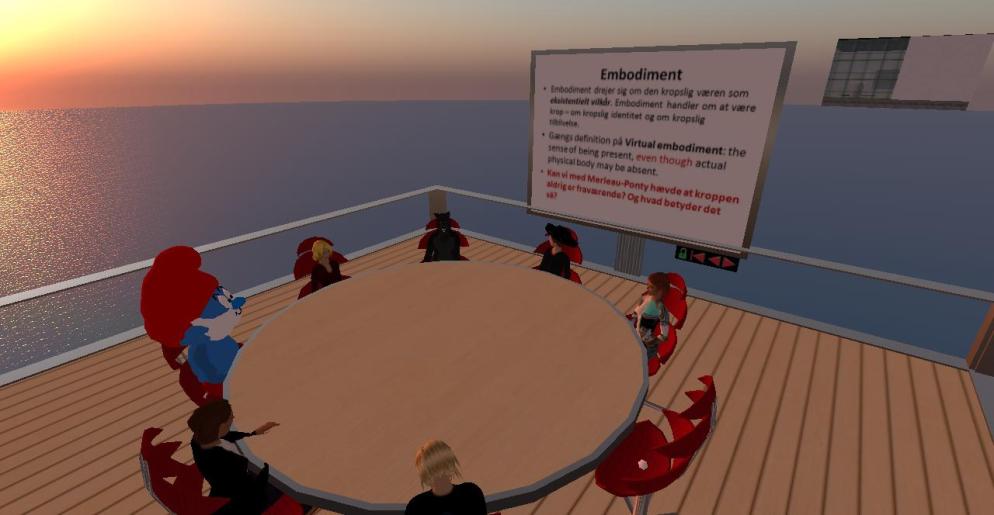
Didactic Design Discussion … on embodiment

The course is accredited with 4 ECTS points, which means that there is an expected workload of approx. 100 hours. MIL students are used to working hard, so I was a bit surprised when the student posed this particular question. On the other hand, I knew that this course was quite different from other MIL courses because of all the synchronous activities. Initially I told the students that I only expected them to participate in one synchronous activity in-world during the course, but all of them chose to participate in several. One of the major challenges of conducting distance education for further studies is to maintain a high level of flexibility. The MIL students are all attending the programme in their spare time from work and life in general, and most activities are asynchronous so that the students can chose to participate whenever they can fit it into their busy schedules. Since I knew that many of the students wouldn’t be able to attend on specific days, I tried to plan the activities covering most days of the week, including the weekends so that they had lots to choose from. From November 5th to December 15th there were a total of 25 activities with duration between 1-3 hours. The flip side to this was of course the risk that some students felt that they missed important stuff whenever they weren’t able to attend our in-world meetings. Furthermore the assessment criteria (a minimum of 3 postings in our asynchronous platform) of the course conflicted with the general workload. The students were asked to post their reflections in 5 different conferences covering essential didactic elements;

  1. Didactics and target groups – 32 postings by 12 students and me (8). Approx. 40 A4 pages.
  2. Orientation and navigation – 8 postings by 5 students and me (1). Approx. 8 A4 pages.
  3. Interaction0 posts!
  4. Learning processes – 68 posting by 11 students and me (21). Approx. 83 A4 pages.
  5. Audio-visuals – 9 postings by 2 students and me (4). Approx. 15 A4 pages.

Given that the official criteria was 3 postings corresponding to 3 A4 pages the degree of student activity has been uniquely high also considering the fact that besides these asynchronous discussions we had many, many long discussion in-world! I must say that I’m quite impressed :-)

Even though all students didn’t comment in all of the conferences it was clear from our in-world discussions that they had been reading and reflecting on all of the postings. We also had a general meta conference, which I mainly used to inform the students of upcoming activities and the students posted thoughts they could not fit into one of the 5 above mentioned conferences – there was a total of 232 postings there! Finally there was a conference where the students presented their avatars.

kgi161108_001
Visiting The Connectivism Course in Chilbo …

MIL students are generally recognized for their huge engagement, but I have to say that this course has exceeded even my highest expectations and it quite funny since the students initially expressed anxiety and fear of not meeting the official criteria.

The assessment criteria and the workload were topics we discussed eagerly during the course, and these are didactic elements that I need to reconsider, not only because the workload may prevent some students from choosing this course in the future, but also because 3 asynchronous postings may not be the best way to show learning potential and outcome of SL. I will return to this in a future post where I’ll be evaluating the different in-world activities also. For now I’ll plunge into the students own articulations of their qualitative learning outcomes and return asap … but based on the course activities I think its safe to say that all the students reached the course goals admirably!
/Mariis

ScienceRoll – a new blog to explore

I just discovered a blogger named, Bertalan Meskóa last year medical student at the University of Debrecen, Hungary, who is exploring and blogging about medicine, especially genetics in relation to web 2.0.

scienceroll

Even though medicine really isn’t my field of research a glance through Meskó’s posts promise interesting reading. Meskó has done interviews with a number of designers responsible for some of the great medical islands in-world – e.g. I’m looking forward to reading the interview with Dr. James Kinross who is working at the Imperial College of London (Division of Surgery, Oncology, Reproductive Biology and Anaesthetics) and is a pioneer in conducting medical simulations in SL. I’ve visisted Imperial College of London’s loaction in-world several times, and of course it’ll be interesting to learn what one of the founders has to say.

Another great medical place in-world is the Genome Island, and Meskó also has an interview and a video on this. Interested in in-world educational design and research methods (e.g. interviews) as I am,  this blog really looks promising :-)

/Mariis

Does in-world teaching include anonymous acting?

Preparing for a class next week I’ve been revisiting some of the resources that I’ve recommended for my MIL students. One of the articles, Jolly (2006), I’ve chosen because it describes the multiple roles of the in-world teacher. Based on a triple case study conducted in-world during term three of 2006 at Central Gippsland Institute of TAFE (GippsTAFE™) in south-east Victoria, Jolly has identified several roles of the teacher – here listed numerically to ease my reference:

  1. Teacher as explorer
  2. Teacher as a learner
  3. Teacher as avatar
  4. Teacher as a client
  5. Teacher as  inductor
  6. Teacher as guide
  7. Teacher as planner
  8. Teacher as innovator
  9. Teacher as debriefer
  10. Teacher as an industry expert
  11. Teacher as preparer
  12. Teacher as facilitator
  13. Teacher as communicator

Besides the roles 4 and 10, which are directly linked to the subject matter in the cases and 3, which of course is distinct for teaching in virtual worlds, I don’t think the identified roles differ that much from conventional teaching – at least not when I compare the list to my own and my colleagues teaching at E-Learning Lab in general, and at MIL in particular. Teaching in an age heavily influenced by new technology and the Internet, in my opinion, naturally calls for multiple roles of the teacher, it is however interesting to see the roles listed, which also is one of the reasons why I recommend this article to my students.

Another argument for introducing the students to this article is much more important though. I think this article invites (even provokes) for discussions regarding the teacher’s ethical responsibilities. Returning to the 3rd role, teacher as an avatar, Jolly states:

It is important that the teacher has a number of avatars, each performing a different role. Their appearance, character traits, language, ‘likes’ and ‘dislikes’ may vary significantly. The students may not know who is behind any given avatar. (Jolly, 2006:8 – my highlight)

And Jolly continues explaining:

In the real world, the students clearly knew myself (Malcom Jolly) and fellow project team member Glenda McPherson through a range of face-to-face meetings/discussions with them. When we were in Second Life as Malcolm Dalgleish and Glenda Arrow, the students knew that we were behind the characters and this served an important role. As Glenda and Malcolm, the students knew that they could always turn to us for support/assistance. For some students this was very important and reassuring. (ibid: 8 – my highlight)

However, at other times Jolly played out the role of a different character:

As GippsTAFE Gonzales, the owner of GippsTAFE Island, my attire was more formal; I acted differently and exhibited different characteristics to Malcolm Dalgleish. I didn’t offer assistance unless specifically asked for it. From the student’s perspective, all they knew was that I was one of the project team. (ibid: 8 – my highlight)

Continuing the role-playing, Jolly sometimes acted as 4) a client in the “painting and decorating” class:

My role was to be the client, meet the student and discuss with them the type of refurbishment I wanted in my house. The students did not know who I was or where in the real world I was located. I was simply ‘the client’. In order to get to know me the student had to question me, ascertain my ‘likes’ and ‘dislikes’ or form assumptions based on my appearance or mannerisms. (ibid: 9 – my highlight)

Jolly sums up the experience of using different avatars/identities:

It is important that students know support is available through particular people (avatars) but it can also be extremely powerful for the teacher to assume other identities. These characters may simply be people passing by or standing around observing – their use provides the teacher with wonderful material when conducting a debriefing session. (ibid: 9)

I do believe that one of the great pedagogical potentials in avatar-based teaching and learning lies in the possibility to role-play, and I suppose Jolly and his colleagues were trying to enhance authenticity by acting out different characters. Want I don’t understand, is the need for anonymity, and I have to say that this example oversteps some of my personal ethical boundaries. Wouldn’t it be possible to role-play without anonymity, I mean, doesn’t acting exactly entail that you assume a different character? To me one of the most important roles of the teacher – if not the most important – is to be trustworthy, and that simply doesn’t align with acting anonymously in my point of view.

I’m greatly puzzled by this, since Jolly in so many other parts of the article expresses some very emphatic and sympatric thoughts. The 3 cases were conducted mainly at closed islands in-world, and I realize that the students were aware that they might encounter anonymous project staff members, but I still find it problematic to use anonymity like this in an educational context.

Nevertheless, the article makes for interesting discussions on the whole anonymity issue of online teaching and learning, and I’m looking forward to hearing my students’ responses to this.

/Mariis

Designing an alternate class room

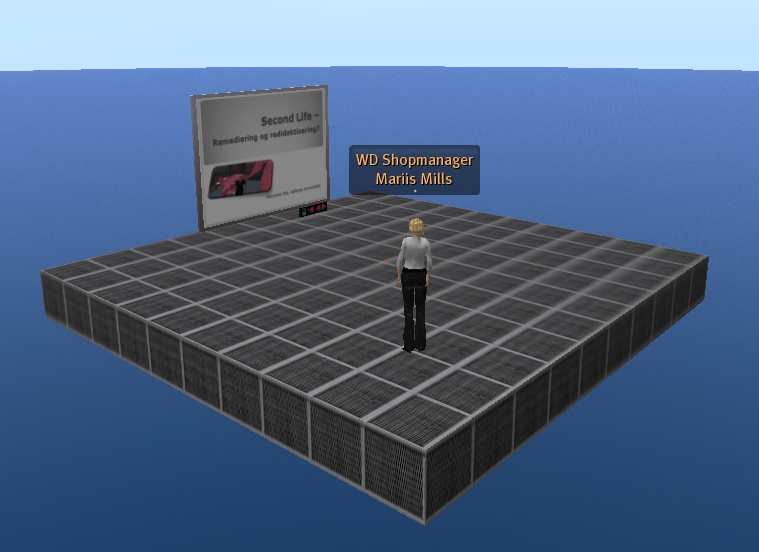
Since I’ve decided to have 4 sessions where we’ll discuss didactic design issues I need a place for this activity. The office that MIL rents on the ground at the Wonderful Denmark Island is way too small, so we have to see if we can fit into the platform, where our Holodeck is located. Luckily Dr. Asp was able to help me clear the location and he also gave me a viewer, where I can present a few slides. So for now the class room looks like this:

holodeck_m_skaerm

I’ve been touring in-world to find places with nice furniture, but instead of decorating the place myself, I think I’ll ask the students to bring their own sitting devices – some might prefer to sit on alternate “chairs” or even lay down or float while attending, and I do believe we should try to experiment with different ways of “attending class”. I’m a bit anxious about the space available – if all students turn up, we might run into a problem, but then we can move to a sandbox, where I quickly can rezz the viewer.

I’ll take some pictures from the first session to show how the place ended design vice …

/Mariis