Design and Education Thinking with Gregory and Moholy-Nagy

This week I’ve been attending both a seminar and a PhD course with Judith Gregory, Institute of Design, Illinois Institute of Technology and Anne Marie Kanstrup, Department of Communication and Psychology, Aalborg University. This post is mainly an overview of my impressions from the seminar – I’ll return to more explicit content issues and a few but very important decisions I’ve made based on especially the PhD course.

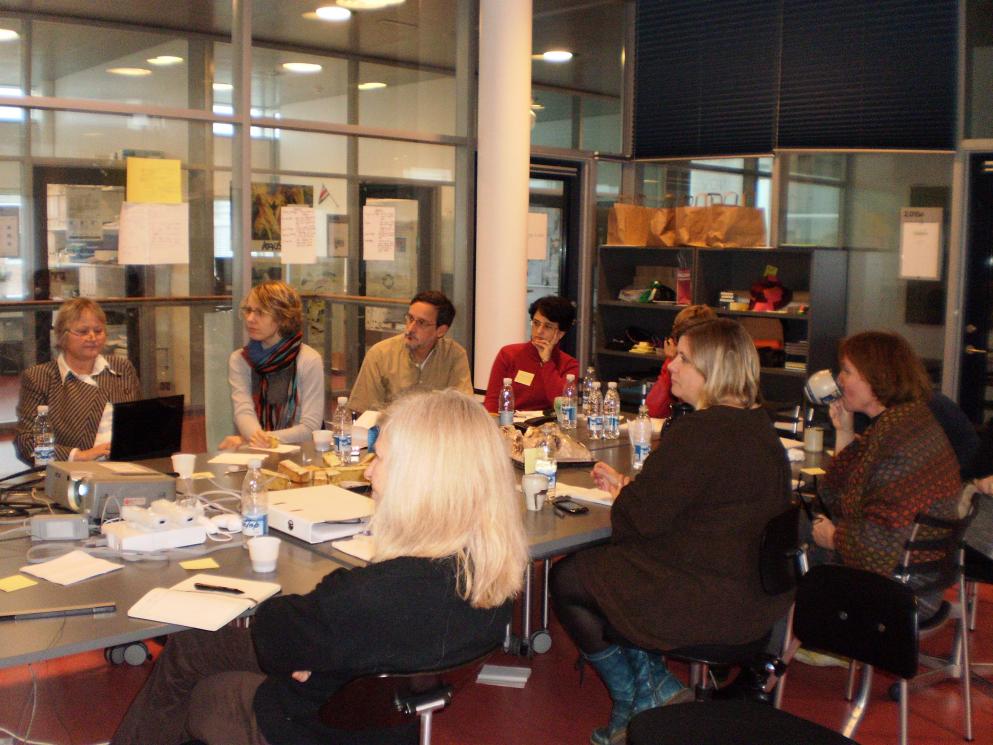
On Tuesday, January 13th Gregory was invited to speak at an internal ELL seminar. Besides Gregory, Kanstrup and ELL’s leader, Lone Dirckinck-Holmfeld (my main PhD supervisor) we were 8 PhD candidates and researchers from ELL and two researchers from Department of Development and Planning. After Dirckinck-Holmfeld had given a short introduction to ELL and the general research and educational /pedagogical strategies of Aalborg University, we all described our research interests to give Gregory an overview of the multidisciplinary field we’re working in.
p1130060
Colleagues in the E-Learning Lab

Gregory then introduced her background, which in the short version includes the following:

  • Institute of Design, IIT, Chicago (since 2005)
  • University of Oslo, Department of Informatics (2001-2005 faculty, 1999-2000 research fellow)
  • Oslo School of Architecture & Design (2003-2006 Professor II, Doctoral Research)
  • Ph.D. in Communication, University of California-San Diego (2000) (Laboratory of Comparative Human Cognition & 3 areas)

When describing her current research interest, it became evident that we would be able to find common ground in many areas:

  • Formal scientific contributions and social commitments & social inclusion
  • Transdisciplinarity in design: thinking across domains & disciplines
  • Social practices basis for understanding users
  • International and inter-cultural collaboration
  • Reciprocal understanding across context
  • Design for negotiation of disparate logics
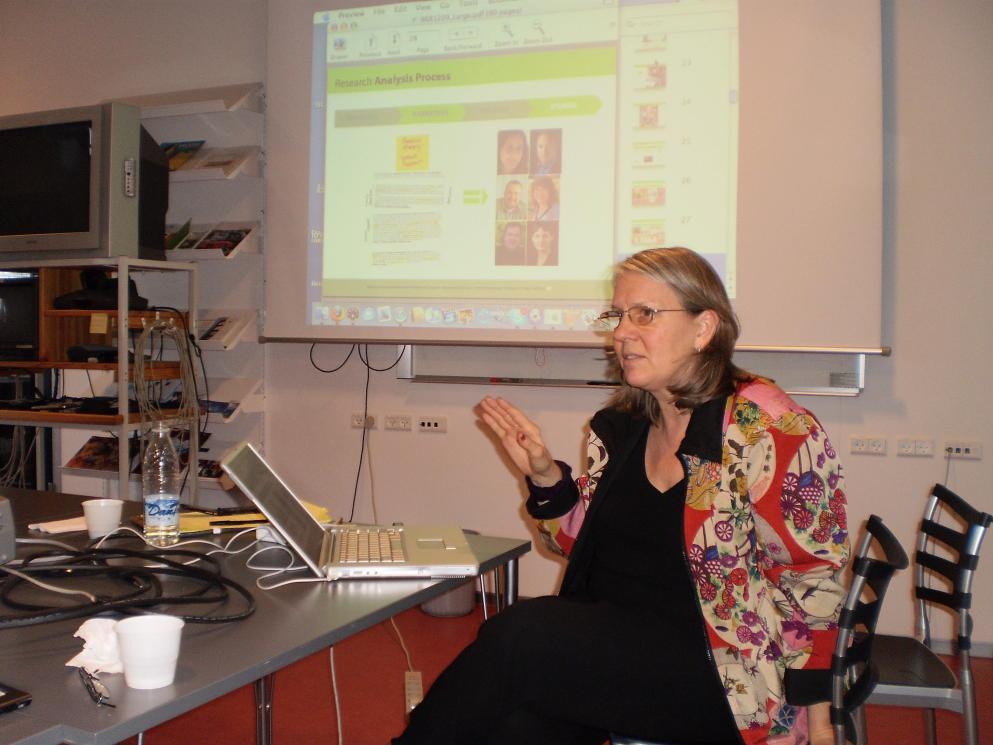
p1130064
Judith Gregory

Besides showing us a number of very interesting case studies she has been involved in, Gregory also shared a very thoughtful and quite progressive statement from the prospectus brochure made by the founder of the School of Design (Institute as of 1944), Lázló Moholy-Nagy back in 1939:
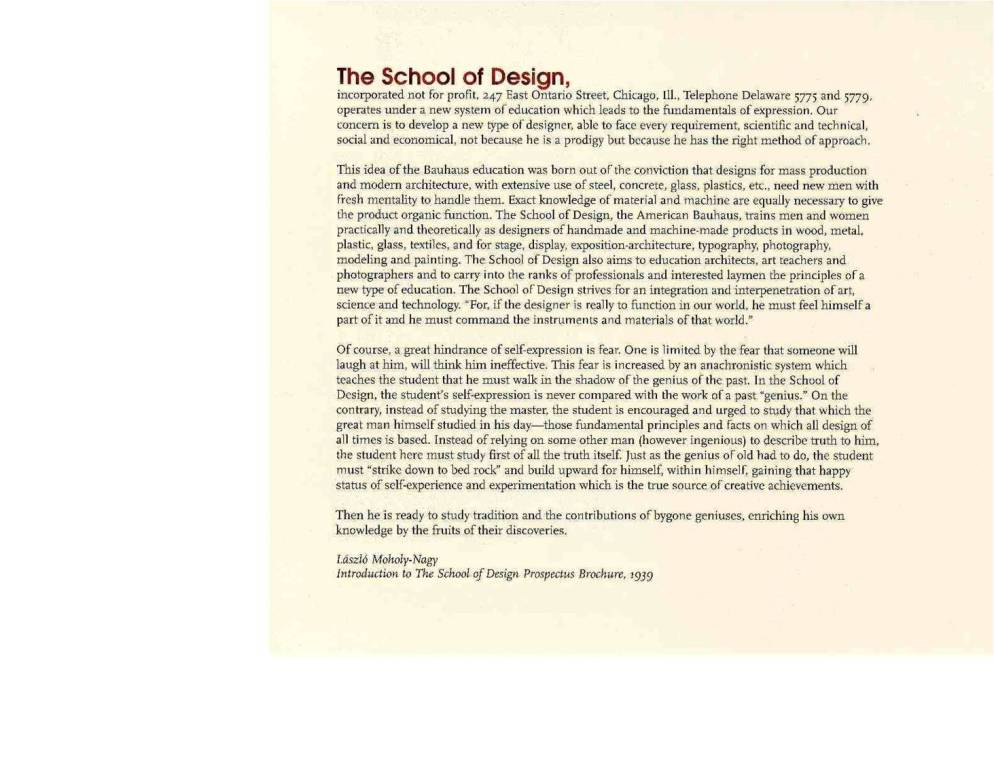
moholy-nagy
Moholy-Nagy’s 1939 statement

Unfortunately this picture is rather unclear, but what I found especially remarkable was Moholy-Nagy’s thoughts on the teacher-student relationship and the potential fruitful learning process:

In the School of Design, the student’s self-expression is never compared with the work of a past “genius”. On the contrary, instead of studying the master, the student is encouraged and urged to study that which the great man himself studied in his day – those fundamental principles and facts on which all design of all times is based. Instead of relying on some other man (however ingenious) to describe truth to him, the student here must study here first of all the truth itself. Just as the genius of old had to do, the student must “strike down to bed rock” and build upward for himself, within himself, gaining that happy status of self-experience and experimentation which is the true source of creative achievements.

Then he is ready to study tradition and the contributions of bygones geniuses, enriching his own knowledge by the fruits of their discoveries.

On a more personal level, Gregory told us that her father actually studied under Moholy-Nagy, and that this was one of the reasons why she had found it difficult not to accept the offer of coming to work at the Institute of Design when she was given that opportunity. Another more professional reason for working at the institute was that it has continued to honor and respect the pedagogical foundations of Moholy-Nagy.

moholy-nagy_portrait2Lucia Moholy, László Moholy-Nagy
1926 © Bauhaus-Archiv, Berlin

In a truly inspiring paper on Moholy-Nagy’s Design Pedagogy, Findeli (1990) describes how Moholy-Nagy developed his pedagogy based on Bauhaus pedagogy, Goethe’s Naturphilosphie and Dewey’s pragmatism.

In bridging the social responsibility with a scientific method based on intuition and problem based experimentation facilitated by a nondirective, noninterventionist, and nonviolent teacher it’s my impression that Moholy-Nagy managed to found a visionary pedagogical philosophy and practice that must have been (and maybe still is) quite provocative and radical to many educators. Findeli (1990:19) concludes that “the general pedagogical approach of Moholy-Nagy, if correctly adapted to the new circumstances, still constitutes a valid preparation toward the tasks that await future designers”. So let me finish this post by quoting Moholy-Nagy once again, this time on his thoughts on designers:

To be a designer means not only to sensibly manipulate techniques and analyze production processes, but also to accept the concomitant social obligations … Thus quality of design is dependent not alone on function, science, and technological processes, but also upon social consciousness. (from Findeli. 1990:19)

Personally, I could rather easily replace designer and design with educator and education hereby deducing that educators are a certain type of designers!

After the seminar we were all invited to Dirckinck-Holmfeld and her husband Arne Remmen’s house for dinner where we continued more informal talks on design, education, politics and democracy, which was a beautiful way to end a perfect day :-)
p11300691
Lone and Arne’s kitchen

/Mariis

Reference

Findeli, A. (1990): Moholy-Nagy’s Design Pedagogy in Chicago (1937-46)
Design Issues, Vol. 7, No. 1, Educating the Designer (Autumn, 1990), pp 4-19
The MIT Press
Design Thinking and Informatics

Next week I’ll participate in a 2 day PhD course on”Design Thinking and Informatics” at HCCI-Doctoral research programme in Human Centered Communication and Informatics, Aalborg University. Course lecturers are Judith Gregory, Institute of Design, Illinois Institute of Technology & Anne Marie Kanstrup, Department of Communication and Psychology, Aalborg University.

Day one focuses on design thinking (vs. construction). Introductions will be made to the history of design thinking in general and current trends in design thinking in informatics in particular. Socio-technical, theoretical perspectives will be introduced and used in discussions of what this way of thinking means for students’ doctoral research projects.
Day two focuses on methodological practices and consequences of design thinking. Case examples will be presented for how selected methods have been employed and students will work on how to integrate design thinking into their research projects.

In order to enroll in this course I had to prepare 1-3 questions related to design within my PhD project. In my view design is an ambiguous term. I do use the term in my project, but depending on what area of my project it concerns, I use the term with different meanings. I tend to regard my whole project as a design, and in Danish I would use the term didactic design to strengthen that I’m concerned with design aimed at a pedagogical practice. However, when I speak with non-Scandinavians the term didactic doesn’t seem to make much sense, and I usually resolve to say educational design instead, but this doesn’t cover my project either. When I explain in further detail what my project entails people – especially Americans – often respond by saying “oh, you mean instructional design”. But instructional design is in my opinion related to a certain pedagogical epistemology on which I don’t agree. It has been suggested that I might use the term curriculum design, but that doesn’t really cover my project either … This uncertainty about how I should coin my design is the main reason for me to participate in the PhD course as I’m hoping it will inspire me to clarify not only the prefix but also the design concept in itself. I therefore have posed the following questions:

  1. How can I define (think of) Design? According to Owen.2004:3 design can be described as “a profession that is concerned with the creation of products, systems, communications and services that satisfy human needs, improve people’s lives and do all of this with respect for the welfare of the natural environment (…) Design involves problem finding, problem solving, analysis, invention and evaluation guided by a deep sensitivity to environmental concerns and human-centered aesthetic, cultural and functional needs.” However, this is not an adequate description of my design concept …
  2. How can I coin my design concept so that it includes pedagogical, participatory and technological aspects?

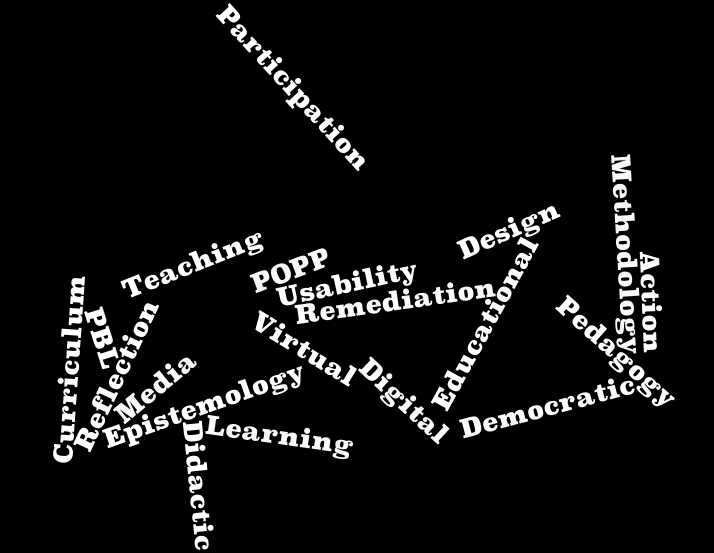
Rheingold. 2008 advocates for the need of Participative Pedagogy as a strategy for designing social media. Participation is already a keyword in my project – both with regards to my overall Action Research inspired approach and with regards to my pedagogical foundation within PBL and POPP. In spite of this, I’m not really sure how to include that particular keyword in describing my project. So as you can imagine, I’m in desperate need of the course ;-) Below I have placed some of my project’s keywords in Wordle, which seems as an appropriate way of illustrating my current state of mind – one big mess!

wordle109

Another interesting part of this PhD course will be for me to figure out how I (my project) fit into the field of Informatics. At ELL we have several researches working within Informatics on either information processing and/or development/design of information systems (IS), but they are using a quite different terminology (which typically indicates different views and practices) and I don’t usually consider myself to be part of that “gang” at ELL. I don’t really like the term IS. First of all, I think the information part associates with a narrow view on communication and system(s) in my ears simply rings too machine’ish putting too much emphasis on the technology. I’m aware that system(s) in several theories* refers to human activity and organization, but I just don’t like it. From talks with my colleagues, I know they share most of my humanistic views and I probably will stand corrected on this after the course – not least because I know for sure that we have common interests on the methodological level. Anyways, I’m looking forward to a couple of interesting days, and hopefully I’ll soon be able to return with a clarifying post on my project design …

/Mariis

References
Owen, C.L (2004): What Is Design? Some questions and answers.
Location

Rheingold, H. (2008): Participative Pedagogy for a Literacy of Literacies.
Location

*) Intersting resource on theories used in IS

Quantitative learning outcome of the MIL course

12 students participated full time in the MIL course, one student divided his attention between SL and the second analytical object, the serious learning game, Global Conflicts, and 2 students who also chose Global Conflicts attended some SL activities ad hoc. The official learning goals of the course (regardless of choice) according to the MIL curriculum were;

The intellectual competence goals are that the student attains competence in:

  • identifying, reflecting on and appraising the scientific basis of ICT and didactic design formulating
  • analyzing and assessing problems within ICT and didactic design.

The professional competence goals are that the student attains competence in:

  • understanding and appraising theories and methods relating to didactic design
  • analyzing and assessing ICT based learning products and virtual learning environments on the basis of theories and methods relating to didactic design.

The practical competence goals are that the student attains competence in:

  • analyzing and assessing ICT based learning products and virtual learning environments on the basis of theories and methods relating to didactic design.

Besides these official goals, I stated that it was my hope that this SL course would force the students to reconsider familiar didactic elements and think out-of-the-box. When trying to articulate his learning outcome, one of the students suggested that this could be done in answering the following 3 questions; 1) What is your most significant learning outcome? 2) Has it been hard? And 3) How does this course differ from other MIL courses?

I think the second question is rather interesting and closely connected to the last question, but also to SL as a medium itself. It is widely recognized that SL has a very steep learning curve and that it takes a lot of time and effort to get accustomed to SL. Based on the general course findings and especially the many interesting discussion I had with the students I will return to this matter in a future post. In this post, I wish to focus on the course design and what this meant for the quantitative learning outcome in general.

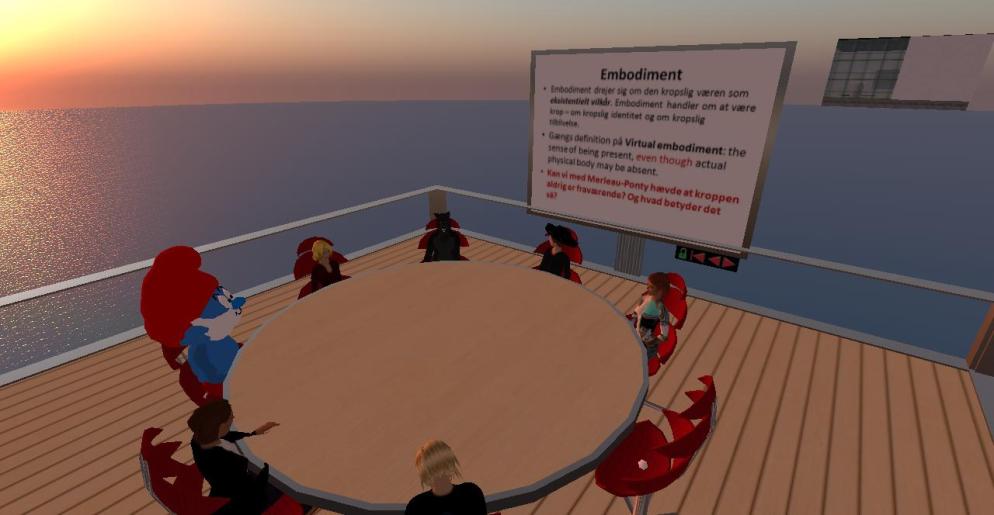
ddd141208_005
Didactic Design Discussion … on embodiment

The course is accredited with 4 ECTS points, which means that there is an expected workload of approx. 100 hours. MIL students are used to working hard, so I was a bit surprised when the student posed this particular question. On the other hand, I knew that this course was quite different from other MIL courses because of all the synchronous activities. Initially I told the students that I only expected them to participate in one synchronous activity in-world during the course, but all of them chose to participate in several. One of the major challenges of conducting distance education for further studies is to maintain a high level of flexibility. The MIL students are all attending the programme in their spare time from work and life in general, and most activities are asynchronous so that the students can chose to participate whenever they can fit it into their busy schedules. Since I knew that many of the students wouldn’t be able to attend on specific days, I tried to plan the activities covering most days of the week, including the weekends so that they had lots to choose from. From November 5th to December 15th there were a total of 25 activities with duration between 1-3 hours. The flip side to this was of course the risk that some students felt that they missed important stuff whenever they weren’t able to attend our in-world meetings. Furthermore the assessment criteria (a minimum of 3 postings in our asynchronous platform) of the course conflicted with the general workload. The students were asked to post their reflections in 5 different conferences covering essential didactic elements;

  1. Didactics and target groups – 32 postings by 12 students and me (8). Approx. 40 A4 pages.
  2. Orientation and navigation – 8 postings by 5 students and me (1). Approx. 8 A4 pages.
  3. Interaction0 posts!
  4. Learning processes – 68 posting by 11 students and me (21). Approx. 83 A4 pages.
  5. Audio-visuals – 9 postings by 2 students and me (4). Approx. 15 A4 pages.

Given that the official criteria was 3 postings corresponding to 3 A4 pages the degree of student activity has been uniquely high also considering the fact that besides these asynchronous discussions we had many, many long discussion in-world! I must say that I’m quite impressed :-)

Even though all students didn’t comment in all of the conferences it was clear from our in-world discussions that they had been reading and reflecting on all of the postings. We also had a general meta conference, which I mainly used to inform the students of upcoming activities and the students posted thoughts they could not fit into one of the 5 above mentioned conferences – there was a total of 232 postings there! Finally there was a conference where the students presented their avatars.

kgi161108_001
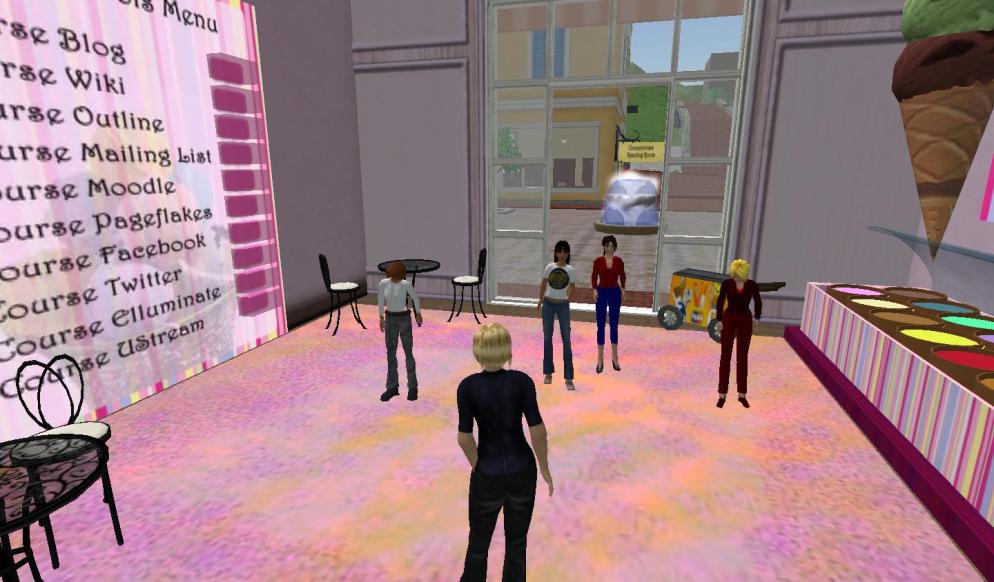
Visiting The Connectivism Course in Chilbo …

MIL students are generally recognized for their huge engagement, but I have to say that this course has exceeded even my highest expectations and it quite funny since the students initially expressed anxiety and fear of not meeting the official criteria.

The assessment criteria and the workload were topics we discussed eagerly during the course, and these are didactic elements that I need to reconsider, not only because the workload may prevent some students from choosing this course in the future, but also because 3 asynchronous postings may not be the best way to show learning potential and outcome of SL. I will return to this in a future post where I’ll be evaluating the different in-world activities also. For now I’ll plunge into the students own articulations of their qualitative learning outcomes and return asap … but based on the course activities I think its safe to say that all the students reached the course goals admirably!
/Mariis

Challenges of flexibility and facilitation

Last week we had a 3 day f2f seminar at the MIL programme, where my colleagues and I introduced the 4th module on Ict and Educational design – the module in which I facilitate a blended in-world course. Saturday afternoon I started out by giving a lecture on remediation and redidactization focusing on respectful and radical design in SL both regarding people, places and processes. After the introduction we had a hands-on workshop where basic SL functionalities were explained and tested. 13 students out of 25 signed up for the course, and 5 other students, who chose to analyze a learning environment different from SL, wish to participate informally which I allow.

The course in fact started on November 1st but the period up until the seminar is mainly reserved for the students’ preparation (reading, creating an account and joining the in-world group). I did however plan some “Get off to a good start” in-world activities before the seminar, but only a few students attended these. All the different activities in-world are voluntary and I only demand that each student participates at least once in scheduled in-world activities during the course. The argument is that the MIL programme is intended to be flexible in order for the students to be able to participate even though the majority is full time employed, and several mandatory online activities would challenge that flexibility. Furthermore as part of a problem based pedagogy the students are expected to explore and investigate on their own and in their study groups. This pedagogical strategy is possible not least because the students are adults, highly motivated, comfortable with taking responsibility for their own learning and in most cases appreciate the freedom of choice. Last year when I did the same course, a handful of the students chose to participate in several of the activities, and I expect that to be the case this year also.

kgi161108_001

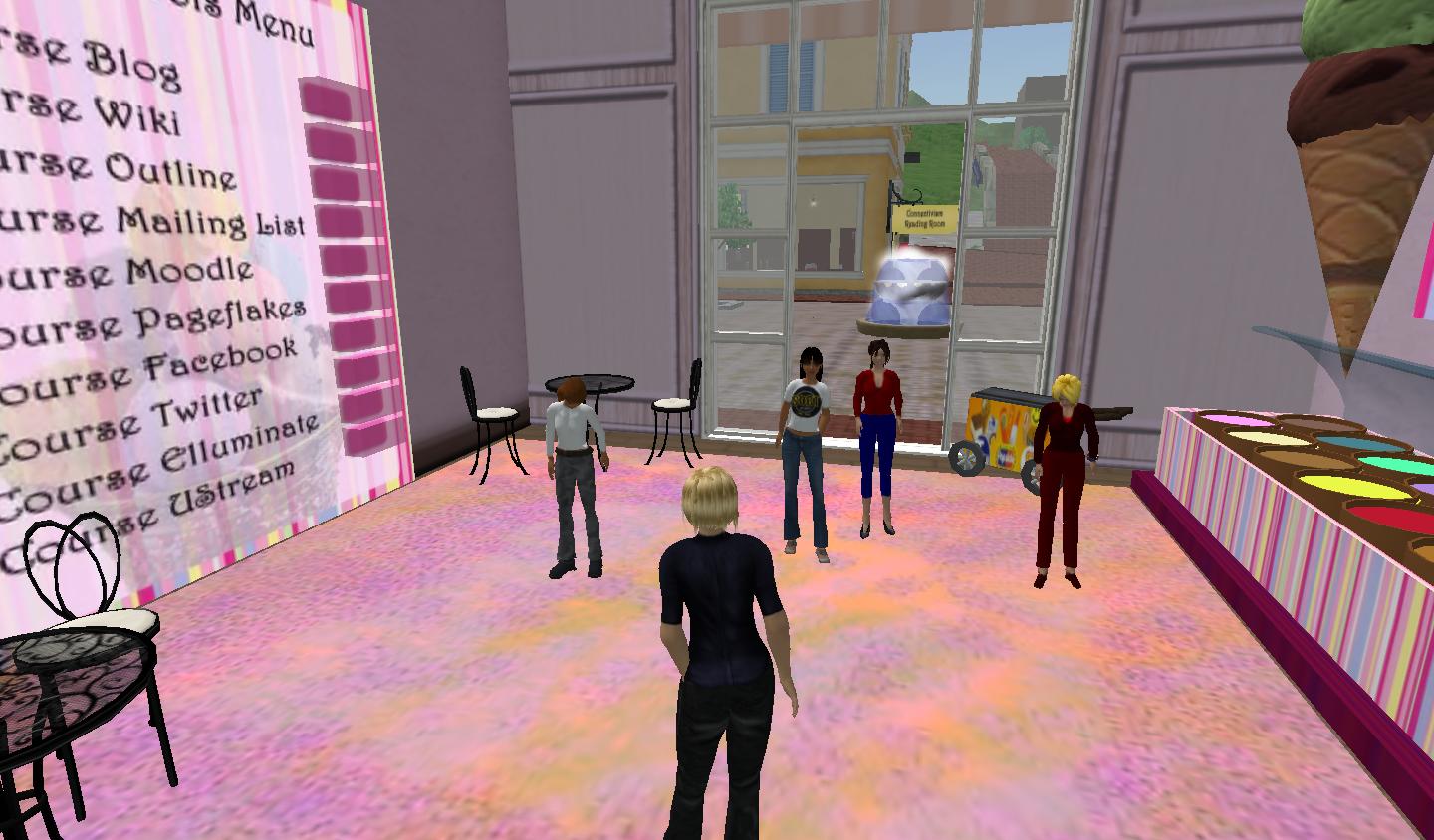
Meeting on November 16th – showing some students the Connectivism Village

Promoting and ensuring student autonomy is a cardinal point of my (and MILs) pedagogical philosophy, nevertheless this strategy poses some challenges as seen from the facilitators point of view. I’ve planned roughly 3 activities pr. week and they last between 2-3 hrs, and so far I’ve been the only facilitator. (This week we’ll start having activities with in-world colleagues). One of the challenges of this “buffet pedagogy” is that I never know how many students will attend, and since the sessions are relatively long some students choose to participate in parts of the activity only. Not knowing the exact number of participants calls for flexible planning thus challenging me to let go of my usual need for control and structure.

A different challenge of this flexibility for me as a facilitator is that I constantly have to be aware of new students joining and try to include them simultaneously during the sessions. A good feature for this of course is the IM, which makes it possible to text without interrupting the whole group. This is something not possible in real life, and I do think that it is quite smart, but I also have to say that it is fairly demanding on the facilitator. I suppose the ability to text chat with several participants simultaneously is a skill that “just” needs to be learned, but I can’t help wonder if this rather complex way of communicating would discourage some potential teachers from trying out SL or similar environments.

The last 2 Mondays I’ve been attending Metanomics meetings with students, and on these occasions I had respectively 10 and 12 active chat windows, so my immediate impression was that I spent most of my time paying attention to the chats rather than the speakers. The main reason for attending these Metanomics meetings was to show the students this particular way of communicating, “Constructive Cacophony” as Bloomfield calls it, so the content wasn’t all that important. I will return to the content issue in another post, but for now I just want to reflect on the possibility of using text and voice simultaneously. At the Metanomics meetings Bloomfield is assisted by moderators, and if we transfer this to an educational setting the solution could be to have more than one teacher or perhaps a TA.

Another option is to limit the text chat and ask participants to use a certain group chat only. This might work well, and we’ll experiment with that down the line, but here in the beginning of the course, I believe that it is very important not to limit the students’ use of IMs to the facilitator. It’s my clear impression that the IMs serve as an invaluable support giving especially less confident students a communication channel where they do not need to “expose” their inexperience and/or insecurity. The trick here – just like in real life – is to create an atmosphere where no questions are too small or too stupid. On the other hand, it is also my impression that the students choose IM because they experience this as being more polite than interrupting the activity with personal /individual questions, and this may be because we have not yet reached consensus on how to communicate in these in-world situations.

Finally, from another perspective this possibility to pose individual questions during group activity may enhance inclusion in a way not possible without technology mediation, and this is truly where I begin to see SL as a strong learning environment … even though it initially challenges both the students and the facilitator :-)

/Mariis

NoEL visits Zotarah Shepherd’s MI build

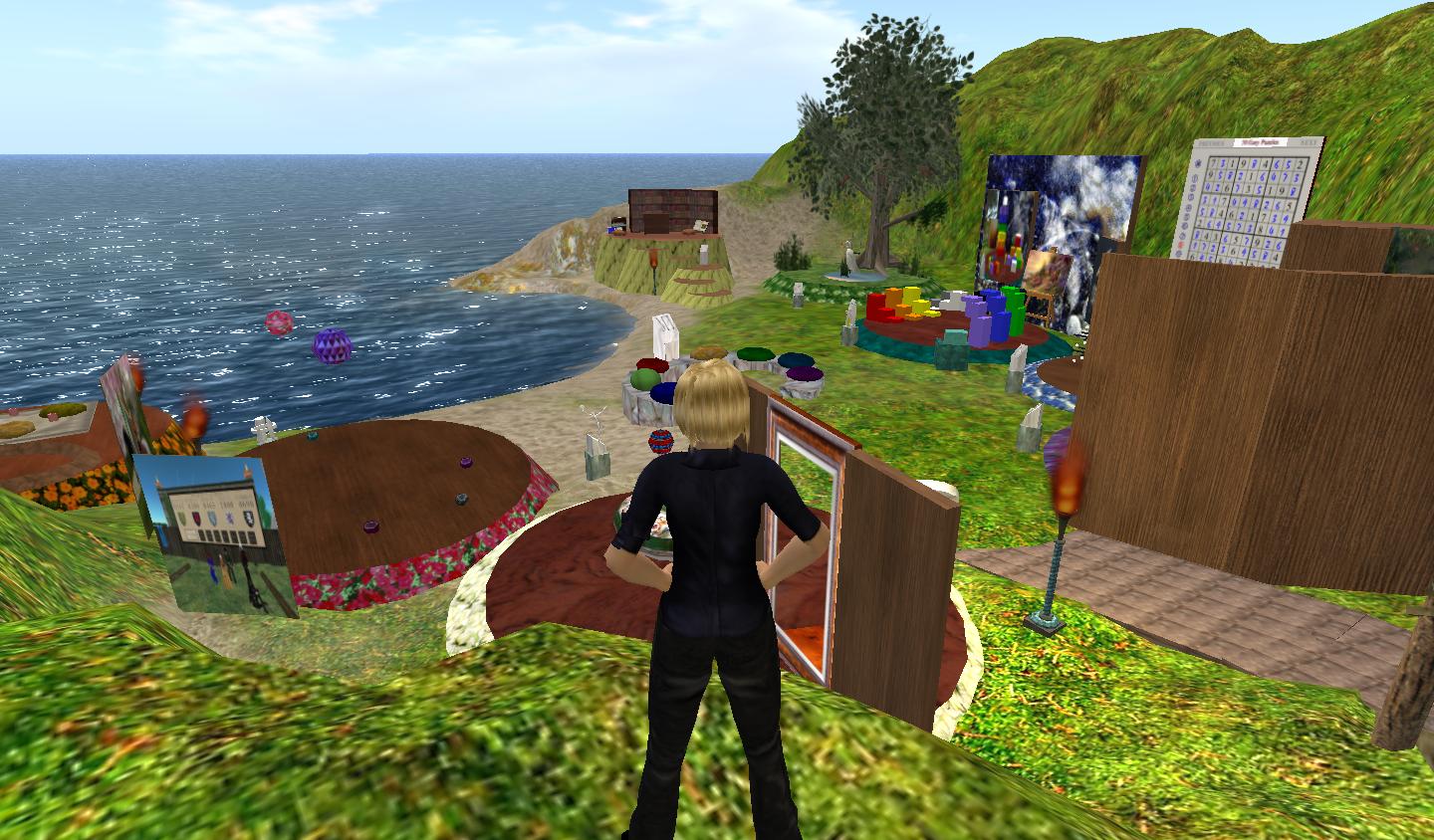
On Tuesday September 30th the NoEL group will visit Zotarah Shepherd on the Koru Island to learn more about her creation of Howard Gardner’s Multiple Intelligences. Zotarah is currently working on her MA in Education CTL at Sonoma State University (California).

Zotarah asks her guests to consider the following questions:

  • Would you use the information in a classroom for teens?
  • Looking over the topics in the curriculum which of them would be most useful to teens?
  • Do you think that SL is an appropriate venue for presenting this information to teens?
  • Would you use interactive builds in SL to teach classes?
  • How well do think my builds work for illustrating the concepts?

We have to meet Zotarah at 20:30 on the Koru Island – use the landmark, including Curriculum send via group notice in-world :-)

/Mariis