Case MIL09: Didactic Design Discussion – 3

On Monday November 30th my co-facilitator, Mew Aeon was in charge of the 3rd Didactic Design Discussion in the MIL course. Unfortunately it was one of those nights where the technology really became an obstacle for me, since I was logged out of SL several times, but judging from what I did experience and the students’ comments they enjoyed the discussion very much.
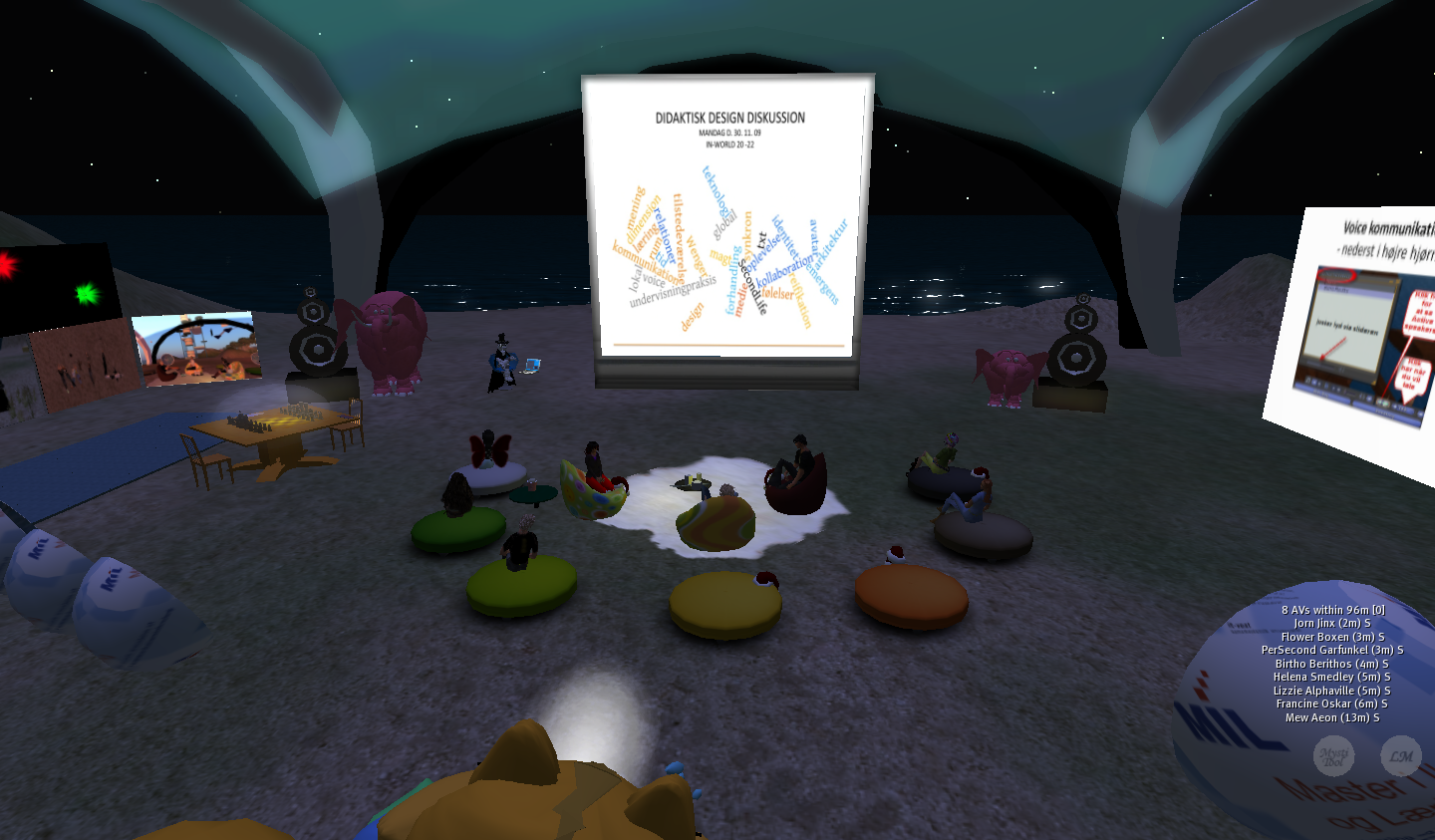
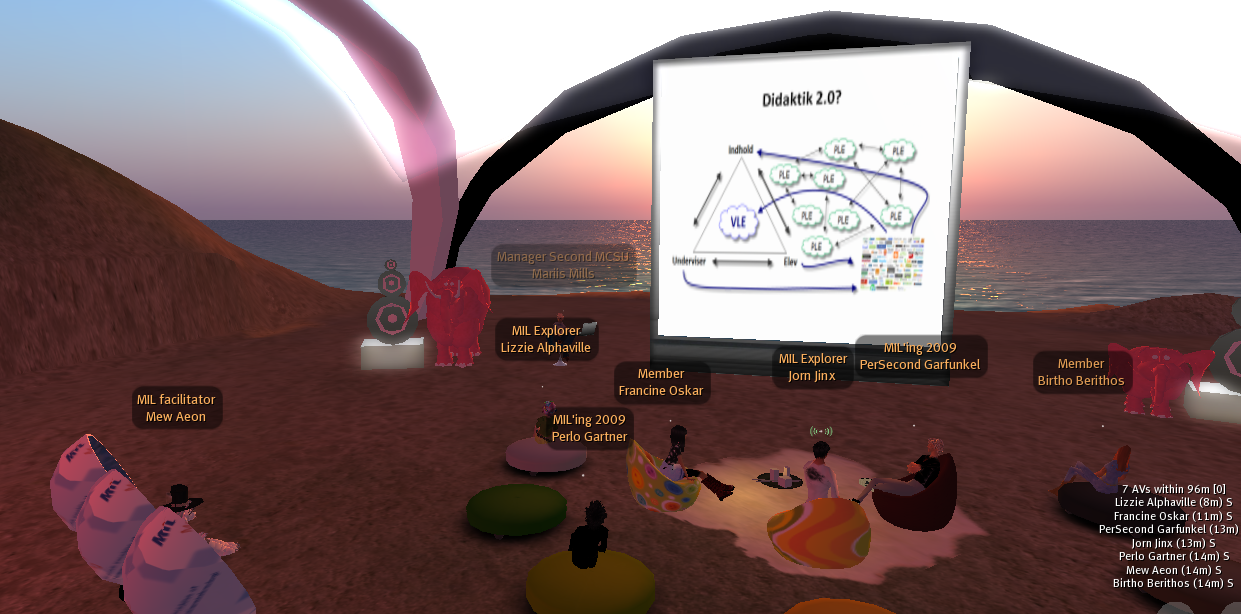
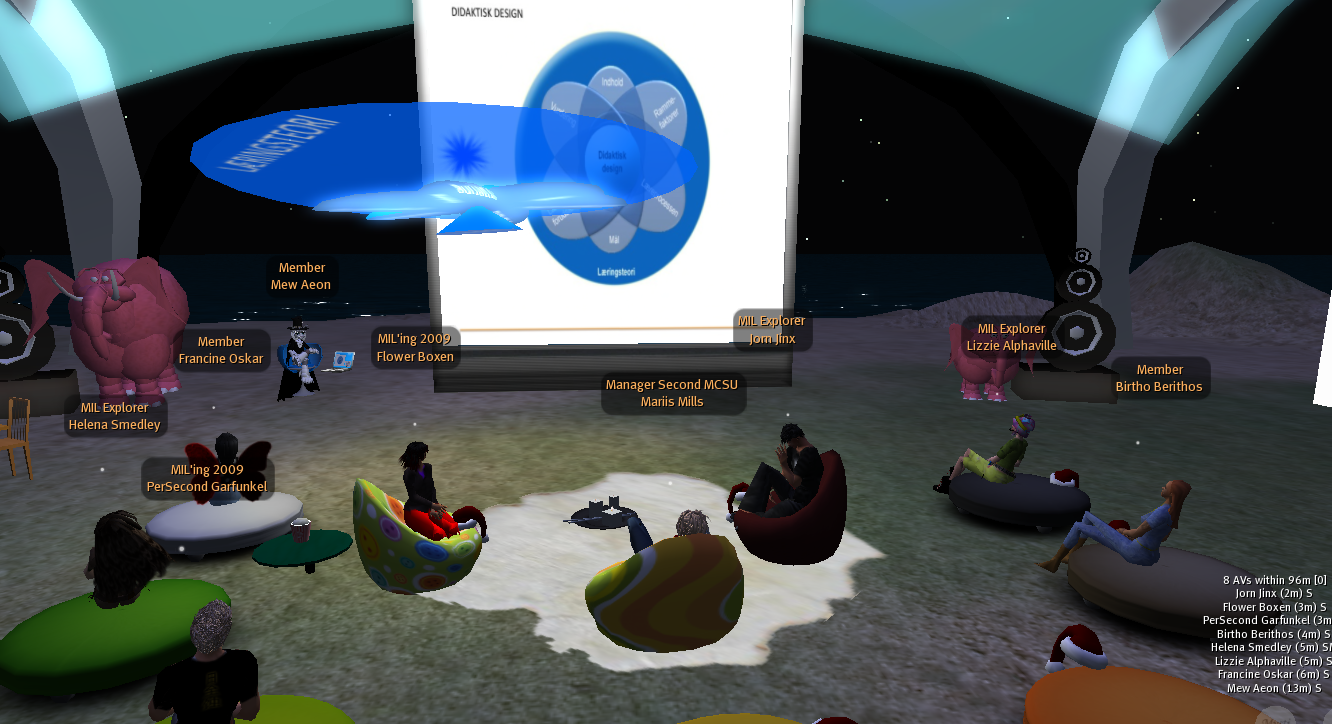
The purpose of these discussions is to stimulate the students’ critical thinking and didactic-pedagogical imagination and Mew chose to present two different models for Didactic Design. The first one, the so called Didactic Relation Model, originally developed by Norwegian educational researchers Bjørndal & Lieberg (1978) and further developed by 2 other Norwegians Hiim & Hippe (1998), is intended as a planning tool for teachers and is widely used in Scandinavia. The Didactic Relation Model illustrates the relations between learning conditions, external factors, goals, content, learning processes and assessment. In Mew’s version he added a learning theoretical layer and included Didactic Design as explicit goal for the use of the model. For the discussion Mew had prepared the model in a 3D version:
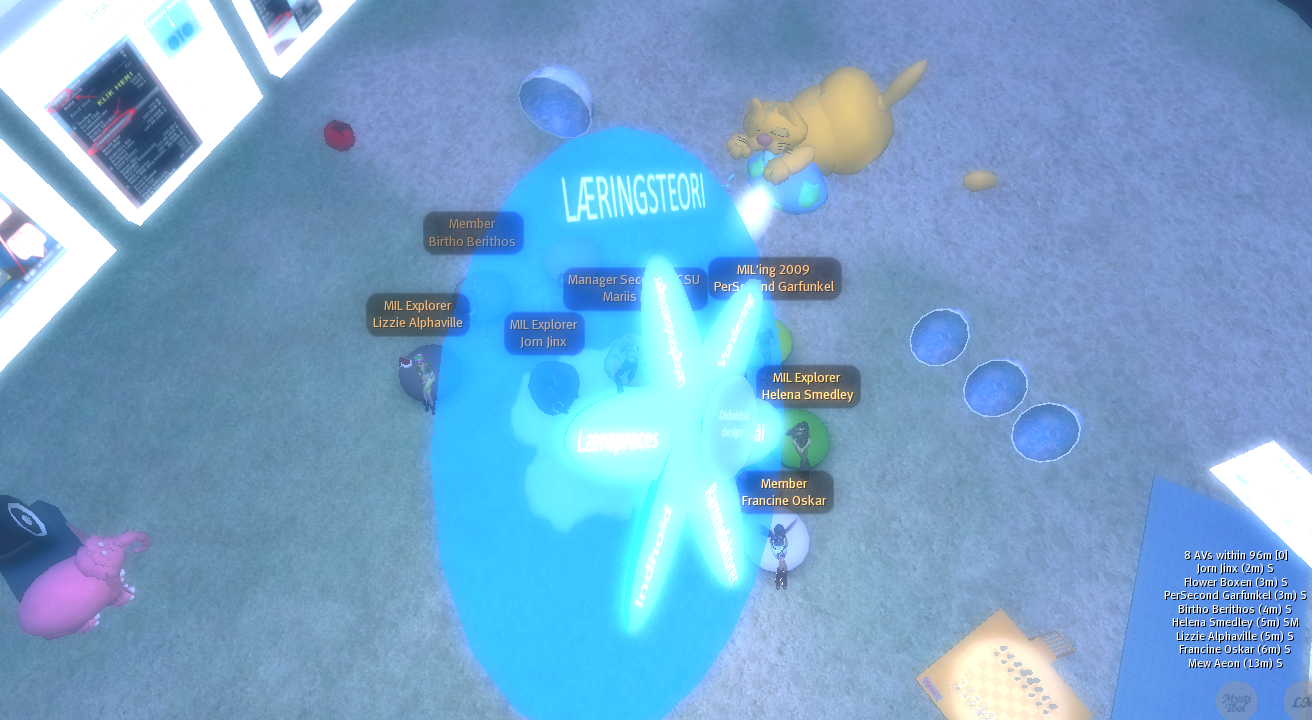
The second model Mew presented was a revised version of Wenger’s (1998) model of Four dimensions of design for learning that shows four dualities between which one will find inherent tensions that need to be  addressed in the designing process. Besides these dualities Mew had added 4 more elements (meaning, time, power and space) that he found valuable to focus on when he originally redesigned Wenger’s model as part of his Master Thesis  work – the report (in Danish) can be downloaded here.
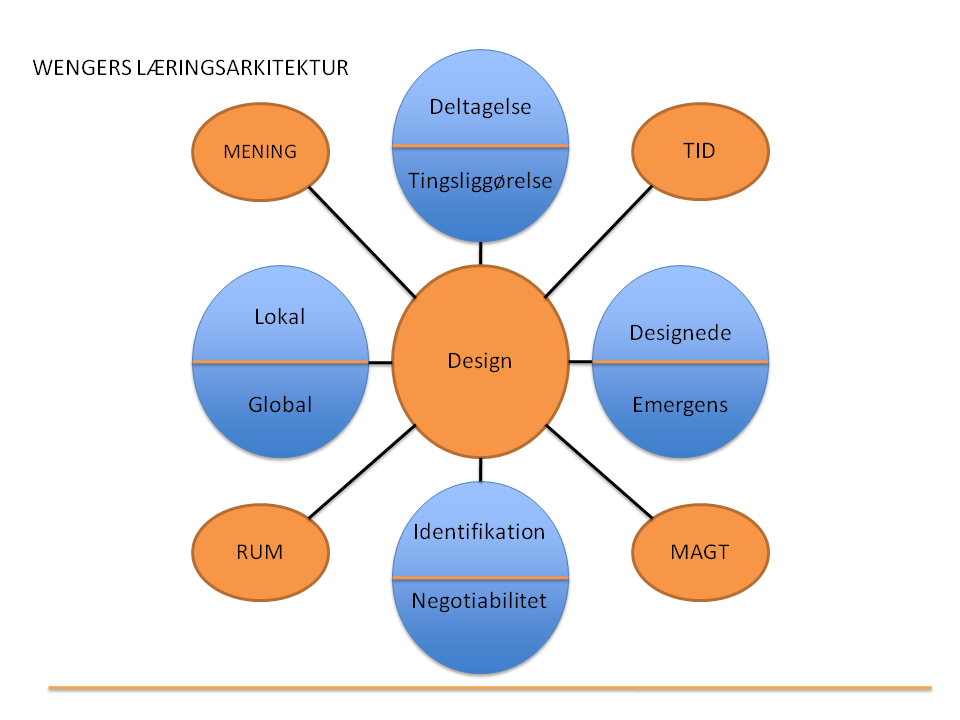
For each of the elements Mew gave examples from SL and since both Wenger’s CoP theory and the concept of Legitimate Peripheral Participation are highly popular among MIL students it seemed to promote a vibrant discussion. After the theoretical discussion Mew took us on tour to three different locations based on design ranging from very respectful remediation to radical, NpIRL remediation:


Sistine Chapel


Exploratorium


Organica


After the session Mew and I stayed a bit to discuss his impressions, since this was his first formal lecture in-world. The keywords were riotous or unmanageable compared to real life, because there were so many simultaneous things going on; the text and voice chat, activity and movement of the avatars while trying to focus on the content of the presentation, looking at notes and managing the slides and steering the 3D model. I clearly recognize these sentiments from my first in-world teaching experience, but the good news are that it gets better – and even though it was different from teaching in real life, Mew definitely got “hocked”, so despite my technical problems, I believe it was a very good night :-)

/Mariis

Case MIL09: Didactic Design Discussion – 2

In the 2. Didactic Design Discussion in the MIL course I’d chosen to focus on some of the central points from my own PhD-project since it also deals with analysis of SL as teaching and learning environment. Discussing some of my own ideas with the students naturally is very inspiring and rewarding for me personally, but I’m also hoping (and sensing) that the students benefit from seeing my approach to the problem, and judging from the vivid discussion I do believe, I managed to challenge some of their presumptions. I’m not able to reproduce all of it, but I will try to highlight a few issues.

Essentially my PhD-project is aimed at improving Blended Learning within Higher and Further Education through remediation and redidactization. Through a process of designing and redesigning two specific Blended Learning courses within 6 research cycles the aim is to enhance learner experience and learning outcome by using new augmented/immersive 3D media and a learner centered Problem Based pedagogical approach. In both cases the target group is adult teachers/ trainers from the educational and the private/industrial sector from different countries.


PhD-project overview – Fall 2009

The concept remediation (in relation to new media) was coined by Jay David Bolter and Richard Grusin (2000), but there was no explicit value or quality identified with different ways of remediating in the original concept. However, Tringham, Mills and Ashley (2007) further developed the remediation concept in their Remediated Places Project and came up with two distinct strategies for remediation, respectively respectful and radical. In my point of view these two strategies can be extended to include pedagogical considerations and thus inform more general implementation strategies for blended teaching and learning using new media.

I first introduced the MIL students to the concepts of respectful and radical remediation in the course last fall and like this year’s students they immediately adopted the terminology. If you’ve ever been in SL you’d know why – it makes perfect sense to distinguish between the two both with regard to people, places and practices. The interesting question nonetheless is whether remediation changes anything in the way we think and practice teaching and learning …


Is a slide show presentation in SL an innovation?

According to Peter Denning an innovation can be defined as a transformation of practice in a group, community or culture – it is not enough just to come up with a brilliant idea or create a new artifact. Surely there are many different definitions of innovation, but I agree with Denning and it aligns very well with Wenger’s 1998 social theory on Communities of Practice, which is one of my core inspirations. Changing practice is easier said than done and Steven Warburton has identified 7 barriers to innovation in 3D environments like SL:

  • Technical – machine and human related [and standards related]
  • Identity – the tension between playfulness and professionalism
  • Culture – reading the codes and etiquette of SL
  • Collaboration – building trust
  • Time – even simple things take time 
  • Economic – nothing is for free
  • Design – perhaps this is a meta-barrier but SL does offer up very particular design challenges

Besides these I would add another meta-barrier, namely the inherent paradox between (re-)production and innovation that all participants in education are facing. This is what I call the didactic double bind. In general double bind is described as dilemmas in communication, and SL seems to be filled with conflicting messages. After the session one of the students posted this photo as her take on a in-world double bind:

The text for that photo could read: ”SL is an open environment. Join us if you can”. Naturally, the experienced SL resident would know that the dilemma in this particular situation is metaphorical – a shift in camera angle and you’d be there… the perspective on the situation would change and shifting perspective, looking at dilemmas at a higher level of abstraction is one way of solving double bind situations and would according to Bateson. 1972 mean learning at level III. And this is actually one of the reasons why I find SL so interesting – if we assume that the learner overcomes the initial difficulties and gets accustomed to the environment it provides rich opportunities for learning at higher levels, because SL inevitable challenges the learner both ontologically and epistemologically due to the whole meta-cognitive nature of the in-world experience.

After this we moved on to discuss the concepts of immersion and augmentation and what these two apparently conflicting ways of engaging in an environment like SL could mean – not least when it comes to teaching and learning practice. Again the students were eager to discuss and we covered a lot of important points on which I will return in a later posting. Suffice to say that we all agree with Tateru Nino on this:

It’s not all black and white.
The whole immersion versus augmentation debate is clouded by one trivial little detail. One is not the opposite of the other. The two aren’t even mutually exclusive.

We ended the session by trying out the Opinionater – it really is a very efficient and fun tool for stimulating discussions :-)

/Mariis

Case MIL09: Didactic Design Discussion – 1

In the MIL course my co-facilitator Mew Aeon and I currently are running in SL the students are expected to analyze SL as teaching and learning environment, and in order to stimulate the students’ critical reflections we have prepared 4 discussions on different topics related to ICT-based Didactic Design. Last night we had the first discussion and for this I had prepared some slides (in Danish) focusing on two main topics; the field of Didactics and target groups.

8 students are enrolled in the course and since 3 of them did not have the possibility to participate in our recent f2f kick-off introductions  I had decided to repeat some central points. First of all there is the term ICT-based Didactic Design, which my colleague, Professor Birgitte Holm Sørensen from the Danish School of Education defines like this:

The process by which the purpose, the goals and the content is determined, and where the planning, the organization and the arena for teaching and learning is shaped based on theories and in relation to ICT-based practice in a context.

Via course readings the students are introduced to various didactic theories and models – one of the latter being the so called Didactic Triangle (usually attributed to German Pedagogical Philosopher Johann Friedrich Herbart 1776-1841) that depicts the basic relationships between teacher – content – student. Though all of us can agree that the field of Didactics includes more elements than the relationships in the Didactic Triangle it does, in my opinion, highlight the fundamentals and creates an excellent starting point for discussions on some of the key issues in Didactics.


Key issues in Didactics: content and actors

Now, what I find particularly interesting when you combine ICT with Didactic Design is that ICT not only serve as materials but also as arena or “room” for teaching and learning –an aspect which clearly is amplified when using 3D virtual technology like SL.  Most MIL students can be characterized as being tech-savvy educators/trainers for whom it is relevant to further enhance their competencies in integrating ICT in their practice and we naturally ended up discussing what impact especially web 2.0 tools/services will have on the way we think and practice didactics.

As I see it Web 2.0 tools/services have the potential of changing our perspectives and thus practices regarding:

  • Users – both the students and the teachers with regard to relations/roles/responsibilities
  • Participation – as we shift from consumption to (co-)production
  • Multimodality – new possibilities to design for teaching and learning processes
  • Networks and connections – from local to global citizenship
  • Knowledge management – both from an information and communication perspective and with regard to security and ethics


How does web 2.0 change the way we think and practice didactics?

For the last decade the Danish pedagogical debate has been focusing on learning and learners (in opposition to teaching and teachers) – and this shift in perspective has been highly welcome and much needed. On the other hand this shift seems to have placed the role of the teacher in some sort of vacuum (are teachers obsolete in the future as polemically stated by David Gelernter ?) making the challenges related to especially ICT integration more difficult and complex than necessary. When discussing target groups we therefore also encourage the MIL students to carefully consider the roles of the teachers. Much as anticipated we did not reach any solid conclusions on any of the topics, but I do believe the discussions inspired the students and I’m looking forward to the next session later this week.

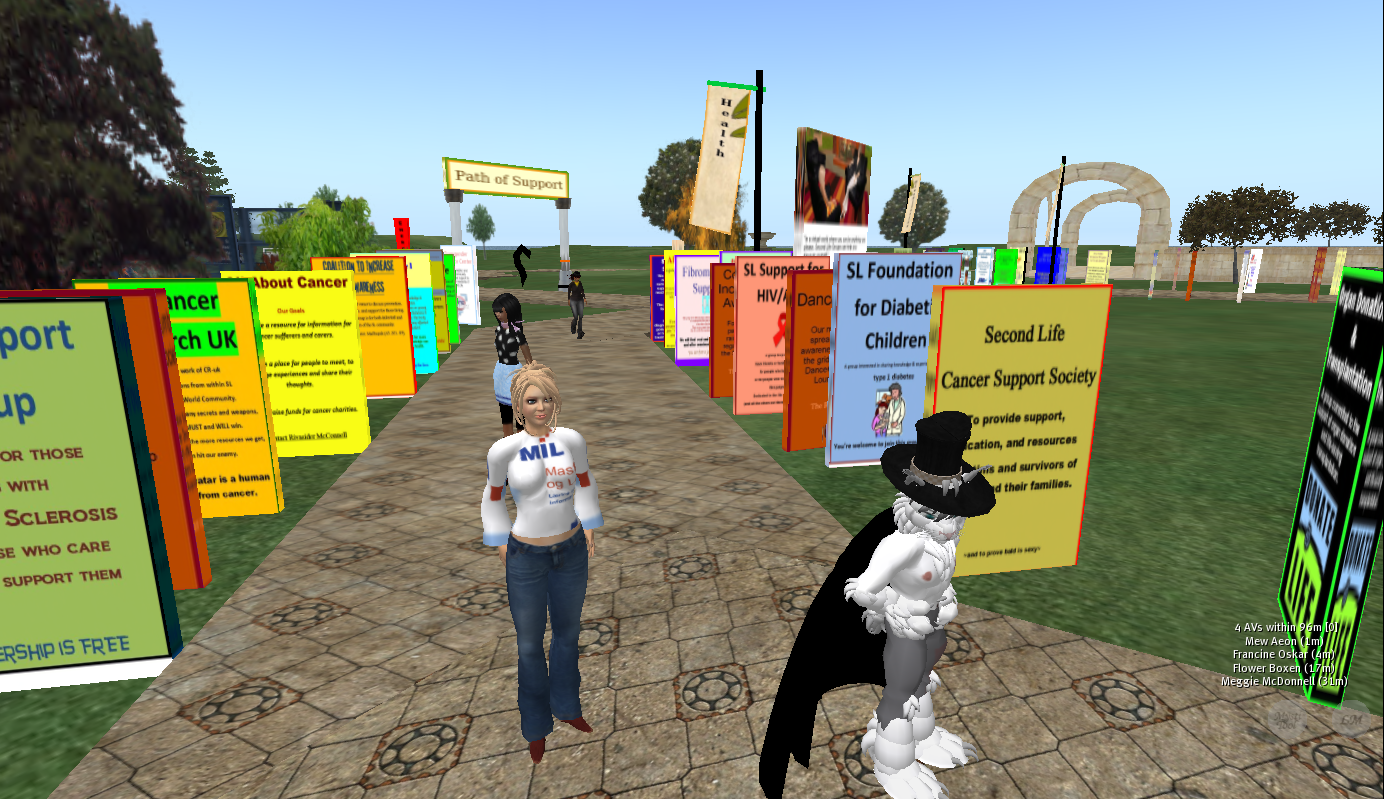
As part of our focus on target groups who could benefit from an environment like SL, we ended the night by visiting Health Info Island, including The Path of Support and finished off by investigating the Virtual Guide Dog.

/Mariis

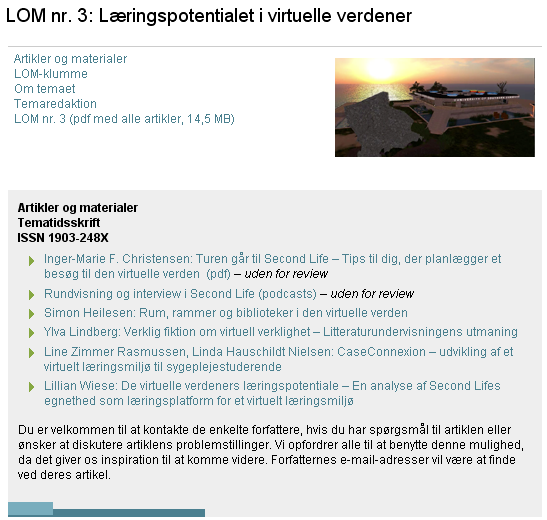
LOM nr. 3: Læringspotentialet i virtuelle verdener

Online tidsskriftet Læring og Medier nr. 3 handler denne gang om læringspotentialet i virtuelle verdener.


Om artiklerne:

Rejseguide til Second Life I erkendelsen af at mange har en mening om virtuelle verdner og at kun få har faktiske erfaringer, indledes LOM #3 med Inger-Marie F. Christensens rejseguide ”Turen går til Second Life”. Artiklen er optaget uden for review. Formålet med denne artikel er at give et overblik over Second Life for at gøre det muligt for førstegangsbesøgende at orientere sig og planlægge meningsfulde besøg in-world. Artiklen er opdelt i to sektioner. I første sektion har forfatteren samlet en række praktiske oplysninger om bl.a. avatarfænomenet, installation af Second Life, tidsforskel, valuta samt kommunikationsformer og transport/navigation in-world. I anden del af artiklen har en række dedikerede og entusiastiske Second Life brugere bidraget med slurls til og en kort beskrivelse af deres favoritsteder. Der er noget for enhver smag.

Interview med og rundvisning ved avatar Gunhild Soderstrom – 2 Second Life-optagelser
Første optagelse tager seeren med på en rundvisning in-world, hvor Gunhild Soderstrom præsenterer Percipitopia, der bl.a. byder på en rekonstruktion af den irske filosof George Berkeleys hjem ”Whitehall” på Rhode Island og The White Room of Disorientation, der illustrerer Berkeleys ”Theory of vision”. Rundvisningen afsluttes med en solopgang ved klippen Hanging Rock, hvor Berkeley efter sigende har udtænkt flere af sine teorier. Bag avataren Gunhild Soderstrom gemmer sig lektor i filosofi Cynthia Grund fra SDU, som avataren Inga Miles alias Inger-Marie Christensen i anden optagelse har interviewet i Second Life. Det er blevet til en diskussion om læringspotentialet i virtuelle verdner og om Cynthias konkrete Second Life projekt Percipitopia, der er et eksperiment med 3D mediering af museumsundervisning. Begge produktioner er optaget uden for review.

Rum og rammer i det virtuelle
Efter det indledende afsnit omkring Second Life og det efterfølgende eksempel og interview optaget i Second Life, introducerer Simon Heilesen i ”Rum, rammer og biblioteker i den virtuelle verden” til, hvordan den virtuelle verdens miljø anvendes og opleves i en faglig sammenhæng. Heilesen tager udgangspunk i det danske biblioteksprojekt Info Island DK i Second Life, og sammenligner det med en række andre typiske biblioteker i in-world i relation til design. Han konkluderer, at den virtuelle verden kommer med en række betingelser af både mental og metaforisk art, som både sætter ramme og betingelser for anvendelsen og udfoldelsen.

Litteraturundervisning og virtuelle verdner
Artiklen ”Verklig fiktion om virtuell verklighed” af Ylva Lindberg tager udgangspunkt i spørgsmålet om, hvorfor og hvordan humaniora skal integrere ny teknik, underforstået den virtuelle verden repræsenteret af Second Life. Lindberg tager afsæt i et konkret forsøg på at anvende Second Life i litteraturundervisningen og argumenterer for, at den virtuelle verden er et oplagt sted at lade litteratur og teknik mødes. Afslutningsvis binder Lindberg litteraturen og den virtuelle verden sammen på ny vis, idet hun viser, hvordan to konkrete romaner omhandlende virtuelle verdener, kan knytte an til væsentlige indsigter og diskussioner om litteraturens genstand.

Virtuelt læringsmiljø til sygeplejestuderende
I artiklen ”CaseConnexion – udvikling af et virtuelt læringsmiljø til sygeplejestuderende” videregiver Line Zimmer Rasmussen og Linda Hauschildt Nielsen deres erfaringer i forbindelse med udviklingen af et interaktivt 3D læringsmiljø. Læringsmiljøet indeholder hospitalsstuer og patienter, som gør det muligt for sygeplejestuderende at omsætte teori til praksis, og tager udgangspunkt i problembaseret læring, hvor de studerende arbejder med cases og opnår øvelse via simulationer. Artiklen indeholder didaktiske refleksioner over valg af platform samt over de principper, der ligger til grund for det konkrete design af læringsmiljøet, herunder overvejelser mht. professionstænkningens indflydelse på disse designprincipper. Artiklen afsluttes med vigtige anbefalinger ift. hvordan undervisere og studerende klædes på til at gennemføre succesfulde læringsforløb in-world.

Hvad mener de studerende selv?
Lillian Wiese har foretaget en analyse af en gruppe studerendes oplevelser i Second Life med henblik på at vurdere, hvor velegnet den virtuelle verden er som platform for udvikling af et 3D-online læringsmiljø baseret på edutainment og pervasive learning. I artiklen ”De virtuelle verdeners læringspotentiale” videregiver hun resultaterne samt egne konklusioner og anbefalinger. Endvidere peger Lillian Wieses analyse af de studerendes oplevelser på nødvendigheden af at skabe gennemtænkte forløb med interessante og veltilrettelagte aktiviteter. Hun anbefaler, at der skabes trygge rammer både psykisk og fysisk og peger på behovet for mentorer og coaches.

Det er fælles for artiklerne i dette nummer af LOM, at de alle illustrerer, hvordan en remediering af undervisning og andre praksisser til en 3D virtuel verden kræver nytænkning frem for overførsel af traditionelle processer og rammer. Nytænkningen viser sig altafgørende for at kunne skabe meningsfulde forløb for deltagerne. CaseConnexion er et glimrende eksempel på, hvordan de virtuelle verdners helt unikke karakteristika anvendes til at skabe immersiv læring, der sætter det sensomotoriske i spil og giver de lærende mulighed for at opnå praksiserfaring.

Det samme gør sig også gældende i VIA University College projektet ”Innovative Learning”, der er nævnt i artiklen ”Turen går til Second Life”, og som netop har modtaget ”Den Nationale e-Læringspris 2009”.  Innovative Learning er et 3D læringsmiljø, der er konstrueret som en byggeplads, og hvor tømmerlærlinge uddannes indenfor sikkerhed og miljø. Her viser Second Life sit potentiale som læringsplatform for unge og ældre, der ikke har gode erfaringer med det overvejende boglige uddannelsessystem i Danmark. Virtuelle verdner er unikke på den måde, at de ikke primært er baseret på sproglige erkendelsesformer, men tværtimod har en stærk visuel og kropslig dimension. Måske er det netop virtuelle verdner, der kan være medvirkende til at give det danske uddannelsessystem et løft og bidrage til at opfylde målsætningen om, at flere unge skal igennem dels en ungdomsuddannelse og dels en videregående uddannelse.

/Mariis

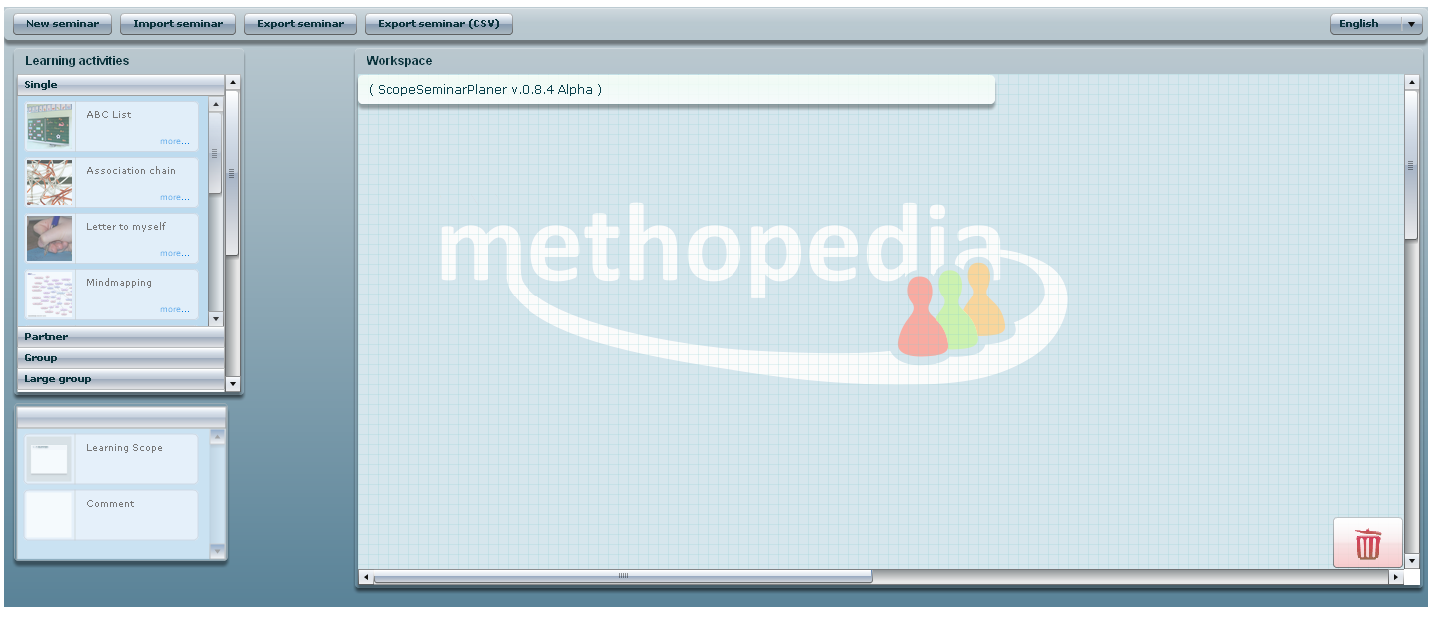
Methopedia – new tool for teaching and learning design

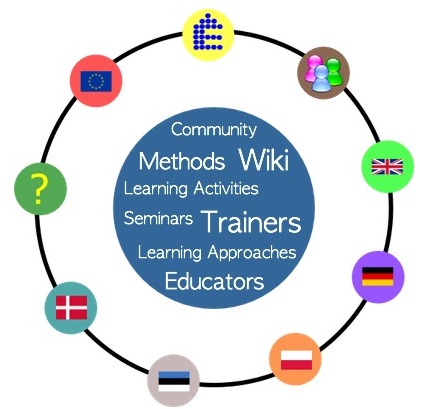
In relation to the COMBLE project where my colleague Heilyn Camacho and I designed and implemented a course on Problem Based Blended Learning using Moodle and SL, other project partners have been working on developing a wiki that focuses on teaching and learning methods and approaches: Methopedia.

As part of the wiki community concept anyone can add and share content concerning teaching and learning activities, methods, approaches and designs.  Complementary to the wiki our partners from University of Applied Science Wildau have developed a flash tool for designing different kinds of teaching and learning events – the Learning Designer.

The main idea is that the Designer tool can import whatever is put into Methopedia and then the user can create visual overviews of events spanning from short activities to seminars and courses.

Learn more about the tool from this video:

The partners have also written a paper on the work with Methopedia which was recently presented at the 8th European Conference on e-Learning (ECEL).

/Mariis