ICT, transfer, and boundary crossing in VET – part 3

For the time being, this will be the third and final post describing our research project. In the first post, I wrote about the background for initiating the project, and in the the second post I zoomed in on our research questions. In this post, I focus on the design of our study.

According to Mackenzie & Knipe (2006), in the social and applied science, the exact nature of how research is defined will depend on the researcher’s personal and professional beliefs. Therefore, it is important to discern such assumptions before embarking in any research endeavour, because:

All research is interpretive: it is guided by a set of beliefs and feelings about the world and how it should be understood and studied. Some beliefs may be taken for granted, invisible, or only assumed, whereas others are highly problematic and controversial. (Denzin & Lincoln, 2011, p. 13)

Mackenzie & Knipe (2006) suggest four sets of underlying assumptions or paradigms: 1) Positivist/postpositivist, 2) Interpretivist/constructivist, 3) Transformative, and 4) Pragmatic. It is the choice of paradigm that sets down the intent, motivation and expectation for the research,  and I would say that our project mainly is situated within an interpretivist line of thinking in which the intention of the research is to understand the world by trying to make sense of the experiences and attributed meanings others have about the world. Researchers focus on the processes of interaction among individuals and on the specific contexts in which individuals live and work. Further, proponents of this paradigm recognize that the researchers’ own background impact the research and their interpretation hereof. Initially we wanted to design our project as a transformative study building on a Design based Research approach, but our local research leader advised against this assuming the VET schools would be too busy to get involved in a significant manner.

Consequently, we ended up designing our project as a multiple case study (Yin, 2009) with interviews and observations as primary methods to generate and collect data in different phases of the project.

In the preliminary research phase of the project we conducted six ethnographic interviews with VET teachers, which we have written about in a short paper presented at the Designs for Learning 2016 conference (Riis et al, 2016). Building on Spradley’s (1979) ideas of descriptive questioning, and questions loosely structured around the elements in a third generation activity system, we interviewed six vocational teachers from the three dominant strands of the Danish VET system (technical, business and social- and health schools). As stated by Spradley (1979), descriptive questioning aims at uncovering the informant’s personal experience with the practice and phenomenon under study by way of having the informant elaborate through thick descriptions and examples, often times by repeating and rephrasing questions. The data generated in this initial phase was mainly targeted at answering our first sub-question regarding VET teachers’ understanding and practice concerning the concepts of boundary crossing and continuity. In brief, we found that the interviewed VET teachers predominantly think in terms of vertical learning processes and one-time and one-directional transfer, rather than horizontal processes, continuity, and boundary crossing.

In the second phase of the project (Spring 2016), we conducted classroom observations combined with further interviews (with VET students and trainers as well), and we are still in the process of analyzing the data.

Due to organizational changes in our department, which led to a reduction from five to three people in the research group (with one being a newcomer to the project), we decided not to interact directly with VET schools this fall. Instead we have focused on analyzing data and on field validating some of our pedagogic-didactic materials that we have developed, and this we have done in our teaching at the Diploma for VET teachers.

Based on our findings so far, it has become obvious that we need to focus on observing teachers and students acting with technology in the future in order to better understand the phenomenon of ICT-based artefacts and their role in boundary crossing. When looking at the different types of ICT that participants in our study actually use, it seems fruitful to focus on the use of video and learning management systems, and we are hoping to interact with VET schools in this regard beginning 2017.

/Mariis

References

Denzin, N.K. & Lincoln, Y.S. (2011). The SAGE Handbook of Qualitative Research. SAGE

Mackenzie, N. & Knipe, S. (2006). Research dilemmas: Paradigms, methods and methodologyIssues In Educational Research, Vol 16, 2006.

Riis, M., Bergstedt, P., Jørgensen, C.B., Koch, H.H. & Rasmussen, C.L. (2016). Challenges in designing for horizontal learning – in the Danish VET system. Short paper accepted for Designs for Learning conference, May 18.-20., 2016 in Copenhagen, Denmark at Aalborg University, http://www.designsforlearning2016.aau.dk/

Spradley, J.P. (1979). The Ethnographic Interview. Wadsworth, Cengage Learning.

Yin, R. K. (2009). Case Study Research. Design and methods. 4th edition. SAGE.

Designs4Learning – PhD project on transformation of knowledge

hachmann_logoOver on Designs4Learning, my friend* Roland Hachmann has recently started blogging about his PhD-project, which is part of the research program Designing for Situated Knowledge in a World of Change at the University of Southern Denmark. Roland explains that his project

… focuses on how designs for learning at the teacher education, that embrace practice (contexts) as a core element, can support transformation of knowledge. The project investigates a group of students, who move across educational and professional contexts to resituate and transform their academic knowledge and put it into use as they teach fifth graders. The project uses design based research as a methodological approach and furthermore draws upon theories from the situated and socio cultural domain, where learning is seen as a result of participation and use of artefacts situated in specific contexts.

In his project, Roland is also investigating the concept of transfer, and he recently published a very interesting post entitled Concepts of transfer and transformation in designing for situated knowledge across contextsIn this post, you’ll find some valuable ressources Roland created in collaboration with fellow PhD-student, Lea Tilde Rosenlund: a map of different transfer concepts, a presentation on transfer, and not least a bibliography of transfer literature. It’s really worth checking out!

Given that we clearly share research interests and that we, in our research project, are inspired by theories in the socio-cultural domain as well (e.g. we have used Activity Theory and boundary crossing theory for our analyses), Roland and I have discussed the possibility of sharing knowledge and perhaps collaborating in the future. For now, I’m just delighted that Roland has started blogging and sharing his thoughts with the rest of us.

/Mariis

*) Disclaimer.
Roland and I have known each other for years. We initially met at The Master Programme on ICT and Learning (MIL) at Aalborg University, where Roland first attended one of my courses in Second Life, and later I invited him to co-facilitate in another course as part of my research. Since then we have stayed in contact, and I’m happy to call him my friend :-)

mewRoland aka Mew Aeon in Second Life.

ICT, transfer, and boundary crossing in VET – part 2

As I explained in a previous post, in our current research project my colleagues and I are interested in studying why and how vocational teachers understand and design for boundary crossing through the use of ICT-based artefacts. The research project is guided by the following two main research questions (RQs):

RQ1: In what ways and why do VET teachers use ICT-based artefacts as boundary objects to design for boundary crossing and continuity in and across different contexts?

RQ2: What didactic and pedagogic recommendations can support VET schools’ future work with establishing enhanced school-workplace interaction through the use of ICT?

A couple of important points should be made regarding these RQs. First of all, at the Metropolitan University College, we are obligated to conduct “applied research”, which means that besides generating new knowledge, the research must be directed towards “a specific practical aim or objective” (cf. OECD’s Frascati manual). This obligation influences both the identification and formulation of RQs, and as seen in RQ2, we have to conclude our research with concrete recommendations for practice, and ideally these recommendations should be “field validated” by practitioners through our research. In our case, we develop didactic and pedagogic materials (models, cases, exercises etc.) the in-service VET teachers can use when they participate in our educational programme*, and hopefully also when they’re back in their schools.

Another point has to do with our use of the term “didactic”. In a Scandinavian or German academic tradition, our a study would be situated within the field of Didactics. However, according to Hamilton (1999), in the Anglo-American mind, the term “didactic” may have very negative connotations implying a moralizing and heavily teacher driven approach to teaching and learning. Professor emeritus, Karsten Schnack from the Danish School of Education (Aarhus University) therefore recommends Danish scholars to avoid using the term when communicating in English (Schnack, 2000). While we don’t subscribe to a moralizing and teacher driven approach, we do recognize this aspect, and so in general when we present our research outside a Scandinavian context, we use the more neutral concept of “design for learning” (cf. Wenger, 1998).

To further guide our research, we have some additional sub-RQs as well:

  1. How and why is boundary crossing and continuity understood and practiced?
  2. How and why are boundary objects understood, designed and used as mediating artefacts?
  3. What types of ict-based artefacts can be identified as boundary objects, and what didactic and pedagogic pros and cons can be attributed to these?
  4. What types of ict-mediated boundary crossing can be identified, and what didactic and pedagogic pros and cons can be attributed to these?

As the reader will notice, we are using the concept “boundary crossing” and not “transfer” in our RQs, even though our project in Danish is entitled “ICT and transfer in VET”. According to Akkerman & Bakker (2012):

Boundary crossing is a concept that has been proposed as an enriched notion of transfer (Tuomi-Gröhn et al., 2003), but differs from transfer in various ways. First of all, whereas transfer is mostly about one-time and one-directional transitions, primarily affecting an individual who moves from one context of learning (e.g. school) to one of application (e.g. work), the notion of boundary crossing includes ongoing, two-sided actions and interactions between practices (Säljö, 2003). Second, whereas transfer emphasizes the need for similarities between practices, boundary crossing is about finding productive ways of relating intersecting dissimilar practices. (Akkerman & Bakker, 2012, s. 155 – my emphasis)

In a Danish VET practitioner context, however, the concept of boundary crossing is unknown and our research dean therefore recommended that we use the more traditional transfer concept. We have, nonetheless started to use boundary crossing and boundary objects in our teaching.

Further, as already stated in the above mentioned first post on our project, we are constantly challenged by the similarities and differences between the concepts.

/Mariis

*) In Denmark, VET teachers are obligated to attend in-service further education, and at the Metropolitan University College we offer such programmes.

References

Akkerman, S.F. & Bakker, A. (2012). Crossing boundaries between school and work during apprenticeship. Vocations and Learning. 5:153-173

Hamilton, D. (1999). The Pedagogic Paradox (or Why No Didactics in England?). Pedagogy, Culture & Society. Vol. 7, No. 1. pp. 135-152.

Schnack, K. (2000). Er didaktik og curriculum det samme? Danmarks Lærerhøjskole.

Wenger, E. (1998). Communities of Practice. Learning, Meaning, and Identity. Cambridge University Press.

Tomatoe, tomatoe – Didactics, … ?

I’m currently writing about the conventions that I’ve chosen to use in my PhD-project. Essentially, my study investigates the development of a design for teaching and learning remediated in the 3D virtual world, SL. In a Scandinavian or German academic tradition, such a study would be situated within the field of Didactics. However, according to Hamilton (1999) and Schnack (2000), in the Anglo-American mind, the term “didactic” has very negative connotations implying a moralizing and heavily teacher driven approach to teaching and learning. At the Master Programme on ICT and Learning (MIL), where I have conducted my research, we often use a didactic-based terminology (e.g. we often speak about didactic elements, didactic analyses, and didactic design), at least when we communicate in Danish. Despite our terminology, we do not adhere to the Anglo-American perception. Nonetheless, Professor emeritus, Karsten Schnack from the Danish School of Education (Aarhus University) actually recommends Danish scholars to avoid using the term when communicating in English:

In English the term “didactics” is rarely used. The reason probably is that the word has strong associations with the adjective form “didactic”, which is more often used. And for some reason “didactic” has a very negative ring to it. When something is done in a “didactic” way or didactically it is considered to be moralizing and/or heavily teacher driven in a negative way.

Since didactic considerations e.g. in Denmark almost always deals with the contrary, a good advice is to avoid using the words “didactic” and “didactics” in English communication. The risk of misunderstandings is very high.”(Schnack. 2000:2 – my translation)

Because of this language barrier it has become customary for many continental European researchers within the field of teaching and learning to either use the German word “Didaktik” or simply use Anglo/American terms e.g. “instructional design” when describing their activities. Accordingly, and mainly to avoid misunderstandings because I write my dissertation in English, I have decided to use the more neutral concepts of “pedagogy”, and “design for teaching and learning” when speaking about matters concerning the field and the process of designing. While this is not something I deal with in greater details in my PhD, I actually don’t think this is “just a matter of semantics” – there is a distinction that makes a difference. The way we construct, interpret, clarify, and negotiate meaning – even based on similar words – changes over time, but also within and cross cultures.

Turning to the term Didactic, there is absolutely no consensus in the literature regarding the meaning  – not even when looking at the origin – the Greek “didaskein”. Even 2.500 years ago, according to Jank & Meyer (2006), the term didaskein could have several meanings; “to teach”, “to be instructed” and “to learn” and the term didaxis refered to both curriculum (primarily as content) and what was learned (outcome). Even though there has been a tendency towards focusing on the teaching aspect of the term Didactic, many Scandinavian researchers refer to the so-called “Didactic Triangle” when trying to explain the basic components of Didactics.

DD

When dealing with teaching and learning, and at the core of any Didactic Design, there’s always a minimum of three basic components to consider: the teacher, the student and the content/subject matter. However, depending on your focus, the triangle can also be used to point to different, more specialized design approaches:

  • Pedagogical Design – with particular focus on the pedagogical practice typically emphasizing the responsibility/role of the teacher
  • Instructional Design – with particular focus on development and implementation of tools and content (materials)
  • Curriculum Design – with particular focus on content based on curriculum as organizational framework for practice
  • Learning Design – with particular focus on the learning practice typically emphasizing the responsibility/role of the learner

Since I use the term Didactic in a very broad sense, I would consider any of the above mentioned approaches didactic designs as long as they were dealing with teaching and learning in formal, educational contexts. During my PhD research, I have often presented and discussed my work with Anglo-American educators/researchers, and while most seem to understand what I’ve been working on as long as I remember to say “instructional design”, the irony is that to many Scandinavian researchers this label implies “a moralizing and heavily teacher driven approach to teaching and learning.” So I guess in order to understand each other, we need to dig deeper and discuss the finer details of our practices and understandings ;-)

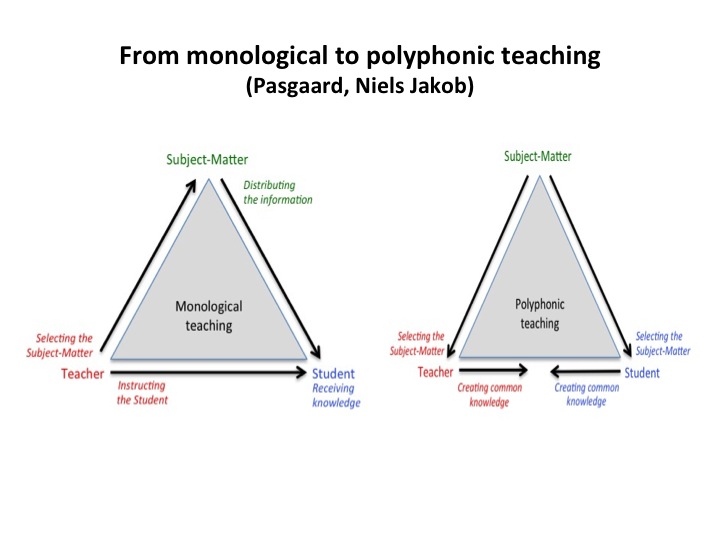
One matter of detail that I’ve often discussed, both with Danish and International colleagues, is the locus of control in the teaching and learning situation. I was recently reminded of a very interesting pedagogical framework developed by Niels Jakob Pasgaard, who blogs at eDidaktik. Pasgaard’s framework is based on a distinction between a monological, a dialogical, and a polyphonic way of teaching. It is derived from the work of M.M. Bakhtin, and Pasgaard uses the Didactic Triangle to illustrate his points:

Mono-Poly

Read a more detailed description here

What’s really interesting about this framework is the way it highlights the different approaches to the selection of the content/the subject matter, and the way knowledge is created based on different forms of teaching and learning. Furthermore, the framework can be used to analyse and thus select appropriate tools for teaching and learning – and Pasgaard offers examples of all three types here.

To me, Pasgaard’s framework is an excellent example of how the work of someone coming from a Scandinavian Didactic tradition doesn’t necessarily equal a negative approach to teaching and learning, rather – and as a core principle in Didactics – Pasgaard critically reflects upon our practices and understandings. Just as I have witnessed several Anglo-American “instructional designers” do.

/Mariis

References

Hamilton, D. (1999) The pedagogic paradox (or why no didactics in England?), Pedagogy, Culture & Society, 7:1, 135-152

Schnack, K. (2000) Er didaktik og curriculum det same? Danmarks Lærerhøjskole.

Jank, W & Meyer, H. (2006) Didaktiske modeller. Grundbog i didaktik. Gyldendals Lærerbibliotek.

Alice and Dorothy play together – but what about Wendy?

In a recent post I wrote about why I don’t consider SL a game, Richard Bartle was very kind to comment and point my attention to one of his articles entitled “Alice and Dorothy play together” (Bartle, 2009). I’ve now read it and together with some of Bartle’s other works, I find it very useful in relation to my own work with what I prefer to call open-ended Virtual Worlds – so thank you again, Richard for stopping by and pointing to various resources :-)

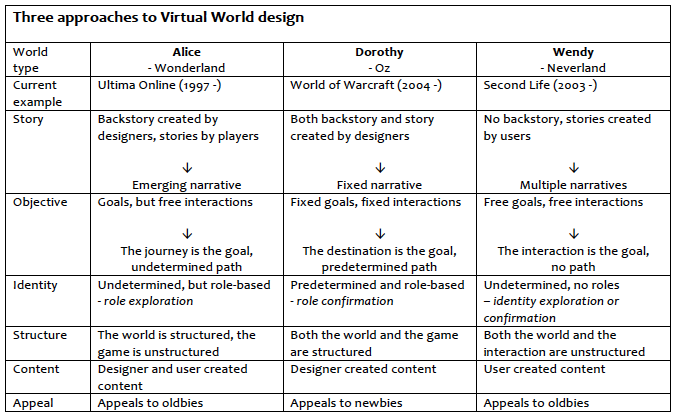
In the article, Bartle describes three philosophies or design approaches that have influenced the work of designing Virtual Worlds. Based on three major fictional works, Alice in Wonderland, Dorothy from Oz, and Wendy in Neverland, Bartle identifies differences and commonalities and discusses their ability to “play together”. It’s important to notice that Bartle is addressing a game (world) designer audience, and that Bartle’s work in general has focused on Virtual Worlds designed with the explicit intent to entertain the players – fun is the key motivation for using such worlds. In the table below, I’ve tried to summarize some of Bartle’s points.

Without going too much into detail with the table here in this post, I think it’s important to notice a couple of things in order to understand what follows. In terms of “appeal” this should be seen in the light of immediate attraction, does the world attract and more importantly retain newbies? Evidently, a Dorothy world like WoW (with millions of active players) also appeals to oldbies, the kind of players who find joy and interest in “leveling up”, the kind Bartle calls “Achievers” (as we shall see further down). The table also shows why SL has problems when it comes to retaining users (with approx. 20 mio. accounts, but less than 100.000 concurrent users on a daily basis, there is a problem). Judging from the table, SL’s credo “Your World, Your Imagination” becomes a double-edged sword. The lack of a fixed narrative leaves the SL-user completely on his/her own to come up with a reason to play/stay. This problem, however, is not unique to SL, but points to a classic dilemma between the different needs of newbies and oldbies. Following from this, the next question that comes to mind then is: what motivates Wendy? or more precisely, why do users find interest in SL and what do they do in SL?

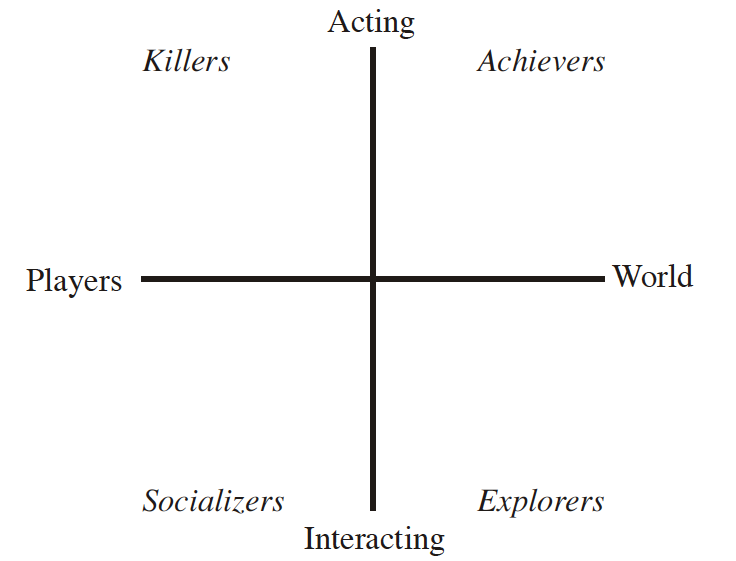
In “Designing Virtual Worlds” Bartle explains how he in the early 90’s, based on a long-lasting debate between senior players of MUD2 regarding the motives for playing, analyzed the ideas of what constituted fun and found that players could be categorized into four major types:

  • Achievers, who are interested in doing things to the game, i.e. in ACTING on the WORLD. (later sub-categorized in Opportunists and Planners)
  • Explorers, who are interested in having the game surprise them, i.e. in INTERACTING with the WORLD. (later sub-categorized in Scientists and Hackers*)
  • Socializers, who are interested in INTERACTING with other PLAYERS. (later sub-categorized in Networkers and Friends)
  • Killers, who are interested in doing things to people, ie. in ACTING on other PLAYERS. (later sub-categorized in Griefers and Politicians)

Based on continued refinement of these categories, Bartle created the so-called Player Interest Graph depicted below:

The Original Player Interest Graph (Bartle, 1996/2004 – see references)

The graph describes players in terms of two dimensions: how they prefer acting on things as opposed to interacting with, and how they prefer to direct their attentions toward other players. When trying to apply this graph to SL, I see three issues that don’t match.

  • The term “players” indicates that there is a game to be played**.
  • The category “killers” implies a combat game-type world.
  • The category “achievers” is also closely tied to the existence of a game – Bartle highlights their motivation: “These people put the game-like aspect of the virtual world to the fore. They like doing things that achieve defined goals, thereby progressing their character through the world’s built-in ranking system.” (Bartle, 2004, p. 130)

Regardless of this, I still think the principal idea of the graph can be used in relation to SL, and so I have re-designed the graph:

SL User Interest Graph

  • Users is my personal preference. Linden Lab calls its users “residents”, and many experienced users in SL refer to themselves as “residents” – I do too. It is, however, a problematic term. My observations and research data clearly show that many (especially newbies, but not only) feel homeless and marginalized from the general SL community (but this has to be the topic of another post).
  • Griefers is a term borrowed from the game worlds, it is, however, how we define trouble-makers in SL too, and the term is also used in academic writings on SL (i.e. Boellstorff, 2008). I did consider the Internet term “troll”, but since trolls seem to be deliberately malicious, and my experience with (some) griefers is that they often have more humorous intentions (albeit still annoying to those they act upon), I discarded it.
  • Designers refers to the SL users, who well … design things (buildings, art, clothes, animations etc.). I did consider the term “producers”, but in my opinion the socializers also produce and contribute to the content of SL. Compared to Bartle’s achievers, there are some interesting similarities. Designers also aim at mastering and acting upon the world, and even though there is no leveling system in SL, the mastery also results in high scores in terms of social capital (cf. Huvila et al, 2010).

Given my particular focus on education, I would also categorize teachers (and to some extent students) as designers – we design for learning, but that’s another story :-)

/Mariis

*) Bartle uses the term to refer to skills, rather than (malicious) intentions.

**) Yes, I’m aware of Linden Realms and the many RP-communities in SL, but that still doesn’t make it a game per se.

References

Bartle, R.A. (no date): Virtual Worlds: Why People Play.

Bartle, R.A. (1996): Hearts, Clubs, Diamonds, Spades: Players who suit MUDs.

Bartle, R.A. (2004): Designing Virtual Worlds. New Riders.

Bartle, R.A. (2009): Alice and Dorothy play together. In: Harrigan, P. & Wardrip-Fruin, N. (eds) Third Person – authoring and exploring vast narratives. The MIT Press. p. 105-117

Boellstorff, T. (2008): Coming of age in Second Life. An anthropologist explores the virtually human. Princeton University Press.

Huvila, I.; Holmberg, K.; Ek, S. & Widen-Wulff (2010): Social capital in Second Life. In: Emeralindsight, Vol. 34, No. 2, 2010. p. 295-316