Interesting study on Boundary Objects and virtual collaboration

In our research project we are highly influenced by the Dutch researcher Sanne F. Akkerman and her colleagues and their research on boundary crossing and boundary objects in (vocational) education. Like many others in the field, we have benefited greatly from Akkerman & Bakker’s (2011) excellent review entitled Boundary Crossing and Boundary Objects, and I’ll return to this in future posts.

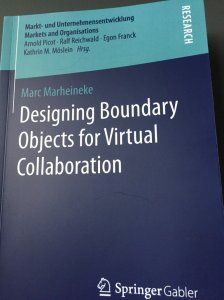
marheineke2016Nonetheless, other researchers have been studying these concepts from other perspectives, and I recently came across what turns out to be a PhD study (Marheineke, 2016) on the use of boundary objects in virtual collaboration, which seems very promising in relation to our current focus on ICT-mediated boundary objects.

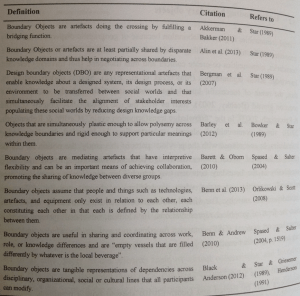
In this study, Marheineke provides an interesting literature review on the use of different types of virtual boundary objects. In his work, Marheineke is inspired by Carlile’s (2004, 2002) typology, which we have been studying as well. However, as Marheineke states “emerging interest in the phenomenon of boundary object(s) has led to many definitions in the literature” (p. 80).

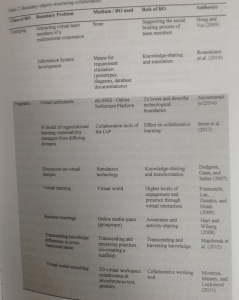
I have yet to study Marheineke’s research in detail, but so far I’m delighted to find many interesting and relevant tables e.g.:

marheineke2016_table3

Part of table 3: Selected definitions on the term “boundary object”
(Marheineke, 2016, p. 80-81)

marheineke2016_table7

Part of table 7: Boundary objects structuring collaboration
(Marheineke, 2016, p. 95-96)

/Mariis

References

Carlile, P.R. (2004). Transferring, Translating, and Transforming: An Integrative Framework for Managing Knowledge Across Boundaries.

Carlile, P.R. (2002). A Pragmatic View of Knowledge and Boundaries: Boundary Objects in New Product Development.

Designs4Learning – PhD project on transformation of knowledge

hachmann_logoOver on Designs4Learning, my friend* Roland Hachmann has recently started blogging about his PhD-project, which is part of the research program Designing for Situated Knowledge in a World of Change at the University of Southern Denmark. Roland explains that his project

… focuses on how designs for learning at the teacher education, that embrace practice (contexts) as a core element, can support transformation of knowledge. The project investigates a group of students, who move across educational and professional contexts to resituate and transform their academic knowledge and put it into use as they teach fifth graders. The project uses design based research as a methodological approach and furthermore draws upon theories from the situated and socio cultural domain, where learning is seen as a result of participation and use of artefacts situated in specific contexts.

In his project, Roland is also investigating the concept of transfer, and he recently published a very interesting post entitled Concepts of transfer and transformation in designing for situated knowledge across contextsIn this post, you’ll find some valuable ressources Roland created in collaboration with fellow PhD-student, Lea Tilde Rosenlund: a map of different transfer concepts, a presentation on transfer, and not least a bibliography of transfer literature. It’s really worth checking out!

Given that we clearly share research interests and that we, in our research project, are inspired by theories in the socio-cultural domain as well (e.g. we have used Activity Theory and boundary crossing theory for our analyses), Roland and I have discussed the possibility of sharing knowledge and perhaps collaborating in the future. For now, I’m just delighted that Roland has started blogging and sharing his thoughts with the rest of us.

/Mariis

*) Disclaimer.
Roland and I have known each other for years. We initially met at The Master Programme on ICT and Learning (MIL) at Aalborg University, where Roland first attended one of my courses in Second Life, and later I invited him to co-facilitate in another course as part of my research. Since then we have stayed in contact, and I’m happy to call him my friend :-)

mewRoland aka Mew Aeon in Second Life.

ICT, transfer, and boundary crossing in VET – part 2

As I explained in a previous post, in our current research project my colleagues and I are interested in studying why and how vocational teachers understand and design for boundary crossing through the use of ICT-based artefacts. The research project is guided by the following two main research questions (RQs):

RQ1: In what ways and why do VET teachers use ICT-based artefacts as boundary objects to design for boundary crossing and continuity in and across different contexts?

RQ2: What didactic and pedagogic recommendations can support VET schools’ future work with establishing enhanced school-workplace interaction through the use of ICT?

A couple of important points should be made regarding these RQs. First of all, at the Metropolitan University College, we are obligated to conduct “applied research”, which means that besides generating new knowledge, the research must be directed towards “a specific practical aim or objective” (cf. OECD’s Frascati manual). This obligation influences both the identification and formulation of RQs, and as seen in RQ2, we have to conclude our research with concrete recommendations for practice, and ideally these recommendations should be “field validated” by practitioners through our research. In our case, we develop didactic and pedagogic materials (models, cases, exercises etc.) the in-service VET teachers can use when they participate in our educational programme*, and hopefully also when they’re back in their schools.

Another point has to do with our use of the term “didactic”. In a Scandinavian or German academic tradition, our a study would be situated within the field of Didactics. However, according to Hamilton (1999), in the Anglo-American mind, the term “didactic” may have very negative connotations implying a moralizing and heavily teacher driven approach to teaching and learning. Professor emeritus, Karsten Schnack from the Danish School of Education (Aarhus University) therefore recommends Danish scholars to avoid using the term when communicating in English (Schnack, 2000). While we don’t subscribe to a moralizing and teacher driven approach, we do recognize this aspect, and so in general when we present our research outside a Scandinavian context, we use the more neutral concept of “design for learning” (cf. Wenger, 1998).

To further guide our research, we have some additional sub-RQs as well:

  1. How and why is boundary crossing and continuity understood and practiced?
  2. How and why are boundary objects understood, designed and used as mediating artefacts?
  3. What types of ict-based artefacts can be identified as boundary objects, and what didactic and pedagogic pros and cons can be attributed to these?
  4. What types of ict-mediated boundary crossing can be identified, and what didactic and pedagogic pros and cons can be attributed to these?

As the reader will notice, we are using the concept “boundary crossing” and not “transfer” in our RQs, even though our project in Danish is entitled “ICT and transfer in VET”. According to Akkerman & Bakker (2012):

Boundary crossing is a concept that has been proposed as an enriched notion of transfer (Tuomi-Gröhn et al., 2003), but differs from transfer in various ways. First of all, whereas transfer is mostly about one-time and one-directional transitions, primarily affecting an individual who moves from one context of learning (e.g. school) to one of application (e.g. work), the notion of boundary crossing includes ongoing, two-sided actions and interactions between practices (Säljö, 2003). Second, whereas transfer emphasizes the need for similarities between practices, boundary crossing is about finding productive ways of relating intersecting dissimilar practices. (Akkerman & Bakker, 2012, s. 155 – my emphasis)

In a Danish VET practitioner context, however, the concept of boundary crossing is unknown and our research dean therefore recommended that we use the more traditional transfer concept. We have, nonetheless started to use boundary crossing and boundary objects in our teaching.

Further, as already stated in the above mentioned first post on our project, we are constantly challenged by the similarities and differences between the concepts.

/Mariis

*) In Denmark, VET teachers are obligated to attend in-service further education, and at the Metropolitan University College we offer such programmes.

References

Akkerman, S.F. & Bakker, A. (2012). Crossing boundaries between school and work during apprenticeship. Vocations and Learning. 5:153-173

Hamilton, D. (1999). The Pedagogic Paradox (or Why No Didactics in England?). Pedagogy, Culture & Society. Vol. 7, No. 1. pp. 135-152.

Schnack, K. (2000). Er didaktik og curriculum det samme? Danmarks Lærerhøjskole.

Wenger, E. (1998). Communities of Practice. Learning, Meaning, and Identity. Cambridge University Press.

ICT, transfer, and boundary crossing in VET – part 1

In May 2015, colleagues from the Metropolitan University College and I started a research project on ICT, transfer, and boundary crossing in the Danish VET system. In a short series of blog posts I will elaborate on different aspects of the research project to set the scene. The following text is slightly revised from a paper we wrote for the Designs for Learning conference in Copenhagen, 2016 (Riis et al., 2016).

Background
In the Danish dual VET system, students oscillate between school and workplace periods throughout their education. Making sense and use of learning in and from different contexts and experiencing continuity between school and work has long been considered a major pedagogic-didactic challenge in Danish VET research resulting in a continuous focus on the transfer phenomenon (Aarkrog, 2010). Based on a pre-study of vocational teachers’ use of ICT conducted in 2014 (Riis, Bergstedt, Rasmussen, unpublished), we noticed how the teachers attributed a transfer (and sometimes boundary crossing) potential to the use of ICT in teaching and learning processes across different contexts, leading to our current research project. The main research question investigates why and how vocational teachers understand and design for boundary crossing through the use of ICT-based artefacts.

Transfer and boundary crossing
Both in research (Lobato, 2006; Engle, 2012) and among practitioners transfer is a contested concept. In on research project, we adopt Engeström and colleagues’ concepts of vertical and horizontal learning, polycontextuality, and boundary crossing (Engeström, Engeström & Kärkkäinen, 1995; Tuomi-Gröhn, Engeström & Young, 2003), as a way of challenging the traditional notion of transfer understood mainly as a one-time and one-directional transition between a context of acquisition and that of application. As stated by Engeström et al. (ibid.), learning can be conceptualized as both a vertical and a horizontal process. In the former, focus is on learning in a single social system (e.g. in a school) often times based on a narrow, hierarchical view of knowledge and expertise. Conversely, in the latter perspective, learning is based on a broader, multidimensional view of knowledge and expertise and focus is on transitions or crossings in and between multiple social systems (e.g. in and between school and workplace). A horizontal view on learning and transfer understood as boundary crossing, seeks to find productive ways of relating intersecting dissimilar practices (Akkerman & Bakker, 2012), potentially accommodating the inherent contradictions of a dual education system.

According to Akkerman & Bakker “(…) a boundary can be seen as a sociocultural difference leading to discontinuity in action or interaction.” (2011, p. 133), and boundary crossing generally refers to an individual’s transitions and interactions across different contexts. Although discontinuity may be perceived negatively at a glance, in the third generation of CHAT, boundaries understood as contradictions in and between elements and systems, are seen as carrying potential for learning, change, and development. In any activity system, activity is object-oriented, and artefacts (signs or tools) are attributed mediating properties. Whether a mediating artefact functions as a boundary object depends on the purpose and use. In order to function as a boundary object, the artefact needs to inhabit and bridge intersecting practices (Star, 2010), which is not necessarily the case for all mediating signs and tools.

The differences and similarities between the concepts of transfer and boundary crossing are constantly challenging us, so this is something I’ll return to on several occasions.

/Mariis

References

Akkerman, S.F. & Bakker, A. (2012). Crossing boundaries between school and work during apprenticeship. Vocations and Learning. 5:153-173

Akkerman, S.F. & Bakker, A. (2011). Boundary crossing and boundary objects. Review of Educational Research. June 2011, Vol. 81, No. 2, pp. 132-169

Engle, R.A. (2012). The resurgence of research into transfer: an introduction to the final articles of the transfer stand. Journal of the Learning Sciences, 21:3, 347-352.

Engeström, Y., Engeström, R. & Kärkkäinen, M. (1995). Polycontextuality and boundary crossing in expert cognition: Learning and problem solving in complex work activities. Learning and Instruction, Vol. 5. pp. 219-336.

Lobato, J. (2006). Alternative perspectives on the transfer of learning. History, issues, and challenges for future research. Journal of the Learning Sciences, 15(4), 431-449.

Riis, M., Bergstedt, P., Jørgensen, C.B., Koch, H.H. & Rasmussen, C.L. (2016). Challenges in designing for horizontal learning – in the Danish VET system. Short paper accepted for Designs for Learning conference, May 18.-20., 2016 in Copenhagen, Denmark at Aalborg University, http://www.designsforlearning2016.aau.dk/

Riis, M., Bergstedt, P. & Rasmussen, C.L. (unpublished). Undervisningsdifferentiering og it i de erhvervsrettede uddannelser – en eksploartiv forundersøgelse. Intern rapport udarbejdet 2014.

Star, S.L. (2010), This is not a boundary object; Reflections on the origin of the concept. Science, Technology, and Human Values, 25(5), 601-617.

Tuomi-Gröhn, T. Engeström, Y., & Young, M. (2003). From transfer to boundary crossing between school and work as a tool for developing vocational education: An introduction. In T. Tuomi-Gröhn & Y. Engeström (Eds.), Between school and work: New perspectives on transfer and boundary-crossing pp. 1–18. Amsterdam, Netherlands: Pergamon.

Aarkrog, V. (2010). Erhvervsuddannelsesforskningen i Danmark. In Størner, T. & Hansen, J.A. (red.) Erhvervspædagogik – mål, temaer og vilkår i eud’s verden. s. 73-82. Erhvervsskolernes Forlag.
Alice and Dorothy play together – but what about Wendy?

In a recent post I wrote about why I don’t consider SL a game, Richard Bartle was very kind to comment and point my attention to one of his articles entitled “Alice and Dorothy play together” (Bartle, 2009). I’ve now read it and together with some of Bartle’s other works, I find it very useful in relation to my own work with what I prefer to call open-ended Virtual Worlds – so thank you again, Richard for stopping by and pointing to various resources :-)

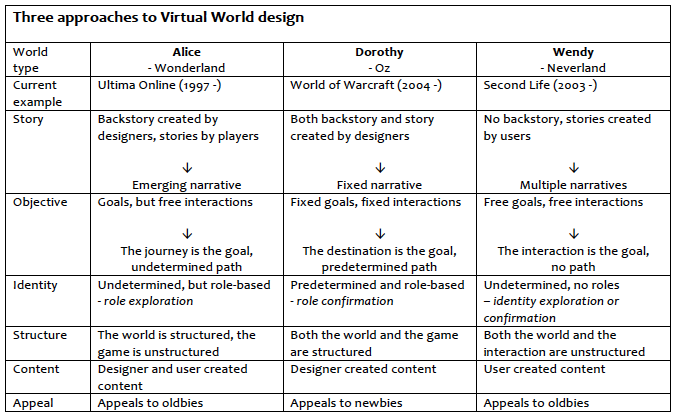
In the article, Bartle describes three philosophies or design approaches that have influenced the work of designing Virtual Worlds. Based on three major fictional works, Alice in Wonderland, Dorothy from Oz, and Wendy in Neverland, Bartle identifies differences and commonalities and discusses their ability to “play together”. It’s important to notice that Bartle is addressing a game (world) designer audience, and that Bartle’s work in general has focused on Virtual Worlds designed with the explicit intent to entertain the players – fun is the key motivation for using such worlds. In the table below, I’ve tried to summarize some of Bartle’s points.

Without going too much into detail with the table here in this post, I think it’s important to notice a couple of things in order to understand what follows. In terms of “appeal” this should be seen in the light of immediate attraction, does the world attract and more importantly retain newbies? Evidently, a Dorothy world like WoW (with millions of active players) also appeals to oldbies, the kind of players who find joy and interest in “leveling up”, the kind Bartle calls “Achievers” (as we shall see further down). The table also shows why SL has problems when it comes to retaining users (with approx. 20 mio. accounts, but less than 100.000 concurrent users on a daily basis, there is a problem). Judging from the table, SL’s credo “Your World, Your Imagination” becomes a double-edged sword. The lack of a fixed narrative leaves the SL-user completely on his/her own to come up with a reason to play/stay. This problem, however, is not unique to SL, but points to a classic dilemma between the different needs of newbies and oldbies. Following from this, the next question that comes to mind then is: what motivates Wendy? or more precisely, why do users find interest in SL and what do they do in SL?

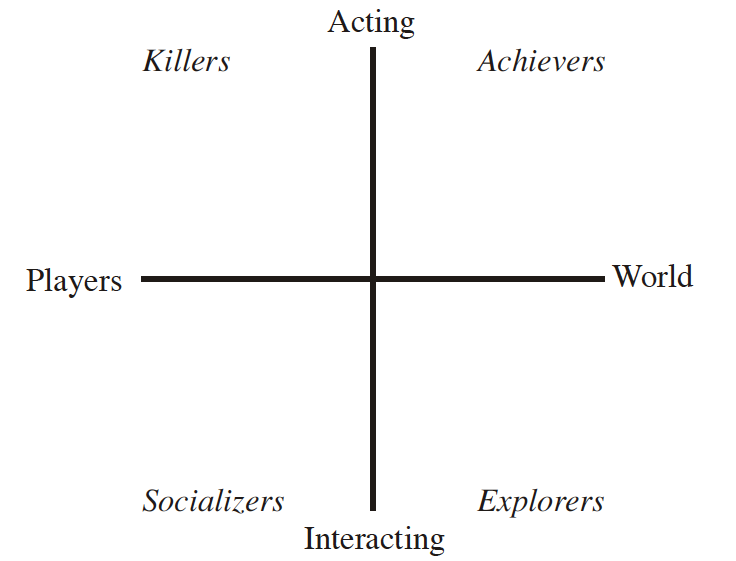
In “Designing Virtual Worlds” Bartle explains how he in the early 90’s, based on a long-lasting debate between senior players of MUD2 regarding the motives for playing, analyzed the ideas of what constituted fun and found that players could be categorized into four major types:

  • Achievers, who are interested in doing things to the game, i.e. in ACTING on the WORLD. (later sub-categorized in Opportunists and Planners)
  • Explorers, who are interested in having the game surprise them, i.e. in INTERACTING with the WORLD. (later sub-categorized in Scientists and Hackers*)
  • Socializers, who are interested in INTERACTING with other PLAYERS. (later sub-categorized in Networkers and Friends)
  • Killers, who are interested in doing things to people, ie. in ACTING on other PLAYERS. (later sub-categorized in Griefers and Politicians)

Based on continued refinement of these categories, Bartle created the so-called Player Interest Graph depicted below:

The Original Player Interest Graph (Bartle, 1996/2004 – see references)

The graph describes players in terms of two dimensions: how they prefer acting on things as opposed to interacting with, and how they prefer to direct their attentions toward other players. When trying to apply this graph to SL, I see three issues that don’t match.

  • The term “players” indicates that there is a game to be played**.
  • The category “killers” implies a combat game-type world.
  • The category “achievers” is also closely tied to the existence of a game – Bartle highlights their motivation: “These people put the game-like aspect of the virtual world to the fore. They like doing things that achieve defined goals, thereby progressing their character through the world’s built-in ranking system.” (Bartle, 2004, p. 130)

Regardless of this, I still think the principal idea of the graph can be used in relation to SL, and so I have re-designed the graph:

SL User Interest Graph

  • Users is my personal preference. Linden Lab calls its users “residents”, and many experienced users in SL refer to themselves as “residents” – I do too. It is, however, a problematic term. My observations and research data clearly show that many (especially newbies, but not only) feel homeless and marginalized from the general SL community (but this has to be the topic of another post).
  • Griefers is a term borrowed from the game worlds, it is, however, how we define trouble-makers in SL too, and the term is also used in academic writings on SL (i.e. Boellstorff, 2008). I did consider the Internet term “troll”, but since trolls seem to be deliberately malicious, and my experience with (some) griefers is that they often have more humorous intentions (albeit still annoying to those they act upon), I discarded it.
  • Designers refers to the SL users, who well … design things (buildings, art, clothes, animations etc.). I did consider the term “producers”, but in my opinion the socializers also produce and contribute to the content of SL. Compared to Bartle’s achievers, there are some interesting similarities. Designers also aim at mastering and acting upon the world, and even though there is no leveling system in SL, the mastery also results in high scores in terms of social capital (cf. Huvila et al, 2010).

Given my particular focus on education, I would also categorize teachers (and to some extent students) as designers – we design for learning, but that’s another story :-)

/Mariis

*) Bartle uses the term to refer to skills, rather than (malicious) intentions.

**) Yes, I’m aware of Linden Realms and the many RP-communities in SL, but that still doesn’t make it a game per se.

References

Bartle, R.A. (no date): Virtual Worlds: Why People Play.

Bartle, R.A. (1996): Hearts, Clubs, Diamonds, Spades: Players who suit MUDs.

Bartle, R.A. (2004): Designing Virtual Worlds. New Riders.

Bartle, R.A. (2009): Alice and Dorothy play together. In: Harrigan, P. & Wardrip-Fruin, N. (eds) Third Person – authoring and exploring vast narratives. The MIT Press. p. 105-117

Boellstorff, T. (2008): Coming of age in Second Life. An anthropologist explores the virtually human. Princeton University Press.

Huvila, I.; Holmberg, K.; Ek, S. & Widen-Wulff (2010): Social capital in Second Life. In: Emeralindsight, Vol. 34, No. 2, 2010. p. 295-316