Kolb’s Experiential Learning revisited

I’ve been a supporter, yet a critical one, of David A. Kolb‘s theory of Experiential Learning for many years, and almost like a recursive cycle I seem to return to Kolb’s ideas, whenever I’m looking for a theoretical framework to illustrate pedagogical activities. As I’ve recently started to process and reflect upon the many different teaching and learning activities in the MIL course (my 2. MIL research cycle), I’ve found it interesting to revisit Kolb’s ideas to study their “applicability” with my current project.

Teaching and learning environment
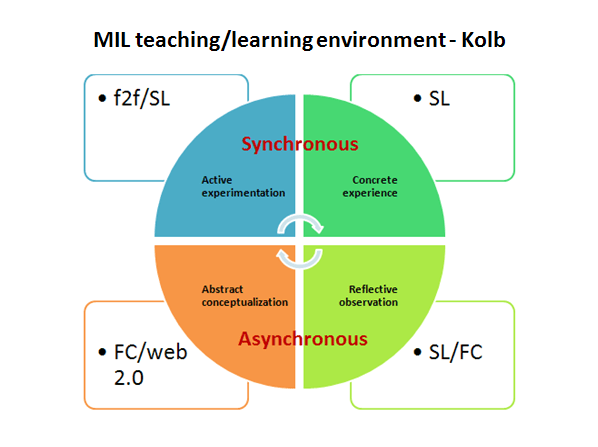
In order to better understand the different activities it’s necessary to get an overview of the teaching and learning environment, which is depicted below.

el-1

Home – given that MIL is a distance education with only four 2 1/2 day f2f-seminar pr. year the majority of the teaching and learning activities took place in the participants’ homes/workplaces.  All synchronous teacher initiated activities took place in the evenings/afternoons on weekends.

f2f seminar – the MIL course started on November 1st and ended on December 15th 2008. Mid November we had a f2f seminar, where the students were introduced to the general theme of the module (ICT and Didactic Design). I had 3 hours to lecture on “Remediation and redidactization in SL” combined with a hands-on workshop on some basic features of SL.

SL – was used for all the synchronous activities, both teacher and learner initiated.

FC (FirstClass) – was used for general information (incl. literature and other resources)/communication regarding the course, and more importantly as setting for the students’ asynchronous discussions/reflections. See this post for reflections on the quantitative outcome of the course.

Web 2.0 – various tools/technologies  supported the information provided in FC. Interestingly, and quite unusual for MIL students in other courses, the blogshpere and video and presentation repositories (like YouTube and Slideshare) were intensely explored in order to find additional information to support the students’ own findings and reflections.

A different perspective on Kolb’s model
Together with colleague Roger Fry, David A. Kolb started exploring the potentials of experiential learning in the 1970’ies, and Kolb further developed their ideas in his 1984 book “Experiential Learning: Experience as Source of Learning and development”. Besides exploring foundations (Dewey, Lewin and Piaget in particular) for experiential learning Kolb presented a model of 4 particular elements, which together constitute an optimal learning process. The elements are:

  • Active experimentation
  • Concrete experience
  • Reflective observation
  • Abstract conceptualization

The model is widely known (and depicted) as a learning cycle and Kolb also used its elements to identify 4 learning styles, each corresponding to the spectrum between 2 elements – e.g. The Diverger, who supposedly prefers to learn through concrete experience and reflective observation. In this post I don’t want to address the otherwise relevant epistemological question of a) the probability of (universal) learning styles (incl. the number issue) or b) the question of how the learning process best can be understood (cycle, spiral, steps, continuum etc.).  Instead I want to return to the 4 core elements and use them to illustrate and discuss activities in different contexts of the MIL course’s teaching and learning environment.
el-2

Active experimentation and concrete experiences were mainly conducted synchronously at the f2f hands-on workshop and in SL. There was a total of 25 teacher initiated in-world activities that included:

  • Get-off-to-a-good-start – meetings where I as the main teacher instructed the newcomers in using different features and took them on tours to designated educational locations.
  • Building Class – 3 1 ½ hrs. sessions where guest teachers, Dr. Asp & Heidi Ballinger, showed the students the in-world building craft and assisted the students in their own building experiments.
  • Didactic Design Discussions – four 2 hrs. sessions, where I lectured on mandatory topics based on the course literature, but also on topics raised by the students in their asynchronous discussions. Due to the use of simultane voice and text communication, these sessions engaged the students more actively, when compared to traditional f2f lectures.
  • Visits – typically 1-2 hrs. sessions where the students and I visited both Danish and International colleagues involved in either in-world education and/or business.
  • Your Tour – 2 1 ½ hrs. sessions where 2 students showed the rest of us two locations of choice (one location of professional interest build by others, one location of professional interest build by the student’s employer).
  • X-Mas celebration – the last in-world meeting with focus on social activity. The students had asynchronously rewritten a well known Christmas song, so that it fit the class’ experiences from the course.
  • Friday Bar – a phenomenon well known from Danish on-campus life. In-world located as part of MIL’s Holodeck classroom. None of the students showed up for these events.

Reflective observation and abstract conceptualization were mainly conducted asynchronously in SL, FC and by the use of different web 2.0 technologies. In-world note cards and pictures were stored and utilized to support the students’ reflections that were expressed in the FC discussions. These reflections were also supported by course literature, and additional information found on the Internet.

The above distinction between synchronous and asynchronous activities is particular to this specific course design, should not be regarded too rigidly and could have been designed otherwise. If Kolb’s model is taken literally reflection happens at a certain stage in the process, whereas other theorists (incl. Kolb’s own inspiration Dewey. 1933) argue for reflection as an ongoing activity and especially Schön. 1983 has contributed with his concepts reflection-in-action and reflection-on-action.  The MIL students were clearly able to reflect-in-action, which became evident in many of the synchronous activities, especially in the didactic design discussions and during the visits. Another interesting comment could be made regarding the abstract conceptualization, which usually is associated with the ability to understand, evaluate and conclude on general principles derived from the previous experiences. The MIL students did this outside SL (mainly in written and graphic formats), but it could possibly have been done in-world as either processes (e.g. teach each other xx) and/or as products (e.g. build a model of xx). This is something I need to consider when planning the next MIL research cycle (Fall 2009) .

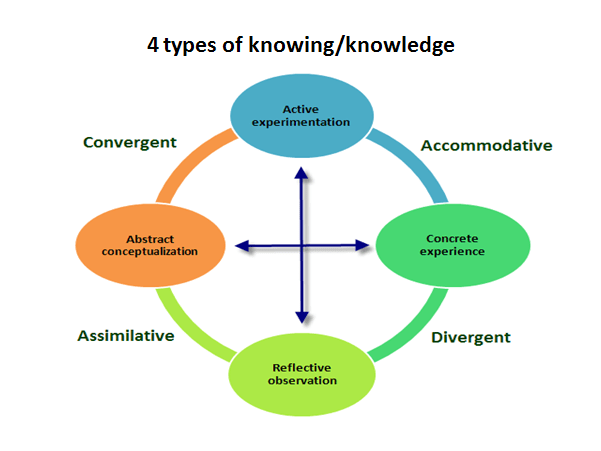
The 4 different activities also correspond to 4 different types of knowing/knowledge, which I’ll try to exemplify with empirical data in future studies.
el-4

Teaching-Learning relations in the environment
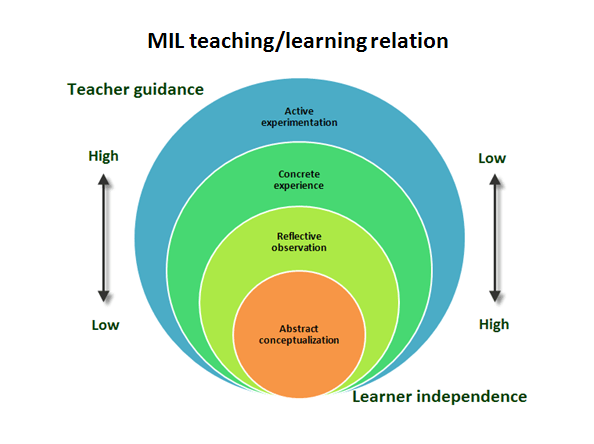
Staying within the framework of Kolb the 4 activities were dominant in the MIL course, and in reviewing these the role/influence of the teacher may be illustrated as below.
el-3

In general MIL students are tech-savvy, used to learning on their own and in their study groups, but SL proved to be an atypical experience, and my impression (also based on the 1. MIL research cycle) was that the students needed much more instruction/facilitation than usual.  Several reasons such as SL’s infamous steep learning curve, the course design, the length of the course period and the rather abstract nature of the subject matter may have contributed to this, but it’s certainly something I need to investigate further. It’s not necessarily a bad thing that the students needed more teacher guidance that usual, but coming from an education that has learner-independence as a goal (as part of a life-long learning perspective) it does bring about some reflections.

Anyways, in reviewing the “applicability” of Kolb’s ideas to my PhD project this preliminary inquiry shows some potential  that need further exploration …

/Mariis

References

Kolb, D. A. (1984): Experiential Learning: Experience as Source of Learning and Development. Englewood Cliffs, NJ.: Prentice Hall

Dewey, J. (1933): How We Think, New York: Heath.

Schön, D. A. (1983): The Reflective Practitioner. How professionals think in action, London: Temple Smith.

Exploring Knowledge Media

Next week I’ll be attending a conference and a Master Class on “Knowledge Media” at Aarhus University.

knowledge-media2

The purpose of the Knowledge Media Conference is to discuss the role of new digital media within education in the knowledge society. What are the potentials of digital media in relation to learning, knowledge sharing and knowledge construction? The conference will focus on use of digital media for learning and knowledge acquisition in both formal and informal situations. The conference includes presentations from invited keynote speakers. Further, the conference will present the results of a research project at the Centre for IT & Learning on Knowledge media, 2007-2008.

Themes

  • Education for all?
  • New learning environments: Web 2.0 and Social Software
  • Knowledge media
  • Formal and informal learning

Keynotes

  • Terry Anderson, Athabasca University, Canada
  • Friedrich Hesse, Knowledge Media Research Center, Tübingen, Germany
  • Lars Qvortrup, School of Education, Aarhus University, Denmark
  • Jørgen Bang, Institute of Information and Media Studies, Aarhus University, Denmark
  • Lynne Schrum, George Mason University, USA

I’m especially interested in hearing Anderson’s talk on “Learning and Teaching beyond the Course Into Networks and Collectives”. The idea that social media, knowledge media or whatever you wish to call new digital media, slowly will dissolve our notion of courses (understood as fixed, teacher-driven activities) as a means of learning seems to gain more and more recognition and attention, and it’ll be interesting to hear Anderson’s thoughts on this in my own area (distance education) – not least since my PhD fundamentally is about course design, hmmm …

The Master Class, with Terry Anderson and Simon Heilesen (senior researcher at the Virtual Worlds Research, Roskilde University) as speakers, will also adress the potentials of digital media in relation to learning, knowledge sharing and knowledge construction. I’ll do a short presentation of Second Life as Knowledge Medium in Distance Education based on my experiences with the MIL course in the 2 research cycles so far. I think it’s a really good idea to hold the Master Class the day after the conference, because I’m quite sure many questions and ideas will come to me, so it’s nice to get an opportunity to discuss more informally.

/Mariis

Lessons learned from one year in the sphere

On January 10th, I was able to celebrate one year in the blog sphere, so it seems natural to reflect a bit on the lessons learned …

Why do I blog?

  • Well, first of all my much, much younger colleague, Thomas Ryberg provoked me by jokingly saying that the older (meaning over 40!) ELL researchers often just don’t understand new media, and as we all know understanding strengthens through practice. TY, Thomas – IOU ;-)
  • I’m inquisitive by nature and had been enjoying lurking in the sphere for a couple of years, and I do think that there are some very high quality, professional blogs out there, so I wanted to join this great knowledge network more actively.
  • As a PhD Candidate I need a place to collect my thoughts and experiences. Old style notes and Post-it’s still work great for me, but the major advantage of blogging is that preliminary thoughts become just a bit more processed or reflected through the writing, so when I return they may still seem unfinished, but yet more coherent than just a few words or lines on a yellow piece of paper.
  • As a PhD Candidate I’m also obliged to disseminate on a regular basis in various types of media. Writing research papers has been the most common way of getting your thoughts out into the research communities, and even though this is a very important activity I find the more immediate nature of blogging very profitable too.
  • Blogging is a great way of documenting activities and storing contextual ideas, links and files.
  • I have to write my thesis in English and needed a place to practice on a regular basis. Blogging in a second language can be really frustrating. I often lack words and phrases, so sometimes I leave out reflections and arguments simply because I don’t know how to articulate them. I’m also aware that especially my grammar often is incorrect. Even though it has become easier over the last year I’m really looking forward to staying at an English speaking university at sometime during my PhD period!
  • My research object, Second Life, brings me so many great and challenging experiences both on a professional and personal level, so this is also a way of showing my appreciation by telling “the world”. As in many other countries Second Life often gets belittled by the Press, most often due to poor research, so this is also a way to counterpart that.
  • When I meet people and talk about my research, I’m often asked for more information, and since I’ve never had a website, this seemed like a perfect way to have a public reference.
  • As a teacher at a Masterprogramme on ICT and Learning it seems not only natural, but also necessary to “practice what I preach”, and I also know that some of my students find it interesting/inspirational to follow my activities.

How do I blog?

I’ve written 72 post during this first year, which I actually find quite ok, since I didn’t blog at all from February till July due to illness both personal and in my family. I’ve written 2-3 personal posts, the rest are professional. The 46 categories reveal that SL, education, MIL, my PhD and research are my favorite 5 topics. I never lack topics to blog about, but due to time restraints I try to focus on topics directly related to my PhD project. I’ve expanded my blogroll quite a lot, and now it works as my favorite list related to my PhD work (my Firefox is more off-topic and often contains temporary links).

I’ve recieved 68 comments. As you may have noticed above I didn’t mention the asynchronous dialogue as an advantage of blogging. I have a dozen of blogs I follow on a regular basis, but I’ve only posted a few comments on other blogs. So far my own posts have mainly been descriptive and have served as a way of preserving preliminary thoughts and ideas. Due to both language restraints and, I guess, professional insecurity I haven’t felt comfortable engaging more and I haven’t done anything to ensure that my blog would show via search engines etc. I started blogging as a very personal experience, as a way of finding my own voice as a researcher – and this may take some time. Being a PhD candidate is very much about learning and I intend to take advantage of this unique opportunity of having three whole years to strengthen my thoughts and expand my knowledge.

In a recent Australian study on the advantages of blogging as part of a PhD candidature by Ward & West (2008:63), it is stated that:

The process of PhD development should, presumably, be one of growth in intellectual confidence, independence and originality of thinking. It would be fair to expect it to result in empowerment and ultimate entry to an elite community. These attributes – that we presume are valued by all the participants in the process – by definition are not, and should not, be easy to achieve.

Although there apparently are major differences between the learning conditions for PhD candidates in Denmark and Australia, I do think that Ward & West’s paper summarizes the advantages of blogging quite accurately, and I would much certainly recommend blogging as part of the PhD learning process.

/Mariis

BTW, thanks to Greg Wadley – another blogging PhD Candidate – for the Ward & West reference :-)

Design Thinking and Informatics

Next week I’ll participate in a 2 day PhD course on”Design Thinking and Informatics” at HCCI-Doctoral research programme in Human Centered Communication and Informatics, Aalborg University. Course lecturers are Judith Gregory, Institute of Design, Illinois Institute of Technology & Anne Marie Kanstrup, Department of Communication and Psychology, Aalborg University.

Day one focuses on design thinking (vs. construction). Introductions will be made to the history of design thinking in general and current trends in design thinking in informatics in particular. Socio-technical, theoretical perspectives will be introduced and used in discussions of what this way of thinking means for students’ doctoral research projects.
Day two focuses on methodological practices and consequences of design thinking. Case examples will be presented for how selected methods have been employed and students will work on how to integrate design thinking into their research projects.

In order to enroll in this course I had to prepare 1-3 questions related to design within my PhD project. In my view design is an ambiguous term. I do use the term in my project, but depending on what area of my project it concerns, I use the term with different meanings. I tend to regard my whole project as a design, and in Danish I would use the term didactic design to strengthen that I’m concerned with design aimed at a pedagogical practice. However, when I speak with non-Scandinavians the term didactic doesn’t seem to make much sense, and I usually resolve to say educational design instead, but this doesn’t cover my project either. When I explain in further detail what my project entails people – especially Americans – often respond by saying “oh, you mean instructional design”. But instructional design is in my opinion related to a certain pedagogical epistemology on which I don’t agree. It has been suggested that I might use the term curriculum design, but that doesn’t really cover my project either … This uncertainty about how I should coin my design is the main reason for me to participate in the PhD course as I’m hoping it will inspire me to clarify not only the prefix but also the design concept in itself. I therefore have posed the following questions:

  1. How can I define (think of) Design? According to Owen.2004:3 design can be described as “a profession that is concerned with the creation of products, systems, communications and services that satisfy human needs, improve people’s lives and do all of this with respect for the welfare of the natural environment (…) Design involves problem finding, problem solving, analysis, invention and evaluation guided by a deep sensitivity to environmental concerns and human-centered aesthetic, cultural and functional needs.” However, this is not an adequate description of my design concept …
  2. How can I coin my design concept so that it includes pedagogical, participatory and technological aspects?

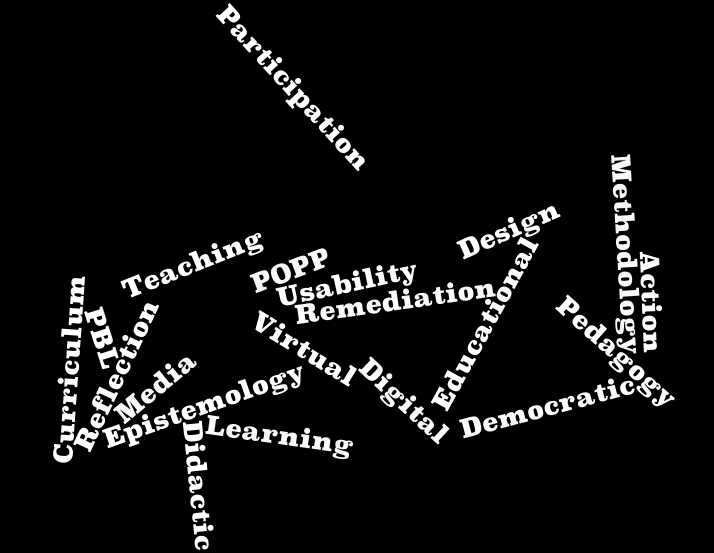
Rheingold. 2008 advocates for the need of Participative Pedagogy as a strategy for designing social media. Participation is already a keyword in my project – both with regards to my overall Action Research inspired approach and with regards to my pedagogical foundation within PBL and POPP. In spite of this, I’m not really sure how to include that particular keyword in describing my project. So as you can imagine, I’m in desperate need of the course ;-) Below I have placed some of my project’s keywords in Wordle, which seems as an appropriate way of illustrating my current state of mind – one big mess!

wordle109

Another interesting part of this PhD course will be for me to figure out how I (my project) fit into the field of Informatics. At ELL we have several researches working within Informatics on either information processing and/or development/design of information systems (IS), but they are using a quite different terminology (which typically indicates different views and practices) and I don’t usually consider myself to be part of that “gang” at ELL. I don’t really like the term IS. First of all, I think the information part associates with a narrow view on communication and system(s) in my ears simply rings too machine’ish putting too much emphasis on the technology. I’m aware that system(s) in several theories* refers to human activity and organization, but I just don’t like it. From talks with my colleagues, I know they share most of my humanistic views and I probably will stand corrected on this after the course – not least because I know for sure that we have common interests on the methodological level. Anyways, I’m looking forward to a couple of interesting days, and hopefully I’ll soon be able to return with a clarifying post on my project design …

/Mariis

References
Owen, C.L (2004): What Is Design? Some questions and answers.
Location

Rheingold, H. (2008): Participative Pedagogy for a Literacy of Literacies.
Location

*) Intersting resource on theories used in IS

What will change (everything) in 2009?

Via George Siemens my attention has been directed towards The Edge Foundation Inc. – a non-profit private organization established in 1988 with a mandate “to promote inquiry into and discussion of intellectual, philosophical, artistic, and literary issues, as well as to work for the intellectual and social achievement of society.”

edge

Every year The Edge asks its contributors a big question, and with reference as to how technology and science can lead to changes in our practices and perceptions, this year’s question was:

What will change everything? What game-changing scientific ideas and developments do you expect to live to see?

150 prominent thinkers have contributed, and there really are some radical food-for-thoughts, and as part of my new year’s resolution of eating more wisely I decided to indulge myself ;-) Here are a few of  my favorites with relevance to my current research interests …

Kevin KellyA New Kind of Mind

It is hard to imagine anything that would “change everything” as much as a cheap, powerful, ubiquitous artificial intelligence—the kind of synthetic mind that learns and improves itself.

When this emerging AI, or ai, arrives it won’t even be recognized as intelligence at first. Its very ubiquity will hide it.

While we will waste the web’s ai on trivial pursuits and random acts of entertainment, we’ll also use its new kind of intelligence for science.

The scientific method is a way of knowing, but it has been based on how humans know. Once we add a new kind of intelligence into this method, it will have to know differently. At that point everything changes.

Following this line of thought I can’t help but think of Connectivism, which in my opinion aims at rethinking our ways of knowing and knowledge “creation” in itself, and thus teaching and learning … I’m not sure that I’ve fully understood Connectivism and its implications, but I do know that my encounters with it so far have changed my own way of thinking education, teaching and learning. I’ll return to this in a post on some of the more qualitative outcomes of the MIL course, the primary case in my PhD.

Howard GardnerCracking Open the Lockbox of Talent

For the first time, it should be possible to delineate the nature of talent. This breakthrough will come about through a combination of findings from genetics (do highly talented individuals have a distinctive, recognizable genetic profile?); neuroscience (are there structural or functional neural signatures, and, importantly, can these be recognized early in life?); cognitive psychology (are the mental representations of talented individuals distinctive when contrasted to those of hard workers); and the psychology of motivation (why are talented individuals often characterized as having ‘a rage to learn, a passion to master?)

Note, however, that will not illuminate two other issues:

1.    What makes someone original, creative? Talent, expertise, are necessary but not sufficient.
2.    What determines whether talents are applied to constructive or destructive ends?

These answers are likely to come from historical or cultural case studies, rather than from biological or psychological science. Part of the maturity of the sciences is an appreciation of which questions are best left to other disciplinary approaches.

Gardner’s MI Theory was mandatory reading when I went to Teacher College in the late 90’ies and I do appreciate the debate and the confrontation with the conventional IQ concept. I do, however, think that Gardner has been greatly misinterpreted leading to misunderstandings of the power of teaching and learning. In this comment Gardner himself goes against the notion that anyone can achieve anything through hard work (putting enormous pressure on all teachers!). I’m not saying that we as teachers shouldn’t strive at facilitating the best learning circumstances for all our different students, but let’s be realistic! When that’s said, I think that I’ve come to see more and more evidence of yet another type of relatively autonomous intelligence, namely one concerned with virtual 3D. At the moment, this is just a gut feeling based on my observations, but I will try theorizing on this in a future post. I don’t expect MI, Learning styles or whatever you wish to call it to be a big part of my PhD, but naturally I will focus on my target group’s prerequisites and potentials for learning.

Chris Anderson (TED) – A Web-Empowered Revolution in Teaching

Five years ago, an amazing teacher or professor with the ability to truly catalyze the lives of his or her students could realistically hope to impact maybe 100 people each year. Today that same teacher can have their words spread on video to millions of eager students. There are already numerous examples of powerful talks that have spread virally to massive Internet audiences.

Driving this unexpected phenomenon is the fact that the physical cost of distributing a recorded talk or lecture anywhere in the world via the internet has fallen effectively to zero. This has happened with breathtaking speed and its implications are not yet widely understood. But it is surely capable of transforming global education.

For one thing, the realization that today’s best teachers can become global celebrities is going to boost the caliber of those who teach. For the first time in many years it’s possible to imagine ambitious, brilliant 18-year-olds putting ‘teacher’ at the top of their career choice list. Indeed the very definition of “great teacher” will expand, as numerous others outside the profession with the ability to communicate important ideas find a new incentive to make that talent available to the world. Additionally every existing teacher can greatly amplify their own abilities by inviting into their classroom, on video, the world’s greatest scientists, visionaries and tutors.

The idea that technology based knowledge has the potential to change the world certainly isn’t new and some of the other Edge Contributors are still waiting for the changes to appear (e.g. Haim Harari below), but the idea that this could lead to young people wanting to step into the teaching business I find really intriguing. Being a TED devotee myself, I sure do understand the power of high quality distributed knowledge sharing, and if the possibility of fame could inspire some, so be it … let’s just hope that somewhere along the way they’ll recognize and appreciate  some of the real qualities of possessing the world’s greatest job :-)

BTW for a more radical take on changes to come in the educational area have a look at David Gelernter, who among other things wants to replace teachers with parent-chosen, cloud-resistant “learning tracs” … I appreciate the problem, but I don’t agree on the solution.

Thomas MetzingerSoul-Travel for Selfless Beings

It is entirely plausible that we may one day directly control virtual models of our own bodies directly with our brain.

First, we manage to selectively block the high-bandwidth “interoceptive” input into the human self-model—all the gut feelings and the incessant flow of inner body perceptions that anchor the conscious self in the physical body.

Second, we develop richer and more complex avatars, virtual agents emulating not only the proprioceptive feedback generated by situated movement, but also certain abstract aspects of ongoing global control itself—new tools, as Brockman would call them. Then suddenly it happens that the functional core process initiating the complex control loop connecting physical and virtual body jumps from the biological brain into the avatar.

I don’t believe this will happen tomorrow. I also don’t believe that it would change everything. But it would change a lot.

In evaluating SL as part of the MIL course one of the students pinpointed the missing link between the avatars and our physical bodies stating that there was a huge discrepancy between all the activities we were enjoying in-world compared to our bodies passively sitting in front of the screens. Due to present technological limitations, my guess is that the majority of virtual world users don’t really feel immersed until after many months (if  ever), so Metzinger’s predictions surely would change a lot. Like Metzinger, I don’t expect this to happen over night, so meanwhile I’ll have to look closer at ensuring future MIL students a smoother entrance into SL.

Haim HarariAt Last: Technology will Change Education

Of the six billion people on our planet, at least four billions are not participating in the knowledge revolution.

The “buzz words” of distant learning, individualized learning, and all other technology-driven changes in education, remain largely on paper, far from becoming a daily reality in the majority of the world’s schools. The hope that affluent areas will provide remote access good education to others has not materialized.

So, my game-changing hope and prediction is that, finally, something significant will change on this front. The time is ripe. A few novel ideas, aided by technologies that did not exist until recently, and based on humanistic values, on compassion and on true desire to extend help to the uneducated majority of the earth population, can do the trick.

This is a change that will create a livable world for the next generations, both in affluent societies and, especially, in the developing or not-even-yet-developing parts of the world. Its time has definitely come. It will happen and it will, indeed, change everything.

This is one of the longer comments on The Edge, and Harari puts forward 5 very intersting and worth reading arguments for why this much needed change finally could happen in the year(s) to come.  If I didn’t share Harari’s vision there would be no point in having this job. I don’t think my own teaching will change a whole lot,  certainly not everything! But in helping other educators (MIL’s target group), I do believe that my colleagues and I are contributing to a positive change.

During the MIL course the students highlighted the fact that we met with educators and business people from all over the world, and this element is something I wish to further develop. Meeting and talking to people from different cultures may not change everything, but it is a small step in the right direction … For a related Edge comment on the impact of culture have a look at Timothy Taylor‘s thoughts.

Mihalyi CsikszentmihalyiThe End of Analytic Science

The idea that will change the game of knowledge is the realization that it is more important to understand events, objects, and processes in their relationship with each other than in their singular structure.

Western science has achieved wonders with its analytic focus, but it is now time to take synthesis seriously. We shall realize that science cannot be value-free after all.

Unfortunately, it does not seem to be enough to protect the neutral objectivity of each separate science, in the hope that the knowledge generated by each will be integrated later at some higher level and used wisely. The synthetic principle will have to become a part of the fundamental axioms of each science. How shall this breakthrough occur? Current systems theories are necessary but not sufficient, as they tend not to take values into account. Perhaps after this realization sets in, we shall have to re-write science from the ground up.

It is by no means accidental that I’ve chosen to finish this post by quoting Csikszentmihalyi’s comment. First of all, I totally agree with Csikszentmihalyi that science/research can’t be value-free. I just don’t see how that would be possible being that it is always humans that interpret the data wither they are quantitative or qualitative. And yes, sometimes we programme systems to detect patterns in large data sets, but it still is humans doing the programming. I may be naïve or even uninformed on this. Many of the Edge comments predict radical changes in AI, and I may be forced to change my opinion on this in the future. More importantly though this comment denotes one of the key changes I need to execute in my PhD in 2009, where I need to (re-)consider some methodological issues that have arisen during the 2 research cycles I’ve completed so far. Without getting into too much detail in this way too long post, I did encounter some major difficulties in a) being both the teacher and the researcher in my primary case, which leads to b) how do I interpret the data securing some degree of validity acknowledging a)?

On Friday January 2nd I attended this year’s first research meeting at Rockcliffe University, where Rockcliffe CEO, Phelan Corrimal, spoke on “Research in Virtual Environments: Data Collection & Validity”.

rockcliffe_020109_006
Researchers at Rockcliffe discussing threaths to research validity …

Unfortunately I still haven’t felt comfortable in joining these discussions actively. My English simply isn’t good enough when it comes to speedy answering, but I do enjoy these discussions very much anyway. I always find some sort of inspiration in these discussions getting new references, learning new phrases, discovering new concepts, and most important listening to researchers from various disciplines clearly enhances my general knowledge about research in virtual environments. It is nonetheless increasingly frustrating not being able to participate more actively in the many interesting discussions, especially because coming from a Scandinavian research tradition I think I may be able to contribute with some (very) different perspectives, so a more personal change in 2009 will be to take a risk and participate more actively … and maybe that will change everything … at least for me :-)

/Mariis