Building Class with Asp & Ballinger

On Tuesday November 18th we had the first building class of the MIL course. Dr. Asp and Heidi Ballinger were the guest teachers, since I don’t know much about building. We first met in MILs Holodeck just to check sound (tedious that you always have to do that, just to be sure it works!) and then we moved on to the sandbox Dr. Asp had set up for the course. I have of course been talking to Asp and Ballinger about the MIL course, the students and why I would like to incorporate a building class in the course. Even though the students will not learn to build complex things, I’m confident that it will give them a unique insight into the process and for sure a greater appreciation for all the things you see and experience in-world.

kgi181108_002
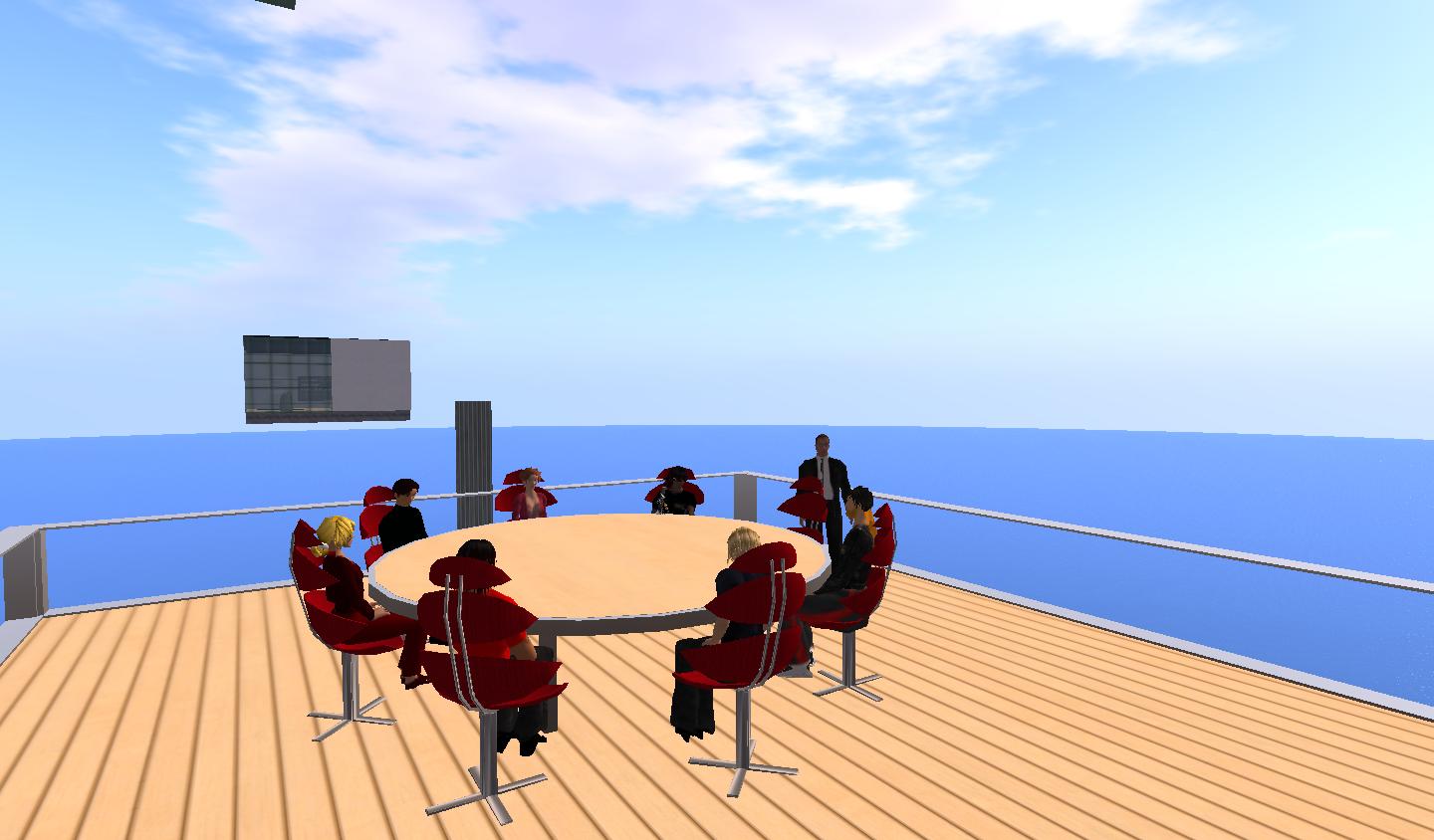
Pre-meeting in MILs holodeck

8 students attended and the 2 hrs passed quickly. I decided to enter the student role and do the assignments Asp and Ballinger had planned, but I have to admit that I do not see myself as a future in-world builder .. . I simply do not have the patience! But the students seemed to appreciate the class and even though most of them thought it was quite difficult and time consuming, they all found it to be a valuable learning experience. One of the students pointed out that it had been especially interesting to see and experience that it is actually possible to learn something technical via SL.

The first class was deliberately designed so that the students would learn the most basic stuff in building, and it was really good that both teachers had the time to pay attention to each individual. One student arrived about one hour into the class, but he had technical problems and never really got integrated. After the class Dr. Asp, Heidi and I decided that the 2 next classes will be for those who attended only. The argument for this is to be able to progress – and with limited time, it would be inappropriate to spend it repeating stuff already learned by the majority – not least since all activities are voluntary.

kgi181108_2_004
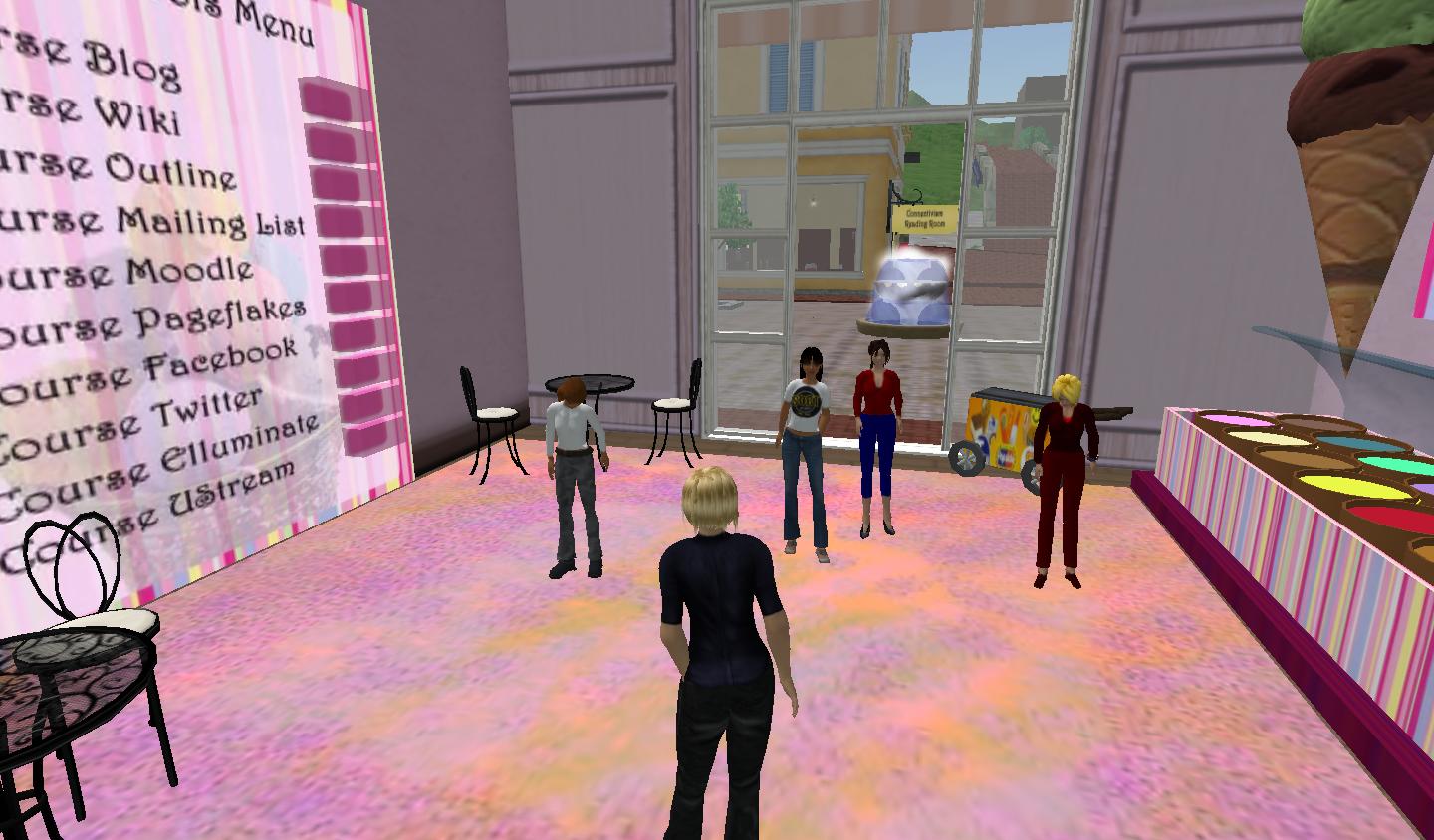
Changing texture – luckily the arms don’t get tired!

Dr. Asp commented on the class on his blog (in Danish), and one of the realizations that he came to, was that builders in-world truly need to possess a lot of knowledge and he himself who has been building for more than 2 years now still learns new things, so of course you cannot become a skilled builder in the course of 3 sessions. The students realize that, but as one of them states; It’s great that other people are willing to spend so much time on building things the rest of us can benefit from ..

I could not agree more – so here is a big, big TY to all the amazing in-world builders:-)

/Mariis

Designing an alternate class room

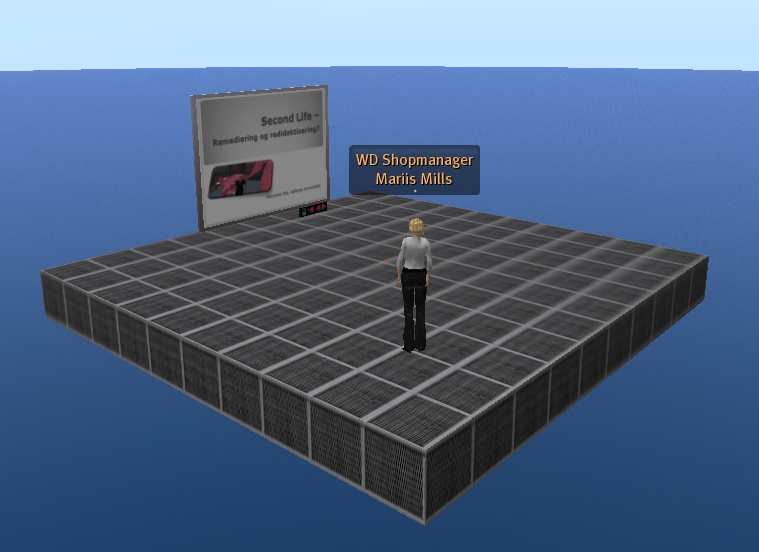
Since I’ve decided to have 4 sessions where we’ll discuss didactic design issues I need a place for this activity. The office that MIL rents on the ground at the Wonderful Denmark Island is way too small, so we have to see if we can fit into the platform, where our Holodeck is located. Luckily Dr. Asp was able to help me clear the location and he also gave me a viewer, where I can present a few slides. So for now the class room looks like this:

holodeck_m_skaerm

I’ve been touring in-world to find places with nice furniture, but instead of decorating the place myself, I think I’ll ask the students to bring their own sitting devices – some might prefer to sit on alternate “chairs” or even lay down or float while attending, and I do believe we should try to experiment with different ways of “attending class”. I’m a bit anxious about the space available – if all students turn up, we might run into a problem, but then we can move to a sandbox, where I quickly can rezz the viewer.

I’ll take some pictures from the first session to show how the place ended design vice …

/Mariis

Challenges of flexibility and facilitation

Last week we had a 3 day f2f seminar at the MIL programme, where my colleagues and I introduced the 4th module on Ict and Educational design – the module in which I facilitate a blended in-world course. Saturday afternoon I started out by giving a lecture on remediation and redidactization focusing on respectful and radical design in SL both regarding people, places and processes. After the introduction we had a hands-on workshop where basic SL functionalities were explained and tested. 13 students out of 25 signed up for the course, and 5 other students, who chose to analyze a learning environment different from SL, wish to participate informally which I allow.

The course in fact started on November 1st but the period up until the seminar is mainly reserved for the students’ preparation (reading, creating an account and joining the in-world group). I did however plan some “Get off to a good start” in-world activities before the seminar, but only a few students attended these. All the different activities in-world are voluntary and I only demand that each student participates at least once in scheduled in-world activities during the course. The argument is that the MIL programme is intended to be flexible in order for the students to be able to participate even though the majority is full time employed, and several mandatory online activities would challenge that flexibility. Furthermore as part of a problem based pedagogy the students are expected to explore and investigate on their own and in their study groups. This pedagogical strategy is possible not least because the students are adults, highly motivated, comfortable with taking responsibility for their own learning and in most cases appreciate the freedom of choice. Last year when I did the same course, a handful of the students chose to participate in several of the activities, and I expect that to be the case this year also.

kgi161108_001

Meeting on November 16th – showing some students the Connectivism Village

Promoting and ensuring student autonomy is a cardinal point of my (and MILs) pedagogical philosophy, nevertheless this strategy poses some challenges as seen from the facilitators point of view. I’ve planned roughly 3 activities pr. week and they last between 2-3 hrs, and so far I’ve been the only facilitator. (This week we’ll start having activities with in-world colleagues). One of the challenges of this “buffet pedagogy” is that I never know how many students will attend, and since the sessions are relatively long some students choose to participate in parts of the activity only. Not knowing the exact number of participants calls for flexible planning thus challenging me to let go of my usual need for control and structure.

A different challenge of this flexibility for me as a facilitator is that I constantly have to be aware of new students joining and try to include them simultaneously during the sessions. A good feature for this of course is the IM, which makes it possible to text without interrupting the whole group. This is something not possible in real life, and I do think that it is quite smart, but I also have to say that it is fairly demanding on the facilitator. I suppose the ability to text chat with several participants simultaneously is a skill that “just” needs to be learned, but I can’t help wonder if this rather complex way of communicating would discourage some potential teachers from trying out SL or similar environments.

The last 2 Mondays I’ve been attending Metanomics meetings with students, and on these occasions I had respectively 10 and 12 active chat windows, so my immediate impression was that I spent most of my time paying attention to the chats rather than the speakers. The main reason for attending these Metanomics meetings was to show the students this particular way of communicating, “Constructive Cacophony” as Bloomfield calls it, so the content wasn’t all that important. I will return to the content issue in another post, but for now I just want to reflect on the possibility of using text and voice simultaneously. At the Metanomics meetings Bloomfield is assisted by moderators, and if we transfer this to an educational setting the solution could be to have more than one teacher or perhaps a TA.

Another option is to limit the text chat and ask participants to use a certain group chat only. This might work well, and we’ll experiment with that down the line, but here in the beginning of the course, I believe that it is very important not to limit the students’ use of IMs to the facilitator. It’s my clear impression that the IMs serve as an invaluable support giving especially less confident students a communication channel where they do not need to “expose” their inexperience and/or insecurity. The trick here – just like in real life – is to create an atmosphere where no questions are too small or too stupid. On the other hand, it is also my impression that the students choose IM because they experience this as being more polite than interrupting the activity with personal /individual questions, and this may be because we have not yet reached consensus on how to communicate in these in-world situations.

Finally, from another perspective this possibility to pose individual questions during group activity may enhance inclusion in a way not possible without technology mediation, and this is truly where I begin to see SL as a strong learning environment … even though it initially challenges both the students and the facilitator :-)

/Mariis

The out-of-avatar experience

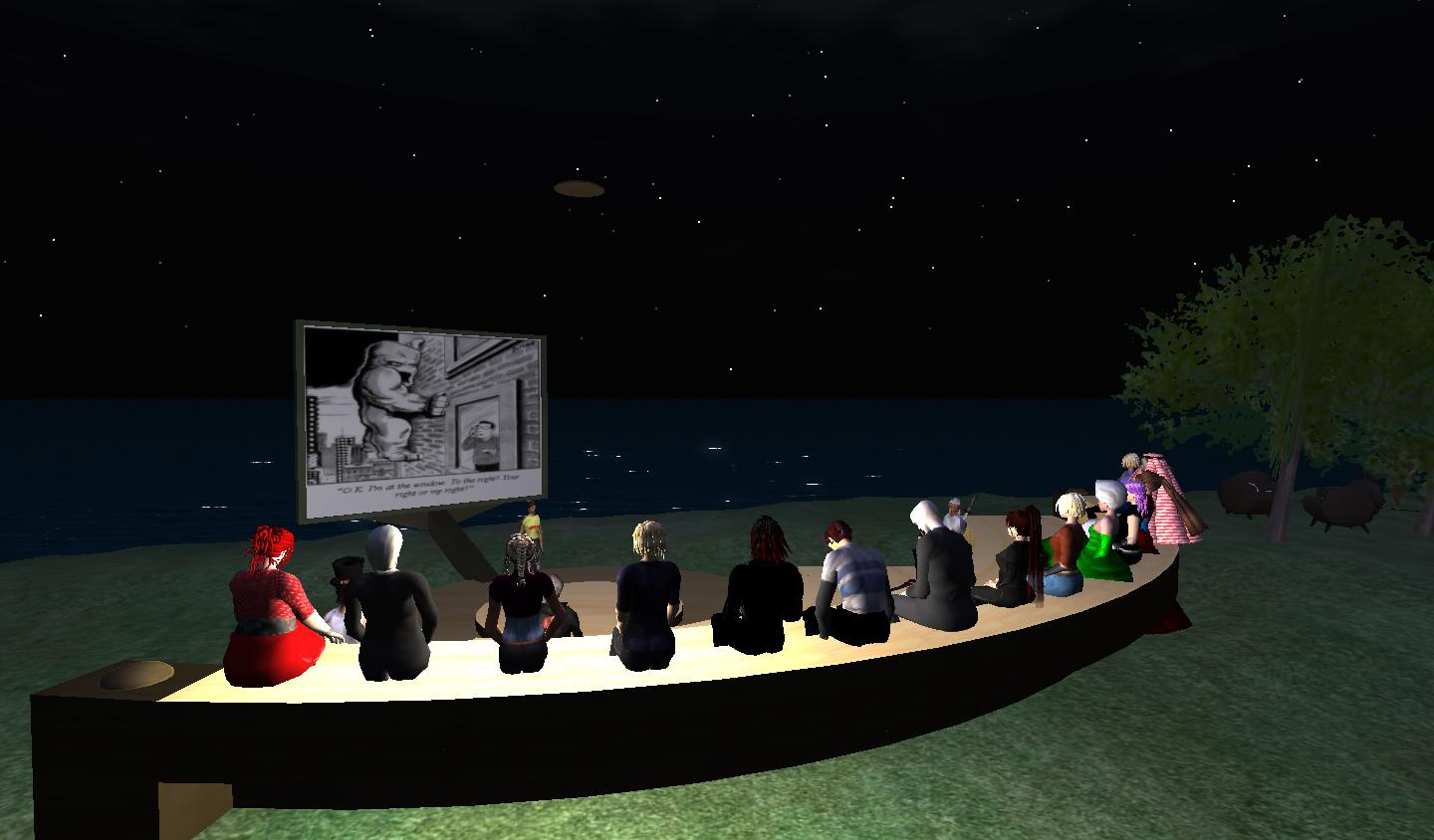
Late last night, one of my students, Mew and I attended a research meeting where Grog Waydelich spoke about the use of voice respectively text, and collaborative building in-world.

grog_003

During the meeting Mew and I chatted (in Danish ;-), and from a teachers point of view this ability to chat simultaneously (while the speaker is on voice) really is a great feature. But what I wanted to point out in this post was Grogs considerations on what he terms “out-of-avatar” experience:

At any moment in SL, a user is either looking through their avatar’s eyes (usually from just behind their avatar’s head) or through the disembodied camera. We called these modes “in-avatar” and “in-camera”. (The latter term reminds us that camera locations are not visible to other users.)

Since I personally prefer looking through my avatars eyes, I hadn’t really payed much attention to this phenomenon, but it adds yet another dimension to the mind/body dichotomy discussion.

In this study Grog and his colleagues at PlayOn found that users in this project spent more time (57%) in-camera than in-avatar, and the more experiences avatars spend 90% of their time in-camera. Most likely it has to do with the fact that this was a building project, where it is necessary to change view regularly, but it is fascinating that the users still identified with their avatars, even when their focus of attention was elsewhere. For further info on this interesting study, have a look here.

/Mariis

In-world course next 5 weeks

From November 1st – December 15th I’ll be facilitating a blended course using SL at The Danish Master programme in ICT and Learning. This course serves a primary case in my PhD-project, and I did a pilot study using the same course last fall together with 22 students. This is a brief description of the course as I’ve planned it this fall.

Educational setting – Master programme on ICT and Learning
The Master programme in ICT and Learning (MIL) was established in 2000 as a shared educational enterprise on equal terms between five Danish Universities, as an attempt to enhance collaboration between universities and working life within further and continued education.The Master programme is research based; teachers come from the five different research environments at the collaborating universities, and all participants (teachers, students and administration) are comfortable with participation in both small and large scale research projects. Hence, characteristic for MIL is that the education continuously tries to reflect and change its own activity by combining research and practice.

The Master programme is blended by a combination of virtual periods and 4 face-to-face seminars pr. study year. Between seminars the teaching and learning processes are conducted in the conventional 2D virtual learning environment, FirstClass combined with various web 2.0 technologies. Despite the fact that the five universities traditionally have represented different pedagogical cultures, MIL was from the beginning build fundamentally on the pedagogical philosophy of Problem Oriented Project Pedagogy, which is a Danish version of Problem Based Learning.

MIL consists of four course modules, a module on ICT tools and two long project periods. Each course module covers a theoretical and practical approach to its field of study combining ICT with

1) Learning

2) Interaction Design

3) Organizational Learning

4) Educational Design

The progression of the programme evolves in interplay between theory, practice and experiences of the participants.

Student profile
The goal of MIL is to upgrade people working with ICT and/or learning, both in the public and in the private sector. An internal investigation conducted in 2004 gave the following profile; a typical MIL student has an average age of 45, and is married with two children in the teens. The majority of the students work fulltime. Their educational background usually stems from the humanities, and all our students have bachelor degrees or equivalent, and about 75% have higher level educations. For most of our students their primary education is more than ten years old, which often means that is has been a while since they last were students and many of them have no or little experience with blended learning. All of them are quite competent regarding general ICT-skills, and nearly 20% are highly competent technicians. About 5% of the latter have never been professionally engaged in teaching and learning. When it comes to working experience almost all of our students (95%) are experienced teachers at different levels in the educational system and in the private sector, and it is not unusual to meet students with more than ten years of teaching experience. Nearly all the participants come with a background from leadership in organization or project groups.

Main motivation for entering the MIL programme is to increase competencies regarding ICT and learning and create intersections between the two. Another strong motivation for entering the MIL programme is the wish to connect with new networks in the field.

Course setting – ICT and Educational Design
The 4th module of the MIL programme “ICT and Educational Design” consists of 2 courses, and it is in the first course that we use SL:

  1. Educational design, ICT based learning products and virtual learning environments; theory and analysis
  2. Educational design, ICT based learning products and virtual learning environments; concept and implementation

Though separate, the two courses should be regarded as connected, in the sense that the learning outcome of the first course should be more or less applied in the second course. In the first course the students usually are provided with 2-3 optional virtual learning environments between which they are asked to choose one as analytical object. Throughout the MIL programme the students are introduced to different virtual learning environments covering a wide range of mainly conventional 2D asynchronous and synchronous examples. Therefore the learning environments chosen for this course always represent the more unconventional trends, since it is our experience that these often provide more rich and radical settings, which can stimulate reflections. This study year the students can choose either the 3D virtual game Global Conflicts Palestine or SL as their analytical object. Regardless of choice, the students are expected to discuss and analyze the learning environment on the basis of the 5 following mandatory topics:

Pedagogical design and target groups
Orientation and navigation
Interaction
Learning processes
Audio-visuals

SL setting and activities
MIL does not own land in-world, but we rent 2 locations on the island, Wonderful Denmark, but these locations are mainly used as meeting places. As mentioned above the students are expected to explore and analyze SL form a pedagogical point of view. In order to show the students the rich potential, I arrange tours to different locations where we meet with the owner/designer, have a tour and discuss pedagogical topics. Afterwards the students are expected to reflect on the locations, and document their findings in the asynchronous platform, FirstClass. Naturally the students can tour on their own, locate interesting design and share these experiences.

Besides touring, I’ve planned the following activities:

  • Get off to a good start – meetings where we focus on basic in-world skills
  • A building class running for 3 days with guest teachers Doctor Asp & Heidi Ballinger
  • Didactic Design Discussions – 4 sessions where we’ll focus on course litterature related to the students findings
  • Friday Bar – social meetings just for fun
  • Students Tour – students plan a tour based on their discoveries
  • Christmas celebrations and course finalization

And based on my experiences from last year we’ll have a lot ad hoc meetings, whenever the students need a helping hand :-)

“Without friends no one would choose to live, though he had all other goods”
By quoting Aristotle from Nichomachean Ethics I want to take this opportunity to express my gratitude to my in-world colleagues and friends both from Denmark and the rest of the world for helping me out in showing the potentials of SL – I couldn’t do it without you guys!

As the course progresses I’ll return with posts on our experiences ..

/Mariis