More observations from the PBBL course

So we’re approaching the final week of the PBBL course and it is time to reflect a bit. My colleague Heilyn and I have managed to reflect on the course activities for every week and we have posted these reflections in Moodle, so that the participants could get an idea of why we have designed course elements in certain ways and what we have thought of the outcome. These meta-reflections  (on which the participants have commented) have proved to be very valuable in both our and the participants’ learning experience and it is definitely a course component I want to further develop in my next course. In this post I’ll highlight some of our reflections.

In the first SLecture the text and voice check took almost 45 min. and Heilyn and I agreed that this was unacceptable, so in the second SLecture we reduced the scheduled time to 15 min. and we put out further information on voice settings etc.  It worked for the majority of the participants, but there still seems to be 1-2 participants in every session struggling with technical problems. We actually asked everybody to check out if they could access especially SL before enrolling in this course, but in future courses this should be stressed, since we cannot help/ do anything about local problems e.g. firewall problems, inadequate graphics cards, poor internet connections and lack of headset etc. In designing this course we had planned a preparation week where participants were expected to solve a newbie assignment aimed at learning the basic skills in SL. These activities were optional and unfortunately very few participants decided to make use of this offer. For future courses we would recommend making newbie assignments/activities mandatory.
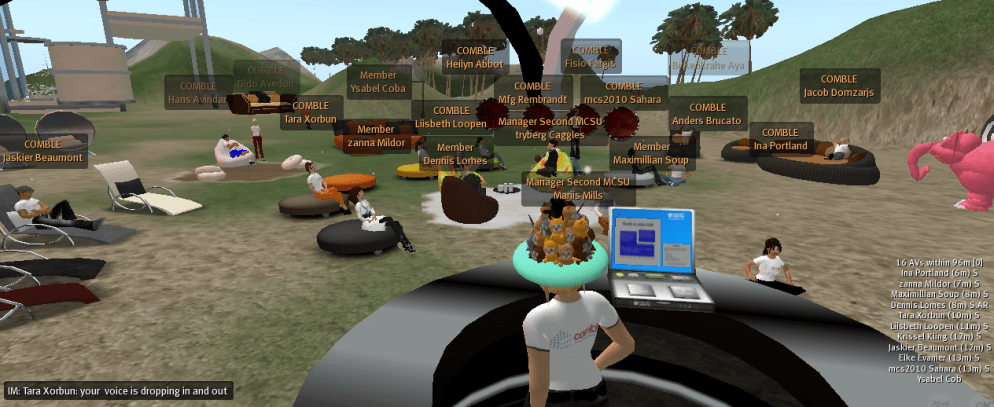
SLecture2
SLecture 2 in session …

In this course the participants are expected to work in Teams and Heilyn and I decided to form the teams based on nationality. The argument for this type of division was quite pragmatic. We knew that all participants would have difficulties in finding time to participate, so we figured it would ease their process if they were able to work in their own languages  for some of the activities (mainly the Mini-project work), and in the second SLecture these Learning Teams met for the first time.  Whether this has been a good decision we’ll know more about in the final course evaluation …
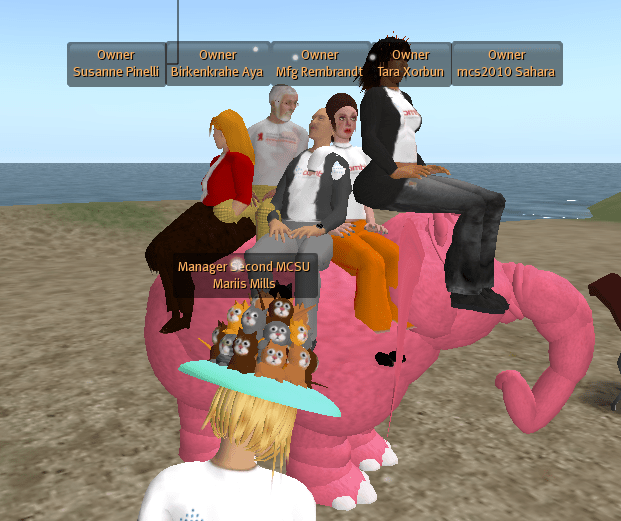
Germany
Learning Team Germany decided to meet on one of the Pink Elephants …

The third SLecture was Heilyn’s first real teaching experience in SL, and I think she did a great job. Her presentation was about Action Learning and by the end of the SLecture the Learning Teams were asked to go shopping for Team mascots.  I asked Heilyn about her experience and she pointed out two things. First of all she did not consider doing a presentation a creative way of teaching. I agree, but I do believe presentations are necessary when the participants have little or no prior experience with the subject matter, come from very different pedagogical cultures, speak different languages and in general have very different prerequisites. Lecturing then serves the purpose of trying to establish common ground, common language, common terminology and as a means to clarify questions. I also believe that the participants’ general SL skills should be taken into consideration before planning more difficult activities. Besides this, I do believe that lectures in SL are quite different from conventional f2f lectures due to the possibility of using simultaneous voice and text.

Heilyn-SL3
SLecture 3 in session …

Another point Heilyn made was that she felt somewhat alone during the SLecture, in the beginning she felt worried because she couldn’t see the participants’ reactions. It felt like talking to an empty space, but then the comments started to appear in the chats. By the end she was more tired than usual after a 2 hr lesson. Before the SLecture, we discussed if she should ask the participants to wait with their questions till after the presentation, but I recommended her to allow for questions during exactly because I thought she might otherwise feel quite alone – and it is also more interesting for the participants if they are allowed to contribute to the discussion. But lecturing this way and in a foreign language certainly is something you need to learn and especially when there are many questions/comments it can be difficult to stay focused. I’ve logged both local and group chat from all the lectures and as an example there were a total of 33 pages in the second SLecture – that is a lot of information you need to attend to while lecturing …
Optional-MI
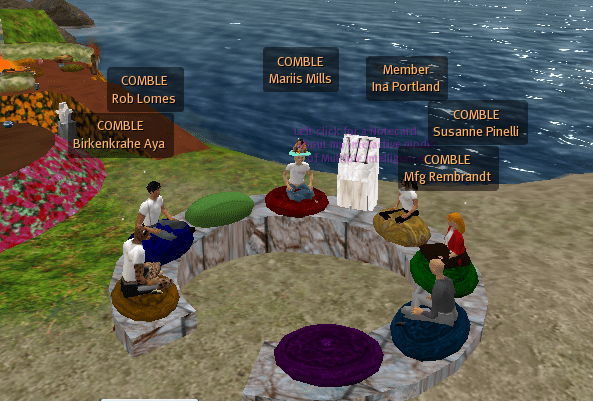
Discussion on the MI theory …

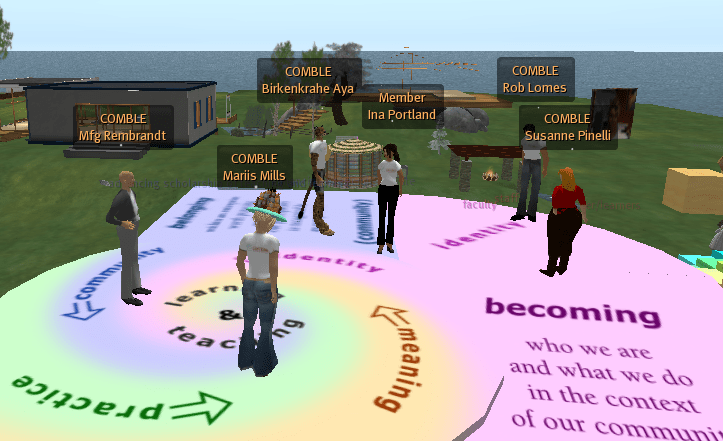
Recognizing that participation in lectures is not the most interesting way to get to know SL, we have also included Optional visits, and in the first visit I showed the participants Zotarah Shepherd’s MI design and Thursday Xu’s designs of Bloom’s taxonomy and Wenger’s CoP.  Touring, exploring and trying out things together in an informal way combined with discussion on topics that are somewhat peripheral to the subject matter is in my opinion a very nice activity, and judging from the feedback the participants also appreciate this kind of activity.
Wenger060909
Discussion on the CoP theory …

The fifth SLecture was on PBL, networked learning and web 2.0 technologies conducted by my other colleague, Thomas. I was not able to attend, but judging by the comments in Moodle the participants enjoyed the lecture. At this point in the course Heilyn and I decided to make part of the lectures more interactive, since the participants now seemed more at ease in SL. For the 6th SLecture we prepared 5 statements on PBL/AL and used them together with the Opinionater tool. This turned out to be a very interesting exercise. We had not anticipated that the participants would disagree to the extent that they actually did.

Statement3
No consensus on problem types in PBL/AL …

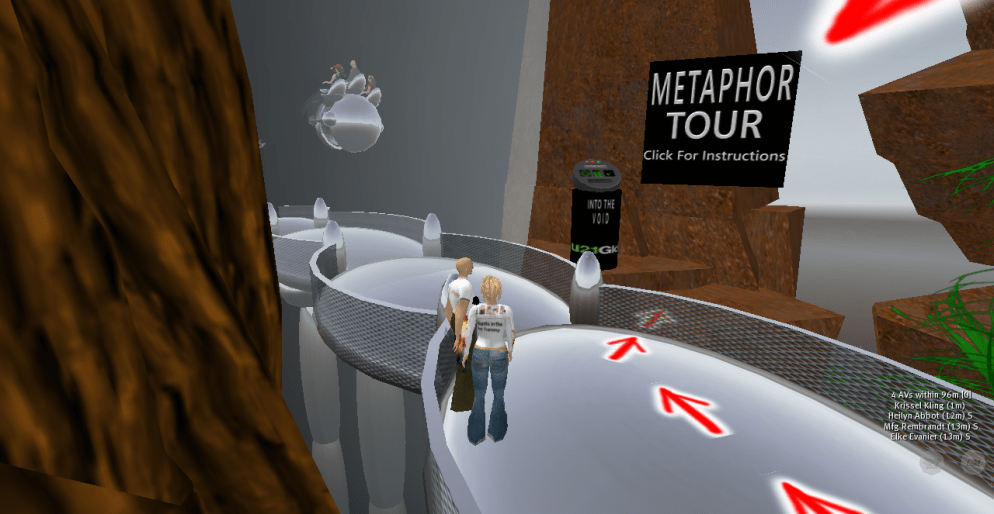
The Opinionater is a quite simple tool, but highly effective. We managed to have some interesting discussions on different aspects of PBL/AL and in that sense the tool also served as a formative evaluation tool giving us educators some hints on the participants’ perceptions. After this exercise I took some of the participants to U21 Global Island where we tried out the Metaphor Tour.
160909_014

The Metaphor Tour … a trip focusing on constructivist learning  …

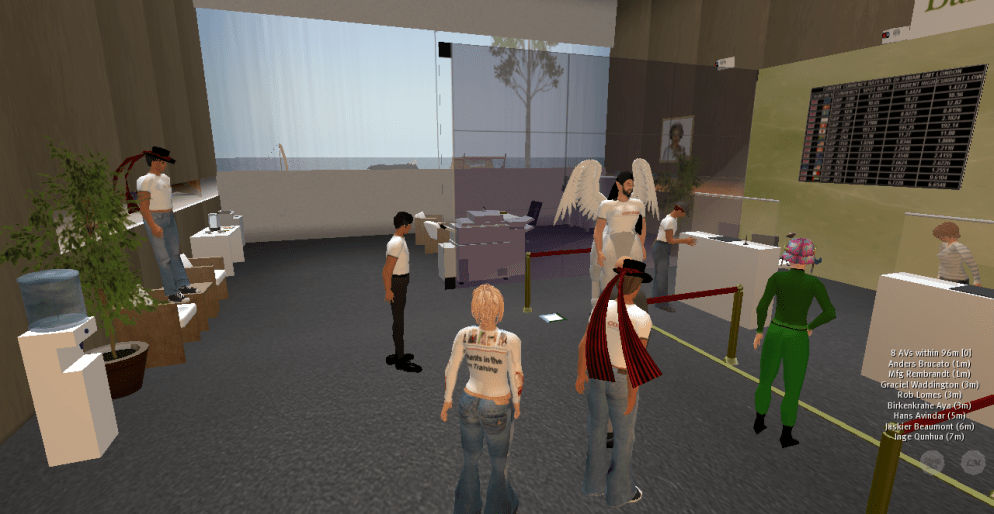
In the second optional visit we met my friend, Inge Qunhua who is a Danish educator and SL designer. Inge has a lot of creative ideas and has made several small displays of her designs on her island.

130909_011
Investigating one of Inge’s designs …
130909_017
The Bank setting in Inge’s holodeck …
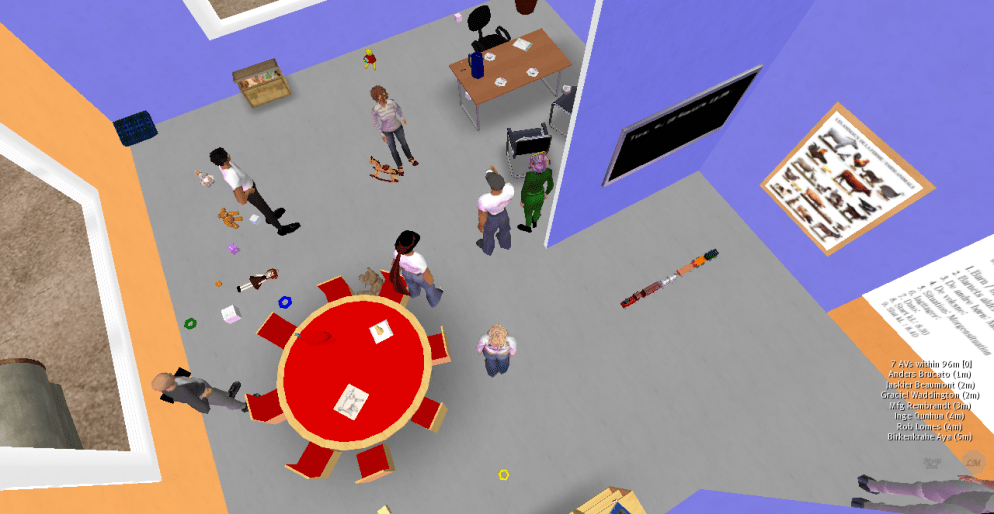
130909_022
The Kindergarden …

In the seventh SLecture this week we experimented with video display, but it did not turn out quite as we had hoped it would. However, we have not yet reflected on this experience, so I’ll return to that in a future post. This week the participants were expected to hand in their Mini-projects on Friday. Only 3 out of 6 teams did so, and this in my opinion is not satisfactory.  For the last 10 years I’ve been using project work in my teaching and I’ve never before had the experience of only half of the students/participants handing in projects. One team has asked for an extension of the deadline, whereas the two other teams haven’t given us any indication of what’s going on.

Mascot display
Learning teams displaying their mascots in the sandbox …

This course has been designed as a test course with the aim of finding out whether this certain design is sustainable and even though we all have learned a lot, I’m not convinced that this particular design is suitable for the general learning objectives.  Learning about PBL – especially the way we see this at Aalborg University, where we combine PBL with project organization – is a process that needs a lot of time. I’ve been skeptical of the very short course period (6 weeks, incl. preparation) from the beginning. We actually wanted to design a 10 week course, but preliminary investigations among our project partners indicated that a 10 week period would be too long. I can think of several reasons as to why only half of the teams managed to hand in their projects on time, but I’ll wait with further conclusions till we have done both project and course evaluation next week….

/Mariis

Networked Learning Conference 2010 – Cfp

At Aalborg University we’re very proud to host the 7th international conference on Networked Learning 3rd & 4th May, 2010.

The Networked Learning Conference is an international, research-based conference. Since its inception in 1998 the conference has developed a strong following by international researchers. In addition it is well supported by practitioners, managers and learning technologists interested in contributing to and hearing about research in this area. The conference is considered a major event in the international ‘technology enhanced learning’ conference circuit. Conference papers are peer reviewed by international researchers in the field, and published in proceedings and online.

Keynote Speakers
The 2010 conference features keynote presentations and discussions by two leading international researchers: Yrjö Engeström & Etienne Wenger.

Yrjo
Etienne

Conference themes
The conference is an opportunity to participate in a forum for the critical examination and analysis of research in networked learning i.e. learning and teaching carried out largely via the Internet/Web which emphasizes dialogical learning, collaborative and cooperative learning, group work, interaction with on-line materials, and knowledge production.

Papers critically reporting on the results of research and evaluation in Networked Learning are invited on the main themes of:

  • Understanding, Designing and Facilitating Learning in a Networked World
  • Theories and Methodologies for Research in Networked Learning
  • Impact on Learning of Networked Technologies
  • Learning in Social Networks and Networked Learning
  • Participation and Alienation in Networked Learning
  • Embedding Networked Learning in Public and Private Organizations
  • Formal and Informal learning in Networked Learning
  • Work Based Networked Learning and Knowledge Management
  • Problem Based Networked Learning
  • Practice Based Research for Professional Development
  • Issues of Social Justice and Social Responsibility in Networked Learning
  • Globalization and Interculturality in Networked Learning
  • Networked Learning and International Development

Conference papers will be peer reviewed by international researchers, and published in electronic proceedings and online. The conference steering committee will be supporting symposium organizers in publishing selected papers in special issues of refereed journals.

Submission date
Last date for submission of full papers for review: Friday 13th November, 2009

More details on submission

Further information about Networked Learning
You may find inspiration in the conference proceedings from previous years, and here I’ve copied a definition of networked learning from the British “Networked Learning in Higher Education” project:

Networked Learning:
learning in which C&IT is used to promote connections: between one learner and other learners, between learners and tutors; between a learning community and its learning resources.

Questions about the conference?
Please note that I’m not personally involved in the organization of this conference – questions should be directed to NLC Committee Administrator, Alice Jesmont, Educational Research Department, County South, Lancaster University, Lancaster. LA1 4YD. UK

nlc2010@lancaster.ac.uk

Symposium on Second Life in networked distance education
I would like to use this opportunity to invite 2-3 other distance educators using SL to participate in creating a suggestion for a symposium on the use of SL in networked distance education – if this has caught your interest please contact me for further elaborations in-world or on regular e-mail: mil01mr@hum.aau.dk

I’m hoping to see many Danish and International colleagues at this conference :-)

/Mariis

Handbook of Emerging Technologies for Learning

George Siemens & Peter Tittenberger (unfortunately his personal website is currently unavailable)  just released their number 1 version of “Handbook of Emerging Technologies for Learning”. A wiki, which will continue to be updated is available, but it’s also possible to view it as a pfd-file.

handbook

Siemens & Tittenberger encourage everyone to comment, discuss and react – so enjoy studying it :-)

/Mariis

CCK08 continues in 2009

From Stephen Downes’ weekly newsletter I learned that he has posted a description of the Connectivism & Connective Knowledge (also known as CCK08) course on the Access to Open Educational Resources (a UNESCO community) – and if you’re interested in course design the description is well worth a read.  The CCK08 ran for 12 weeks during the fall 2008, butI only found time to participate by lurking, nonetheless it was very inspirational, and I still return to many of the course resources on a regular basis:

In his newsletter Downes also reveals that he and George Siemens will run the course again this fall, and from the cross posting of the course description on Downes’ own blog I saw that one of the course participants, Sui Fai John Mak, has created a Ning to continue networked explorations of connectivism, technology, web 2.0, education and research. As far as I can tell, anyone interested in these topics can join the network – participation in the CCK08 is not a requirement. Since I still don’t have sufficient time to devote to those topics, I’m reluctant to join, but I will try to follow their endeavors …

Via another partcipant’s blogpost, Jenny Mackness, I found this video created by three other participants, Viplav Baxi, Carlos Casares and Maru del Campo as part of their final CCK08 project.

I appreciate the humor and the Cat vs. Dog learning style, but what really struck me as intersting was their PLE’s – especially when these were merged, I think they illustrated very well the complexity of learning via connected technology and people – great job :-)

/Mariis

Myths and research on ways of learning

In this week’s newsletter George Siemens questions the use of visuals in communication and refers to a poorly researched article on this:

As I’ve stated, I’m trying to make greater use of visuals. Hard to make sense of the value of visuals with poorly presented articles like this: Why communicate visually. Some sloppy research on the old “10% hear, 20% read, 80% do” – this time attributed to Bruner. Will Thalheimer  debunks/questions the validity of this claim. This automatically calls into question related statements in the article (not cited properly) about the prominence of visuals in learning and retention. I don’t trust the author. But then I have to ask myself, why I want to use images/visuals. To increase effectiveness of learners who take a course I teach? To improve my ability to communicate? What can visuals do that text can’t? And where is the research that supports that claim?

Though relevant, I don’t want to address all Siemens’ questions in this post. Instead I spent some time on looking closer into the Will Thalheimer post on one of the major myths in learning, namely that people remember 10% of what they read, 20% of what they see, 30% of what they hear, etc. indicating that “learning by doing” always is the best way of learning.

Apparently the percentages have often been attributed the work of American educator Edgar Dale (1900-1985) and his book “Audiovisual Methods in Teaching” (1946, 1954 & 1969). In this book Dale presented The Cone of Experience, which depicts various types of audio-visual experiences that can be classified in terms of greater or lesser concreteness and abstractness, but it includes no percentages at all! In numerous posts Thalheimer has exposed the misuse/misinterpretations of Dale’s original work – including a fresh example from a conference in the workplace learning field in January 2009.

Back in 2002 Tony Betrus & Al Januszewski gave a presentation at the Association of Educational Communications and Technology (AECT) conference entitled “For the Record: The Misinterpretation of Edgar Dale’s Cone of Experience”. Betrus & Januszewski present 14 examples of misinterpretations – all exposing sloppy research, and as Donald H. Taylor comments:

The very worst of it? Some of these diagrams are produced by people who really should know better. Academic bodies such as North Caroline State University, services for educators such as Video4learning.com, and one individual – working for the good of others – who put a lot of work into producing two different pyramids, with the specific aim of making the diagrams available for free, general use, under creative commons.

A part from the disturbing fact that certain academic researchers continue to misuse and misinterpret Dale’s model and combine it with bogus data, this example raises a fundamental question of what we actually know – based on valid research! – about effective ways of learning.  Depending on how you define learning, I think many answers could be given to that question. However, in a recent study on the effectiveness of multimodal learning by Cisco Head of Education, Charles Fadel writes the following in the foreword of the report:

There is a lot of misinformation circulating about the effectiveness of multimodal learning, some of it seemingly fabricated for convenience. As curriculum designers embrace multimedia and technology wholeheartedly, we considered it important to set the record straight, in the interest of the most effective teaching and learning.

This report is the 3rd in a series that addresses “what research say” and it also refers to the many misinterpretations of Dale’s model and concludes:

The person(s) who added percentages to the cone of learning were looking for a silver bullet, a simplistic approach to a complex issue. A closer look now reveals that one size does not fit all learners. As it turns out, doing is not always more efficient than seeing, and seeing is not always more effective than reading. (p.8)

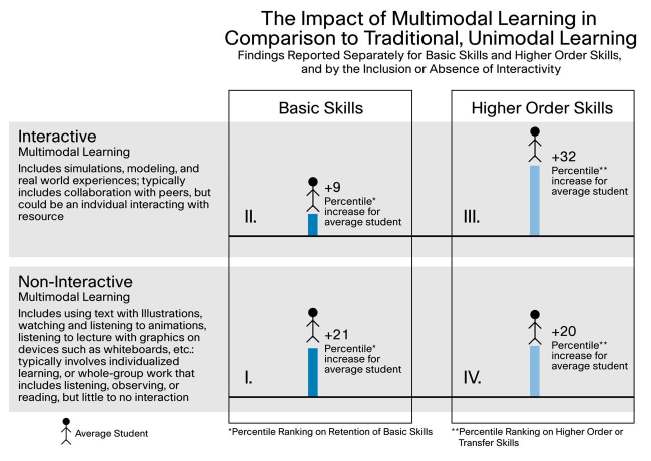
The report then explores the effectiveness on multimodal learning in comparison to traditional learning based on meta-analysis and experimental and quasi-experimental design studies published from 1997 to 2007, and comes up with this interesting figure:

cisco-8

  • Quadrants I and II: The average student’s scores on basic skills assessments increase by 21 percentiles when engaged in non-interactive, multimodal learning (includes using text with visuals, text with audio, watching and listening to animations or lectures that effectively use visuals, etc.) in comparison to traditional, single-mode learning. When that situation shifts from non-interactive to interactive, multimedia learning (such as engagement in simulations, modeling, and real-world experiences – most often in collaborative teams or groups), results are not quite as high, with average gains at 9 percentiles. While not statistically significant, these results are still positive. (p. 13)
  • Quadrants III and IV: When the average student is engaged in higher-order thinking using multimedia in interactive situations, on average, their percentage ranking on higher-order or transfer skills increases by 32 percentile points over what that student would have accomplished with traditional learning. When the context shifts from interactive to noninteractive multimodal learning, the result is somewhat diminished, but is still significant at 20 percentile points over traditional means. (p.14)

This report actually provides some substantiated evidence of the effectiveness of multimodal learning, but wisely cautions the reader:

This analysis provides a clear rationale for using multimedia in learning. That said, the reader should be cautioned that the research in this field is evolving, with recent articles suggesting that efficacy, motivation, and volition of learners, as well as the type of learning task and the level of instructional scaffolding, can weigh heavily on the learning outcomes from the use of multimedia. (p.14)

It’s an interesting report well worth reading, but you can also watch Charles Fadel discuss it with Elliott Masie at the Learning 2008 conference here.

/Mariis

Special thanks to Carsten Storgaard for the video link :-)