Case MIL09: Student analysis of SL – part 1

As part of the MIL course this year the students could choose to do their didactic analysis of SL either asynchronously in FirstClass or synchronously in SL, and 6 out 8 students chose the latter. Regardless of mode the students were asked to investigate 5 elements of particular importance when dealing with didactic analysis; Didactics (understood as theoretical foundation) and target groups, Orientation and navigation, Interaction, Learning processes and Audio-visuals. All of the students received the Zebra presenter and could use the sandbox to arrange the setting for their presentations, but they were also encouraged to find tools and places on their own. Each presentation was set to last approx. 2 hrs. and judging by the comments from all the students who chose the SL format, the analysis thus ended up feeling like an oral exam. In this and upcoming posts I’ll present some of the students’ findings and reflections.

Perlo & Francine


EduIsland 4: Practice classroom

First up were Perlo & Francine who had found a free practice classroom for trainee teachers at one of the EduIslands. Perlo & Francine had chosen to prepare their analysis as a streamed video which we were able to watch via the presenter in the classroom. As foundation for their analysis they had chosen the Didactic Relation model and the target group was adult students at a Teacher College studying religion. The purpose of using SL should be to conduct field studies that would otherwise be impossible to do in real life within the given college settings. Perlo & Francine envisioned using SL as part of a blended learning environment where they would include a wiki for the students’ asynchronous reflections and also f2f activities e.g. workshops aimed at teaching the students how to use SL.

One of the advantages Perlo & Francine pointed out about SL is the way the medium allows the user to change perspective, not only via camera controls, but rather because of the avatar phenomenon that enables the user to have a detached, 3rd person view on him-/herself and the activities/interactions in the environment. Conversely they also pointed to the other pole in the participation-observation continuum, where – provided you feel immersed or attached to your avatar – you would be able to participate (almost) like a native in different cultures. This change of perspective and the ontologically challenging question of being present or not was underlined by the way Perlo & Francine chose to present their thoughts as themselves in the video, but displayed on a screen and discussed in-world as avatars.
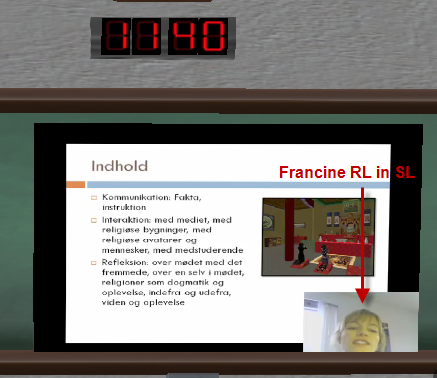
Despite their enthusiasm about SL as teaching and learning medium, they also worried about especially technical challenges, the fact that most communication in SL is in English and the rather vast amount of time that is needed to get to know SL sufficiently so that the students actually would be able to use SL as intended. Nonetheless, they did find the possibility to do field studies via SL to be really appealing and worth trying out, and they are currently preparing a course that’ll be running in the beginning of 2010. After the presentation we visited a couple of the religious places that would be relevant in their course:


The Kaaba at IslamOnline


Looking at The Black Stone – something NpIRL for non-muslims …
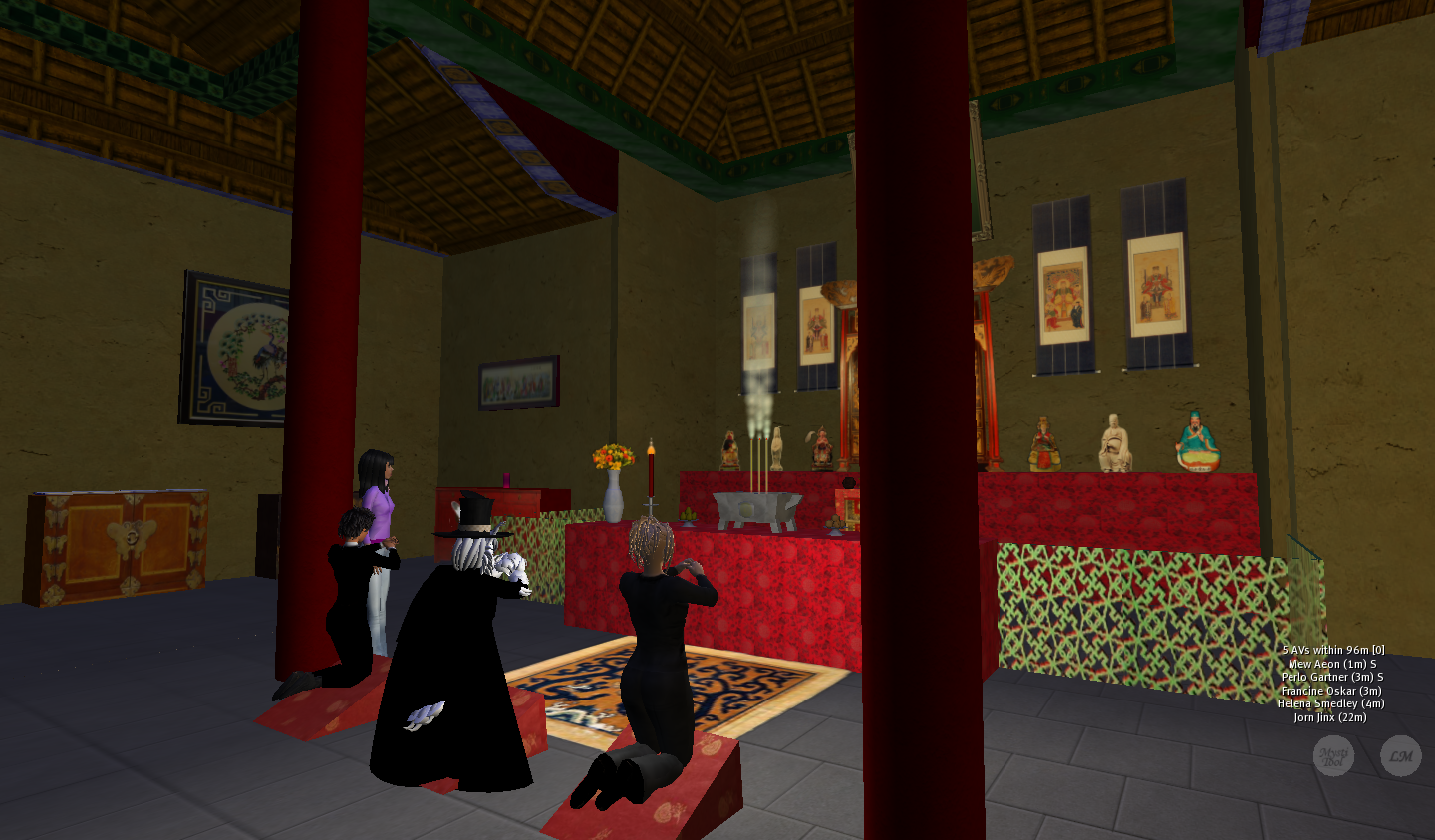

Praying at The Cijian Temple

Afterwards Perlo & Francine reflected on the experience in FirstClass and they both focused on the many things – especially technological – that you need to pay attention to when teaching in-world. Compared to f2f they found it more difficult to control and mange the activities, make sure everybody understood their instructions and when touring making sure nobody got lost. These are quite typical impressions from initial teaching experience in-world – but don’t worry –  it does get easier in time :-)

/Mariis
3D remediation – people

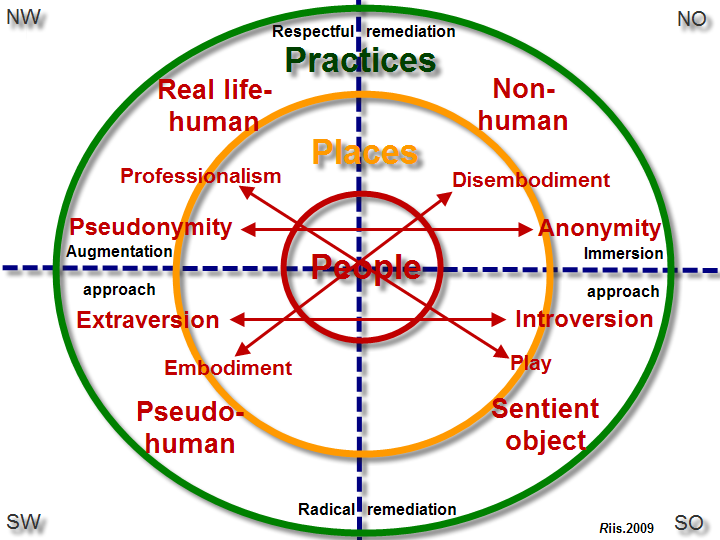
As I continue my work with the model for 3D remediation strategies, I’ve decided to replace the numbers in the four quadrants with indicators of the four corners of the world thinking they don’t imply a fixed sequence in the same way as numbers or letters tend to do. Having done this, I’ve also abandoned the idea of merging my model with Kolb’s learning cycle. Though I do believe that Kolb’s model has been subject to misinterpretations over the years, I’m not interested in forcing one specific learning theory upon my model. Indeed, I think one of the major affordances of 3D user generated VW, as compared to conventional proprietary 2D CMS/LMS/VLE, is the fact that you can design for teaching and learning based on any theoretical foundation. Diversity and countless possibilities are keywords in platforms like SL and with my model I aim at showing this diversity. When you first enter SL it appears to be pretty uniform with lots of beautiful Barbie-Ken-avatars and by and large respectfully remediated places, which unfortunately also is the way the official Linden Lab prefers to promote SL, but there is so much more to this wonderful world …

In connection with my analytical unit, People I’ve identified four archetypical ways of customizing the avatar:

  • Avatar as Real Life-human – respectfully remediated based on an augmented approach.
  • Avatar as Non-human – respectfully remediated based on an immersive approach.
  • Avatar as Pseudo-human – radically remediated based on an augmented approach.
  • Avatar as Sentient object – radically remediated based on an immersive approach.

I’ve also identified a number of seeming dichotomies that one should be aware of when contemplating using SL for teaching and learning. With the addition of these elements in the red People’s sphere the model now look like this:

I don’t mean to imply that the possible tension between e.g. professionalism and play only occurs between the NW-SO corners – I believe this tension (as well as the other tensions) can be identified within the whole sphere. Being a work in progress I’m currently settling for identifying key elements  and placing them in the model, but if thorough investigations prove these elements to be relevant and viable I will improve the graphics.

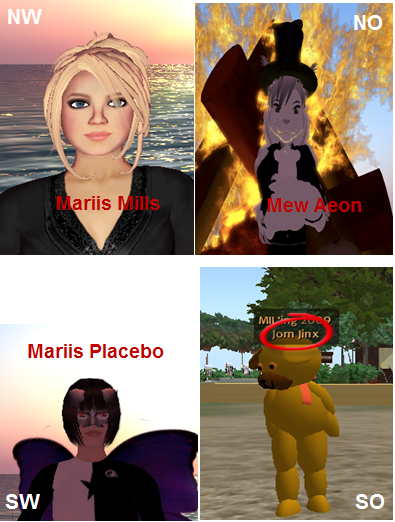
As a preliminary demonstration of how the model can be used, I’ve identified four examples of the avatar types within my current research cycle, the MIL09 case:

NW: Mariis Mills, my main avatar who is a respectful remediation of my real life person. Though I have to admit, that she looks both younger and cuter, I do sense that my students recognize her as a reflection of me.

NO: Mew Aeon
, my co-facilitator who at present chooses to represent himself as a cat because it goes well with his first name and playful nature.

SW: Mariis Placebo
, my main alt who is currently a humanoid super heroine with butterfly wings and special powers. I use her when I need to work undisturbed in-world and she’s also member of a number of groups that are only peripherally connected to my field of study.

SO: At a certain point MIL student, Jorn Jinx showed up as the – in Denmark – very famous teddy bear, Bamse. Though Bamse clearly is an object, it is usually referred to as a male persona and associated with the ability to feel and perceive subjectively.

I think the avatars above represent the more moderate examples of the four achetypes, but it will certainly be possible to identify more extreme cases as in this excellent interview moderated by Hydra Shaftoe (a wolf) for Nokia on the topic of Perceptions of Non-human avatars or as in this Orange Island Identity Summit, where e.g. qDot Bunnyhug is represented as a sentient rectangular box.

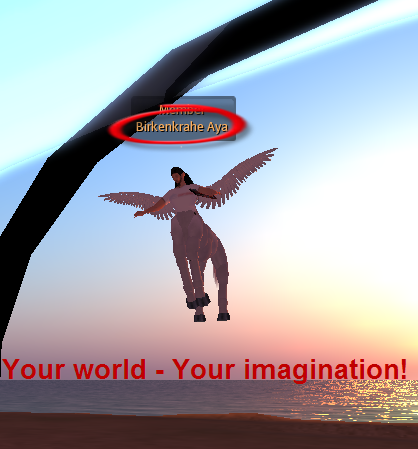
By definition a model is a simplified summary of reality designed to aid further study, and I really do not perceive the world of SL to be as simple, clear-cut and uncomplicated as the model may give the impression of. I do, however find it useful in trying to identify different aspects of possible remediation strategies. With a final example of an avatar remediation that fluctuates between Real life-human and Non-human I’ll finish this post with a photo of my centaur friend, Birkenkrahe:

/Mariis

Case MIL09: Didactic Design Discussion – 2

In the 2. Didactic Design Discussion in the MIL course I’d chosen to focus on some of the central points from my own PhD-project since it also deals with analysis of SL as teaching and learning environment. Discussing some of my own ideas with the students naturally is very inspiring and rewarding for me personally, but I’m also hoping (and sensing) that the students benefit from seeing my approach to the problem, and judging from the vivid discussion I do believe, I managed to challenge some of their presumptions. I’m not able to reproduce all of it, but I will try to highlight a few issues.

Essentially my PhD-project is aimed at improving Blended Learning within Higher and Further Education through remediation and redidactization. Through a process of designing and redesigning two specific Blended Learning courses within 6 research cycles the aim is to enhance learner experience and learning outcome by using new augmented/immersive 3D media and a learner centered Problem Based pedagogical approach. In both cases the target group is adult teachers/ trainers from the educational and the private/industrial sector from different countries.


PhD-project overview – Fall 2009

The concept remediation (in relation to new media) was coined by Jay David Bolter and Richard Grusin (2000), but there was no explicit value or quality identified with different ways of remediating in the original concept. However, Tringham, Mills and Ashley (2007) further developed the remediation concept in their Remediated Places Project and came up with two distinct strategies for remediation, respectively respectful and radical. In my point of view these two strategies can be extended to include pedagogical considerations and thus inform more general implementation strategies for blended teaching and learning using new media.

I first introduced the MIL students to the concepts of respectful and radical remediation in the course last fall and like this year’s students they immediately adopted the terminology. If you’ve ever been in SL you’d know why – it makes perfect sense to distinguish between the two both with regard to people, places and practices. The interesting question nonetheless is whether remediation changes anything in the way we think and practice teaching and learning …


Is a slide show presentation in SL an innovation?

According to Peter Denning an innovation can be defined as a transformation of practice in a group, community or culture – it is not enough just to come up with a brilliant idea or create a new artifact. Surely there are many different definitions of innovation, but I agree with Denning and it aligns very well with Wenger’s 1998 social theory on Communities of Practice, which is one of my core inspirations. Changing practice is easier said than done and Steven Warburton has identified 7 barriers to innovation in 3D environments like SL:

  • Technical – machine and human related [and standards related]
  • Identity – the tension between playfulness and professionalism
  • Culture – reading the codes and etiquette of SL
  • Collaboration – building trust
  • Time – even simple things take time 
  • Economic – nothing is for free
  • Design – perhaps this is a meta-barrier but SL does offer up very particular design challenges

Besides these I would add another meta-barrier, namely the inherent paradox between (re-)production and innovation that all participants in education are facing. This is what I call the didactic double bind. In general double bind is described as dilemmas in communication, and SL seems to be filled with conflicting messages. After the session one of the students posted this photo as her take on a in-world double bind:

The text for that photo could read: ”SL is an open environment. Join us if you can”. Naturally, the experienced SL resident would know that the dilemma in this particular situation is metaphorical – a shift in camera angle and you’d be there… the perspective on the situation would change and shifting perspective, looking at dilemmas at a higher level of abstraction is one way of solving double bind situations and would according to Bateson. 1972 mean learning at level III. And this is actually one of the reasons why I find SL so interesting – if we assume that the learner overcomes the initial difficulties and gets accustomed to the environment it provides rich opportunities for learning at higher levels, because SL inevitable challenges the learner both ontologically and epistemologically due to the whole meta-cognitive nature of the in-world experience.

After this we moved on to discuss the concepts of immersion and augmentation and what these two apparently conflicting ways of engaging in an environment like SL could mean – not least when it comes to teaching and learning practice. Again the students were eager to discuss and we covered a lot of important points on which I will return in a later posting. Suffice to say that we all agree with Tateru Nino on this:

It’s not all black and white.
The whole immersion versus augmentation debate is clouded by one trivial little detail. One is not the opposite of the other. The two aren’t even mutually exclusive.

We ended the session by trying out the Opinionater – it really is a very efficient and fun tool for stimulating discussions :-)

/Mariis

SLecture 1 – observations from the PBBL course

In the PBBL course we have planned 10 lectures in SL and a number of optional informal meetings. Last night we had the first lecture and in this post I’ll reflect a bit on some of my observations. We have 23 participants from 5 countries and an unknown number of Danish on-campus students enrolled. As one of the requirements to pass the course we have asked the participants to attend a minimum of 5 lectures of their own choice (for the students the requirements are different) – so first of all it was interesting to see how many participants/students would actually show up. I’m using the MystiTool to keep track of this and at a certain point in time I counted 22, incl. my colleagues Heilyn, Thomas and Jacob, but some attendees did unfortunately have technical problems so my estimate is that 17 is the most reliable number.

SLecture1_a
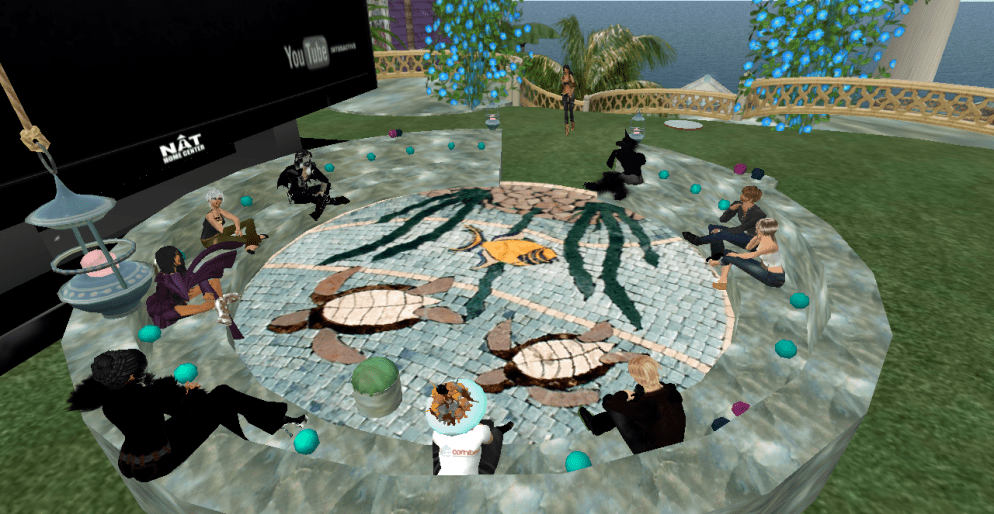
SLecture 1 in session …

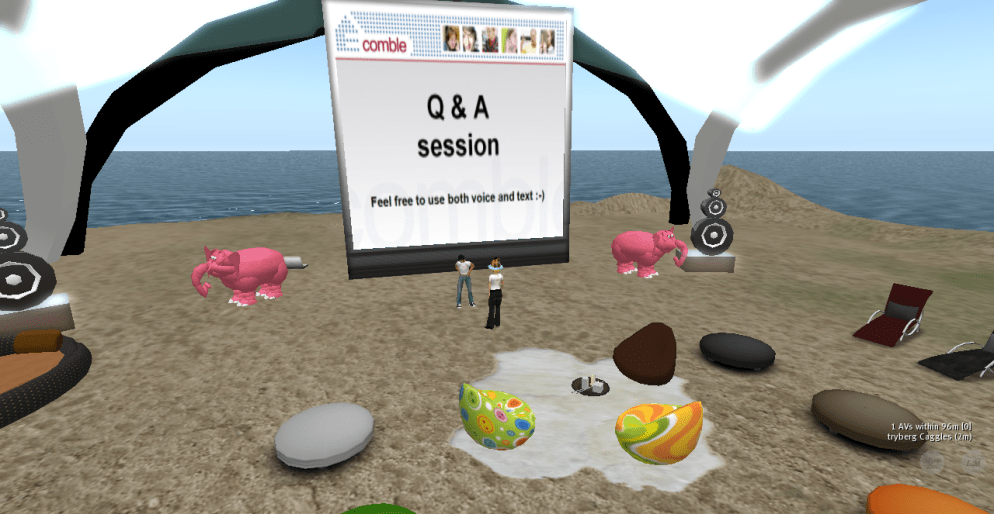
Based on my experience from the two other courses I’ve run in SL and our preparation meetings last week, I anticipated some voice and text chat problems, so I had posted the following program and guidelines for in-world communication in our Moodle platform prior to the SLecture and of course had these slides on the CZ presenter:

Program010909

Commnunication010909

My overall impression is that the SLecture went well, not least since those who managed to get voice and text working engaged in eager questioning and commenting on the different topics for this SLecture; BL, PBL and the various course elements. But there were also challenges and some serious technical problems:

·         The voice and chat check lasted 45 min. which was longer than anticipated. I did point out in the beginning of the SLecture that it should be regarded as a test lecture, but I’m still somewhat surprised it took that long. There were, however, completely new faces in this SLecture and there are still some participants struggling with general voice settings, use of headset and unstable Internet connections.
·         There are still a few of the enrolled participants who have not yet joined our in-world COMBLE group, and a few who do not know how to change their Active Title. The course preparation week was optional and I expected people would join the activities based on their own judgments. This is something I would seriously consider revising in a future course …
·         Since none of the participants or us as facilitators are native English speakers we all struggle with the language. It’s the first time I’ve personally run a course in English and I must say I find it very time consuming and challenging.  With 7 open chat windows, lots of new names, and the language barrier I did find it rather difficult to stay 100 % focused on my presentation. But this is just a matter of experience, so I do not worry too much about it. According to the feedback my main points came across reasonably clear.
·         When we sent out the initial materials for the course, I had made a tutorial for creating the SL account, and in this I recommended that they created their first names so that they would be easy to say/write in English. But I don’t think this message came across clear enough. At least there are a few names I find very difficult to say/write. This could also be a cultural thing and for sure my Polish, Estonian, German and Argentinean pronunciation needs work ;-) I also suspect that for some of the participants the fact that I address them by their first avatar names takes some getting used to – most likely many of them do not identify with those names (yet) and some seem surprised when they discover that I’m actually speaking/writing to them. This probably will change in time. In a future course I would try to explain the name issue more detailed, though.
·         It was the first time I used the CZ presenter and it worked fine. Nonetheless, I will try to find some sort of podium to place the laptop on, so that its position is fixed and I can return to it more smoothly without having to adjust its position.
·         In the two previous courses I’ve run in-world I’ve been the only facilitator and I must say I enjoy having my colleagues with me this time. Not only are they able to help and answer some of the questions (that I might miss!) in the chat, but it is also very beneficial to be able to get their immediate feedback on these SLectures afterwards.

tryberg
After the SLecture my colleague, tryberg and I stayed and reflected a bit on the event…

Next SLecture is tomorrow and I’m really looking forward to that, because this has turned out to be a great learning experience :-)

/Mariis

Virtual Relationships and Roadside Philosophy

Another new friend I made at the SLCC is Pamala Clift also known as The Roadside Philosopher.  Pamala held a well-attended Sunday morning session entitled “Shhh, The Realities of Virtual Relationships”. The crowd seemed diverse with representatives from all the communities, which actually is no surprise since we all have to deal with relationships no matter our in-world intentions. While waiting for everybody to get seated Pamala played this video to set the tone of the session:

As another interesting way of getting us started Pamala asked us all to fill out our 1.life profiles with “catchy” descriptions, she then read out loud our descriptions asking the audience if this particular person was someone people might be interested in meeting RL and then we were asked to stand up and show our RL avatars. This was quite daunting to me – not because I hide my RL identity, but because I’m quite shy RL. I really missed my avatar in that moment, but I did get up feeling safe in the company of kindred spirits. Interesting experience…

Pamala proceeded with a presentation of her thoughts on SL relationships bravely disclosing her own experience with her newbie in-world marriage and her current relationship with in-world partner Yossel – a relationship her RL husband accepts. Others from the audience told their stories of trying to make cross-over from SL to RL relationships – heartfelt stories that were very far from this successful story Hamlet just reported on.

As I understood it there had been some doubts on whether a session like this would be appropriate for the convention, and I’m guessing it has to do with the potential mature content. And yes there was talk about sex and human genitalia, but if anybody could pull off a session like that, it would be Pamala. With her very warm, humorous and open minded spirit she managed the session with elegance, and in all fairness sex was only a very small part of the conversation – emotional relations between humans and avatars were predominant.

I found myself to be quite smitten by Pamala’s personality and back in Denmark I decided to join her in-world group “The Roadside Philosophers”, and yesterday I participated in a 2 hour discussion on Post Mortem Existence at Pamalot.

RP_003

Post Mortem Existence is of course a very complex topic and I’m not able to refer to any conclusions since we evidently didn’t reach any. It was, however a very nice experience. The meeting was well-attended, people were open and friendly and Pamala moderated very well.  The group was founded back in 2007 and holds biweekly meetings on different topics chosen by the members. Here’s the description from the group charter:

1st person group..using SL as a metaphor in the search for truth.. Your thoughts are just as valid as any. Out-of-the box thinkers. Individuals that like to challenge convention by exploring new ideas. No rudeness or hostilities allowed. Brain storming can only work if no idea is stupid but presented with rational thought.

RP_008

To me being in SL is in itself an ontological challenge and I do so enjoy philosophical discussions, so I’ll be joining these meetings whenever possible. Next meeting will be on September 5th, at 8 AM SLT and the topic will be Dreams. Possibly something on the logic and reality of dreams … I’m not quite sure, but Pamala will refine the topic before sending out a group notice.

/Mariis