CCK08 – Lessons learned (1)

This post is about the Massively Online Open Course on Connectivism and Connective knowledge (CCK08) facilitated by Stephen Downes and George Siemens. SL resident Fleep Tuque has organized an in-world cohort that holds weekly meetings. On Tuesday September 16th I attended for the first time, and it turned out to be quite a learning experience.

When I first arrived at The Shrubbery Amphitheatre , I was friendly greeted by some of the other participants text chatting about the course and some of the readings. Quickly the theatre was filled with more members of the cohort and the discussions started to flourish on topics/questions like;

What is Connectivism, is Connectivism a theory, is the question “what is ..” the right one to ask about Connectivism, the concept theory itself is ambiguous, is Connectivism a sort of pragmatism, technology and context as keys for learning, is it plausible to compare the learning process with neural networks, technology helps dealing with information overload as well as it creates overload, internal memory vs. external memory, are we becoming more reliant on external memory as information overload increases.

And then the discussion ended by a debate on the participants’ familiarity with C-map, Mindmeister and Diigo.
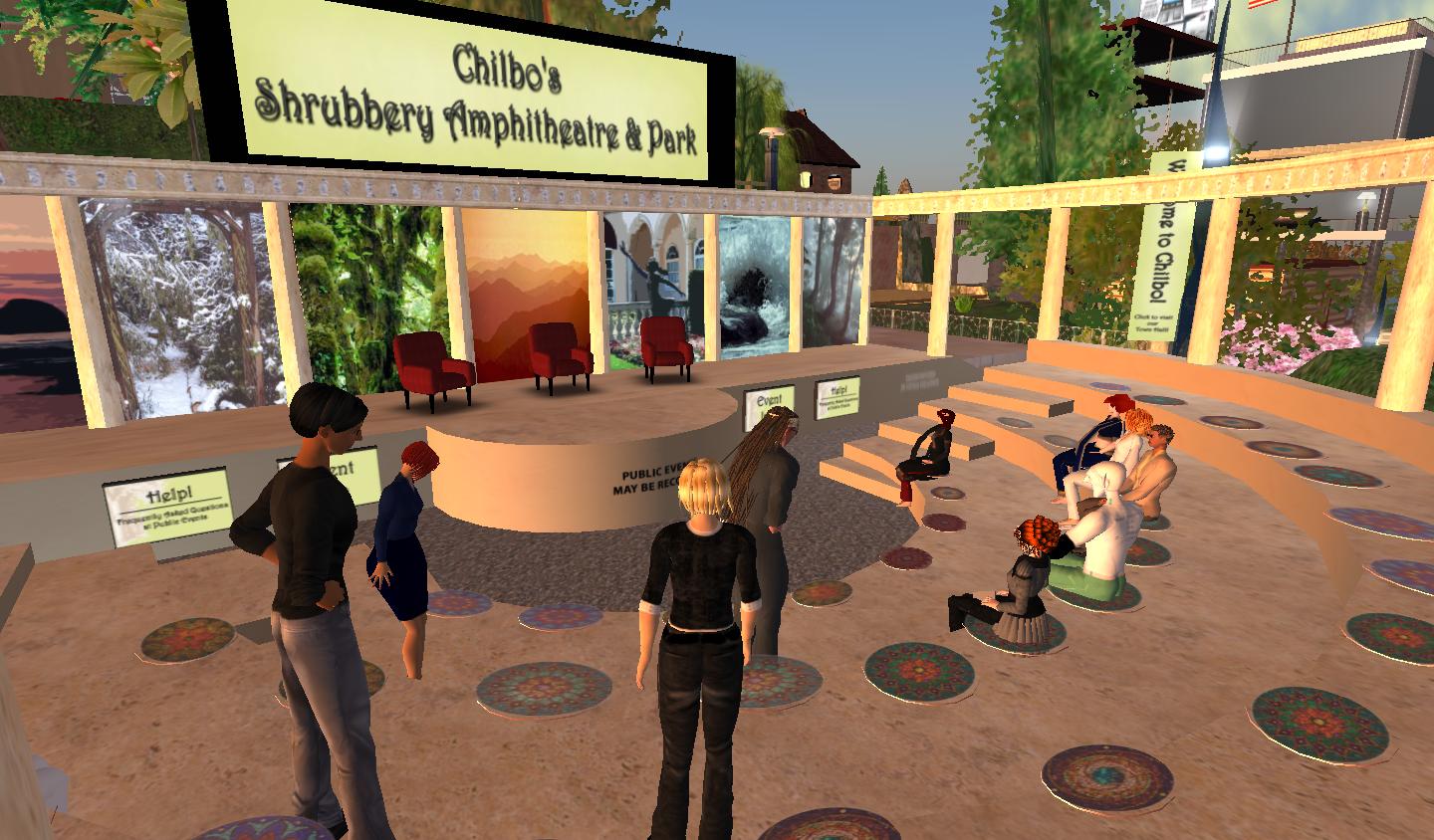
After this half hour of discussion we teleported to The Connectivism Village to have a look at the different facilities Fleep and Graham Mills have designed for the course in-world.
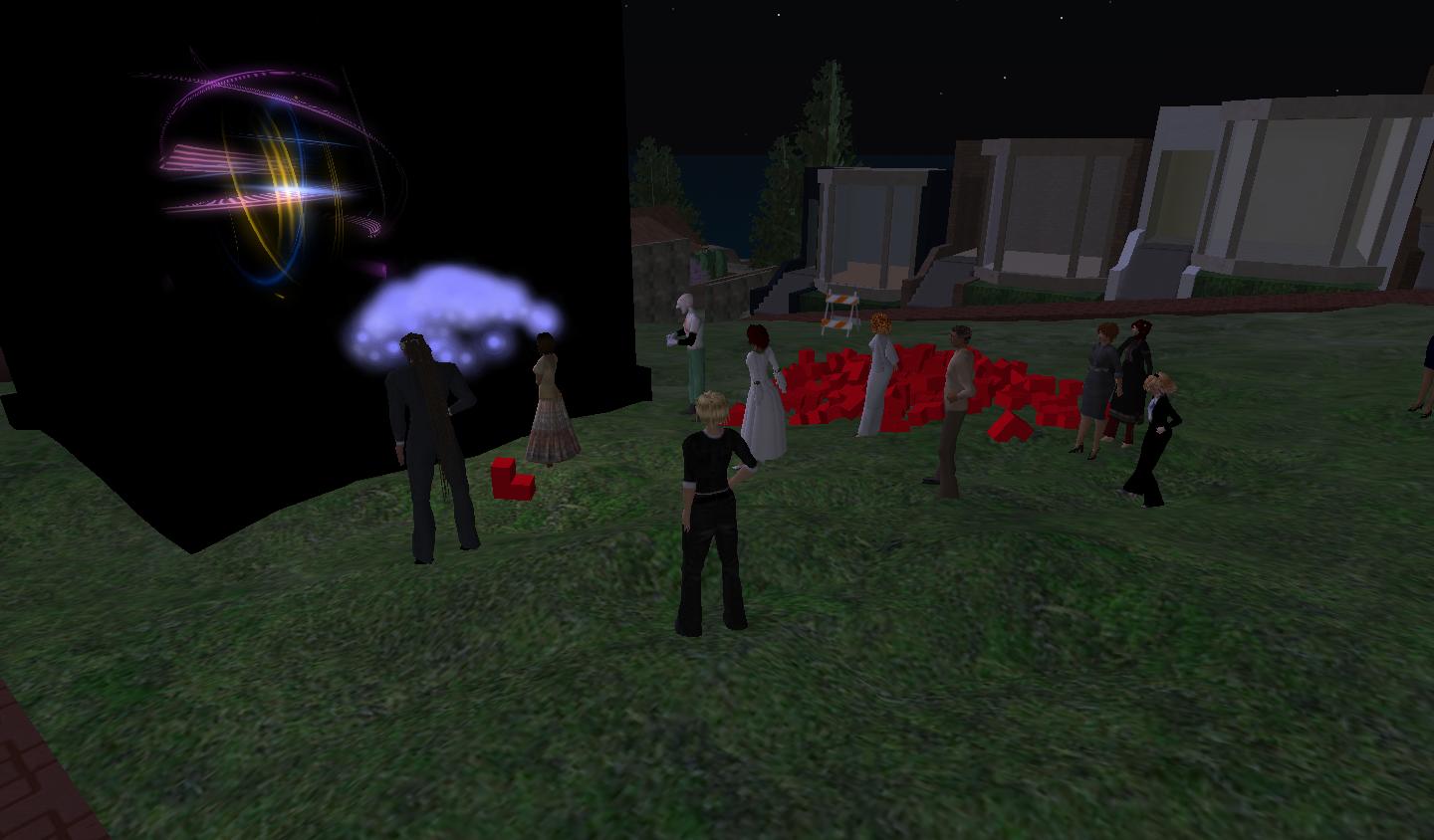

By the end of the session my computer chrashed, but fortunately Fleep stores the text trancripts in the cohort’s wikispace – TY Fleep, that’s really helpful in many ways :-)

So what did I learn from this experience?

1) The language barrier may be a larger problem than first anticipated. Being a non-native English speaker I found it difficult to follow the intense text chatting, and it was impossible for me to contribute to the discussion in-situ. I did understand everything, but it takes time for me to reflect and formulate answers/comments, and since the discussion evolved round many different topics, my contributions probably would seem “out of place” (at least in a timely aspect), so I settled for active listening. I do believe there’s a learning potential in active listening, but it was quite unusual to be in the lurking position ;-)

2) I’m not a fan of text chatting, and I don’t think I ever will be – at least not when discussing complex matters. I’ve been confirmed in my presumption that text chat is best suited for decision making and quick clarification, not as a tool for serious, lengthy debates. However, I don’t want to dismiss text chat as a tool for serious debating just yet. I think it may work if the topic was well defined and narrow.

You may think that I’m more of an asynchronous learner, but I don’t think that’s the case. RL I just love intense discussions, and I can easily handle complex diversity and people interrupting each other. Online it s a different story though. When engaged in synchronous online discussions with many participants I do prefer a more structured organization than usual. RL we’re used to looking at non-verbal signs to decode wither someone is finished, about to say something etc. When non-verbal signs are not possible, I think we may have to compensate in other ways e.g. by structuring the turn-taking.

3) One of the current problems of the cohort is that not all of us (me included!) have read the suggested literature, so we do not yet have “common ground”, which I think can be quite essential for fruitful discussions. As I see it, many of us are still trying to ground ourselves in the many, many different course materials both in- and out-world.

4) As other participants I suspect that Siemens and Downes deliberately have designed the course so that it will illustrate the complexity of connected learning. Siemens (2004/2005) states:

Connectivism is the integration of principles explored by chaos, network, and complexity and self-organization theories. Learning is a process that occurs within nebulous environments of shifting core elements – not entirely under the control of the individual. Learning (defined as actionable knowledge) can reside outside of ourselves (within an organization or a database), is focused on connecting specialized information sets, and the connections that enable us to learn more are more important than our current state of knowing.

Learning how to manage this complexity becomes pertinent, and since there are clear references to chaos theory, it’s only natural (?) that this learning process is quite confusing and at least initially somewhat unpleasant.

5) One of the reasons why I signed up for this course was that I wanted to return to the role of the learner. I actually don’t think I really ever leave this role, but this is a more formal role. Other people (Siemens, Downes, cohort participants) have great influence on my current learning, and being an online facilitator myself, I think it’s important to return to this role occasionally.

As it turns out I, together with my colleague Jørgen Lerche Nielsen, am facilitating an online course with 23 new MIL students parallel with the CCK08. I follow the students discussions and watch them trying to find common ground and become familiar with a way of learning and debating which to most of them is completely new. Participating in the CKK08 reminds me how difficult, confusing, frustrating, exiting, and fun it can be to enter a new community of practice. Lave & Wenger’s (1991) and Wenger ‘s (1999) theories on situated learning and communities of practice in fact are some of the theories that my students have chosen to discuss, and I don’t think it’s all coincidental. The concept of being a legitimate peripheral participant seems very appropriate for all of us.

One of the key points is that you need to become an active participant in the practice of the community, but initially you have to join the community and learn at the periphery. As you become more competent you’ll move more to the centre of the particular community.

A concluding comment would therefore be that even though I may not have achieved the expected goals of the course so far?, I’ve learned other important things, and I don’t have a feeling of disconnection, rather of being in the periphery … slowly moving towards the centre …

/Mariis

References

Jean Lave and Etienne Wenger (1991) Situated Learning. Legitimate peripheral participation, Cambridge: University of Cambridge Press.

Etienne Wenger (1999) Communities of Practice. Learning, meaning and identity, Cambridge: Cambridge University Press.

George Siemens (2004/2005) Connectivism. A Learning Theory for the Digital Age.

Classroom Research and Didactics

Next week I’ll be attending a PhD course entitled ”Classroom Research and Didactics” at The Danish School of Education, Aarhus University. All Danish PhD students must participate in PhD courses equivalent to a minimum of 30 ECTS points, and with this course I’ll hopefully earn 5 points.  Since one of the courses I facilitate at the Master Programme in ICT and Learning (MIL) is about Educational Design and ICT, and given that my primary case in which I’m doing part of my PhD research is that course, I think this PhD course will be especially relevant for my project.

The course is facilitated by Professors from The Danish PhD Programme on Didactics and Curriculum Research. Coming from another Danish University and another PhD Programme (HCCI), it will be quite interesting to learn how they define central pedagogical concepts/terms and what they define as relevant research methodologies. Even before the course has started I’m interested in the terms from the course title, and according to the course description (in Danish only) they could be defined as follows:

·         Classroom – an institutional room.

·         Didactical oriented classroom research – emphasizes the relation between on one side didactically founded goals and intentions and on the other side the actual practice in the classroom.

Part the course literature is about “belief research” implying that teachers’ underpinning beliefs can explain much of the actual classroom practice, and a course objective will be for us to examine and probably challenge our pre-understandings. In trying to do so, I’ll focus on the classroom term in this first post on the course.

Classroom
It is my understanding that the term denotes a tradition within Danish Educational Research, and it is widely used both by researchers and practitioners especially in what I think would be equivalent to K12. However, I don’t think the term is appropriate when describing my own project.  At least to me, the classroom term brings associations of a strictly physical setting, a specific way of organizing the teaching and learning processes, and the term “class” indicates young learners.

My course is blended with approximately 5 hrs. face-to-face confrontation out of a total of five weeks, which means that the vast majority of the course is conducted online in both a traditional 2D learning platform (FirstClass®) and in the 3D virtual world, Second Life ® (SL). Room is simply too restricted a term to describe the setting, and I do prefer learning environment. When emphasizing learning, I do realize that there’s a risk of “forgetting” the teacher/facilitator, but since the term also indicates a very important and much needed paradigmatic shift from almost exclusive focus on the teacher/teaching to the learners/learning processes in educational research and pedagogy in general, I think this term is acceptable – at least as part of a working terminology.

When examining teaching and learning in 3D virtual worlds (and perhaps to a lesser degree in 2D settings) the whole concept of context (room, space, place, environment etc.) becomes highly relevant. The 3rd dimension is, in my opinion, what make these contexts both particular and interesting seen from an educational perspective. So this is something I will return to again and again during my project.

I do appreciate the institutional character of the classroom concept, and my focus is also on teaching and learning in a formal, university setting. However, this doesn’t mean that informal learning processes will be neglected in my own research. In fact, my pilot study (22 participants 5 weeks in SL, fall ’07) indicated that the 3D world setting amplified the students’ motivation and engagement for connecting and collaborating in more informal relations – also with other residents. Here I see another argument for not restricting my terminology to a room metaphor.  If SL is recognized and truly appreciated as a world the implications are numerous, and the complexity of the phenomena becomes apparent.

The term class is used in describing an entity of learners e.g. in a concrete course, but it is a term that we primarily reserve for describing organization in K12, which also is why we would call the learners “pupils” in that context, whereas learners at university level typically would be called “students”.  The learners in my course are adults, and we usually refer to them as students. The distinction between pupils and students may come across as academic babble, but I do think it is relevant in the sense that this distinction also indicates a difference in the roles and responsibilities of all parties involved in the teaching and learning processes.  The term student is actually debated quite often at The MIL Programme, because the term still indicates what you might call an old-fashioned view on the power balance in the learning situation and because there still is a passive, transfer element associated with the term.  So quite often we resolve to call our learners participants.

As organizing principle the term class tends to describe a situation where the whole entity of learners is addressed simultaneously, and apart from our 4 yearly face-to-face seminars, we rarely use this type of one-to-many communication. The MIL Programme is based on a Problem Oriented Project Pedagogy (POPP), which I will elaborate on in future posts. For now it suffices to say, that it basically means that we organize our participants in small groups working and theorizing on real life problems. Connected to these groups will be one or several supervisors practicing different roles/methods ranging from instruction to facilitation depending on the needs of the groups.

My initial critique of the term classroom may be too one-sided, I may not be aware of the current status of the term within classical educational research (which is how I would characterize the research at The Danish School of Education when comparing it to my own university), so I’m looking forward to discussing this and learning more during the course …

/Mariis

Book release: Digital Media and Didactical Design

Today we have a book release; ”Digital Media and Didactical Design – use, experiences and research”. Together with Lone Dirckinck-Holmfeld and MIL alumni Torben Iversen, Ulla Konnerup, Merete Lindemann, Steener Oxbjerre, Torben Pihler and Dorthe S. Schmidt I’ve written an article on collaboration in virtual learning environments based on Master thesis work. It is in Danish though, and so will the rest of this post be ..

Antologien er redigeret af Lars Birch Andreasen, Bente Meyer og Pernille Rattleff og har bidrag fra en række forskere, der diskuterer deres erfaringer med og forskning i brug af digitale medier i undervisnings- og læringssammenhænge.

Antologien er dedikeret til professor Birgitte Holm Sørensen som hyldest til hendes arbejde og betydning for forskningen i medier, it og læring i de seneste årtier.

I denne anledning er der reception på DPU torsdag d. 25. september 2008 kl. 16 i vandrehallen (lokale D170), Tuborgvej 164, 2400 København NV.

Alle er velkomne!

Kort anmeldelse i Folkeskolen.dk kan læses her

/Mariis

Pernille Rattleff om bogens tilblivelse

Gardner’s Multiple Intelligences designed in SL

Yesterday, I discovered the Koru island, where Zotarah Shepherd has created an area dedicated to showing Howard Gardner’s Multiple Intelligences.


Examples – Spatial, Mathematical and Musical Intelligences

It’s the first time I’ve seen learning theoretical concepts so explicitly build in SL, and I think this could lead to some interesting discussions on both Gardner’s theory and educational design – so I’m quite excited about this!


Intra-personal Intelligence; Hmmm .. who am I? No really !?

I sent an IM to Zotarah asking if she would be interested in giving a tour to the NoEL group, and she answered almost immediately that she would be pleased. So now we just have to find the right time (a bit tricky, since Zotarah is located in SF) to meet ..

More on this will follow asap :-)

/Mariis