Challenges of flexibility and facilitation

Last week we had a 3 day f2f seminar at the MIL programme, where my colleagues and I introduced the 4th module on Ict and Educational design – the module in which I facilitate a blended in-world course. Saturday afternoon I started out by giving a lecture on remediation and redidactization focusing on respectful and radical design in SL both regarding people, places and processes. After the introduction we had a hands-on workshop where basic SL functionalities were explained and tested. 13 students out of 25 signed up for the course, and 5 other students, who chose to analyze a learning environment different from SL, wish to participate informally which I allow.

The course in fact started on November 1st but the period up until the seminar is mainly reserved for the students’ preparation (reading, creating an account and joining the in-world group). I did however plan some “Get off to a good start” in-world activities before the seminar, but only a few students attended these. All the different activities in-world are voluntary and I only demand that each student participates at least once in scheduled in-world activities during the course. The argument is that the MIL programme is intended to be flexible in order for the students to be able to participate even though the majority is full time employed, and several mandatory online activities would challenge that flexibility. Furthermore as part of a problem based pedagogy the students are expected to explore and investigate on their own and in their study groups. This pedagogical strategy is possible not least because the students are adults, highly motivated, comfortable with taking responsibility for their own learning and in most cases appreciate the freedom of choice. Last year when I did the same course, a handful of the students chose to participate in several of the activities, and I expect that to be the case this year also.
kgi161108_001

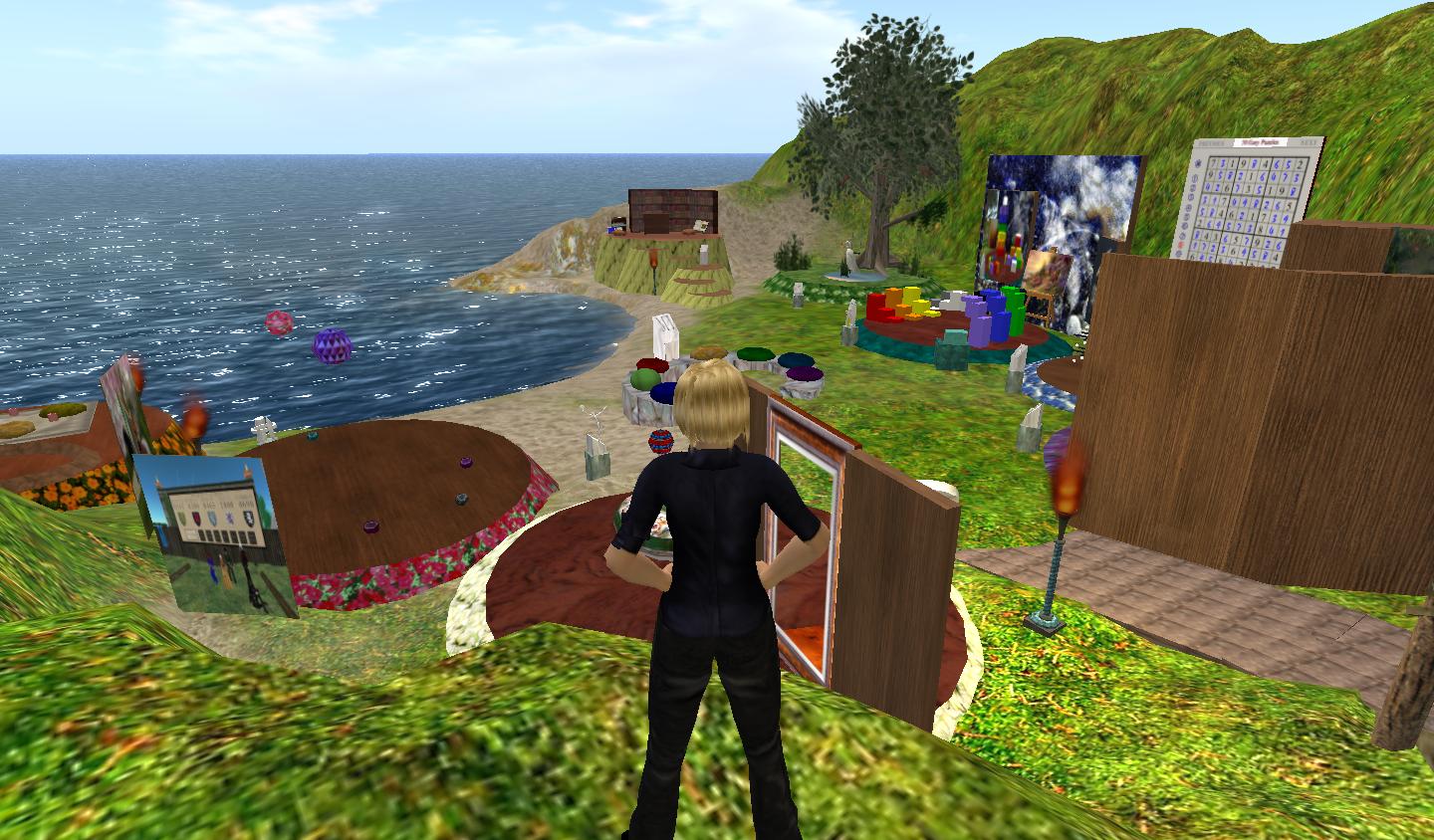
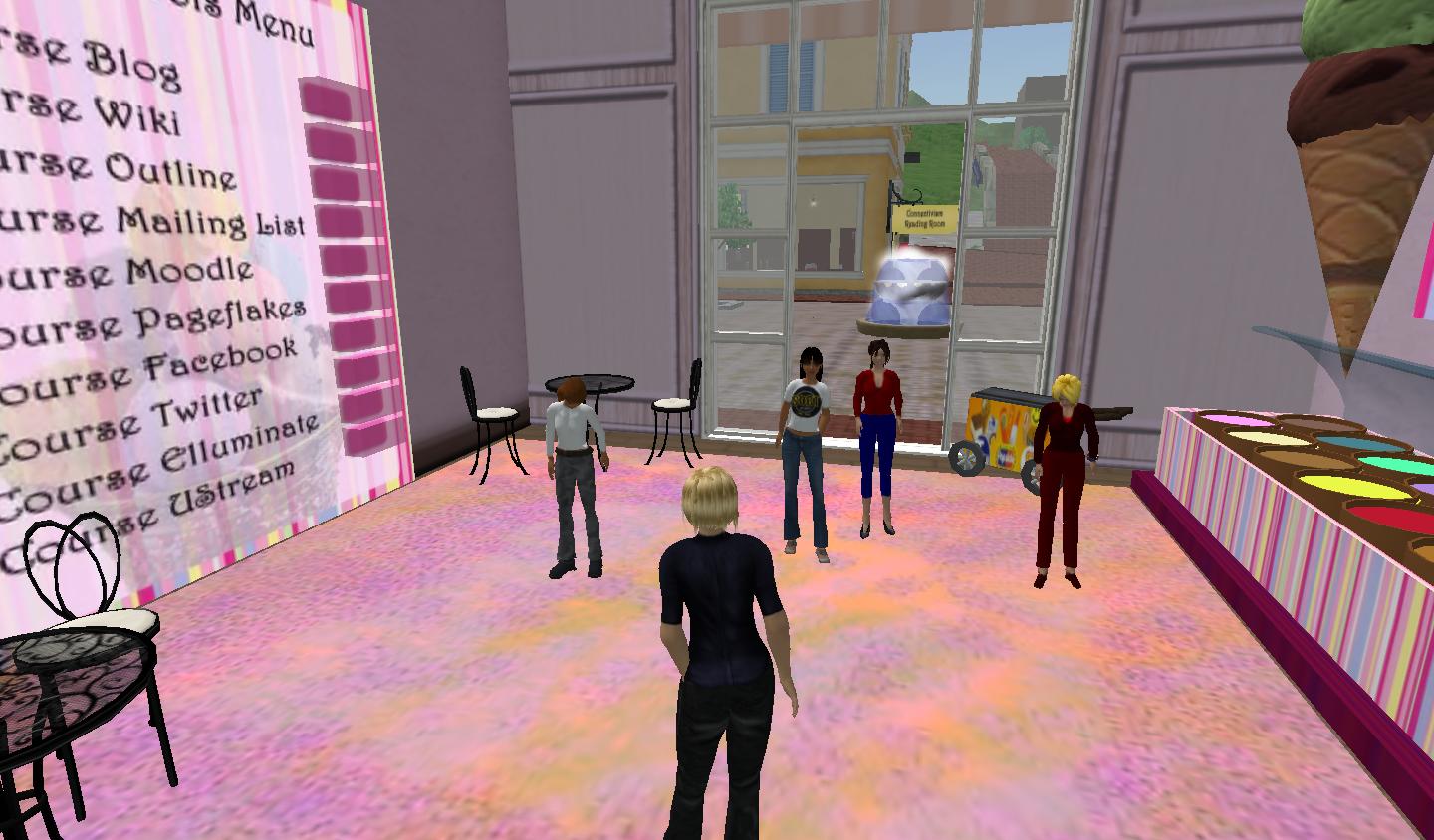
Meeting on November 16th – showing some students the Connectivism Village

Promoting and ensuring student autonomy is a cardinal point of my (and MILs) pedagogical philosophy, nevertheless this strategy poses some challenges as seen from the facilitators point of view. I’ve planned roughly 3 activities pr. week and they last between 2-3 hrs, and so far I’ve been the only facilitator. (This week we’ll start having activities with in-world colleagues). One of the challenges of this “buffet pedagogy” is that I never know how many students will attend, and since the sessions are relatively long some students choose to participate in parts of the activity only. Not knowing the exact number of participants calls for flexible planning thus challenging me to let go of my usual need for control and structure.

A different challenge of this flexibility for me as a facilitator is that I constantly have to be aware of new students joining and try to include them simultaneously during the sessions. A good feature for this of course is the IM, which makes it possible to text without interrupting the whole group. This is something not possible in real life, and I do think that it is quite smart, but I also have to say that it is fairly demanding on the facilitator. I suppose the ability to text chat with several participants simultaneously is a skill that “just” needs to be learned, but I can’t help wonder if this rather complex way of communicating would discourage some potential teachers from trying out SL or similar environments.

The last 2 Mondays I’ve been attending Metanomics meetings with students, and on these occasions I had respectively 10 and 12 active chat windows, so my immediate impression was that I spent most of my time paying attention to the chats rather than the speakers. The main reason for attending these Metanomics meetings was to show the students this particular way of communicating, “Constructive Cacophony” as Bloomfield calls it, so the content wasn’t all that important. I will return to the content issue in another post, but for now I just want to reflect on the possibility of using text and voice simultaneously. At the Metanomics meetings Bloomfield is assisted by moderators, and if we transfer this to an educational setting the solution could be to have more than one teacher or perhaps a TA.

Another option is to limit the text chat and ask participants to use a certain group chat only. This might work well, and we’ll experiment with that down the line, but here in the beginning of the course, I believe that it is very important not to limit the students’ use of IMs to the facilitator. It’s my clear impression that the IMs serve as an invaluable support giving especially less confident students a communication channel where they do not need to “expose” their inexperience and/or insecurity. The trick here – just like in real life – is to create an atmosphere where no questions are too small or too stupid. On the other hand, it is also my impression that the students choose IM because they experience this as being more polite than interrupting the activity with personal /individual questions, and this may be because we have not yet reached consensus on how to communicate in these in-world situations.

Finally, from another perspective this possibility to pose individual questions during group activity may enhance inclusion in a way not possible without technology mediation, and this is truly where I begin to see SL as a strong learning environment … even though it initially challenges both the students and the facilitator :-)

/Mariis
In-world course next 5 weeks

From November 1st – December 15th I’ll be facilitating a blended course using SL at The Danish Master programme in ICT and Learning. This course serves a primary case in my PhD-project, and I did a pilot study using the same course last fall together with 22 students. This is a brief description of the course as I’ve planned it this fall.

Educational setting – Master programme on ICT and Learning
The Master programme in ICT and Learning (MIL) was established in 2000 as a shared educational enterprise on equal terms between five Danish Universities, as an attempt to enhance collaboration between universities and working life within further and continued education.The Master programme is research based; teachers come from the five different research environments at the collaborating universities, and all participants (teachers, students and administration) are comfortable with participation in both small and large scale research projects. Hence, characteristic for MIL is that the education continuously tries to reflect and change its own activity by combining research and practice.

The Master programme is blended by a combination of virtual periods and 4 face-to-face seminars pr. study year. Between seminars the teaching and learning processes are conducted in the conventional 2D virtual learning environment, FirstClass combined with various web 2.0 technologies. Despite the fact that the five universities traditionally have represented different pedagogical cultures, MIL was from the beginning build fundamentally on the pedagogical philosophy of Problem Oriented Project Pedagogy, which is a Danish version of Problem Based Learning.

MIL consists of four course modules, a module on ICT tools and two long project periods. Each course module covers a theoretical and practical approach to its field of study combining ICT with

1) Learning

2) Interaction Design

3) Organizational Learning

4) Educational Design

The progression of the programme evolves in interplay between theory, practice and experiences of the participants.

Student profile
The goal of MIL is to upgrade people working with ICT and/or learning, both in the public and in the private sector. An internal investigation conducted in 2004 gave the following profile; a typical MIL student has an average age of 45, and is married with two children in the teens. The majority of the students work fulltime. Their educational background usually stems from the humanities, and all our students have bachelor degrees or equivalent, and about 75% have higher level educations. For most of our students their primary education is more than ten years old, which often means that is has been a while since they last were students and many of them have no or little experience with blended learning. All of them are quite competent regarding general ICT-skills, and nearly 20% are highly competent technicians. About 5% of the latter have never been professionally engaged in teaching and learning. When it comes to working experience almost all of our students (95%) are experienced teachers at different levels in the educational system and in the private sector, and it is not unusual to meet students with more than ten years of teaching experience. Nearly all the participants come with a background from leadership in organization or project groups.

Main motivation for entering the MIL programme is to increase competencies regarding ICT and learning and create intersections between the two. Another strong motivation for entering the MIL programme is the wish to connect with new networks in the field.

Course setting – ICT and Educational Design
The 4th module of the MIL programme “ICT and Educational Design” consists of 2 courses, and it is in the first course that we use SL:

  1. Educational design, ICT based learning products and virtual learning environments; theory and analysis
  2. Educational design, ICT based learning products and virtual learning environments; concept and implementation

Though separate, the two courses should be regarded as connected, in the sense that the learning outcome of the first course should be more or less applied in the second course. In the first course the students usually are provided with 2-3 optional virtual learning environments between which they are asked to choose one as analytical object. Throughout the MIL programme the students are introduced to different virtual learning environments covering a wide range of mainly conventional 2D asynchronous and synchronous examples. Therefore the learning environments chosen for this course always represent the more unconventional trends, since it is our experience that these often provide more rich and radical settings, which can stimulate reflections. This study year the students can choose either the 3D virtual game Global Conflicts Palestine or SL as their analytical object. Regardless of choice, the students are expected to discuss and analyze the learning environment on the basis of the 5 following mandatory topics:

Pedagogical design and target groups
Orientation and navigation
Interaction
Learning processes
Audio-visuals

SL setting and activities
MIL does not own land in-world, but we rent 2 locations on the island, Wonderful Denmark, but these locations are mainly used as meeting places. As mentioned above the students are expected to explore and analyze SL form a pedagogical point of view. In order to show the students the rich potential, I arrange tours to different locations where we meet with the owner/designer, have a tour and discuss pedagogical topics. Afterwards the students are expected to reflect on the locations, and document their findings in the asynchronous platform, FirstClass. Naturally the students can tour on their own, locate interesting design and share these experiences.

Besides touring, I’ve planned the following activities:

  • Get off to a good start – meetings where we focus on basic in-world skills
  • A building class running for 3 days with guest teachers Doctor Asp & Heidi Ballinger
  • Didactic Design Discussions – 4 sessions where we’ll focus on course litterature related to the students findings
  • Friday Bar – social meetings just for fun
  • Students Tour – students plan a tour based on their discoveries
  • Christmas celebrations and course finalization

And based on my experiences from last year we’ll have a lot ad hoc meetings, whenever the students need a helping hand :-)

“Without friends no one would choose to live, though he had all other goods”
By quoting Aristotle from Nichomachean Ethics I want to take this opportunity to express my gratitude to my in-world colleagues and friends both from Denmark and the rest of the world for helping me out in showing the potentials of SL – I couldn’t do it without you guys!

As the course progresses I’ll return with posts on our experiences ..

/Mariis

Designing for Learning in SL – RL seminar

Monday October 13th I attended a RL seminar at Roskilde University arranged by the Danish research project Sense-making strategies and user-driven innovations in virtual worlds: A critical analysis of virtual market dynamics, cultural and social innovation and knowledge construction. Focus was on design for learning in virtual worlds – especially in SL. Here are some of my personal highlights …

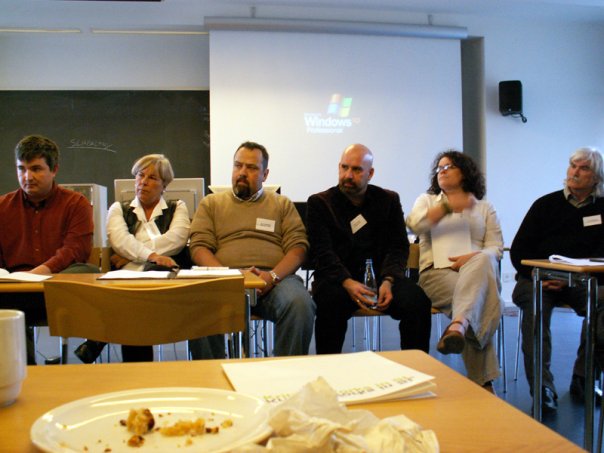
Hunsinger, Jensen, Holmberg, Lester, Doyle & Beaubois

(C) Lis Faurholt

Sisse Siggaard Jensen gave a short presentation of the research project, and what I find most interesting is that the project will be empirically driven and based on collaboration between universities, institutions and private companies, hereby providing an opportunity for researches and practitioners to benefit from each other. Read more about the project here. I’m not part of the research project, but do collaborate with several of the people involved, and since the research on virtual worlds still is rather limited in Denmark, I think it’s pertinent that we join forces – so many thanks to the team for making this event public :-)

John Lester opened with a keynote on SL. Before joining Linden Lab in 2005, Lester worked with creating online communities for both patients and medical staff at the Department of Neurology at Massachusetts General Hospital and at Harvard Medical School. Lester’s background within Neurology gives him a really interesting take on learning, which in his term is bound by biology. As far as I understand Lester, this means that we as humans used to navigate real life actually may find many strengths and advantages in 3D virtual worlds as a sort of default predisposition. Some of the characteristics of humans such as recognizing patterns, navigating in 3D, communicating with other people, creating communities and using tools do seem very applicable or transferable (not without problems though ;-) From a learning theoretical point of view this really is interesting, and I would love to hear Lester talk more specifically on this!

A keyword for Lester when talking about SL was sharing – SL is all about shared experience, and shared places. Elaborating on this, Lester identified several examples of shared places based on different modes of reality:

  • Shared places based on reality – e.g. replicas of RL places
  • Shared places based on intangible reality – e.g. molecular structures
  • Shared places based on soon-to-be reality – e.g. prospects
  • Shared places based on imaginative reality – e.g. art performances

Returning to biology Lester pointed out that our brains appriciate or even demand places and faces, that we crave emotional bandwidth, and that education in SL therefore should be seen at the intersection between people and places reminding us that there are humans behind most avatars.

Lester also provided some updated stats on SL:

30.000 CPU’s (regions)
2.000 square kilometers
540.000 residents spending an average of 56 h/m
Average age of SL resident: 35 yrs.
Gender neutral
65% of residents outside North America

I’ve had the pleasure of meeting Lester twice now, and I have to say that he really incorporates the SL community feel – no wonder he is such a popular Linden :-)

Next up was Denise Doyle from University of Wolverhampton. Doyle has been involved in The Immersed in Learning Project since the beginning in 2007. Creating the Kriti Island has been part of this project in order to have a place for collaboration both nationally and internationally. Kriti Island has also hosted a very successful artist lead project on Reality Jam – an interactive exhibition contemplating creative practices. Doyle has a special research interest in interactive narratives and is using SL as a place for experimenting with different theoretical concepts and as a teaching and learning tool in undergraduate programmes in Digital Media.

Jeremy Hunsinger, from the Centre for Digital Discurses and Culture, Virginia Polytechnic Institute and State University, whom you may know from the weekly SLEd Lessons in Second Life, did a talk on Interaction and Interactivity in SL pinpointing the many boring, non interactive builds in-world and addressing some of the technical problems students may encounter when entering SL. Hunsinger reminded us what a dreadful experience SL can be if it is cluttered by technical problems and if you only explore the world on your own. I agree that SL is best experienced together with others. SL is about collaboration and community first and foremost. So many places in SL are still just pointless replica of RL with no interactivity other that clicking on notecards or being redirected to out-of-world websites. I do feel that realistic rebuild can be appropriate, but respectful remediation just shouldn’t be the prevailing principle for in-world learning design – where is the innovation in that?

With his avatar rezzed back in 2005 Terry Beaubois certainly is one of the more experienced and persistent residents, and it was really illuminating to learn more about Beaubois’ work and research. As Director of Creative Research Lab (CRLab), Montana State University Beaubois has a vision of bringing together academic staff and students from different disciplines both RL and in-world. Being a RL professor of Architecture Beaubois intuitively started out by creating a spectacular place for his students in-world, when it suddenly dawned on him that he actually was depriving them of perhaps some of the most valuable lessons in doing so, and so he tore down the build and let the students do the work. Sharing control and responsibility with his students seemed to be an important part of Beaubois’ pedagogical philosophy and I really enjoyed meeting a teacher who focused so much on the students and their needs. In some projects Beaubois and colleague Larry Johnson have brought together students from disciplines such as art, architecture, and film, and he proudly showed us this little film created as a result of this collaboration:

Final speaker of the day was Kim Holmberg from the Department of Information Studies at Åbo Akademi in Finland. Holmberg is an expert in social media and Library 2.0 and was the first university lecturer to use SL in education. Holmberg reported from a study he did together with colleague Isto Huvila, where they used SL as an alternative learning platform in distance education. Holmberg and Huvila found that SL cannot replace face-to-face, but as an alternative platform SL proved to be more “fun”, and they wish to study this particular aspect further. Holmberg was very interested in the avatar phenomena and how this kind of representation influences the learning processes. Holmberg also focused on the fact that we persist (especially as newbies) on bringing RL behavior into SL even though it doesn’t make much sense – e.g. when we sit down or face the one speaking. In this aspect, I think Holmberg’s talk supplemented Lester’s initial ideas of biological and cultural predispositions very well.

Summarizing the many interesting talks and discussions isn’t easy, but I was personally confirmed in some of my own findings and I was reminded of the complexity of design for learning (in general!).
SL – as a 3D learning platform – has a huge potential, but there still are many critical aspects to consider. The entrance and beginning phase as a newbie in SL can be filled with technical problems that need to be addressed both in- and out-world. Offering a possibility for humans, represented as avatars, to meet synchronously across time zones and geographical place, SL gives us a unique chance to explore communication, interaction, embodiment and many other natural and cultural phenomena. So far, in my personal opinion, much educational design in SL does not take advantage of the new possibilities to design learning environments NpIRL, but I do think this is only natural. When entering a new environment we bring our cultural and biological predispositions/experiences primarily in order to survive, to find “common ground” both literally and figuratively speaking. Only when the new environment has become habitual, I think we’ll be able to cross the intersections between the many modes and possibilities of reality. Since research in learning in virtual worlds like SL is still in its infancy, I’m quite confident that the future will bring exciting, mind-blowing examples of design for learning in 3D – and the great speakers clearly showed us how to continue this endeavor …

/Mariis

CCK08 – Lessons Learned (2)

This post is about the Massively Online Open Course on Connectivism and Connective knowledge (CCK08) facilitated by Stephen Downes and George Siemens. This week I couldn’t attend any of the SL cohort meetings, so I decided to participate in the weekly Ustream ® session for the first time. This meant that I had to face a couple of learning challenges.

1) I’ve never used Ustream, so I had to figure out how to in a technical manner, but fortunately it turned out to be quite intuitive and user-friendly, and the sound quality was pretty good.

2) I also had to get accustomed to this particular synchronous way (speak combined with text chat) of communicating. I’ve been using video conferencing for a couple of years now, but different systems and mainly as facilitator. There were between 47-54 participants while I was logged in. Speakers were Siemens and Downes, and Dave Cormier moderated the discussion – also by asking some of the questions posed by the participants in the chat. Ustream’s video option wasn’t used, which didn’t bother me since I actually find small pictures of people’s heads constantly shifting very distracting. Compared to my text chat experience last week, I found this session easier to follow. I think Cormier did a really good job, it’s not an easy task to moderate :-)

3) It was the first time in the CCK08 I meet participants outside my more familiar SL cohort, and I was a bit concerned that I might feel somewhat disconnected, but I didn’t. This time the context was unfamiliar, but I recognized the voices of both Siemens and Downes, and I’ve had the opportunity to study more of this week’s course materials and I also have some previous experience with this week’s topic (Networks). In the chat I suddenly recognized Jenny :-), who commented on my CCK post last week, but otherwise the usernames represented complete strangers. There was at least one more Dane, Ivrig (Eager), but I have absolutely no idea who that might be? Anyway, I did end up feeling connected, but not in the same sense as last week. I think Jenny’s thoughts on the difference between Network and Community as expressed by Wenger could apply here:

In the words of Etienne Wenger, ‘every community is a network, but not every network is a community’. In a community ‘there is a level of identification that goes beyond degrees of connectedness.’

There’s no doubt that I identify more with the SL cohort than the rest of the CCK participants, but I have a feeling that as the weeks pass by I’ll get more and more acquainted with the non-SL participants and ideally they too can become a valuable community of learning practice. Some of us did ask for Siemens’ and Downes’ take on the distinction between networks and community, but we will focus on that later on in the course, so more on this topic will follow ..

On a completely different topic, there is a question that keeps coming back to me regarding the epistemology of Connectivism. I’m not sure it will make much sense to others, since I find it hard to articulate, but I’ll give a shot – if nothing else documenting is a way of keeping it alive!

I don’t mean to suggest that I have found an epistemological truth in other theories, I don’t even think such a truth exists – the genesis of knowledge is far too complex, but I am however very inspired by my second PhD supervisor, Janni Nielsen’s thoughts on this. According to Nielsen we perceive and generate knowledge via 3 different domains;

  1. Senso-motoric
  2. Emotions
  3. Symbols

No hierarchy intended by the numbers, but 1 and 2 also constitute the domains for tacit knowledge, and when studying Connectivism I find it hard to recognize these domains. I do appreciate Siemens’ distinction between Neural/Biological, Conceptual and External Social and I do think there are some similarities between these types of networks (Siemens)/domains (Downes) and the above mentioned. But … where is the Body in Connectivism, is it just a Cartesian container for the Brain (the Neural) or how is the Biological to be understood –and how do we understand these questions in relation to technology and especially the Web. Would it be plausible in relation to Connectivism to state that technology can provide a perception of embodiment ..

Hmmm !? :-( … learning really can be challenging. Embodiment is a core concept in my PhD project, so I do have to figure out what to think of these questions. Luckily I have 2 ½ years left to do so.

/Mariis

NoEL visits Zotarah Shepherd’s MI build

On Tuesday September 30th the NoEL group will visit Zotarah Shepherd on the Koru Island to learn more about her creation of Howard Gardner’s Multiple Intelligences. Zotarah is currently working on her MA in Education CTL at Sonoma State University (California).

Zotarah asks her guests to consider the following questions:

  • Would you use the information in a classroom for teens?
  • Looking over the topics in the curriculum which of them would be most useful to teens?
  • Do you think that SL is an appropriate venue for presenting this information to teens?
  • Would you use interactive builds in SL to teach classes?
  • How well do think my builds work for illustrating the concepts?

We have to meet Zotarah at 20:30 on the Koru Island – use the landmark, including Curriculum send via group notice in-world :-)

/Mariis