Community of Inquiry (COI) in Virtual Worlds study

Early this spring Ross McKerlich, Terry Anderson & Brad Eastman invited me to participate in a research study on the usefulness of the Community of Inquiry (COI) model as evaluation tool in virtual worlds. Originally the COI model was developed in the late 1990’ies as framework for evaluating educational experience in text-based online environments by D. Randy Garrison, Terry Anderson and Walther Archer:

Central to the study introduced here is a model of community inquiry that constitutes three elements essential to an educational transaction – cognitive presence, social presence, and teaching presence. Indicators (key words/phrases) for each of the three elements emerged from the analysis of computer conferencing transcripts. The indicators described represent a template or tool for researchers to analyze written transcripts as well as a guide to educators for the optimal use of computer conferencing as a medium to facilitate an educational transaction.
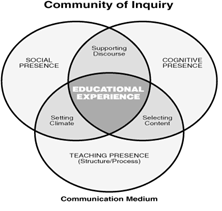
communitymodel_small(COI website)

The COI model was developed as part of a Canadian Social Sciences and Humanities research funded project entitled “A Study of the Characteristics and Qualities of Text-Based Computer Conferencing for Educational Purposes”. Further details on that project, including papers describing the theoretical and methodological underpinnings of the model can be found on the COI website.

Given the COI model’s wide spread use in different educational settings it is by no means coincidental that one of the original founders, Terry Anderson, has found it important to explore the applicability of the model in new immersive environments such as the 3D virtual world, Second Life (SL). Together with McKerlich Anderson conducted a preliminary, qualitative exploratory study in SL in 2007 and basically confirmed that the model also can be used in assessing educational experience in immersive environments (McKerlich & Anderson. 2007).  Not unexpectedly, they did however also find that some adjustments would be appropriate – e.g. extending categories demonstrating social presence. This 2007 study did not allow for the authors to examine methodological issues such as validation deeply. Furthermore McKerlich and Anderson found the phenomenological experience of both learners and teachers would be worth further investigation.

Based on these preliminary findings, McKerlich and Anderson now together with Brad Eastman have initiated a new more quantitative oriented study – and this is also the study I’ve been invited to participate in. Unfortunately, I’ve not been able to contribute with very much so far due to a longer personal leave of absence from my work in general.  Nevertheless, during my absence they have successfully finished the work on developing an evaluation tool – in the shape of a survey intended for students with educational experience in immersive environments – based on original and new indicators of respectively social, cognitive and teaching presence.  The tool was publicly launched last week on several mailing lists relevant for educators using immersive worlds and the data have started to accumulate. We would of course like as many answers as possible though, so if this has caught your interest please have a look at the survey here.

Further down the line we’ll start processing the data and evaluate the tool – also by conducting in-world observations. Participation in this kind of study is quite exciting but also very challenging for me coming from a highly qualitative oriented research background. But I’m also pretty sure that I’ll learn a lot and that we’ll have some interesting discussions :-)

/Mariis

Networked Learning Conference 2010 – Cfp

At Aalborg University we’re very proud to host the 7th international conference on Networked Learning 3rd & 4th May, 2010.

The Networked Learning Conference is an international, research-based conference. Since its inception in 1998 the conference has developed a strong following by international researchers. In addition it is well supported by practitioners, managers and learning technologists interested in contributing to and hearing about research in this area. The conference is considered a major event in the international ‘technology enhanced learning’ conference circuit. Conference papers are peer reviewed by international researchers in the field, and published in proceedings and online.

Keynote Speakers
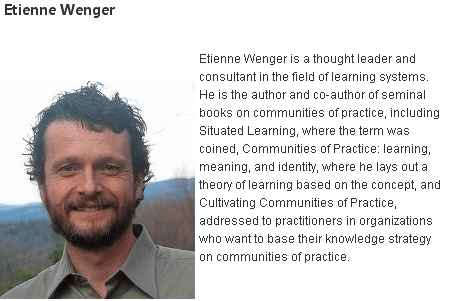
The 2010 conference features keynote presentations and discussions by two leading international researchers: Yrjö Engeström & Etienne Wenger.

Yrjo
Etienne

Conference themes
The conference is an opportunity to participate in a forum for the critical examination and analysis of research in networked learning i.e. learning and teaching carried out largely via the Internet/Web which emphasizes dialogical learning, collaborative and cooperative learning, group work, interaction with on-line materials, and knowledge production.

Papers critically reporting on the results of research and evaluation in Networked Learning are invited on the main themes of:

  • Understanding, Designing and Facilitating Learning in a Networked World
  • Theories and Methodologies for Research in Networked Learning
  • Impact on Learning of Networked Technologies
  • Learning in Social Networks and Networked Learning
  • Participation and Alienation in Networked Learning
  • Embedding Networked Learning in Public and Private Organizations
  • Formal and Informal learning in Networked Learning
  • Work Based Networked Learning and Knowledge Management
  • Problem Based Networked Learning
  • Practice Based Research for Professional Development
  • Issues of Social Justice and Social Responsibility in Networked Learning
  • Globalization and Interculturality in Networked Learning
  • Networked Learning and International Development

Conference papers will be peer reviewed by international researchers, and published in electronic proceedings and online. The conference steering committee will be supporting symposium organizers in publishing selected papers in special issues of refereed journals.

Submission date
Last date for submission of full papers for review: Friday 13th November, 2009

More details on submission

Further information about Networked Learning
You may find inspiration in the conference proceedings from previous years, and here I’ve copied a definition of networked learning from the British “Networked Learning in Higher Education” project:

Networked Learning:
learning in which C&IT is used to promote connections: between one learner and other learners, between learners and tutors; between a learning community and its learning resources.

Questions about the conference?
Please note that I’m not personally involved in the organization of this conference – questions should be directed to NLC Committee Administrator, Alice Jesmont, Educational Research Department, County South, Lancaster University, Lancaster. LA1 4YD. UK

nlc2010@lancaster.ac.uk

Symposium on Second Life in networked distance education
I would like to use this opportunity to invite 2-3 other distance educators using SL to participate in creating a suggestion for a symposium on the use of SL in networked distance education – if this has caught your interest please contact me for further elaborations in-world or on regular e-mail: mil01mr@hum.aau.dk

I’m hoping to see many Danish and International colleagues at this conference :-)

/Mariis

Handbook of Emerging Technologies for Learning

George Siemens & Peter Tittenberger (unfortunately his personal website is currently unavailable)  just released their number 1 version of “Handbook of Emerging Technologies for Learning”. A wiki, which will continue to be updated is available, but it’s also possible to view it as a pfd-file.

handbook

Siemens & Tittenberger encourage everyone to comment, discuss and react – so enjoy studying it :-)

/Mariis

Theoretical bricolage

This week a vicious feverish flu has influenced my research stay at The Danish School of Education. Nonetheless – or perhaps because of the fever ! – I’ve been able to make some important decisions regarding the use of theory in my PhD. Yesterday I presented my PhD project and SL (hands-on) to a bunch of colleagues from the Research Programme, Media and ICT in a Learning Perspective. It was really nice to be among colleagues who were interested in my findings and had fun exploring SL :-)

In my presentation I focused mainly on theory of remediation, PBL , Experiential learning and the Community of Inquiry-model.  However, I’ve also decided to investigate another meta-theory (or Didactic theory as we would say in Northern Europe); The Theory of Interactive Constructivism. This theory stems from Germany and the work of especially Kersten Reich. Reich founded his thoughts back in the 1990’ies when he called this particular branch of constructivism Systemisch-konstruktivistische Didaktik.  It’s not a theory that I’m particularly familiar with but from readings this week it shows potentials!

Reich and his colleagues at the Cologne Dewey Center have published most of their ideas in German, but have recently started to write in English too (luckily, since my German is a bit rusty!).  Reich and colleague Stephan Neubert have set up a site for their work on Interactive Constructivism, and from a text by Neubert (2008) I quote these theoretical perspectives that demonstrate the foundations of the theory:

  • observers-participants-agents in cultural practices, routines, and institutions
  • processes of communication with particular focus on the dimension of lived relationships
  • the interplay between the symbolic resources of a life-world, the imaginative desire of subjects, and the occurrence of real events
  • the connections between processes of construction, reconstruction, and deconstruction in the cultural production of realities,
  • involvements of discourse and power,
  • cultural diversity, otherness, and incommensurability in multicultural contexts. (p.1)

There seems to be many interesting and relevant perspectives for my PhD work, but what I found especially interesting is their thoughts on reality de-/re-/construction.  Since my object of study embrace 3D virtuality I’m always on the lookout for theories that might be able to include what I call a mixed reality perspective. I don’t think Reich and Neubert have 3D virtuality in mind, when they discuss “the limits of reality constructions”, but I have a feeling that it might be possible to expand their ideas.

I was also delighted to learn that they speak of “imaginative desire” and the social aspect;

According to interactive constructivism, furthermore, these imaginative constructions cannot be separated from contexts of social interaction. That is to say, imaginative desire is always involved in mutual mirror experiences between self and others (…). (p. 9)

By bringing in this theory, I’m hoping to be able to focus more explicitly on the social aspect of teaching and learning – an aspect which Kolb often has been (wrongly in my opinion though!) criticized of neglecting.

In any case, what lies ahead of me is extensive reading and work on trying to create a coherent and relevant theory bricolage, and I’m quite positive, since all of the above theories claim to have found their inspiration in the great work of John Dewey.

More on this will follow for sure …

/Mariis

CCK08 continues in 2009

From Stephen Downes’ weekly newsletter I learned that he has posted a description of the Connectivism & Connective Knowledge (also known as CCK08) course on the Access to Open Educational Resources (a UNESCO community) – and if you’re interested in course design the description is well worth a read.  The CCK08 ran for 12 weeks during the fall 2008, butI only found time to participate by lurking, nonetheless it was very inspirational, and I still return to many of the course resources on a regular basis:

In his newsletter Downes also reveals that he and George Siemens will run the course again this fall, and from the cross posting of the course description on Downes’ own blog I saw that one of the course participants, Sui Fai John Mak, has created a Ning to continue networked explorations of connectivism, technology, web 2.0, education and research. As far as I can tell, anyone interested in these topics can join the network – participation in the CCK08 is not a requirement. Since I still don’t have sufficient time to devote to those topics, I’m reluctant to join, but I will try to follow their endeavors …

Via another partcipant’s blogpost, Jenny Mackness, I found this video created by three other participants, Viplav Baxi, Carlos Casares and Maru del Campo as part of their final CCK08 project.

I appreciate the humor and the Cat vs. Dog learning style, but what really struck me as intersting was their PLE’s – especially when these were merged, I think they illustrated very well the complexity of learning via connected technology and people – great job :-)

/Mariis