#vwbpe 2010 – 2nd day impressions (part one)

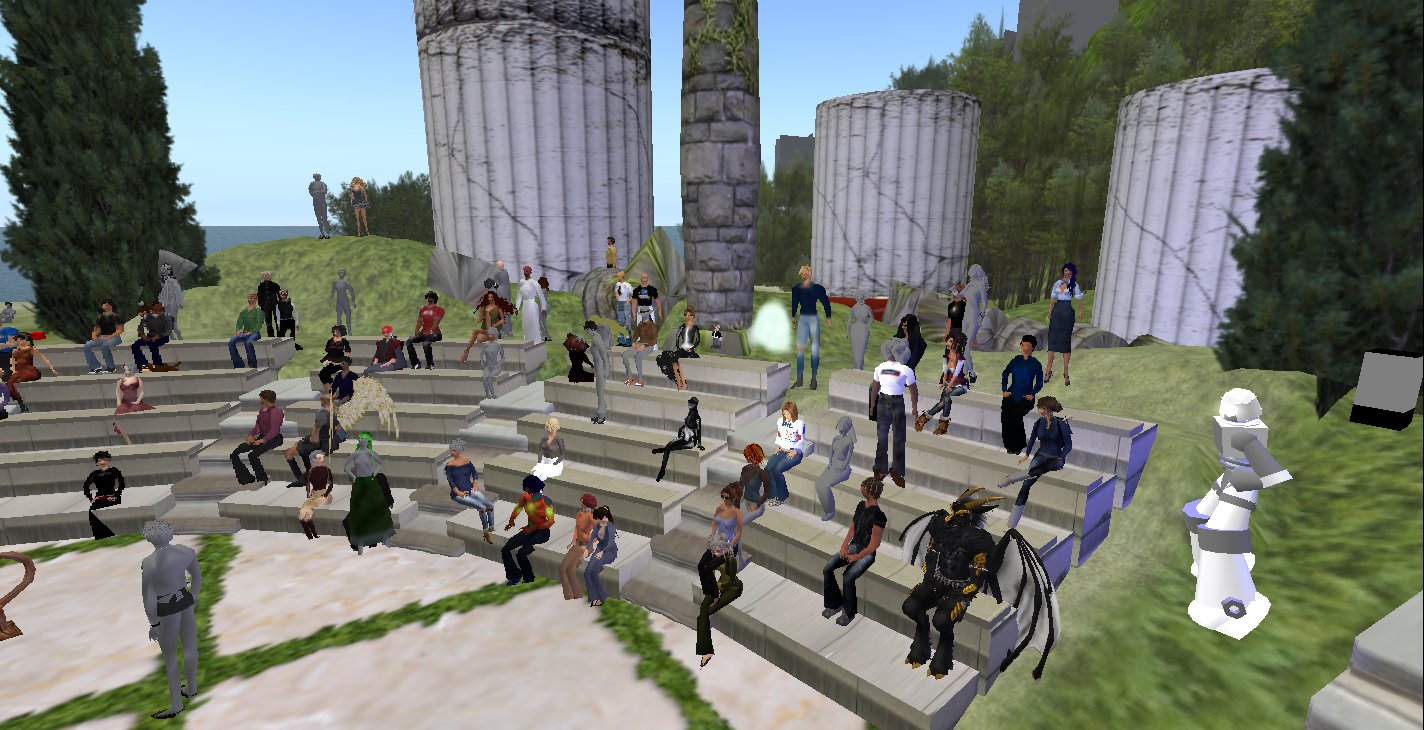
On the 2nd day of the Virtual Worlds Best Practice in Education (vwbpe) I started out by participating in a session by Graham Mills entitled “TBinSL – Thinking Big about the Very Small”. Graham spoke of the use of SL for visualization of especially molecules,  gene data and cells and what was particularly interesting was that he rezzed various objects to support his slides such as the TB genome illustrated below.

Afterwards Graham blogged about his experience mentioning a couple of the challenges a presenter may face. First of all he forgot to lock the slide viewer, which meant that people in the audience could change the slides – for those who have not attended a presentation in-world it may seem rude or strange that the anyone in the audience would do this, but in my experience many SL users spend time running their cursors over objects to see if any are interactive – in spite of this, it was not a problem I was disturbed by during Graham’s presentation.

As I understand it, vwbpe-presenters had been encouraged to use the so-called SpeakEasy-tool by the conference organizers. The SpeakEasy-tool enables the presenter to deliver pre-typed text into local chat, while presenting thus allowing the hearing impaired or anyone else to get the information in the form of text too.  I have not tried out the SpeakEasy-tool, but judging from Graham’s post it adds yet another element to the many issues an in-world presenter needs to be aware of. Graham wisely chose to react instantly to the comments and questions in the local chat during his presentation. This local chat phenomenon is in my point of view one of the major strengths of SL because it has the potential of opening the dialogue between the presenter and the audience. Having run 4 course in-world I do however also know how complex the communication becomes, especially if you have no one to help moderate, and I can fully relate to Graham’s description of the situation.

Note that on the University of Liverpool Island it is possible to check out some of the amazing visualizations Graham and his colleagues have been working on. Graham has also started to explore some of the new features in the SLV2 such as Shared Media and shadow effects, and on his blog,  you’ll find some interesting posts on this.

The next session I attended was a presentation by Kattan Hurnung, who spoke of her experiences with “Design to develop Virtual Wolds”. In this post you’ll find both Kattan’s slides and a recording of her presentation.

Via 5 examples of designing respectively a café, a canteen, a dwelling, an office and an operating theatre Kattan presented a very interesting grid that depicted the relations between information provided if forms of text, images and/or scenarios and the expected learning outcome given by teachers prior to the start of the process of designing these different types of learning spaces.
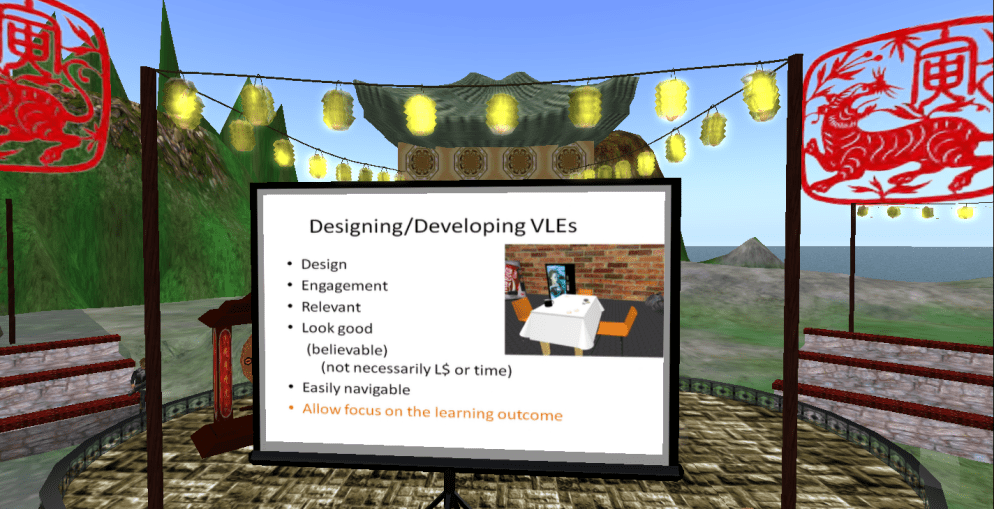
I thought there were many interesting points in Kattan’s presentation and one of the things I took special notice of was her questioning the level of details in designs. Building in-world surely can be very time consuming and perhaps it isn’t necessary to aim for photo-realistic builds – less may suffice as long as the design appears believable.

Next up was a presentation by Kristy Handrick; “Revealing the didactic character of imagery in Second Life.” Unfortunately the technical problems I’d had the day before continued, everything rezzed incredibly slow and I had problems with adjusting the camera, so I gave up and took a break. Kristy also blogged about here experience as an in-world presenter and made an important point on how the SpeakEasy-tool can be helpful to ESL presenters, and since I’m also struggling with the English language, I think I may just try out the tool for my next presentations.

The last session I want to write about in this post was a fascinating conversation between Dusan Writer and Tom Bukowski (author of the book “Coming of Age in Second Life: An Anthropologist explores the Virtually Human”).
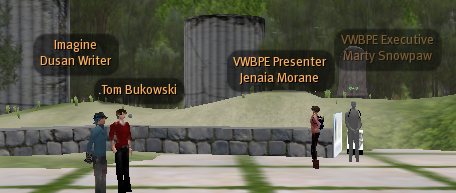
My computer still acted out, but the sound was good and I was really glad to participate in this since it raised a lot of questions/comments I need to look further into – here merely presented as points, but for those interested in seeing/hearing the conversation a recording can be found here.

  • SL is a site of culture and cultures are constantly changing, though some things remain permanent.
  • On AFK Tom discussed the difference between presence (to be present) and immersion (to be in a place) and how virtual worlds enables us to be immersed without being present.
  • Tom was fascinated by the way “friendship has become the new default mode of social relations”, and questioned 1) how friending presumes a relation that is based on choice, and 2) the apparent egalitarian nature of such a relation. And how does this affect teaching – should we as educators friend our students, is it a cool egalitarian thing or is it just a way of masking the fact that we’ll be grading them?
  • Tom studied SL in its own terms meaning he didn’t try to track down SL users in “actual” or “physical” world. This methodological approach naturally depends on one’s research question(s), but he draws the line with the common idea that no research project can be legit unless it also involves studying people in the actual world. It’s sort of a slap in the face of virtual worlds and it’s misunderstanding that what happens in virtual worlds is real, it is culture.
  • There is more and more evidence of SL users identifying with their virtual personas/life – e.g. writing your avatar name on a receipt or wondering how many prims an actual building represents. We have just scratched the surface of ways in which virtual worlds are going to affect our actual lives.
  • Technologies are neutral – the blow back could be positive or negative – that’s up to us, the users, the creators.
  • There is a lag between the technology being invented and us realizing what we can do with it.
  • “Techne within techne” – e.g. the ability for a group to collaboratively change the world that they’re in real time. The number one thing about a virtual world is that it is a place – techne makes the world; you can have techne inside the world, which is a new possibility.

I personally don’t agree that technology is neutral and I was a bit confused when hearing Tom at the end speak of different levels of user-control in different types of virtual worlds (to me the level of user-control indicates foundational ideas forced upon the users by the system developers), but other than that I really found this conversation highly inspirational!

Uh, and another observation I made by watching the recording of the conversation was how boring or non-interactive it appears because we don’t see the backchat on the screen. This was a very interactive event with many, many questions/comments from the audience and that is not the impression you get from just watching the recording. Both Dusan and Tom made several references to the audience, but I think it goes to prove the point that SL is a place and to get the full experience, you really had to have been THERE ;-)

/Mariis

#vwbpe 2010 – 1st day impressions

On March 12th and 13th I participated in the 3rd Annual Virtual Worlds Best Practice in Education conference – a 48 hrs. around the clock/world event mainly taking place in Second Life (SL).

The goal of the conference was “to bring together educators, researchers, academics, and business professionals from around the world with a focus on 3D virtual collaborative environments and how they can best be used to support education” and according to the official website there were 170+ presentations/sessions.

Despite some technical difficulties and the fact that I only participated in 13 sessions, I was overwhelmed, learned a lot and met new interesting people. So in this first post, I want to start out be sending a BIG thank you to the organizers; Zana Kohime, Phelan Corrimal & Marty Snowpaw and their truly amazing crew! :-)

The first session I attended was a presentation by Briarmelle Quintessa; “Building the foundation for Second Life learning in New Zealand”.

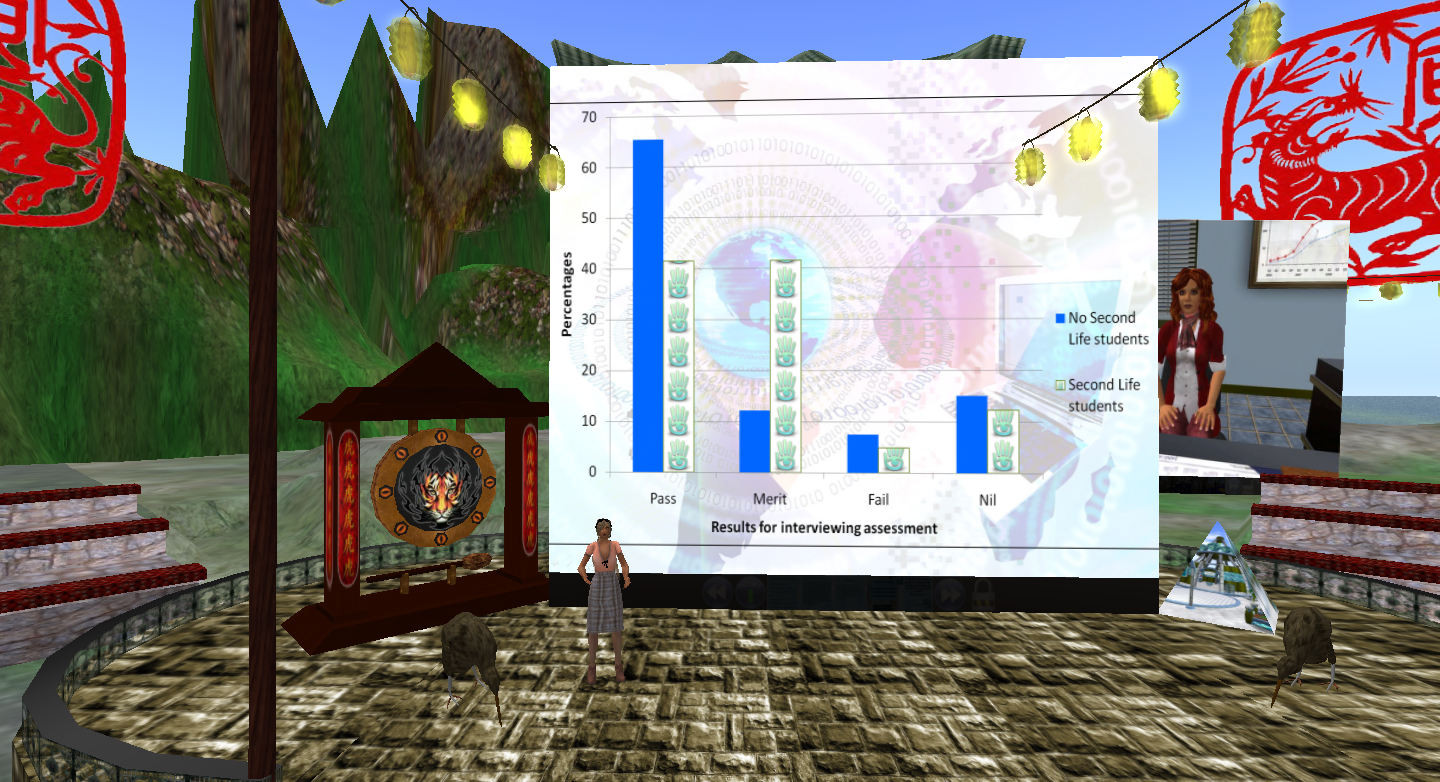
Briarmelle spoke about a pilot project on Foundation Learning conducted as part of the Second Life in New Zealand (SLENZ) project where the main goal was to show “the educational strengths or otherwise” of using a virtual world as means for students to practice interview skills, and according to Briarmelle students who used SL as compared to those who didn’t ended up with better assessments as shown in the slide below.

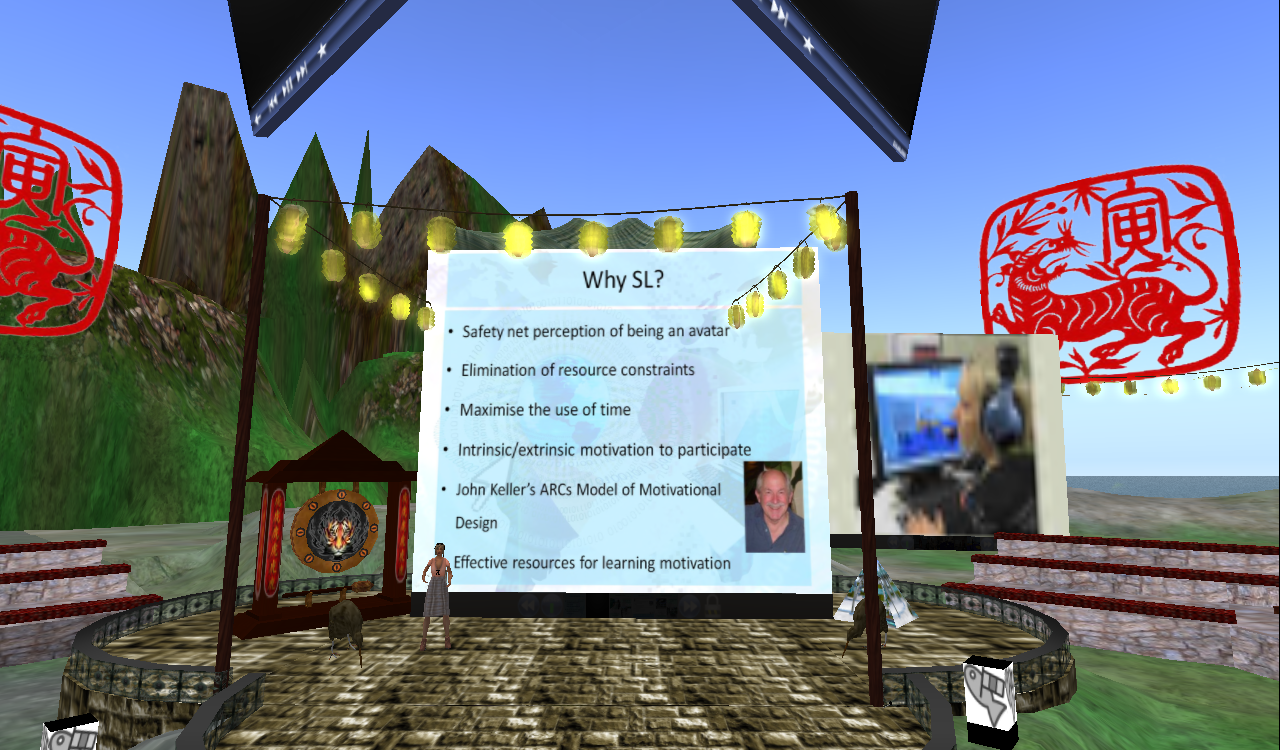
In designing their in-world environment, Briarmelle and her colleagues had been inspired by John Keller’s ARCS Model of Motivational Design, which addresses attention, relevance, confidence and satisfaction. Log-in to Koru Island and explore this and many other designs for teaching and learning.

UPDATE: on March 16th the SLENZ Project’s Lead Developer Isa Goodman announced that a free copy of the Foundation Build is now available on the neighbouring Kowhai Island under a Creative Commons Attribution-Share Alike license, and a new SLENZ blog has been created for discussions on technical issues and further developments.

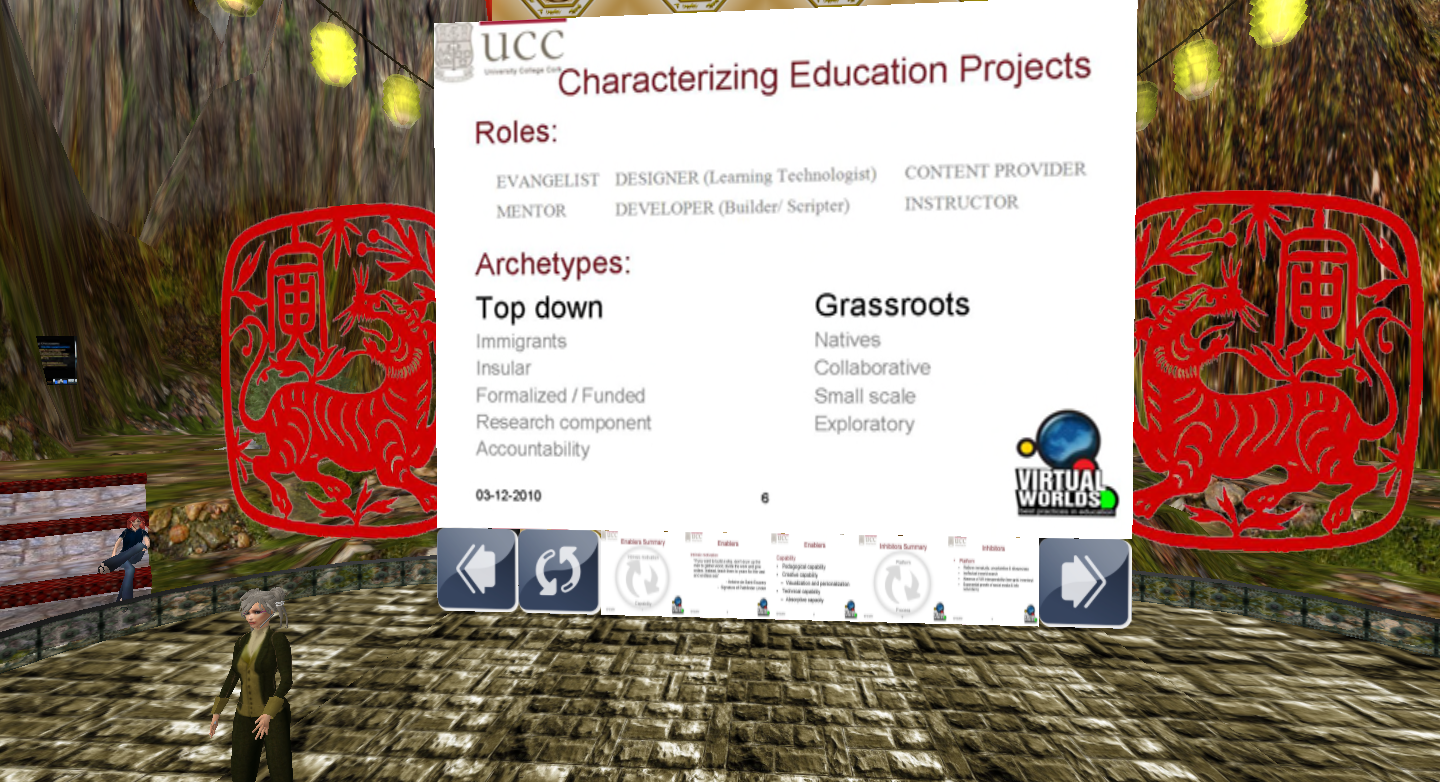
Next up was Logos Sohl who spoke about “Enablers and inhibitors of innovation and creativity in virtual world educational projects”.

Logos had made some interesting observations on enablers and inhibitors, and I’m hoping she’ll put her presentation in the vwbpe-slideshare. At a certain point, Logos asked us to state our geo positions and this really manifested the international nature of SL:

A one minute tour around the world:
[4:57] Hotaling: New Zealand, here. [4:57] Kayo: Oklahoma [4:57] Wozniak: Orlando, FL [4:57] Mills: Denmark [4:57]  Flatley: Newfoundland, Canada [4:57]  Jenvieve: UK, England [4:57]  Darbyshire shouts: NY [4:57] Congrejo: lol Euro [4:57]  Neximus: Germany [4:57]  Lowtide: UK atm [4:57]  Halostar: Germany [4:57] Baroque: Syracuse, NY [4:57]  Congrejo: Texas [4:57]  Jameson: i am in usa, i live in germany [4:57]  Alchemi: Leicester, UK [4:57]  Blogger: Belgium [4:57]  Camel: UK (devon) [4:57]  Bookmite: Georgia, the state [4:57]  Tigerfish: Indiana [4:57]   Hubbenfluff: Pennsylvania [4:57]  Frequency: i’m from singapore [4:57]  Lexenstar: West Virginia, USA [4:57]  Inventor: Czech rep., Europe :) [4:58] Bramlington: Sweden.

After a break, I returned in-world to my 3rd session, which was on “Networked Connectivism, Distributed cognition and PLNS”.

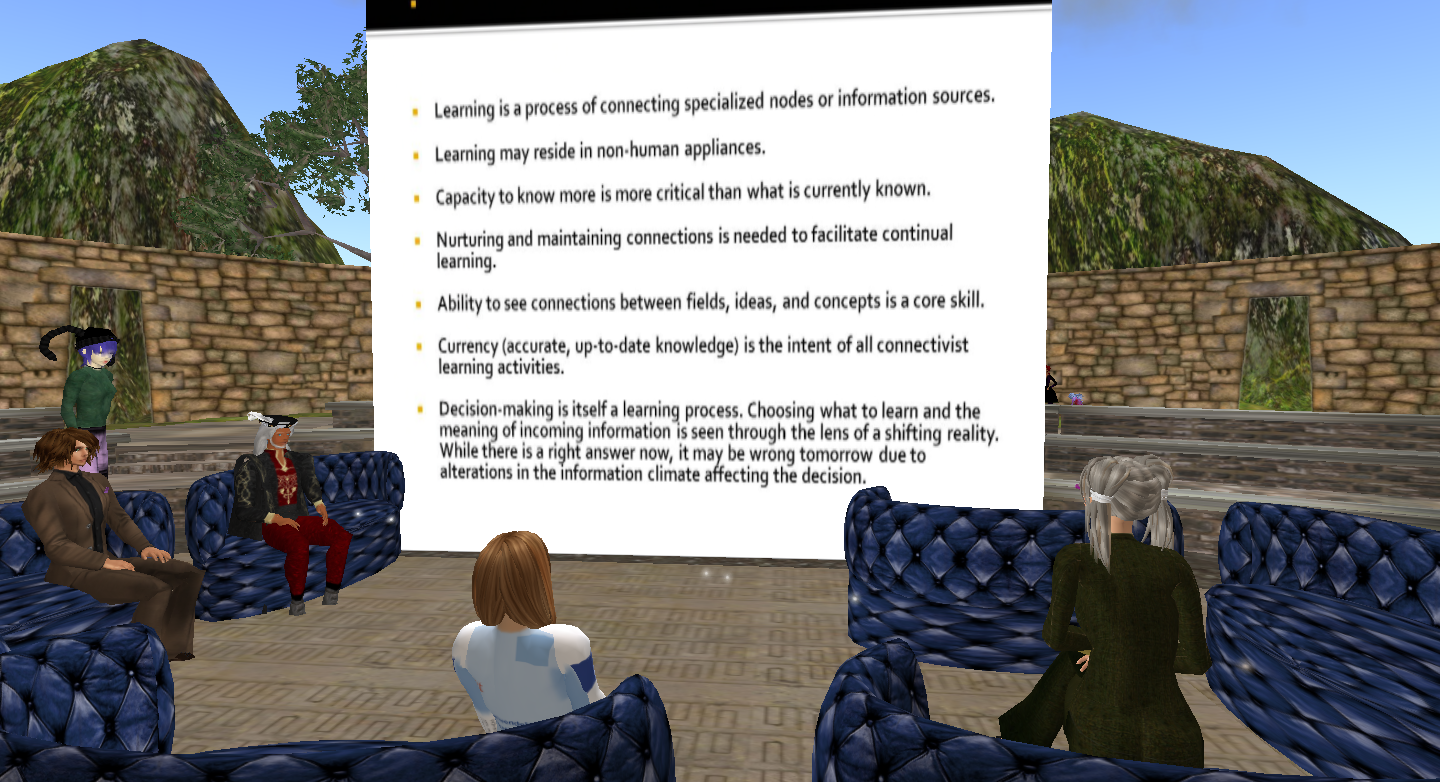
In this session hosted by Michigan Paule, Labatt Pawpaw (one of the founders of Connectivism) gave his thoughts on connectivism, learning and the pedagogical foundations that the technology provides.. Before the session started slides showed nicely on my screen, but during the session my computer started acting up and I ended up logging out due to lag. Labatt later posted an audio of his talk.

As I logged back in it was time for the official opening remarks of M Linden. Sadly my troubles continued and this is how M looked on my screen during the whole talk … um, not really becoming for a CEO ;-)

For those interested it is possible to hear (and see!) M’s talk here on BusinessTreetTV, where other sessions also will be archived.

I finished this first conference day by participating in Claudia Linden’s session on “Educational trends in Second Life”.

Again, I found the outlook to be somewhat grey, but it was nonetheless an interesting session, where Claudia asked us to share “aha-moments in SL”. There were many great, fun, thoughtful examples such as;

  • [13:13] Underwood: When my superintendent starting flying during our orientation,
  • [13:15]  Clawtooth: My “Ah ha” moment in SL was visiting Sistine Chapel and realizing when I saw the Sistine Chapel on TV that I had the same feeling as if I had actually been there in real life from my SL “visit.”,
  • [13:16] Bookmite: My student emailed “I hate second life.” Two months later she spent her summer exploring and learning how to build,

and not least [13:20] Tuque, who so eloquently summed up my first day impressions and the main reason why I enjoy SL so much: I guess that is MY Aha moment – when I realized I could meet, learn from, and work with colleagues from ALL over the world.

/Mariis

Evaluation, Literacy and Transliteracy

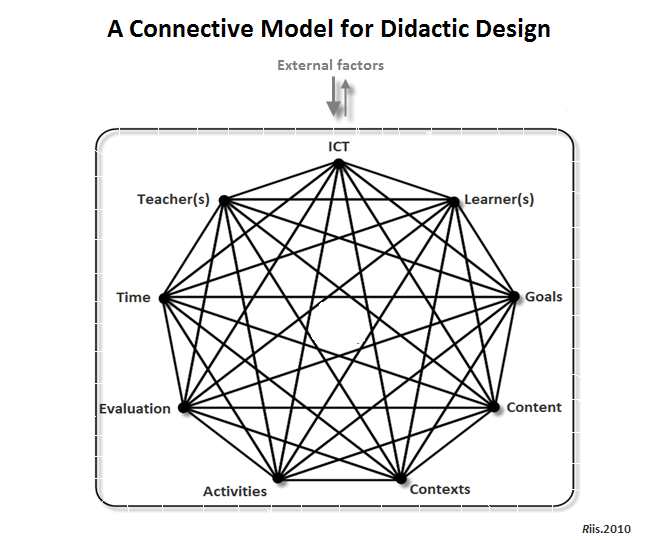
As previously described I’ll be using my Connective Model for ICT-remediated Didactic Design for the general analysis of my PhD data. A first step in this process is working with the 9 basic elements in the model and in this post I’ll focus on some preliminary work I’ve done on the element of Evaluation as depicted in the model below.

Given that definitions shape the way we think about and practice particular phenomena the very act of defining something should not be done without prudence. I’m quite confident that working with the different elements in the model will refine the way I’ll end up describing them, so for now I settle for working definitions and as such I’ve found inspiration in UNESCO’s definition of Evaluation and after modifying it so that it fits better into my study field of Didactic Design it would read as follows:

Evaluation means arriving at a value judgment on the basis of measures (qualitative or quantitative) considered to be valid and reliable, which compare the actual results of a Didactic Design with its anticipated results.

The element of Evaluation is to some degree connected to all the other elements, but according to the working definition there is a particular strong connection to the element of Goals, since this is where we can derive the criteria for evaluating the results. When dealing with Didactic Design there will always be a least two major perspectives from which we can look upon certain elements, namely the teaching perspective and the learning perspective, and in what follows I’ll present some initial reflections on the particular part of evaluation that concerns the evaluation of learning outcome/results. To do so I want to dwell a bit on the concept of Literacy, which I consider to be vital when discussing the purpose and goals of especially formal education.

In its most narrow sense literacy refers to the ability to read and write, but used as a more general concept literacy refers to being knowledgeable or educated within a particular field. In an interesting UNESCO report on the plurality of literacy and the concept’s connection to the right to education as stated in article 26 of  The Universal Declaration of Human Rights of 1948, the evolving notion of literacy is discussed and defined: “Literacy is the ability to identify, understand, interpret, create, communicate and compute, using printed and written materials associated with varying contexts. Literacy involves a continuum of learning in enabling individuals to achieve their goals, to develop their knowledge and potential, and to participate fully in their community and wider society.” (UNESCO.2004:13). Above all the plurality of literacy refers to the many fields in which literacy can be employed – specific literacies denominated by prefixes such as information, computer or media to name a few.

In my research on literacy I recently came across a very interesting article in First Monday that explores the concept of Transliteracy, which the authors Thomas; Joseph; Laccetti; Manson; Mills; Perril & Pullinger. 2007 define like this:

Transliteracy is the ability to read, write and interact across a range of platforms, tools and media from signing and orality through handwriting, print, TV, radio and film, to digital social networks. (Thomas et al. 2007)

What interests me the most is actually not the definition, but rather the idea and purpose of developing some sort of meta-literacy concept. According to the authors Transliteracy can be characterized as:

  • a possible unifying perspective on what it means to be literate in the twenty-first century
  • an extension of transliteration that also includes the increasingly wide range of communication platforms and tools at our disposal
  • a concept that calls for a change of perspective away from the battles over print versus digital, and a move instead towards a unifying ecology not just of media, but of all literacies relevant to reading, writing, interaction and culture, both past and present
  • a concept that doesn’t replace but contains both media and digital literacy
  • a possible literacy for (media) convergence
  • a concept of not just computer–based materials, but about all communication types across time and culture
  • a concept that insists on a lateral approach to history, context and culture, an interest in lived experience and a focus on interpretation via practice and production
  • an inclusive concept which bridges and connects past, present and, hopefully, future modalities
  • a concept that pays attention to the whole range of modes and to the synergies between them to produce a sense of a ‘transliterate lifeworld’ in constant process
  • both a concept and a practice productively situated in a liminal space between being a new cognitive tool and the recovery of an old one
  • a concept that deliberately refuses to presuppose any kind of offline/online divide
  • the kind of literacy we require to be able to simultaneously attend to multiple media and modes of communication as well as the kind of literacy we use to apply the literacies of one mode or medium to another one

Based on these characteristics I would interpret Transliteracy as a meta-literacy and I do find the characteristics both relevant and much needed in trying to define some sort of unifying literacy. The authors describe their work with the concept as a work in progress and “a good example of open source thinking between diverse collaborators” and they encourage further discussion and development of the concept. First author, Sue Thomas and her co-writers are all involved in the Production and Research in Transliteracy (PART) Group at the Institute of Creative Technologies (IOCT) at De Montfort University, UK and they’ll be hosting a conference on Transliteracy on February 9th 2010, which can be followed via several social media. In the video lecture below Sue Thomas explains the concept of Transliteracy based on the above mentioned article:

Returning to my interest in Literacy and especially new forms of literacy, I believe that there is a strong need to consider and develop new ways/methods of evaluation of learning outcome – not least when the learning processes and products have been facilitated by ICT-remediated Didactic Design. In this process of developing new evaluation methods, I think concepts like Transliteracy can prove quite valuable in giving indications of what criteria to focus on. Especially in Academia we seem to be stuck in using evaluation criteria and methods based on traditional literacy giving primacy to old media and modalities. Quoting Yancey. 2004: 90 “we use the frameworks and processes of one medium to assign value and to interpret work in a different medium”, which obviously is not the most appropriate way of accommodating the use of multiple and/or new media. In my third research cycle in the MIL case, I experimented with both criteria and methods of evaluation, and the results from this experiment will form the basis of a forthcoming post on evaluation of new media productions/compositions…

/Mariis

Connective models for Didactic Design

As previously described my PhD-project is aimed at improving Blended Learning within Higher and Further Education through remediation and redidactization. Through a process of designing and redesigning two specific Blended Learning courses within 6 research cycles the aspiration is to enhance learner experience and learning outcome by using new augmented/immersive 3D media and a learner centered Problem Based pedagogical approach. In both cases the target group is adult teachers/ trainers from the educational and the private/industrial sector from different countries. Having teachers/trainers as target group has made it quite natural to situate my work within the field of Didactics.

Especially in Northern Europe Didactics refers to a field of research and practice concerned with reflections and actions related to teaching and learning. Historically the field has been teacher-, goal- and/or content-centered, but since the mid 1970’ies we have – at least in Scandinavia – seen an almost paradigmatic shift to a more learning and learner-centered approach.  In Denmark this shift was above all initiated by the establishment of two new universities, in 1972 Roskilde and in 1974 Aalborg (where I work) that were founded in clear opposition to the “Old(fashioned)” universities by using an overall pedagogical approach based on Problem Based Learning and Project Organization in an attempt to amplify student motivation, engagement and learning with higher relevance for the surrounding society.

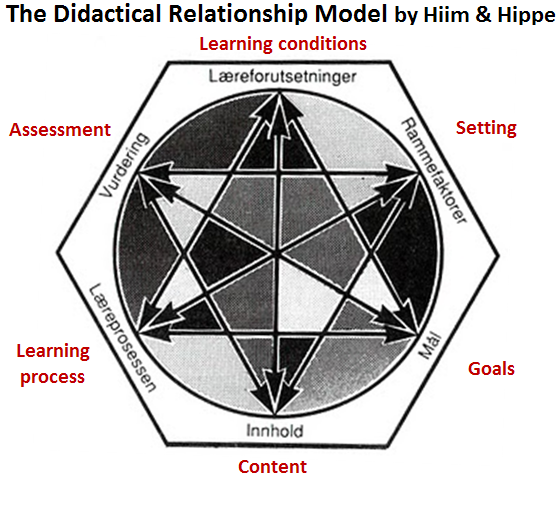
Within teacher/trainer education Didactic Analysis, as a means to learn how to plan, act, observe and reflect on didactic practices, has been a core component of the curriculum, and especially one model for didactic analysis has gained widespread use, namely the so called “Didactical Relationship Model” by Norwegian education researchers, Hilde Hiim and Else Hippe. Building on the work of fellow countrymen, Bjørndal and Lieberg (whose original model was more teacher-centered), Hiim and Hippe developed the model to show some important relations between different elements in Didactics using a learning theoretical approach. An English description of the model and the use of it in developing an online tutorial for Information Literacy can be found here.

In my PhD-project I currently have data from 4 completed research cycles and I’ve decided to use modified versions of the Hiim & Hippe model as part of my analytical strategy, which will consist of several phases progressing from a general to a more specific focus on didactic elements I find relevant in my particular case. Throughout the different phases I will be using different models, but as I find Hiim & Hippe’s model useful in depicting important relations and elements for general analysis, I’ll start by presenting this model briefly.

As mentioned above the model shows 6 important elements in a teaching/learning situation, these elements are interrelated and so influence each other in various ways and to various degrees. Even though I find the concept of depicting interrelated elements valuable, I don’t agree on the chosen elements, the description/content of the elements and the semantics in general. In my dissertation I will of course elaborate on this, but for now I will turn to my own revised models.

At the Master Programme in ICT and Learning (MIL), where I conduct most of my teaching and research, my colleagues, Bo Fibiger (1945-2008) and Birgitte Holm Sørensen originally conceived the concept of Didactic Design and combined with the use of Information and Communication Technology (ICT), Sørensen today defines it as: “The process by which the purpose, the goals and the content is determined, and where the planning, the organization and the arena for teaching and learning is shaped based on theories and in relation to ICT-based practice in a context.” I agree on the essence of the definition, but I also see Didactic Design as a result/product and sometime down the line I will also work on revising this definition. For now, the important point is that I consider my work to be part of the emerging field of Didactics combined with ICT and as a consequence my revised model is aimed at Didactic Design as depicted below:

In line with Hiim & Hippe’s model, my model also portrays important didactic elements, but I have chosen to add a few more elements, substitute one and rename some of them. I also prefer to speak of connections instead of relations, while the latter to me implies some sort of personalized bond that I don’t see between all the elements that are interconnected. I suspect that the major reason as to why Hiim & Hippe’s model has gained such popularity has to do with the fact that the elements are quite generic and thus enable the user of the model to define sub-elements depending on own needs and purpose.  One could argue that the elements I’ve added already are part of Hiim & Hippe’s model as sub-elements, but by highlighting them I believe greater emphasis can be obtained. While I do consider the elements in my model to be generic too and that my work with the model will refine the content/sub-elements, I do have some preliminary reflections.

  • ICT – in Hiim & Hippe’s model part of the setting. In my point of view the use of ICT has the potential of changing the Didactic Design quite dramatically and should as such not just be a sub-element. Furthermore the use of ICT has been written into the curricular of most educational practices from pre-schools to HE in Denmark.
  • Teacher(s) & Learner(s) – in Hiim & Hippe’s model people are absent at first glance. The Teacher is considered to be part of the setting and I guess that since the model is aimed at describing learning conditions and learning processes the student is somehow inherent. Based on my own teaching experience I, however consider the people involved in the Didactic Design to be the most influential element. This does not mean that I don’t consider the conditions (e.g. prerequisites) for teaching and learning to be important. On the contrary, but I think there is an acute need to focus on teachers’ conditions separately – especially when we combine Didactics with ICT.
  • Goals – in formal education goals are dominated by curriculum, but depending on theoretical foundation they can be formulated and attained more or less teacher-driven. One of the major advantages of a Problem Based approach is exactly the possibility of sharing the responsibility for this element between all participants in the Didactic Design.
  • Content – another element typically determined by curriculum and goals, but again within a Problem Based and especially Project Oriented approach this element can be based on collective decisions.
  • Contexts – teaching and learning doesn’t happen in a vacuum. Didactic Design is always situated, but not restricted to physical buildings or formal settings.
  • Activities – another very important element that shapes the teaching and learning processes possible and therefore also potential outcome.
  • Evaluation – Hiim & Hippe use the word assessment, which I think mainly relates to the learners and I do believe that a critical review on the teacher(s) and the teaching also is an important part of sustaining quality and I think that evaluation better covers this.
  • Time – is a crucial element, but is often missing in models and theories of teaching and learning despite the fact that there seems to be consensus on the fact that learning at a certain level actually takes a lot of time. Besides the time available for learners another sub-element could be time available for the teacher(s). In my experience many teachers/trainers find especially ICT-integration difficult and frustrating precisely because they don’t feel that they have sufficient time to learn to master the technologies and subsequent practices.

Besides revising the number and to some extend the content of the elements, I’ve also chosen to place the elements within a frame illustrating the point that Didactic Designs within formal education generally function as quite closed systems with very little permeability. Usually the influence from external factors (e.g. political, economical and other societal factors) is much greater than the other way.

In my PhD-project I’ve been working with 2 different cases. The MIL course (3 research cycles) and the COMBLE course (1 research cycle). In the MIL course the majority of the activities have been online, whereas the COMBLE course was 100% online, and I would describe the Didactic Design in both cases as having been ICT-remediated. In Bolter & Grusin’s original concept remediation refers to the process whereby new media refashions older media, but when we start to rely more and more on ICT/new media in our practices, I would argue that not only the media are refashioned, but there is a potential and in many cases a need to also reconsider and most likely revise the other elements in the model. These considerations have led to the next model:

It may come as a surprise that the model doesn’t appear that different, but that’s actually an important point of mine. ICT-remediation constitutes a potential for change, but it doesn’t happen automatically, and changes will depend on the various types of ICT. Walled Garden technology – like conventional LMS’/VLEs – is never pedagogical neutral. Different types of technology have different kinds of affordances and the user’s possibility to change or modify intrinsic ways of communication and content creation is usually very limited. As long as the majority of formal educational institutions choose to rely on conventional technology for remediating their practices, I personally see little prospect of real change. There are, nonetheless, some positive aspects in all of this. Regardless of the rest of the elements in the model ICT-remediation – especially based on Web 2.0 – will force the system to open up and connect more with the outside world and as both learners and teachers become more ICT literate as a consequence of ICT permeating our daily practices, I do expect changes to occur.

At the MIL education ICT is part of the curriculum and even though we also could do with more change, we do try to keep an eye on new media and their teaching and learning potentials. This was also the reason why my PhD-project became concerned with new augmented/immersive media in the shape of the 3D virtual world, Second Life (SL). Based on my experience with remediating existing practice into SL, this kind of medium clearly has the potential of changing the Didactic Design. Without having gone thoroughly through my data, I do see some changes regarding especially teacher(s), learner(s), contexts and activities. These four elements will be foci points in my analysis of SL and are highlighted in the model below:

It is quite deliberate that I’ve maintained the ICT element in this version of the model, because the use of SL doesn’t diminish the need to consider ICT in general. Several kinds of 2D technologies are at play in-world, and as I still consider SL to be an emerging, and sometimes very unstable technology, I wouldn’t at this point in time recommend using SL as a stand-alone technology.

These models all focus on traditional didactic elements and I will use them (most likely in revised versions) for my general Didactic Analysis. The last version has a clear connection to another model I’ve developed, which focuses on People (teachers/learners), Places (contexts) and Practices (activities). Based on that PPP-model I’ll be able to focus on topics that are less common in Didactics and in this way I think the models will complement each other profitably.

/Mariis

Case MIL09: Student analysis of SL – part 1

As part of the MIL course this year the students could choose to do their didactic analysis of SL either asynchronously in FirstClass or synchronously in SL, and 6 out 8 students chose the latter. Regardless of mode the students were asked to investigate 5 elements of particular importance when dealing with didactic analysis; Didactics (understood as theoretical foundation) and target groups, Orientation and navigation, Interaction, Learning processes and Audio-visuals. All of the students received the Zebra presenter and could use the sandbox to arrange the setting for their presentations, but they were also encouraged to find tools and places on their own. Each presentation was set to last approx. 2 hrs. and judging by the comments from all the students who chose the SL format, the analysis thus ended up feeling like an oral exam. In this and upcoming posts I’ll present some of the students’ findings and reflections.

Perlo & Francine


EduIsland 4: Practice classroom

First up were Perlo & Francine who had found a free practice classroom for trainee teachers at one of the EduIslands. Perlo & Francine had chosen to prepare their analysis as a streamed video which we were able to watch via the presenter in the classroom. As foundation for their analysis they had chosen the Didactic Relation model and the target group was adult students at a Teacher College studying religion. The purpose of using SL should be to conduct field studies that would otherwise be impossible to do in real life within the given college settings. Perlo & Francine envisioned using SL as part of a blended learning environment where they would include a wiki for the students’ asynchronous reflections and also f2f activities e.g. workshops aimed at teaching the students how to use SL.

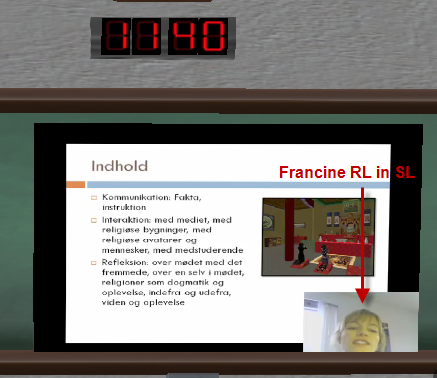
One of the advantages Perlo & Francine pointed out about SL is the way the medium allows the user to change perspective, not only via camera controls, but rather because of the avatar phenomenon that enables the user to have a detached, 3rd person view on him-/herself and the activities/interactions in the environment. Conversely they also pointed to the other pole in the participation-observation continuum, where – provided you feel immersed or attached to your avatar – you would be able to participate (almost) like a native in different cultures. This change of perspective and the ontologically challenging question of being present or not was underlined by the way Perlo & Francine chose to present their thoughts as themselves in the video, but displayed on a screen and discussed in-world as avatars.

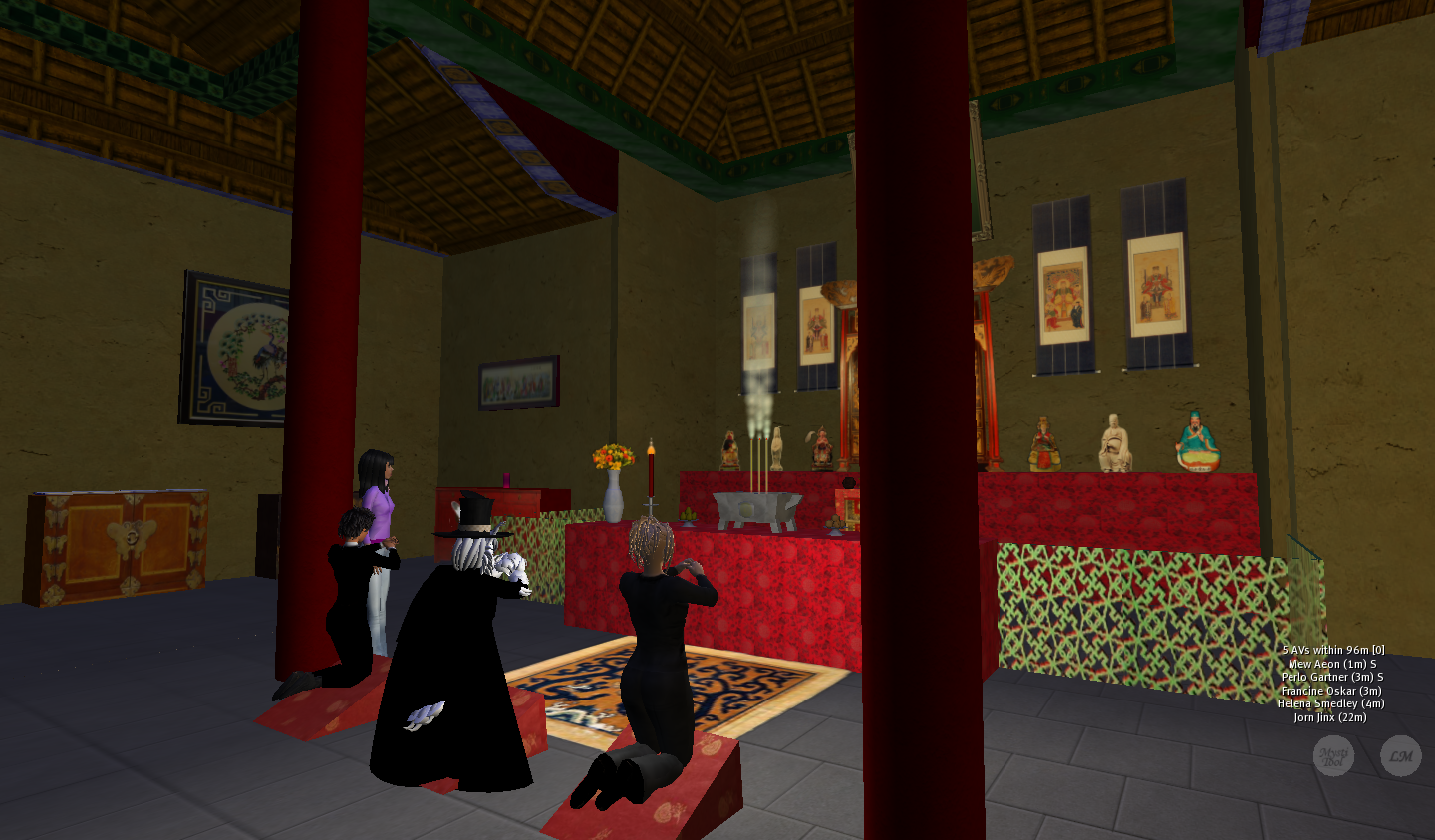
Despite their enthusiasm about SL as teaching and learning medium, they also worried about especially technical challenges, the fact that most communication in SL is in English and the rather vast amount of time that is needed to get to know SL sufficiently so that the students actually would be able to use SL as intended. Nonetheless, they did find the possibility to do field studies via SL to be really appealing and worth trying out, and they are currently preparing a course that’ll be running in the beginning of 2010. After the presentation we visited a couple of the religious places that would be relevant in their course:


The Kaaba at IslamOnline


Looking at The Black Stone – something NpIRL for non-muslims …


Praying at The Cijian Temple

Afterwards Perlo & Francine reflected on the experience in FirstClass and they both focused on the many things – especially technological – that you need to pay attention to when teaching in-world. Compared to f2f they found it more difficult to control and mange the activities, make sure everybody understood their instructions and when touring making sure nobody got lost. These are quite typical impressions from initial teaching experience in-world – but don’t worry –  it does get easier in time :-)

/Mariis