
More fun tools here
/Mariis
On Wednesday, January 21st I participated in a Master Class on Learning 2.0 and Knowledge Media at Aarhus University.Terry Anderson (Athabasca University) and Simon Heilesen (Roskilde University) were guest lecturers, while my MIL colleagues Christian Dalsgaard, Jørgen Bang and Elsebeth K. Sorensen (Aarhus University) served as moderators. Six Master- and PhD Candidates from different Danish Universities besides me participated, four of us giving short presentations of our projects.
Anderson gave an interesting presentation entitled “Overview of Research Methodologies for Social Software Research”, which initiated quite a discussion on research methodologies especially within educational research. Anderson was critical of educational research asking what results in fact had been able to instigate real change in educational practices. This lead to a critical overview of three dominant research paradigms respectively Quantitative, Qualitative and Critical. Anderson quoted a study by Mary M. Kennedy (1999):
The findings from this study cast doubt on virtually every argument for the superiority of any particular research genre, whether the criterion for superiority is persuasiveness, relevance, or ability to influence practitioners’ thinking. (from Anderson’s presentation above)
According to Anderson, who also is the director of Canadian Institute of Distance Education Research (CIDER), there is a need for development of new research strategies emphasizing possibilities for innovation and change. Anderson pointed to Design Based Research (DBR) as a potential strategy. At ELL we have a strong tradition of employing Action Research (AR) based strategies, including DBR, which in my point of view is a variant of AR. Both strategies are:
However, there are at least two major differences between AR and DBR, namely the role of the researcher and the role of theory. In DBR the researcher works closely together with the practitioners, whereas in AR – especially in educational research – the researcher quite often also is the practitioner studying his/her own practice as a participant/insider. In DBR the role of theory is clearly defined as the point of departure of the research process:
Design-based researchers’ innovations embody specific theoretical claims about teaching and learning, and help us understand the relationships among educational theory, designed artifact, and practice. (DBRC.2003:5)
In AR theory isn’t necessarily applied from the beginning of the research process but to a higher degree grounded by the practice in the different research cycles, thus making it a more open strategy. Still, in claiming this I want to stress that there are many different takes on AR strategies. See Raelin (1999) for a good overview of different action based strategies.
Heilesen proceeded with another interesting presentation on “Learning 2.0 – Conditions and potentials of the social web”. There are so many comments to be made on this topic, but one of the issues Heilesen addressed was the potential of using new digital social technologies as means to change conventional conference participation from a typical closed and time limited event to a more open and continuous activity – exemplified by the MetaverseU conference at Stanford, February 2008 (where both Heilesen and I participated ;-). Anyone who has participated in RL conferences knows that it can be a somewhat dreary experience based mainly on one-to-many communication, and in my personal experience it can also be quite difficult to expand the effect/outcome afterwards. This issue of “frustrating conferences” is currently being addressed by George Siemens and colleagues. Note the upcoming open, online conference on this topic and see Siemens, Tittenberger & Anderson (2008) for a really interesting perspective on this.
After the lunch break, I and three other candidates were asked to present our projects. Presenting a PhD project in 15 min. really is an ungrateful task making it quite difficult to convey a coherent and comprehensible impression. On the other hand, I have to admit that at this stage in my PhD research many of my ideas and thoughts still need to be qualified by further research and a Master Class can be a really good opportunity to discuss this kind of “work-in-progress”. In my presentation, I chose to focus on the possibility of using SL as a knowledge medium – primarily based on the preliminary findings of my 2. research cycle, which was conducted in November/December 2008.
One of the things, which were critiqued as being unclear in my presentation, was my use of the concepts respectful and radical remediation. Initially I was inspired by Tringham, Mills & Ashley (2007) and their experiences from the Remediated Places Project, where they used these two concepts (elaborating on Bolter & Grusin.1999) as a way of describing different ways of remediating. Based on my own experiences from remediating a specific course via SL I do find these two concepts very useful in describing not only different ways of remediating places, but also people and practices. There is, however, no doubt that I need to further develop and qualify my work on this, so that I can convey a more coherent, and thus convincing argument on this.
All in all, it was a very inspiring learning experience to participate in this Master Class, so my concluding words will be thanking all the participants :-)
/Mariis
References
Bolter, J. & Grusin, R. (1999): Remediation. Understanding New Media. The MIT Press
Kennedy, M. M. (1999) The problem of evidence in teacher education. In: Roth, R. (Ed). The Role of the University in the Preparation of Teachers. (pgs 87-107). London: Falmer Press.
Raelin, J. (1999) Preface. In: Management Learning. Vol. 30(2): 115-125. Sage Publications
Example of my ELL colleagues using DBR in current research
Coto, M. & Dirckinck-Holmfeld, L (2008): Facilitating Communities of Practice in Teacher Professional Development. Networked Learning Conference Proceedings 2008.
Other relevant resources
CIDER’s SIG on DBR
Smith, M.K. (1996, 2001, 2007): Action Research. The encyclopedia of informal education.
Next week I’ll be attending a conference and a Master Class on “Knowledge Media” at Aarhus University.

The purpose of the Knowledge Media Conference is to discuss the role of new digital media within education in the knowledge society. What are the potentials of digital media in relation to learning, knowledge sharing and knowledge construction? The conference will focus on use of digital media for learning and knowledge acquisition in both formal and informal situations. The conference includes presentations from invited keynote speakers. Further, the conference will present the results of a research project at the Centre for IT & Learning on Knowledge media, 2007-2008.
Themes
Keynotes
I’m especially interested in hearing Anderson’s talk on “Learning and Teaching beyond the Course Into Networks and Collectives”. The idea that social media, knowledge media or whatever you wish to call new digital media, slowly will dissolve our notion of courses (understood as fixed, teacher-driven activities) as a means of learning seems to gain more and more recognition and attention, and it’ll be interesting to hear Anderson’s thoughts on this in my own area (distance education) – not least since my PhD fundamentally is about course design, hmmm …
The Master Class, with Terry Anderson and Simon Heilesen (senior researcher at the Virtual Worlds Research, Roskilde University) as speakers, will also adress the potentials of digital media in relation to learning, knowledge sharing and knowledge construction. I’ll do a short presentation of Second Life as Knowledge Medium in Distance Education based on my experiences with the MIL course in the 2 research cycles so far. I think it’s a really good idea to hold the Master Class the day after the conference, because I’m quite sure many questions and ideas will come to me, so it’s nice to get an opportunity to discuss more informally.
/Mariis
This week I’ve been attending both a seminar and a PhD course with Judith Gregory, Institute of Design, Illinois Institute of Technology and Anne Marie Kanstrup, Department of Communication and Psychology, Aalborg University. This post is mainly an overview of my impressions from the seminar – I’ll return to more explicit content issues and a few but very important decisions I’ve made based on especially the PhD course.
On Tuesday, January 13th Gregory was invited to speak at an internal ELL seminar. Besides Gregory, Kanstrup and ELL’s leader, Lone Dirckinck-Holmfeld (my main PhD supervisor) we were 8 PhD candidates and researchers from ELL and two researchers from Department of Development and Planning. After Dirckinck-Holmfeld had given a short introduction to ELL and the general research and educational /pedagogical strategies of Aalborg University, we all described our research interests to give Gregory an overview of the multidisciplinary field we’re working in.
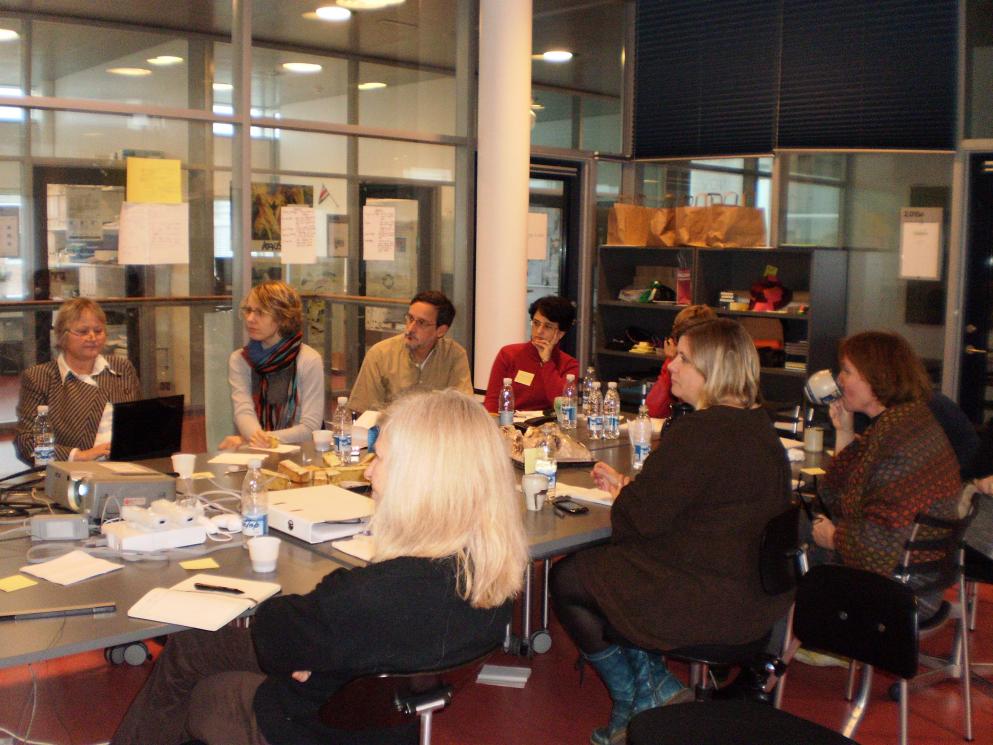
Colleagues in the E-Learning Lab
Gregory then introduced her background, which in the short version includes the following:
When describing her current research interest, it became evident that we would be able to find common ground in many areas:
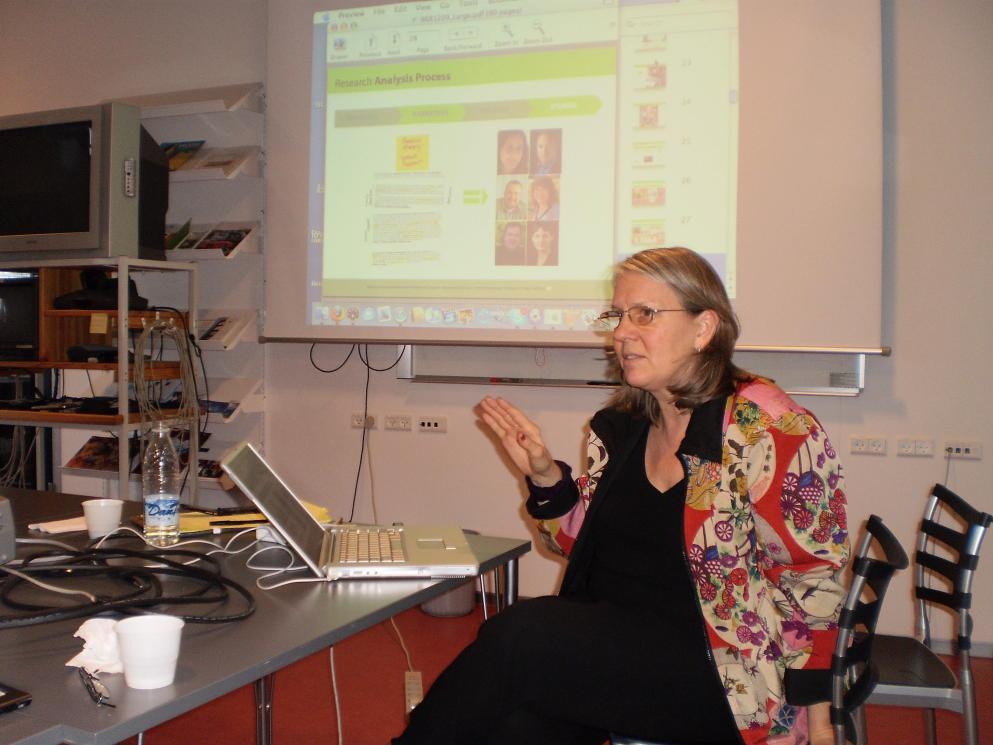
Judith Gregory
Besides showing us a number of very interesting case studies she has been involved in, Gregory also shared a very thoughtful and quite progressive statement from the prospectus brochure made by the founder of the School of Design (Institute as of 1944), Lázló Moholy-Nagy back in 1939:
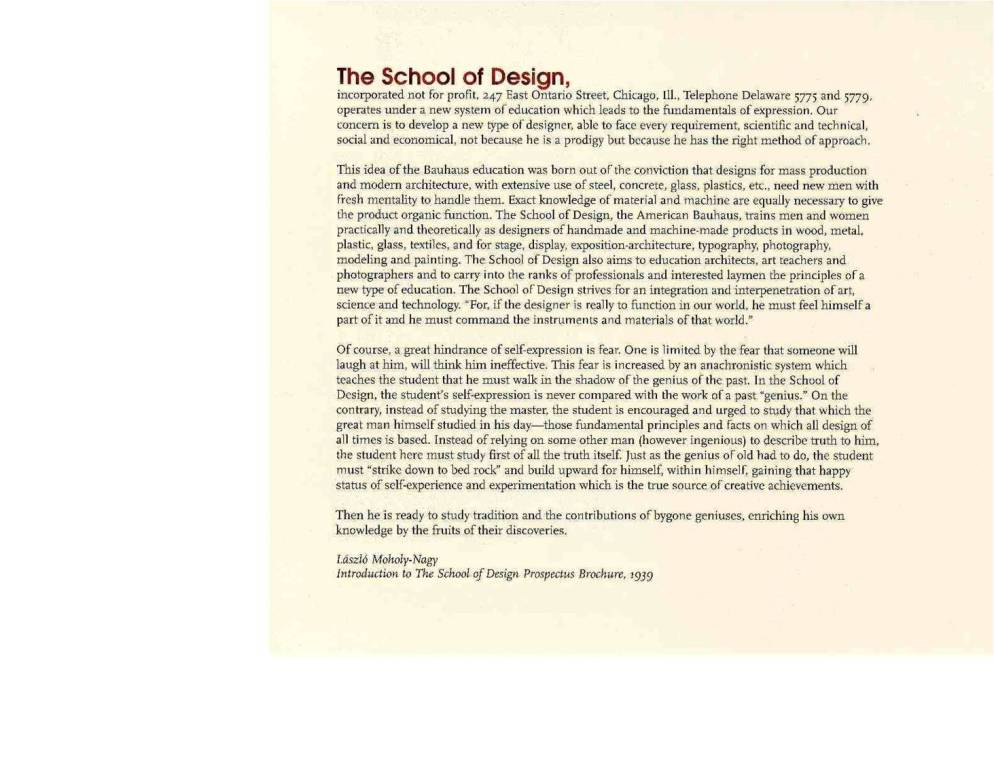
Moholy-Nagy’s 1939 statement
Unfortunately this picture is rather unclear, but what I found especially remarkable was Moholy-Nagy’s thoughts on the teacher-student relationship and the potential fruitful learning process:
In the School of Design, the student’s self-expression is never compared with the work of a past “genius”. On the contrary, instead of studying the master, the student is encouraged and urged to study that which the great man himself studied in his day – those fundamental principles and facts on which all design of all times is based. Instead of relying on some other man (however ingenious) to describe truth to him, the student here must study here first of all the truth itself. Just as the genius of old had to do, the student must “strike down to bed rock” and build upward for himself, within himself, gaining that happy status of self-experience and experimentation which is the true source of creative achievements.
Then he is ready to study tradition and the contributions of bygones geniuses, enriching his own knowledge by the fruits of their discoveries.
On a more personal level, Gregory told us that her father actually studied under Moholy-Nagy, and that this was one of the reasons why she had found it difficult not to accept the offer of coming to work at the Institute of Design when she was given that opportunity. Another more professional reason for working at the institute was that it has continued to honor and respect the pedagogical foundations of Moholy-Nagy.
 Lucia Moholy, László Moholy-Nagy
1926 © Bauhaus-Archiv, Berlin
In a truly inspiring paper on Moholy-Nagy’s Design Pedagogy, Findeli (1990) describes how Moholy-Nagy developed his pedagogy based on Bauhaus pedagogy, Goethe’s Naturphilosphie and Dewey’s pragmatism.
In bridging the social responsibility with a scientific method based on intuition and problem based experimentation facilitated by a nondirective, noninterventionist, and nonviolent teacher it’s my impression that Moholy-Nagy managed to found a visionary pedagogical philosophy and practice that must have been (and maybe still is) quite provocative and radical to many educators. Findeli (1990:19) concludes that “the general pedagogical approach of Moholy-Nagy, if correctly adapted to the new circumstances, still constitutes a valid preparation toward the tasks that await future designers”. So let me finish this post by quoting Moholy-Nagy once again, this time on his thoughts on designers:
To be a designer means not only to sensibly manipulate techniques and analyze production processes, but also to accept the concomitant social obligations … Thus quality of design is dependent not alone on function, science, and technological processes, but also upon social consciousness. (from Findeli. 1990:19)
Personally, I could rather easily replace designer and design with educator and education hereby deducing that educators are a certain type of designers!
After the seminar we were all invited to Dirckinck-Holmfeld and her husband Arne Remmen’s house for dinner where we continued more informal talks on design, education, politics and democracy, which was a beautiful way to end a perfect day :-)
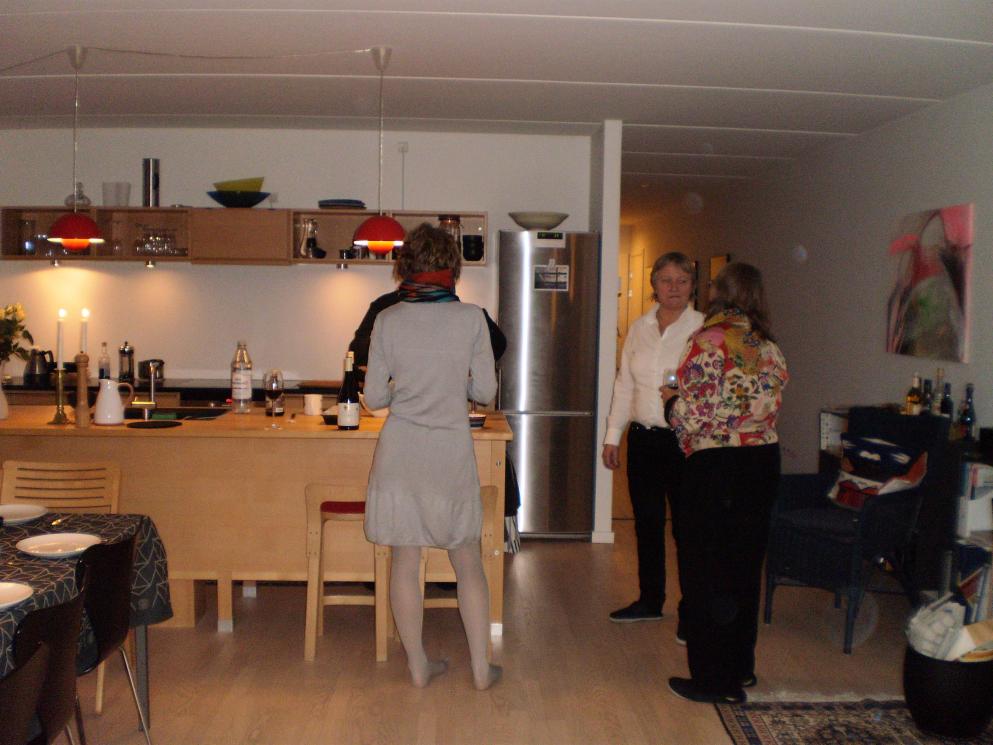
Lone and Arne’s kitchen
/Mariis
Reference
Findeli, A. (1990): Moholy-Nagy’s Design Pedagogy in Chicago (1937-46)
Design Issues, Vol. 7, No. 1, Educating the Designer (Autumn, 1990), pp 4-19
The MIT Press
On January 10th, I was able to celebrate one year in the blog sphere, so it seems natural to reflect a bit on the lessons learned …
Why do I blog?
How do I blog?
I’ve written 72 post during this first year, which I actually find quite ok, since I didn’t blog at all from February till July due to illness both personal and in my family. I’ve written 2-3 personal posts, the rest are professional. The 46 categories reveal that SL, education, MIL, my PhD and research are my favorite 5 topics. I never lack topics to blog about, but due to time restraints I try to focus on topics directly related to my PhD project. I’ve expanded my blogroll quite a lot, and now it works as my favorite list related to my PhD work (my Firefox is more off-topic and often contains temporary links).
I’ve recieved 68 comments. As you may have noticed above I didn’t mention the asynchronous dialogue as an advantage of blogging. I have a dozen of blogs I follow on a regular basis, but I’ve only posted a few comments on other blogs. So far my own posts have mainly been descriptive and have served as a way of preserving preliminary thoughts and ideas. Due to both language restraints and, I guess, professional insecurity I haven’t felt comfortable engaging more and I haven’t done anything to ensure that my blog would show via search engines etc. I started blogging as a very personal experience, as a way of finding my own voice as a researcher – and this may take some time. Being a PhD candidate is very much about learning and I intend to take advantage of this unique opportunity of having three whole years to strengthen my thoughts and expand my knowledge.
In a recent Australian study on the advantages of blogging as part of a PhD candidature by Ward & West (2008:63), it is stated that:
The process of PhD development should, presumably, be one of growth in intellectual confidence, independence and originality of thinking. It would be fair to expect it to result in empowerment and ultimate entry to an elite community. These attributes – that we presume are valued by all the participants in the process – by definition are not, and should not, be easy to achieve.
Although there apparently are major differences between the learning conditions for PhD candidates in Denmark and Australia, I do think that Ward & West’s paper summarizes the advantages of blogging quite accurately, and I would much certainly recommend blogging as part of the PhD learning process.
/Mariis
BTW, thanks to Greg Wadley – another blogging PhD Candidate – for the Ward & West reference :-)
 Mariis' digitale refleksioner