To date I’ve completed two research cycles in my PhD, and both cycles were conducted within a specific course at The Masterprogramme on Ict and Learning (MIL). The course is entitled “Ict and Didactic Design” and basically the students are asked to analyze, assess and reflect upon the teaching and learning potential of SL. In order to do so, we ask the students to focus on five mandatory topics; Didactics and target groups, Orientation and navigation, Interactivity, Learning processes and Audio-visual elements.
The students are expected to discuss these topics asynchronously in our main virtual teaching and learning environment, FirstClass® (FC) and during synchronous in-world activities (typically lasting between 1-3 hrs.). So far I’ve spent most of my time reflecting on the use of SL, but since I’m investigating SL as a supplement and not as stand-alone environment in my PhD, I’ve now been looking a bit at the use of FC in the two research cycles. I’ll start with a brief description of the two cycles.
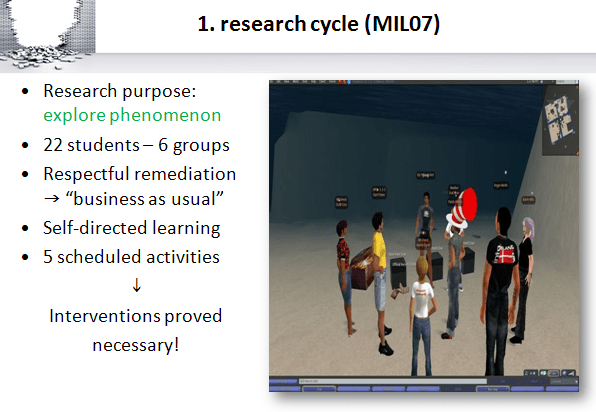
I was rezzed as Mariis Mills in March 2007, and I conducted the first research cycle about half a year later. The main purpose of the first cycle was to explore SL as phenomenon in order to understand this media’s potential as teaching and learning environment. Several studies conducted at MIL (Dircknink-Holmfeld.2002; Dirckinck-Holmfeld et al. 2004; Sorensen & Takle. 2005) indicate that the majority of our students participate in one or several communities of practice, CoP (Wenger. 1998) during the masterprogramme, and I also wanted to observe what would happen to these CoP’s as a consequence of remediating into SL.
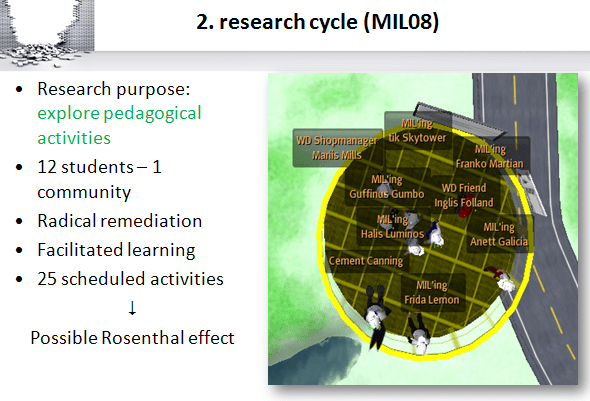
The second research cycle was conducted in the Fall 2008. Based on the findings from the first cycle and additional experience and research the course was redesigned in several ways. Even though the first cycle confirmed the presence of CoP’s, I decided to try to enhance the community creation and feeling by asking the students to work as one entity instead of working in their usual smaller study groups. I also changed my own role from being a somewhat distant observer to a fully engaged participant and facilitator. In the first research cycle there were only 5 scheduled activities, but in the second cycle I decided to focus on many different pedagogical activities resulting in a total of 25 (this post further elaborates on these activities).
Apart from the changes mentioned above, I also decided to change the design (and thus expected use) of the FC setting. As stated by Nyvang, Tolsby & Dirckinck-Holmfeld (2004) VLEs/LMS’ and other systems we use for teaching and learning are never neutral in the sense that they always convey some underpinning pedagogical philosophy. And like physical buildings these systems can be designed more or less optimal to support different types of teaching and learning processes. In FC the user is able to see a tree structure of the way we’ve organized the many conferences in the left side of the screen, and for many users this tree structure provides an overview. The picture below shows the tree structure as it appeared in the two cycles:

The SL course is part of the first course (m4c1) in the 4th module and as such it would be found below the main conference for that module. In this first course the students can choose either SL (3D world) or Global Conflicts (3D game) as analytical objects. Traditionally the students work in small study groups (K-gruppe). In the MIL07 case the conferences for the students’ groups were placed directly below the main course conference (used by all students and the teachers for communication regarding the course in general), while the two conferences for more specific communication regarding the analytical objects were placed in the bottom of the tree structure. A tentative interpretation of this structure would put emphasis on the study groups, which for many students probably made perfect sense, since it was in these group conferences their main activities were supposed to take place. At a glance this structure did not however indicate which groups were working with SL respectively GC. Though working in separate groups many MIL students appreciated following the work of their fellow students and they proposed that we designed for a better overview over the groups’ interests in the future.
So in the MIL08 case we decided to place the study group conferences below the two conferences for the analytical objects, which also meant that the GC and SL conferences moved up in the hierarchical tree structure – perhaps putting more emphasis on the subject matter? There was another major difference, namely that I decided that the students who chose SL should work in one large group/as a community meaning that the 12 SL students were not assigned separate group conferences. In ‘07 there was only one conference dedicated to SL and this proved to be inappropriate since we used that one conference for all SL related communication including meeting information, literature upload, small talk etc. making it very difficult to locate specific information as the course progressed. Thus in the MIL08 case I created several sub-conferences each dedicated to specific topics and types of information. I also utilized different icons to indicate the differences between these conferences and when the student clicked on the main SL conference he/she would get an overview of all these affiliated conferences as show in the right side of the picture above.
As mentioned before the tree structure in FC is shown in the left side of the user’s screen. In the right side the same information is presented in a different way/view. In the MIL07 case the right side could look like this:

and in the MIL08 case it could look like this:

Apart from the aesthetic perspective which I’ll leave for the reader to assess, I do think that the MIL08 design provides a much better overview. The red circles point to the main activity areas – in MIL07 in the study groups, in MIL08 in the topic conferences. The ’08 students did not place any of their postings in the “Interactivity” conference. Nonetheless they did discuss interactivity quite vividly, but as they explained, they often found the separation of topics somewhat artificial, and this may be something I need to design differently in the next research cycle (Fall 2009).
Anyway, my purpose in this post is to investigate whether the design made a difference in the way the students used FC. In both cycles the students were asked to post a minimum of 3 postings in order to pass the course. The majority of MIL students are part-time students, full-time employed and actively engaged in other life activities. Even so MIL students are renowned for their very high engagement and activity level. In the table below I’ve compared some data from the two cycles:
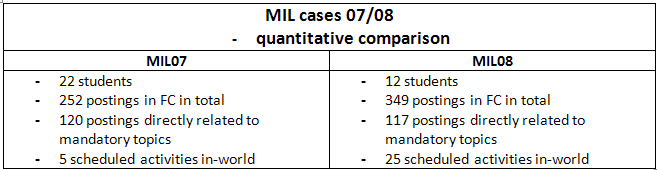
My involvement in the topics discussions was quite similar in the two cycles, and already back in 2007 I was highly impressed by the students’ engagement and level of activity, but as you can see the engagement of the MIL08 students was extraordinary in all aspects. Bear in mind that besides participation in numerous online activities the students also need to find time to study the mandatory course literature! All students passed both courses, but in each cycle 1-2 students were asked to elaborate on their findings/reflections in order to pass. The quality of the students’ discussions was high in both courses, but it was quite clear that the MIL08 students’ postings were more informed with regards to SL.
I’m quite confident that the amplified engagement, level of activity and quality in the MIL08 case stems from a combination of redesigns, but as FC is part of the collected teaching and learning environment, I do believe that careful consideration and design of the FC structure is an important part of the whole design puzzle and as such should be given appropriate attention.
/Mariis
References
Dirckinck-Holmfeld, L. (2002): CSCL – Computer Supported Collaborative Learning – Projektpædagogiske læringsformer i virtuelle omgivelser. IN: Uddannelse, læring og It. 26 forskere og praktikere gør status på området. IN: Undervisningsministeriet. http://pub.uvm.dk/2002/uddannelse/5.html
Dirckinck-Holmfeld, L., Sorensen, E.K., Ryberg, T., Buus, L. (2004). A Theoretical Framework for Designing Online Master Communities of Practice. IN: Proceedings of the 4th Networked Learning Conference.
Nyvang, T., Tolsby, H. & Dirckinck-Holmfeld, L. (2004): E-læringssystemer og projektpædagogik – pædagogikkens krav til systemdesign og funktionalitet. IN: Georgsen, M. & Bennedsen, J. (ed.): Fleksibel læring og undervisning – erfaringer, konsekvenser og muligheder med ikt, s. 207-238. Aalborg Universitetsforlag.
Sorensen, E.K. & Takle, E.S. (2005). Investigating knowledge building dialogues in networked communities of practice. A collaborative learning endeavour across cultures. IN: Interactive Educational Multimedia, No.10.
Wenger, E. (1998). Communities of Practice. Learning, Meaning, and Identity. Cambridge University Press.

 Mariis' digitale refleksioner