Together with several colleagues from different Danish universities/companies, I’ve been invited to participate in a workshop at Stanford University that aims at exploring different kinds of virtuality.
The workshop is inviting researchers and practitioners from across a great number of disciplines to come together and inspire each other in discussions on 4 overall themes:
The sensational organization
Embodying the Virtual
Transformations of time and space
Virtuality and affects
Jeremy Bailenson, Director of Stanford’s Virtual Human Interaction Lab will open the workshop with a keynote on the book “Infinite Reality“, which he co-autored with Jim Blascovich. Since I’ve been using the book in my PhD-work, I’m really looking forward to getting the opportunity to hear Bailenson elaborate and discuss some of the issues raised. My colleague, Anders Drachen and I are currently trying to establish a research center on virtual environments, and we are hoping to use this opportunity to connect with relevant partners both at Stanford and some of the other universities and companies in the area.
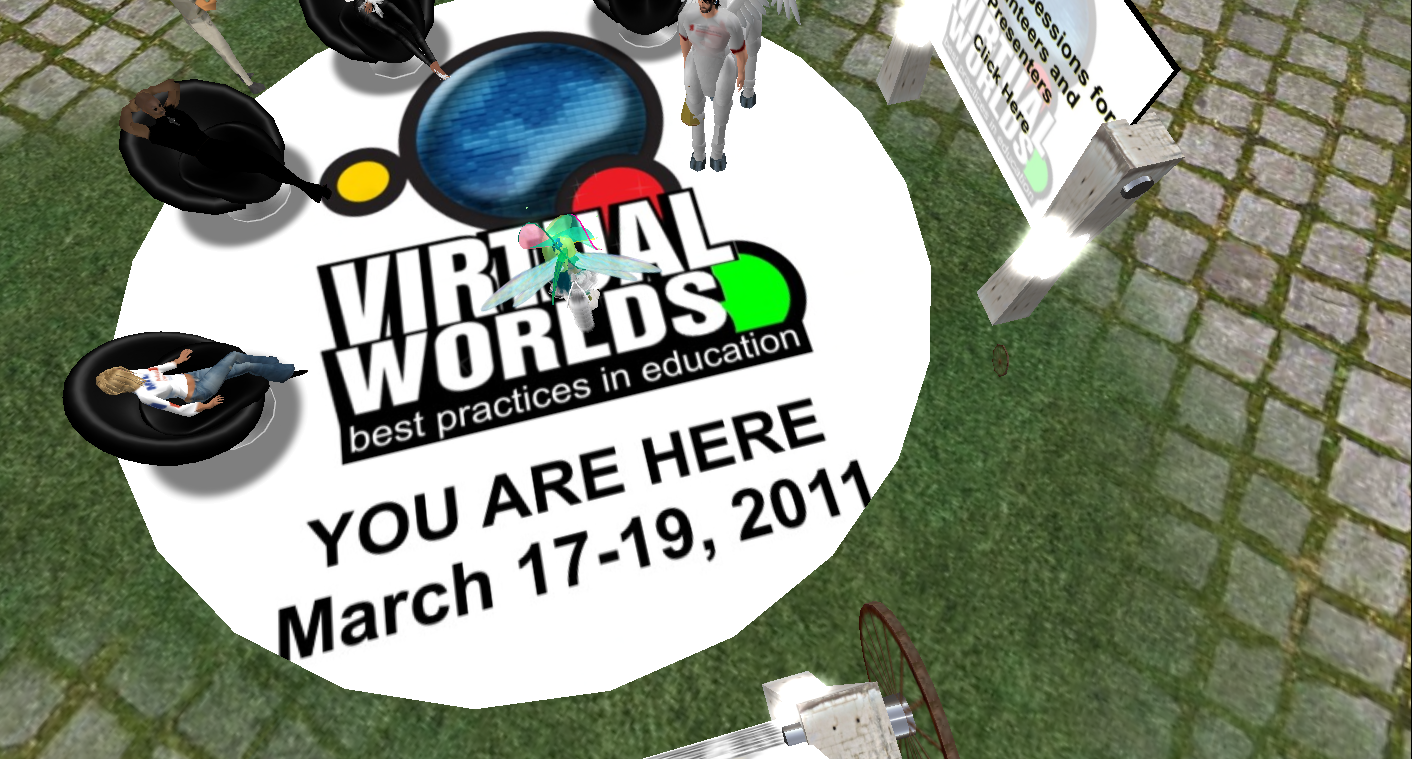
On March 17-19 the 4th annual Virtual Worlds Best Practice in Education (#VWBPE11) will be taking place in SL and other Virtual Worlds such as OpenSim, World of Warcraft, Eve Online and Club Penguin.
The VWBPE is is a community-based conference that provides opportunities for participants in all virtual worlds to share current research, teaching, and learning practices in 3D virtual environments. This 53 hour conference will provide opportunities for sharing and further understanding virtual world technology, and will focus on teaching/learning, scholarly work, projects, events, activities and new and innovative tools for virtual education. According to the VWBPE-website this year’s conference is about people, the community, and it’s about being together;
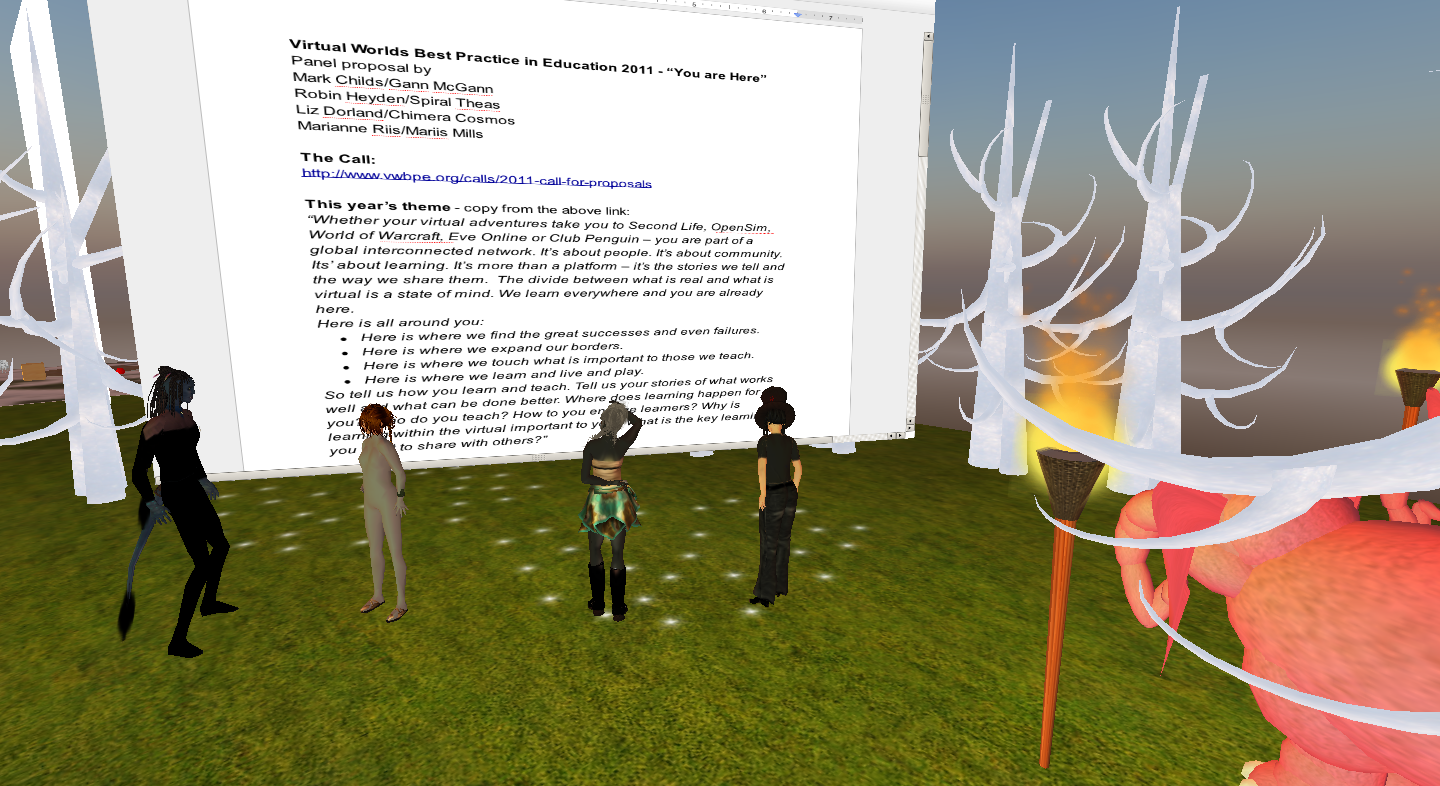
This year’s theme is You are Here. The divide between what is real and what is virtual is a state of mind. We learn everywhere and you are already here.
Here is all around you:
Here is where we find the great successes and even failures.
Here is where we expand our borders.
Here is where we touch what is important to those we teach.
Here is where we learn and live and play.
I have been attending the conference for a couple of years as an observer, which has been very inspirational, and I highly recommend anyone interested in 3D Virtual Worlds to participate in this amazing, free event! :-)
Furthermore, this year I have the great pleasure of doing a panel discussion together with 3 SL friends and colleagues: Chimera Cosmos, Spiral Theas, and Gann McGann.
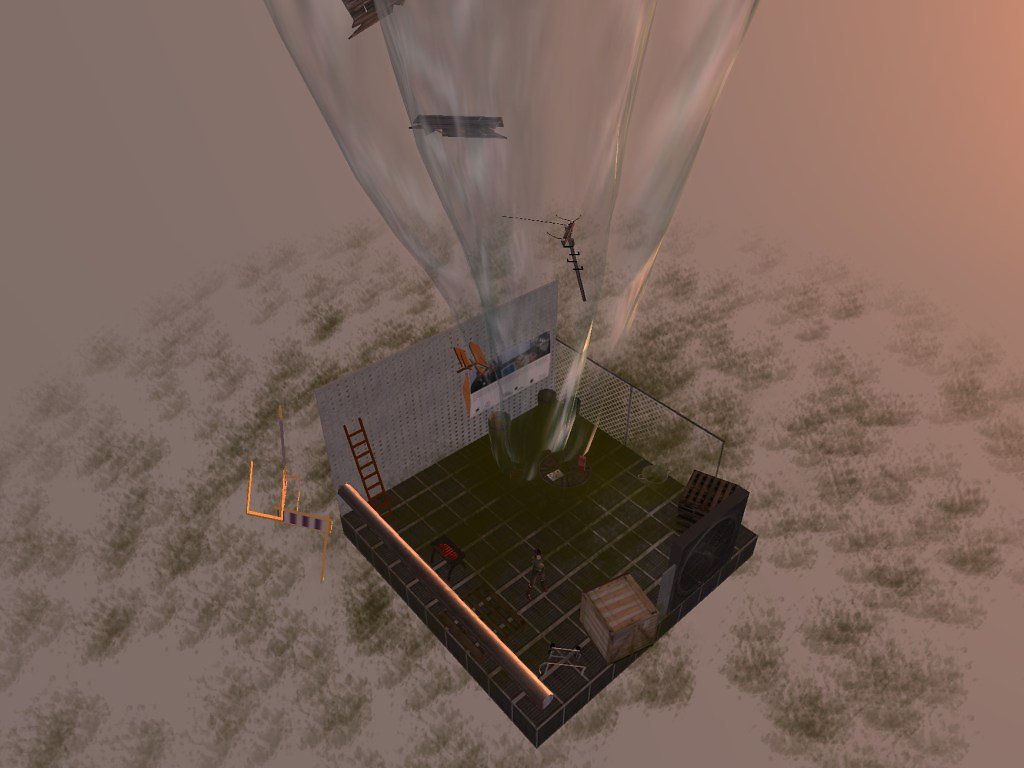
First planning session on my holodeck with Gann & Chimera
Our session is entitled: Hats, HUDs, Wands and Weather: Building Activities for Engagement in Second Life. One of the things we all appreciate about SL is the fun and playful parts of this environment, which could include changing the avatar’s appearance and using different types of artifacts – e.g. in our first meeting Chimera couldn’t help but show off one of her magic wands ;-)
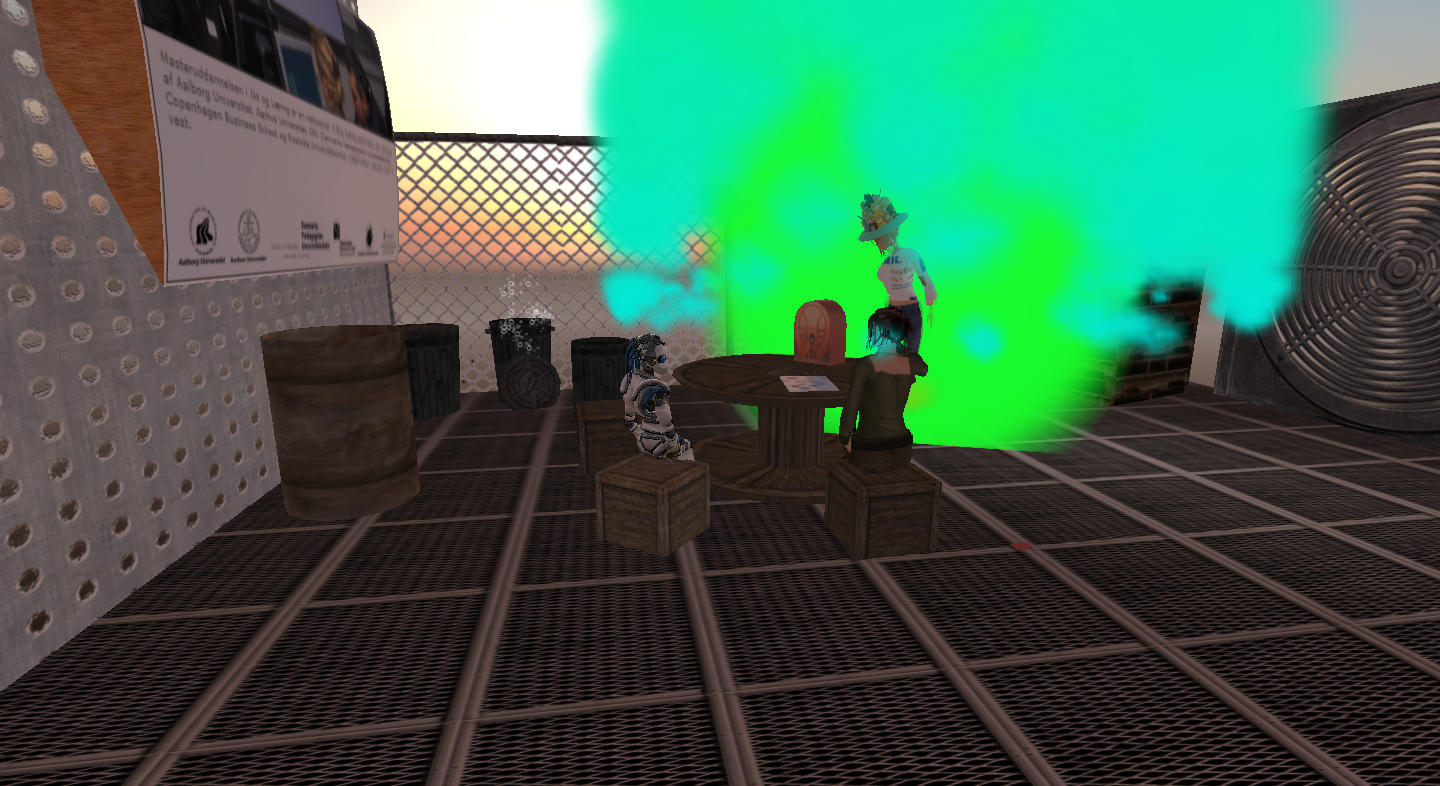
And in fact after Gann and I left, Chimera used her tornado stick on the holodeck as seen in this photo from Chimera’s KoinUp stream:
While the user-controlled ability to change both the environment and one’s appearance definitely is an important part of SL, we as educators are also concerned about the kind of activities that can promote, facilitate, and not least sustain engagement in teaching and learning in an environment such as SL.
Gann, Spiral, Chimera and I discussing the call for VWBPE in our second meeting
We all have both positive and a few negative experiences with teaching in SL, and so in our panel we have decided to focus on activities that help overcome some of the barriers for meaningful, and sustained engagement in SL as stated in our proposal:
There are numerous barriers to engagement in virtual worlds. First, new residents must become familiar with the interface. Beyond technical considerations, the nature of their early experiences will determine whether and how quickly they will build an identification with their avatar and a reason to stay. Without this, it is likely that their interest in further engagement in the virtual world will lessen and their participation will drop off. A sense of presence and identity through embodiment and immersion is an important contributor to ongoing and satisfactory participation in the world and finding the motivation to continue to return until the technical and navigational thresholds are surmounted. This roundtable will discuss the essential acts, the “ah-ha” or Eureka moments, the triggering gizmos, features, activities or places that inspire students or colleagues (and have inspired us) to continue to participate.
In other words, what works to help new residents pass these technical and navigational thresholds? The speakers will share their own stories drawn from their work with students in higher education, business people, health professionals, and education colleagues. Presentations will include demonstrations and audience participation.
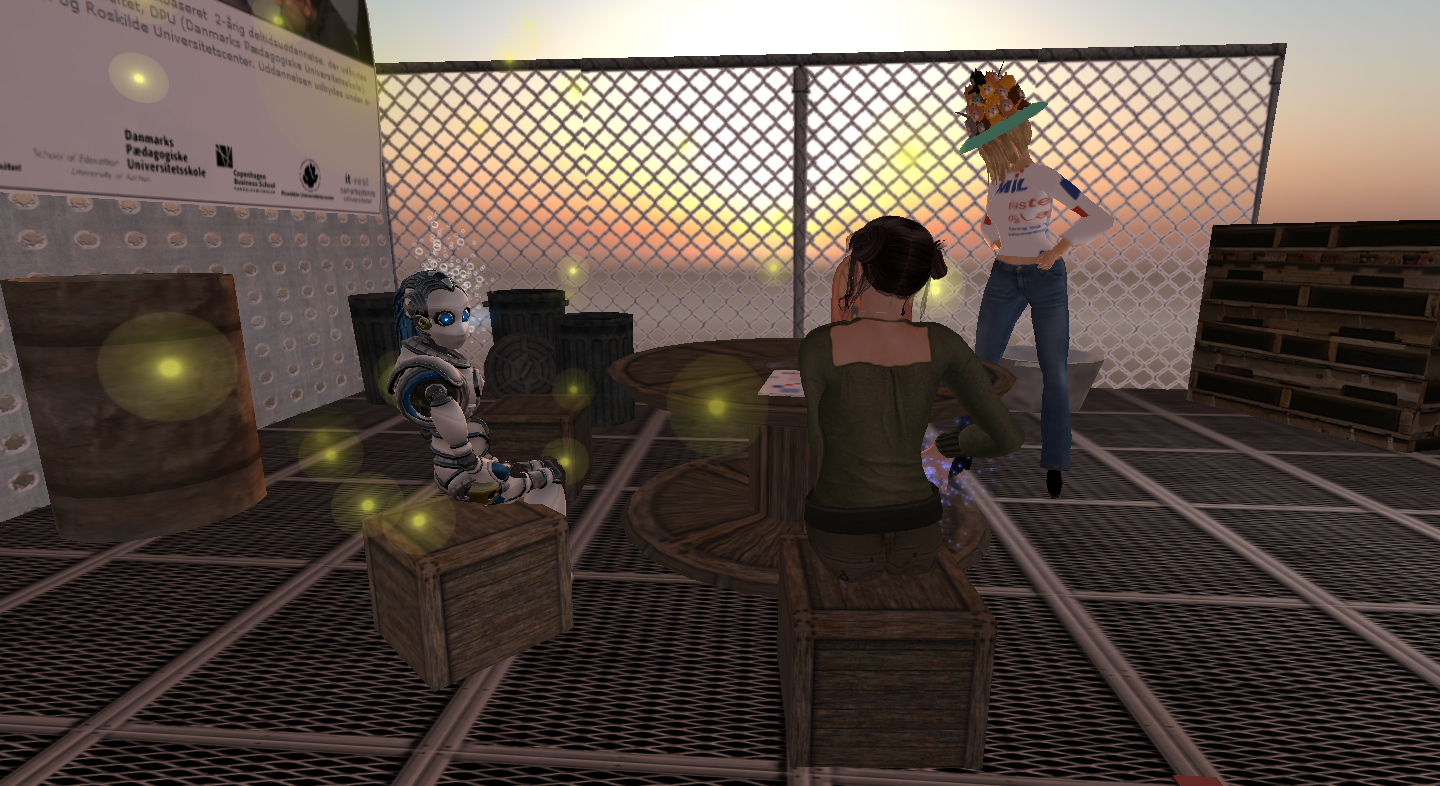
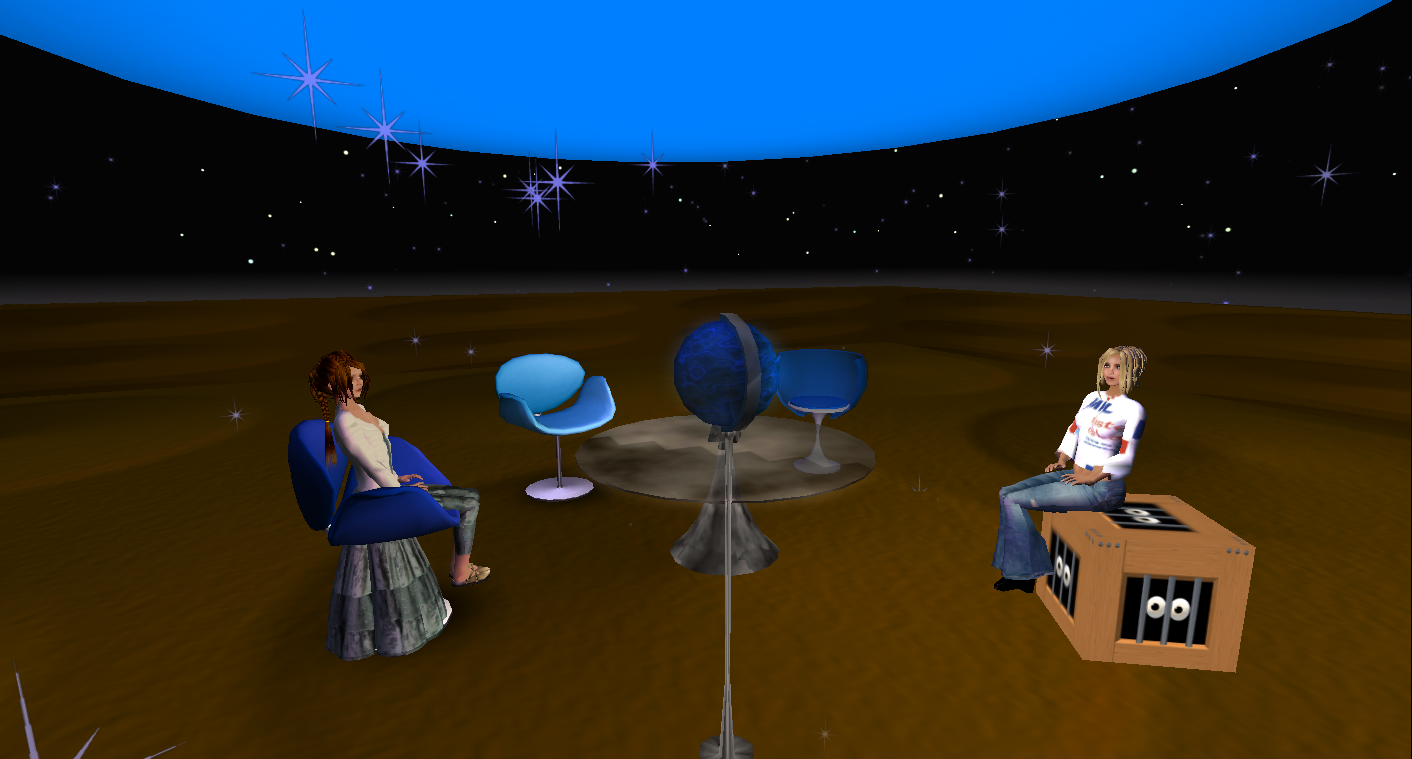
Spiral and I chatting under the Blue Thinking hat before our third panel meeting
Identity issues are very important in SL – and we will be showcasing Identity-cubes as part of the session
As mentioned above Gann, Spiral, Chimera, and I will be sharing some of our experiences, but we are also very much hoping to hear from the audience, and so we hope You will join us :-)
Update
We will be presenting Friday, March 18th from 8AM-10AM SLT (16-18 Dansk tid) – Building South, Room South Auxiliary, and the rest of the schedule can be found here
Also please note that even though the conference is free, you need to register in order to participate via this link. By registering you will be helping the organizers plan out resources to ensure the conference runs smoothly and that there is allocated enough space to ensure everyone gets an opportunity to participate.
/Mariis
For inspiration here are three posts I wrote about VWBPE last year:
On February 1oth Dr. Ralph Schroeder of The Oxford Internet Institute will be giving a talk entitled ” Being There Together: Social Interaction in Virtual Environments” on the CAVE island at 9AM SLT.
The talk is organized by the Applied Research in Virtual Environments for Learning Special Interest Group (ARVEL SIG) as part of their ongoing in-world discussions.
This talk will be of particular interest to me given that different ways of being there together are some of the core concerns in my PhD, and the first book I read in relation to my PhD research was in fact “The Social Life of Avatars” (2002) edited by Dr. Schroeder. Since then I’ve been following Dr. Schroeder’s work, and especially some of the articles he has published in The MIT Journal, “Presence – Teleoperators and Virtual Environments“. In my opinion the different ways of being there together are closely connected to different perspectives of the perception of presence that humans potentially get when interacting with computers (the HCI perspective), and in this regard I think it is possible (at least in an analytical sense) to distinguish between
a sense of being – related to self-presence
a sense of there – related to tele-/or virtual presence
a sense of togetherness – related to co-presence
In so far as you define a “virtual environment” to include the affordance of creation, I would add a sense of doing, which then in turn also could relate to doing together (co-creation), and then could relate to social presence. However, these are my preliminary thoughts, and it is important to stress that there is no consensus in the literature as to neither definition nor use of the terms of presence. When I’m done with the final analysis of my data, I’m hoping to be more articulate on this matter. An interesting challenge here is also that I’m hoping to connect Wenger’s (1998) 4 components of learning (practice, community, identity, and meaning) to the different aspects of presence, and this will be tested in my analysis. Regardless of this outcome, I find it important to emphasize that when dealing with virtual environments such as 3D virtual worlds doing together becomes just as – if not more – important as being together. And I have a strong feeling (not very academic yet, I know ;-) that becoming together may be even more important … anyways, these are some of the issues I’m currently struggling with in my PhD-work.
As I understand it, Dr. Schroeder will focus on results from his latest 2011 book (with the same title as the talk) “Being There Together. Social Interaction in Shared Virtual Environments“, which I haven’t read yet. Nonetheless, Dr. Schroeder’s slides for the talk have already been put up for viewing on the island, and judging from these, the talk will include some of the ideas Schroeder expressed in a 2007 paper entitled “Virtual Environments and Other Media for Being There Together: Towards a Convergence of Technologies, Uses, and Research Agendas.” In this paper Schroeder compares “virtual environments” (VEs) with three other technologies: 1) videoconferencing, 2) online spaces for socializing and gaming, and 3) online awareness and social networking technologies. One of the things that puzzle me about this is the way Schroeder defines “virtual environments”:
VEs are defined as providing the sensory experience of being in a place other than the you are physically in, and being able to interact with that place [1, 2] A shorthand is to say that these are technologies for ‘being there’, and multi-user VEs for ‘being there together’ [3]. (Schroeder. 2007: 1 – see original for references)
And in the video below Dr. Schroeder repeats at least the first part of this definition of VEs :
It is in fact not so much the definition that puzzles me, but rather the way Dr. Schroeder uses it to differentiate between VEs and other media. In the 2007 paper Schroeder summarizes his comparison of the four technologies in this table below:
Figure 1 from Schroeder. 2007:5
When looking at this table actually a couple of things puzzle me. First of all, I’m wondering what kinds of technologies Schroeder would label as VEs? In the above mentioned 2002 book Schroeder links VR and VE tech closely, and that could perhaps explain the “face with limited expressiveness, and body” in the Appearance cell, but I’m honestly not sure … Secondly, when I look through my SL-avatar-based glasses, I guess a medium like SL would best fit in the column of “Online spaces for gaming and socializing”, but again I’m not sure. However, if this is where Schroeder would place SL it brings forward new questions/comments. As a general comment I would say that SL fits the definition of a VE in that it also gives the user the experience of being in another place, being able to interact in this place, and of being there with others. Schroeder does in fact point to an increasing overlap between different technologies, and so I wondering why he doesn’t reserve VE as an overarching concept or definition. In more specific terms related to SL I would comment on some of the claims in the column;
ad. Realism: judging from the rest of the paper I think Schroeder mainly refers to fidelity here, which would explain the “low” claim. However, whiter or not something is perceived “real” in psychosocial terms remains highly controversial.
ad. Object and environment interaction: here I’m simply not sure what Schroeder means by “restricted field view” – at least not if it refers to the user’s control over different POVs?
ad. Communication and interaction: while it is true that much communication in SL is synchronous (text/voice chat), the asynchronous aspect should not be neglected, and this is something that has improved with the Shared Media feature that enables users to communicate in web-based systems outside SL from inside SL, and this of course does not have to real-time.
I’m fully aware that a general comparison can’t and shouldn’t capture more system specific nuances, and Schroeder recognizes that this comparison may “be drawn too sharply – in reality many of them overlap” (2007:2). Even so, I’m really looking forward to meeting Dr. Schroeder in-world later this week, and I’m hoping that I get the chance to ask him to elaborate on some of these issues – and meanwhile I’m impatiently waiting for his new book to arrive :-)
On Thursday, January 20th Milo Spot and Viola Stonesoul from the “MILOVIOLA” group did their presentation and analysis of SL as teaching and learning environment for pupils diagnosed with ADHD. Both Milo and Viola have previously investigated more general use of ICT as tool for people with ADHD in coping with daily activities, and so were interested in exploring if and how this multi-modal medium could be applied with regards to such a target group. We started off in a sandbox up in the sky, where we were asked to switch to sunset setting, and Milo and Viola made it clear that they wanted to focus on different affordances of the teaching and learning space.
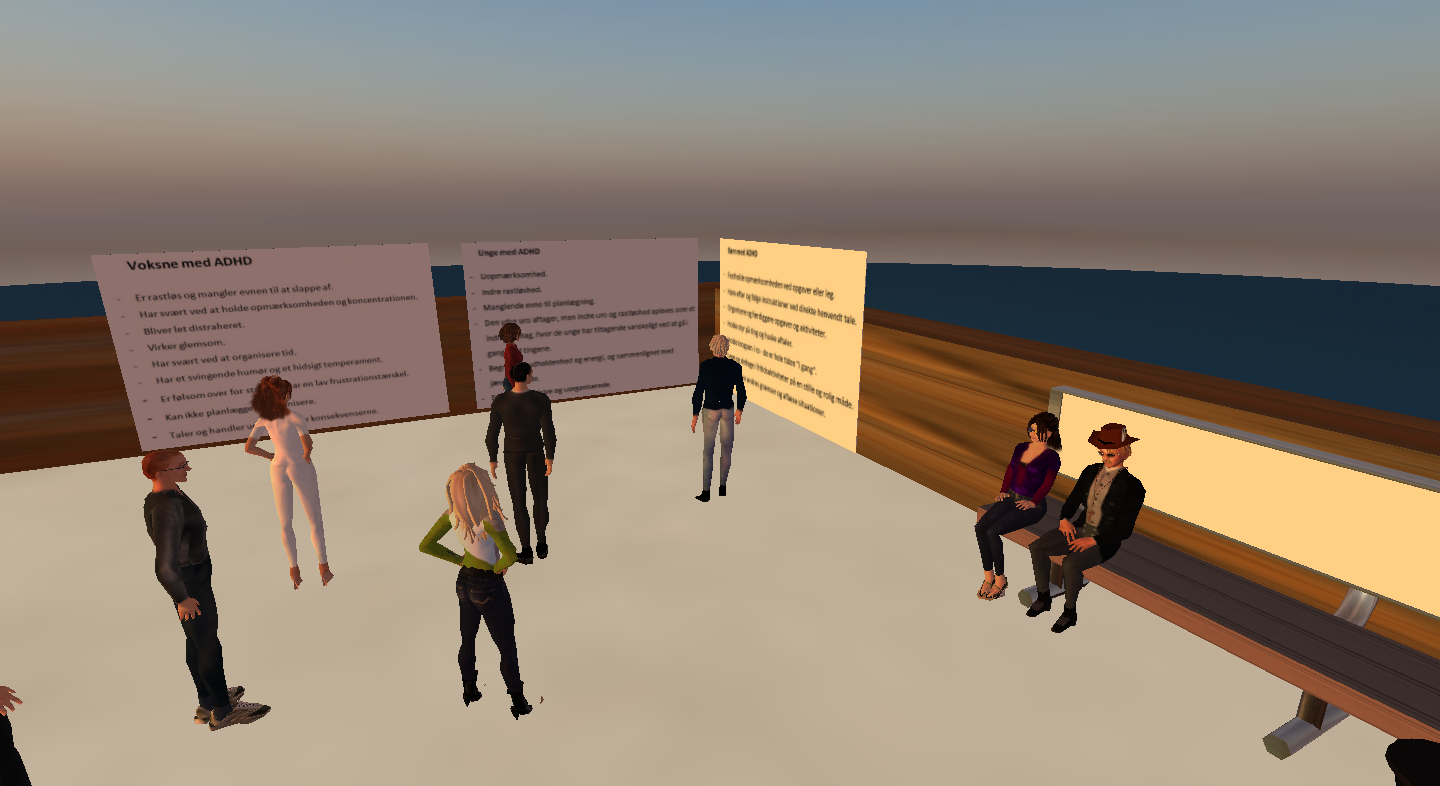
In the NE corner of the sandbox, Milo and Viola had set up several display screens with information about ADHD, and Milo gave us a short introduction, so that we could better understand the background for their design thoughts.
Milo explaining ADHD …
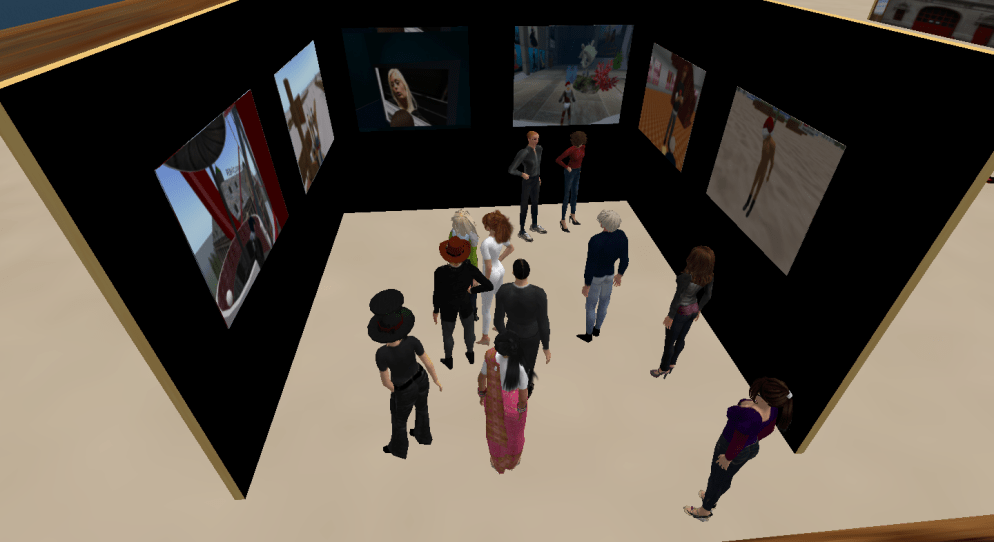
One of the major challenges for people diagnosed with ADHD is their problem with staying in focus if too many impressions are perceived simultaneously, and in the space depicted below Milo and Viola wanted to show us how multiple impressions could become overwhelming because of lacking ability to filter information – the many pictures sort of “coming toward us” in this space illustrated this point very well.
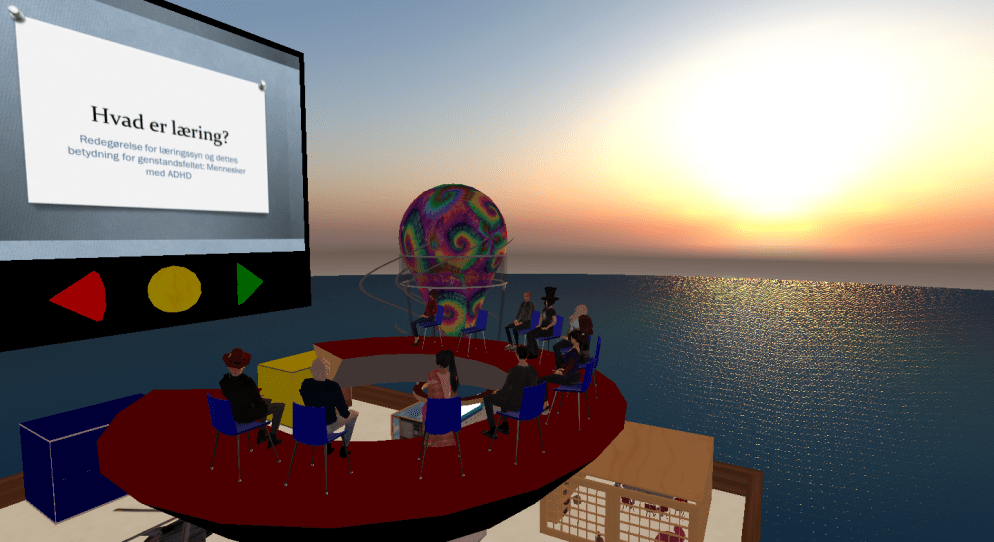
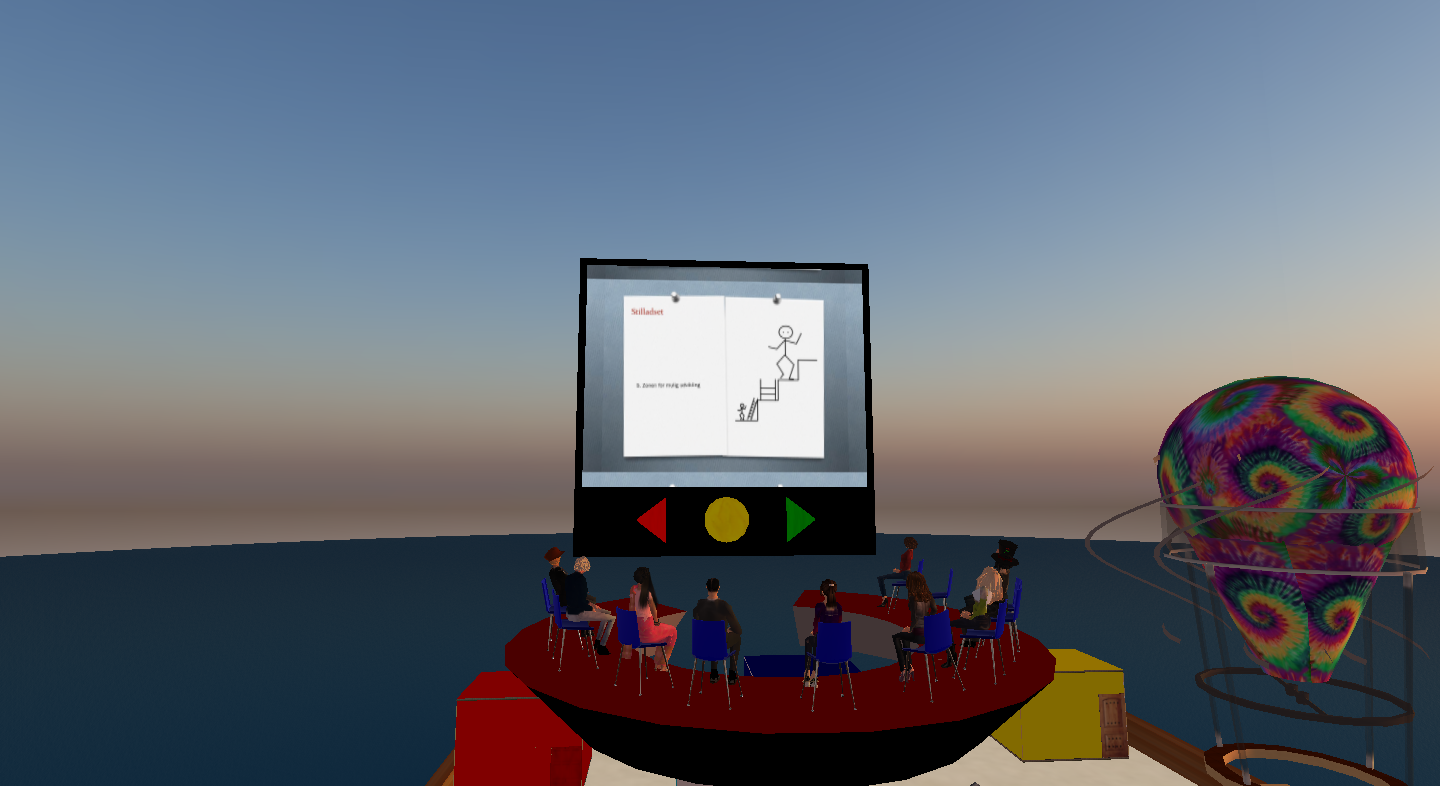
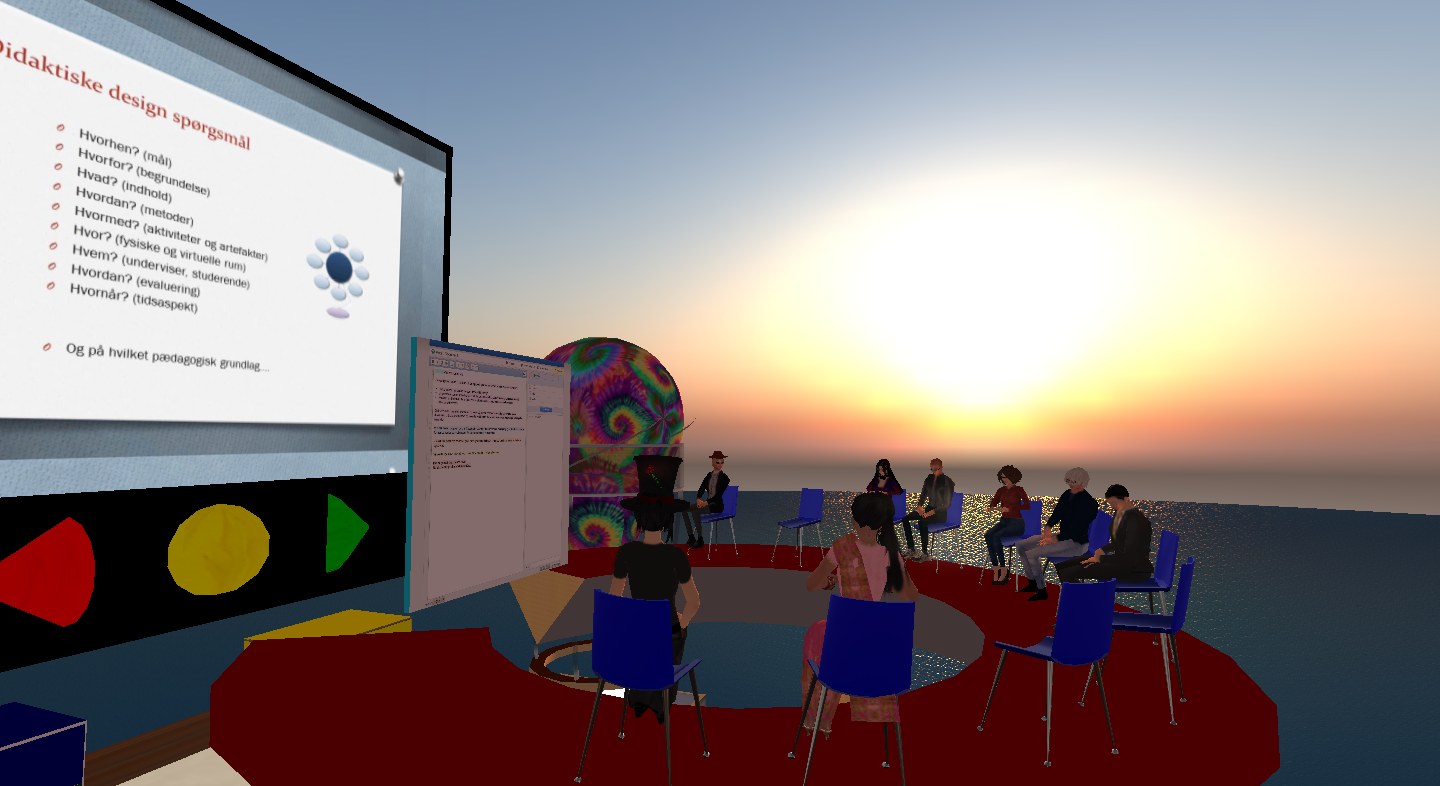
After this short introduction to some of the challenges involved in designing for ADHD-patients, we were asked to fly up above the sandbox to sit down and listen to Viola’s more theoretical presentation of using SL. Viola and Milo explained that it was on purpose they had chosen to place this part up in the air to illustrate the common perception of Theory, and as one of the other students subsequently noted it was hard not to think of Aristophanes’ “The Clouds” ;-)
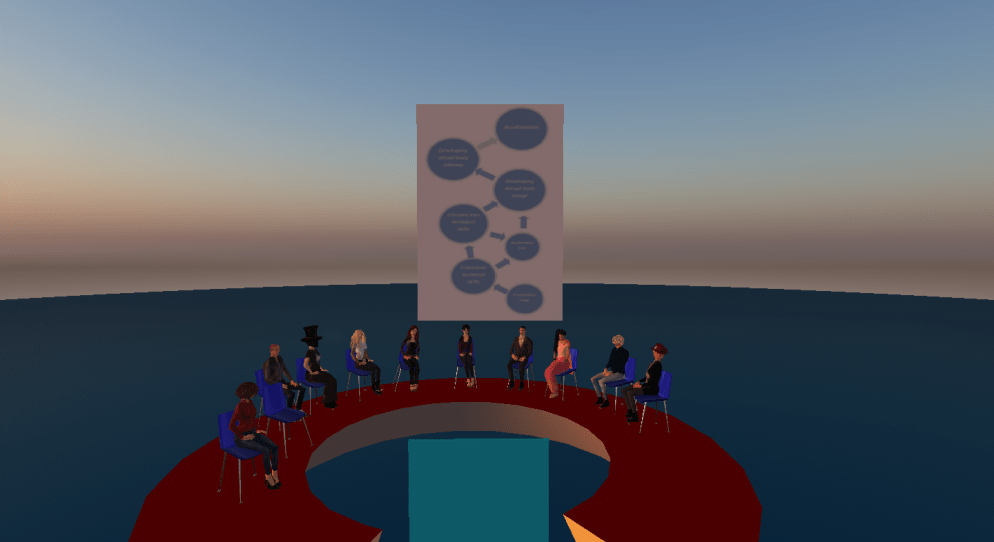
Scaffolding (as depicted in the slide above) was one of the key words in Viola and Milo’s analysis, and in a related manner, they referred to a model illustrating the stages of learners’ participation in virtual worlds created by Dr. Mark Childs as part of his PhD dissertation. Childs visited the class in-world as Gann McGann on January 3rd, and his thoughts on avatar identity, presence, and embodiment really seem to have influenced the students (and me!).
Gann McGann and one of his alts visiting the MIL Class.
Childs’ model in the horizon …
Back on the ground in the sandbox, Milo and Viola walked us through some of the designs/objects they had considered as part of their teaching and learning design for this particular target group. ADHD-patients tend to become frustrated if their daily routines are disrupted, it is not a target group that handles change well, and as an example one of Viola’s pupils demanded there be a clock in a classroom – otherwise she wouldn’t enter the room.
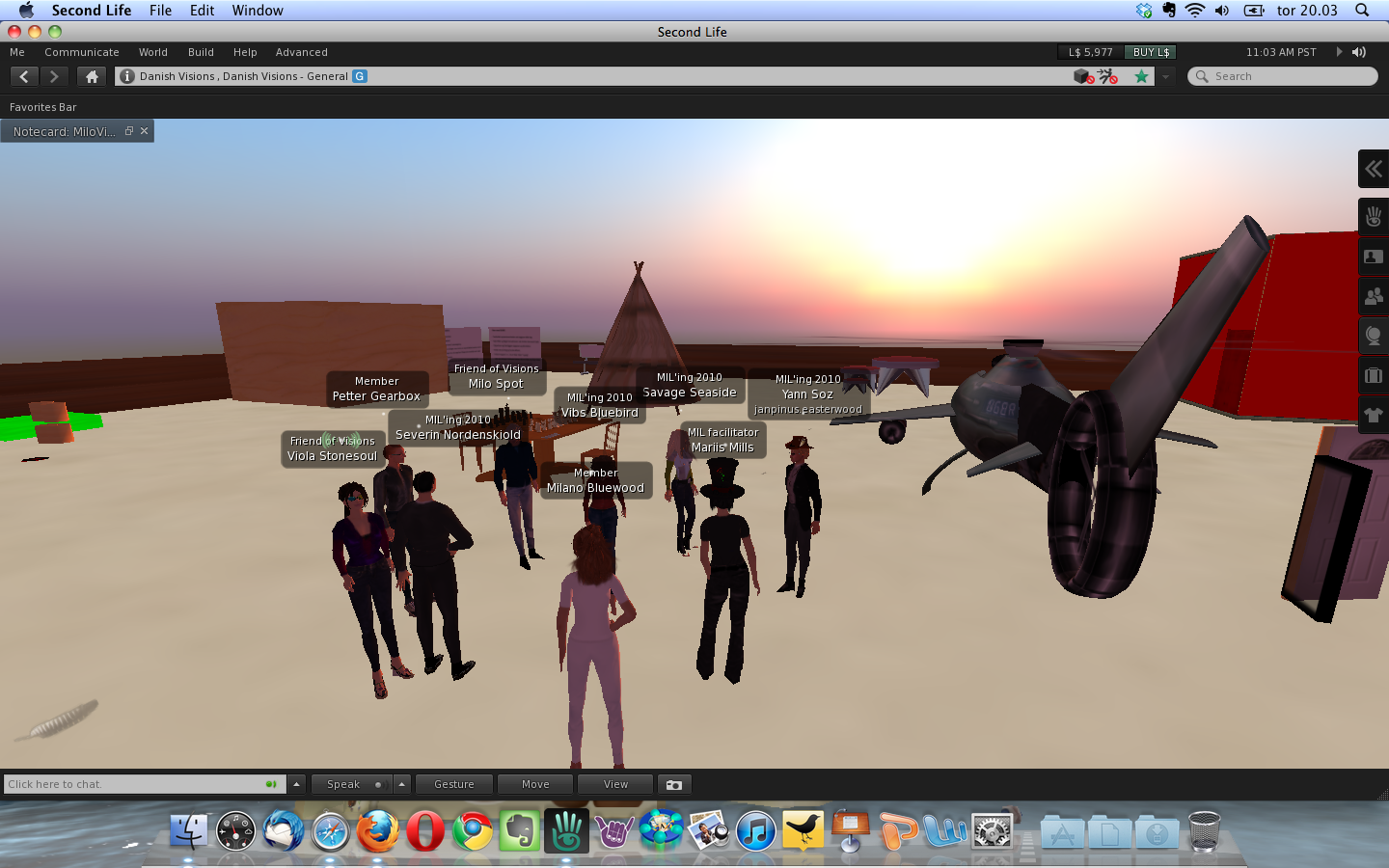
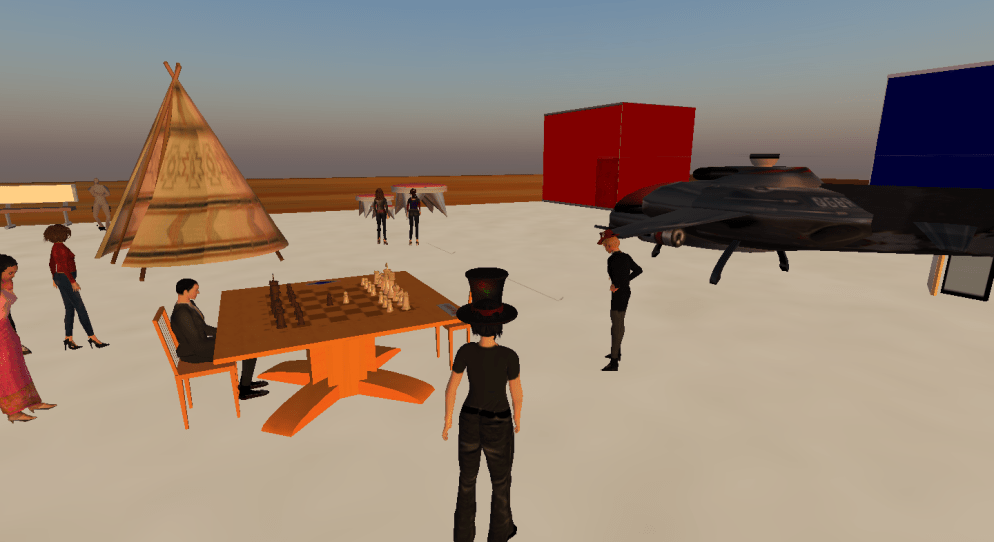
Chess with its meticulous rules appeal to some ADHD-patients, and strengthen their ability to stay focused. Many ADHD-patients also need private space, even when in a social space, and the tipi in the background could accommodate this need.
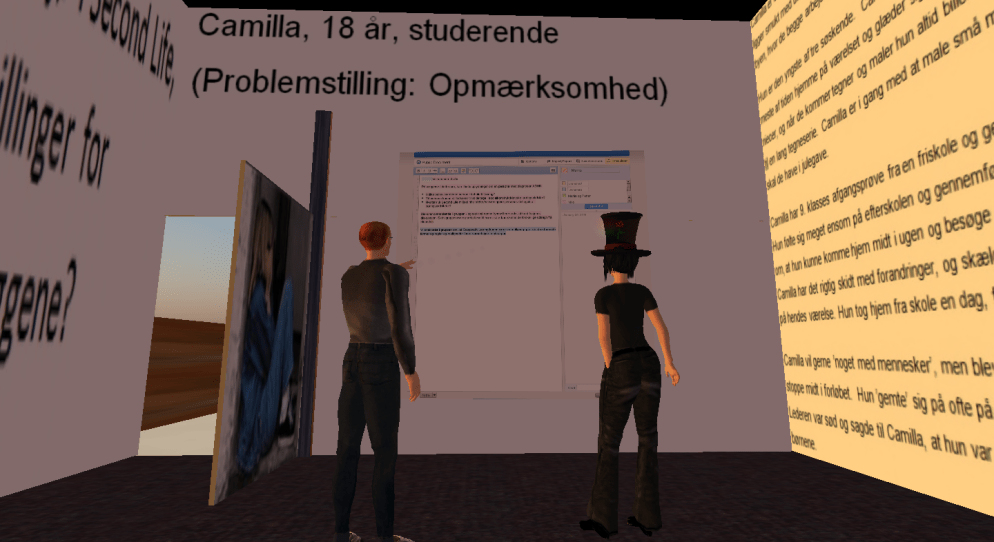
In the next part of their session, Milo and Viola divided us into three teams, Red, Blue, and Yellow, and we were asked to enter the similar colored boxes/spaces set up in the south end of the sandbox. We all got note cards with case-scenarios each describing someone with ADHD. Our task in the boxes was to identify learner needs and write them in a shared document.
Petter and I writing in the typewith.me-doc that was shared among the 3 groups enabling us to see real time what the other groups were writing.
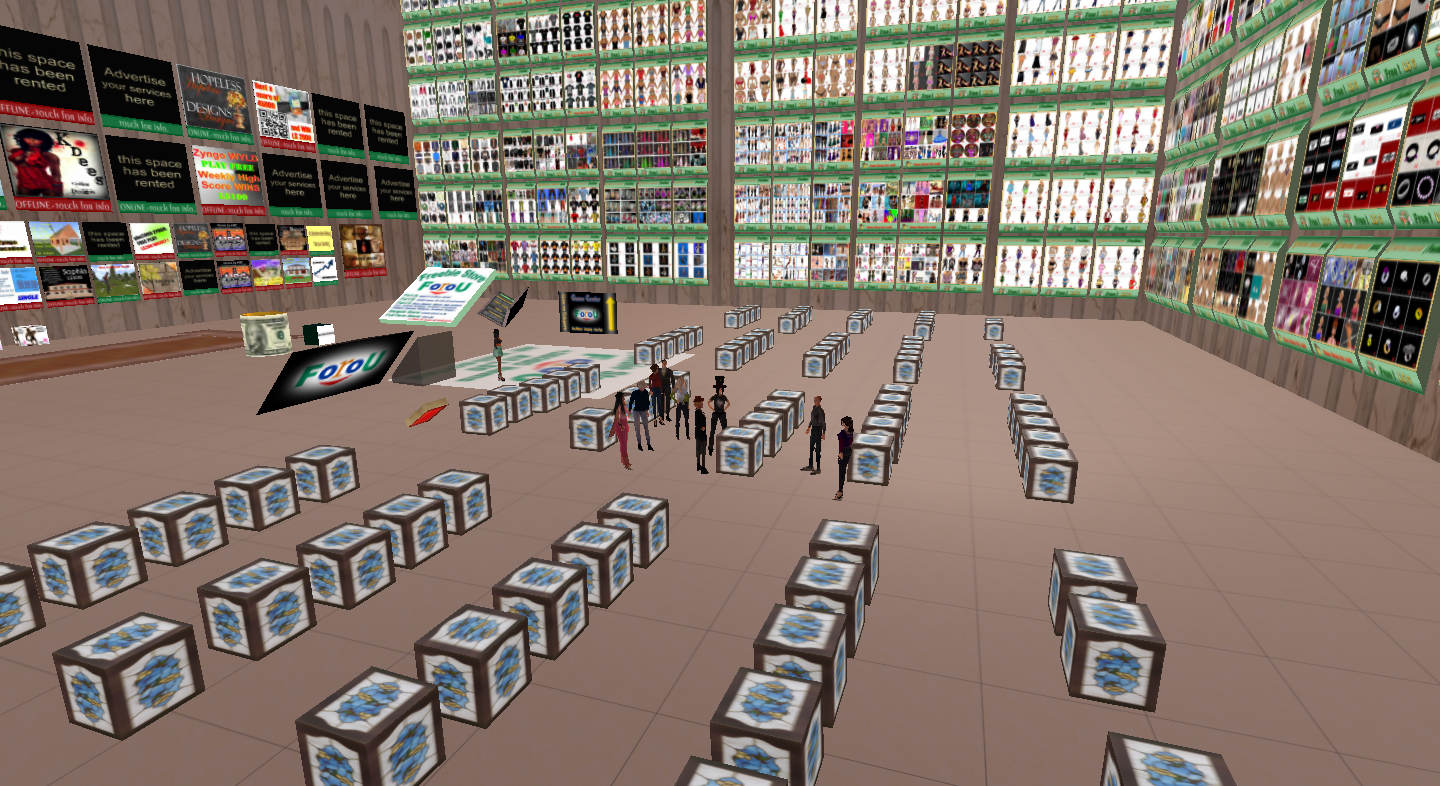
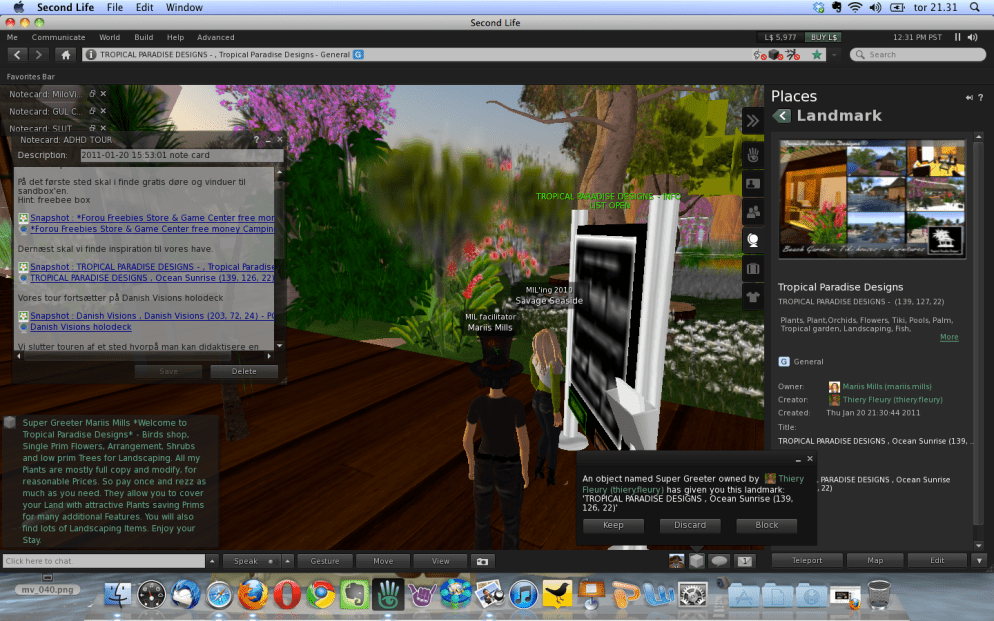
One of the concerns Milo and Viola expressed with regard to using SL in relation to their specific target group was the amount of information that the SL-user constantly is expected to cope with. To exemplify this they asked us to go to a freebie store and see if we could find and buy some doors ….
Lots of screen info – tuff .. not only for ADHD-patients …
Next stop on the tour was the holodeck on the Danish Vision island. In the setting below ADHD-patients could practice social and communication skills in a safe environment.
We ended the tour visiting the Al Andalus Mezquita, which could be used in teaching more general life skill and as a setting for discussing different perspectives on culture, religion, life, and death.
Finally we all went back to the sandbox for the feedback session. Through this highly packed program Milo and Viola splendidly showed how the space in SL can be transformed into meaningful teaching and learning places, and we all appreciated their effort to use different features in the environment such as audio-visuals and shared media. The connection between pedagogic underpinnings and practical use of the medium was very strong and well reflected. Furthermore, Milo and Viola clearly demonstrated how an educational setting could be designed with free objects found in various freebie shops in-world.
This was the fourth and final student presentation in the course – and I do think that Milo and Viola managed to leave us all with a very good impression of the teaching and learning potentials of SL – not only in relation to ADHD-patients, but in general.
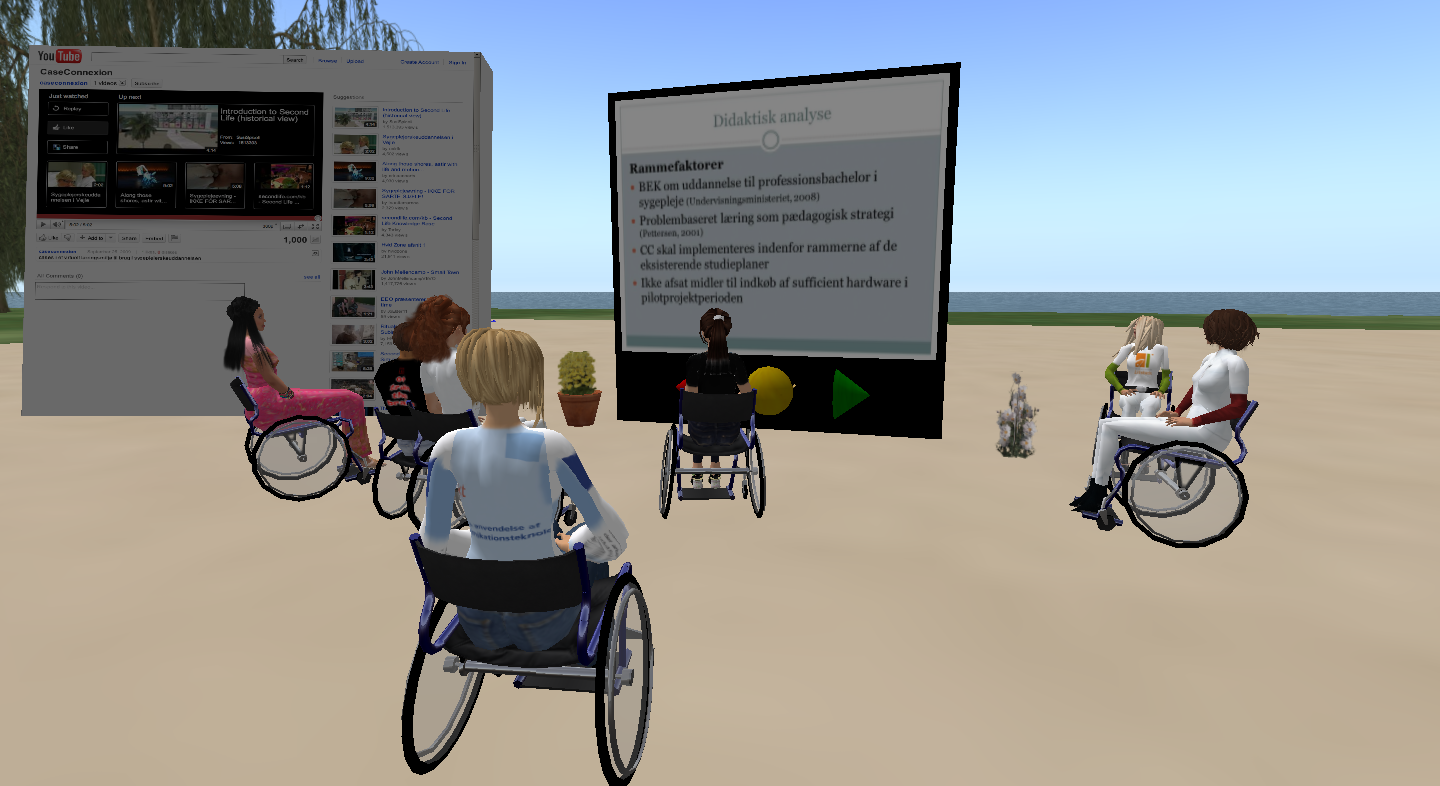
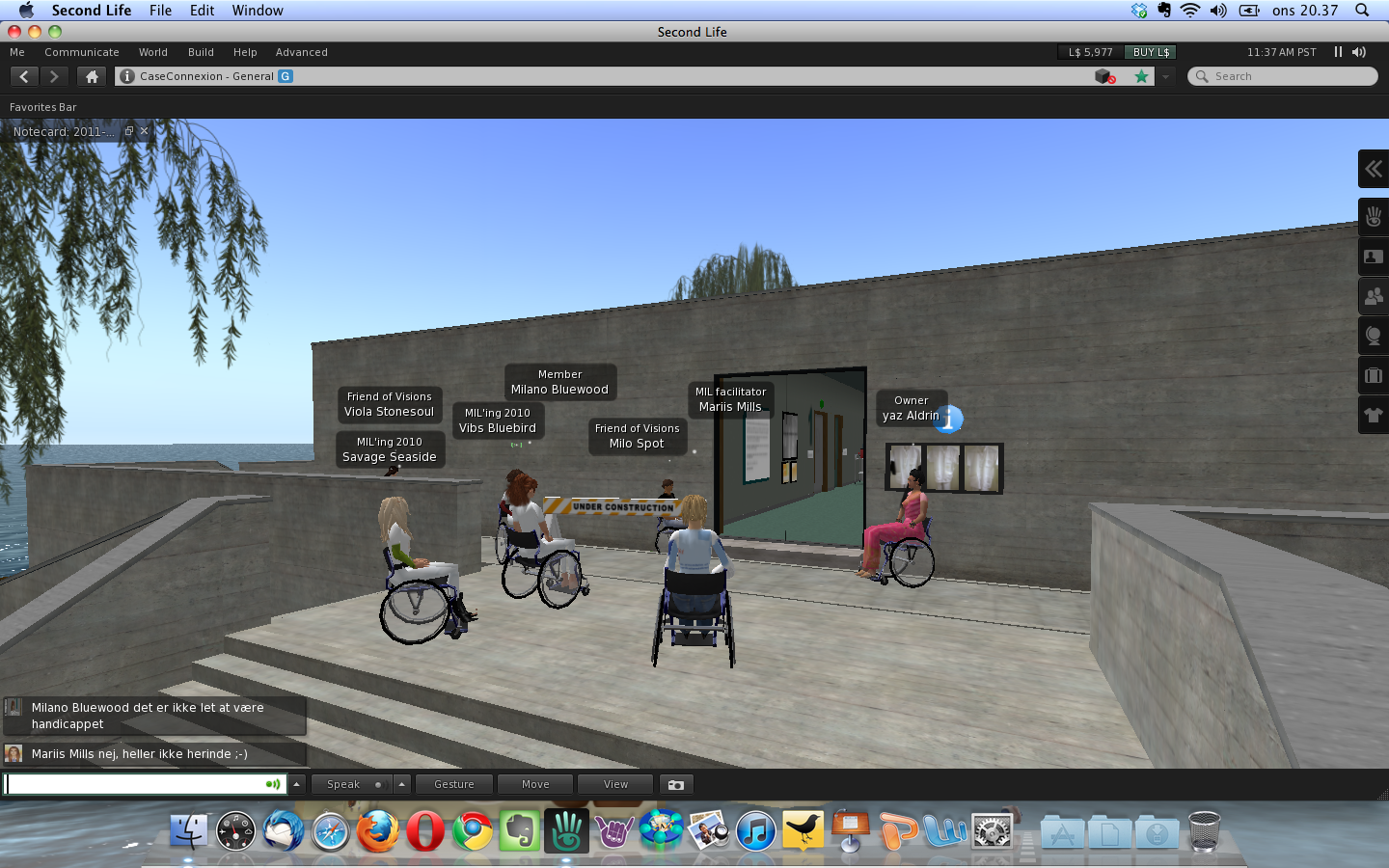
On Wednesday, January 19th Milano Bluewood, Savage Seaside, and Vibs Bluebird from the MIL-Health group did their presentation and analysis of SL as teaching and learning environment based on a Danish in-world project called CaseConnexion (Danish description). This is a project aimed at Nurse Education, and Milano is actively involved in the project. A pilot study was run in the fall of 2009, and it was the experiences from this study, the group had decided to present and discuss, and so naturally we started off on the island CaseConnexion.
Milano, Vibs, and Savage presenting in CaseConnexion’s sandbox
The main purpose of starting the in-world CaseConnexion project was to investigate its potentials in bridging/connecting some of the theoretical and clinical elements of Nurse Education. A survey, with answers from 85 students and 7 teachers, pointed to a variety of issues that should be addressed in future use of CaseConnexion (thoroughly described in this Danish evaluation report); steep learning curve, lack of identification with the avatar, fear of looking stupid in front of class-mates, technical difficulties and “waste” of valuable time spent on learning the system rather than the subject matter as a consequence of the former issues.
These were all issues that we also had encountered and discussed during this MIL-course, and so the group wanted our feedback on ways to solve these problems. As the group explained, the survey fortunately also pointed to issues on the plus side such as variation in teaching and learning methods, and the ability to practice skills without actually hurting/harming real humans through case-based role-play. As part of the set-up for their presentation, the group provided us with wheel chairs, which contributed to set the scene. It was interesting to experience and observe how we all felt the limitations of this type of handicap, and this led to discussions on how design can enhance/limit the sense of embodiment. We were also asked to watch this brief Danish video abut the project.
Next part of the presentation was to drive over to the hospital …
Racing towards the hospital … except that racing while taking pictures is a no-go in SL!
First quiz at the entrance; pick the right uniform or you’ll not be allowed enter!
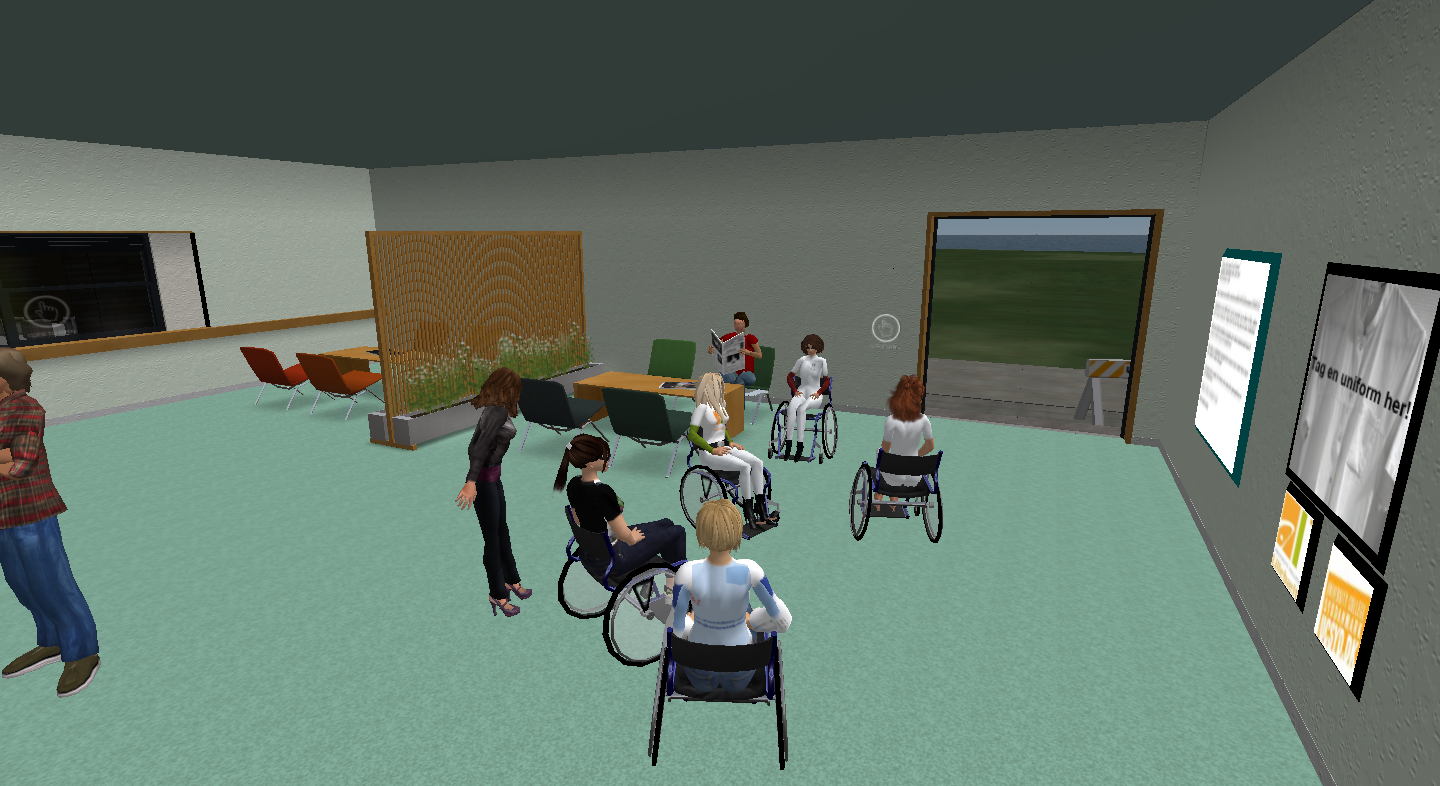
Reception area with free uniforms and bots to add to the RL-feel of this respectful remediation of a hospital environment.
Wash your hands upon entrance into patients’ rooms – otherwise simulations don’t work.
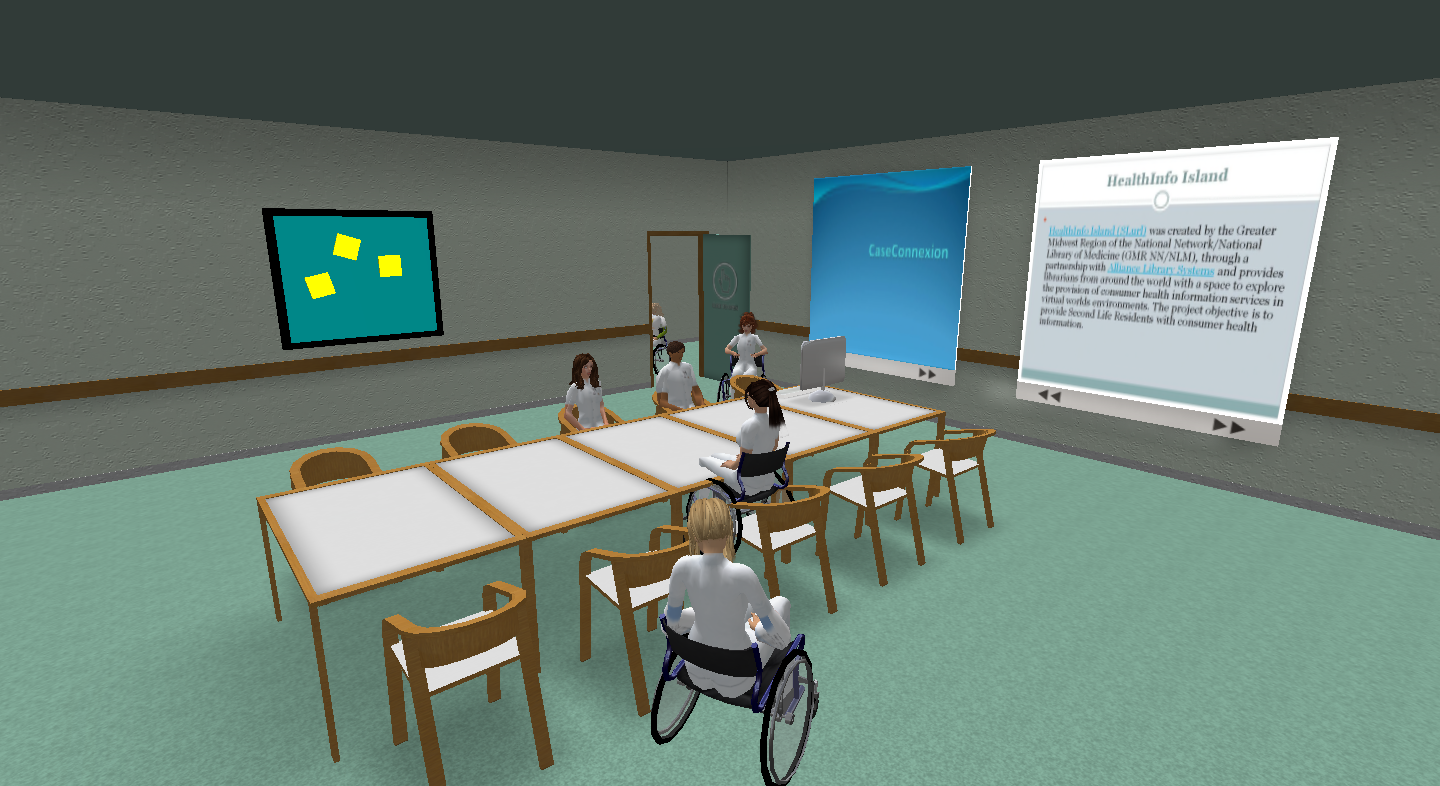
Staff’s conference room.
Exploring patient cases.
After exploring the hospital we went back to the sandbox, where Milano, Savage, and Vibs presented other, international examples of in-world Nurse Education – one of them being a project led by University of Auckland in collaboration with several other universities. After watching a few minutes of the video below, we were asked to go to the island Land of the Long White Cloud.
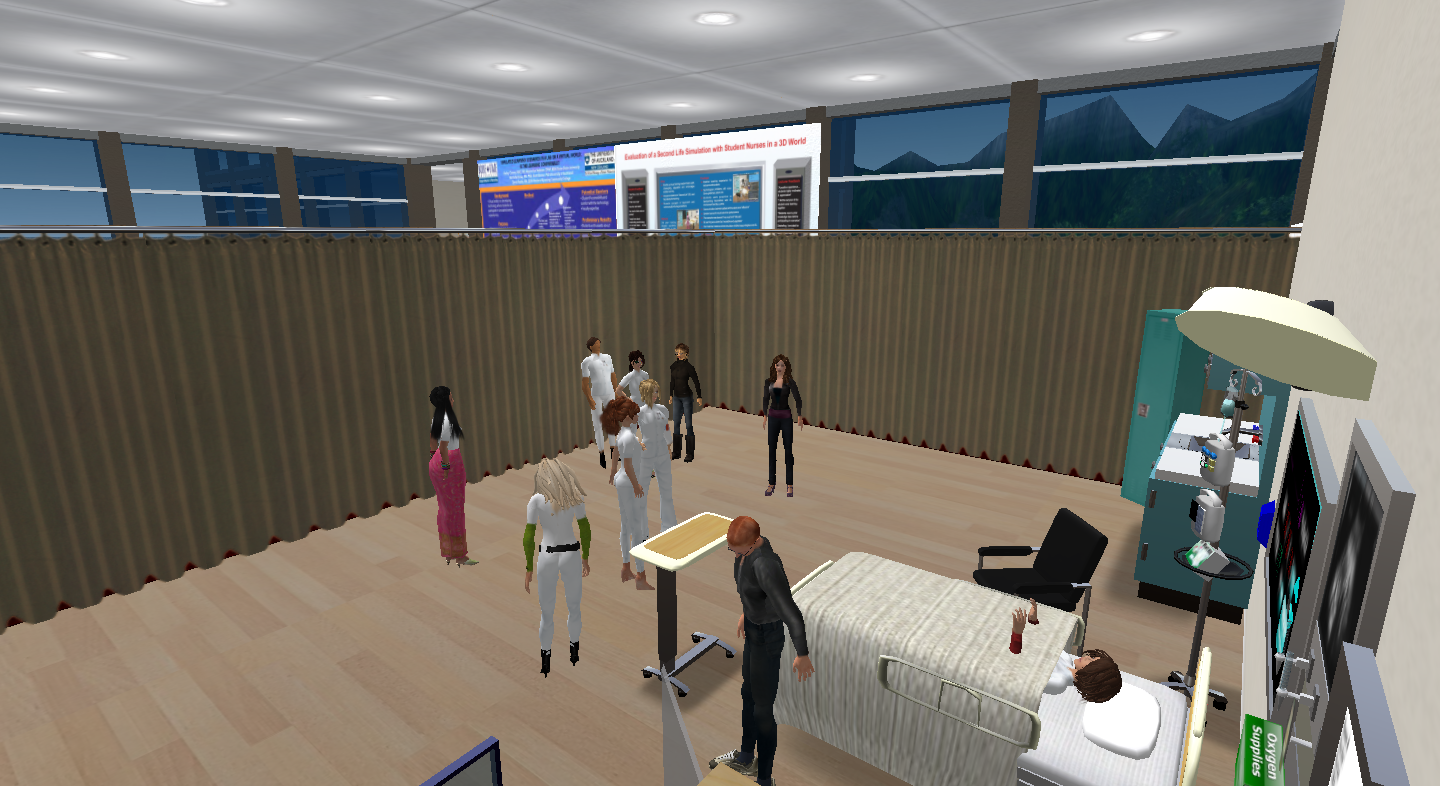
In the hospital on the Land of the Long White Cloud, we had the opportunity to investigate a different patient room also designed to be used in case-based teaching and learning.
An avatar (as opposed to a bot as we saw on CaseConnexion) can climb into the bed and actively participate in the case.
The patient room from one side of the curtain …
… and the same patient room from the other side. A nice feature enabling the instructors and other audience to overlook the simulation. Just as in real life – except for the ability to change POV.
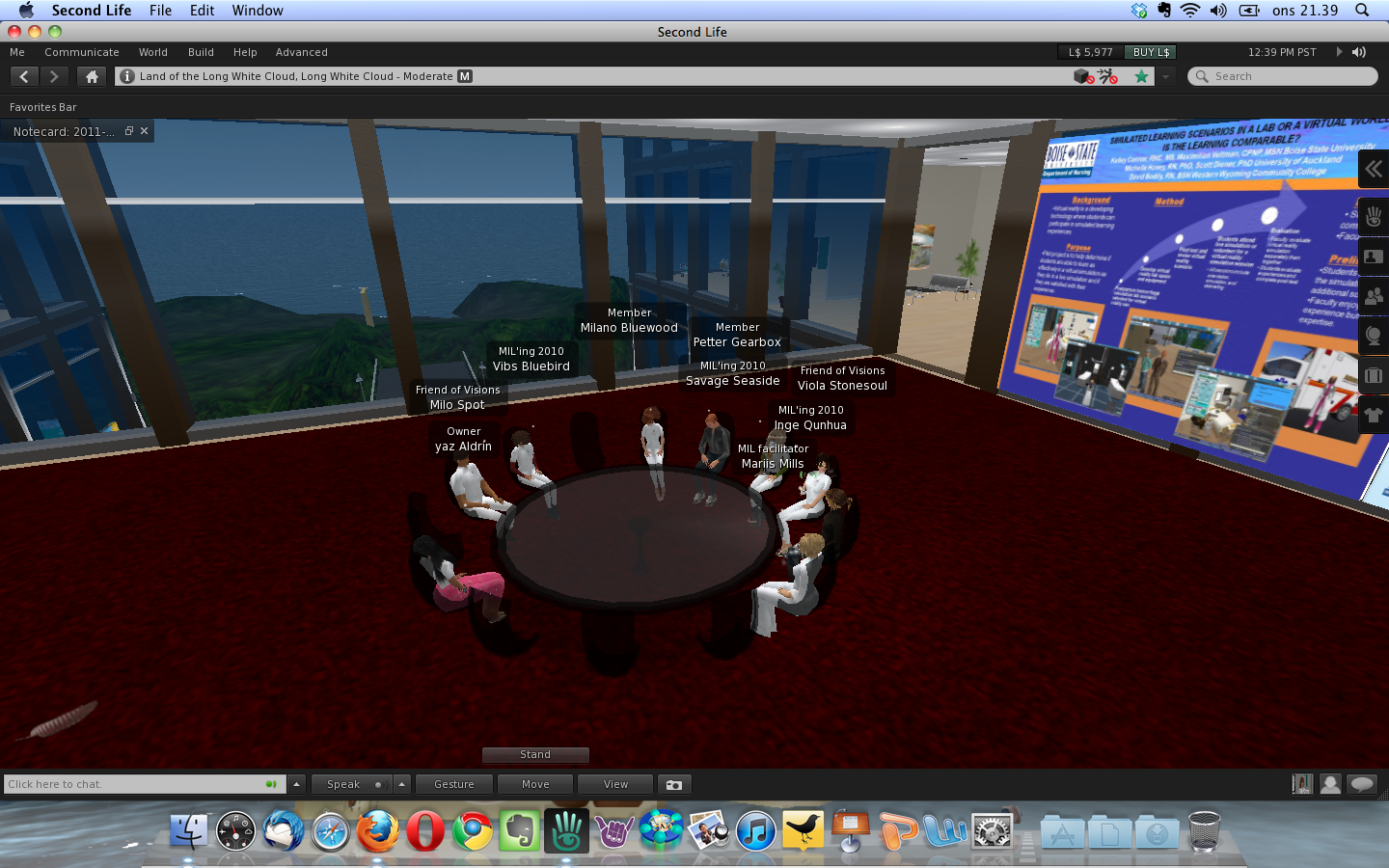
Debriefing/feedback session
Having tried out different features of the patient room, the MIL-Health group invited us to the debriefing table, where we continued discussions on especially design for embodiment, sense of presence and collaboration. Milano, Savage, and Vibs had prepared a presentation, which in itself illustrated the connection between theory and practice, and it was refreshing to discuss some of the more difficult parts of designing for teaching and learning in 3D-avatar based worlds like SL.
The CaseConnexion project showed that designing for teaching and learning in SL is challenging and complex, and this is also my personal experience from having run 5 in-world courses. Milano, Savage, and Vibs’ session reminded me of László Moholy-Nagy by whom I’ve previously been inspired, and one of his famous quotes on design from Vision in Motion:
“Design has many connotations. It is the organization of materials and processes in the most productive, economic way, in a harmonious balance of all elements necessary for a certain function. It is not a matter of façade, of mere external appearance; rather it is the essence of products and institutions, penetrating and comprehensive. Designing is a complex and intricate task. It is integration of technological, social and economic requirements, biological necessities, and the psychophysical effects of materials, shape, color, volume, and space: thinking in relationships.”














 Mariis' digitale refleksioner