Does in-world teaching include anonymous acting?

Preparing for a class next week I’ve been revisiting some of the resources that I’ve recommended for my MIL students. One of the articles, Jolly (2006), I’ve chosen because it describes the multiple roles of the in-world teacher. Based on a triple case study conducted in-world during term three of 2006 at Central Gippsland Institute of TAFE (GippsTAFE™) in south-east Victoria, Jolly has identified several roles of the teacher – here listed numerically to ease my reference:

  1. Teacher as explorer
  2. Teacher as a learner
  3. Teacher as avatar
  4. Teacher as a client
  5. Teacher as  inductor
  6. Teacher as guide
  7. Teacher as planner
  8. Teacher as innovator
  9. Teacher as debriefer
  10. Teacher as an industry expert
  11. Teacher as preparer
  12. Teacher as facilitator
  13. Teacher as communicator

Besides the roles 4 and 10, which are directly linked to the subject matter in the cases and 3, which of course is distinct for teaching in virtual worlds, I don’t think the identified roles differ that much from conventional teaching – at least not when I compare the list to my own and my colleagues teaching at E-Learning Lab in general, and at MIL in particular. Teaching in an age heavily influenced by new technology and the Internet, in my opinion, naturally calls for multiple roles of the teacher, it is however interesting to see the roles listed, which also is one of the reasons why I recommend this article to my students.

Another argument for introducing the students to this article is much more important though. I think this article invites (even provokes) for discussions regarding the teacher’s ethical responsibilities. Returning to the 3rd role, teacher as an avatar, Jolly states:

It is important that the teacher has a number of avatars, each performing a different role. Their appearance, character traits, language, ‘likes’ and ‘dislikes’ may vary significantly. The students may not know who is behind any given avatar. (Jolly, 2006:8 – my highlight)

And Jolly continues explaining:

In the real world, the students clearly knew myself (Malcom Jolly) and fellow project team member Glenda McPherson through a range of face-to-face meetings/discussions with them. When we were in Second Life as Malcolm Dalgleish and Glenda Arrow, the students knew that we were behind the characters and this served an important role. As Glenda and Malcolm, the students knew that they could always turn to us for support/assistance. For some students this was very important and reassuring. (ibid: 8 – my highlight)

However, at other times Jolly played out the role of a different character:

As GippsTAFE Gonzales, the owner of GippsTAFE Island, my attire was more formal; I acted differently and exhibited different characteristics to Malcolm Dalgleish. I didn’t offer assistance unless specifically asked for it. From the student’s perspective, all they knew was that I was one of the project team. (ibid: 8 – my highlight)

Continuing the role-playing, Jolly sometimes acted as 4) a client in the “painting and decorating” class:

My role was to be the client, meet the student and discuss with them the type of refurbishment I wanted in my house. The students did not know who I was or where in the real world I was located. I was simply ‘the client’. In order to get to know me the student had to question me, ascertain my ‘likes’ and ‘dislikes’ or form assumptions based on my appearance or mannerisms. (ibid: 9 – my highlight)

Jolly sums up the experience of using different avatars/identities:

It is important that students know support is available through particular people (avatars) but it can also be extremely powerful for the teacher to assume other identities. These characters may simply be people passing by or standing around observing – their use provides the teacher with wonderful material when conducting a debriefing session. (ibid: 9)

I do believe that one of the great pedagogical potentials in avatar-based teaching and learning lies in the possibility to role-play, and I suppose Jolly and his colleagues were trying to enhance authenticity by acting out different characters. Want I don’t understand, is the need for anonymity, and I have to say that this example oversteps some of my personal ethical boundaries. Wouldn’t it be possible to role-play without anonymity, I mean, doesn’t acting exactly entail that you assume a different character? To me one of the most important roles of the teacher – if not the most important – is to be trustworthy, and that simply doesn’t align with acting anonymously in my point of view.

I’m greatly puzzled by this, since Jolly in so many other parts of the article expresses some very emphatic and sympatric thoughts. The 3 cases were conducted mainly at closed islands in-world, and I realize that the students were aware that they might encounter anonymous project staff members, but I still find it problematic to use anonymity like this in an educational context.

Nevertheless, the article makes for interesting discussions on the whole anonymity issue of online teaching and learning, and I’m looking forward to hearing my students’ responses to this.

/Mariis

Visit to Pop Art Lab/ Claus Uriza

On Thursday November 20th the MIL students and I visited Claus Uriza, CEO of Pop Art Lab. As usual we met in the Holodeck before going to see Claus. Two of the students had been shopping animations and Franko could not help showing off his new swimming moves :-) I have to say that I truly appreciate this ability to attend meetings in new ways. Even though we’re engaged in serious academic studies, I do not really get why it always has to be so conservative and boring … show me hard evidence that learning only occurs when it hurts, and I might change my mind! Until then … let’s have fun while working!

201108_004
Swimming … or rather floating moves :-)

At 11:30 AM SLT we showed up at Pop Art Lab, which has just been redesigned so that Claus and his team can start having live music events recorded by SLCN.tv – I think they start out on December 5th, but you can always check out Claus’ blog for updates.

201108_007
Checking out Claus’ office in-world …

Claus gave us a tour of the Lab while talking about his project in-world. Claus’ mission is to give residents musical experiences combining the latest music releases with live events, the latter usually during weekends.

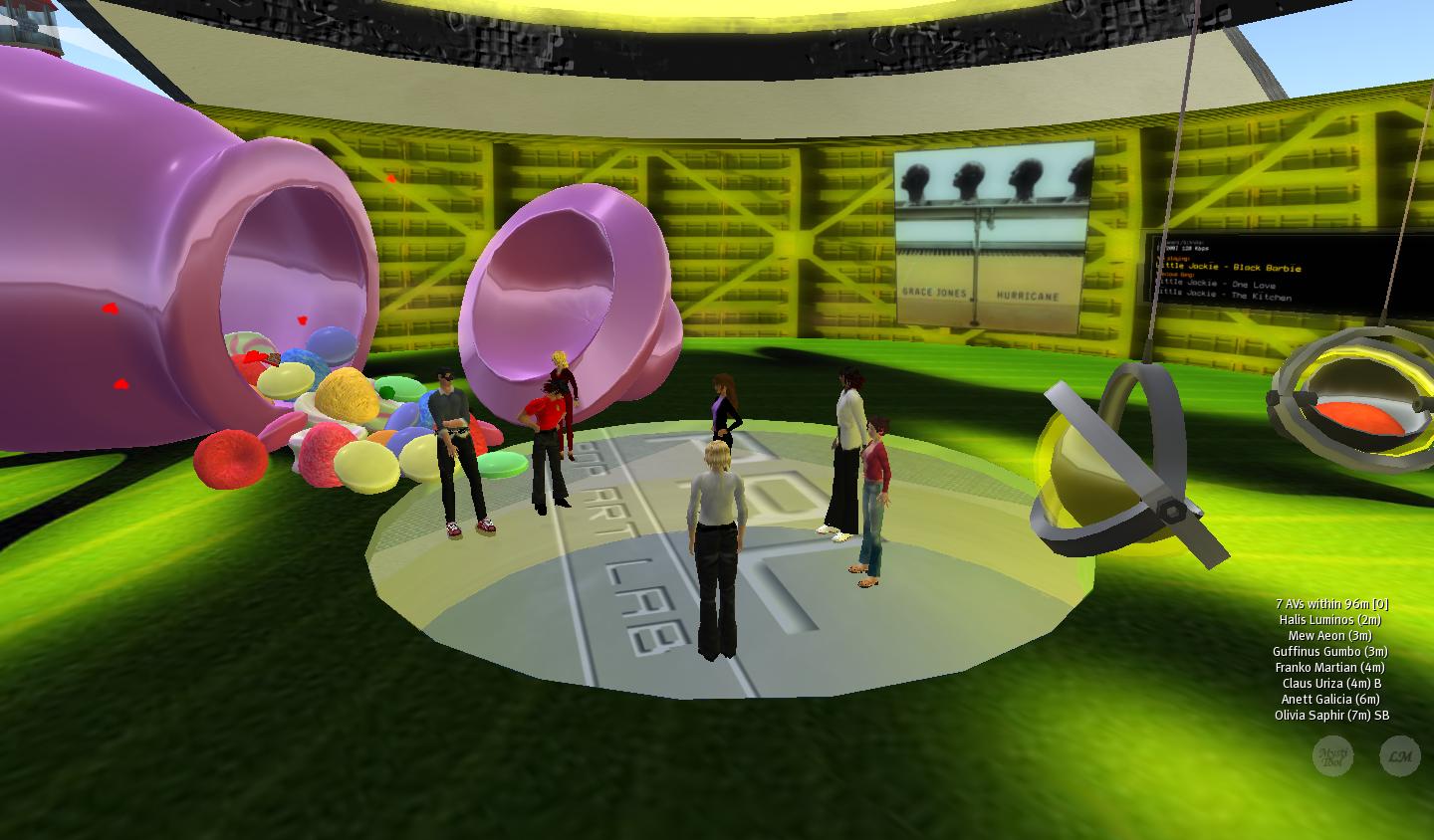
The Pop Art Lab consists of 4 Domes playing the latest releases in different genres – here we are in the Pop section listening to Grace Jones still going strong :-)

201108_008

When planning the in-world activities I was initially completely focused on showing the students educational sites, but I quickly realized that such a focus would deprive the students of valuable lessons and most likely they would not be able to grasp the huge potential of SL.  So I’ve arranged for us to meet with various personalities and in many different settings. Visiting Claus not only provided the students with factual information on how to manage sound in-world, it also showed the students the sort of dedication and community, which I personally find most appealing about SL. Also it was an opportunity to talk a bit about the SLCN.tv – not many newcomers realize that we actually have our own TV station … quite remarkable for a virtual world!

201108_009
Part of the studio where SLCN.TV will be recording live music events

We ended the tour in an underwater world below the Lab, and this really was Franko’s right element!

201108_010

When Claus left we debriefed the visit and I tried to explain some of my didactical thoughts and arguments, and it seemed as if the students appreciated this type of visit very much. I guess they too can become a bit tired of speaking about education all the time :-) It was also the first time for most of the students to meet and talk to somebody other than me (and our 2 guest teachers Dr. Asp and Heidi Ballinger), and of course that’s always interesting. Most of the students are still a bit shy when it comes to connecting with others in-world and I tried to explain how I felt when first entering the world.

Earlier on Claus had expressed his sentiment of SL being a very friendly and easy going place – and I agree. For sure we sometimes hear of unpleasant incidents and I too have been griefed, but in general SL truly is a nice place to be.

These first weeks of the MIL course I’ve arranged for us to meet with Danish in-world friends, and I want to thank them for helping me out. Next week we’ll start visiting some of my international friends, and both the students and I are looking forward to doing that :-)

/Mariis

Building Class with Asp & Ballinger

On Tuesday November 18th we had the first building class of the MIL course. Dr. Asp and Heidi Ballinger were the guest teachers, since I don’t know much about building. We first met in MILs Holodeck just to check sound (tedious that you always have to do that, just to be sure it works!) and then we moved on to the sandbox Dr. Asp had set up for the course. I have of course been talking to Asp and Ballinger about the MIL course, the students and why I would like to incorporate a building class in the course. Even though the students will not learn to build complex things, I’m confident that it will give them a unique insight into the process and for sure a greater appreciation for all the things you see and experience in-world.

kgi181108_002
Pre-meeting in MILs holodeck

8 students attended and the 2 hrs passed quickly. I decided to enter the student role and do the assignments Asp and Ballinger had planned, but I have to admit that I do not see myself as a future in-world builder .. . I simply do not have the patience! But the students seemed to appreciate the class and even though most of them thought it was quite difficult and time consuming, they all found it to be a valuable learning experience. One of the students pointed out that it had been especially interesting to see and experience that it is actually possible to learn something technical via SL.

The first class was deliberately designed so that the students would learn the most basic stuff in building, and it was really good that both teachers had the time to pay attention to each individual. One student arrived about one hour into the class, but he had technical problems and never really got integrated. After the class Dr. Asp, Heidi and I decided that the 2 next classes will be for those who attended only. The argument for this is to be able to progress – and with limited time, it would be inappropriate to spend it repeating stuff already learned by the majority – not least since all activities are voluntary.

kgi181108_2_004
Changing texture – luckily the arms don’t get tired!

Dr. Asp commented on the class on his blog (in Danish), and one of the realizations that he came to, was that builders in-world truly need to possess a lot of knowledge and he himself who has been building for more than 2 years now still learns new things, so of course you cannot become a skilled builder in the course of 3 sessions. The students realize that, but as one of them states; It’s great that other people are willing to spend so much time on building things the rest of us can benefit from ..

I could not agree more – so here is a big, big TY to all the amazing in-world builders:-)

/Mariis

Challenges of flexibility and facilitation

Last week we had a 3 day f2f seminar at the MIL programme, where my colleagues and I introduced the 4th module on Ict and Educational design – the module in which I facilitate a blended in-world course. Saturday afternoon I started out by giving a lecture on remediation and redidactization focusing on respectful and radical design in SL both regarding people, places and processes. After the introduction we had a hands-on workshop where basic SL functionalities were explained and tested. 13 students out of 25 signed up for the course, and 5 other students, who chose to analyze a learning environment different from SL, wish to participate informally which I allow.

The course in fact started on November 1st but the period up until the seminar is mainly reserved for the students’ preparation (reading, creating an account and joining the in-world group). I did however plan some “Get off to a good start” in-world activities before the seminar, but only a few students attended these. All the different activities in-world are voluntary and I only demand that each student participates at least once in scheduled in-world activities during the course. The argument is that the MIL programme is intended to be flexible in order for the students to be able to participate even though the majority is full time employed, and several mandatory online activities would challenge that flexibility. Furthermore as part of a problem based pedagogy the students are expected to explore and investigate on their own and in their study groups. This pedagogical strategy is possible not least because the students are adults, highly motivated, comfortable with taking responsibility for their own learning and in most cases appreciate the freedom of choice. Last year when I did the same course, a handful of the students chose to participate in several of the activities, and I expect that to be the case this year also.

kgi161108_001

Meeting on November 16th – showing some students the Connectivism Village

Promoting and ensuring student autonomy is a cardinal point of my (and MILs) pedagogical philosophy, nevertheless this strategy poses some challenges as seen from the facilitators point of view. I’ve planned roughly 3 activities pr. week and they last between 2-3 hrs, and so far I’ve been the only facilitator. (This week we’ll start having activities with in-world colleagues). One of the challenges of this “buffet pedagogy” is that I never know how many students will attend, and since the sessions are relatively long some students choose to participate in parts of the activity only. Not knowing the exact number of participants calls for flexible planning thus challenging me to let go of my usual need for control and structure.

A different challenge of this flexibility for me as a facilitator is that I constantly have to be aware of new students joining and try to include them simultaneously during the sessions. A good feature for this of course is the IM, which makes it possible to text without interrupting the whole group. This is something not possible in real life, and I do think that it is quite smart, but I also have to say that it is fairly demanding on the facilitator. I suppose the ability to text chat with several participants simultaneously is a skill that “just” needs to be learned, but I can’t help wonder if this rather complex way of communicating would discourage some potential teachers from trying out SL or similar environments.

The last 2 Mondays I’ve been attending Metanomics meetings with students, and on these occasions I had respectively 10 and 12 active chat windows, so my immediate impression was that I spent most of my time paying attention to the chats rather than the speakers. The main reason for attending these Metanomics meetings was to show the students this particular way of communicating, “Constructive Cacophony” as Bloomfield calls it, so the content wasn’t all that important. I will return to the content issue in another post, but for now I just want to reflect on the possibility of using text and voice simultaneously. At the Metanomics meetings Bloomfield is assisted by moderators, and if we transfer this to an educational setting the solution could be to have more than one teacher or perhaps a TA.

Another option is to limit the text chat and ask participants to use a certain group chat only. This might work well, and we’ll experiment with that down the line, but here in the beginning of the course, I believe that it is very important not to limit the students’ use of IMs to the facilitator. It’s my clear impression that the IMs serve as an invaluable support giving especially less confident students a communication channel where they do not need to “expose” their inexperience and/or insecurity. The trick here – just like in real life – is to create an atmosphere where no questions are too small or too stupid. On the other hand, it is also my impression that the students choose IM because they experience this as being more polite than interrupting the activity with personal /individual questions, and this may be because we have not yet reached consensus on how to communicate in these in-world situations.

Finally, from another perspective this possibility to pose individual questions during group activity may enhance inclusion in a way not possible without technology mediation, and this is truly where I begin to see SL as a strong learning environment … even though it initially challenges both the students and the facilitator :-)

/Mariis

The out-of-avatar experience

Late last night, one of my students, Mew and I attended a research meeting where Grog Waydelich spoke about the use of voice respectively text, and collaborative building in-world.

grog_003

During the meeting Mew and I chatted (in Danish ;-), and from a teachers point of view this ability to chat simultaneously (while the speaker is on voice) really is a great feature. But what I wanted to point out in this post was Grogs considerations on what he terms “out-of-avatar” experience:

At any moment in SL, a user is either looking through their avatar’s eyes (usually from just behind their avatar’s head) or through the disembodied camera. We called these modes “in-avatar” and “in-camera”. (The latter term reminds us that camera locations are not visible to other users.)

Since I personally prefer looking through my avatars eyes, I hadn’t really payed much attention to this phenomenon, but it adds yet another dimension to the mind/body dichotomy discussion.

In this study Grog and his colleagues at PlayOn found that users in this project spent more time (57%) in-camera than in-avatar, and the more experiences avatars spend 90% of their time in-camera. Most likely it has to do with the fact that this was a building project, where it is necessary to change view regularly, but it is fascinating that the users still identified with their avatars, even when their focus of attention was elsewhere. For further info on this interesting study, have a look here.

/Mariis