SLoodle hands-on workshop

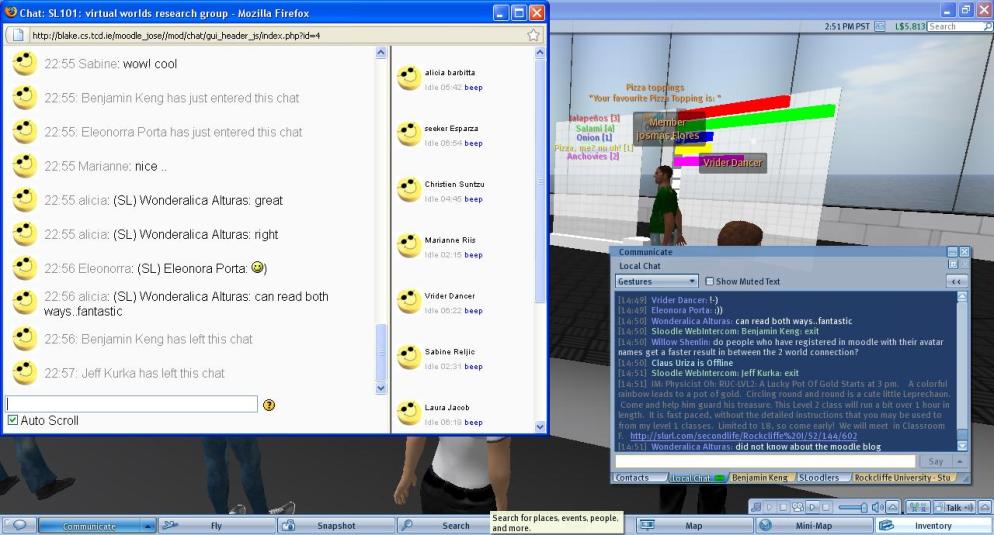
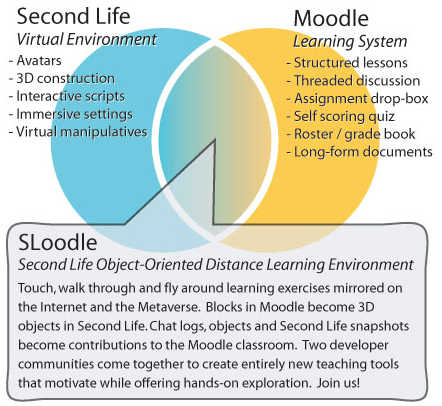
Yesterday I attended a hands-on workshop on SLoodle led by Josmas Flores as part of the weekly meetings of the Virtual Worlds Research Group Discussions. SLoodle (Simulation Linked Object Oriented Dynamic Learning Environment) is an Open Source project which integrates SL with Moodle.

sloodle-wiki
SLoodle figure from the SLoodle wiki

According to the SLoodle website, some of the key features of SLoodle are:

  • Web-intercom. A chat-room that brings Moodle chatroom and Second Life chats together. Students can participate in chats in Second Life using the accessible Moodle chatroom. Discussions can be archived securely in a Moodle database.
  • Registration booth. Identity management for Second Life and Moodle. Link students’ avatars to their Moodle user accounts.
  • Quiz tool and 3D Drop Box. Assess in Second Life – grade in Moodle. Set quizzes or 3D modelling tasks in an engaging 3D environment. Review grades quickly and easily in the standard Moodle gradebook.
  • Choice tool. Allow students to vote (and see results) in Second Life as well as in Moodle.
  • Multi-function SLOODLE Toolbar. Enhances the Second Life user interface. Use a range of classroom gestures, quickly get a list of the Moodle user names of the avatars around or write notes directly into to your Moodle blog from Second Life.
  • Presenter (in development). Quickly author Second Life presentations of slides and/or web-pages on Moodle. Present in Second Life without having go through lengthy processes to convert or upload images.
  • … and more. More tools are being prototyped on a regular basis.

In the workshop we tried – quite successfully I might add (Thx, Josmas!) – most of the features, and it is for sure something I will look further into. In the COMBLE course my colleagues and I will run in April/May we will be using both SL and Moodle, so I’m hoping we can find the resources to experiment with SLoodle.

sloodle_005
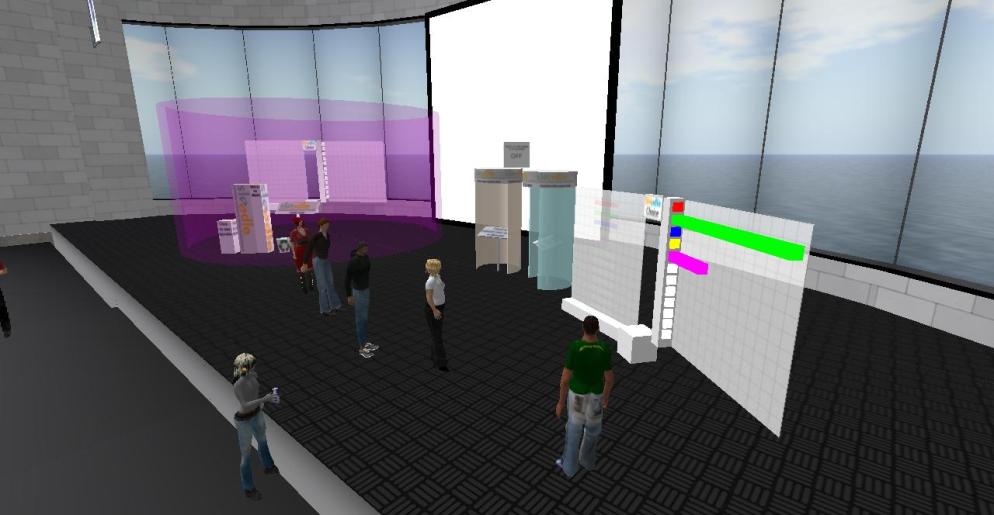
Watching Josmas demonstrating some of the features …

sloodle-1a
Checking chat feature in both sites …

I don’t think all of the above mentioned features would be relevant in my courses – we never vote and I find it hard to see how I could use such a tool in assessing the students (I wouldn’t use this feature in Moodle either), but I do see potential in both the chat and the blog features. As one of the participants, Grog Waydelich, said an interesting question could also be what kind of gestures are needed for classroom attendance?

One of the MIL students from my 1. MIL research cycle in 2007 experimented with SLoodle and attended some of the in-world SLoodle meetings, and he was very positive about the possibilities and especially the helpful community surrounding the project.

kryger1
Kryger meeting with other SLoodlers in 2007

The SLoodle project was founded by Daniel Livingstone & Jeremy Kemp with fundation from EduServ. In this paper Livingstone & Kemp (2008) describe the project and the importance of the SLoodle community.

UPDATE March 6th – from Willow Shenlin:

This coming week’s meeting is hosted by Jeremy Kemp at 1400SLT. He will discuss the research and issues behind the SLoodle Project.

We will meet him directly at SJSU SLIS 128/128/0, in the new student orientation site.

Also, as usual, I am asking for educators and/or developers who have an in-world tool that they wish to demonstrate and promote to the research, teaching and learning community. Let me know and I’ll schedule you on http://socialpresence3d.wikispaces.com/SpeakerSchedule

Cheers,
Willow

UPDATE March 10th
In yesterdays session Kemp told us how Linden Lab had forced them to change the project’s name from Second Life Object Oriented Learning Environment to Simulation Linked Object Oriented Learning Environment.

/Mariis

Kolb’s Experiential Learning revisited

I’ve been a supporter, yet a critical one, of David A. Kolb‘s theory of Experiential Learning for many years, and almost like a recursive cycle I seem to return to Kolb’s ideas, whenever I’m looking for a theoretical framework to illustrate pedagogical activities. As I’ve recently started to process and reflect upon the many different teaching and learning activities in the MIL course (my 2. MIL research cycle), I’ve found it interesting to revisit Kolb’s ideas to study their “applicability” with my current project.

Teaching and learning environment
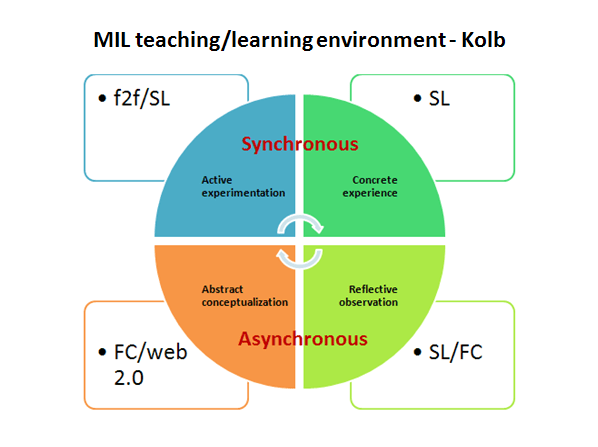
In order to better understand the different activities it’s necessary to get an overview of the teaching and learning environment, which is depicted below.

el-1

Home – given that MIL is a distance education with only four 2 1/2 day f2f-seminar pr. year the majority of the teaching and learning activities took place in the participants’ homes/workplaces.  All synchronous teacher initiated activities took place in the evenings/afternoons on weekends.

f2f seminar – the MIL course started on November 1st and ended on December 15th 2008. Mid November we had a f2f seminar, where the students were introduced to the general theme of the module (ICT and Didactic Design). I had 3 hours to lecture on “Remediation and redidactization in SL” combined with a hands-on workshop on some basic features of SL.

SL – was used for all the synchronous activities, both teacher and learner initiated.

FC (FirstClass) – was used for general information (incl. literature and other resources)/communication regarding the course, and more importantly as setting for the students’ asynchronous discussions/reflections. See this post for reflections on the quantitative outcome of the course.

Web 2.0 – various tools/technologies  supported the information provided in FC. Interestingly, and quite unusual for MIL students in other courses, the blogshpere and video and presentation repositories (like YouTube and Slideshare) were intensely explored in order to find additional information to support the students’ own findings and reflections.

A different perspective on Kolb’s model
Together with colleague Roger Fry, David A. Kolb started exploring the potentials of experiential learning in the 1970’ies, and Kolb further developed their ideas in his 1984 book “Experiential Learning: Experience as Source of Learning and development”. Besides exploring foundations (Dewey, Lewin and Piaget in particular) for experiential learning Kolb presented a model of 4 particular elements, which together constitute an optimal learning process. The elements are:

  • Active experimentation
  • Concrete experience
  • Reflective observation
  • Abstract conceptualization

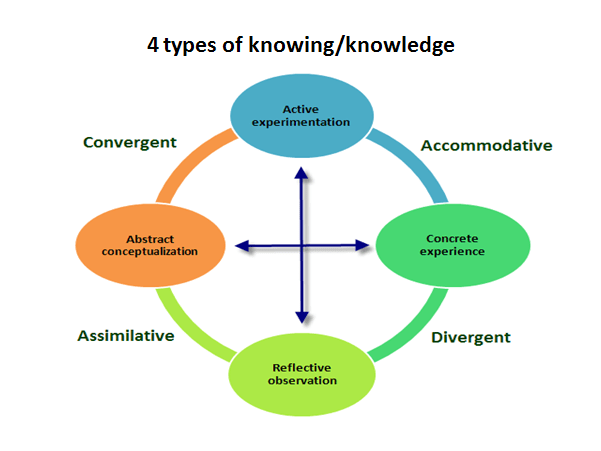
The model is widely known (and depicted) as a learning cycle and Kolb also used its elements to identify 4 learning styles, each corresponding to the spectrum between 2 elements – e.g. The Diverger, who supposedly prefers to learn through concrete experience and reflective observation. In this post I don’t want to address the otherwise relevant epistemological question of a) the probability of (universal) learning styles (incl. the number issue) or b) the question of how the learning process best can be understood (cycle, spiral, steps, continuum etc.).  Instead I want to return to the 4 core elements and use them to illustrate and discuss activities in different contexts of the MIL course’s teaching and learning environment.
el-2

Active experimentation and concrete experiences were mainly conducted synchronously at the f2f hands-on workshop and in SL. There was a total of 25 teacher initiated in-world activities that included:

  • Get-off-to-a-good-start – meetings where I as the main teacher instructed the newcomers in using different features and took them on tours to designated educational locations.
  • Building Class – 3 1 ½ hrs. sessions where guest teachers, Dr. Asp & Heidi Ballinger, showed the students the in-world building craft and assisted the students in their own building experiments.
  • Didactic Design Discussions – four 2 hrs. sessions, where I lectured on mandatory topics based on the course literature, but also on topics raised by the students in their asynchronous discussions. Due to the use of simultane voice and text communication, these sessions engaged the students more actively, when compared to traditional f2f lectures.
  • Visits – typically 1-2 hrs. sessions where the students and I visited both Danish and International colleagues involved in either in-world education and/or business.
  • Your Tour – 2 1 ½ hrs. sessions where 2 students showed the rest of us two locations of choice (one location of professional interest build by others, one location of professional interest build by the student’s employer).
  • X-Mas celebration – the last in-world meeting with focus on social activity. The students had asynchronously rewritten a well known Christmas song, so that it fit the class’ experiences from the course.
  • Friday Bar – a phenomenon well known from Danish on-campus life. In-world located as part of MIL’s Holodeck classroom. None of the students showed up for these events.

Reflective observation and abstract conceptualization were mainly conducted asynchronously in SL, FC and by the use of different web 2.0 technologies. In-world note cards and pictures were stored and utilized to support the students’ reflections that were expressed in the FC discussions. These reflections were also supported by course literature, and additional information found on the Internet.

The above distinction between synchronous and asynchronous activities is particular to this specific course design, should not be regarded too rigidly and could have been designed otherwise. If Kolb’s model is taken literally reflection happens at a certain stage in the process, whereas other theorists (incl. Kolb’s own inspiration Dewey. 1933) argue for reflection as an ongoing activity and especially Schön. 1983 has contributed with his concepts reflection-in-action and reflection-on-action.  The MIL students were clearly able to reflect-in-action, which became evident in many of the synchronous activities, especially in the didactic design discussions and during the visits. Another interesting comment could be made regarding the abstract conceptualization, which usually is associated with the ability to understand, evaluate and conclude on general principles derived from the previous experiences. The MIL students did this outside SL (mainly in written and graphic formats), but it could possibly have been done in-world as either processes (e.g. teach each other xx) and/or as products (e.g. build a model of xx). This is something I need to consider when planning the next MIL research cycle (Fall 2009) .

The 4 different activities also correspond to 4 different types of knowing/knowledge, which I’ll try to exemplify with empirical data in future studies.
el-4

Teaching-Learning relations in the environment
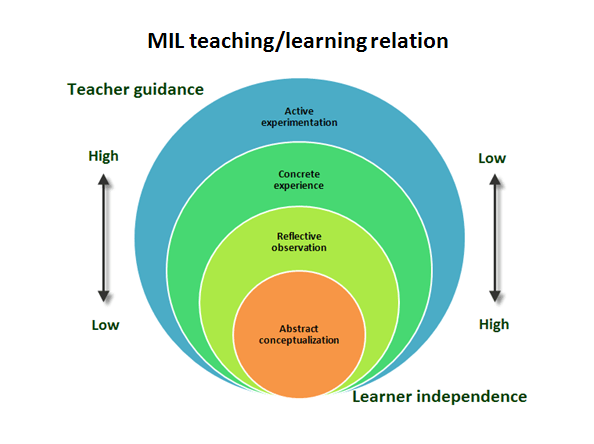
Staying within the framework of Kolb the 4 activities were dominant in the MIL course, and in reviewing these the role/influence of the teacher may be illustrated as below.
el-3

In general MIL students are tech-savvy, used to learning on their own and in their study groups, but SL proved to be an atypical experience, and my impression (also based on the 1. MIL research cycle) was that the students needed much more instruction/facilitation than usual.  Several reasons such as SL’s infamous steep learning curve, the course design, the length of the course period and the rather abstract nature of the subject matter may have contributed to this, but it’s certainly something I need to investigate further. It’s not necessarily a bad thing that the students needed more teacher guidance that usual, but coming from an education that has learner-independence as a goal (as part of a life-long learning perspective) it does bring about some reflections.

Anyways, in reviewing the “applicability” of Kolb’s ideas to my PhD project this preliminary inquiry shows some potential  that need further exploration …

/Mariis

References

Kolb, D. A. (1984): Experiential Learning: Experience as Source of Learning and Development. Englewood Cliffs, NJ.: Prentice Hall

Dewey, J. (1933): How We Think, New York: Heath.

Schön, D. A. (1983): The Reflective Practitioner. How professionals think in action, London: Temple Smith.
Research strategies and SL as Knowledge Medium

On Wednesday, January 21st I participated in a Master Class on Learning 2.0 and Knowledge Media at Aarhus University.Terry Anderson (Athabasca University) and Simon Heilesen (Roskilde University) were guest lecturers, while my MIL colleagues Christian Dalsgaard, Jørgen Bang and Elsebeth K. Sorensen (Aarhus University) served as moderators. Six Master- and PhD Candidates from different Danish Universities besides me participated, four of us giving short presentations of our projects.

Anderson gave an interesting presentation entitled “Overview of Research Methodologies for Social Software Research”, which initiated quite a discussion on research methodologies especially within educational research. Anderson was critical of educational research asking what results in fact had been able to instigate real change in educational practices. This lead to a critical overview of three dominant research paradigms respectively Quantitative, Qualitative and Critical. Anderson quoted a study by Mary M. Kennedy (1999):

The findings from this study cast doubt on virtually every argument for the superiority of any particular research genre, whether the criterion for superiority is persuasiveness, relevance, or ability to influence practitioners’ thinking. (from Anderson’s presentation above)

According to Anderson, who also is the director of Canadian Institute of Distance Education Research (CIDER), there is a need for development of new research strategies emphasizing possibilities for innovation and change. Anderson pointed to Design Based Research (DBR) as a potential strategy. At ELL we have a strong tradition of employing Action Research (AR) based strategies, including DBR, which in my point of view is a variant of AR. Both strategies are:

  • Iterative
  • Process and utility oriented
  • Intervention driven
  • Collaborative
  • Multileveled
  • Theory generating

However, there are at least two major differences between AR and DBR, namely the role of the researcher and the role of theory. In DBR the researcher works closely together with the practitioners, whereas in AR – especially in educational research – the researcher quite often also is the practitioner studying his/her own practice as a participant/insider. In DBR the role of theory is clearly defined as the point of departure of the research process:

Design-based researchers’ innovations embody specific theoretical claims about teaching and learning, and help us understand the relationships among educational theory, designed artifact, and practice. (DBRC.2003:5)

In AR theory isn’t necessarily applied from the beginning of the research process but to a higher degree grounded by the practice in the different research cycles, thus making it a more open strategy. Still, in claiming this I want to stress that there are many different takes on AR strategies. See Raelin (1999) for a good overview of different action based strategies.

Heilesen proceeded with another interesting presentation on “Learning 2.0 – Conditions and potentials of the social web”. There are so many comments to be made on this topic, but one of the issues Heilesen addressed was the potential of using new digital social technologies as means to change conventional conference participation from a typical closed and time limited event to a more open and continuous activity – exemplified by the MetaverseU conference at Stanford, February 2008 (where both Heilesen and I participated ;-). Anyone who has participated in RL conferences knows that it can be a somewhat dreary experience based mainly on one-to-many communication, and in my personal experience it can also be quite difficult to expand the effect/outcome afterwards. This issue of “frustrating conferences” is currently being addressed by George Siemens and colleagues. Note the upcoming open, online conference on this topic and see Siemens, Tittenberger & Anderson (2008) for a really interesting perspective on this.

After the lunch break, I and three other candidates were asked to present our projects. Presenting a PhD project in 15 min. really is an ungrateful task making it quite difficult to convey a coherent and comprehensible impression. On the other hand, I have to admit that at this stage in my PhD research many of my ideas and thoughts still need to be qualified by further research and a Master Class can be a really good opportunity to discuss this kind of “work-in-progress”. In my presentation, I chose to focus on the possibility of using SL as a knowledge medium – primarily based on the preliminary findings of my 2. research cycle, which was conducted in November/December 2008.

One of the things, which were critiqued as being unclear in my presentation, was my use of the concepts respectful and radical remediation. Initially I was inspired by Tringham, Mills  & Ashley (2007) and their experiences from the Remediated Places Project, where they used these two concepts (elaborating on Bolter & Grusin.1999) as a way of describing different ways of remediating. Based on my own experiences from remediating a specific course via SL I do find these two concepts very useful in describing not only different ways of remediating places, but also people and practices. There is, however, no doubt that I need to further develop and qualify my work on this, so that I can convey a more coherent, and thus convincing argument on this.

All in all, it was a very inspiring learning experience to participate in this Master Class, so my concluding words will be thanking all the participants :-)

/Mariis

References

Bolter, J. & Grusin, R. (1999): Remediation. Understanding New Media. The MIT Press

Kennedy, M. M. (1999) The problem of evidence in teacher education. In: Roth, R. (Ed). The Role of the University in the Preparation of Teachers. (pgs 87-107). London: Falmer Press.

Raelin, J. (1999) Preface. In: Management Learning. Vol. 30(2): 115-125. Sage Publications


Example of my ELL colleagues using DBR in current research

Coto, M. & Dirckinck-Holmfeld, L (2008): Facilitating Communities of Practice in Teacher Professional Development. Networked Learning Conference Proceedings 2008.

Other relevant resources

CIDER’s SIG on DBR

Smith, M.K. (1996, 2001, 2007): Action Research. The encyclopedia of informal education.

Center for Collaborative Action Research

Action Research Resources

Exploring Knowledge Media

Next week I’ll be attending a conference and a Master Class on “Knowledge Media” at Aarhus University.

knowledge-media2

The purpose of the Knowledge Media Conference is to discuss the role of new digital media within education in the knowledge society. What are the potentials of digital media in relation to learning, knowledge sharing and knowledge construction? The conference will focus on use of digital media for learning and knowledge acquisition in both formal and informal situations. The conference includes presentations from invited keynote speakers. Further, the conference will present the results of a research project at the Centre for IT & Learning on Knowledge media, 2007-2008.

Themes

  • Education for all?
  • New learning environments: Web 2.0 and Social Software
  • Knowledge media
  • Formal and informal learning

Keynotes

  • Terry Anderson, Athabasca University, Canada
  • Friedrich Hesse, Knowledge Media Research Center, Tübingen, Germany
  • Lars Qvortrup, School of Education, Aarhus University, Denmark
  • Jørgen Bang, Institute of Information and Media Studies, Aarhus University, Denmark
  • Lynne Schrum, George Mason University, USA

I’m especially interested in hearing Anderson’s talk on “Learning and Teaching beyond the Course Into Networks and Collectives”. The idea that social media, knowledge media or whatever you wish to call new digital media, slowly will dissolve our notion of courses (understood as fixed, teacher-driven activities) as a means of learning seems to gain more and more recognition and attention, and it’ll be interesting to hear Anderson’s thoughts on this in my own area (distance education) – not least since my PhD fundamentally is about course design, hmmm …

The Master Class, with Terry Anderson and Simon Heilesen (senior researcher at the Virtual Worlds Research, Roskilde University) as speakers, will also adress the potentials of digital media in relation to learning, knowledge sharing and knowledge construction. I’ll do a short presentation of Second Life as Knowledge Medium in Distance Education based on my experiences with the MIL course in the 2 research cycles so far. I think it’s a really good idea to hold the Master Class the day after the conference, because I’m quite sure many questions and ideas will come to me, so it’s nice to get an opportunity to discuss more informally.

/Mariis