Case MIL09: Didactic Design Discussion – 4

On December 3rd we had a special edition of the Didactic Design Discussion in the MIL course, since both Terry Anderson and Ross McKerlich visited us to talk about the Community of Inquiry (COI) model. The COI model was developed in the late 1990’ies as framework for evaluating educational experience in text-based online environments by D. Randy Garrison, Terry Anderson and Walther Archer. Given the COI model’s wide spread use in different educational settings it is by no means coincidental that one of the original founders, Terry Anderson, has found it important to explore the applicability of the model in new online environments such as the 3D virtual world, Second Life (SL). Together with McKerlich Anderson conducted a preliminary, qualitative exploratory study in SL in 2007 and basically confirmed that the model also can be used in assessing educational experience in 3D virtual environments (McKerlich & Anderson. 2007). Anderson and McKerlich later invited Brad Eastmann and I to participate in the continued study of COI in 3D virtual worlds and as part of this study we record different educational experiences in SL to be used for later analysis.
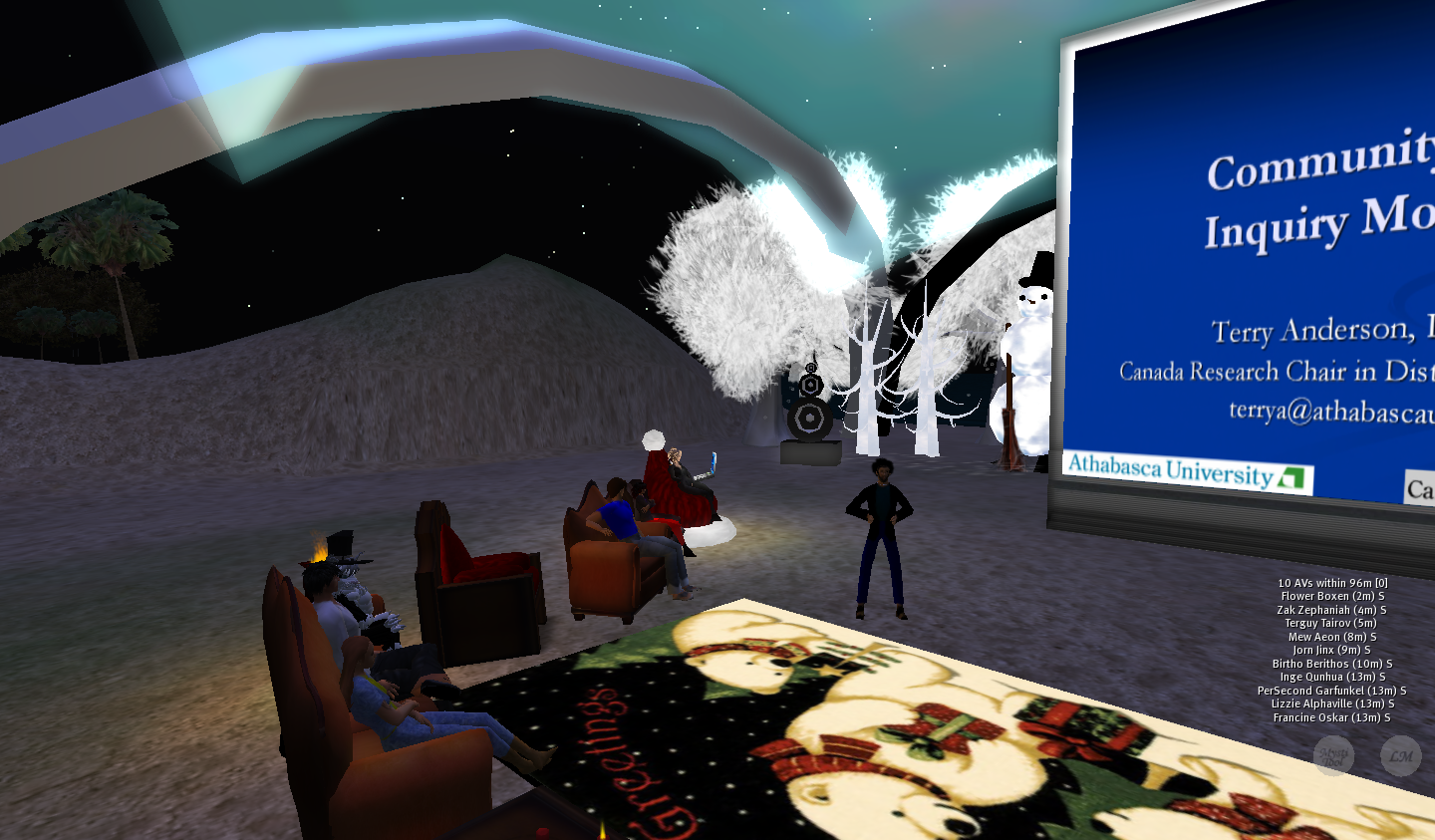

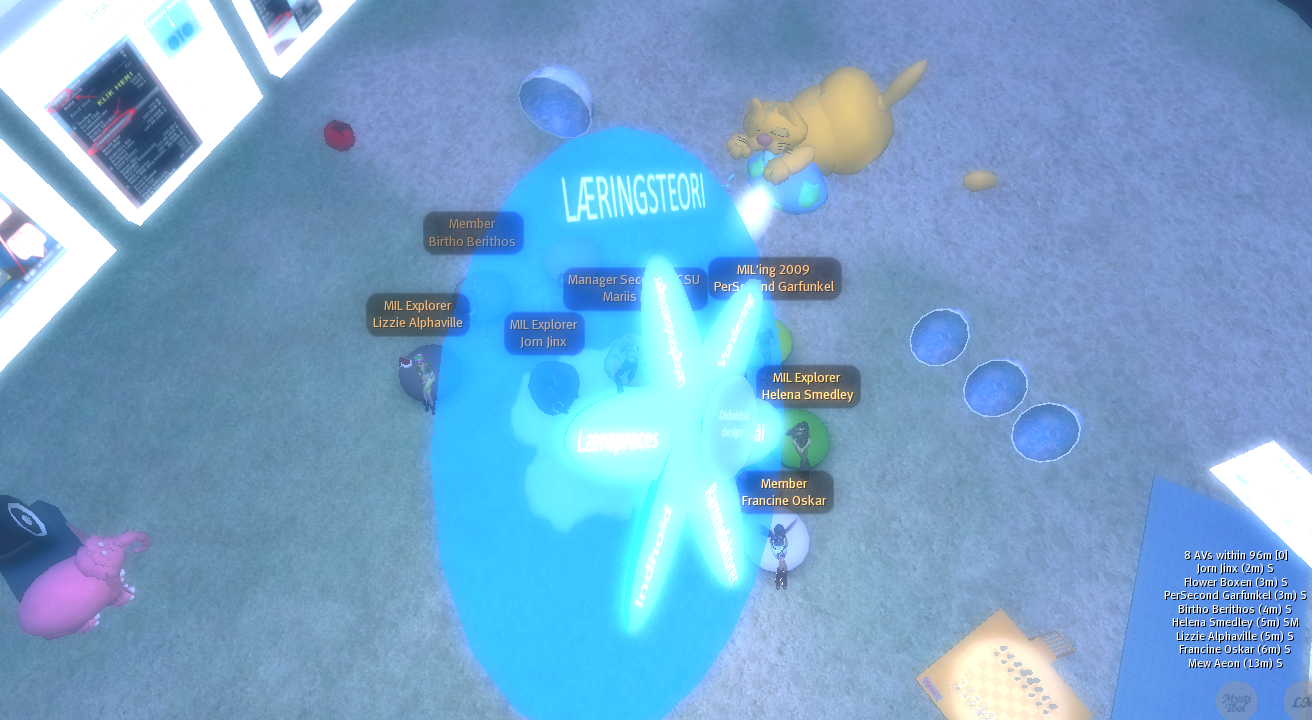
Terry presenting COI to the MIL students

Besides being an excellent tool with regard to analyzing interaction and communication the COI model, which consists of 3 different  types of presence indicators (cognitive, social and teaching), can also be used as a heuristic tool for designing online educational experiences. The MIL students in this year’s course are all educators involved in course designing within blended learning and they all seemed to find the COI model interesting and relevant to their current work. What I appreciate about the model is the fact that it deals with presence and not immersion which otherwise seems to be the buzz word when studying 3D virtual worlds. Even though both presence and immersion have to do with the user experience, I do find there is an important difference between the two concepts. Based on the four research cycles I’ve completed in my PhD project so far, my experience is that all users achieve a sense of presence when they enter a virtual environment like SL, which I think above all has to do with the avatar and its ability to move around and meet other avatars, communicate and interact in real time. It is, however not my impression that all users in these types of environments achieve the sense of immersion – at least not if immersion is defined by a sense of “willing suspension of disbelief” as proposed by Dede. 2005 among others.  An important part of this discussion is of course how one chooses to define the concepts and since I intend to use both presence and immersion in my own model this is something I’ll return to.

After the presentation, McKerlich introduced to our survey related to the COI study and we went on to use The Opinionater, which once again proved its worth as a great tool for initiating discussions.

/Mariis
Case MIL09: Didactic Design Discussion – 3

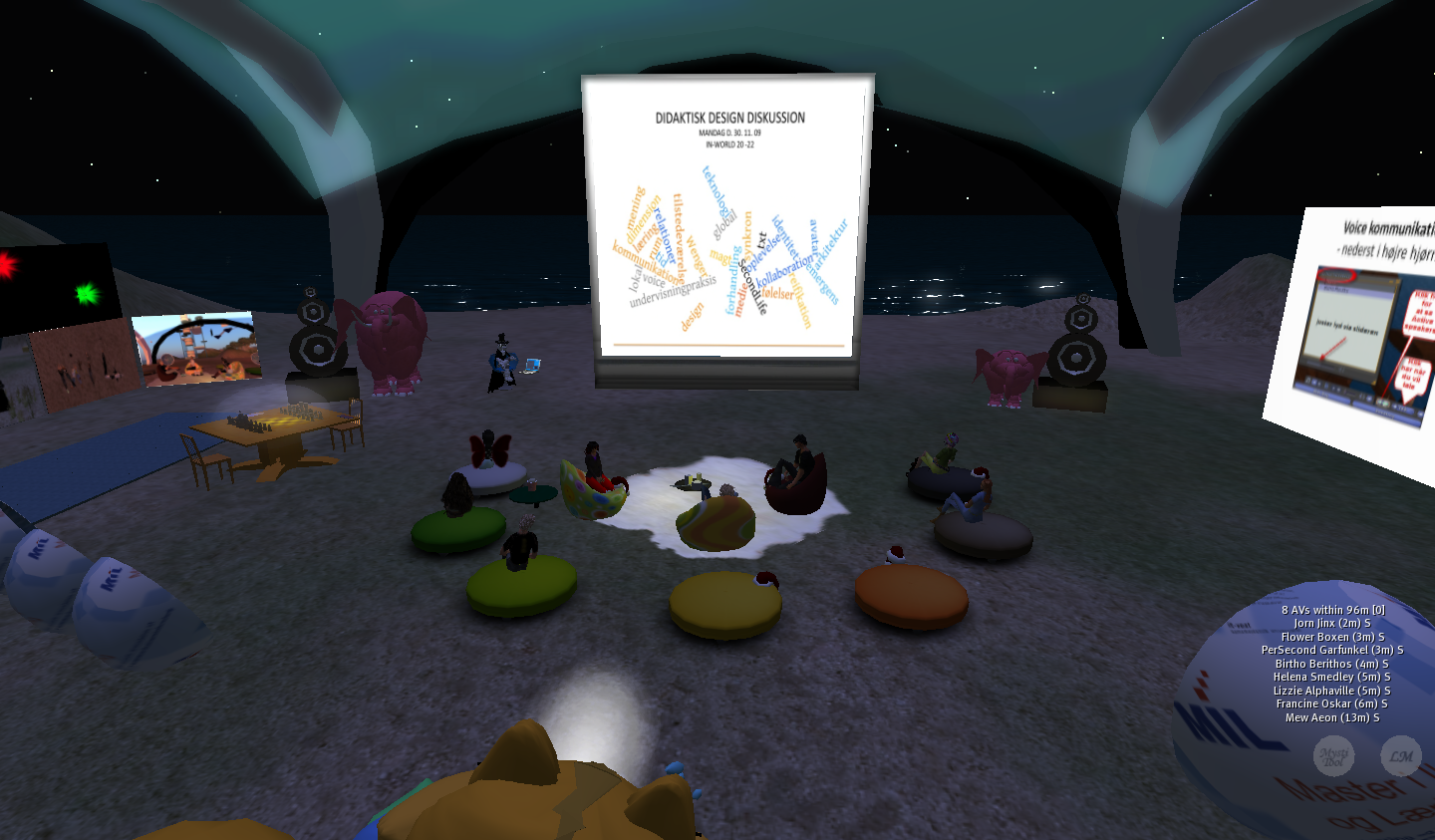
On Monday November 30th my co-facilitator, Mew Aeon was in charge of the 3rd Didactic Design Discussion in the MIL course. Unfortunately it was one of those nights where the technology really became an obstacle for me, since I was logged out of SL several times, but judging from what I did experience and the students’ comments they enjoyed the discussion very much.

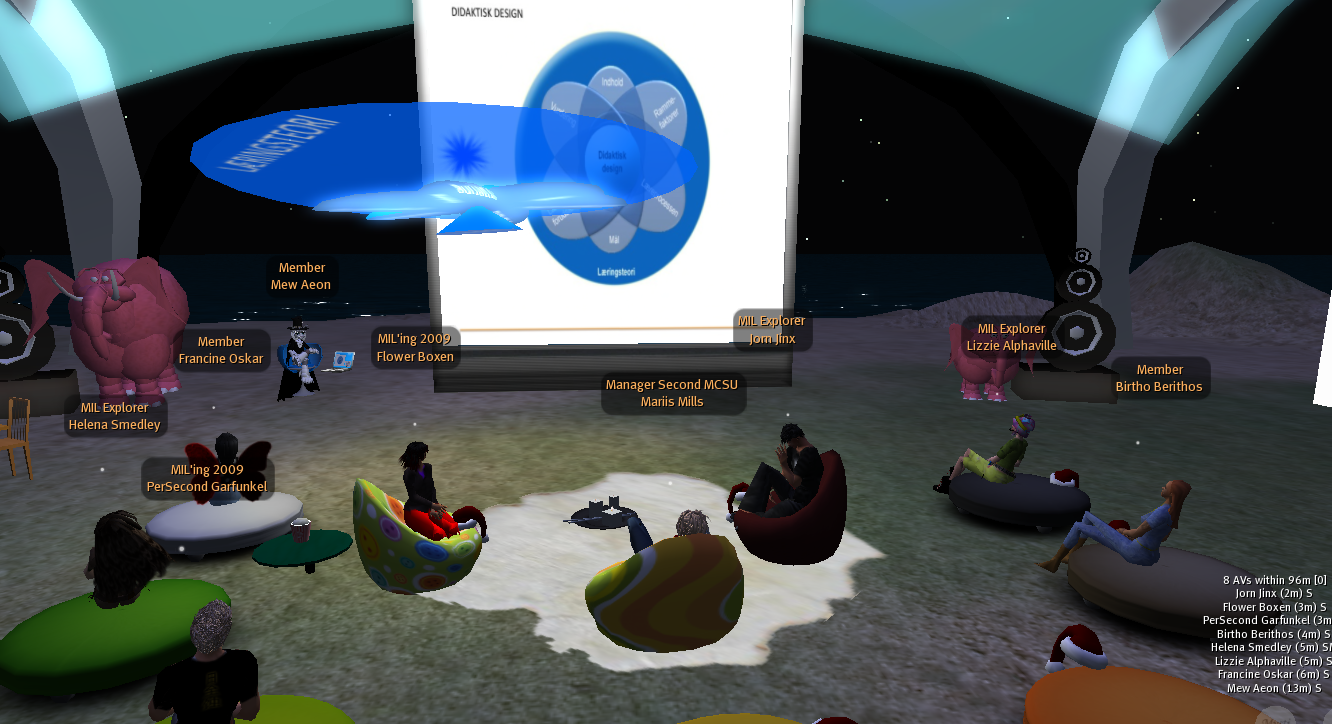
The purpose of these discussions is to stimulate the students’ critical thinking and didactic-pedagogical imagination and Mew chose to present two different models for Didactic Design. The first one, the so called Didactic Relation Model, originally developed by Norwegian educational researchers Bjørndal & Lieberg (1978) and further developed by 2 other Norwegians Hiim & Hippe (1998), is intended as a planning tool for teachers and is widely used in Scandinavia. The Didactic Relation Model illustrates the relations between learning conditions, external factors, goals, content, learning processes and assessment. In Mew’s version he added a learning theoretical layer and included Didactic Design as explicit goal for the use of the model. For the discussion Mew had prepared the model in a 3D version:

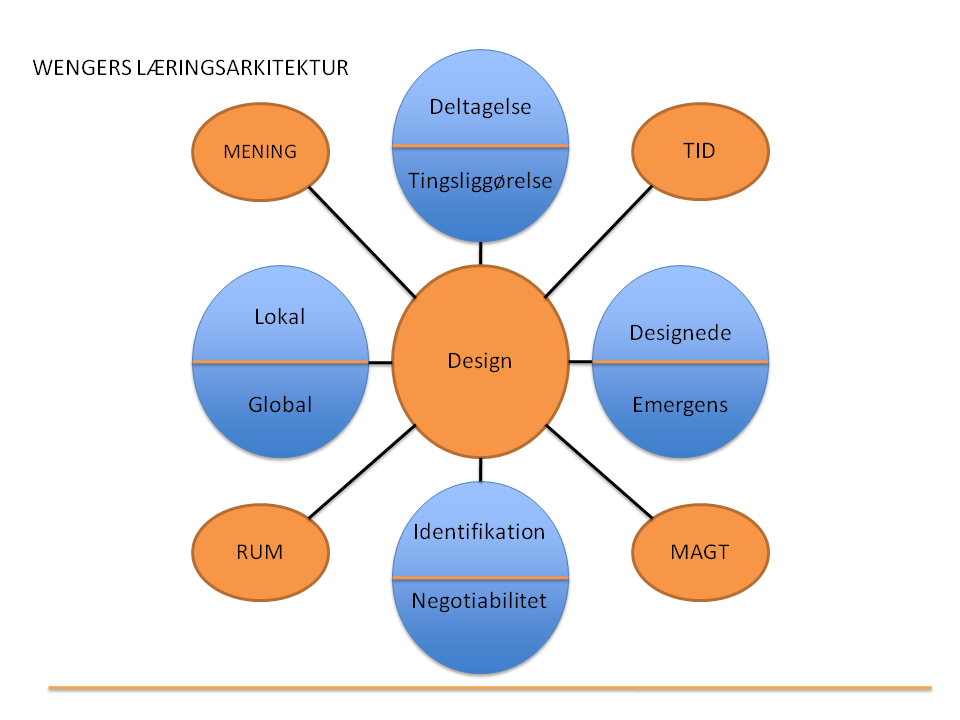
The second model Mew presented was a revised version of Wenger’s (1998) model of Four dimensions of design for learning that shows four dualities between which one will find inherent tensions that need to be  addressed in the designing process. Besides these dualities Mew had added 4 more elements (meaning, time, power and space) that he found valuable to focus on when he originally redesigned Wenger’s model as part of his Master Thesis  work – the report (in Danish) can be downloaded here.

For each of the elements Mew gave examples from SL and since both Wenger’s CoP theory and the concept of Legitimate Peripheral Participation are highly popular among MIL students it seemed to promote a vibrant discussion. After the theoretical discussion Mew took us on tour to three different locations based on design ranging from very respectful remediation to radical, NpIRL remediation:


Sistine Chapel


Exploratorium


Organica


After the session Mew and I stayed a bit to discuss his impressions, since this was his first formal lecture in-world. The keywords were riotous or unmanageable compared to real life, because there were so many simultaneous things going on; the text and voice chat, activity and movement of the avatars while trying to focus on the content of the presentation, looking at notes and managing the slides and steering the 3D model. I clearly recognize these sentiments from my first in-world teaching experience, but the good news are that it gets better – and even though it was different from teaching in real life, Mew definitely got “hocked”, so despite my technical problems, I believe it was a very good night :-)

/Mariis

3D remediation – people

As I continue my work with the model for 3D remediation strategies, I’ve decided to replace the numbers in the four quadrants with indicators of the four corners of the world thinking they don’t imply a fixed sequence in the same way as numbers or letters tend to do. Having done this, I’ve also abandoned the idea of merging my model with Kolb’s learning cycle. Though I do believe that Kolb’s model has been subject to misinterpretations over the years, I’m not interested in forcing one specific learning theory upon my model. Indeed, I think one of the major affordances of 3D user generated VW, as compared to conventional proprietary 2D CMS/LMS/VLE, is the fact that you can design for teaching and learning based on any theoretical foundation. Diversity and countless possibilities are keywords in platforms like SL and with my model I aim at showing this diversity. When you first enter SL it appears to be pretty uniform with lots of beautiful Barbie-Ken-avatars and by and large respectfully remediated places, which unfortunately also is the way the official Linden Lab prefers to promote SL, but there is so much more to this wonderful world …

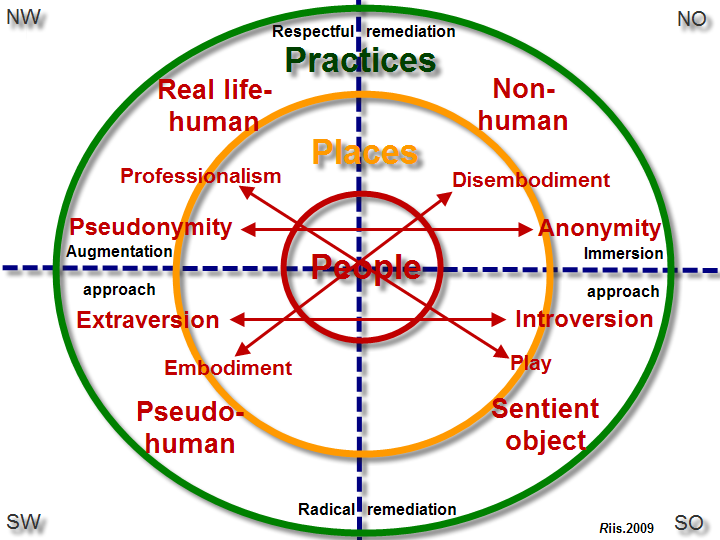
In connection with my analytical unit, People I’ve identified four archetypical ways of customizing the avatar:

  • Avatar as Real Life-human – respectfully remediated based on an augmented approach.
  • Avatar as Non-human – respectfully remediated based on an immersive approach.
  • Avatar as Pseudo-human – radically remediated based on an augmented approach.
  • Avatar as Sentient object – radically remediated based on an immersive approach.

I’ve also identified a number of seeming dichotomies that one should be aware of when contemplating using SL for teaching and learning. With the addition of these elements in the red People’s sphere the model now look like this:

I don’t mean to imply that the possible tension between e.g. professionalism and play only occurs between the NW-SO corners – I believe this tension (as well as the other tensions) can be identified within the whole sphere. Being a work in progress I’m currently settling for identifying key elements  and placing them in the model, but if thorough investigations prove these elements to be relevant and viable I will improve the graphics.

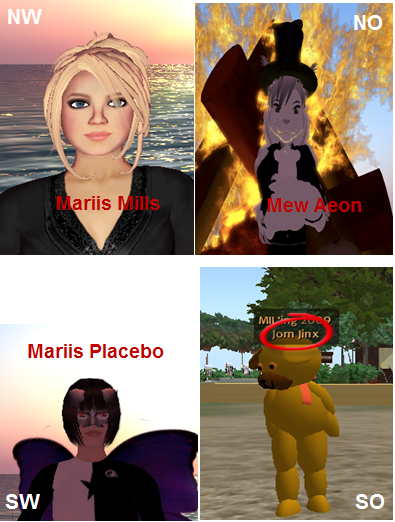
As a preliminary demonstration of how the model can be used, I’ve identified four examples of the avatar types within my current research cycle, the MIL09 case:

NW: Mariis Mills, my main avatar who is a respectful remediation of my real life person. Though I have to admit, that she looks both younger and cuter, I do sense that my students recognize her as a reflection of me.

NO: Mew Aeon
, my co-facilitator who at present chooses to represent himself as a cat because it goes well with his first name and playful nature.

SW: Mariis Placebo
, my main alt who is currently a humanoid super heroine with butterfly wings and special powers. I use her when I need to work undisturbed in-world and she’s also member of a number of groups that are only peripherally connected to my field of study.

SO: At a certain point MIL student, Jorn Jinx showed up as the – in Denmark – very famous teddy bear, Bamse. Though Bamse clearly is an object, it is usually referred to as a male persona and associated with the ability to feel and perceive subjectively.

I think the avatars above represent the more moderate examples of the four achetypes, but it will certainly be possible to identify more extreme cases as in this excellent interview moderated by Hydra Shaftoe (a wolf) for Nokia on the topic of Perceptions of Non-human avatars or as in this Orange Island Identity Summit, where e.g. qDot Bunnyhug is represented as a sentient rectangular box.

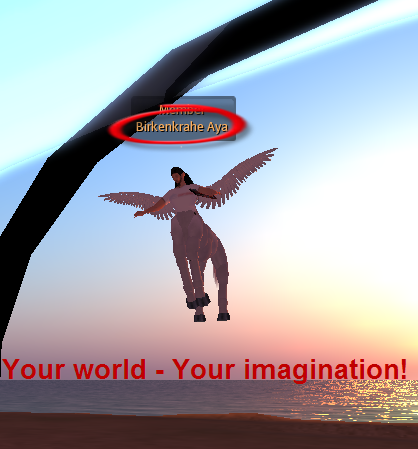
By definition a model is a simplified summary of reality designed to aid further study, and I really do not perceive the world of SL to be as simple, clear-cut and uncomplicated as the model may give the impression of. I do, however find it useful in trying to identify different aspects of possible remediation strategies. With a final example of an avatar remediation that fluctuates between Real life-human and Non-human I’ll finish this post with a photo of my centaur friend, Birkenkrahe:

/Mariis

A model for 3D remediation – version 2’ish

The creation of my model for 3D remediation is clearly a work in progress…

As I’m starting to assemble literature and other resources that have influenced my thinking and may be relevant for the theoretical foundation of the model I’ve been reviewing the so called Metaverse Roadmap Overview (MVR 2007). Back in February 2008 I had the fortune of participating in the first MetaverseU conference organized by Henrik Bennetsen and others from Stanford Humanities Lab, and this was the first time I was introduced to the MVR.

The MVR focuses on defining and exploring potential pathways to the 3D web by creating a roadmap consisting of 4 Metaverse scenarios. As a starting point the MVR defines metaverse as follows:

the convergence of 1) virtually-enhanced physical reality and 2) physically persistent virtual space. It is a fusion of both, while allowing users to experience it as either.

There is no single, unified entity called the Metaverse—rather, there are multiple mutually-reinforcing ways in which virtualization and 3D web tools and objects are being embedded everywhere in our environment and becoming persistent features of our lives. (…). In sum, for the best view of the changes ahead, we suggest thinking of the Metaverse not as virtual space but as the junction or nexus of our physical and virtual worlds.

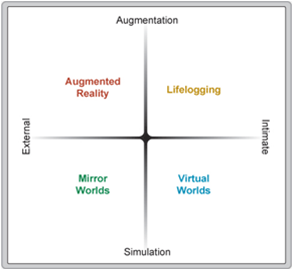
Derived from multiple inputs, enabling trends, constants and a survey among other things, the group of authors behind the MVR came up with 4 scenarios based on “two key continua that are likely to influence the ways in which the Metaverse unfolds: the spectrum of technologies and applications ranging from augmentation to simulation; and the spectrum ranging from intimate (identity-focused) to external (world-focused).” In the MVR augmentation refers to “technologies that add new capabilities to existing real systems; in the Metaverse context, this means technologies that layer new control systems and information onto our perception of the physical environment.”, whereas simulation refers to “technologies that model reality (or parallel realities), offering wholly new environments; in the Metaverse context, this means technologies that provide simulated worlds as the locus for interaction.”. The combination of these continua leads to 4 different types of Metaverse technologies; 1) Virtual worlds, 2) Mirror worlds, 3) Augmented reality and 4) Life Logging as depicted below:


4 Metaverse scenarios by MVR 2007

Though I find these 4 scenarios very interesting, I’m somewhat puzzled by the augmentation-simulation continuum – mainly because I don’t see them as two opposite conditions which usually is the definition of a continuum. A flight simulator would for instance draw on both conditions in trying to simulate the experience of flying, but doing it as realistically as possible and sometimes with the use of HUDs. Now, my puzzlement may stem from poor understanding of the English language and native connotations of which I’m not aware, and the authors behind the MVR do state that the scenarios are partly-overlapping.

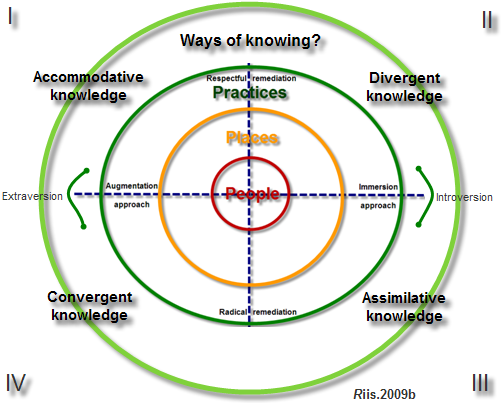
In any case, it makes more sense to me to place augmentation on a continuum with immersion. It should also be noted that my model aims at illustrating 4 possible strategies for remediation within 3D virtual worlds which means my focus is narrower only concerned with one of the four technologies in the MVR. The second continuum in the MVR between external and intimate makes a bit more sense to me, though again I would prefer a different terminology inspired by Jung (1920)’s psychological concepts of extraversion and introversion. The reference to Jung is by no means incidental but leads to another theoretical inspiration, namely the Theory of Experiential Learning by David A. Kolb (1984) by which I have previously been inspired in my PhD workings. In relation to his classic “Learning cycle” Kolb argues for a transformation dimension of learning consisting of two polar modes, respectively extension and intention. At this point Kolb is clearly inspired by, but chooses to go beyond, Jung’s extraversion-introversion concept, and even though I often find myself highly inspired by Kolb’s work, I’ve decided to maintain Jung’s original terminology in my own model … for now. I have, however also started to investigate the possibility of including Kolb’s 4 ways of knowing which would result in a 2. version of my model looking like this:

… um!? As tempting as it is trying to make the “whole world” fit into one little neat model, I have to say that I’m not sure about this at all – is it feasible to merge the two models? And perhaps even more important; is it desirable? This experiment is primarily based on intuition and I will need to further investigate this as part of my theoretical work and subsequent data analysis, but as part of my own learning and research process, I needed to get this version out of my head …

/Mariis

A model for 3D remediation – in colors

… because the seeming dichotomy between augmentation and immersion approaches to remediation in 3D virtual worlds like SL isn’t real and the world isn’t black and white ;-)

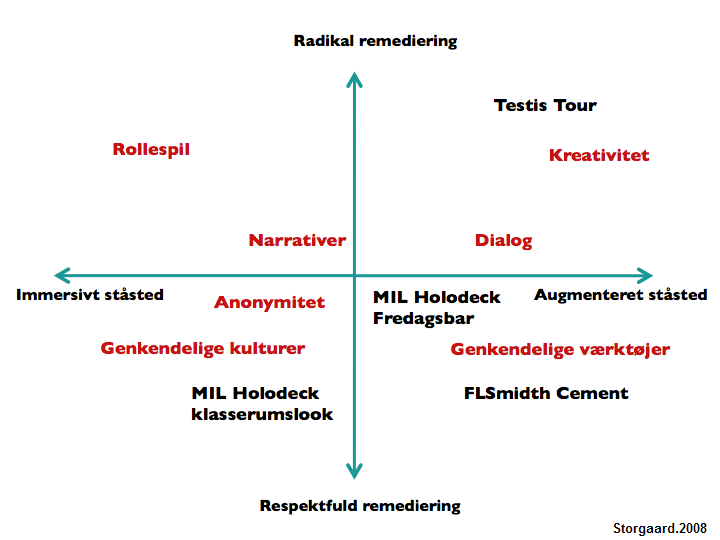
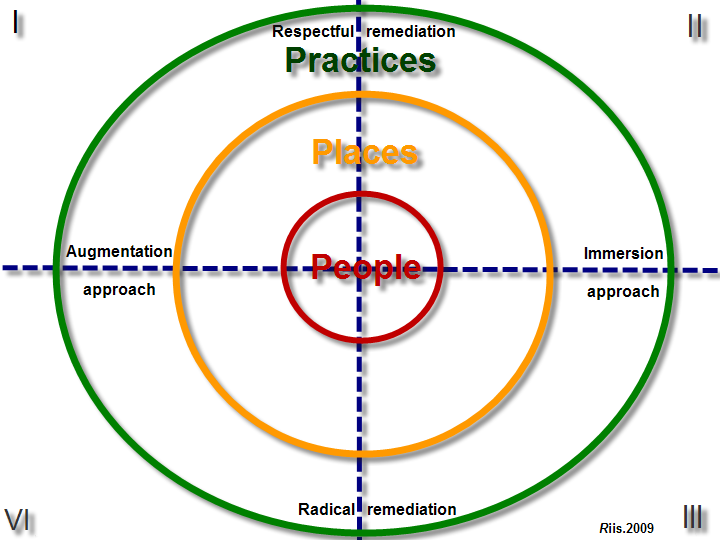
As mentioned in my previous post we had a great discussion on augmentation vs. immersion in the MIL course in relation to our 2. Didactic Design Discussion. Even though I personally do not consider the two approaches to be mutually exclusive (as it would seem in this post), I do think the discussion is worth having, since it highlights some difference there can be in different users’ perception of and engagement in 3D virtual worlds. Remediation is a core concept in my PhD, and last year one of the students, Carsten Storgaard created this model to show the relations between augmentation-immersion and respectful-radical remediation, including different types of activities and places:

While I do find the basics of the model quite useful, I do not necessarily agree with Storgaard´s suggestions to activities and places in the four quadrants, but it has inspired me to create a new model where I’ve made some changes and added more foci points from my PhD.

First of all, I decided to flip augmentation and immersion, so that augmentation now is placed in the left side of the model and immersion in the right side in an attempt to relate to the two brain hemispheres each representing different qualities and approaches to the world. Secondly, I decided to make the borders between the quadrants permeable thinking they can influence each other and that it will only be in rare cases that one would find “pure” examples – at least in my educational context. Finally, I added three other foci points from my PhD – my analytical units; people, places and practices.

For now I’ve decided to leave out examples of people, places and practices, because I need to analyze my data thoroughly and further develop the theoretical foundation for the model. In regard to the remediation concept I’m highly inspired by the work of Professor Tringham of UC Berkeley, and as it happens I just received a scholarship to go work with her for four months in the spring 2010. In the original remediation concept Bolter & Grusin (2000) made a distinction between immediacy and hypermediacy as ways of describing different remediation strategies. Interestingly, Professor Tringham and colleagues decided to place respectful and radical remediation in relation to hypermediacy only. I’m not sure I agree with that decision and this is just one of many reasons as to why I’m really looking forward to my Berkeley stay – I’m quite sure I’ll learn a lot and that we’ll have some highly inspirational discussions :-)

/Mariis