SL presentation in the Danish Ministry of Science

On Friday October 15th, a total of more than 200 museums, churches, exhibition halls, galleries, political institutions, and other venues will open their doors in connection to the annual “Night of Culture” that has been a Copenhagen event since 1993. As part of this event, the Danish Ministry of Science has asked me to participate by presenting research, teaching, and learning in SL.

The event will run from 6PM until midnight (local time), and I will be in the Ministry together with one of my MIL-students, Inge Knudsen, from Business College, Horsens.Inge is a highly experienced SL educator and builder, who has run in-world courses on English, Chinese and Cultural Understanding among other things and last year she won the Danish Research Network’s annual Innovation Prize because of her work in SL.
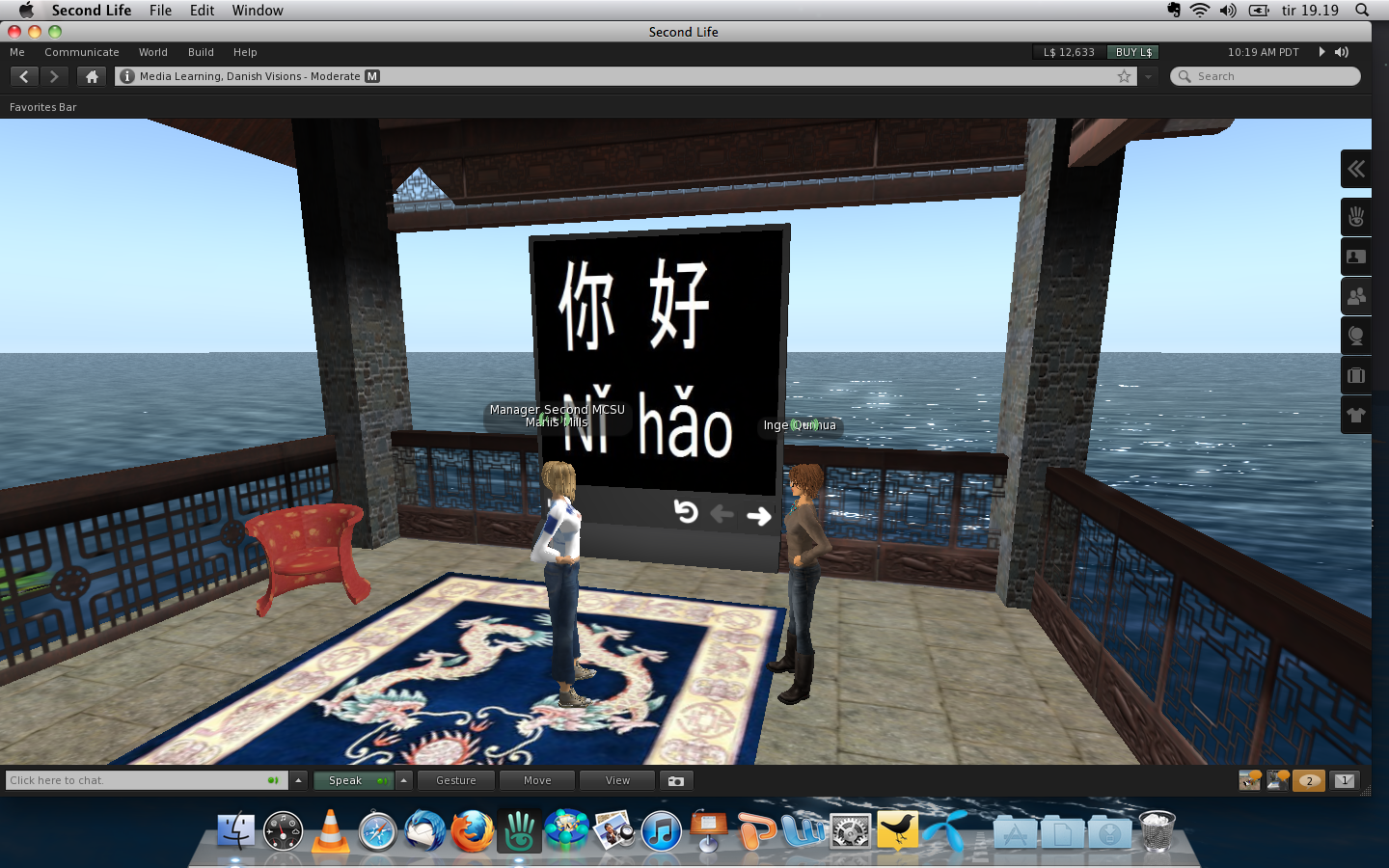

Inge and I discussing part of her presentation for the “Night of Culture”.

In-world we will be accompanied by MIL alumni, Per Christensen and two of his close colleagues, Nicolai Green Hansen and Erik Hansen – all from VIA University College. Per and his colleagues are currently preparing for a cross-cultural collaboration with a Chinese University on their island Innovative Learning, where it is also possible to see and experience another build that last year won the Danish Ministry of Education’s annual e-Learning award.
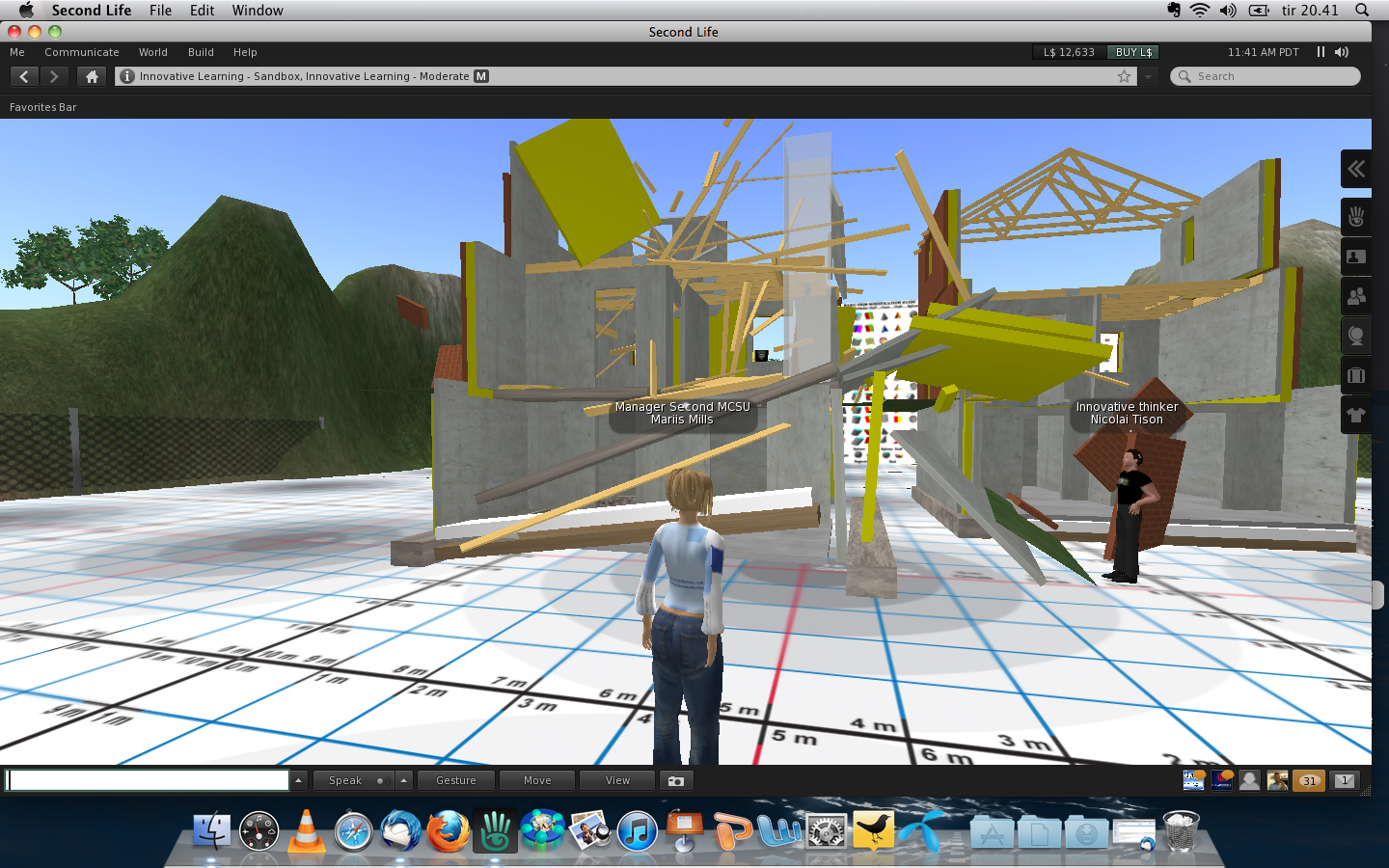

Nicolai and I discussing part of their presentation for the “Night of Culture”.

We are all still in the process of planning this event, and there are several challenges. The Ministry has put together an extensive program (in Danish) including lots of interesting activities all night. This means that it is impossible for Inge and I to foresee how many guests will find their way to our presentations. Last year approx. 1000 guests participated in the Ministry’s activities.

We have two rooms at our disposal, and so far we’ve planned for one of them to be the “Teaching and Learning Room”, while the other will be the “Presentation Room”. In the “Teaching and Learning Room” planned in-world session with Inge and Per will run twice the hour, and guests in this room will be able to participate via guest-avatars. In the “Presentation Room” several computers with logged in guest-avatars will enable guests to explore and participate in different in-world places/events covering education, business, art, music, RL rebuilds and not least places/builds NpIRL. Inge and I will oscillate between the two rooms, and in between scheduled sessions, we’ll be available for questions and discussion of the many, different research, teaching, and learning potentials of a medium like SL.

We are also in the process of preparing note cards covering all sorts of topics, events and locations – and I encourage other SL residents to send me (Mariis Mills) suggestions of interesting locations/events. The entire event will take place from 9AM – 3PM SLT. Putting together a program for a 6 hours in a row event is quite daunting, and I personally find that the biggest challenge lies in trying to convey a sense of meaning of SL for RL-guests just passing by…

When we’re done planning, I’ll update this post with SLurls to locations where it will possible to join us in-world.

/Mariis

UPDATE – program

Most of the activities are directed towards the RL guests visiting the Ministry – and they will be in Danish. However, Inge Qunhua will do her sessions in English too, if anyone asks her. Inge will teach the audience how to introduce themselves in Chinese and there will be general lessons in understanding the Chinese culture.

Inge’s sessions will take place on her Island, Danish Visions. The first session starts at 10:30 AM SLT, and she will repeat it every hour until the last one at 2:30 PM SLT.

In between Inge’s sessions there will be live music and other activities on her Island.

For those interested in the Danish VIA-session please have a look in the group “Kulturnat 2010”, where you find all sorts of notices with LMs and further details on the in-world program.

In one of the two rooms in the Ministry, we will, starting at noon SLT, be streaming from Pop Art Lab, Claus Uriza – and later on we’ll visit The Yard Club, where there will be “Open Mic” with Torben Asp.

SLurl to Pop Art Lab

SLurl to The Yard Club

Conference on IT and Innovative Learning Environments

Thursday/Friday his week I’ll be attending a conference/workshop on “It and innovative learning environments” at university level organized by the Danish Ministry of Science in Copenhagen.

I’m especially looking forward to hearing the two keynote speakers:

  • Phillip D. Long, Ph.D. Professor of Innovation and Educational Technology and Founding Director, Centre for Educational Innovation and Technology, University of Queensland, Australia.
  • Renate Fruchter, Ph.D. Founding Director of Project Based Learning Laboratory and Senior Research Engineer, Department of Civil Engineering, Stanford University, USA

I’ve never met Professor Long, but I’ve read a some of his publications concerning design of learning spaces (i.e. Trends in Learning Space Design), and I think he has some pretty interesting takes on educational design. He is scheduled to talk about Open Scholarship and Learning, which should be interesting too!

I’ve had the pleasure of meeting Professor Fruchter a couple of times during my recent research stay in the Bay Area. She’s a very energetic and positive woman, and I think it’ll be fun to reconnect with her. During this research stay a bunch of my colleagues from 5 different Danish universities and I attended a 2-day workshop at Stanford exploring the future of e-learning, and since this conference is kind of a follow-up event I’m also looking forward to reconnecting with them and the organizers from Innovation Center Denmark in Silicon Valley.

I’m also interested in hearing the Danish Minister of Science, Charlotte Sahl-Madsen’s thoughts on innovative learning and the future of our universities … On Friday I’ll be attending different workshops, and here I’m especially looking forward to hearing what colleagues from the Danish School of Education, Tina Bering Keiding & Morten Misfeldt have to say on the alignment between learning and physical space – not least since this is a topic I normally don’t pay much attention to due to my explicit focus on virtual space/place in my PhD-project.

Dan Gilbert, Learner Designer Technologist, Learning Innovations Inc. will facilitate a workshop entitled Innovative Tools and Techniques to Enhance Creativity in Your Classes: Connecting Design Thinking with Teaching and Learning”, and this should be interesting too. I’ve previously attended a workshop by Dan and it was inspirational and great fun!

Finally, I’m really looking forward to seeing how conference participants will be using Twitter #itlearning. This will be my first Danish conference organized with the explicit goal of using Twitter and I have no idea how this will be received – but I am expecting a lot of fun :-)

/Mariis

Second Life Community Convention 2010

For the third year in a row I’m hoping to participate in the annual Second Life Community Convention (SLCC10). This year the convention will be held in Boston, August 13-15.

As usual the convention will be organized by SL users, bringing together new and old residents in a mixture of business, education, non-profit and not least the music and art scene.

This year I’ve submitted a proposal for the educational track entitled “Contradictions that make perfect sense – remediation strategies for problem based blended learning in SL”, and so I hope to get the opportunity to present and discuss some of the ideas I’ve been working on as part of my recent stay at UC Berkeley.

In any case the convention is a definite must-go, a unique opportunity to connect with old and new friends. If there’s any one event that has influenced my PhD work, this is definitely it! Given that research in 3D virtual worlds still is a rather limited research field it is always a pleasure to connect with other educators and innovative thinkers from various parts of the SL community :-)

/Mariis

UPDATE
Much to my surprise (and regret) my PhD-supervisor has instructed me not to participate in any activities as I should focus on writing my dissertation. I therefore had to withdraw my proposal and will not be attending this year’s SLCC :-(

Free PBL conference at Aalborg University – May 4-6 2010

As pre-conference to the 7th Networked Learning conference (#nlc2010), Aalborg University invites to a free 2 day conference on Problem Based Learning (PBL) on May 4-6 2010.

Aalborg University has 35 years’ experiences in educating students through the use of an overall PBL framework, which combined with project organization, is referred to as The Aalborg PBL Model. Furthermore Aalborg University Professor, Anette Kolmos holds the UNESCO Chair in Problem Based Learning. The conference will feature international experts and scientists, a.o. Scott Barge, Harvard University who together with an expert group from Aalborg University, initiated an accreditation process of the Aalborg PBL model. Standards and criteria for proper and relevant use of the method have been outlined.

Objectives of the conference are:

  • Sharing experiences and visions with universities from all over the world with leaders, scientists and practitioners meeting and discussing conditions, practise and development of PBL strategies.
  • Mutual learning in order to formulate standards, criteria and conditions for developing PBL practices that may serve a common platform for collaboration and benchmarking.
  • Reaching an agreement on central principles, codes, standards and visions for the proficient PBL university in the 21th century.

Important dates:
Abstract submission: March 29th
Registration: March 31st
Paper submission: April 15th

The preliminary programme can be found here.

/Mariis

First impressions from a Twitter newbie

After more than a month of computer problems, incl. malfunctioning OS, lack of permissions, ruined logic board, slow support and lots of frustration I’ve been reinstalling programmes, applications and services, incl. Twitter. I’ve actually had a Twitter profile for quite some time, but I’ve been reluctant to use it – not sure why, when and how? But yesterday, as I logged in to check my account, I noticed a lot of buzz concerning a live-streamed event – TEDxNYED – and since the list of speakers seemed interesting, I decided to hang around. As it turned out to be a very interesting learning experience, I thought I’d use this post to reflect a bit on my newbie impressions …

Why use Twitter?
Well, the jury is still out on that question. My main concern is whether I really need more information? It may seem a bit strange, but I’m already experiencing some information overload from existing mail lists, the blogsphere and my other networks. At this point in time in my PhD-project I really should be aiming at convergence, but on the other hand the constant drawback of living in a connected, digital world is the fear of missing out on important information. As always information management is key and I’ll return to that. Even though I’m a newbie, I have of course been listening in on colleagues’ discussions and research, comments in the media and especially in the blogsphere etc., but I have to admit that it wasn’t until yesterday’s experience that the use of Twitter became valuable to me, which leads to the next question.

When to use Twitter?
In yesterday’s event it was possible to use Twitter and Facebook as backchannels during the live-steamed presentations. Despite newbie problems trying to figure out exactly “how to” and also some language constraints (Twitter and general Anglo-American idioms and lingo), I did find the Twitter chat valuable. I’m familiar with the backchannel phenomenon from SL, where especially the Metanomics show makes really good use of the backchat (via the so-called chatbridge) to democratize and expand the discussions, and in my PhD I’m focusing on promoting this particular way of communicating in my in-world teaching sessions. Now, I’m not sure if yesterday’s speakers actually followed the Twitter chat real time (they seemed to focus on the local f2f audience), but after the presentations several of the speakers continued discussing and elaborating, and as I understood from experienced Tweeters this is common practice. George Siemens (one of yesterdays speakers) wrote an interesting piece on “frustrating (= non-participative, non-sustainable) conferences” and together with Tittenberger and Anderson, he wrote an article on how to improve live participation and sustainability of conferences – and yesterday was the first time I had a really good experience with this (outside SL) thanks to Twitter. There can of course also be disadvantages to this backchannel phenomenon as expressed and experienced by Danah Boyd in this much debated post, but I did see an interesting potential and I’m sure I’ll be logging in to Twitter for future events.

However, I’m not so sure that I’ll start using Twitter on a daily basis – at least not for now. I definitely need to learn more about the many possibilities, so for a while I’ll settle for being a lurking participant in the periphery until I get a better feel for the many accompanying tools one can choose to use in relation to Twitter, and that leads to the final question.

How to use Twitter?

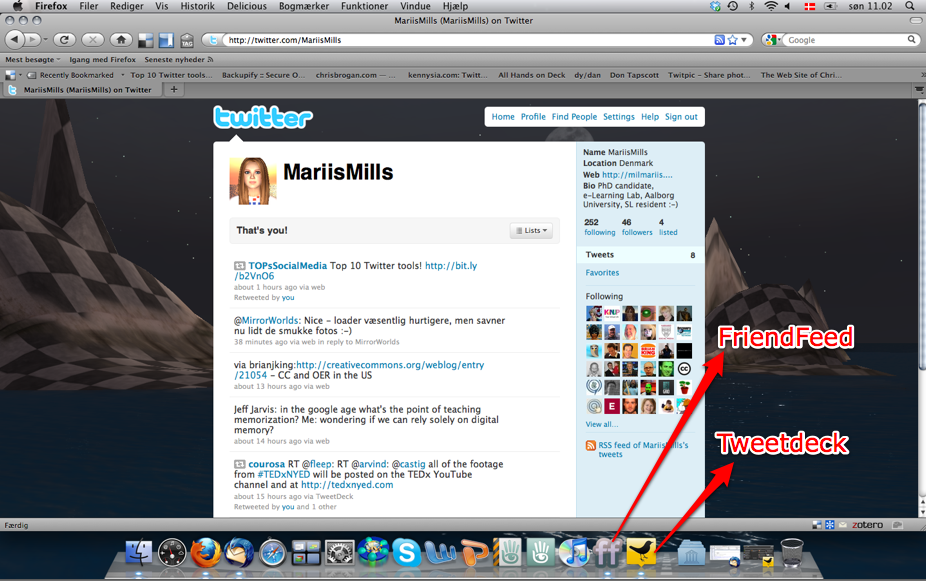
Evidently writing a max. of 140 characters is not complicated – it’s the management/storage of information that can be a little tricky, not least because there are so many different accompanying tools to choose from. When I started out yesterday, I already had FriendFeed installed and I like that probably because I’m used to pop-ups from my Thunderbird mail.

During the event I started following more people, and when my SL/FB friend BevanWhitfield noticed me, she quickly recommended Tweetdeck, but also mentioned that I should be careful in joining too many groups. And so I installed Tweetdeck, but it’s a much more complex tool than FriendFeed. I had a look at SIGs related to e-learning and there were soo many! And which one do you choose then? Another friend of mine made a “mention” in Tweetdeck and I wasn’t sure how to reply. A nice feature was the ability to synchronize with other accounts such as FB, but here I’m wondering if that’s really what I want to do. There’s bound to be a lot of redundancy, and I need to figure out how to handle that.

In sorting the information hashtags (#) seem to be part of the solution, but this is also something I need to learn more about. My SL/FB friend, ldinstl_chimera, pointed my attention to Backupify, which may turn out to be a great service for storage and management, whereas Arielion Clawtooth, mentioned Twapperkeeper, so there are plenty of new things to figure out. Incidentally, today TOPsSocialMedia tweeted a list of top 10 Twitter tools.

So to summarize my first impressions; it was fun, engaging and somewhat confusing and overwhelming – just as one would expect a newbie experience to be :-)

/Mariis