Research strategies and SL as Knowledge Medium

On Wednesday, January 21st I participated in a Master Class on Learning 2.0 and Knowledge Media at Aarhus University.Terry Anderson (Athabasca University) and Simon Heilesen (Roskilde University) were guest lecturers, while my MIL colleagues Christian Dalsgaard, Jørgen Bang and Elsebeth K. Sorensen (Aarhus University) served as moderators. Six Master- and PhD Candidates from different Danish Universities besides me participated, four of us giving short presentations of our projects.

Anderson gave an interesting presentation entitled “Overview of Research Methodologies for Social Software Research”, which initiated quite a discussion on research methodologies especially within educational research. Anderson was critical of educational research asking what results in fact had been able to instigate real change in educational practices. This lead to a critical overview of three dominant research paradigms respectively Quantitative, Qualitative and Critical. Anderson quoted a study by Mary M. Kennedy (1999):

The findings from this study cast doubt on virtually every argument for the superiority of any particular research genre, whether the criterion for superiority is persuasiveness, relevance, or ability to influence practitioners’ thinking. (from Anderson’s presentation above)

According to Anderson, who also is the director of Canadian Institute of Distance Education Research (CIDER), there is a need for development of new research strategies emphasizing possibilities for innovation and change. Anderson pointed to Design Based Research (DBR) as a potential strategy. At ELL we have a strong tradition of employing Action Research (AR) based strategies, including DBR, which in my point of view is a variant of AR. Both strategies are:

  • Iterative
  • Process and utility oriented
  • Intervention driven
  • Collaborative
  • Multileveled
  • Theory generating

However, there are at least two major differences between AR and DBR, namely the role of the researcher and the role of theory. In DBR the researcher works closely together with the practitioners, whereas in AR – especially in educational research – the researcher quite often also is the practitioner studying his/her own practice as a participant/insider. In DBR the role of theory is clearly defined as the point of departure of the research process:

Design-based researchers’ innovations embody specific theoretical claims about teaching and learning, and help us understand the relationships among educational theory, designed artifact, and practice. (DBRC.2003:5)

In AR theory isn’t necessarily applied from the beginning of the research process but to a higher degree grounded by the practice in the different research cycles, thus making it a more open strategy. Still, in claiming this I want to stress that there are many different takes on AR strategies. See Raelin (1999) for a good overview of different action based strategies.

Heilesen proceeded with another interesting presentation on “Learning 2.0 – Conditions and potentials of the social web”. There are so many comments to be made on this topic, but one of the issues Heilesen addressed was the potential of using new digital social technologies as means to change conventional conference participation from a typical closed and time limited event to a more open and continuous activity – exemplified by the MetaverseU conference at Stanford, February 2008 (where both Heilesen and I participated ;-). Anyone who has participated in RL conferences knows that it can be a somewhat dreary experience based mainly on one-to-many communication, and in my personal experience it can also be quite difficult to expand the effect/outcome afterwards. This issue of “frustrating conferences” is currently being addressed by George Siemens and colleagues. Note the upcoming open, online conference on this topic and see Siemens, Tittenberger & Anderson (2008) for a really interesting perspective on this.

After the lunch break, I and three other candidates were asked to present our projects. Presenting a PhD project in 15 min. really is an ungrateful task making it quite difficult to convey a coherent and comprehensible impression. On the other hand, I have to admit that at this stage in my PhD research many of my ideas and thoughts still need to be qualified by further research and a Master Class can be a really good opportunity to discuss this kind of “work-in-progress”. In my presentation, I chose to focus on the possibility of using SL as a knowledge medium – primarily based on the preliminary findings of my 2. research cycle, which was conducted in November/December 2008.

One of the things, which were critiqued as being unclear in my presentation, was my use of the concepts respectful and radical remediation. Initially I was inspired by Tringham, Mills  & Ashley (2007) and their experiences from the Remediated Places Project, where they used these two concepts (elaborating on Bolter & Grusin.1999) as a way of describing different ways of remediating. Based on my own experiences from remediating a specific course via SL I do find these two concepts very useful in describing not only different ways of remediating places, but also people and practices. There is, however, no doubt that I need to further develop and qualify my work on this, so that I can convey a more coherent, and thus convincing argument on this.

All in all, it was a very inspiring learning experience to participate in this Master Class, so my concluding words will be thanking all the participants :-)

/Mariis

References

Bolter, J. & Grusin, R. (1999): Remediation. Understanding New Media. The MIT Press

Kennedy, M. M. (1999) The problem of evidence in teacher education. In: Roth, R. (Ed). The Role of the University in the Preparation of Teachers. (pgs 87-107). London: Falmer Press.

Raelin, J. (1999) Preface. In: Management Learning. Vol. 30(2): 115-125. Sage Publications


Example of my ELL colleagues using DBR in current research

Coto, M. & Dirckinck-Holmfeld, L (2008): Facilitating Communities of Practice in Teacher Professional Development. Networked Learning Conference Proceedings 2008.

Other relevant resources

CIDER’s SIG on DBR

Smith, M.K. (1996, 2001, 2007): Action Research. The encyclopedia of informal education.

Center for Collaborative Action Research

Action Research Resources

Exploring Knowledge Media

Next week I’ll be attending a conference and a Master Class on “Knowledge Media” at Aarhus University.

knowledge-media2

The purpose of the Knowledge Media Conference is to discuss the role of new digital media within education in the knowledge society. What are the potentials of digital media in relation to learning, knowledge sharing and knowledge construction? The conference will focus on use of digital media for learning and knowledge acquisition in both formal and informal situations. The conference includes presentations from invited keynote speakers. Further, the conference will present the results of a research project at the Centre for IT & Learning on Knowledge media, 2007-2008.

Themes

  • Education for all?
  • New learning environments: Web 2.0 and Social Software
  • Knowledge media
  • Formal and informal learning

Keynotes

  • Terry Anderson, Athabasca University, Canada
  • Friedrich Hesse, Knowledge Media Research Center, Tübingen, Germany
  • Lars Qvortrup, School of Education, Aarhus University, Denmark
  • Jørgen Bang, Institute of Information and Media Studies, Aarhus University, Denmark
  • Lynne Schrum, George Mason University, USA

I’m especially interested in hearing Anderson’s talk on “Learning and Teaching beyond the Course Into Networks and Collectives”. The idea that social media, knowledge media or whatever you wish to call new digital media, slowly will dissolve our notion of courses (understood as fixed, teacher-driven activities) as a means of learning seems to gain more and more recognition and attention, and it’ll be interesting to hear Anderson’s thoughts on this in my own area (distance education) – not least since my PhD fundamentally is about course design, hmmm …

The Master Class, with Terry Anderson and Simon Heilesen (senior researcher at the Virtual Worlds Research, Roskilde University) as speakers, will also adress the potentials of digital media in relation to learning, knowledge sharing and knowledge construction. I’ll do a short presentation of Second Life as Knowledge Medium in Distance Education based on my experiences with the MIL course in the 2 research cycles so far. I think it’s a really good idea to hold the Master Class the day after the conference, because I’m quite sure many questions and ideas will come to me, so it’s nice to get an opportunity to discuss more informally.

/Mariis

What will change (everything) in 2009?

Via George Siemens my attention has been directed towards The Edge Foundation Inc. – a non-profit private organization established in 1988 with a mandate “to promote inquiry into and discussion of intellectual, philosophical, artistic, and literary issues, as well as to work for the intellectual and social achievement of society.”
edge

Every year The Edge asks its contributors a big question, and with reference as to how technology and science can lead to changes in our practices and perceptions, this year’s question was:

What will change everything? What game-changing scientific ideas and developments do you expect to live to see?

150 prominent thinkers have contributed, and there really are some radical food-for-thoughts, and as part of my new year’s resolution of eating more wisely I decided to indulge myself ;-) Here are a few of  my favorites with relevance to my current research interests …

Kevin KellyA New Kind of Mind

It is hard to imagine anything that would “change everything” as much as a cheap, powerful, ubiquitous artificial intelligence—the kind of synthetic mind that learns and improves itself.

When this emerging AI, or ai, arrives it won’t even be recognized as intelligence at first. Its very ubiquity will hide it.

While we will waste the web’s ai on trivial pursuits and random acts of entertainment, we’ll also use its new kind of intelligence for science.

The scientific method is a way of knowing, but it has been based on how humans know. Once we add a new kind of intelligence into this method, it will have to know differently. At that point everything changes.

Following this line of thought I can’t help but think of Connectivism, which in my opinion aims at rethinking our ways of knowing and knowledge “creation” in itself, and thus teaching and learning … I’m not sure that I’ve fully understood Connectivism and its implications, but I do know that my encounters with it so far have changed my own way of thinking education, teaching and learning. I’ll return to this in a post on some of the more qualitative outcomes of the MIL course, the primary case in my PhD.

Howard GardnerCracking Open the Lockbox of Talent

For the first time, it should be possible to delineate the nature of talent. This breakthrough will come about through a combination of findings from genetics (do highly talented individuals have a distinctive, recognizable genetic profile?); neuroscience (are there structural or functional neural signatures, and, importantly, can these be recognized early in life?); cognitive psychology (are the mental representations of talented individuals distinctive when contrasted to those of hard workers); and the psychology of motivation (why are talented individuals often characterized as having ‘a rage to learn, a passion to master?)

Note, however, that will not illuminate two other issues:

1.    What makes someone original, creative? Talent, expertise, are necessary but not sufficient.
2.    What determines whether talents are applied to constructive or destructive ends?

These answers are likely to come from historical or cultural case studies, rather than from biological or psychological science. Part of the maturity of the sciences is an appreciation of which questions are best left to other disciplinary approaches.

Gardner’s MI Theory was mandatory reading when I went to Teacher College in the late 90’ies and I do appreciate the debate and the confrontation with the conventional IQ concept. I do, however, think that Gardner has been greatly misinterpreted leading to misunderstandings of the power of teaching and learning. In this comment Gardner himself goes against the notion that anyone can achieve anything through hard work (putting enormous pressure on all teachers!). I’m not saying that we as teachers shouldn’t strive at facilitating the best learning circumstances for all our different students, but let’s be realistic! When that’s said, I think that I’ve come to see more and more evidence of yet another type of relatively autonomous intelligence, namely one concerned with virtual 3D. At the moment, this is just a gut feeling based on my observations, but I will try theorizing on this in a future post. I don’t expect MI, Learning styles or whatever you wish to call it to be a big part of my PhD, but naturally I will focus on my target group’s prerequisites and potentials for learning.

Chris Anderson (TED) – A Web-Empowered Revolution in Teaching

Five years ago, an amazing teacher or professor with the ability to truly catalyze the lives of his or her students could realistically hope to impact maybe 100 people each year. Today that same teacher can have their words spread on video to millions of eager students. There are already numerous examples of powerful talks that have spread virally to massive Internet audiences.

Driving this unexpected phenomenon is the fact that the physical cost of distributing a recorded talk or lecture anywhere in the world via the internet has fallen effectively to zero. This has happened with breathtaking speed and its implications are not yet widely understood. But it is surely capable of transforming global education.

For one thing, the realization that today’s best teachers can become global celebrities is going to boost the caliber of those who teach. For the first time in many years it’s possible to imagine ambitious, brilliant 18-year-olds putting ‘teacher’ at the top of their career choice list. Indeed the very definition of “great teacher” will expand, as numerous others outside the profession with the ability to communicate important ideas find a new incentive to make that talent available to the world. Additionally every existing teacher can greatly amplify their own abilities by inviting into their classroom, on video, the world’s greatest scientists, visionaries and tutors.

The idea that technology based knowledge has the potential to change the world certainly isn’t new and some of the other Edge Contributors are still waiting for the changes to appear (e.g. Haim Harari below), but the idea that this could lead to young people wanting to step into the teaching business I find really intriguing. Being a TED devotee myself, I sure do understand the power of high quality distributed knowledge sharing, and if the possibility of fame could inspire some, so be it … let’s just hope that somewhere along the way they’ll recognize and appreciate  some of the real qualities of possessing the world’s greatest job :-)

BTW for a more radical take on changes to come in the educational area have a look at David Gelernter, who among other things wants to replace teachers with parent-chosen, cloud-resistant “learning tracs” … I appreciate the problem, but I don’t agree on the solution.

Thomas MetzingerSoul-Travel for Selfless Beings

It is entirely plausible that we may one day directly control virtual models of our own bodies directly with our brain.

First, we manage to selectively block the high-bandwidth “interoceptive” input into the human self-model—all the gut feelings and the incessant flow of inner body perceptions that anchor the conscious self in the physical body.

Second, we develop richer and more complex avatars, virtual agents emulating not only the proprioceptive feedback generated by situated movement, but also certain abstract aspects of ongoing global control itself—new tools, as Brockman would call them. Then suddenly it happens that the functional core process initiating the complex control loop connecting physical and virtual body jumps from the biological brain into the avatar.

I don’t believe this will happen tomorrow. I also don’t believe that it would change everything. But it would change a lot.

In evaluating SL as part of the MIL course one of the students pinpointed the missing link between the avatars and our physical bodies stating that there was a huge discrepancy between all the activities we were enjoying in-world compared to our bodies passively sitting in front of the screens. Due to present technological limitations, my guess is that the majority of virtual world users don’t really feel immersed until after many months (if  ever), so Metzinger’s predictions surely would change a lot. Like Metzinger, I don’t expect this to happen over night, so meanwhile I’ll have to look closer at ensuring future MIL students a smoother entrance into SL.

Haim HarariAt Last: Technology will Change Education

Of the six billion people on our planet, at least four billions are not participating in the knowledge revolution.

The “buzz words” of distant learning, individualized learning, and all other technology-driven changes in education, remain largely on paper, far from becoming a daily reality in the majority of the world’s schools. The hope that affluent areas will provide remote access good education to others has not materialized.

So, my game-changing hope and prediction is that, finally, something significant will change on this front. The time is ripe. A few novel ideas, aided by technologies that did not exist until recently, and based on humanistic values, on compassion and on true desire to extend help to the uneducated majority of the earth population, can do the trick.

This is a change that will create a livable world for the next generations, both in affluent societies and, especially, in the developing or not-even-yet-developing parts of the world. Its time has definitely come. It will happen and it will, indeed, change everything.

This is one of the longer comments on The Edge, and Harari puts forward 5 very intersting and worth reading arguments for why this much needed change finally could happen in the year(s) to come.  If I didn’t share Harari’s vision there would be no point in having this job. I don’t think my own teaching will change a whole lot,  certainly not everything! But in helping other educators (MIL’s target group), I do believe that my colleagues and I are contributing to a positive change.

During the MIL course the students highlighted the fact that we met with educators and business people from all over the world, and this element is something I wish to further develop. Meeting and talking to people from different cultures may not change everything, but it is a small step in the right direction … For a related Edge comment on the impact of culture have a look at Timothy Taylor‘s thoughts.

Mihalyi CsikszentmihalyiThe End of Analytic Science

The idea that will change the game of knowledge is the realization that it is more important to understand events, objects, and processes in their relationship with each other than in their singular structure.

Western science has achieved wonders with its analytic focus, but it is now time to take synthesis seriously. We shall realize that science cannot be value-free after all.

Unfortunately, it does not seem to be enough to protect the neutral objectivity of each separate science, in the hope that the knowledge generated by each will be integrated later at some higher level and used wisely. The synthetic principle will have to become a part of the fundamental axioms of each science. How shall this breakthrough occur? Current systems theories are necessary but not sufficient, as they tend not to take values into account. Perhaps after this realization sets in, we shall have to re-write science from the ground up.

It is by no means accidental that I’ve chosen to finish this post by quoting Csikszentmihalyi’s comment. First of all, I totally agree with Csikszentmihalyi that science/research can’t be value-free. I just don’t see how that would be possible being that it is always humans that interpret the data wither they are quantitative or qualitative. And yes, sometimes we programme systems to detect patterns in large data sets, but it still is humans doing the programming. I may be naïve or even uninformed on this. Many of the Edge comments predict radical changes in AI, and I may be forced to change my opinion on this in the future. More importantly though this comment denotes one of the key changes I need to execute in my PhD in 2009, where I need to (re-)consider some methodological issues that have arisen during the 2 research cycles I’ve completed so far. Without getting into too much detail in this way too long post, I did encounter some major difficulties in a) being both the teacher and the researcher in my primary case, which leads to b) how do I interpret the data securing some degree of validity acknowledging a)?

On Friday January 2nd I attended this year’s first research meeting at Rockcliffe University, where Rockcliffe CEO, Phelan Corrimal, spoke on “Research in Virtual Environments: Data Collection & Validity”.

rockcliffe_020109_006
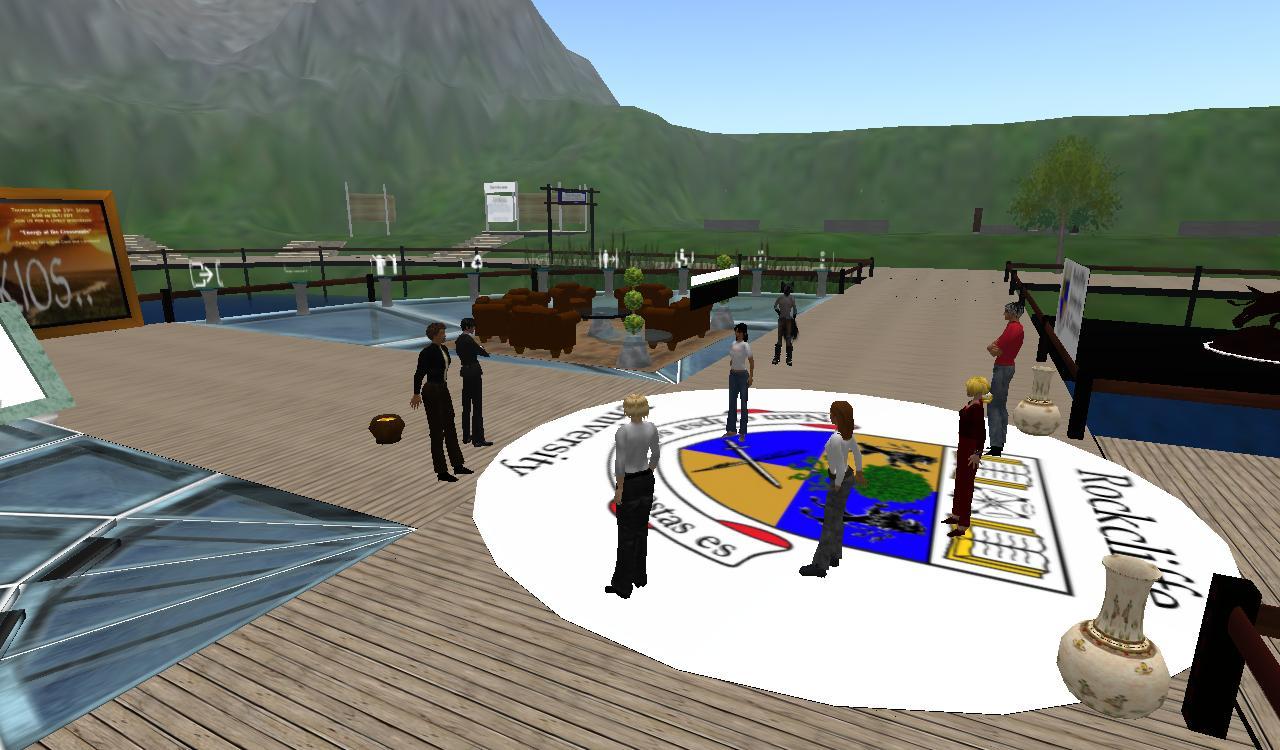
Researchers at Rockcliffe discussing threaths to research validity …

Unfortunately I still haven’t felt comfortable in joining these discussions actively. My English simply isn’t good enough when it comes to speedy answering, but I do enjoy these discussions very much anyway. I always find some sort of inspiration in these discussions getting new references, learning new phrases, discovering new concepts, and most important listening to researchers from various disciplines clearly enhances my general knowledge about research in virtual environments. It is nonetheless increasingly frustrating not being able to participate more actively in the many interesting discussions, especially because coming from a Scandinavian research tradition I think I may be able to contribute with some (very) different perspectives, so a more personal change in 2009 will be to take a risk and participate more actively … and maybe that will change everything … at least for me :-)

/Mariis

Quantitative learning outcome of the MIL course

12 students participated full time in the MIL course, one student divided his attention between SL and the second analytical object, the serious learning game, Global Conflicts, and 2 students who also chose Global Conflicts attended some SL activities ad hoc. The official learning goals of the course (regardless of choice) according to the MIL curriculum were;

The intellectual competence goals are that the student attains competence in:

  • identifying, reflecting on and appraising the scientific basis of ICT and didactic design formulating
  • analyzing and assessing problems within ICT and didactic design.

The professional competence goals are that the student attains competence in:

  • understanding and appraising theories and methods relating to didactic design
  • analyzing and assessing ICT based learning products and virtual learning environments on the basis of theories and methods relating to didactic design.

The practical competence goals are that the student attains competence in:

  • analyzing and assessing ICT based learning products and virtual learning environments on the basis of theories and methods relating to didactic design.

Besides these official goals, I stated that it was my hope that this SL course would force the students to reconsider familiar didactic elements and think out-of-the-box. When trying to articulate his learning outcome, one of the students suggested that this could be done in answering the following 3 questions; 1) What is your most significant learning outcome? 2) Has it been hard? And 3) How does this course differ from other MIL courses?

I think the second question is rather interesting and closely connected to the last question, but also to SL as a medium itself. It is widely recognized that SL has a very steep learning curve and that it takes a lot of time and effort to get accustomed to SL. Based on the general course findings and especially the many interesting discussion I had with the students I will return to this matter in a future post. In this post, I wish to focus on the course design and what this meant for the quantitative learning outcome in general.

ddd141208_005
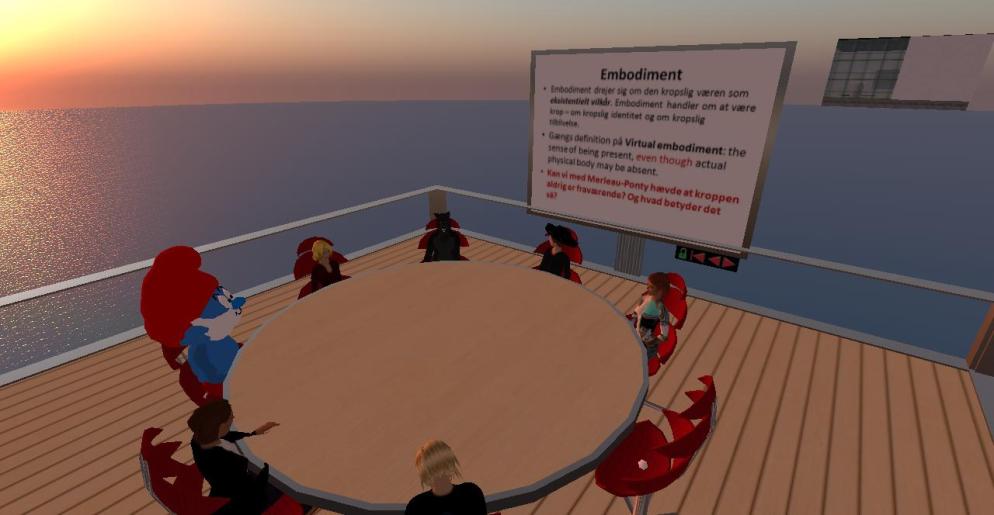
Didactic Design Discussion … on embodiment

The course is accredited with 4 ECTS points, which means that there is an expected workload of approx. 100 hours. MIL students are used to working hard, so I was a bit surprised when the student posed this particular question. On the other hand, I knew that this course was quite different from other MIL courses because of all the synchronous activities. Initially I told the students that I only expected them to participate in one synchronous activity in-world during the course, but all of them chose to participate in several. One of the major challenges of conducting distance education for further studies is to maintain a high level of flexibility. The MIL students are all attending the programme in their spare time from work and life in general, and most activities are asynchronous so that the students can chose to participate whenever they can fit it into their busy schedules. Since I knew that many of the students wouldn’t be able to attend on specific days, I tried to plan the activities covering most days of the week, including the weekends so that they had lots to choose from. From November 5th to December 15th there were a total of 25 activities with duration between 1-3 hours. The flip side to this was of course the risk that some students felt that they missed important stuff whenever they weren’t able to attend our in-world meetings. Furthermore the assessment criteria (a minimum of 3 postings in our asynchronous platform) of the course conflicted with the general workload. The students were asked to post their reflections in 5 different conferences covering essential didactic elements;

  1. Didactics and target groups – 32 postings by 12 students and me (8). Approx. 40 A4 pages.
  2. Orientation and navigation – 8 postings by 5 students and me (1). Approx. 8 A4 pages.
  3. Interaction0 posts!
  4. Learning processes – 68 posting by 11 students and me (21). Approx. 83 A4 pages.
  5. Audio-visuals – 9 postings by 2 students and me (4). Approx. 15 A4 pages.

Given that the official criteria was 3 postings corresponding to 3 A4 pages the degree of student activity has been uniquely high also considering the fact that besides these asynchronous discussions we had many, many long discussion in-world! I must say that I’m quite impressed :-)

Even though all students didn’t comment in all of the conferences it was clear from our in-world discussions that they had been reading and reflecting on all of the postings. We also had a general meta conference, which I mainly used to inform the students of upcoming activities and the students posted thoughts they could not fit into one of the 5 above mentioned conferences – there was a total of 232 postings there! Finally there was a conference where the students presented their avatars.

kgi161108_001
Visiting The Connectivism Course in Chilbo …

MIL students are generally recognized for their huge engagement, but I have to say that this course has exceeded even my highest expectations and it quite funny since the students initially expressed anxiety and fear of not meeting the official criteria.

The assessment criteria and the workload were topics we discussed eagerly during the course, and these are didactic elements that I need to reconsider, not only because the workload may prevent some students from choosing this course in the future, but also because 3 asynchronous postings may not be the best way to show learning potential and outcome of SL. I will return to this in a future post where I’ll be evaluating the different in-world activities also. For now I’ll plunge into the students own articulations of their qualitative learning outcomes and return asap … but based on the course activities I think its safe to say that all the students reached the course goals admirably!
/Mariis

Visit to Rockcliffe/ Phelan Corrimal

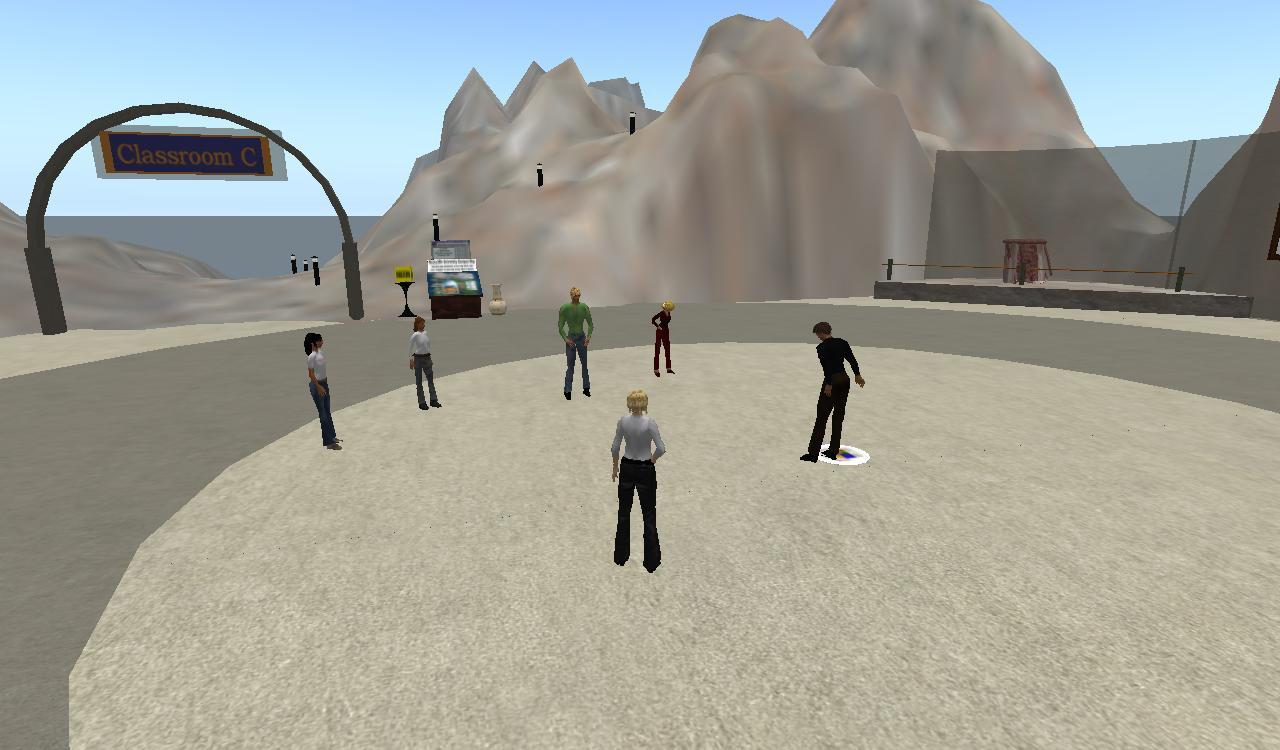
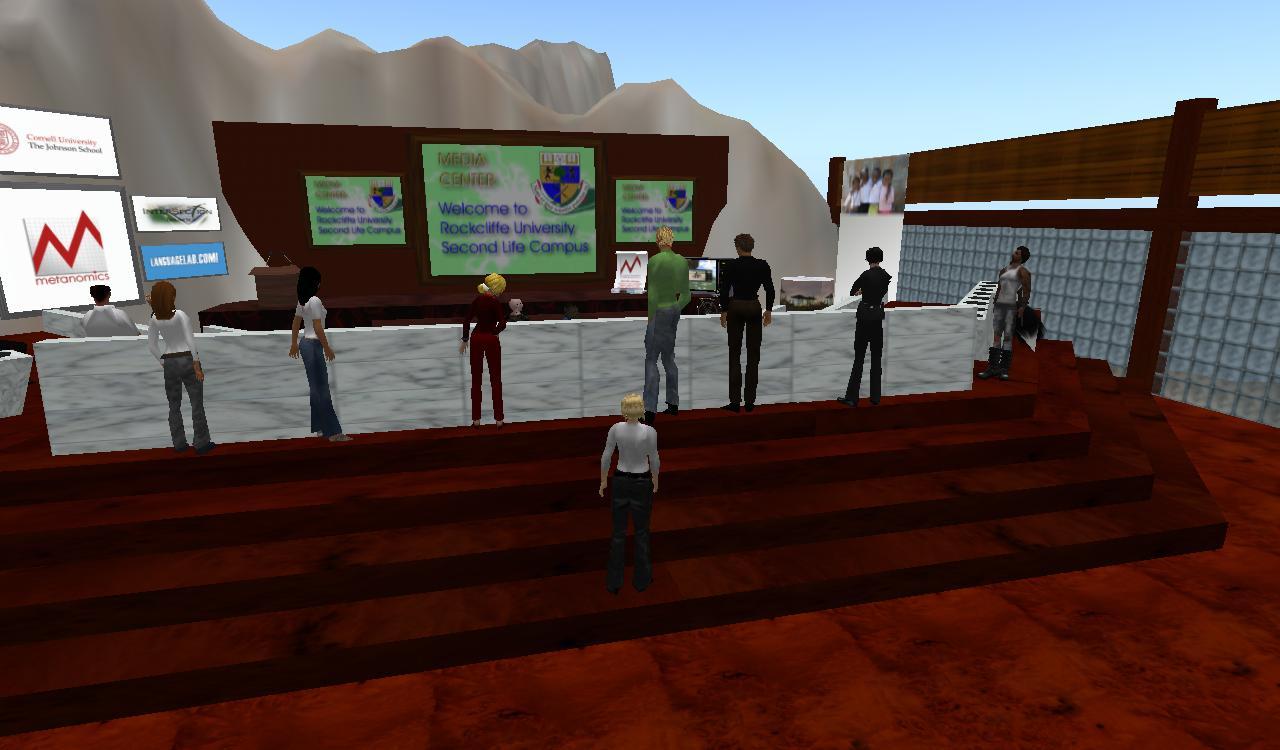
On Monday November 24th the MIL students and I visited Phelan Corrimal at Rockcliffe University. The Rockcliffe University Consortium is a distance learning organization servicing worldwide virtual learners and businesses. Located in Canada, the United States and the metaverse Rockcliffe University Consortium provides education, training and real time collaboration for its virtual members by incorporating interactive 3D immersive learning environments. Rockcliffe also is one of the Metanomics partners hosting part of the community on Mondays. Phelan is the President of Rockcliffe and is a very experienced in-world resident, so it was a great privilege that he took the time to share some of his thought on metaverse-based education and give us a tour to some of the locations on Rockcliffe’s many islands.

We started off in the reception area, unfortunately I had some initial voice-problems, but Phelan and the students seemed to manage just fine without me :-)

rockcliffe_002
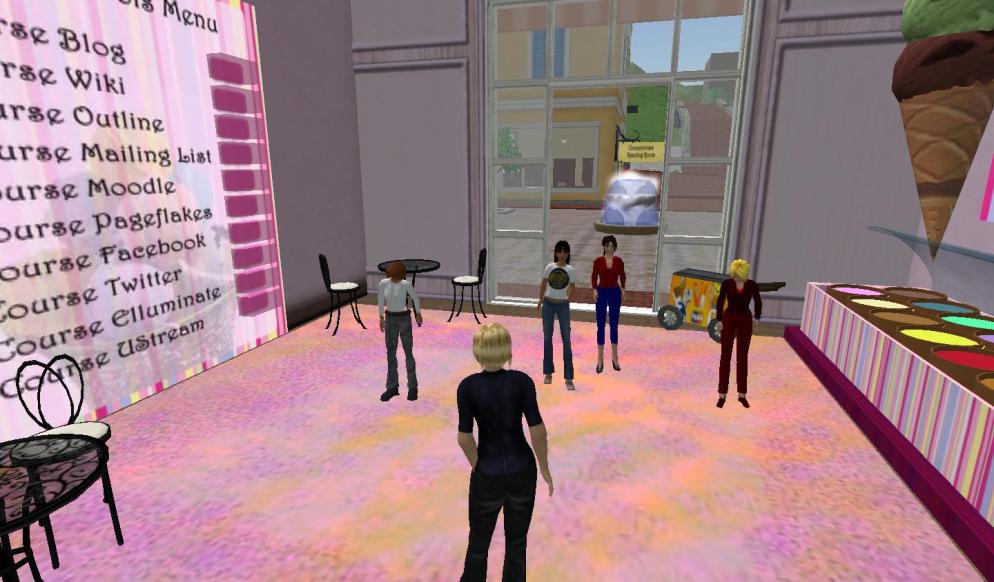
At the Rockcliffe reception listening to Phelan

While we were standing in the reception area an unknown avatar arrived. Usually when an avatar arrives in the middle of a discussion he/she will be greeted in the text-chat, but this was not the case. The students and I discussed this later on, since it was a breach in normal behavior, and we all agreed that the reason why nobody greeted this particular avatar was that he/she had explicit sexual references in his title. All of us are adults, pretty open minded and I don’t think any of us are particularly sensitive, but somehow sexual references just wasn’t appropriate in this context. Interestingly, the avatar representation made it more obvious that we were ignoring somebody and I did feel a bit impolite – a sentiment I don’t think I would have had, if I had just been ignoring a textual message …

rockcliffe_004
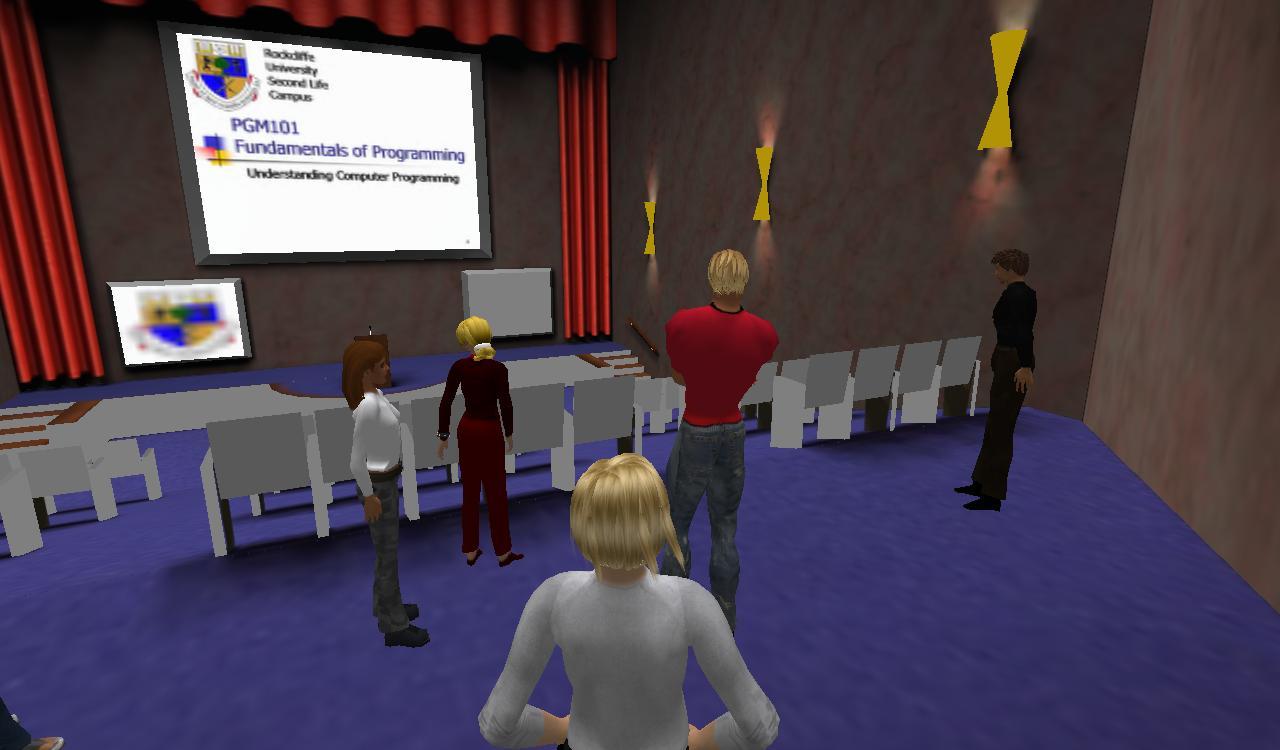
Investigating one of the more traditional classrooms

One of the topics Phelan talked about was how to create sustainable education in the metaverse. Unlike other in-world projects Rockcliffe isn’t funded by organizations or sponsors and developing a sustainable economy is one of the biggest challenges Phelan and his staff are facing. We discussed the possibility of having open classes with the option to buy some sort of certification, diploma or the like afterwards. It’s my impression that Phelan very much would like to employ a temporary kind of open-content’ish principle to their in-world work, but that’s easier said than done!

rockcliffe_007
Another type of classroom

Phelan had been attending the E-Learn World Conference in Las Vegas a few days before meeting us, and as he explained his head was filled with lots of inspiration. One of these sources of inspiration was Constance Steinkuehler (though I’m not sure she attended the above mentioned conference), who has done extensive research into MMOs, including learning potentials, cognitive theory and media literacy. Apparently she’s also looking at Second Life and explores the “3rd Places” concept  in that context. As far as I know, the  concept of “3rd Places” was coined by Ray Oldenburg in his book The Great Good Place, and can be used to define places where we gather publicly to facilitate and strengthen local democracy and community. Both references surely need a closer investigation in the future.

rockcliffe_008
Visiting the Metanomics show from the Rockcliffe partner location

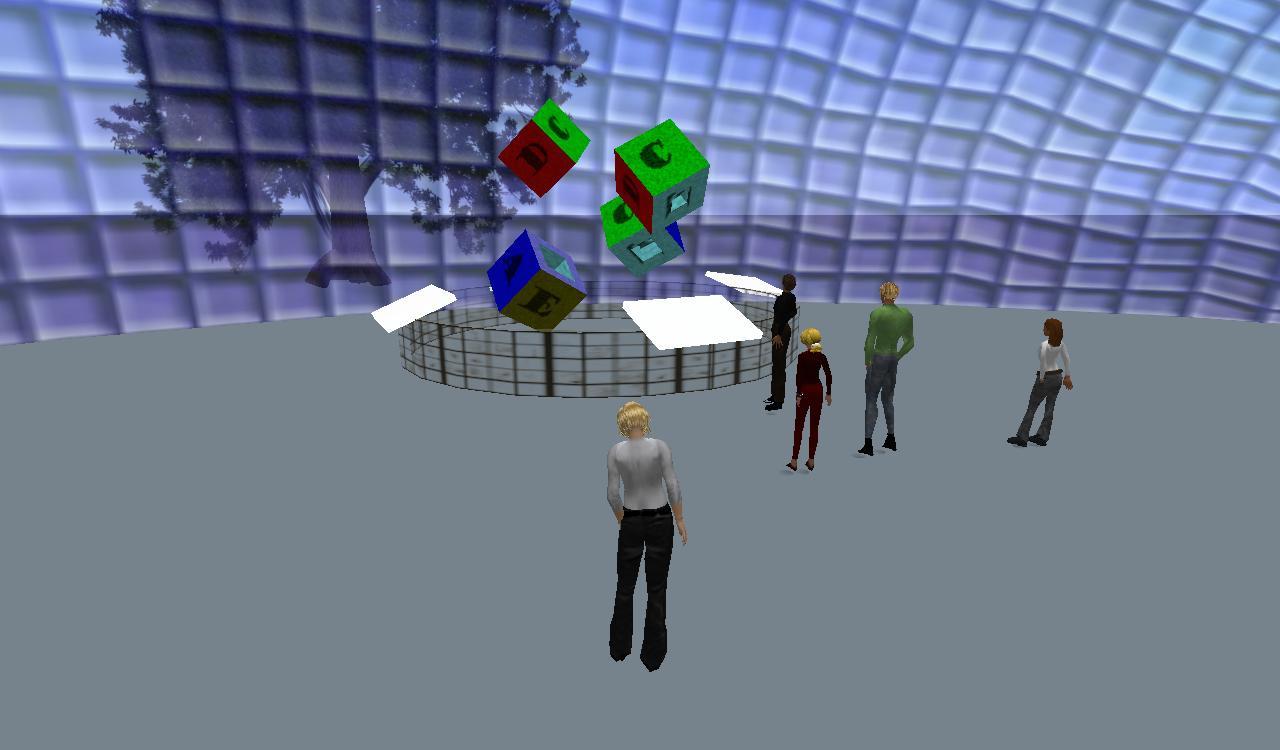
We ended the tour in one of the less traditional classroom settings where Phelan and his staff have experimented with building interactive learning objects – some of them supplemented by both text and voice-over instructions. Some of the courses at Rockcliffe are designed to learn building in-world and this is one of the areas used for that, including a large sandbox. This is also one of the areas that Phelan hopes to find time to expand and further develop in the future.

rockcliffe_010
Studying an interactive learning object

I had the great pleasure of meeting Phelan RL at The SLCC’08 in Florida in September, and we had some fun and very interesting talks during the convention. Phelan, in my view, truly is of the metaverse visionaries and I’m really grateful that he took the time to meet us. I know the students appreciate these meetings with other avatars/people very much, and with his interest in e-learning and research Phelan was a very relevant and good guy to visit – TY Phelan :-)

/Mariis