Toward a strategy for remediation of pedagogical practice in SL

I’ve recently reviewed findings from three completed research cycles based on the primary case (MIL) and SL in my PhD-project. The case study was conducted at the Danish online Masters program on ICT and Learning (MIL) at Aalborg University and consisted of remediating a course in three consecutive research cycles spanning from 2007-2009. Based on the findings I’ve started to outline a strategy for remediation of pedagogical practice in SL. In a newly published article Hunsinger & Krotoski (2010:94) state that “trying to reproduce experiences that exist in our physical world is often not the best strategy for designing learning and research experiences in virtual environments”, and they call for strategies that go beyond replicating and reconstructing physical environments. Combining my own findings with ideas from Vygotsky (1978), Wenger (1998) and especially Bolter & Grusin’s “Remediation. Understanding New Media” (1999), I’ve found that it is possible to identify two different strategies;

  • Respectful remediation. Main objective is to reproduce prior practice with no apparent critique – often focusing on a quantitative outcome. Other media are represented without manipulation in the mediation. In general, this type of remediation enhances the authenticity and enforces the authority of the original media and practice. Tradition, familiarity, and certainty are keywords in this strategy. Changes are experienced as minor, evolutionary modifications and typically only involve change in modality, not specific activities.
  • Radical remediation. Main objective is to reinvent prior practice based on critical review – often focusing on a qualitative outcome. Other media are represented manipulatively in the mediation. In general, this type of remediation challenges both authenticity and authority of the original media and practice. Innovation, alienation, and uncertainty are keywords in this strategy. Changes are experienced as major, revolutionary transformations, and typically involve change in both modality and activities.

Given the technologic, pedagogic, and not least ontological complexity of a rich medium like SL, I’ve found that an overall respectful remediation strategy isn’t a viable choice, but it is also possible to distinguish between respectful and radical remediation at the tactic level, and here I’ve found that a combination is fruitful. Furthermore, since SL not a an abstract space for interaction, but a remediated world, also the participants (remediated as avatars) and the teaching and learning environment (remediated as places) can be remediated either respectfully or radically.

In “Learning in 3D – adding a new dimension to enterprise learning and collaboration” Kapp & O’Driscoll claim that the first step to escape Flatland and avoid routinization is to “distance oneself from existing processes and practices and examine a newly emerging technology on its own merits“, and they speak of right and wrong ways of dealing with teaching and learning in 3D:

Done right, 3DLEs provide the opportunity for instructional designers to overcome their captivation with the classroom and move in a direction that is more congruent with the needs of the increasingly digitized and virtualized enterprise. Done wrong, 3DLEs will remain the domain of digital avatars in digital classrooms discussing content on digitally rendered PowerPoint slides. (Kapp & O’Driscoll. 2010:56).

While I do agree that any technology/medium should be examined in its own right, I do find it a bit hasty to dismiss prior experience and practice, and I find the dichotomy of right/wrong inappropriate. Naturally, it is possible to talk about more or less suitable ways of designing and using media, but it’s a very complex issue and should involve consideration of all elements of the practice. In my case study, I experimented with the use of slideshows in the two last research cycles, and found that this kind of respectfully remediated practice could have the same benefits and pitfalls as in the world outside SL. However, I also found that the build-in backchannel made it possible to draw use of the mediums more unique affordances by combining simultaneous use of text-chat and voice. By encouraging the students to comment and post questions during a presentation, an otherwise inactive one-way presentation can turn into quite an engaging teaching and learning activity. Nonetheless, by adding this component to the activity, the “rules of engagement” changed, as far as both the teachers and students needed to learn new roles and communication skills. Learning to deal with this kind of multi-voiced communication takes time, but it has the potential to open up and democratize the dialogue. My point here is that a seemingly respectful remediation in SL actually can result in radical changes, and another important aspect is that I don’t see respectful and radical remediation as a dichotomy, but as a dualism. Further, whether or not something is perceived as being respectful or radical will differ between individuals, communities, and cultures.

I’m not arguing that we should cease from experimenting with completely new ways of doing things, but my findings clearly show that an element of respectful remediation is important – at least until the participants have reached a certain level of experience and mastery of the medium. As an educator, I find that one of the advantages of respectful remediation is that it’s based on recognition and familiarity enabling the user to build on prior experience, and changes are experienced as minor, evolutionary modifications, which potentially leaves more energy for the participants to focus on the task at hand, rather than on the medium and the mediation. I’m currently working on designing a model to illustrate the complexity of different remediation strategies, so more on this will follow …

/Mariis

References

Hunsinger, J. & Krotoski, A. (2010): Learning and researching in virtual worlds. In: Learning, Media and Technology, 35:2, p. 93-97

Vygotsky, L.S. (1978): Mind in society. The development of higher psychological processes. (trans. M. Cole). Cambridge, MA: Harvard University Press.

Wenger, E. (1998): Communities of Practice. Learning, Meaning and Identity. Cambridge, MA: Harvard University Press.

Bolter, J. & Grusin, R. (1999): Remediation. Understanding New Media. Cambridge, MA: MIT Press.

Kapp, K. & O’Driscoll, T. (2010): Learning in 3D. Adding a new dimension to enterprise learning and collaboration. Pfeiffer.

Conference on IT and Innovative Learning Environments

Thursday/Friday his week I’ll be attending a conference/workshop on “It and innovative learning environments” at university level organized by the Danish Ministry of Science in Copenhagen.

I’m especially looking forward to hearing the two keynote speakers:

  • Phillip D. Long, Ph.D. Professor of Innovation and Educational Technology and Founding Director, Centre for Educational Innovation and Technology, University of Queensland, Australia.
  • Renate Fruchter, Ph.D. Founding Director of Project Based Learning Laboratory and Senior Research Engineer, Department of Civil Engineering, Stanford University, USA

I’ve never met Professor Long, but I’ve read a some of his publications concerning design of learning spaces (i.e. Trends in Learning Space Design), and I think he has some pretty interesting takes on educational design. He is scheduled to talk about Open Scholarship and Learning, which should be interesting too!

I’ve had the pleasure of meeting Professor Fruchter a couple of times during my recent research stay in the Bay Area. She’s a very energetic and positive woman, and I think it’ll be fun to reconnect with her. During this research stay a bunch of my colleagues from 5 different Danish universities and I attended a 2-day workshop at Stanford exploring the future of e-learning, and since this conference is kind of a follow-up event I’m also looking forward to reconnecting with them and the organizers from Innovation Center Denmark in Silicon Valley.

I’m also interested in hearing the Danish Minister of Science, Charlotte Sahl-Madsen’s thoughts on innovative learning and the future of our universities … On Friday I’ll be attending different workshops, and here I’m especially looking forward to hearing what colleagues from the Danish School of Education, Tina Bering Keiding & Morten Misfeldt have to say on the alignment between learning and physical space – not least since this is a topic I normally don’t pay much attention to due to my explicit focus on virtual space/place in my PhD-project.

Dan Gilbert, Learner Designer Technologist, Learning Innovations Inc. will facilitate a workshop entitled Innovative Tools and Techniques to Enhance Creativity in Your Classes: Connecting Design Thinking with Teaching and Learning”, and this should be interesting too. I’ve previously attended a workshop by Dan and it was inspirational and great fun!

Finally, I’m really looking forward to seeing how conference participants will be using Twitter #itlearning. This will be my first Danish conference organized with the explicit goal of using Twitter and I have no idea how this will be received – but I am expecting a lot of fun :-)

/Mariis

COMBLE – “Project of the Month” at elearningeuropa.info

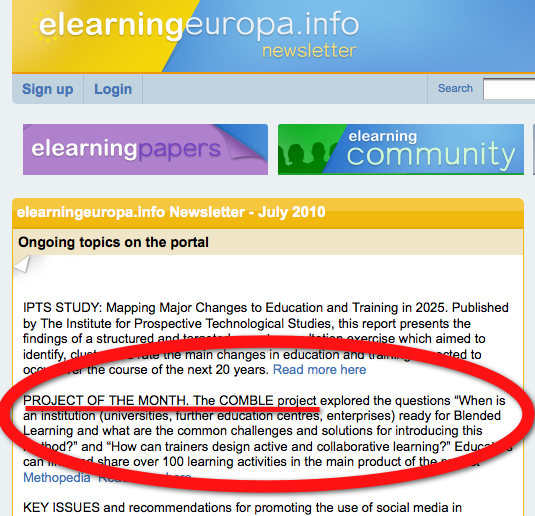
In July it was announced that the COMmunity of integrated Blended Learning in Europe (COMBLE) project had been chosen as “Project of the month” by the elearningeuropa. info portal. This portal is established by the European Commission to promote the use of multimedia technologies and Internet at the service of education and training, and so all of us involved in the COMBLE project are quite happy about this recognition of our work :-)

In this project several colleagues from e-Learning Lab (Aalborg University) and I worked together with partners from Germany, Poland and Estonia from January 2008 – December 2009.

In the COMBLE project we investigated the following questions:

  • When is an institution (universities, further education, enterprises) ready for Blended Learning?
  • What are the common challenges and solutions?” and
  • How can trainers design for active and collaborative learning?

Together with my PhD-colleague, Heilyn Camacho, I designed and ran a highly successful 6 week course on Problem Based Blended Learning in Second Life and Moodle on which I’ve written several posts (i.e. this one explaining the course concept).


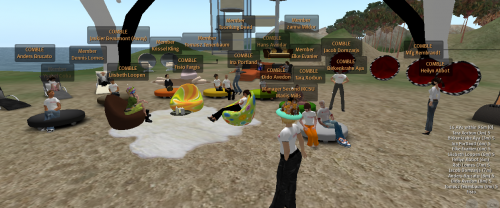
A scene from one of the SLectures in the course.

Besides this the COMBLE project also resulted in:

  • A wiki-based community called Methopedia for Blended Learning experts to share relevant knowledge and experience. Methopedia is available in four languages and contains about 100 different learning activities and an interactive seminar planer.
  • A Blended Learning Readiness Wiki to support strategic planning, change management and the evaluation of blended learning scenarios at the institutional level.
  • The Methopedia Learning Designer: an online flash tool to design seminars.

BTW: we would like to encourage anyone interested in Blended Learning to join our community – either at the Methopedia website or on Facebook :-)

/Mariis

Dissertation time – time for final decisions

When I return from holidays by mid-August I’ll commence the final phase of my PhD-project, seeing that I’ll have to start writing my dissertation, which is due next summer. This means that I have to start making final decisions on what to include respectively exclude. To date I’ve completed four research cycles and I have the opportunity of running a fifth and final research cycle in December 2010 – February 2011, as I’ll be conducting yet another SL-course. However, I don’t have to include the fifth cycle in my PhD because I already have a LOT of data, and so inclusion will depend on how I’ll be doing on time. Now making decisions is difficult, but I find that sticking with them can be even more so! Fortunately a few important decisions have turned out to be long-standing.

From a methodological point of view I opted for an Action Research inspired approach from the beginning of my project and this has worked out very well giving me the data I’d hoped for through redesign/remediation, participant-observation, interviews and surveys.

I’m hoping to find the time to do a few follow-up interviews with former participants of my courses and perhaps with one of the methodological experts by who I’ve been greatly inspired, namely the anthropologist and author of “Coming of age in Second Life – An anthropologist explores the virtually human”, Tom Boellstorff of UC Irvine. As previously expressed in this post, Boellstorff advocates studying SL in its own rights, and in my opinion he’s the first anthropologist, who truly recognized how “real” the “virtual” can be, and I applaud his attempt to challenge old-school anthropology.

When it comes to other theories relevant for my work the decisions have been harder to come by, but that’s just part of the learning process. Just as it is sometimes necessary in life in general, I’ve had to make a few detours to find my way. Taking “the road less travelled by” has always been a credo of mine and I don’t expect that to change sometime soon.

Throughout my project I’ve been exploring different theories – especially within the field of teaching and learning, but lately also with regard to media theory. My affiliations with Aalborg University (AAU) and the Danish online Master Program on ICT and Learning (MIL) have nonetheless guaranteed a few fix points. At AAU the overall pedagogical framework is based on our local understanding of Problem-Based Learning (PBL) and at MIL we’ve tried to combine PBL with principles from a sociocultural-historical perspective most notably expressed by Lave & Wenger and Wenger and their ideas on Situated Learning and Communities of Practice (CoP).

While CoP-theory can help explain certain aspects of teaching and learning, it lacks the ability to explain others, and this is only logic since we’re dealing with very complex phenomena. When we combine these complex processes with the use of tools, I’ve found Vygotsky’s concept of mediation relevant and aligned with this I do believe that Bolter & Grusin’s concept of remediation contributes to a more specific understanding when the tools are identified as new, digital media. Engestrom has further developed Vygotsky’s and especially Leontjev’s ideas focusing on activity and conflicts (or even double binds) as motivation for change.  Combined with ideas of scaffolding through the zone of proximal development all of the above theories have the potential to illuminate the problems I’ve identified in my project.  The major challenge that lies ahead is trying to create a unified model that includes all of these important aspects – something that has caused me trouble, since these theorists work with different analytical units and attribute different meanings to similar or even the same concepts. Throughout my project I’ve been experimenting with using existing models and creating new ones, and even though it now seems that I will not be using any of them in my dissertation, they have served as important tools to sharpen my thinking. The most important outcome of this work has been the realization that none of the existing models satisfy my project’s need, and I therefore have to create my own model that also includes some of the aspects I’ve come to find pertinent in working with remediation in new media – i.e. time is rarely included in models depicting teaching and learning.

And so, as I’m getting ready to spend some much anticipated time AFK, I’m feeling quite confident about the next phase, even though I know that more decisions are needed and that that process will not end until I’ve Ph.inisheD. ;-)

/Mariis

The AVATAR project: “Added Value of teAching in a virTuAl woRld”

Alumni from The Danish Online Masters Program in ICT and Learning (MIL) and one of the participants in my first research cycle in SL back in 2007, Inger-Marie F. Christensen from Southern University of Denmark (SDU), is currently involved in an interesting project called AVATAR “Added Value of teAching in a virTuAl woRld”.

The project runs for two years (December 2009 – November 2011), is co-financed by the European Commission under the Lifelong Learning Sub-Programme Comenius, and involves partners from Austria, Bulgaria, Denmark, Italy, Spain and the UK.

AVATAR is inspired by the lack of ICT use in schools throughout Europe despite the possible educational benefits and social learning opportunities they promote, and the project’s primary aim is to enhance the quality of teaching and education in secondary schools.

So far a six-month research phase has been completed based on desktop research, online questionnaires, video interviews, and case studies. The next phase of the project will be to design, build and develop training contents, activities and virtual labs for an upcoming AVATAR course “Teaching in a Virtual World” on an e-learning platform combined with SL and Teen Grid. This course is expected to run from mid-January 2011 and will be open for secondary school teachers and their students. The project partners will collectively select about 100 secondary school teachers from each partner country to participate in the course and test out virtual worlds in their classrooms. Towards the end of the course, each teacher trainee will design a “project work”, consisting of a lesson or course in a subject of their choice to test out on a group of students at their school.

The AVATAR course aims at enhancing the level of ICT use in education by providing teachers with new methodological and pedagogical tools. Virtual Worlds (VW) can help teachers and students learn key skills and information in different subjects, while incorporating collaborative learning and a learning-by-doing approach.

Course description and application form is expected to be published here on the project website by the end of July :-)

/Mariis