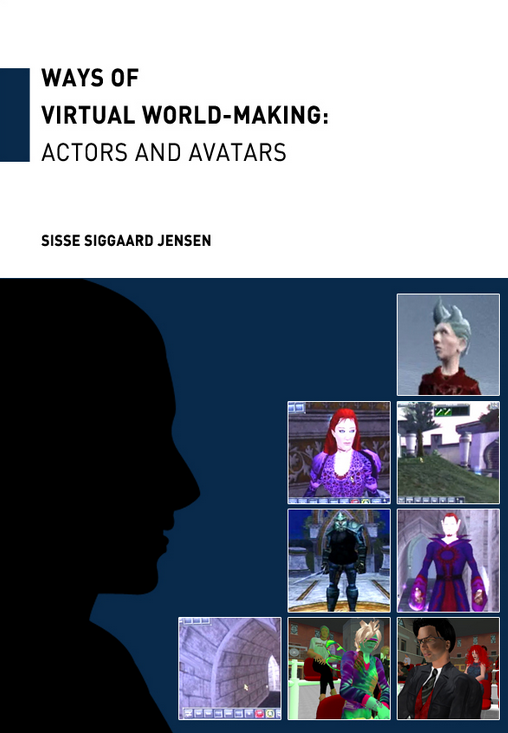
Sisse Siggaard Jensen, Professor, Ph.D. of Digital Communication at Roskilde University, Denmark has had her dissertation “Ways of Virtual World-making – Actors and Avatars” accepted for defense for the doctorate degree Dr. Phil. Sisse truly is one of the leading pioneers in this emerging research field, I’ve had the pleasure of meeting her many times during my PhD-work, and this is just wonderful news – big congrats Sisse :-)
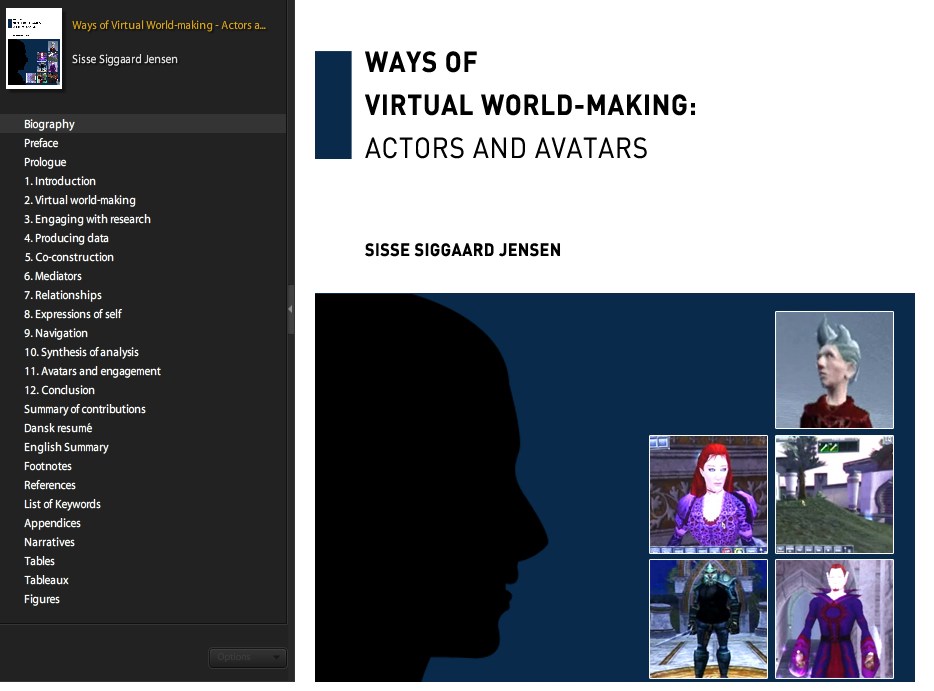
The dissertation can be purchased as e-book here
UPDATE: Non-native Danish speakers can order the book by sending a request to: academicbooks@academicbooks.dk
l bought the dissertation yesterday and I have been unable to put it aside – it really is fascinating reading for those interested in research in VWs! The dissertation contributes to the research field with an interpretive, constructivist, and semiotic understanding of human actors’ engagement with the virtual worlds of EverQuest and Second Life. The study is aimed at empirical analysis of different ways of engaging with VWs, and it is based on longtime participatory observation and video interviews (from 2002-2009). The overall research question is: In what ways do actors make sense of situations of engagement with virtual worlds?
Key theoretical and methodological influences in the study are:
- The concept of metaphors (i.e. Lakoff & Johnson 1980, Johnson 1987)
- The sense-making approach (i.e. Dervin 2003)
- The optic of actor-network theory (i.e. Latour 2005)
- The emphasis on ways of seeing in relation to video analysis (i.e. Grimshaw 2001, 2005)
Besides contributing with models of her own (actor-network diagram, sense-making triangle) that I need to study further, I also noted that Sisse provides some very good overviews of key points of interest in VW research such as; history of VWs, and overviews of research in relation to avatars, identity, and engagement. Further, Sisse’s work with video interviews and analysis hereof also makes this dissertation interesting from a methodological point of view, and in general it is a valuable resource and important contribution to the field.
Sisse will defend her dissertation on Friday June 1, 2012 at 1 – 5 PM (GMT+1) in building 00, at Roskilde University, and it will be streamed on Roskilde university’s website: ruc.dk as well as on the blog: worlds.ruc.dk, which is the blog of the Danish research project “Sense-making strategies of the innovations of Virtual Worlds”.
The opponents for the defense are: Professor Jay D. Bolter, Georgia Institute of Technology, Professor Andrew Burn, London University, Professor Kim C. Schrøder, Roskilde University (chair).
/Mariis
References
- Dervin, B. (2003): Sense-Making’s journey from metatheory to methodology to method: An example using information seeking and use as research focus. In Dervin, B.; Foreman-Wernet; L & Lauterbach; E. (Eds.). (2003). Sense-Making Methodology reader: Selected writings of Brenda Dervin (pp. 133-164). Cresskill, NJ: Hampton Press.
-
Grimshaw, A. (2001): The Ethnographer’s Eye: Ways of Seeing in Anthropology. Cambridge: Cambridge University Press.Grimshaw, A. (2005): Eyeing the Field: New Horizons for Visual Anthropology. In: A. Grimshaw & A. Ravetz (Eds.), Visualizing Anthropology (pp. 17-31). Bristol, UK: New Media Intellect.
- Johnson, M. (1987): The Body in the Mind. The Bodily Basis of Meaning, Imagination, and Reason. Chicago, London: The University of Chicago Press.
- Lakoff, G., & Johnson, M. (1980): Conceptual Metaphor in Everyday Language. The Journal of Philisophy, 77(8), 453-486.
- Lakoff, G., & Johnson, M. (2003 [1980]): Metaphors we live by. Chicago: The University of Chicago Press.
- Latour, B. (2005): Reassembling the Social. An Introduction to Actor-Network-Theory. Oxford, New York: Oxford University Press.



 Mariis' digitale refleksioner