Vodpod videos no longer available.
Sunday mood in-world, posted with vodpod
Vodpod videos no longer available.
Friday November 5th, I was invited to speak at a Polish organized in-world conference about “Internet – New Media – Culture 2.0“.

Conference site at the Second UMCS island
The conference was organized by colleagues from different departments of Uniwersytet Marii Curie-Skłodowskie – some of whom I’ve previously worked with in the EU funded research project COMBLE. I was very pleased to get the opportunity to talk about some of my findings, and there were some great questions and comments on especially immersion and media convergence.
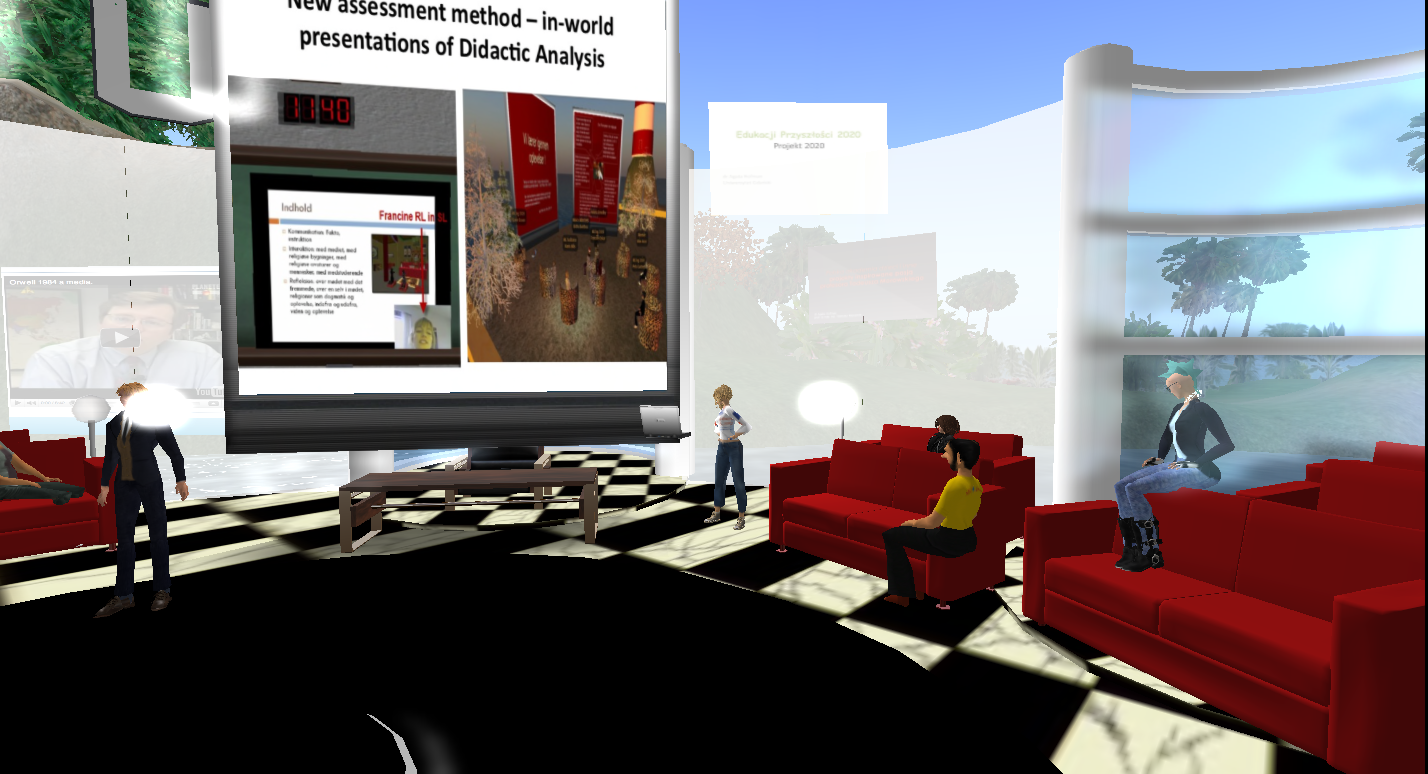
Talk about the new assessment method I implemented in my 3rd research cycle.
As promised to the participants, I’m hereby uploading my presentation.
Special thanks to Raf Moczadlo for inviting me :-)
/Mariis
On Friday October 15th, a total of more than 200 museums, churches, exhibition halls, galleries, political institutions, and other venues will open their doors in connection to the annual “Night of Culture” that has been a Copenhagen event since 1993. As part of this event, the Danish Ministry of Science has asked me to participate by presenting research, teaching, and learning in SL.

The event will run from 6PM until midnight (local time), and I will be in the Ministry together with one of my MIL-students, Inge Knudsen, from Business College, Horsens.Inge is a highly experienced SL educator and builder, who has run in-world courses on English, Chinese and Cultural Understanding among other things and last year she won the Danish Research Network’s annual Innovation Prize because of her work in SL.
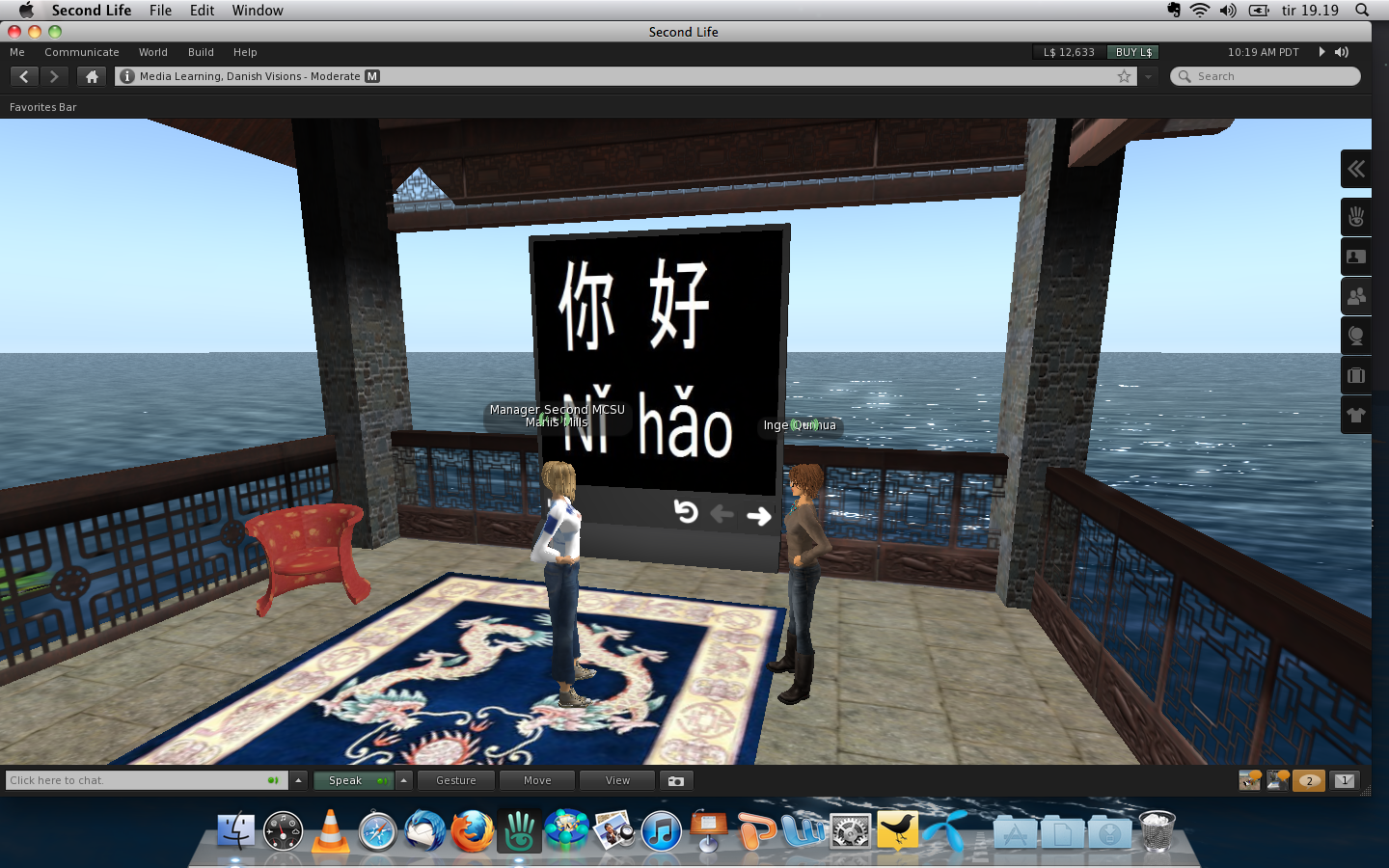
Inge and I discussing part of her presentation for the “Night of Culture”.
In-world we will be accompanied by MIL alumni, Per Christensen and two of his close colleagues, Nicolai Green Hansen and Erik Hansen – all from VIA University College. Per and his colleagues are currently preparing for a cross-cultural collaboration with a Chinese University on their island Innovative Learning, where it is also possible to see and experience another build that last year won the Danish Ministry of Education’s annual e-Learning award.
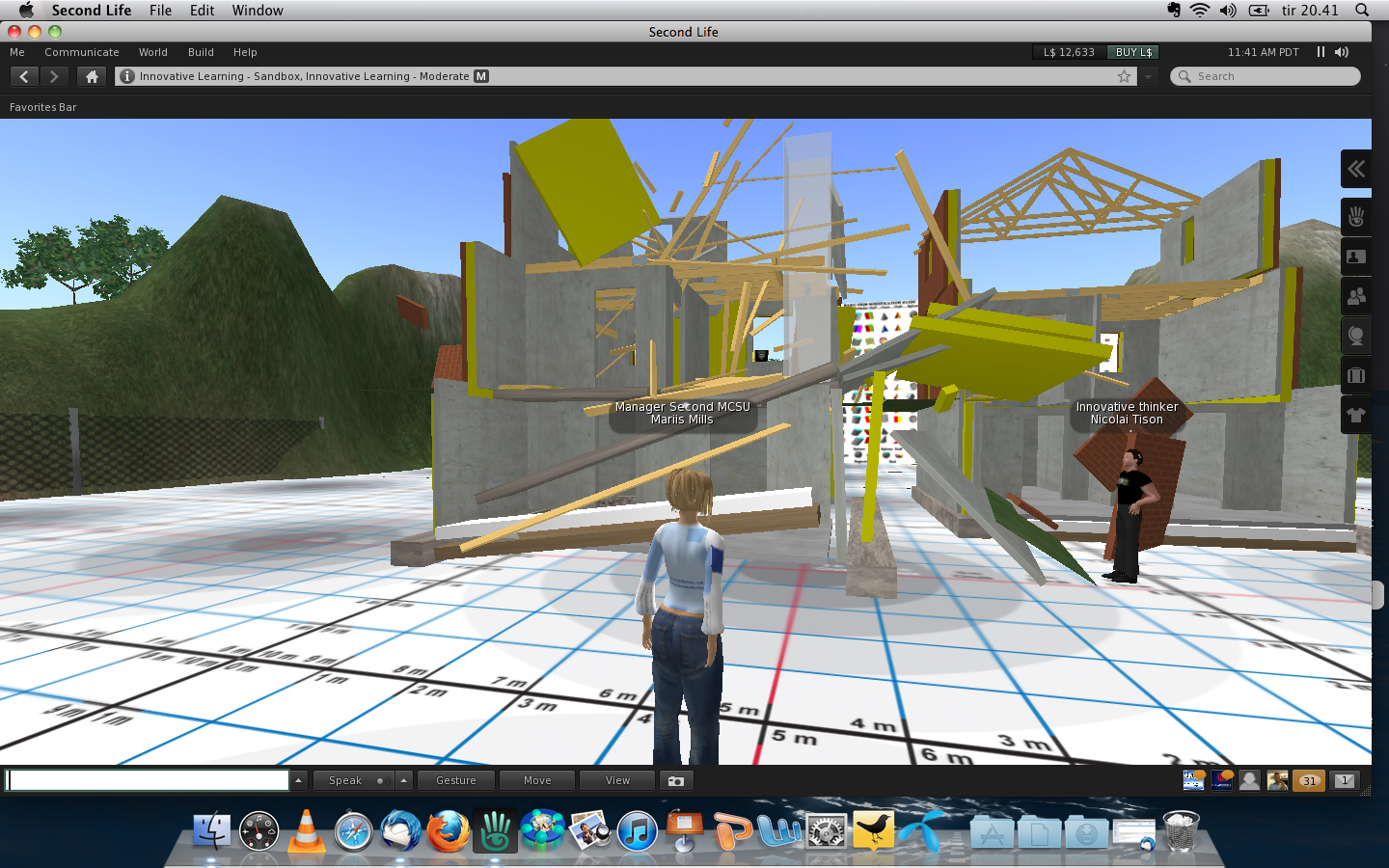
Nicolai and I discussing part of their presentation for the “Night of Culture”.
We are all still in the process of planning this event, and there are several challenges. The Ministry has put together an extensive program (in Danish) including lots of interesting activities all night. This means that it is impossible for Inge and I to foresee how many guests will find their way to our presentations. Last year approx. 1000 guests participated in the Ministry’s activities.
We have two rooms at our disposal, and so far we’ve planned for one of them to be the “Teaching and Learning Room”, while the other will be the “Presentation Room”. In the “Teaching and Learning Room” planned in-world session with Inge and Per will run twice the hour, and guests in this room will be able to participate via guest-avatars. In the “Presentation Room” several computers with logged in guest-avatars will enable guests to explore and participate in different in-world places/events covering education, business, art, music, RL rebuilds and not least places/builds NpIRL. Inge and I will oscillate between the two rooms, and in between scheduled sessions, we’ll be available for questions and discussion of the many, different research, teaching, and learning potentials of a medium like SL.
We are also in the process of preparing note cards covering all sorts of topics, events and locations – and I encourage other SL residents to send me (Mariis Mills) suggestions of interesting locations/events. The entire event will take place from 9AM – 3PM SLT. Putting together a program for a 6 hours in a row event is quite daunting, and I personally find that the biggest challenge lies in trying to convey a sense of meaning of SL for RL-guests just passing by…
When we’re done planning, I’ll update this post with SLurls to locations where it will possible to join us in-world.
/Mariis
UPDATE – program
Most of the activities are directed towards the RL guests visiting the Ministry – and they will be in Danish. However, Inge Qunhua will do her sessions in English too, if anyone asks her. Inge will teach the audience how to introduce themselves in Chinese and there will be general lessons in understanding the Chinese culture.
Inge’s sessions will take place on her Island, Danish Visions. The first session starts at 10:30 AM SLT, and she will repeat it every hour until the last one at 2:30 PM SLT.
In between Inge’s sessions there will be live music and other activities on her Island.
For those interested in the Danish VIA-session please have a look in the group “Kulturnat 2010”, where you find all sorts of notices with LMs and further details on the in-world program.
In one of the two rooms in the Ministry, we will, starting at noon SLT, be streaming from Pop Art Lab, Claus Uriza – and later on we’ll visit The Yard Club, where there will be “Open Mic” with Torben Asp.
I’ve recently reviewed findings from three completed research cycles based on the primary case (MIL) and SL in my PhD-project. The case study was conducted at the Danish online Masters program on ICT and Learning (MIL) at Aalborg University and consisted of remediating a course in three consecutive research cycles spanning from 2007-2009. Based on the findings I’ve started to outline a strategy for remediation of pedagogical practice in SL. In a newly published article Hunsinger & Krotoski (2010:94) state that “trying to reproduce experiences that exist in our physical world is often not the best strategy for designing learning and research experiences in virtual environments”, and they call for strategies that go beyond replicating and reconstructing physical environments. Combining my own findings with ideas from Vygotsky (1978), Wenger (1998) and especially Bolter & Grusin’s “Remediation. Understanding New Media” (1999), I’ve found that it is possible to identify two different strategies;
Given the technologic, pedagogic, and not least ontological complexity of a rich medium like SL, I’ve found that an overall respectful remediation strategy isn’t a viable choice, but it is also possible to distinguish between respectful and radical remediation at the tactic level, and here I’ve found that a combination is fruitful. Furthermore, since SL not a an abstract space for interaction, but a remediated world, also the participants (remediated as avatars) and the teaching and learning environment (remediated as places) can be remediated either respectfully or radically.
In “Learning in 3D – adding a new dimension to enterprise learning and collaboration” Kapp & O’Driscoll claim that the first step to escape Flatland and avoid routinization is to “distance oneself from existing processes and practices and examine a newly emerging technology on its own merits“, and they speak of right and wrong ways of dealing with teaching and learning in 3D:
Done right, 3DLEs provide the opportunity for instructional designers to overcome their captivation with the classroom and move in a direction that is more congruent with the needs of the increasingly digitized and virtualized enterprise. Done wrong, 3DLEs will remain the domain of digital avatars in digital classrooms discussing content on digitally rendered PowerPoint slides. (Kapp & O’Driscoll. 2010:56).
While I do agree that any technology/medium should be examined in its own right, I do find it a bit hasty to dismiss prior experience and practice, and I find the dichotomy of right/wrong inappropriate. Naturally, it is possible to talk about more or less suitable ways of designing and using media, but it’s a very complex issue and should involve consideration of all elements of the practice. In my case study, I experimented with the use of slideshows in the two last research cycles, and found that this kind of respectfully remediated practice could have the same benefits and pitfalls as in the world outside SL. However, I also found that the build-in backchannel made it possible to draw use of the mediums more unique affordances by combining simultaneous use of text-chat and voice. By encouraging the students to comment and post questions during a presentation, an otherwise inactive one-way presentation can turn into quite an engaging teaching and learning activity. Nonetheless, by adding this component to the activity, the “rules of engagement” changed, as far as both the teachers and students needed to learn new roles and communication skills. Learning to deal with this kind of multi-voiced communication takes time, but it has the potential to open up and democratize the dialogue. My point here is that a seemingly respectful remediation in SL actually can result in radical changes, and another important aspect is that I don’t see respectful and radical remediation as a dichotomy, but as a dualism. Further, whether or not something is perceived as being respectful or radical will differ between individuals, communities, and cultures.
I’m not arguing that we should cease from experimenting with completely new ways of doing things, but my findings clearly show that an element of respectful remediation is important – at least until the participants have reached a certain level of experience and mastery of the medium. As an educator, I find that one of the advantages of respectful remediation is that it’s based on recognition and familiarity enabling the user to build on prior experience, and changes are experienced as minor, evolutionary modifications, which potentially leaves more energy for the participants to focus on the task at hand, rather than on the medium and the mediation. I’m currently working on designing a model to illustrate the complexity of different remediation strategies, so more on this will follow …
/Mariis
References
Hunsinger, J. & Krotoski, A. (2010): Learning and researching in virtual worlds. In: Learning, Media and Technology, 35:2, p. 93-97
Vygotsky, L.S. (1978): Mind in society. The development of higher psychological processes. (trans. M. Cole). Cambridge, MA: Harvard University Press.
Wenger, E. (1998): Communities of Practice. Learning, Meaning and Identity. Cambridge, MA: Harvard University Press.
Bolter, J. & Grusin, R. (1999): Remediation. Understanding New Media. Cambridge, MA: MIT Press.
Kapp, K. & O’Driscoll, T. (2010): Learning in 3D. Adding a new dimension to enterprise learning and collaboration. Pfeiffer.
In July it was announced that the COMmunity of integrated Blended Learning in Europe (COMBLE) project had been chosen as “Project of the month” by the elearningeuropa. info portal. This portal is established by the European Commission to promote the use of multimedia technologies and Internet at the service of education and training, and so all of us involved in the COMBLE project are quite happy about this recognition of our work :-)
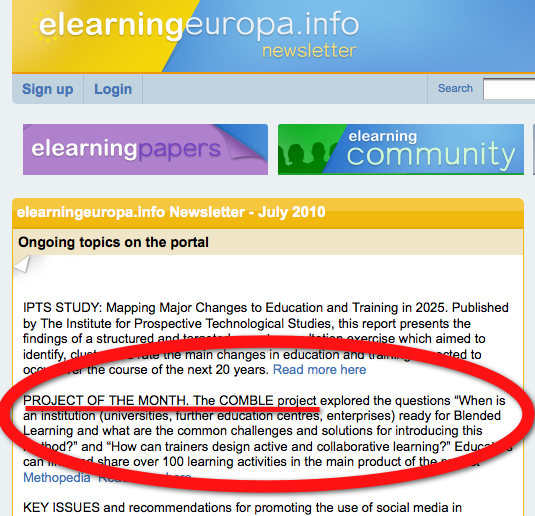
In this project several colleagues from e-Learning Lab (Aalborg University) and I worked together with partners from Germany, Poland and Estonia from January 2008 – December 2009.
In the COMBLE project we investigated the following questions:
Together with my PhD-colleague, Heilyn Camacho, I designed and ran a highly successful 6 week course on Problem Based Blended Learning in Second Life and Moodle on which I’ve written several posts (i.e. this one explaining the course concept).
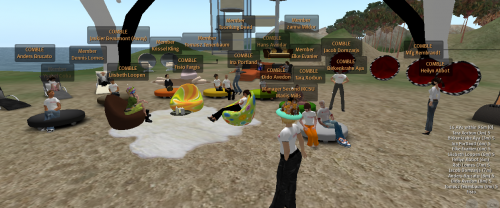
A scene from one of the SLectures in the course.
Besides this the COMBLE project also resulted in:
BTW: we would like to encourage anyone interested in Blended Learning to join our community – either at the Methopedia website or on Facebook :-)

/Mariis
 Mariis' digitale refleksioner