In-world course next 5 weeks

From November 1st – December 15th I’ll be facilitating a blended course using SL at The Danish Master programme in ICT and Learning. This course serves a primary case in my PhD-project, and I did a pilot study using the same course last fall together with 22 students. This is a brief description of the course as I’ve planned it this fall.

Educational setting – Master programme on ICT and Learning
The Master programme in ICT and Learning (MIL) was established in 2000 as a shared educational enterprise on equal terms between five Danish Universities, as an attempt to enhance collaboration between universities and working life within further and continued education.The Master programme is research based; teachers come from the five different research environments at the collaborating universities, and all participants (teachers, students and administration) are comfortable with participation in both small and large scale research projects. Hence, characteristic for MIL is that the education continuously tries to reflect and change its own activity by combining research and practice.

The Master programme is blended by a combination of virtual periods and 4 face-to-face seminars pr. study year. Between seminars the teaching and learning processes are conducted in the conventional 2D virtual learning environment, FirstClass combined with various web 2.0 technologies. Despite the fact that the five universities traditionally have represented different pedagogical cultures, MIL was from the beginning build fundamentally on the pedagogical philosophy of Problem Oriented Project Pedagogy, which is a Danish version of Problem Based Learning.

MIL consists of four course modules, a module on ICT tools and two long project periods. Each course module covers a theoretical and practical approach to its field of study combining ICT with

1) Learning

2) Interaction Design

3) Organizational Learning

4) Educational Design

The progression of the programme evolves in interplay between theory, practice and experiences of the participants.

Student profile
The goal of MIL is to upgrade people working with ICT and/or learning, both in the public and in the private sector. An internal investigation conducted in 2004 gave the following profile; a typical MIL student has an average age of 45, and is married with two children in the teens. The majority of the students work fulltime. Their educational background usually stems from the humanities, and all our students have bachelor degrees or equivalent, and about 75% have higher level educations. For most of our students their primary education is more than ten years old, which often means that is has been a while since they last were students and many of them have no or little experience with blended learning. All of them are quite competent regarding general ICT-skills, and nearly 20% are highly competent technicians. About 5% of the latter have never been professionally engaged in teaching and learning. When it comes to working experience almost all of our students (95%) are experienced teachers at different levels in the educational system and in the private sector, and it is not unusual to meet students with more than ten years of teaching experience. Nearly all the participants come with a background from leadership in organization or project groups.

Main motivation for entering the MIL programme is to increase competencies regarding ICT and learning and create intersections between the two. Another strong motivation for entering the MIL programme is the wish to connect with new networks in the field.

Course setting – ICT and Educational Design
The 4th module of the MIL programme “ICT and Educational Design” consists of 2 courses, and it is in the first course that we use SL:

  1. Educational design, ICT based learning products and virtual learning environments; theory and analysis
  2. Educational design, ICT based learning products and virtual learning environments; concept and implementation

Though separate, the two courses should be regarded as connected, in the sense that the learning outcome of the first course should be more or less applied in the second course. In the first course the students usually are provided with 2-3 optional virtual learning environments between which they are asked to choose one as analytical object. Throughout the MIL programme the students are introduced to different virtual learning environments covering a wide range of mainly conventional 2D asynchronous and synchronous examples. Therefore the learning environments chosen for this course always represent the more unconventional trends, since it is our experience that these often provide more rich and radical settings, which can stimulate reflections. This study year the students can choose either the 3D virtual game Global Conflicts Palestine or SL as their analytical object. Regardless of choice, the students are expected to discuss and analyze the learning environment on the basis of the 5 following mandatory topics:

Pedagogical design and target groups
Orientation and navigation
Interaction
Learning processes
Audio-visuals

SL setting and activities
MIL does not own land in-world, but we rent 2 locations on the island, Wonderful Denmark, but these locations are mainly used as meeting places. As mentioned above the students are expected to explore and analyze SL form a pedagogical point of view. In order to show the students the rich potential, I arrange tours to different locations where we meet with the owner/designer, have a tour and discuss pedagogical topics. Afterwards the students are expected to reflect on the locations, and document their findings in the asynchronous platform, FirstClass. Naturally the students can tour on their own, locate interesting design and share these experiences.

Besides touring, I’ve planned the following activities:

  • Get off to a good start – meetings where we focus on basic in-world skills
  • A building class running for 3 days with guest teachers Doctor Asp & Heidi Ballinger
  • Didactic Design Discussions – 4 sessions where we’ll focus on course litterature related to the students findings
  • Friday Bar – social meetings just for fun
  • Students Tour – students plan a tour based on their discoveries
  • Christmas celebrations and course finalization

And based on my experiences from last year we’ll have a lot ad hoc meetings, whenever the students need a helping hand :-)

“Without friends no one would choose to live, though he had all other goods”
By quoting Aristotle from Nichomachean Ethics I want to take this opportunity to express my gratitude to my in-world colleagues and friends both from Denmark and the rest of the world for helping me out in showing the potentials of SL – I couldn’t do it without you guys!

As the course progresses I’ll return with posts on our experiences ..

/Mariis
In the Sweet Bye and Bye

Due to a vicious flu which makes me unable to read or write for more than half an hour in a row, I’ve turned to my favorite relaxation; touring the world :-)

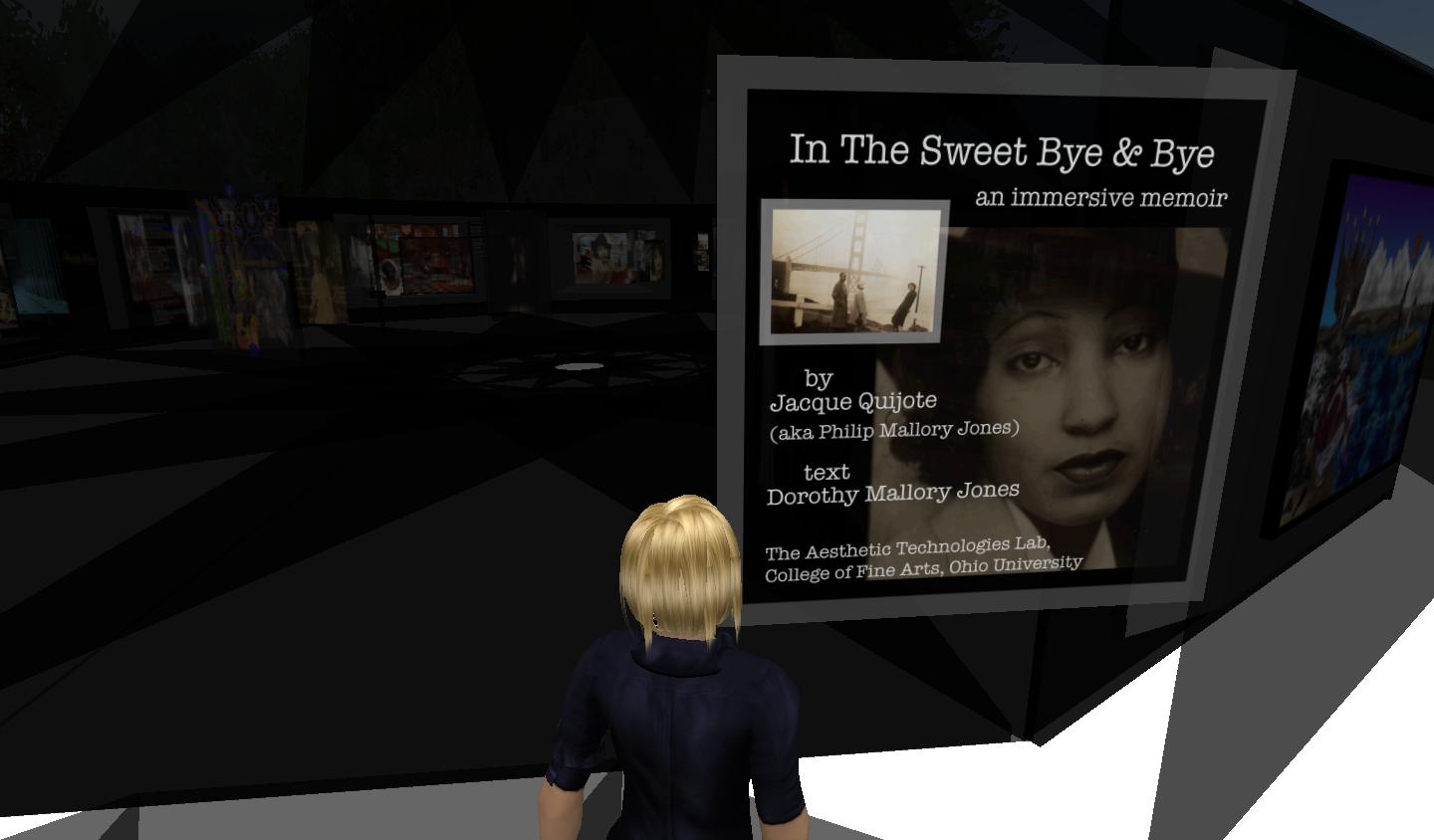
One of my SLCC friends, Jacque Quijote has created a wonderful 3D narrative or immersive memoir called IN THE SWEET BYE & BYE.

Quijote describes it this way:

A fusion of traditional and avant garde genres that can only be realized in the synthetic world. It is designed to be “read” in three dimensions. The narrative threads and paths are discovered in the overlap of images and texts, and in the compositions of planes and angles that form/transform as the avatar pov shifts. The narratives are on three levels – personal/family anecdote, communal lore, and allegory.

RL Quijote is, Phillip Mallory Jones , Lead Design Artist at The Aesthetics Technologies Lab, College of Fine Arts, Ohio University.

In this video Jones explains his art and research which is based on strong collaboration with several family members representing different art domains. At the end of the video Jones describes the unique process of bulding in SL.

Great place for a Sunday trip!

/Mariis

Designing for Learning in SL – RL seminar

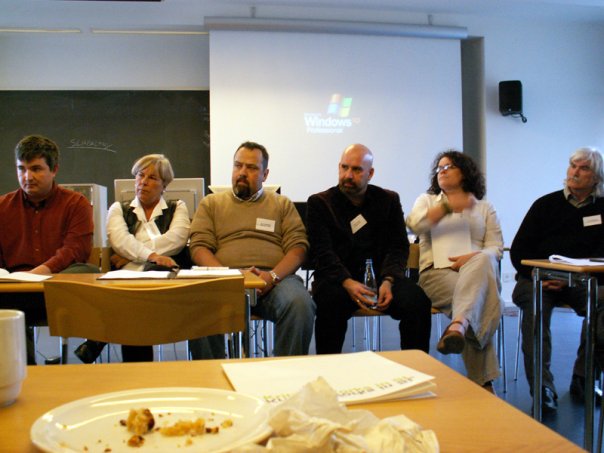
Monday October 13th I attended a RL seminar at Roskilde University arranged by the Danish research project Sense-making strategies and user-driven innovations in virtual worlds: A critical analysis of virtual market dynamics, cultural and social innovation and knowledge construction. Focus was on design for learning in virtual worlds – especially in SL. Here are some of my personal highlights …

Hunsinger, Jensen, Holmberg, Lester, Doyle & Beaubois

(C) Lis Faurholt

Sisse Siggaard Jensen gave a short presentation of the research project, and what I find most interesting is that the project will be empirically driven and based on collaboration between universities, institutions and private companies, hereby providing an opportunity for researches and practitioners to benefit from each other. Read more about the project here. I’m not part of the research project, but do collaborate with several of the people involved, and since the research on virtual worlds still is rather limited in Denmark, I think it’s pertinent that we join forces – so many thanks to the team for making this event public :-)

John Lester opened with a keynote on SL. Before joining Linden Lab in 2005, Lester worked with creating online communities for both patients and medical staff at the Department of Neurology at Massachusetts General Hospital and at Harvard Medical School. Lester’s background within Neurology gives him a really interesting take on learning, which in his term is bound by biology. As far as I understand Lester, this means that we as humans used to navigate real life actually may find many strengths and advantages in 3D virtual worlds as a sort of default predisposition. Some of the characteristics of humans such as recognizing patterns, navigating in 3D, communicating with other people, creating communities and using tools do seem very applicable or transferable (not without problems though ;-) From a learning theoretical point of view this really is interesting, and I would love to hear Lester talk more specifically on this!

A keyword for Lester when talking about SL was sharing – SL is all about shared experience, and shared places. Elaborating on this, Lester identified several examples of shared places based on different modes of reality:

  • Shared places based on reality – e.g. replicas of RL places
  • Shared places based on intangible reality – e.g. molecular structures
  • Shared places based on soon-to-be reality – e.g. prospects
  • Shared places based on imaginative reality – e.g. art performances

Returning to biology Lester pointed out that our brains appriciate or even demand places and faces, that we crave emotional bandwidth, and that education in SL therefore should be seen at the intersection between people and places reminding us that there are humans behind most avatars.

Lester also provided some updated stats on SL:

30.000 CPU’s (regions)
2.000 square kilometers
540.000 residents spending an average of 56 h/m
Average age of SL resident: 35 yrs.
Gender neutral
65% of residents outside North America

I’ve had the pleasure of meeting Lester twice now, and I have to say that he really incorporates the SL community feel – no wonder he is such a popular Linden :-)

Next up was Denise Doyle from University of Wolverhampton. Doyle has been involved in The Immersed in Learning Project since the beginning in 2007. Creating the Kriti Island has been part of this project in order to have a place for collaboration both nationally and internationally. Kriti Island has also hosted a very successful artist lead project on Reality Jam – an interactive exhibition contemplating creative practices. Doyle has a special research interest in interactive narratives and is using SL as a place for experimenting with different theoretical concepts and as a teaching and learning tool in undergraduate programmes in Digital Media.

Jeremy Hunsinger, from the Centre for Digital Discurses and Culture, Virginia Polytechnic Institute and State University, whom you may know from the weekly SLEd Lessons in Second Life, did a talk on Interaction and Interactivity in SL pinpointing the many boring, non interactive builds in-world and addressing some of the technical problems students may encounter when entering SL. Hunsinger reminded us what a dreadful experience SL can be if it is cluttered by technical problems and if you only explore the world on your own. I agree that SL is best experienced together with others. SL is about collaboration and community first and foremost. So many places in SL are still just pointless replica of RL with no interactivity other that clicking on notecards or being redirected to out-of-world websites. I do feel that realistic rebuild can be appropriate, but respectful remediation just shouldn’t be the prevailing principle for in-world learning design – where is the innovation in that?

With his avatar rezzed back in 2005 Terry Beaubois certainly is one of the more experienced and persistent residents, and it was really illuminating to learn more about Beaubois’ work and research. As Director of Creative Research Lab (CRLab), Montana State University Beaubois has a vision of bringing together academic staff and students from different disciplines both RL and in-world. Being a RL professor of Architecture Beaubois intuitively started out by creating a spectacular place for his students in-world, when it suddenly dawned on him that he actually was depriving them of perhaps some of the most valuable lessons in doing so, and so he tore down the build and let the students do the work. Sharing control and responsibility with his students seemed to be an important part of Beaubois’ pedagogical philosophy and I really enjoyed meeting a teacher who focused so much on the students and their needs. In some projects Beaubois and colleague Larry Johnson have brought together students from disciplines such as art, architecture, and film, and he proudly showed us this little film created as a result of this collaboration:

Final speaker of the day was Kim Holmberg from the Department of Information Studies at Åbo Akademi in Finland. Holmberg is an expert in social media and Library 2.0 and was the first university lecturer to use SL in education. Holmberg reported from a study he did together with colleague Isto Huvila, where they used SL as an alternative learning platform in distance education. Holmberg and Huvila found that SL cannot replace face-to-face, but as an alternative platform SL proved to be more “fun”, and they wish to study this particular aspect further. Holmberg was very interested in the avatar phenomena and how this kind of representation influences the learning processes. Holmberg also focused on the fact that we persist (especially as newbies) on bringing RL behavior into SL even though it doesn’t make much sense – e.g. when we sit down or face the one speaking. In this aspect, I think Holmberg’s talk supplemented Lester’s initial ideas of biological and cultural predispositions very well.

Summarizing the many interesting talks and discussions isn’t easy, but I was personally confirmed in some of my own findings and I was reminded of the complexity of design for learning (in general!).
SL – as a 3D learning platform – has a huge potential, but there still are many critical aspects to consider. The entrance and beginning phase as a newbie in SL can be filled with technical problems that need to be addressed both in- and out-world. Offering a possibility for humans, represented as avatars, to meet synchronously across time zones and geographical place, SL gives us a unique chance to explore communication, interaction, embodiment and many other natural and cultural phenomena. So far, in my personal opinion, much educational design in SL does not take advantage of the new possibilities to design learning environments NpIRL, but I do think this is only natural. When entering a new environment we bring our cultural and biological predispositions/experiences primarily in order to survive, to find “common ground” both literally and figuratively speaking. Only when the new environment has become habitual, I think we’ll be able to cross the intersections between the many modes and possibilities of reality. Since research in learning in virtual worlds like SL is still in its infancy, I’m quite confident that the future will bring exciting, mind-blowing examples of design for learning in 3D – and the great speakers clearly showed us how to continue this endeavor …

/Mariis

The Body in Online Learning (1)

In my post on lessons learned from the CCK08 course last week I posed the question where the Body is in Connectivism, and one of the CCK08 facilitators, Steven Downes, commented and so did my PhD-supervisor, Janni Nielsen. This has inspired me to do some preliminary reflections on the Body in online learning in general. Since embodiment is a core concept in my PhD, this is something I’ll return to again and again, but I do have to start at some point …

I think Downes, Nielsen and I agree that technology can provide a perception of embodiment, and as I commented to Downes, that’s why I dare claim “that 3D representation e.g. in SL, offers a unique opportunity (especially in distance education) for users to feel part of an authentic or real context even if it is mediated through technology.”

Nielsen confronts my “to feel part of .. even if ..” phrase, which may seem illogical if you really believe that technology can provide a sense of embodiment. I guess this stems from my talks about SL. It’s my impression that 3D technology still is rather exotic to most people (even 2D!), and I think I might lose credibility if I started a talk by stating that this is real! Perhaps I underestimate my audience, but I do feel that if you’re not familiar with online behavior and haven’t been immersed in a 3D setting it may seem surreal … And I know that some people who actually are familiar with e.g. online learning do not feel the way I do.

I am very much inspired by phenomenology, and in preparation for my PhD application last summer, I revisited some of the great thinkers within that field, some of them being Maurice Merleau-Ponty and Hubert L. Dreyfus. According to Ajana (2005) perception in Merleau-Ponty’s terms is:

(…) a ‘system’ of meanings by which the phenomenological process of recognizing and ‘sensing’ objects takes place, and it is through the medium of the body that we get to ‘experience’ and ‘perceive’ the world: ‘Our own body is in the world as the heart is in the organism: it keeps the visible spectacle constantly alive, it breathes life into it and sustains it inwardly, and with it forms a system’ (Merleau-Ponty, 1962: 203).

This may be what Downes refers to, when he states that “we’re pattern recognition devices” though I’m not sure Downes would label himself as a phenomenologist.

Anyway, Dreyfus inspires me, because he is also influenced by Merleau-Ponty, but I have to say that we read and interpret Merleau-Ponty in different ways, and that forces me to reflect on my own position. In 2001 Dreyfus published the book “On the Internet”, and if I had to point to one single reason why I wanted to do a PhD on 3D-mediated teaching and learning potential this is it!

Dreyfus goes against the hype on the potentials of the Internet, and I do think that that can be quite appropriate, but I just do not agree with the majority of Dreyfus’ points and his argumentation. In the introduction Dreyfus writes:

(…) in what follows, I hope to show that, if our body goes, so does relevance, skill, reality and meaning. If that is the trade-off, the prospect of living our lives in and through the Web may not be as attractive after all. (Dreyfus, 2001:7 – my italics)

A short comment to this could be that our bodies do not go (anywhere!) when we engage in internet activities – like the heart in the organism we’re bodily grounded in the world regardless of how it presents itself to us. Furthermore I’m pretty sure that millions of Internet users find meaning and learn skills no matter how they perceive reality. But my intention in this post is not to review and comment on Dreyfus’ entire book, where he of course elaborates this and many other points.

First of all, I’m in the beginning of my research and I still lack insight and sufficient academic competencies to do so in a reputable manner, and I certainly do not want to seem disrespectful. That specific comment just triggered my research and for that I do feel appreciative to Dreyfus.

Second, other researchers have already presented arguments against the Dreyfus claims, and in this post I want to point the reader’s attention to Ray Land.

One of Dreyfus’ claims is that risk-taking is a necessary prerequisite for learning at a higher level and that especially due to the anonymous nature of online learning the learner and the teacher do not really take any risks. Land (2004) addresses this issue;

What is puzzling about Dreyfus’ analysis is how it seems to take no cognizance of the many risks to identity, confidence, emotional security and esteem that are encountered on a daily basis by participants within online learning environments.

I think both my MIL students and some of the participants in the CCK08 will recognize Land’s description, I know I do – even here as I write on my “own” blog. An interesting angle to this could be to explore Dreyfus (and Dreyfus. 1986) renowned taxonomy of learning. I do appreciate the methodic/analytical benefits of looking at the learning process this way, but I’m really not convinced that learning occurs linearly …

These will be my first public thoughts on the body in online learning – I will return…

/Mariis

If this caught your attention I really recommend that you read Dreyfus and the other below mentioned references :-)

References:
Ajana, B. (2005): Disembodiment and Cyberspace: A Phenomenological Approach.

Dreyfus, H.L. (2001): On the Internet.

Land, R. (2004): Issues of Embodiment and Risk in Online Learning.

Related references:
Virtual Identity and the Cyberspace

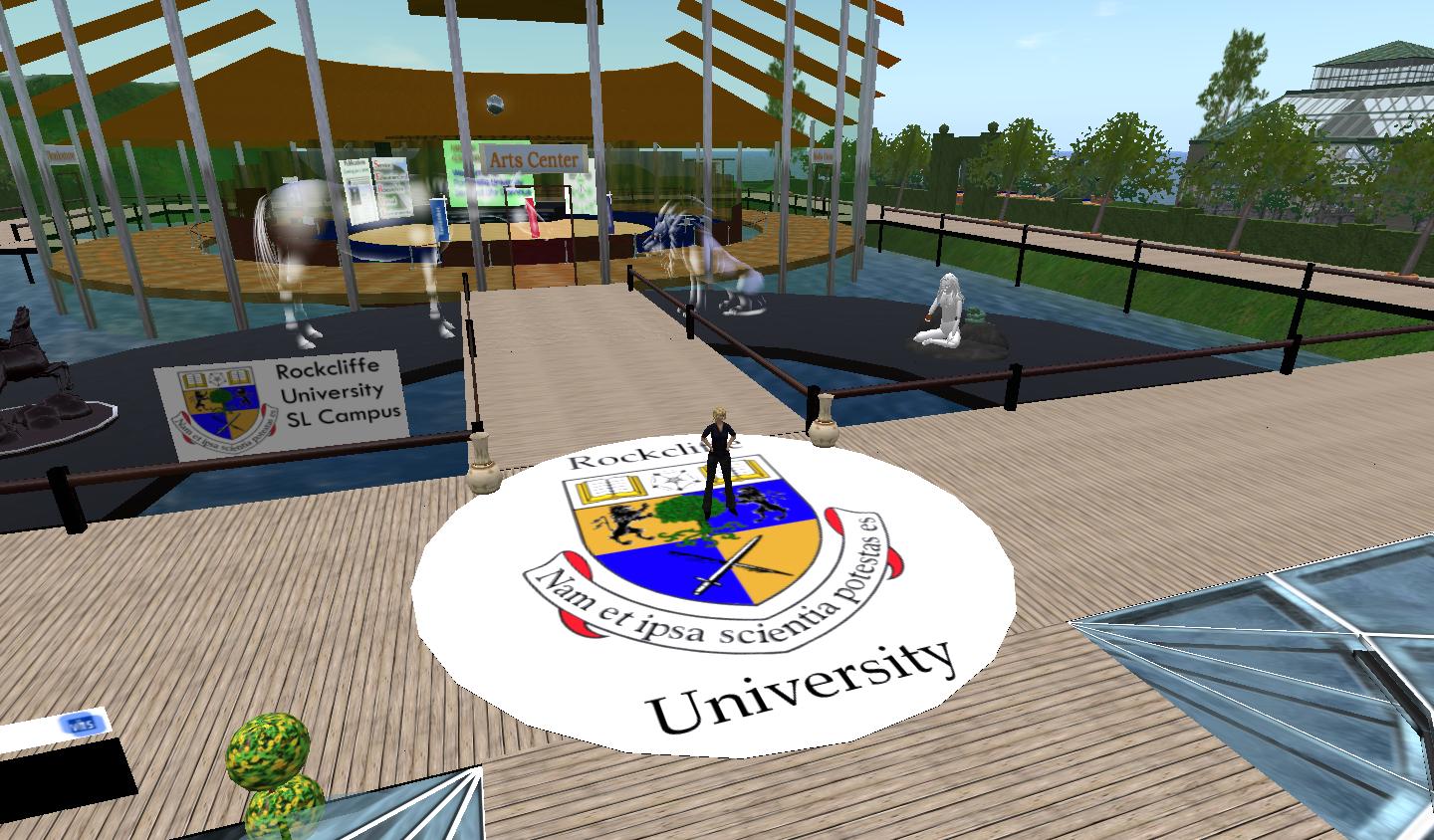
NoEL visits “Rockcliffe University Consortium”

On Wednesday October 8th the NoEL group will visit Phelan Corrimal to learn about the Rockcliffe University Consortium in SL.

Rockcliffe University Consortium is a distance learning organization servicing worldwide virtual learners and businesses. Located in Canada, the United States and the metaverse. Rockcliffe University Consortium provides education, training and real time collaboration for its virtual members by incorporating interactive 3D immersive learning environments.

Phelan is the President of Rockcliffe and will tell us about his visions and work in-world while showing us selected locations.

We have to meet Phelan at 20:30 on the Rockcliffe island – use the landmark send via notice in-world :-)

/Mariis