Lessons learned from one year in the sphere

On January 10th, I was able to celebrate one year in the blog sphere, so it seems natural to reflect a bit on the lessons learned …

Why do I blog?

  • Well, first of all my much, much younger colleague, Thomas Ryberg provoked me by jokingly saying that the older (meaning over 40!) ELL researchers often just don’t understand new media, and as we all know understanding strengthens through practice. TY, Thomas – IOU ;-)
  • I’m inquisitive by nature and had been enjoying lurking in the sphere for a couple of years, and I do think that there are some very high quality, professional blogs out there, so I wanted to join this great knowledge network more actively.
  • As a PhD Candidate I need a place to collect my thoughts and experiences. Old style notes and Post-it’s still work great for me, but the major advantage of blogging is that preliminary thoughts become just a bit more processed or reflected through the writing, so when I return they may still seem unfinished, but yet more coherent than just a few words or lines on a yellow piece of paper.
  • As a PhD Candidate I’m also obliged to disseminate on a regular basis in various types of media. Writing research papers has been the most common way of getting your thoughts out into the research communities, and even though this is a very important activity I find the more immediate nature of blogging very profitable too.
  • Blogging is a great way of documenting activities and storing contextual ideas, links and files.
  • I have to write my thesis in English and needed a place to practice on a regular basis. Blogging in a second language can be really frustrating. I often lack words and phrases, so sometimes I leave out reflections and arguments simply because I don’t know how to articulate them. I’m also aware that especially my grammar often is incorrect. Even though it has become easier over the last year I’m really looking forward to staying at an English speaking university at sometime during my PhD period!
  • My research object, Second Life, brings me so many great and challenging experiences both on a professional and personal level, so this is also a way of showing my appreciation by telling “the world”. As in many other countries Second Life often gets belittled by the Press, most often due to poor research, so this is also a way to counterpart that.
  • When I meet people and talk about my research, I’m often asked for more information, and since I’ve never had a website, this seemed like a perfect way to have a public reference.
  • As a teacher at a Masterprogramme on ICT and Learning it seems not only natural, but also necessary to “practice what I preach”, and I also know that some of my students find it interesting/inspirational to follow my activities.

How do I blog?

I’ve written 72 post during this first year, which I actually find quite ok, since I didn’t blog at all from February till July due to illness both personal and in my family. I’ve written 2-3 personal posts, the rest are professional. The 46 categories reveal that SL, education, MIL, my PhD and research are my favorite 5 topics. I never lack topics to blog about, but due to time restraints I try to focus on topics directly related to my PhD project. I’ve expanded my blogroll quite a lot, and now it works as my favorite list related to my PhD work (my Firefox is more off-topic and often contains temporary links).

I’ve recieved 68 comments. As you may have noticed above I didn’t mention the asynchronous dialogue as an advantage of blogging. I have a dozen of blogs I follow on a regular basis, but I’ve only posted a few comments on other blogs. So far my own posts have mainly been descriptive and have served as a way of preserving preliminary thoughts and ideas. Due to both language restraints and, I guess, professional insecurity I haven’t felt comfortable engaging more and I haven’t done anything to ensure that my blog would show via search engines etc. I started blogging as a very personal experience, as a way of finding my own voice as a researcher – and this may take some time. Being a PhD candidate is very much about learning and I intend to take advantage of this unique opportunity of having three whole years to strengthen my thoughts and expand my knowledge.

In a recent Australian study on the advantages of blogging as part of a PhD candidature by Ward & West (2008:63), it is stated that:

The process of PhD development should, presumably, be one of growth in intellectual confidence, independence and originality of thinking. It would be fair to expect it to result in empowerment and ultimate entry to an elite community. These attributes – that we presume are valued by all the participants in the process – by definition are not, and should not, be easy to achieve.

Although there apparently are major differences between the learning conditions for PhD candidates in Denmark and Australia, I do think that Ward & West’s paper summarizes the advantages of blogging quite accurately, and I would much certainly recommend blogging as part of the PhD learning process.

/Mariis

BTW, thanks to Greg Wadley – another blogging PhD Candidate – for the Ward & West reference :-)
Does in-world teaching include anonymous acting?

Preparing for a class next week I’ve been revisiting some of the resources that I’ve recommended for my MIL students. One of the articles, Jolly (2006), I’ve chosen because it describes the multiple roles of the in-world teacher. Based on a triple case study conducted in-world during term three of 2006 at Central Gippsland Institute of TAFE (GippsTAFE™) in south-east Victoria, Jolly has identified several roles of the teacher – here listed numerically to ease my reference:

  1. Teacher as explorer
  2. Teacher as a learner
  3. Teacher as avatar
  4. Teacher as a client
  5. Teacher as  inductor
  6. Teacher as guide
  7. Teacher as planner
  8. Teacher as innovator
  9. Teacher as debriefer
  10. Teacher as an industry expert
  11. Teacher as preparer
  12. Teacher as facilitator
  13. Teacher as communicator

Besides the roles 4 and 10, which are directly linked to the subject matter in the cases and 3, which of course is distinct for teaching in virtual worlds, I don’t think the identified roles differ that much from conventional teaching – at least not when I compare the list to my own and my colleagues teaching at E-Learning Lab in general, and at MIL in particular. Teaching in an age heavily influenced by new technology and the Internet, in my opinion, naturally calls for multiple roles of the teacher, it is however interesting to see the roles listed, which also is one of the reasons why I recommend this article to my students.

Another argument for introducing the students to this article is much more important though. I think this article invites (even provokes) for discussions regarding the teacher’s ethical responsibilities. Returning to the 3rd role, teacher as an avatar, Jolly states:

It is important that the teacher has a number of avatars, each performing a different role. Their appearance, character traits, language, ‘likes’ and ‘dislikes’ may vary significantly. The students may not know who is behind any given avatar. (Jolly, 2006:8 – my highlight)

And Jolly continues explaining:

In the real world, the students clearly knew myself (Malcom Jolly) and fellow project team member Glenda McPherson through a range of face-to-face meetings/discussions with them. When we were in Second Life as Malcolm Dalgleish and Glenda Arrow, the students knew that we were behind the characters and this served an important role. As Glenda and Malcolm, the students knew that they could always turn to us for support/assistance. For some students this was very important and reassuring. (ibid: 8 – my highlight)

However, at other times Jolly played out the role of a different character:

As GippsTAFE Gonzales, the owner of GippsTAFE Island, my attire was more formal; I acted differently and exhibited different characteristics to Malcolm Dalgleish. I didn’t offer assistance unless specifically asked for it. From the student’s perspective, all they knew was that I was one of the project team. (ibid: 8 – my highlight)

Continuing the role-playing, Jolly sometimes acted as 4) a client in the “painting and decorating” class:

My role was to be the client, meet the student and discuss with them the type of refurbishment I wanted in my house. The students did not know who I was or where in the real world I was located. I was simply ‘the client’. In order to get to know me the student had to question me, ascertain my ‘likes’ and ‘dislikes’ or form assumptions based on my appearance or mannerisms. (ibid: 9 – my highlight)

Jolly sums up the experience of using different avatars/identities:

It is important that students know support is available through particular people (avatars) but it can also be extremely powerful for the teacher to assume other identities. These characters may simply be people passing by or standing around observing – their use provides the teacher with wonderful material when conducting a debriefing session. (ibid: 9)

I do believe that one of the great pedagogical potentials in avatar-based teaching and learning lies in the possibility to role-play, and I suppose Jolly and his colleagues were trying to enhance authenticity by acting out different characters. Want I don’t understand, is the need for anonymity, and I have to say that this example oversteps some of my personal ethical boundaries. Wouldn’t it be possible to role-play without anonymity, I mean, doesn’t acting exactly entail that you assume a different character? To me one of the most important roles of the teacher – if not the most important – is to be trustworthy, and that simply doesn’t align with acting anonymously in my point of view.

I’m greatly puzzled by this, since Jolly in so many other parts of the article expresses some very emphatic and sympatric thoughts. The 3 cases were conducted mainly at closed islands in-world, and I realize that the students were aware that they might encounter anonymous project staff members, but I still find it problematic to use anonymity like this in an educational context.

Nevertheless, the article makes for interesting discussions on the whole anonymity issue of online teaching and learning, and I’m looking forward to hearing my students’ responses to this.

/Mariis

Designing for Learning in SL – RL seminar

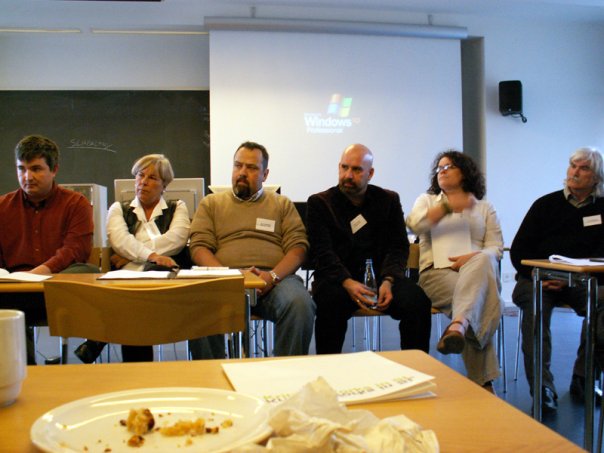
Monday October 13th I attended a RL seminar at Roskilde University arranged by the Danish research project Sense-making strategies and user-driven innovations in virtual worlds: A critical analysis of virtual market dynamics, cultural and social innovation and knowledge construction. Focus was on design for learning in virtual worlds – especially in SL. Here are some of my personal highlights …

Hunsinger, Jensen, Holmberg, Lester, Doyle & Beaubois

(C) Lis Faurholt

Sisse Siggaard Jensen gave a short presentation of the research project, and what I find most interesting is that the project will be empirically driven and based on collaboration between universities, institutions and private companies, hereby providing an opportunity for researches and practitioners to benefit from each other. Read more about the project here. I’m not part of the research project, but do collaborate with several of the people involved, and since the research on virtual worlds still is rather limited in Denmark, I think it’s pertinent that we join forces – so many thanks to the team for making this event public :-)

John Lester opened with a keynote on SL. Before joining Linden Lab in 2005, Lester worked with creating online communities for both patients and medical staff at the Department of Neurology at Massachusetts General Hospital and at Harvard Medical School. Lester’s background within Neurology gives him a really interesting take on learning, which in his term is bound by biology. As far as I understand Lester, this means that we as humans used to navigate real life actually may find many strengths and advantages in 3D virtual worlds as a sort of default predisposition. Some of the characteristics of humans such as recognizing patterns, navigating in 3D, communicating with other people, creating communities and using tools do seem very applicable or transferable (not without problems though ;-) From a learning theoretical point of view this really is interesting, and I would love to hear Lester talk more specifically on this!

A keyword for Lester when talking about SL was sharing – SL is all about shared experience, and shared places. Elaborating on this, Lester identified several examples of shared places based on different modes of reality:

  • Shared places based on reality – e.g. replicas of RL places
  • Shared places based on intangible reality – e.g. molecular structures
  • Shared places based on soon-to-be reality – e.g. prospects
  • Shared places based on imaginative reality – e.g. art performances

Returning to biology Lester pointed out that our brains appriciate or even demand places and faces, that we crave emotional bandwidth, and that education in SL therefore should be seen at the intersection between people and places reminding us that there are humans behind most avatars.

Lester also provided some updated stats on SL:

30.000 CPU’s (regions)
2.000 square kilometers
540.000 residents spending an average of 56 h/m
Average age of SL resident: 35 yrs.
Gender neutral
65% of residents outside North America

I’ve had the pleasure of meeting Lester twice now, and I have to say that he really incorporates the SL community feel – no wonder he is such a popular Linden :-)

Next up was Denise Doyle from University of Wolverhampton. Doyle has been involved in The Immersed in Learning Project since the beginning in 2007. Creating the Kriti Island has been part of this project in order to have a place for collaboration both nationally and internationally. Kriti Island has also hosted a very successful artist lead project on Reality Jam – an interactive exhibition contemplating creative practices. Doyle has a special research interest in interactive narratives and is using SL as a place for experimenting with different theoretical concepts and as a teaching and learning tool in undergraduate programmes in Digital Media.

Jeremy Hunsinger, from the Centre for Digital Discurses and Culture, Virginia Polytechnic Institute and State University, whom you may know from the weekly SLEd Lessons in Second Life, did a talk on Interaction and Interactivity in SL pinpointing the many boring, non interactive builds in-world and addressing some of the technical problems students may encounter when entering SL. Hunsinger reminded us what a dreadful experience SL can be if it is cluttered by technical problems and if you only explore the world on your own. I agree that SL is best experienced together with others. SL is about collaboration and community first and foremost. So many places in SL are still just pointless replica of RL with no interactivity other that clicking on notecards or being redirected to out-of-world websites. I do feel that realistic rebuild can be appropriate, but respectful remediation just shouldn’t be the prevailing principle for in-world learning design – where is the innovation in that?

With his avatar rezzed back in 2005 Terry Beaubois certainly is one of the more experienced and persistent residents, and it was really illuminating to learn more about Beaubois’ work and research. As Director of Creative Research Lab (CRLab), Montana State University Beaubois has a vision of bringing together academic staff and students from different disciplines both RL and in-world. Being a RL professor of Architecture Beaubois intuitively started out by creating a spectacular place for his students in-world, when it suddenly dawned on him that he actually was depriving them of perhaps some of the most valuable lessons in doing so, and so he tore down the build and let the students do the work. Sharing control and responsibility with his students seemed to be an important part of Beaubois’ pedagogical philosophy and I really enjoyed meeting a teacher who focused so much on the students and their needs. In some projects Beaubois and colleague Larry Johnson have brought together students from disciplines such as art, architecture, and film, and he proudly showed us this little film created as a result of this collaboration:

Final speaker of the day was Kim Holmberg from the Department of Information Studies at Åbo Akademi in Finland. Holmberg is an expert in social media and Library 2.0 and was the first university lecturer to use SL in education. Holmberg reported from a study he did together with colleague Isto Huvila, where they used SL as an alternative learning platform in distance education. Holmberg and Huvila found that SL cannot replace face-to-face, but as an alternative platform SL proved to be more “fun”, and they wish to study this particular aspect further. Holmberg was very interested in the avatar phenomena and how this kind of representation influences the learning processes. Holmberg also focused on the fact that we persist (especially as newbies) on bringing RL behavior into SL even though it doesn’t make much sense – e.g. when we sit down or face the one speaking. In this aspect, I think Holmberg’s talk supplemented Lester’s initial ideas of biological and cultural predispositions very well.

Summarizing the many interesting talks and discussions isn’t easy, but I was personally confirmed in some of my own findings and I was reminded of the complexity of design for learning (in general!).
SL – as a 3D learning platform – has a huge potential, but there still are many critical aspects to consider. The entrance and beginning phase as a newbie in SL can be filled with technical problems that need to be addressed both in- and out-world. Offering a possibility for humans, represented as avatars, to meet synchronously across time zones and geographical place, SL gives us a unique chance to explore communication, interaction, embodiment and many other natural and cultural phenomena. So far, in my personal opinion, much educational design in SL does not take advantage of the new possibilities to design learning environments NpIRL, but I do think this is only natural. When entering a new environment we bring our cultural and biological predispositions/experiences primarily in order to survive, to find “common ground” both literally and figuratively speaking. Only when the new environment has become habitual, I think we’ll be able to cross the intersections between the many modes and possibilities of reality. Since research in learning in virtual worlds like SL is still in its infancy, I’m quite confident that the future will bring exciting, mind-blowing examples of design for learning in 3D – and the great speakers clearly showed us how to continue this endeavor …

/Mariis

The Body in Online Learning (1)

In my post on lessons learned from the CCK08 course last week I posed the question where the Body is in Connectivism, and one of the CCK08 facilitators, Steven Downes, commented and so did my PhD-supervisor, Janni Nielsen. This has inspired me to do some preliminary reflections on the Body in online learning in general. Since embodiment is a core concept in my PhD, this is something I’ll return to again and again, but I do have to start at some point …

I think Downes, Nielsen and I agree that technology can provide a perception of embodiment, and as I commented to Downes, that’s why I dare claim “that 3D representation e.g. in SL, offers a unique opportunity (especially in distance education) for users to feel part of an authentic or real context even if it is mediated through technology.”

Nielsen confronts my “to feel part of .. even if ..” phrase, which may seem illogical if you really believe that technology can provide a sense of embodiment. I guess this stems from my talks about SL. It’s my impression that 3D technology still is rather exotic to most people (even 2D!), and I think I might lose credibility if I started a talk by stating that this is real! Perhaps I underestimate my audience, but I do feel that if you’re not familiar with online behavior and haven’t been immersed in a 3D setting it may seem surreal … And I know that some people who actually are familiar with e.g. online learning do not feel the way I do.

I am very much inspired by phenomenology, and in preparation for my PhD application last summer, I revisited some of the great thinkers within that field, some of them being Maurice Merleau-Ponty and Hubert L. Dreyfus. According to Ajana (2005) perception in Merleau-Ponty’s terms is:

(…) a ‘system’ of meanings by which the phenomenological process of recognizing and ‘sensing’ objects takes place, and it is through the medium of the body that we get to ‘experience’ and ‘perceive’ the world: ‘Our own body is in the world as the heart is in the organism: it keeps the visible spectacle constantly alive, it breathes life into it and sustains it inwardly, and with it forms a system’ (Merleau-Ponty, 1962: 203).

This may be what Downes refers to, when he states that “we’re pattern recognition devices” though I’m not sure Downes would label himself as a phenomenologist.

Anyway, Dreyfus inspires me, because he is also influenced by Merleau-Ponty, but I have to say that we read and interpret Merleau-Ponty in different ways, and that forces me to reflect on my own position. In 2001 Dreyfus published the book “On the Internet”, and if I had to point to one single reason why I wanted to do a PhD on 3D-mediated teaching and learning potential this is it!

Dreyfus goes against the hype on the potentials of the Internet, and I do think that that can be quite appropriate, but I just do not agree with the majority of Dreyfus’ points and his argumentation. In the introduction Dreyfus writes:

(…) in what follows, I hope to show that, if our body goes, so does relevance, skill, reality and meaning. If that is the trade-off, the prospect of living our lives in and through the Web may not be as attractive after all. (Dreyfus, 2001:7 – my italics)

A short comment to this could be that our bodies do not go (anywhere!) when we engage in internet activities – like the heart in the organism we’re bodily grounded in the world regardless of how it presents itself to us. Furthermore I’m pretty sure that millions of Internet users find meaning and learn skills no matter how they perceive reality. But my intention in this post is not to review and comment on Dreyfus’ entire book, where he of course elaborates this and many other points.

First of all, I’m in the beginning of my research and I still lack insight and sufficient academic competencies to do so in a reputable manner, and I certainly do not want to seem disrespectful. That specific comment just triggered my research and for that I do feel appreciative to Dreyfus.

Second, other researchers have already presented arguments against the Dreyfus claims, and in this post I want to point the reader’s attention to Ray Land.

One of Dreyfus’ claims is that risk-taking is a necessary prerequisite for learning at a higher level and that especially due to the anonymous nature of online learning the learner and the teacher do not really take any risks. Land (2004) addresses this issue;

What is puzzling about Dreyfus’ analysis is how it seems to take no cognizance of the many risks to identity, confidence, emotional security and esteem that are encountered on a daily basis by participants within online learning environments.

I think both my MIL students and some of the participants in the CCK08 will recognize Land’s description, I know I do – even here as I write on my “own” blog. An interesting angle to this could be to explore Dreyfus (and Dreyfus. 1986) renowned taxonomy of learning. I do appreciate the methodic/analytical benefits of looking at the learning process this way, but I’m really not convinced that learning occurs linearly …

These will be my first public thoughts on the body in online learning – I will return…

/Mariis

If this caught your attention I really recommend that you read Dreyfus and the other below mentioned references :-)

References:
Ajana, B. (2005): Disembodiment and Cyberspace: A Phenomenological Approach.

Dreyfus, H.L. (2001): On the Internet.

Land, R. (2004): Issues of Embodiment and Risk in Online Learning.

Related references:
Virtual Identity and the Cyberspace

CCK08 – Lessons Learned (2)

This post is about the Massively Online Open Course on Connectivism and Connective knowledge (CCK08) facilitated by Stephen Downes and George Siemens. This week I couldn’t attend any of the SL cohort meetings, so I decided to participate in the weekly Ustream ® session for the first time. This meant that I had to face a couple of learning challenges.

1) I’ve never used Ustream, so I had to figure out how to in a technical manner, but fortunately it turned out to be quite intuitive and user-friendly, and the sound quality was pretty good.

2) I also had to get accustomed to this particular synchronous way (speak combined with text chat) of communicating. I’ve been using video conferencing for a couple of years now, but different systems and mainly as facilitator. There were between 47-54 participants while I was logged in. Speakers were Siemens and Downes, and Dave Cormier moderated the discussion – also by asking some of the questions posed by the participants in the chat. Ustream’s video option wasn’t used, which didn’t bother me since I actually find small pictures of people’s heads constantly shifting very distracting. Compared to my text chat experience last week, I found this session easier to follow. I think Cormier did a really good job, it’s not an easy task to moderate :-)

3) It was the first time in the CCK08 I meet participants outside my more familiar SL cohort, and I was a bit concerned that I might feel somewhat disconnected, but I didn’t. This time the context was unfamiliar, but I recognized the voices of both Siemens and Downes, and I’ve had the opportunity to study more of this week’s course materials and I also have some previous experience with this week’s topic (Networks). In the chat I suddenly recognized Jenny :-), who commented on my CCK post last week, but otherwise the usernames represented complete strangers. There was at least one more Dane, Ivrig (Eager), but I have absolutely no idea who that might be? Anyway, I did end up feeling connected, but not in the same sense as last week. I think Jenny’s thoughts on the difference between Network and Community as expressed by Wenger could apply here:

In the words of Etienne Wenger, ‘every community is a network, but not every network is a community’. In a community ‘there is a level of identification that goes beyond degrees of connectedness.’

There’s no doubt that I identify more with the SL cohort than the rest of the CCK participants, but I have a feeling that as the weeks pass by I’ll get more and more acquainted with the non-SL participants and ideally they too can become a valuable community of learning practice. Some of us did ask for Siemens’ and Downes’ take on the distinction between networks and community, but we will focus on that later on in the course, so more on this topic will follow ..

On a completely different topic, there is a question that keeps coming back to me regarding the epistemology of Connectivism. I’m not sure it will make much sense to others, since I find it hard to articulate, but I’ll give a shot – if nothing else documenting is a way of keeping it alive!

I don’t mean to suggest that I have found an epistemological truth in other theories, I don’t even think such a truth exists – the genesis of knowledge is far too complex, but I am however very inspired by my second PhD supervisor, Janni Nielsen’s thoughts on this. According to Nielsen we perceive and generate knowledge via 3 different domains;

  1. Senso-motoric
  2. Emotions
  3. Symbols

No hierarchy intended by the numbers, but 1 and 2 also constitute the domains for tacit knowledge, and when studying Connectivism I find it hard to recognize these domains. I do appreciate Siemens’ distinction between Neural/Biological, Conceptual and External Social and I do think there are some similarities between these types of networks (Siemens)/domains (Downes) and the above mentioned. But … where is the Body in Connectivism, is it just a Cartesian container for the Brain (the Neural) or how is the Biological to be understood –and how do we understand these questions in relation to technology and especially the Web. Would it be plausible in relation to Connectivism to state that technology can provide a perception of embodiment ..

Hmmm !? :-( … learning really can be challenging. Embodiment is a core concept in my PhD project, so I do have to figure out what to think of these questions. Luckily I have 2 ½ years left to do so.

/Mariis