Who needs pseudonyms?

I was actually working on a different post on the nymwars, FB and Google, when this tweet from Botgirl Questi caught my eye:
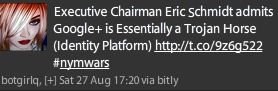
I will return to the content of this tweet later in this post, but it reminded me of a conversation I recently had a with one of my friends regarding why I left FB and G+. When I asked him, how he would react if a large part of his network connections was excluded from one of his networks, he acknowledged this, but also pointed to a difference in our connections; “But because you’re working with SL, you have more friends with unusual names and unknown identities – and you’re used to dealing with that – most people aren’t”. I found this very interesting because it points to two common conceptions regarding the pseudonym/nymwars issue.

First of all, my friend had the impression that mainly avatars (or other fictional characters, sic) need/want to use pseudonyms. This is by far the case, but it is sadly a very common misconception, and so I want to point to a webpage that was created in defense of pseudonyms and shows the many different groups of people, who may need/want to use pseudonyms for various reasons: the my name is me webpage.
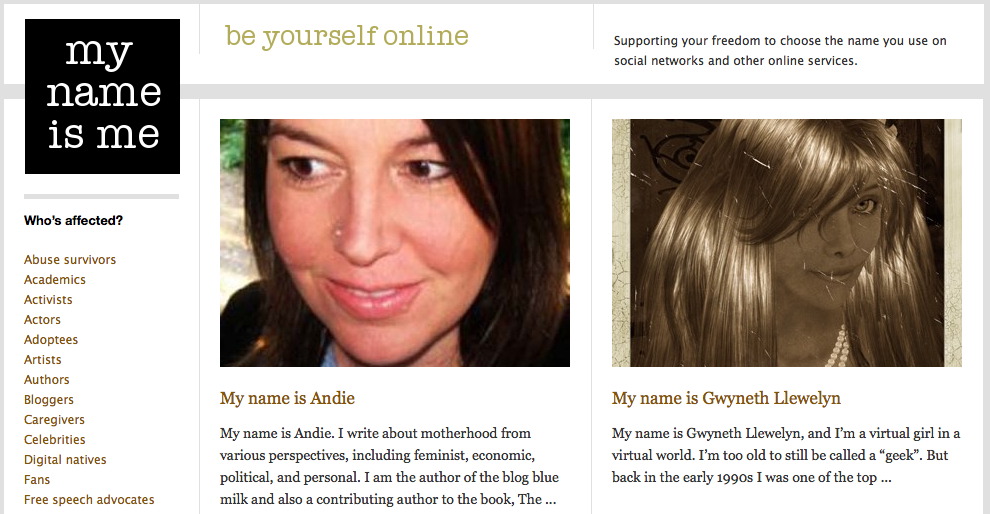
This page was created to raise awareness about people who need pseudonyms and clearly shows how closely this need is related to the freedom of expression:

“My Name Is Me” is about having the freedom to be yourself online. We want people to be able to identify themselves as they wish, rather than being forced to choose names by social networking websites and other online service providers.

Websites such as Facebook and Google+ ask you to use a name that conforms to a certain standard. Though their policies vary, what they would like you to use is the name that appears on the ID in your wallet, your employer’s records, or on the letters your bank sends you. They don’t understand that many people go by other names, for a wide variety of reasons.

Take a look at some of these heartfelt and personal stories – it really just isn’t us “strange” avatars that need/want pseudonyms – and even so, I believe we all, avatars included, should have the right to choose! Additionally, The Geek Feminism wiki has another list of “Who’s harmed by “Real names” policy”, and the Electronic Frontier Foundation (EFF) makes A Case for Pseudonyms.

Looking at these stories, nobody in his/her right mind can dismiss the need for pseudonyms some people have to enable them to interact safely online. Or so I thought, but let us return to the content of Botgirl’s above mentioned tweet. Botgirl links to a post on her blog wherein she quotes NPR‘s Andy Carvin, who met Google’s Executive chairman, Eric E. Schmidt at a recent film festival.

Carvin asked Schmidt how he could justify their policy about “real names” given that real identities could put people at risk:

He replied by saying that G+ was build primarily as an identity service, so fundamentally, it depends on people using their real names if they’re going to build future products that leverage that information.

Regarding people who are concerned about their safety, he said G+ is completely optional. No one is forcing you to use it. It’s obvious for people at risk if they use their real names, they shouldn’t use G+. Regarding countries like Iran and Syria, people there have no expectation of privacy anyway due to their government’s own policies, which implies there’s no point of even trying to have a service that allows pseudonyms.

He also said the internet would be better if we knew you were a real person rather than a dog or a fake person. Some people are just evil and we should be able to ID them and rank them downward. (quoted from Carvin‘s G+ (!) page)

I’m trying my very best to ignore the arrogance and stupidity of Schmidt’s comment and to keep a civil tone here, so I’ll let it be for now.

However, let me just finish by pointing to the second part of the statement from my friend where he implies that acceptance of pseudonyms requires (positive) experience. During this period of nymwars, but also during my research in SL, I’ve struggled to understand the fear some people have towards pseudonyms, or as my colleague, Mark Childs calls it: the obsession people have with “real” identities. Based on my own research experience, I think my friend’s stance is quite plausible, people fear the unknown. And identities that do not conform to “real” or “normal” standards do provoke ontological/existential questions. I have no other particular qualified (read: academic referable) explanations at this point, but it is a topic, I will continue to investigate.

/Mariis
Update
On August 30th, Andy Carvin posted a “a transcript of what Google CEO Eric Schmidt said in the Q&A at the MediaGuardian Edinburgh International TV Festival, so you can see his direct words rather than my paraphrasing of it”.

Upcoming PD course in SL for teachers at Universidad Nacional, Heredia Costa Rica

In September, I’ll be kicking off a new PD course in SL. Participants will be teachers from The Computing School at Universidad Nacional (UNA) in Heredia, Costa Rica. The main objective of the course is to provide the participants with a combination of conceptual, theoretical, and practical (in-world) strategies with regard to designing, implementing, and teaching/learning courses of different duration using SL as main medium/approach. Unlike most of my previous courses in SL, I will not work alone in this course, but will be joined by an amazing group of co-facilitators;

  • Inge Qunhua – Danish Instructional designer and teacher in SL since 2007
  • Heilyn Abbot – Costa Rican colleague, Post Doc at e-Learning Lab, Aalborg University (AAU), co-facilitator in the COMBLE course
  • Wica Sorbet & Ena Adjani – new Costa Rican colleagues from UNA

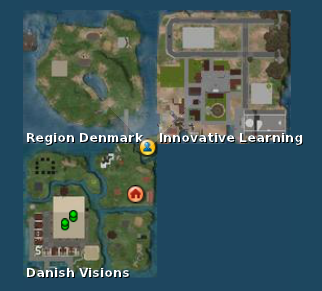
In-world the majority of the teaching activities will be taking place in a region with 3 Danish islands; Region Denmark, Innovative Learning, and Danish Visions.

In designing this course, I’ve naturally been drawing on my experience from previous SL courses. However, our Costa Rican colleagues are also interested in learning more about the particular PBL model we have implemented at AAU, the so-called Aalborg PBL-model. Further, during my PhD-research in SL, I’ve found the “Communities of Practice” (CoP) ideas from Wenger, 1998 to be particularly useful when teaching new technologies/media. The goal of the design is to try to establish a pedagogical Community of Practice, wherein the teaching and learning processes will be situated. Core principles in this design strategy therefore are:

  • A strong and ongoing focus on learning as transformation of identity and negotiation of meaning
  • Focus on Legitimate Peripheral Participation
  • A socio-cultural, constructivist perspective on learning
  • Learning is participant-centred
  • Focus on problem orientation where learning combines theory and practice
  • Learning is usually realized in pairs/groups
  • Responsibility of the learning process is mutual – both between learners and learners/facilitators
  • Self- and peer assessment through reflection-in-action and reflection-on-action is central

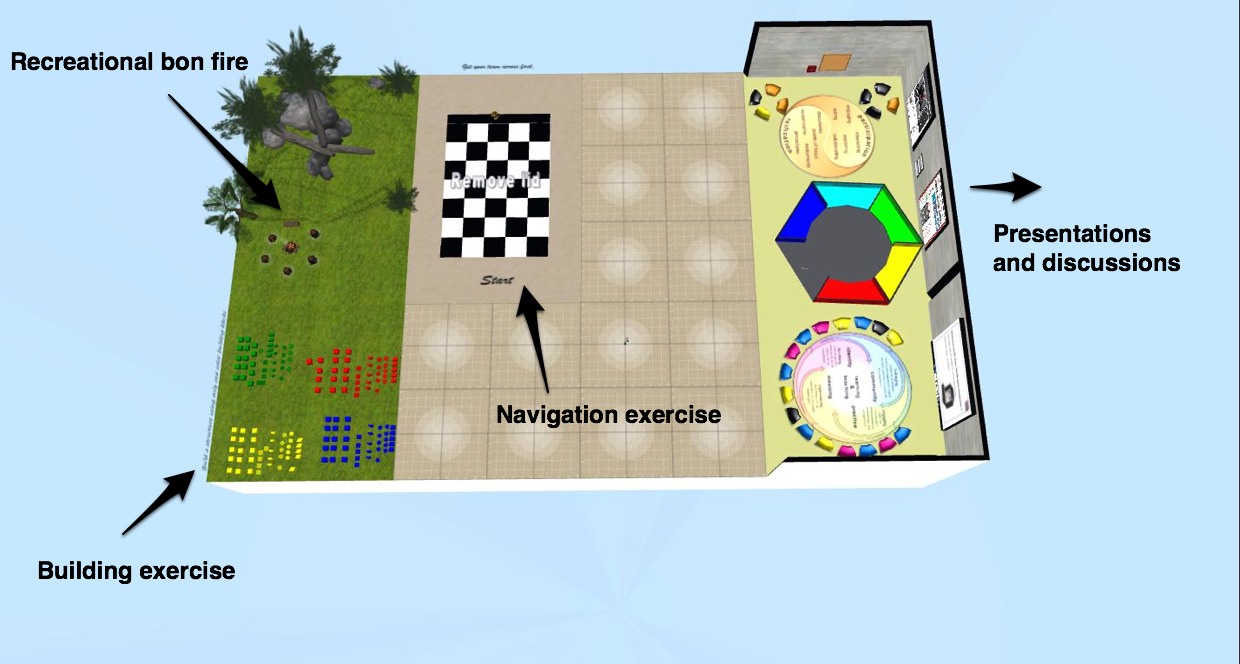
An important part of this strategy is to respect the newbie experience of the participants. The ontological challenge that is to become an avatar should be acknowledged and designed for. In practice, this means that Inge and I, who will be the main in-world facilitators, will focus on creating a safe learning environment where the newbie participants will be able to learn some of the most important basic SL skills before we actually proceed to focus on the subject matter. Today, Inge invited me in-world to see the sky sandbox, she has designed for the initial stage of the course:

Overview of the sky sandbox


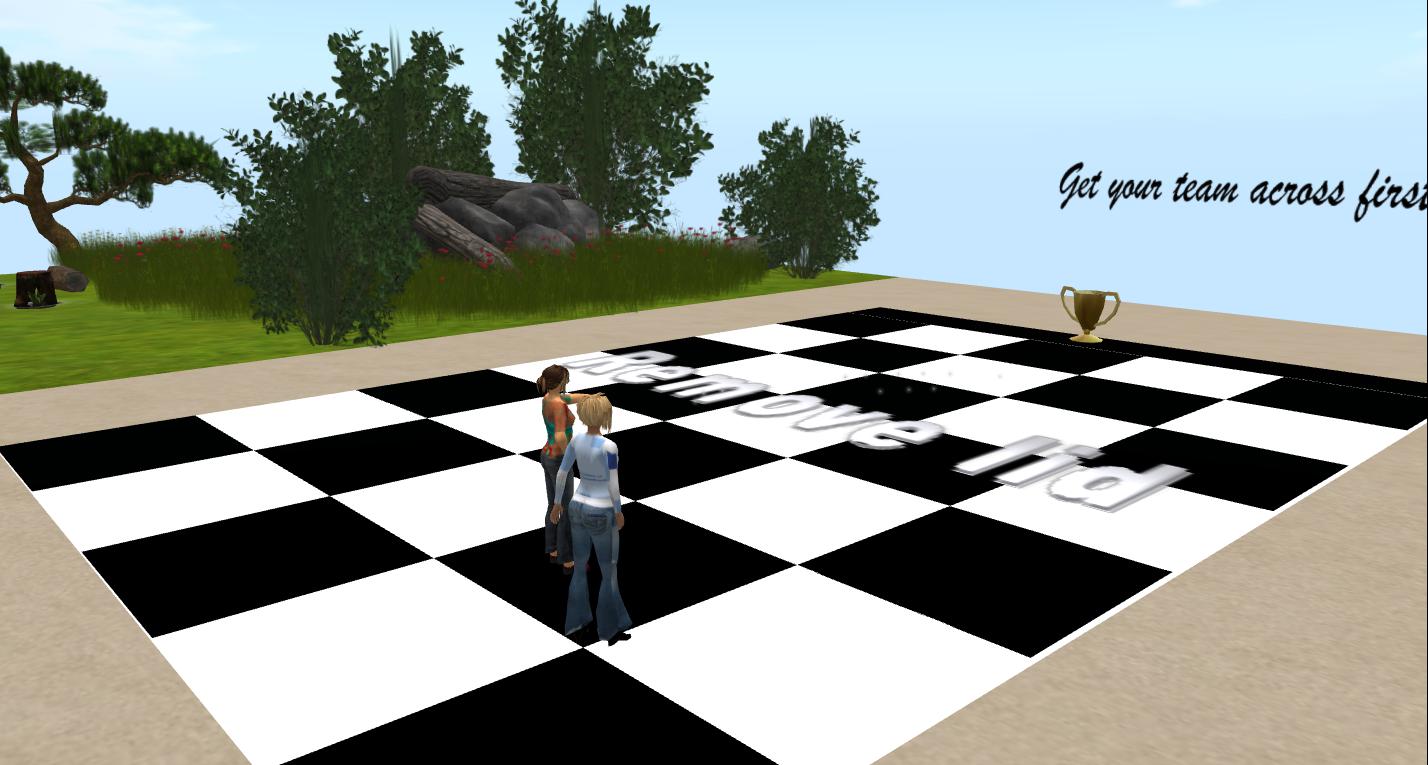
The participants will learn how to navigate their avatars in trying to get their teams across the board that includes invisible holes.


For the building exercise the participants also will have to work in teams.


In the presentation and discussion area all sorts of media can be used; Slide shows, Type-with-Me, videos, and websites are included.

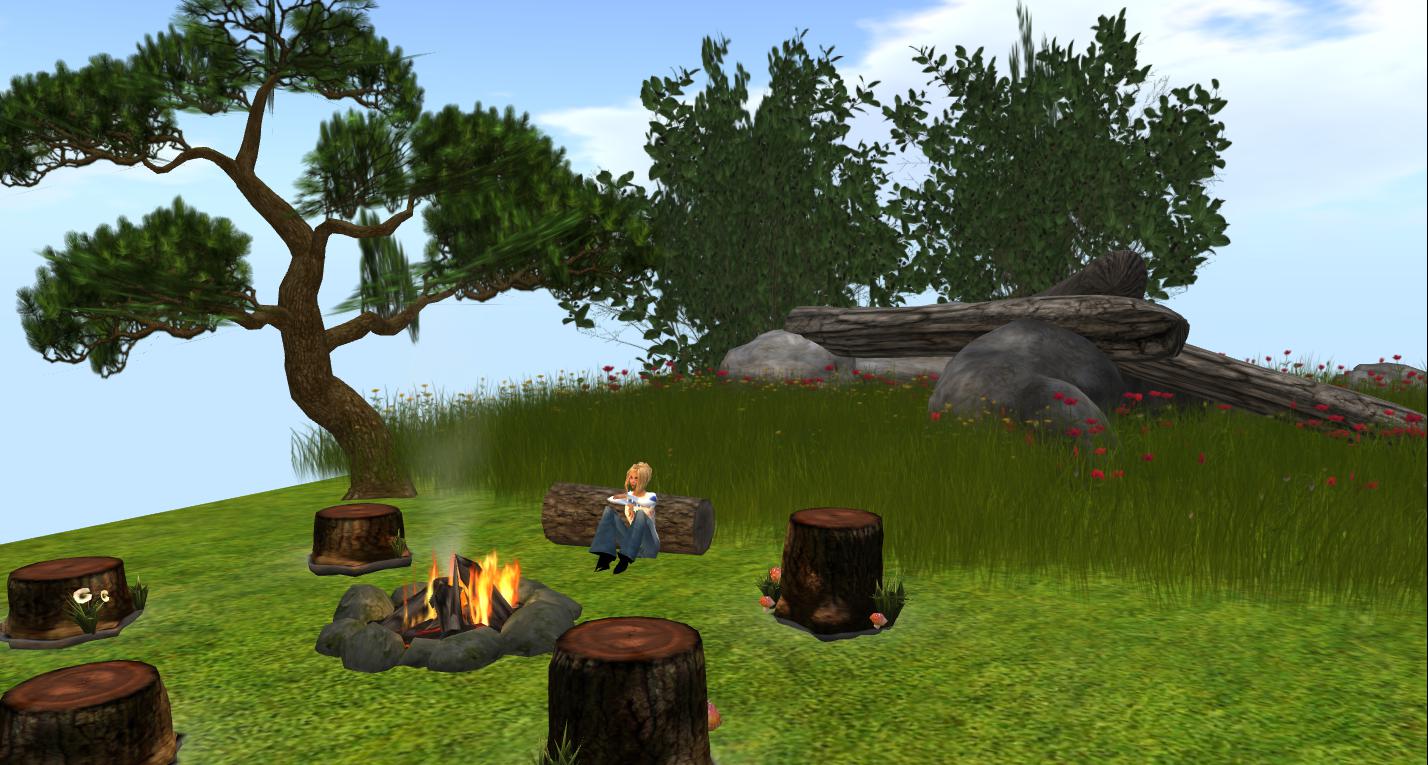
And so, now that Inge has done all the hard work, all I need to do is to take some time in front of the fire to reflect on more fun, engaging, and interesting activities :-)

The dubbed UNA-AAU course starts in-world on September 12th, and I’m sure it will generate some future posts …

/Mariis

G+ – and minus

Despite officially being on vacation, I’ve been trying out some of the tech’s on my “to-explore-list”, most notably Google’s G+ service. I signed in to G+ on July 13th, but two weeks later, I decided to close my account. Since some of the people I had in my circles are also people I know from Facebook, I decided to post a short notice on Facebook just to let them know that I’d left the G+ service. When asked why, these were some of my immediate reasons:

I disagree on the terms of service, especially the part that excludes people in need of pseudonyms, and I’m shocked by the way, Google treats its customers. I had hoped G+ could replace FB/Twitter, but a service that excludes a large part of Internet users, incl. my personal network (and not only avatars), is of no use to me. G+ has been an eye-opener for me in terms intellectual property and cloud computing, and I’ll write a post about it since I think it has implications in an educational and democratic perspective …

Now, Internet law, ToS, intellectual property, etc. are not topics I normally deal with, so this post is simply an account of my personal experience as a “regular” user/customer of Google services. As so many other tech-oriented educators, I enjoy exploring new technologies in terms of educational potential, and this professional interest was if fact my initial reason to start on G+. I was especially excited about the possibility to “circle” connections allowing me to control communication, the prospect of being able to create synchronous “hangouts”, create “sparks”, and the integration with other Google services seemed like a very convenient solution. Despite my current hesitation towards G+, I still believe it is a service with huge educational potential – this doc explores some of these potentials.

Having done research in Second Life (SL) since March 2007, I’ve come to know and respect SL users as tech-savvy, early adopters and so of course my SL connections were some of the first people I added to my circles. In hindsight, it is no surprise that it was through my SL connections, my avatar friends that I first came to hear about the pseudonymity controversy. Not until recently has it been possible to sign up for SL by using your own name, consequently all SL users are used to using pseudonyms, many (myself included) use these pseudonyms in other Internet services, and in fact many SL users are only known by their pseudonym/avatar names. However, Google decided for a non-pseudonym (albeit unclear) policy, and shortly after I entered G+, I started noticing reports of SL/pseudonym-users being excluded from the service. From my research in virtual worlds, I’m fully aware that the mere idea of having a “virtual identity” that somehow differs form a “real identity” is something that provokes the ignorant and often causes controversy, and I honestly don’t think this non-pseudonym problem had gained much attention had it not affected many other users besides avatars. But it did/it does, and soon the controversy hit other media and G+ itself. I’m not going to repeat the controversy, but will link to this excellent post by Kee Hinckley, who elaborates on the issue, the pros and cons, and links to some of the articles written on the subject.

As stated in my own quote above, I was shocked by the way, Google treats its customers. I don’t usually use words like “shocked” when reflecting on professional matters, but it is the truth. I admit that up until now I’ve been incredibly naïve about ToS and intellectual property, I also admit that I often have not taken the time to thoroughly read ToS (not only on Google), but simply have accepted these in a “well, what else can I do” (stupid, stupid!) manner.  And so, I was shocked reading Thomas Monopoly’s story. Followed by a brief automated statement by Google saying that it had “perceived a violation”, Google decided to close all of Monopoly’s services with Google. As it later turned out, Monopoly (as he explains here) had in fact violated the Google ToS unintentionally by posting a series of pictures on The Evolution of Sex (as part of an art project) in which one was flagged as child pornography by Google’s automated systems. It is not for me to question the violation, and it is of course Google’s right to enforce its policy. I am, however, questioning Google’s procedure. The Monopoly case had nothing to do with the pseudonymity controversy, but it revealed how Google handles its business and its customers. The “guilty, until proven innocent” approach, is also the way Google handles pseudonymity issues – e.g. this, this, and this case. The  last case is especially grotesque since this G+ user actually used his real names. Again, I’m not questioning Google’s legal rights, but from a moral point of view, I do find its way of enforcing its rules and regulations very dubious – Jyri Engeström has written an excellent comment on this – in G+ !

Here I’m only referring to a few examples in the Google controversy, but to sum up seeing part of my network being excluded combined with an unclear and sometimes unwarranted procedure, I decided to close my account. I did not use my pseudonym in G+, and I did not intend to violate Google’s ToS. But I lost my confidence in Google. Up until now, I’ve been a satisfied user of several of Google’s services, but now I’ve started to export my content to other providers – not that I have any immediate intentions of leaving my other Google services, I like them and I am a creature of habit, but just in case … and this leads me to the educational perspective on all of this.

For the last couple of years, Personal Learning Environments (PLEs)/Networks (PLNs) have been concepts explored by many tech-oriented educators who have a wish to try and tear down the walls of education and especially traditional Virtual Learning Environments (VLEs)/Learning Management Systems (LMS’) in order to open up education to the rest of the world, and Cloud Computing has been a central concept in this work. I entered G+ thinking that maybe here Google had come up with an interesting solution that could supplement our efforts in this area. However, the returning problem of using (free) hosted services is that of property, and ever so often, I hear system administrators express reluctance towards moving our activities into the “Cloud”. In this Google controversy, I’ve seen the “well, what did you expect – it is a free service” argument in several comments. Well, frankly I do expect even a free service provider to treat its customers right. I would also argue that the term “free” is debatable; we the customers “pay” with our content/our behavior. If the free service providers didn’t make any money on us, they wouldn’t be doing it. Again, this is not my area of expertise, I just call it as I see it, but I must admit that this Google experience has made me very conscious of the pitfalls of moving our content and practices out of our safe, but closed and proprietary VLE. Sadly in this way, I also think the Google controversy can be a set-back in terms of loosening up the traditional educational boarders, and this will not only affect Google’s own services, but also those of other providers.

My final reflection on this combines the educational perspective with that of democratization. Some months ago, I wrote a post in relation to the “Purpose of Education” (Purpos/ed) initiative. In this post I referred to the Declaration of Human Rights which states that everyone has the right to education,  and in my perspective this must include rights to information and the freedom of expression. Incidentally, the UN Human Rights Committee, only this week released a general comment stating that the right to freedom of expression outweighs all other rights.

Previously, and probably naively, I’ve always considered Google to be an important player in the democratization of information, but based on my current experience with G+, I’m wondering what role Google actually sees itself playing, I’m honestly surprised by Google, and I admit, I expected a different approach, when first we heard of Google wanting to launch an alternative to Facebook. Even though my faith in Google has been shattered, I’ve not completely given up (not that I think it cares, but maybe it should), and I do recognize that G+ has been in beta. However, being in beta does not mean “do evil, and sort it out afterwards” – it means “do no evil, to begin with”. I’m truly hoping Google will listen to its customers, and learn. If nothing else, I hope Google recognizes that the controversy and the many reactions by and large reflect that people care – care about Google, and more importantly care about people.

/Mariis