MUVEs for learning

In the beginning of his book “Being There Together – Social interaction in Virtual Environments” Ralph Schroeder (2011) provides a definition of Multi-User Virtual Environments (MUVEs):

The VEs discussed here relate to virtual reality (VR) technologies. In a previous book, I defined virtual reality technology as ” a computer-generated display that allows or compels the user (or users) to have a feeling of being present in an environment other than the one that they are actually in and to interact with that environment” (Schroeder 1996: 25; see also Ellis 1995) – in short, “being there”. (Schroeder, 2011, p. 4 – original emphasis)

And from this follows that MUVEs can be defined:

(…) as those [virtual environments] in which users experience other participants as being present in the same environment and interacting with them – or as “being there together.” (Schroeder, 2011, p. 4 – my emphasis)

In line with Schroeder’s definition, the term MUVEs is sometimes used exclusively to characterize virtual environments designed on a 3D spatial metaphor (i.e. Ketelhut, Dede, Clarke & Nelson, 2006), because this is seen as a precondition for experiencing presence when there is an emphasis on the “there” component in the understanding of presence. However, in the field of distance education, the concept of presence has been debated for decades, and has included the sense of self and sense of others that do/do not occur also in 2D virtual environments. Most notably the work of a Canadian research project referred to as “Community of Inquiry” (COI) that ran from 1997-2001,  managed to bring focus to the concepts of cognitive, social, and teaching presence as being essential to especially distance educational experiences. The COI project started with a focus on presence in text-based computer-mediated communication (i.e. Garrison, Anderson & Archer, 2000; Rourke, Anderson, Garrison & Archer, 2001), but has since moved on to also study these particular types of presence in 3D virtual environments such as Second Life (i.e. McKerlich & Anderson, 2007; McKerlich, Riis, Anderson & Eastman, 2011). The difference, between Schroeder’s perception of the presence concept and that of COI research, highlights the fact that there is no (cross-disciplinary) consensus on the definition.  In fact, many definitions and sub-categories of presence can be identified, and this is evidently something I’ll discuss thoroughly in my PhD.

It is important to notice that the primary focus of my study is on Second Life. Nonetheless, other types of MUVEs cannot be ignored simply because both the research literature and the participants in my study often refer to these other types in an attempt to make sense of Second Life. In the table below, I’ve provided an overview of the different types of MUVEs that are relevant to have in mind as part of the overall context of my study.
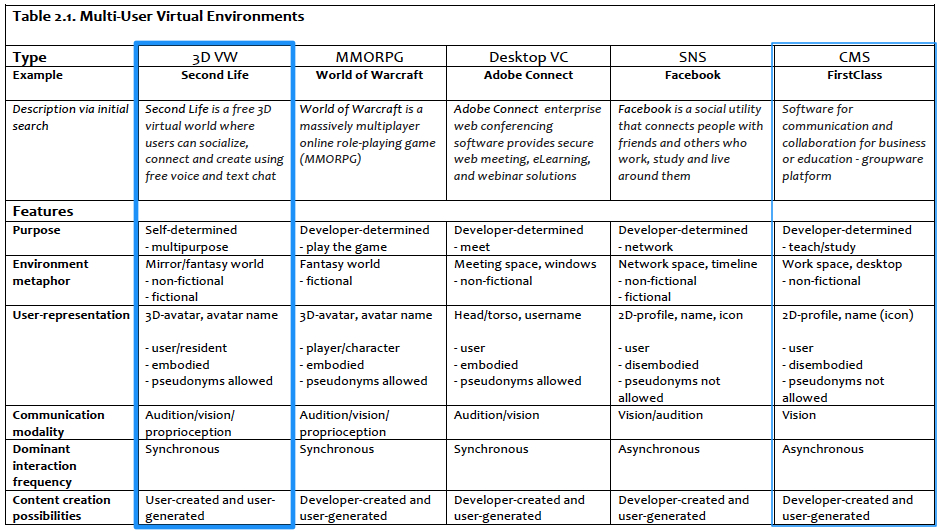
Clearly, learning happens in all these MUVEs, but from a formal educational perspective, there are some very interesting differences between these different types of MUVEs. Among critics of VWs, I’ve often heard the argument that “VWs are just virtual learning environments based on a spatial metaphor”, and while it is true that VWs, such as Second Life, are based on a 3D spatial metaphor and that this is an important difference, it is not the only one. To me, the communication modalities, the interaction frequency, and not least the content creation possibilities offered in these types of virtual environments, are just as important.

In my study, the teaching and learning processes have been situated in a blended environment consisting primarily of a combination of Second Life and the more conventional 2D virtual environment called FirstClass. At the Master’s Program of ICT and Learning (MIL) that I have used as case for my study, FirstClass provides the ICT infrastructure in this distance ed program, this is were the majority of the administrative and teaching activities take place – the students tend to use complementing technologies for their learning processes. During my research period (2007-2011), the use of FirstClass and Second Life has changed: in the first research cycle, the majority of both teaching and learning activities took place in FirstClass, whereas in the final, fourth research cycle, Second Life provided the setting for the majority of the activities. Regardless of this, I still believe both environments contribute with some unique affordances that are important to ensure high quality teaching and learning – and ideally, none of them should be used as stand-alone environments.

/Mariis

References

Garrison, D., Anderson T. &  Archer, W (2000): Critical inquiry in a text-based environment: Computer conferencing in higher education. The Internet and Higher Education, 2: 87–105

Ketelhut, D. J., Dede, C., Clarke, J., & Nelson, B. (2006): A multi-user virtual environment for building higher order inquiry skills in science.Paper presented at the American Educational Research Association, San Francisco, CA.

McKerlich, R. & Anderson, T. (2007): Community of inquiry and learning in immersive environments. Journal of Asynchronous Learning Networks. 11(4).

Rourke, L, Anderson, T., Garrison, D.R., Archer, W. (2001): Assessing social presence in asynchronous text based computer conferencing. Journal of Distance Education, 14(2), 50-71.
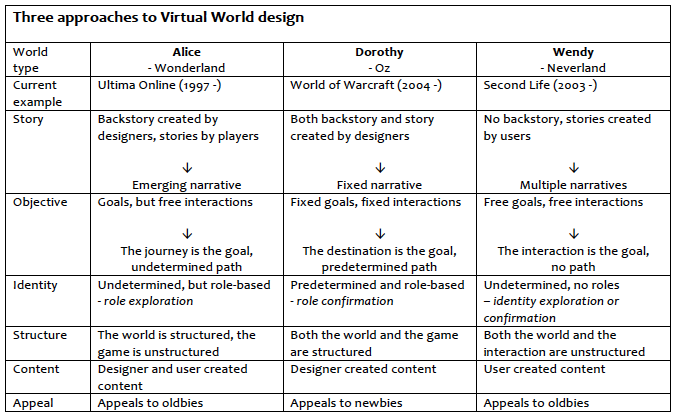
Alice and Dorothy play together – but what about Wendy?

In a recent post I wrote about why I don’t consider SL a game, Richard Bartle was very kind to comment and point my attention to one of his articles entitled “Alice and Dorothy play together” (Bartle, 2009). I’ve now read it and together with some of Bartle’s other works, I find it very useful in relation to my own work with what I prefer to call open-ended Virtual Worlds – so thank you again, Richard for stopping by and pointing to various resources :-)

In the article, Bartle describes three philosophies or design approaches that have influenced the work of designing Virtual Worlds. Based on three major fictional works, Alice in Wonderland, Dorothy from Oz, and Wendy in Neverland, Bartle identifies differences and commonalities and discusses their ability to “play together”. It’s important to notice that Bartle is addressing a game (world) designer audience, and that Bartle’s work in general has focused on Virtual Worlds designed with the explicit intent to entertain the players – fun is the key motivation for using such worlds. In the table below, I’ve tried to summarize some of Bartle’s points.

Without going too much into detail with the table here in this post, I think it’s important to notice a couple of things in order to understand what follows. In terms of “appeal” this should be seen in the light of immediate attraction, does the world attract and more importantly retain newbies? Evidently, a Dorothy world like WoW (with millions of active players) also appeals to oldbies, the kind of players who find joy and interest in “leveling up”, the kind Bartle calls “Achievers” (as we shall see further down). The table also shows why SL has problems when it comes to retaining users (with approx. 20 mio. accounts, but less than 100.000 concurrent users on a daily basis, there is a problem). Judging from the table, SL’s credo “Your World, Your Imagination” becomes a double-edged sword. The lack of a fixed narrative leaves the SL-user completely on his/her own to come up with a reason to play/stay. This problem, however, is not unique to SL, but points to a classic dilemma between the different needs of newbies and oldbies. Following from this, the next question that comes to mind then is: what motivates Wendy? or more precisely, why do users find interest in SL and what do they do in SL?

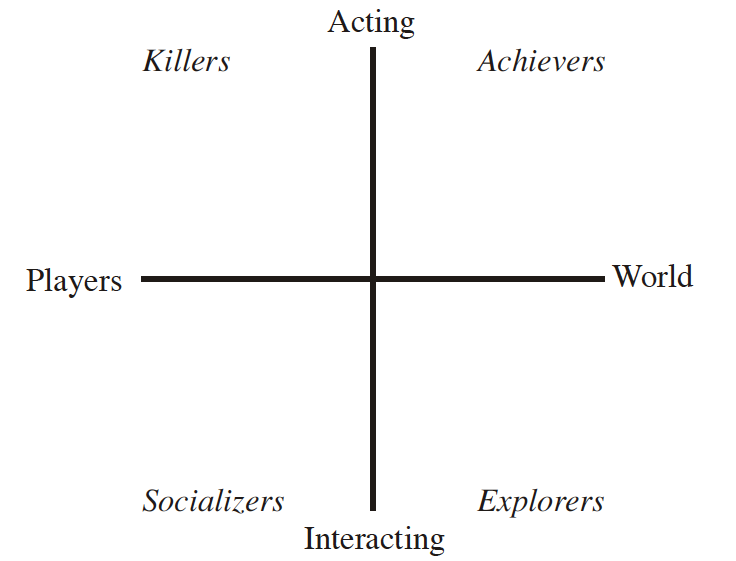
In “Designing Virtual Worlds” Bartle explains how he in the early 90’s, based on a long-lasting debate between senior players of MUD2 regarding the motives for playing, analyzed the ideas of what constituted fun and found that players could be categorized into four major types:

  • Achievers, who are interested in doing things to the game, i.e. in ACTING on the WORLD. (later sub-categorized in Opportunists and Planners)
  • Explorers, who are interested in having the game surprise them, i.e. in INTERACTING with the WORLD. (later sub-categorized in Scientists and Hackers*)
  • Socializers, who are interested in INTERACTING with other PLAYERS. (later sub-categorized in Networkers and Friends)
  • Killers, who are interested in doing things to people, ie. in ACTING on other PLAYERS. (later sub-categorized in Griefers and Politicians)

Based on continued refinement of these categories, Bartle created the so-called Player Interest Graph depicted below:

The Original Player Interest Graph (Bartle, 1996/2004 – see references)

The graph describes players in terms of two dimensions: how they prefer acting on things as opposed to interacting with, and how they prefer to direct their attentions toward other players. When trying to apply this graph to SL, I see three issues that don’t match.

  • The term “players” indicates that there is a game to be played**.
  • The category “killers” implies a combat game-type world.
  • The category “achievers” is also closely tied to the existence of a game – Bartle highlights their motivation: “These people put the game-like aspect of the virtual world to the fore. They like doing things that achieve defined goals, thereby progressing their character through the world’s built-in ranking system.” (Bartle, 2004, p. 130)

Regardless of this, I still think the principal idea of the graph can be used in relation to SL, and so I have re-designed the graph:

SL User Interest Graph

  • Users is my personal preference. Linden Lab calls its users “residents”, and many experienced users in SL refer to themselves as “residents” – I do too. It is, however, a problematic term. My observations and research data clearly show that many (especially newbies, but not only) feel homeless and marginalized from the general SL community (but this has to be the topic of another post).
  • Griefers is a term borrowed from the game worlds, it is, however, how we define trouble-makers in SL too, and the term is also used in academic writings on SL (i.e. Boellstorff, 2008). I did consider the Internet term “troll”, but since trolls seem to be deliberately malicious, and my experience with (some) griefers is that they often have more humorous intentions (albeit still annoying to those they act upon), I discarded it.
  • Designers refers to the SL users, who well … design things (buildings, art, clothes, animations etc.). I did consider the term “producers”, but in my opinion the socializers also produce and contribute to the content of SL. Compared to Bartle’s achievers, there are some interesting similarities. Designers also aim at mastering and acting upon the world, and even though there is no leveling system in SL, the mastery also results in high scores in terms of social capital (cf. Huvila et al, 2010).

Given my particular focus on education, I would also categorize teachers (and to some extent students) as designers – we design for learning, but that’s another story :-)

/Mariis

*) Bartle uses the term to refer to skills, rather than (malicious) intentions.

**) Yes, I’m aware of Linden Realms and the many RP-communities in SL, but that still doesn’t make it a game per se.

References

Bartle, R.A. (no date): Virtual Worlds: Why People Play.

Bartle, R.A. (1996): Hearts, Clubs, Diamonds, Spades: Players who suit MUDs.

Bartle, R.A. (2004): Designing Virtual Worlds. New Riders.

Bartle, R.A. (2009): Alice and Dorothy play together. In: Harrigan, P. & Wardrip-Fruin, N. (eds) Third Person – authoring and exploring vast narratives. The MIT Press. p. 105-117

Boellstorff, T. (2008): Coming of age in Second Life. An anthropologist explores the virtually human. Princeton University Press.

Huvila, I.; Holmberg, K.; Ek, S. & Widen-Wulff (2010): Social capital in Second Life. In: Emeralindsight, Vol. 34, No. 2, 2010. p. 295-316

Psychological Relativism – perspectives on reality/virtuality

Yesterday, in a talk at The Federal Consortium for Virtual Worlds (FCVW) conference, Jim Blascovich spoke about reality, virtuality, and our perceptions hereof. Blascovich made some interesting and provocative claims about reality, starting with the question: “What is reality?” and answering it by saying: “No one knows!” Blascovich then presented a photo of the Earth and a photo from SL, and asked are they both real? Yes! Are they both virtual? Yes!

Um, so at first glance this may seem confusing, but as far as I understood it Blascovich’ point was that our perceptions (of anything) are idiosyncratic hallucinations, and we see/perceive things that are not there and things that cannot be there – the human brain adapts and “right things” (cf. the work of George Stratton on perceptual adaptation). Together with Cade McCall, Blascovich explains this in a paper on “Attitudes in Virtual Reality“:

“In contrast to the continuing struggle and debate among interested scholars over the hard consciousness problem, many scholars from many fields concerned with the question, “What is reality?” agree that what people think of as reality is an hallucination; that is, a cognitive construction. Together with religious gurus and mystics, philosophers (Huxley, 1954) and experimental psychologists (e.g., Shepard, 1984), maintain that perceptions are invariably idiosyncratic hallucinations, albeit often assumed and treated as collective. (Blascovich & McCall, 2009, p. 3 – my emphasis)”

I don’t know … I think this is difficult to comprehend, and I couldn’t help but think about Plato and his cave-analogy. Based on a question from the twitter-audience, I did get the impression that Blascovich recognizes the empirical world (our Earth) as real though; because he went on to make the distinction between “grounded reality” and “virtual reality”. However, the tricky part is that what we consider “real” or “virtual” depends on our individual perspectives, and this is referred to as the principle of psychological relativism:

“Analogous to Einstein’s theory of special relativity regarding time and space, psychological relativity theory states that what is mentally processed (i.e., perceived or thought of) as real and what is mentally processed (and thought of) as not real (i.e., virtual) depends on one’s point of view. People contrast a particular “grounded reality”— what they believe to be the natural or physical world—with other realities they perceive—what at times they believe to be imaginary or “virtual” worlds. However, what is thought to be grounded reality and what is thought to be virtual reality is often muddled or even reversed. (Blascovich & McCall, 2009, p. 4 – my emphasis)”

While I really appreciate Blascovich’ emphasis on “context” as being crucial to our perceptions, I think the problem with relativity is that it makes it very hard to reach consensus on anything, or to achieve “collective hallucinations” so to speak – and for many people the uncertainty of relativism is unsettling. Whenever I bring students into SL, they clearly struggle with such ontological questions, and I think the uncertainty about what is/isn’t real can become a barrier to adaptation of the medium.

Fortunately, it isn’t all completely relative. The research done by Blascovich and colleagues (not least Jeremy Bailenson – cf. Infinite Reality) shows how i.e. movement, anthropometric, and photographic variables influence our perceptions. And by studying such results, we – as VW designers/users – can accommodate different perceptions and it gives us a more informed starting point for some very interesting discussions on the ontology of VWs.

Admittedly, I’m still processing some of Blascovich’ points in terms of consequences for VWs design, and I’m not sure if it makes sense or if I can make sense of it … according to Blascovich “reality is a state of mind”, and mine sure is messy!

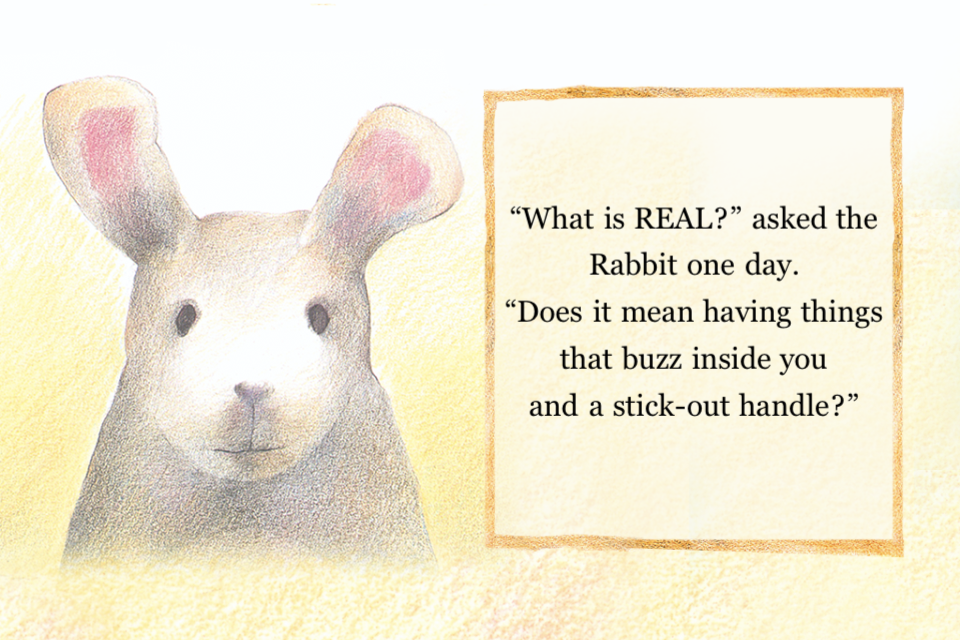
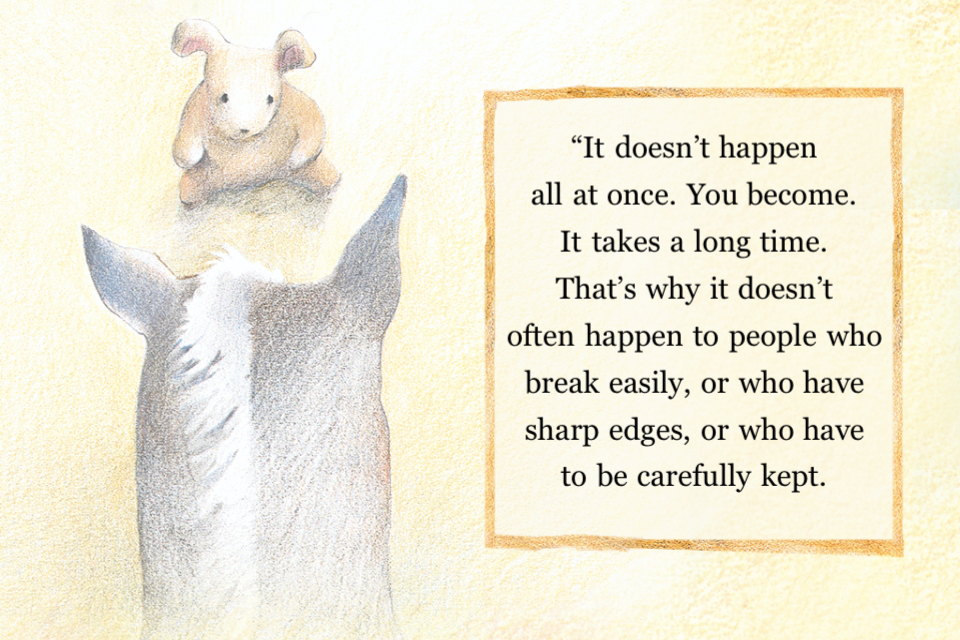
Without diminishing the work of Blascovich et al. I still think that one of the best explanations of “real” stems from a dialogue between a rabbit and a wise old skin horse:

/Mariis

Virtual World – a working definition

A favourite book of mine on the topic of “virtual” is Anne Friedberg‘s “The Virtual Window – from Alberti to Microsoft” in which she explores the window as metaphor, as architectural component, and as an opening to dematerialized reality. In the first chapter, Friedberg sets out to define “virtual” because “in the glare of a jargon-ridden present, the term “virtual” may have lost its descriptive power”, and she hopes “to reclaim its considerable utility for making distinctions about the ontological status – and materiality – of an object” (Friedberg, 2006, p. 7).

To start off her endeavour, Friedberg presents the following definition from Webster’s (1993) Third New International Dictionary Unabridged:

“Virtual (Latin, virtus, for strength or power) of, relating to, or possessing a power of acting without the agency of matter; being functionally or effectively but not formally of its kind.”

Subsequently, Friedberg (ibid. p. 8-11) makes the following points that I found of particular interest:

  • The virtual is a substitute – “acting without agency of the matter” – an immaterial proxy for the material.
  • “Virtual” refers to the register of representation itself – but representation can be either simulacral (with no referent in the real) or mimetic.
  • The term “original” and “copy” do not apply, because virtuality does not imply direct mimesis, but a transfer – more like a metaphor – from one plane of meaning to another.
  • A “virtual” object has a materiality and a reality but of a different kind, a second-order materiality, liminally immaterial.

Friedberg further explains that for the purpose of her study: “the term “virtual” serves to distinguish between any representation or appearance (whether optically, technologically, or artisanally produced) that appears “functionally or effectively, but not formally” of the same materiality of what it represents.” (ibid. p.11)

It’s important to notice that Friedberg mentions different production forms, which of course highlights her point that “virtual” doesn’t apply to technology mediated objects and experiences only.

In the inaugural 2008 issue of The Journal of Virtual Worlds Research, which also includes reprints of earlier writings considered seminal to the field, six of 17 papers offer explicit attempts to define “virtual worlds”, and at least two of the authors (Bittarello & Damer) also consider literary worlds (i.e. The Garden of Eden and Dante’s Inferno) to be “virtual worlds”.

Based on this and a bunch of other readings, I’ve decided to use the following quite simple working definition:

“Virtual World” =df “Any representation of a world that appears functionally or effectively, but not formally of the same materiality as the world it represents.”

Through this definition, the only thing we learn about “virtual worlds” is that they are of a different materiality than the ones they represent. And from this follows that if we want to know more about a particular “virtual world”, we need to add more to the definiendum i.e. 3D, computer-based, social etc.

I see some advantages:

  • The essence of “virtual world” refers to materiality and does not imply an inherent quality difference other than form
  • It’s possible to honour/include the history of “virtual worlds”
  • It’s possible to include both game-based and non-game based worlds – cf. the differences between Bartle and Ondrejka on the concept of “virtual worlds”
  • It’s possible to specify what isn’t a “virtual world” – a virtual representation that doesn’t refer to a world materiality
  • When talking about “virtual worlds” it’s necessary to specify what type of “virtual world” we are referring to in order to avoid confusion and ambiguity

Nonetheless, I still prefer to call it a “working” definition, because there are some important issues to consider:

  • I’m considering whether or not to include something about production/media forms – cf. Friedberg’s definition.
  • A definition must not be circular; it shouldn’t include the word to be defined. I have used the word “world” twice, but because the definition is about representation I think it’s hard not to include …
  • I’m wondering if a representation has “no referent in the real” is it then possible to talk about “the same materiality of what it represents”? Some “virtual worlds” are purely imaginary worlds that don’t exist in the real, do they then have a materiality, do they re-present?

I definitely need to consult with some of my philosophical friends on this! Meanwhile, I’m investigating different “virtual world” typologies and they provide another fruitful perspective on the concept …

/Mariis

Also check out The Virtual Window Interactive

Inspired by Friedberg’s account of Alberti, I’ve previously written about the window metaphor in SL in relation to remediation.

It’s Not a Game …

Even though my PhD-research has focused exclusively on Second Life, I will in one of my theoretical chapters examine the concept and evolution of Virtual Worlds in general. As a prelude to a discussion of several Virtual World definitions and typologies, I have chosen to look closer at what two prominent figures within the field have to say about Virtual Worlds. Richard A. Bartle (co-creator of MUD1, which by many is considered the first computer-based (albeit text only) Virtual World) and Cory Ondrejka (co-creator of Second Life) both agree that Virtual Worlds are not games.  However, what’s interesting is that Bartle and Ondrejka seem to reach this conclusion based on very different arguments.

On the first page in his book, “Designing Virtual Worlds”, Richard A. Bartle proposes a definition of Virtual Worlds:

Virtual worlds are implemented by a computer (or networks of computers) that simulates an environment. Some – but not all  – entities in this environment act under the direct control of individual people. Because several such people can affect the same environment simultaneously, the world is said to be shared or multi-user. The environment continues to exist and develop internally (at least to some degree) even when there are no people interacting with it; this means it is persistent. (Bartle, 2004, p.1)

According to Bartle Virtual Worlds began as computer games, which explains why much of the vocabulary used to describe Virtual Worlds is games-based:

Thus, the human beings who interact with the simulated environment are known as players rather than users; the means by which the environment introduces goals for the players is called gameplay; the activity of interacting with the environment is referred to as playing. (Bartle, 2004, p.2 – original emphasis)

Further, Bartle explains that the first Virtual Worlds were text-based and known as Multi-User Dungeons, MUDs, and although “all these persistent, shared, computer-based environments can and should be referred to as MUDs, the term is sufficiently loaded that outside the cognoscenti it is unlikely to be universally interpreted this way”, and Bartle therefore prefers to adopt the “more descriptive and less emotive” concept of Virtual Worlds (ibid. p.3). Based on Bartle’s initial characteristics of Virtual Worlds, which in the first chapter includes a review of what easily could be perceived of as computer-game history, it is interesting to see why Bartle dismisses the term “game”. Bartle, in fact, devotes the book’s sixth chapter entitled “It’s Not a Game, It’s a …” to explaining why he has abandoned the term. The beginning of the chapter reveals the core argument:

Virtual worlds began as games. However, right from the beginning – MUD1 – it was clear there was more to them than being mere games. Trying to convince people to take what they considered to be a “game” seriously was problematical, though. In academic circles, the only intellectual acceptable games were traditional ones, such as chess and checkers. A new game was not a worthwhile object of study. Playing games was a waste of computer resources. Thus, virtual worlds became “simulations” – and far more respectable! (Bartle, 2004, p. 473)

Bartle’s need to distance himself from the game term was essentially due to a public (mis)conception of games as unserious contexts/activities and hence unworthy of serious studies[1]. While this concern is commonly recognized and shared among several authors, it does come across as somewhat curious insofar as Bartle insists on using a gaming vocabulary and gaming principles when discussing design of Virtual Worlds.

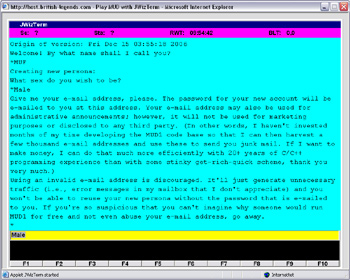
MUD1 (source)

Nonetheless, the need to differentiate between games and Virtual Worlds is also of concern for Cory Ondrejka, although his argumentation is quite different from Bartle’s. According to Ondrejka Virtual Worlds represent a new category of digital experience different from games[2] most notably because Virtual Worlds like Second Life have no game fictions or leveling;

Strong game fictions mean the games take place within relatively cohesive settings that discourage intermingling with the real world. Fantasy motifs are common, but certainly not the only option. Leveling is the process of measuring progress via increases in experience points. These experience points are gained by activities appropriate to the level, and each new level grants the player access to new abilities or game features. (Ondrejka, 2008, p. 230-231)

While fully recognizing the close relationship to games due to shared history, technology, vocabulary, and oftentimes customers, Ondrejka continues to delineate the difference:

Virtual worlds are something different. While still massively multiplayer, meaning that thousands of players simultaneously experience the world in a shared space, they possess neither strong fictions nor leveling. Instead, their defining characteristic is the ability of residents to generate creations of value within a shared, simulated, 3D space. Strong, predefined fictions are not appropriate, as they limit the design space available to the residents. Instead, residents create their own fictions and communities, imbuing them with meaning through interaction. (Ondrejka, 2008, p. 231)

For me, as seen from an educational design perspective, the lack of gameplay (i.e. pre-determined context, goals of use, roles and rules of interaction, progression, and quantifiable outcome) is one of the most important – if not the most important – defining features of Virtual Worlds because of the design possibilities and challenges it poses. “Your World, Your Imagination” truly has defined my SL experience since 2007, and I have to agree that it’s not a game! Still, exactly what it is remains to be determined ;-)

/Mariis

[1] Ironically, as Bartle further notices, when Virtual Worlds became commercially successful through the advent of Massively Multi-Player Online Role-playing Games (MMORPGs), such as Ultima Online in the late 1990’s, Virtual Worlds were once again commonly referred to as games. Nonetheless, the less serious connotations related to the term game continued and in Academia, the concept of “serious games” emerged to justify the study of human behaviour in games used for purposes other than mere entertainment. The term “serious game” was actually used long before the introduction of computer and electronic devices into entertainment. Clark Abt discussed the idea and used the term in his 1970 book Serious Games, although his references were primarily to the use of board and card games.

[2] Based on Salen and Zimmerman (2003) Ondrejka defines a game as “a system in which players engage in an artificial conflict, defined by rules, that results in a quantifiable outcome” (Ondrejka, 2008, p. 231).

References

Bartle, R.A. (2004): “Designing Virtual Worlds”. New Riders.

Ondrejka, C. (2008): “Education Unleashed: Participatory Culture, Education, and Innovation in Second Life.” The Ecology of Games: Connecting Youth, Games, and Learning. Edited by Katie Salen. The John D. and Catherine T. MacArthur Foundation Series on Digital Media and Learning. Cambridge, MA: The MIT Press. p.229–252.