In a recent post I wrote about why I don’t consider SL a game, Richard Bartle was very kind to comment and point my attention to one of his articles entitled “Alice and Dorothy play together” (Bartle, 2009). I’ve now read it and together with some of Bartle’s other works, I find it very useful in relation to my own work with what I prefer to call open-ended Virtual Worlds – so thank you again, Richard for stopping by and pointing to various resources :-)
In the article, Bartle describes three philosophies or design approaches that have influenced the work of designing Virtual Worlds. Based on three major fictional works, Alice in Wonderland, Dorothy from Oz, and Wendy in Neverland, Bartle identifies differences and commonalities and discusses their ability to “play together”. It’s important to notice that Bartle is addressing a game (world) designer audience, and that Bartle’s work in general has focused on Virtual Worlds designed with the explicit intent to entertain the players – fun is the key motivation for using such worlds. In the table below, I’ve tried to summarize some of Bartle’s points.
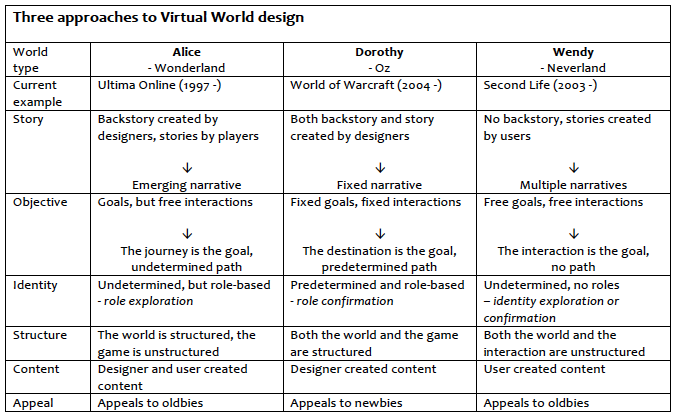
Without going too much into detail with the table here in this post, I think it’s important to notice a couple of things in order to understand what follows. In terms of “appeal” this should be seen in the light of immediate attraction, does the world attract and more importantly retain newbies? Evidently, a Dorothy world like WoW (with millions of active players) also appeals to oldbies, the kind of players who find joy and interest in “leveling up”, the kind Bartle calls “Achievers” (as we shall see further down). The table also shows why SL has problems when it comes to retaining users (with approx. 20 mio. accounts, but less than 100.000 concurrent users on a daily basis, there is a problem). Judging from the table, SL’s credo “Your World, Your Imagination” becomes a double-edged sword. The lack of a fixed narrative leaves the SL-user completely on his/her own to come up with a reason to play/stay. This problem, however, is not unique to SL, but points to a classic dilemma between the different needs of newbies and oldbies. Following from this, the next question that comes to mind then is: what motivates Wendy? or more precisely, why do users find interest in SL and what do they do in SL?
In “Designing Virtual Worlds” Bartle explains how he in the early 90’s, based on a long-lasting debate between senior players of MUD2 regarding the motives for playing, analyzed the ideas of what constituted fun and found that players could be categorized into four major types:
- Achievers, who are interested in doing things to the game, i.e. in ACTING on the WORLD. (later sub-categorized in Opportunists and Planners)
- Explorers, who are interested in having the game surprise them, i.e. in INTERACTING with the WORLD. (later sub-categorized in Scientists and Hackers*)
- Socializers, who are interested in INTERACTING with other PLAYERS. (later sub-categorized in Networkers and Friends)
- Killers, who are interested in doing things to people, ie. in ACTING on other PLAYERS. (later sub-categorized in Griefers and Politicians)
Based on continued refinement of these categories, Bartle created the so-called Player Interest Graph depicted below:
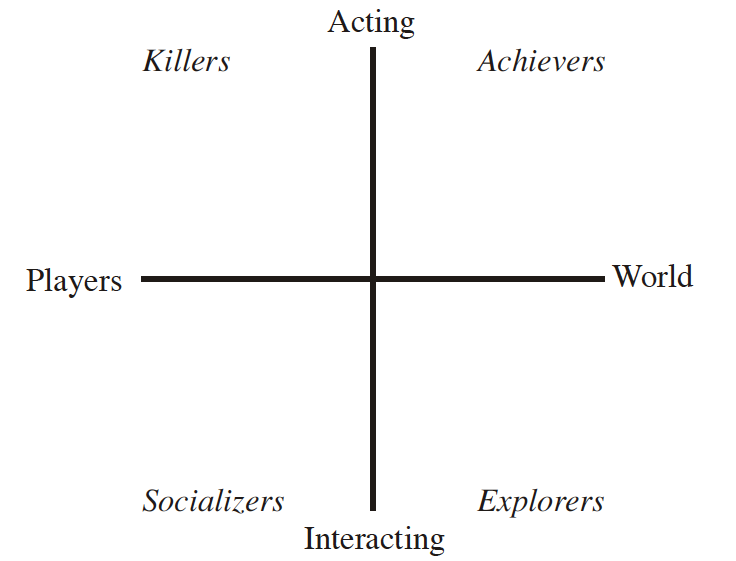
The Original Player Interest Graph (Bartle, 1996/2004 – see references)
The graph describes players in terms of two dimensions: how they prefer acting on things as opposed to interacting with, and how they prefer to direct their attentions toward other players. When trying to apply this graph to SL, I see three issues that don’t match.
- The term “players” indicates that there is a game to be played**.
- The category “killers” implies a combat game-type world.
- The category “achievers” is also closely tied to the existence of a game – Bartle highlights their motivation: “These people put the game-like aspect of the virtual world to the fore. They like doing things that achieve defined goals, thereby progressing their character through the world’s built-in ranking system.” (Bartle, 2004, p. 130)
Regardless of this, I still think the principal idea of the graph can be used in relation to SL, and so I have re-designed the graph:

SL User Interest Graph
- Users is my personal preference. Linden Lab calls its users “residents”, and many experienced users in SL refer to themselves as “residents” – I do too. It is, however, a problematic term. My observations and research data clearly show that many (especially newbies, but not only) feel homeless and marginalized from the general SL community (but this has to be the topic of another post).
- Griefers is a term borrowed from the game worlds, it is, however, how we define trouble-makers in SL too, and the term is also used in academic writings on SL (i.e. Boellstorff, 2008). I did consider the Internet term “troll”, but since trolls seem to be deliberately malicious, and my experience with (some) griefers is that they often have more humorous intentions (albeit still annoying to those they act upon), I discarded it.
- Designers refers to the SL users, who well … design things (buildings, art, clothes, animations etc.). I did consider the term “producers”, but in my opinion the socializers also produce and contribute to the content of SL. Compared to Bartle’s achievers, there are some interesting similarities. Designers also aim at mastering and acting upon the world, and even though there is no leveling system in SL, the mastery also results in high scores in terms of social capital (cf. Huvila et al, 2010).
Given my particular focus on education, I would also categorize teachers (and to some extent students) as designers – we design for learning, but that’s another story :-)
/Mariis
*) Bartle uses the term to refer to skills, rather than (malicious) intentions.
**) Yes, I’m aware of Linden Realms and the many RP-communities in SL, but that still doesn’t make it a game per se.
References
Bartle, R.A. (no date): Virtual Worlds: Why People Play.
Bartle, R.A. (1996): Hearts, Clubs, Diamonds, Spades: Players who suit MUDs.
Bartle, R.A. (2004): Designing Virtual Worlds. New Riders.
Bartle, R.A. (2009): Alice and Dorothy play together. In: Harrigan, P. & Wardrip-Fruin, N. (eds) Third Person – authoring and exploring vast narratives. The MIT Press. p. 105-117
Boellstorff, T. (2008): Coming of age in Second Life. An anthropologist explores the virtually human. Princeton University Press.
Huvila, I.; Holmberg, K.; Ek, S. & Widen-Wulff (2010): Social capital in Second Life. In: Emeralindsight, Vol. 34, No. 2, 2010. p. 295-316


 Mariis' digitale refleksioner