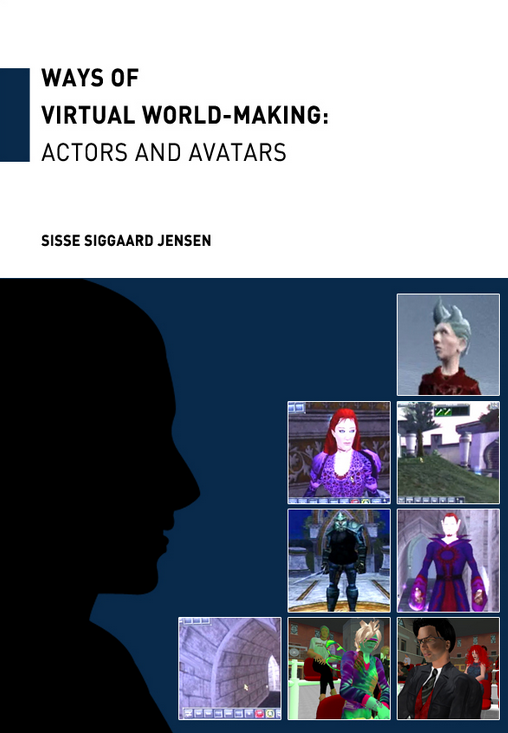
Research on “Ways of Virtual World-making – Actors and Avatars”

Sisse Siggaard Jensen, Professor, Ph.D. of Digital Communication at Roskilde University, Denmark has had her dissertation “Ways of Virtual World-making – Actors and Avatars” accepted for defense for the doctorate degree Dr. Phil. Sisse truly is one of the leading pioneers in this emerging research field, I’ve had the pleasure of meeting her many times during my PhD-work, and this is just wonderful news – big congrats Sisse :-)


The dissertation can be purchased as e-book here

UPDATE: Non-native Danish speakers can order the book by sending a request to: academicbooks@academicbooks.dk

l bought the dissertation yesterday and I have been unable to put it aside – it really is fascinating reading for those interested in research in VWs! The dissertation contributes to the research field with an interpretive, constructivist, and semiotic understanding of human actors’ engagement with the virtual worlds of EverQuest and Second Life. The study is aimed at empirical analysis of different ways of engaging with VWs, and it is based on longtime participatory observation and video interviews (from 2002-2009). The overall research question is: In what ways do actors make sense of situations of engagement with virtual worlds? 

Key theoretical and methodological influences in the study are:

  • The concept of metaphors (i.e. Lakoff & Johnson 1980, Johnson 1987)
  • The sense-making approach (i.e. Dervin 2003)
  • The optic of actor-network theory (i.e. Latour 2005)
  • The emphasis on ways of seeing in relation to video analysis (i.e. Grimshaw 2001, 2005)

Besides contributing with models of her own (actor-network diagram, sense-making triangle) that I need to study further, I also noted that Sisse provides some very good overviews of key points of interest in VW research such as; history of VWs, and overviews of research in relation to avatars, identity, and engagement. Further, Sisse’s work with video interviews and analysis hereof also makes this dissertation interesting from a methodological point of view, and in general it is a valuable resource and important contribution to the field.

Sisse will defend her dissertation on Friday June 1, 2012 at 1 – 5 PM (GMT+1) in building 00, at Roskilde University, and it will be streamed on Roskilde university’s website: ruc.dk as well as on the blog: worlds.ruc.dk, which is the blog of the Danish research project “Sense-making strategies of the innovations of Virtual Worlds”.

The opponents for the defense are: Professor Jay D. Bolter, Georgia Institute of Technology, Professor Andrew Burn, London University, Professor Kim C. Schrøder, Roskilde University (chair).

/Mariis

References

  • Dervin, B. (2003): Sense-Making’s journey from metatheory to methodology to method: An example using information seeking and use as research focus. In Dervin, B.; Foreman-Wernet; L & Lauterbach; E.  (Eds.). (2003). Sense-Making Methodology reader: Selected writings of Brenda Dervin (pp. 133-164). Cresskill, NJ: Hampton Press.
  • Grimshaw, A. (2001): The Ethnographer’s Eye: Ways of Seeing in Anthropology. Cambridge: Cambridge University Press.
    Grimshaw, A. (2005):  Eyeing the Field: New Horizons for Visual Anthropology. In: A. Grimshaw & A. Ravetz (Eds.), Visualizing Anthropology (pp. 17-31). Bristol, UK: New Media Intellect.
  • Johnson, M. (1987): The Body in the Mind. The Bodily Basis of Meaning, Imagination, and Reason. Chicago, London: The University of Chicago Press.
  • Lakoff, G., & Johnson, M. (1980): Conceptual Metaphor in Everyday Language. The Journal of Philisophy, 77(8), 453-486.
  • Lakoff, G., & Johnson, M. (2003 [1980]): Metaphors we live by. Chicago: The University of Chicago Press.
  • Latour, B. (2005): Reassembling the Social. An Introduction to Actor-Network-Theory. Oxford, New York: Oxford University Press.

Great field trip to Pathfinder’s Jibe world

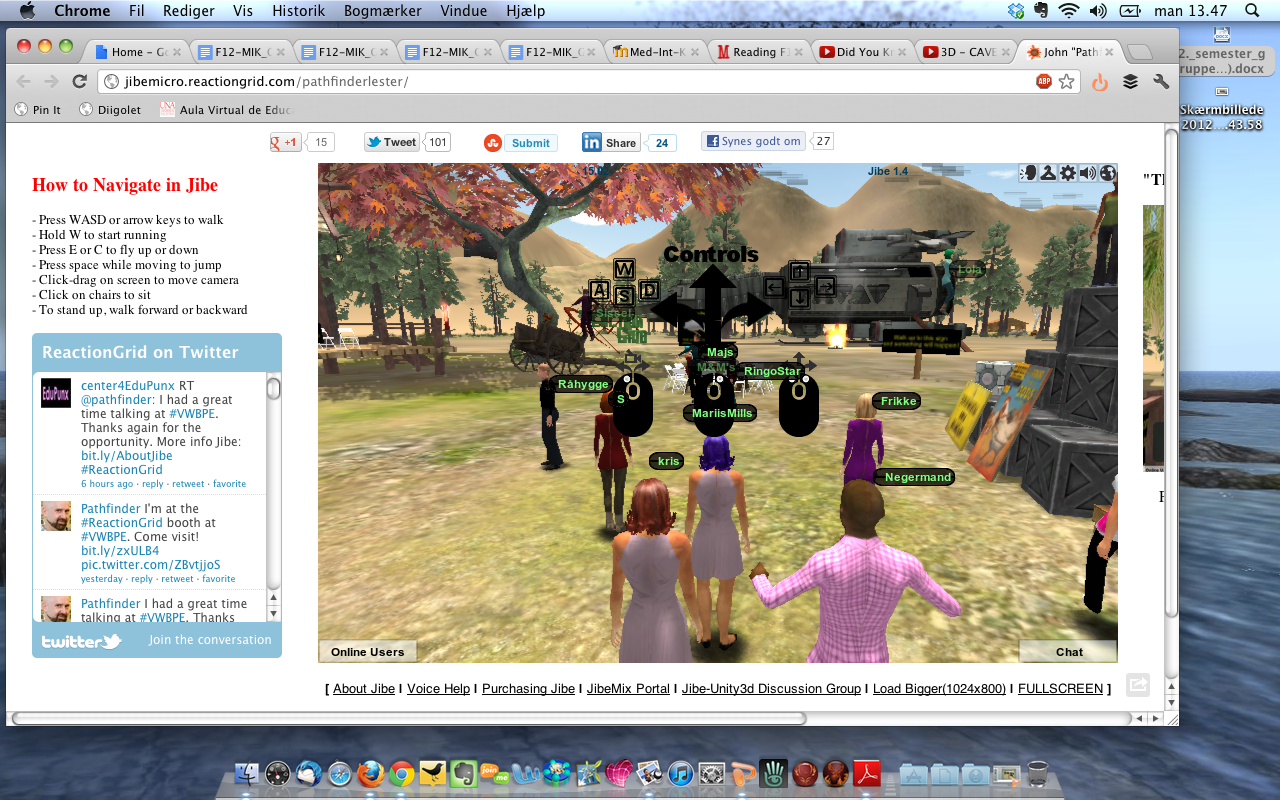
One of the classes I’ve been teaching this spring has been dealing with interpersonal CMC, and as part of this I have of course been talking about avatar-based communication. Based on my experience with bringing newbies into SL, I knew that I had to find another example of a 3D Virtual World to use with this particular class that had 89 students. During the 5th annual Virtual Worlds Best Practice in Education Conference  (March 15-17, 2012), I ran into John “Pathfinder “Lester, and I was reminded of the Jibe platform created by ReactionGrid .

Pathfinder is currently Chief Learning Officer at ReactionGrid Inc., but worked for LL/SL for five years where he led the development of education and healthcare, and I’ve actually met Pathfinder a couple of times in RL too – even here in Denmark :-) I’ve been following Pathfinder’s work with alternate Grids/worlds since he left LL, and I consider him a true innovator and visionary within the field of 3D Virtual Worlds.

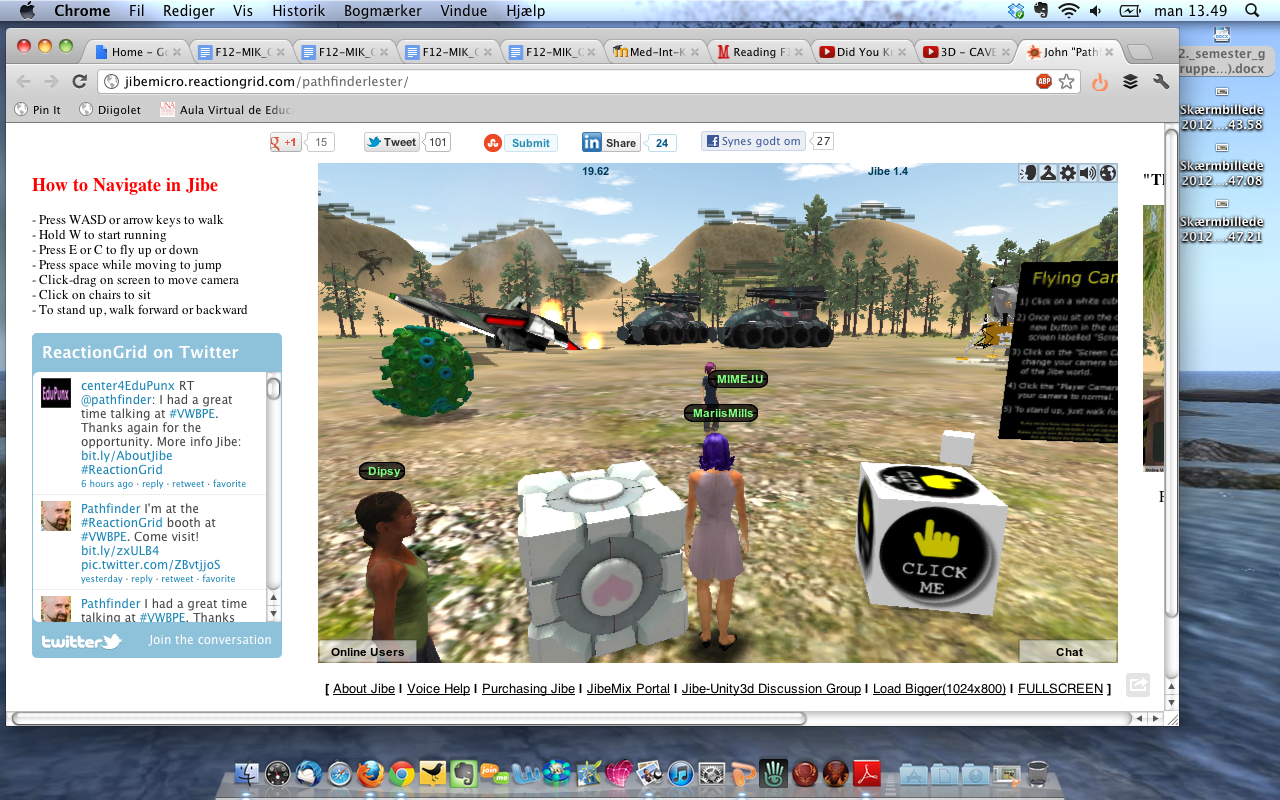
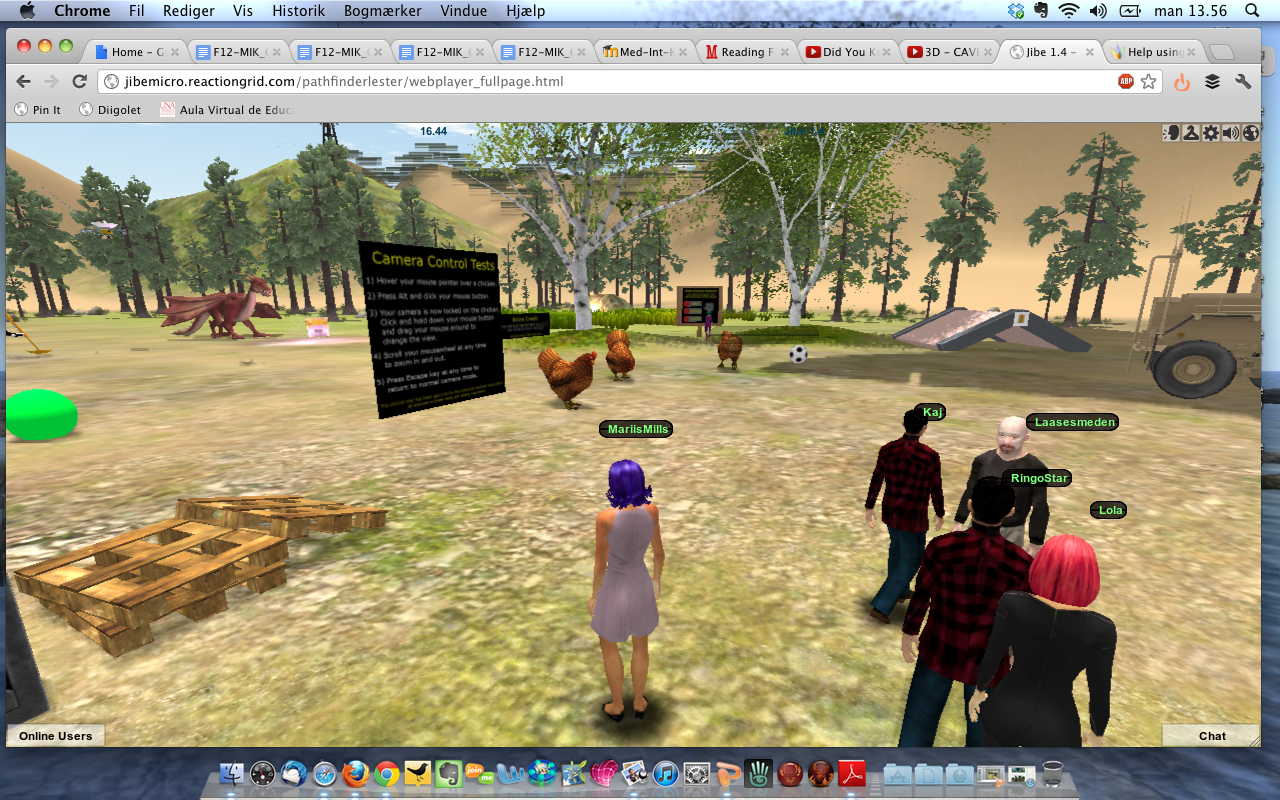
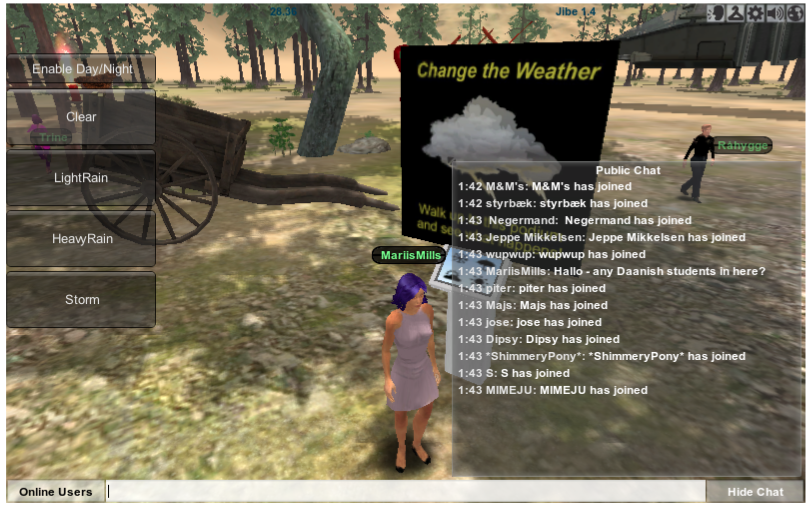
So on March 19th, I decided to try to bring my class into Pathfinder’s Jibe world. Being used to many technical obstacles with SL, I did not know exactly what to expect. As it turned out only a few of the students had any experience with 3D Virtual Worlds (and only from WoW and The Sims), so I was admittedly a bit worried. However, from a technical point of view things went very well – I was really impressed with just how easy it was for the students to start using Jibe! Some of the students had to install a Unity3d plugin (the player), but that didn’t cause any problems and within minutes from showing the students the url, they were in-world gaining their first experiences with navigating a 3D-avatar. I have rarely heard students laugh this much in class!

All the students on laptops managed to get into Jibe without any problems, but a few of the students use iPads, and sadly Jibe/Unity3d doesn’t work on those yet. I did try to see if I could access Jibe via Chrome in the AlwaysOn PC app, but no ;-) In user forums on Unity3d I’ve read about attempts to jailbreak the iOS and work around the plugin need, but this is not a solution I’m going to pursue or even recommend to my students, so for now we’ll have to settle for using laptops, and that’s ok.

These 2. semester students had a very limited knowledge of 3D Virtual Worlds, and even though I did demonstrate SL, being able to access and play around on their own in such a world really enhanced their understanding. They did find the whole idea of using 3D Virtual Worlds for serious purposes quite exotic, and it will take much more time (and practice) to convince them of the virtues of such communication media. However, based on this very positive (especially from a technical point of view) experience, I will try to learn more about Jibe and consider if I can somehow use it in my future classes. Compared to SL, Jibe has three very important features that makes it an interesting platform in relation to my (often times very large) on-campus classes:

  • The platform easily holds 100+ participants
  • The platform is browser based
  • The platform is very user friendly – at least in terms of initial UX

For demonstration and first hand experience of avatars and 3D virtual environments, this makes Jibe very interesting. Further, Jibe supports industry standard 3D modeling programs and scripting, and that could also make it an interesting tool to use for some of the more advanced classes where our students have to learn this, and perhaps this could mean that more colleagues would take an interest in this type of technology. As much as I love SL, I really think that the future of 3D Virtual Worlds will be browser based, and to further enhance interoperability standards are a must, so Jibe really seems to be heading in the right direction.

Here’s a short introduction by Pathfinder, and be sure to follow his blog, if you want to learn more :-)

On ReactionGrid’s own blog there were some interesting news today;

  1. An open source version of Jibe is underway officially today.  LearnNC & ReactionGrid are partnering to allow teachers and students to qualify for no cost editions of Jibe.
  2. Jibe-Enterprise is now available for corporate training, meetings, collaboration and more.
  3. Jibe-Blend is also underway.  Jibe-Blend is a real-time shared collaborative building system which allows users to model in Blender and stream their work live into a Jibe/Unity3D world.

/Mariis

In-world kick-off session with technical challenges

Yesterday, my colleagues Inge Qunhua, Heilyn Abbot, and I were ready to kick-off the first in-world session in the UNA-AAU course. As part of the course, we have designed for two kick-off sessions in SL, before Heilyn and I go to Costa Rica and start the course with a 2-day f2f-workshop at the Universidad Nacional. As far as, we had understood it, our two Costa Rican colleagues, Ena & Wica did a f2f-session with the course participants last week where they created the SL-accounts and settled possible technical challenges. Therefore, the main purpose of the in-world kick-off session was to socialize (make friends, and join our group) and to familiarize the participants with the sandbox and the island where the majority of the course activities will take place. However, another important reason to have sessions before we go to Costa Rica, was to see how the participants would manage to get into/and navigate in SL from a technical point of view – how would the participants’ user experience turn out? In planning the course, we have been discussing the technical challenges that may occur, and we have been somewhat worried about this aspect – and sadly, we did experience many technical difficulties in yesterday’s session.

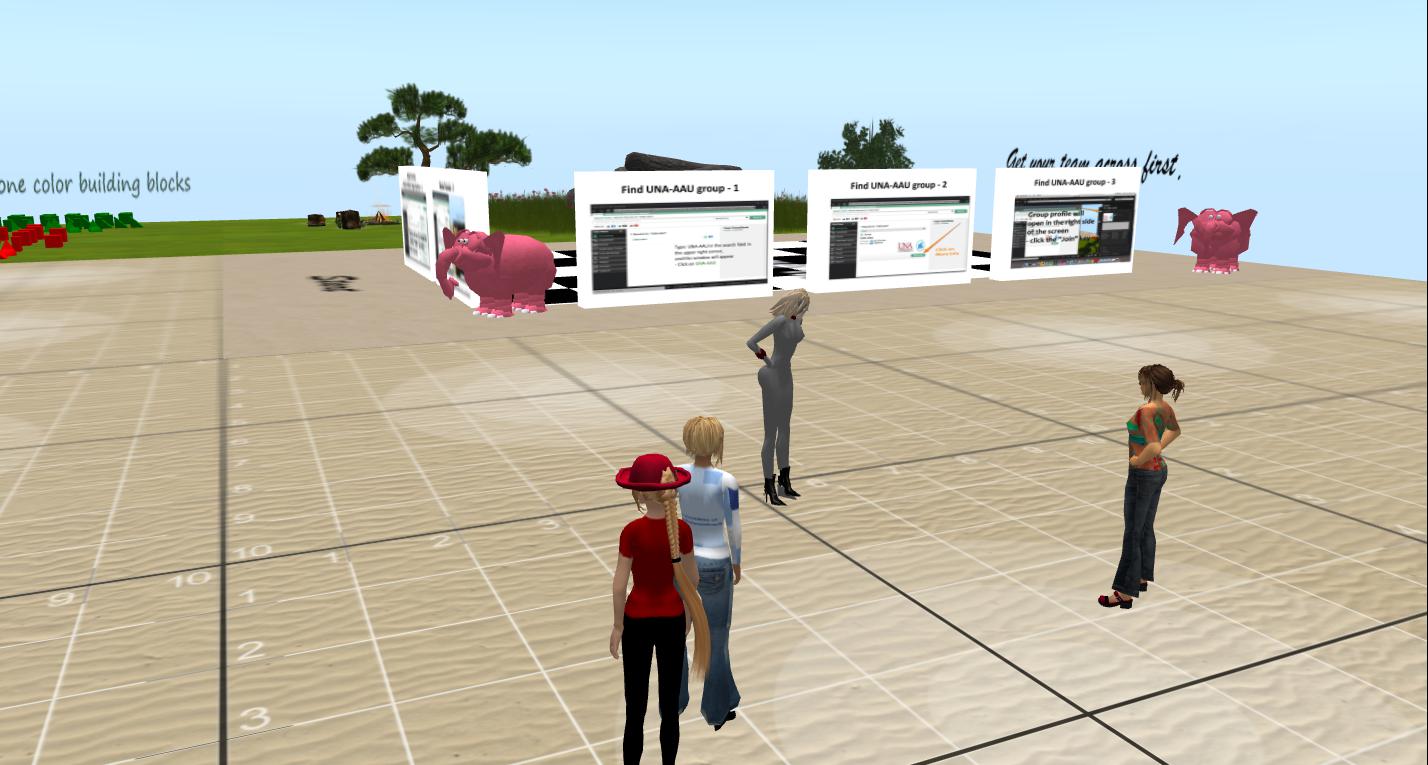
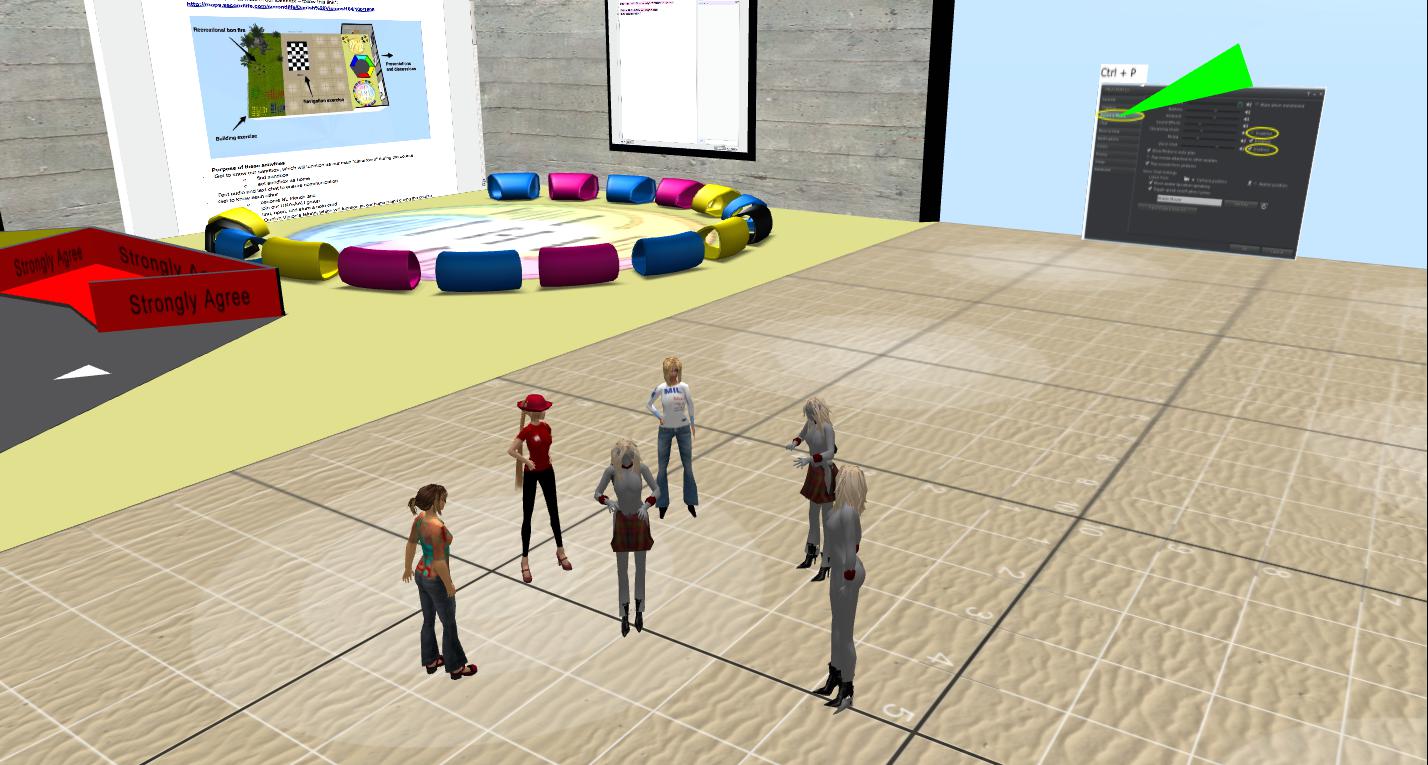
The first participant to turn up in the sandbox was our Costa Rican co-facilitator, Ena. However, as the picture below illustrates, Ena’s avatar did not rezz well, and in the text chat she managed to tell us that everything looked grey, and that she had no voice/audio.

Ena’s grey avatar in front of Heilyn, me, and Inge

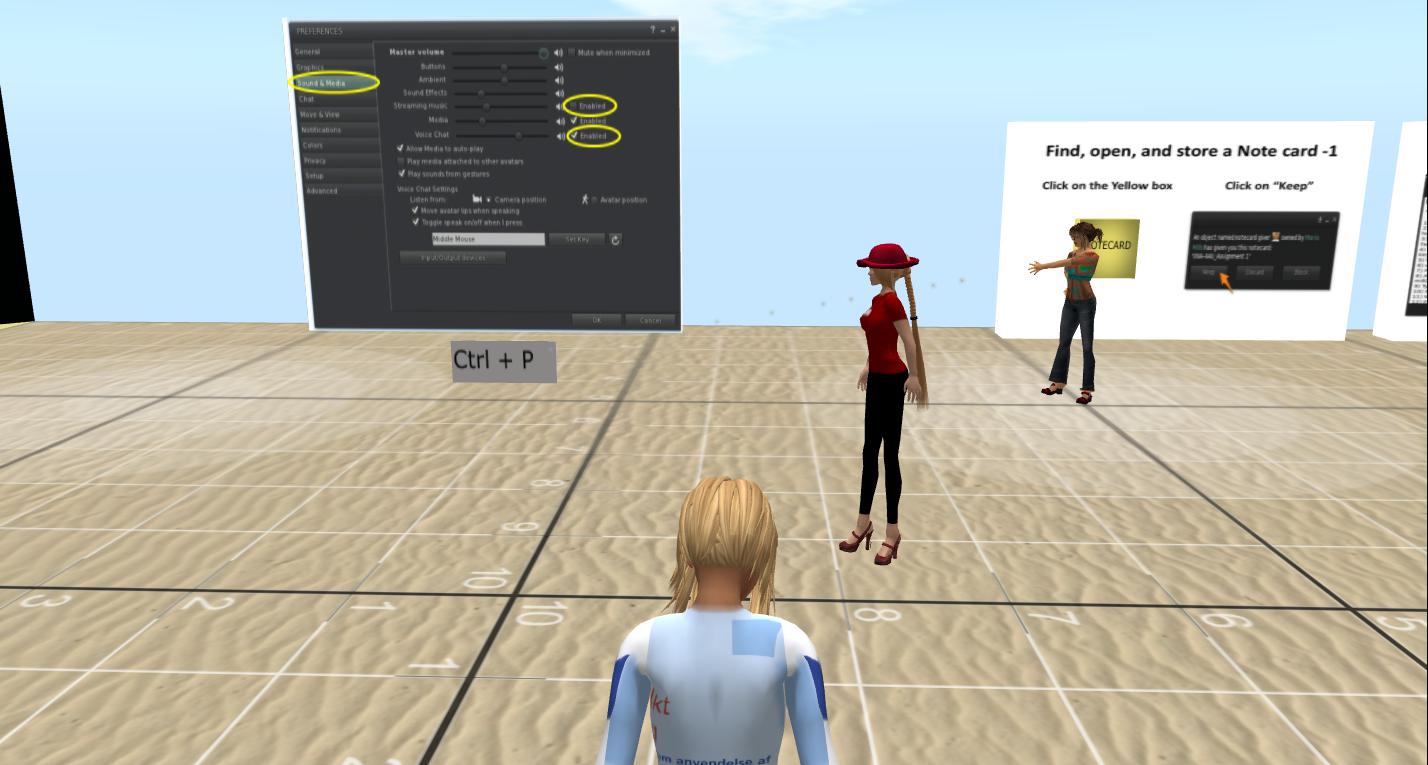
Technical difficulties in SL can occur for a variety of reasons one of which can be incorrect settings (e.g. for audio and graphics), so Inge quickly decided to put up a board explaining how to set the audio settings properly.

Inge sets up a board explaining audio settings on the fly

However, as Ena also had problem with an unrezzed (grey) environment, she couldn’t see this properly, so Inge ended up calling her on Skype. Meanwhile, Heilyn and I were waiting for more participants to arrive, but we soon realized that most of them apparently experienced technical difficulties. Two more participants did show, and we all got into a Skype call, and even though advice on how to set audio and graphics correctly helped the participants a bit, we did not manage to settle all the technical difficulties, and finally decided to cut the session short.

Our 3 Costa Rican participants – all dressed in grey :D

Our next kick-off session is planned for next week, and before then we hope to settle the technical problems, but we have also started to discuss alternative plans; a) we use Skype instead of the built-in SL-voice (and hope the problems with graphics can be solved locally), b) we use an alternative viewer (for some users this does seem to help in terms of graphics). None of these solutions are perfect, and if the problems stem from insufficient bandwidth, I’m not sure how we will solve it.  This UNA-AAU course is envisioned as a pilot-project where the main goal is to investigate if it will be possible to run bilateral courses between Aalborg University and Universidad Nacional through SL and Moodle in the future, and so we are already gaining important information about some of the possible challenges. I’m confident that we will solve the problems somehow, but I also can’t wait to actually go to Costa Rica to experience the challenges first-hand – some problems can simply be to difficult to solve on a distance …

/Mariis

Consequences of Walking the Walk

While we’re waiting for the top management of Google to clarify and elaborate on the surprising (1,2) and controversial statement from Google’s executive chairman, Mr. Schmidt, (paraphrased by Andy Carvin) on G+ primarily being an “identity service”, rather that a social network (3), I want to reflect a bit on what leaving G+ and FB has meant for me personally and professionally as an educator and researcher.

On August 2nd 2011, I chose to close my FB account. My leaving FB was greatly inspired by leaving G+  just a few days earlier. Even though FB and G+ are two very different services provided by two very different companies, there are also certain resemblances and my main arguments for leaving FB were similar to leaving G+. I left both services because I disagree on their ToS. Besides concerns regarding intellectual property, neither system allows its customers to use pseudonyms, but insists on enforcing a “real name” policy. I realize, that I’m a very privileged person, because I’m currently not in need of using a pseudonym, but I have chosen to do so in many online services (ironically not on FB and G+), and I understand and respect other people’s need and choice to use pseudonyms. In short, I chose to leave FB and G+ in protest and out of solidarity. And yes, I know that in some parts of the world, solidarity is a intimidating concept, but to me it is one of the most important human virtues and a cornerstone of Democracy (4). The decision to leave did not come easy, but I did so “eyes wide open” understanding there would be consequences.

In an excellent post on why she chose to leave G+, Gwyneth Llewelyn, a fellow SL-resident who uses a pseudonym, explains why some users of social networks feel more or less forced to participate (5) – in this case FB:

I just joined because, well, nobody who is serious about social networking and online communities can afford not to be on Facebook, even if they don’t use it much.

I can easily relate to that. I was an active user of FB for 3 years. However, unlike many others, I didn’t use it for private reasons, but mainly as a platform to connect with colleagues and students. Having been involved in online and distance education since 2003 on a professional level, connecting f2f is rarely an option, and social networks are simply more appealing than most educational LMSs. On a personal level, I don’t miss FB, and I guess I’ve come to realize that I’m just not that (kind of) social.  However, on a more professional level I’m most certainly missing out. I was recently invited to participate in a research workshop, and as part of this participants were encouraged to discuss workshop topics prior to the actual event – I guess to enable people to get acquainted and give the organizers a better idea of what participants would find valuable. Great idea, except it is intended to take place in a FB group. And this of course leads back to the quote from Gwyneth, given the popularity of FB (although I don’t buy the whole 750 mio. unique, real name user stat), it is not surprising that organizers of any events tend to think “everybody is there, so lets utilize that to reach as many as possible”. I would have made the same assumption not so long ago.

Fortunately, FB is only  a social network (as opposed to G+ – I’ll return to that shortly), and besides not having access to more or less relevant information, so far the most significant professional consequence has to do with 3rd party services that exclusively use FB-login for authentication. An example of this could be Kitely, a virtual world service where I had a presence as part of my research. I never really used it though, mainly because it didn’t make sense to me to use my “wallet” name in that context, and I never understood why a service clearly aimed at (SL) avatar-users would require this kind of authentication. Nonetheless, these example illustrate the kind of problems I most likely will experience more of in the future …


Source: Botgirl Questi (6)

Despite the fact that I only spent two weeks on G+, I did see a great potential in terms of social networking (also in an educational setting), and though I don’t miss it, I do feel left out, when connections refer to it. As earlier mentioned, I chose to leave, so yes, you could say that it is my “own fault” (as someone told me). Solidarity is difficult to explain to privileged people with no empathy, so I’m not even going to try. Instead, I’ll focus on a more practical and selfish reason to opt out. One of the things that really surprised me about Google by my time of leaving was the way it treated its customers, the “guilty, until proven innocent” approach, which really is quite the opposite of what we in the Western part of the world are used to (7). G+ users who were suspected of violating the ToS were simply suspended without warning. Later on, Google renounced on that practice and now gives a 4-day “grace period” (8). But here is the chilling part; when suspended and if banned you are at risk of loosing access to all of your Google services, yes all!


Source

In my work as a researcher and educator, I have been using quite a few of Google’s services; docs, picasa, reader, gmail to name a few. When I witnessed how Google enforced its policy, I decided that a network, where people can flag each other with no apparent proof (it is only up to the accused to prove him-/herself innocent), really wasn’t worth the risk – especially not a network, where a lot of the people I normally connect with, are excluded. Judging from conversations in the social media sphere, a great deal of people doesn’t understand the “fuss about names and Google in general”, and there are a lot of Schmidt’y comments such as “love it or leave it”. I wish it were just that simple. Bonnie Nadri has written an excellent post explaining “those who say “they don’t get it” … (Google, G+, etc)”what this really is all about (9).  It’s not only about names and whether or not you can participate in a given network – it’s about fundamental human rights, intellectual property, surveillance and much, much more. All things, that not only affect “people with strange names”, but all of us.

So how has not being on G+ affected me? Not so much on a personal level. The people I truly care about, I connect with elsewhere. However, from a professional point of view there are several consequences. I teach and research Information and Communication Technology used in various fields and subject areas. This fall, I’ll be teaching 5 different classes, both on- and off-campus. I had planned to use several of Google’s services in all of those, but now I’m looking for alternatives. I’m not going to ban Google’s services in my classes, it is not really my place to do so, but on the other hand I’m no longer going to endorse its products, and I will use this controversy to spark (!) discussion and reflection on some of the issues raised above. I’m quite sure it will be possible to teach without Google, but it is frustrating, because I actually liked its services a lot. Many of my colleagues use gdocs as preferred collaborative tool, so I’m not quite ready to leave all of Google – yet. G+ is still, as has been said many times by its defenders, a product in beta, and there will be changes, but I doubt that it will cave in on the name/privacy issue (10). Precisely because it still is in beta, and hereby limited by an invitation-only policy, we have yet to see the true impact it’ll have in the field of social media. The good thing that can come from this is that the debate (although still fairly limited to geeks and tech-savvy people) has the potential to raise awareness about some very important issues – and this is also why I’ve chosen to blog about it.

I talked the talk, but have yet to discover fully what it means to walk the walk …

/Mariis

Notes
(1) This expression of Google's view on freedom of expression, privacy, and anonymity from 2007 is a good example of why so many users believed the "do no evil" motto and trusted Google with their information.
(2) On the other hand, if we had payed closer attention to Mr. Schmidt, such as in these  All Things Digital interviews just prior to the launch of G+, there is nothing surprising about Google's actions.
(3) Botgirl located this interview with Mr. Smidth, where he confirms the part about G+ as "identity service".
(4) In this video series Tony Benn discusses the origin of  "Democracy as one of the Big Ideas That Changed The World" - especially in part 5 Benn highlights the influence of the Internet.
(5) On a related note a newly released study from Pew Research Centre shows that 65% of adult Americans use social networking sites.
(6) Although I'm not shedding any tears over this (I have two kitties!), I really appreciate Botgirl's satirical, clever, and creative inputs - her blog, flickr, vimeo, and aggregation of #nymwars stories.
(7) Lauren Weinstein wrote a very good and informative post on this back in July.
(8) This talk between Stilgherrian and Skud gives a good overview of the nymwar, the name issues, and Google. Stilgherrian has had his G+ supsended because his mononym (but legal name) doesn't comply to the ToS, and Skud has also been suspended, and she's a former Google employee.
(9) Nadri has covered the nymwar in several posts on her blog and offers good advice to those who may wish to leave Google's services.
(10) Pete Cashmore offers a perspective on why Google  will never change its mind.

Uh, a final note to the reader who sent me a message complaining that my English isn't perfect. I know. If you took the time to carefully read my profile, you'd know that I'm not a native speaker. I'm, however exercising my freedom of expression, and perhaps you should appreciate the fact that I'm trying to write in a language that you too understand - instead of being offended. #justthinkin'
Who needs pseudonyms?

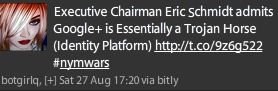
I was actually working on a different post on the nymwars, FB and Google, when this tweet from Botgirl Questi caught my eye:

I will return to the content of this tweet later in this post, but it reminded me of a conversation I recently had a with one of my friends regarding why I left FB and G+. When I asked him, how he would react if a large part of his network connections was excluded from one of his networks, he acknowledged this, but also pointed to a difference in our connections; “But because you’re working with SL, you have more friends with unusual names and unknown identities – and you’re used to dealing with that – most people aren’t”. I found this very interesting because it points to two common conceptions regarding the pseudonym/nymwars issue.

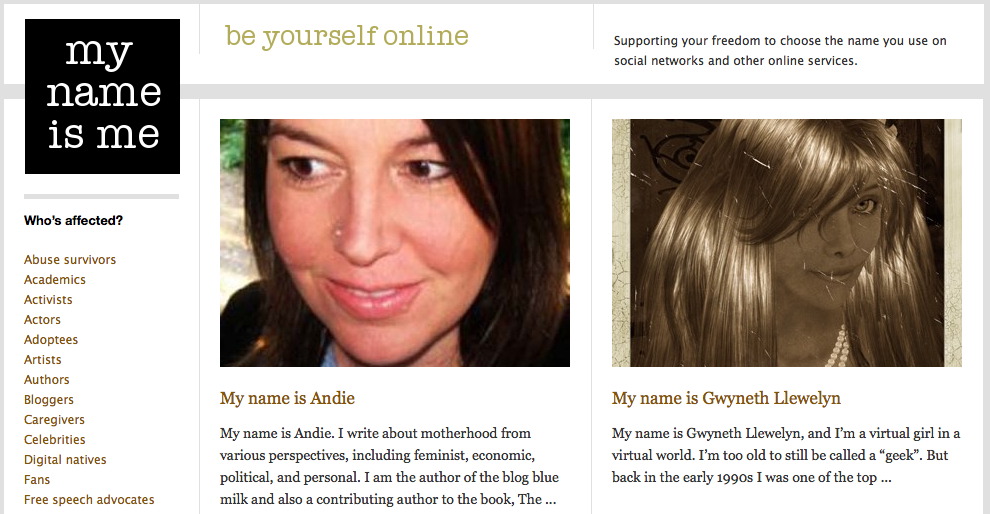
First of all, my friend had the impression that mainly avatars (or other fictional characters, sic) need/want to use pseudonyms. This is by far the case, but it is sadly a very common misconception, and so I want to point to a webpage that was created in defense of pseudonyms and shows the many different groups of people, who may need/want to use pseudonyms for various reasons: the my name is me webpage.

This page was created to raise awareness about people who need pseudonyms and clearly shows how closely this need is related to the freedom of expression:

“My Name Is Me” is about having the freedom to be yourself online. We want people to be able to identify themselves as they wish, rather than being forced to choose names by social networking websites and other online service providers.

Websites such as Facebook and Google+ ask you to use a name that conforms to a certain standard. Though their policies vary, what they would like you to use is the name that appears on the ID in your wallet, your employer’s records, or on the letters your bank sends you. They don’t understand that many people go by other names, for a wide variety of reasons.

Take a look at some of these heartfelt and personal stories – it really just isn’t us “strange” avatars that need/want pseudonyms – and even so, I believe we all, avatars included, should have the right to choose! Additionally, The Geek Feminism wiki has another list of “Who’s harmed by “Real names” policy”, and the Electronic Frontier Foundation (EFF) makes A Case for Pseudonyms.

Looking at these stories, nobody in his/her right mind can dismiss the need for pseudonyms some people have to enable them to interact safely online. Or so I thought, but let us return to the content of Botgirl’s above mentioned tweet. Botgirl links to a post on her blog wherein she quotes NPR‘s Andy Carvin, who met Google’s Executive chairman, Eric E. Schmidt at a recent film festival.

Carvin asked Schmidt how he could justify their policy about “real names” given that real identities could put people at risk:

He replied by saying that G+ was build primarily as an identity service, so fundamentally, it depends on people using their real names if they’re going to build future products that leverage that information.

Regarding people who are concerned about their safety, he said G+ is completely optional. No one is forcing you to use it. It’s obvious for people at risk if they use their real names, they shouldn’t use G+. Regarding countries like Iran and Syria, people there have no expectation of privacy anyway due to their government’s own policies, which implies there’s no point of even trying to have a service that allows pseudonyms.

He also said the internet would be better if we knew you were a real person rather than a dog or a fake person. Some people are just evil and we should be able to ID them and rank them downward. (quoted from Carvin‘s G+ (!) page)

I’m trying my very best to ignore the arrogance and stupidity of Schmidt’s comment and to keep a civil tone here, so I’ll let it be for now.

However, let me just finish by pointing to the second part of the statement from my friend where he implies that acceptance of pseudonyms requires (positive) experience. During this period of nymwars, but also during my research in SL, I’ve struggled to understand the fear some people have towards pseudonyms, or as my colleague, Mark Childs calls it: the obsession people have with “real” identities. Based on my own research experience, I think my friend’s stance is quite plausible, people fear the unknown. And identities that do not conform to “real” or “normal” standards do provoke ontological/existential questions. I have no other particular qualified (read: academic referable) explanations at this point, but it is a topic, I will continue to investigate.

/Mariis

Update
On August 30th, Andy Carvin posted a “a transcript of what Google CEO Eric Schmidt said in the Q&A at the MediaGuardian Edinburgh International TV Festival, so you can see his direct words rather than my paraphrasing of it”.