New! Multi-User Virtual Environments Research (MUVER) Lab

Aalborg University (AAU) is not merely a physical location, but also a general idea/pedagogical concept. Since 2008 AAU has branched out and now has campuses in several locations in Denmark – one of which is in Copenhagen, where I’ve been situated since late 2010. In the Department of Communication at AAU-CPH, we have decided to create a local research unit to combine our research and teaching efforts; The Multi-User Virtual Environments Research (MUVER) Lab.


Initial logo – Fall 2011

The Multi-User Virtual Environments Research (MUVER) Lab is a multi-disciplinary and cross-faculty unit based at the Faculty of Humanities, Aalborg University – Copenhagen (AAU-CPH). The lab is focused on collaborative research into multi-user virtual environments (MUVEs), with an overall focus on learning, persuasion, innovation and communication. The lab will emphasize collaborative, applied research with real-world applications, distinguishing its activities from other Danish and international centers/labs focusing on various other aspects of virtual environments research.  The activities of the lab will have a strong focus on applied research of relevance to the industry and organizations, notably within the areas of learning, persuasion, technology, information, innovation and communication. A notable focus will be forming collaborations with startup/SMV industry typical of the Danish setting, but which has a high need for research partners in order to increase sustainability, for example in learning and games.

The MUVER Lab is envisioned as having four overall research focus areas:

  1. Learning in MUVEs – CSCL, Networked Learning, CSCW
  2. Persuasion in MUVEs – behavior, IS, UX, HCI
  3. Innovation in MUVEs – embedded and distributed innovation, user-driven, co-creation
  4. Communication in MUVEs – CMC, organizational and interpersonal
As part of our work, we envision a close collaboration with our colleagues from the e-Learning Lab in Aalborg, and hopefully with other colleagues from Danish and international universities.

My colleague, Anders Drachen and I conceived the idea of the MUVER Lab in the spring of 2011, and after discussing our ideas with both the Dean of Humanities, the Director of the Dept. of Communication, and our local colleagues, we now have started the work of setting up a homepage (actually another WP-blog for now), create content, and organize our future work.

As another part of our work with this new Lab, we have received funding from the Faculty of Humanities to create a physical lab in our Copenhagen campus, and we hope that this lab will include; an area for teaching with ICT, a social area for the students to hang-out, a creative area, an area for games, an audio-visual lab, and a usability lab. We will also launch a contest among our students to create a new logo for the lab, and we are currently working on a research application hoping to land a project involving several Danish research libraries in a project aimed at facilitating improved student seeking, search, information retrieval and information application from bachelor to PhD-level using elements from persuasion and our overall pedagogical framework Problem-Based Learning.

More on this, incl. a link to our MUVER Lab homepage will be published asap.

/Mariis

Student perceptions of Presence in a Virtual World

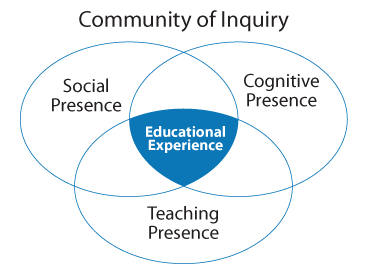
Together with Ross McKerlich, Terry Anderson, and Bard Eastmann I have a paper out in the Journal of Online Learning and Technology (JOLT). The paper is entitled Student Perceptions of Teaching Presence, Social Presence and Cognitive Presence in a Virtual World, and is based on research collaboration we started back in 2009. Back in January 2099, I participated in a Master Class on Learning 2.0 and Knowledge Media at Aarhus University, where Terry Anderson (Athabasca University) was one of the guest lecturers. When Terry learned about my research in SL, he invited me to participate in a research project that was aimed at investigating the use of the Community of Inquiry (COI) model in 3D environments.

The COI model was developed in the late 1990’s as framework for evaluating educational experience in text-based online environments by D. Randy Garrison, Terry Anderson, and Walther Archer. Given the COI model’s wide spread use in different educational settings it is by no means coincidental that one of the original founders, Terry, has found it important to explore the applicability of the model in new online environments such as the 3D virtual world, SL. Together with Ross McKerlich, Terry conducted a preliminary, qualitative exploratory study in SL in 2007, and basically confirmed that the model also can be used in assessing educational experience in 3D virtual environments (McKerlich & Anderson. 2007).

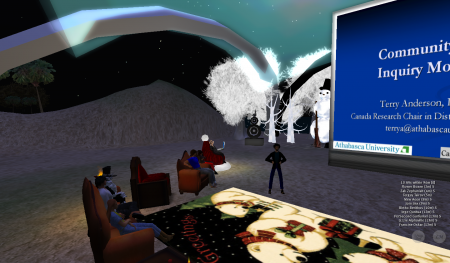
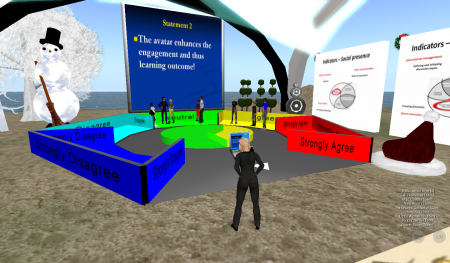
As part of our collaboration, Terry & Ross, participated in one of my in-world classes with the MIL09 students – something both the students and I appreciated very much.


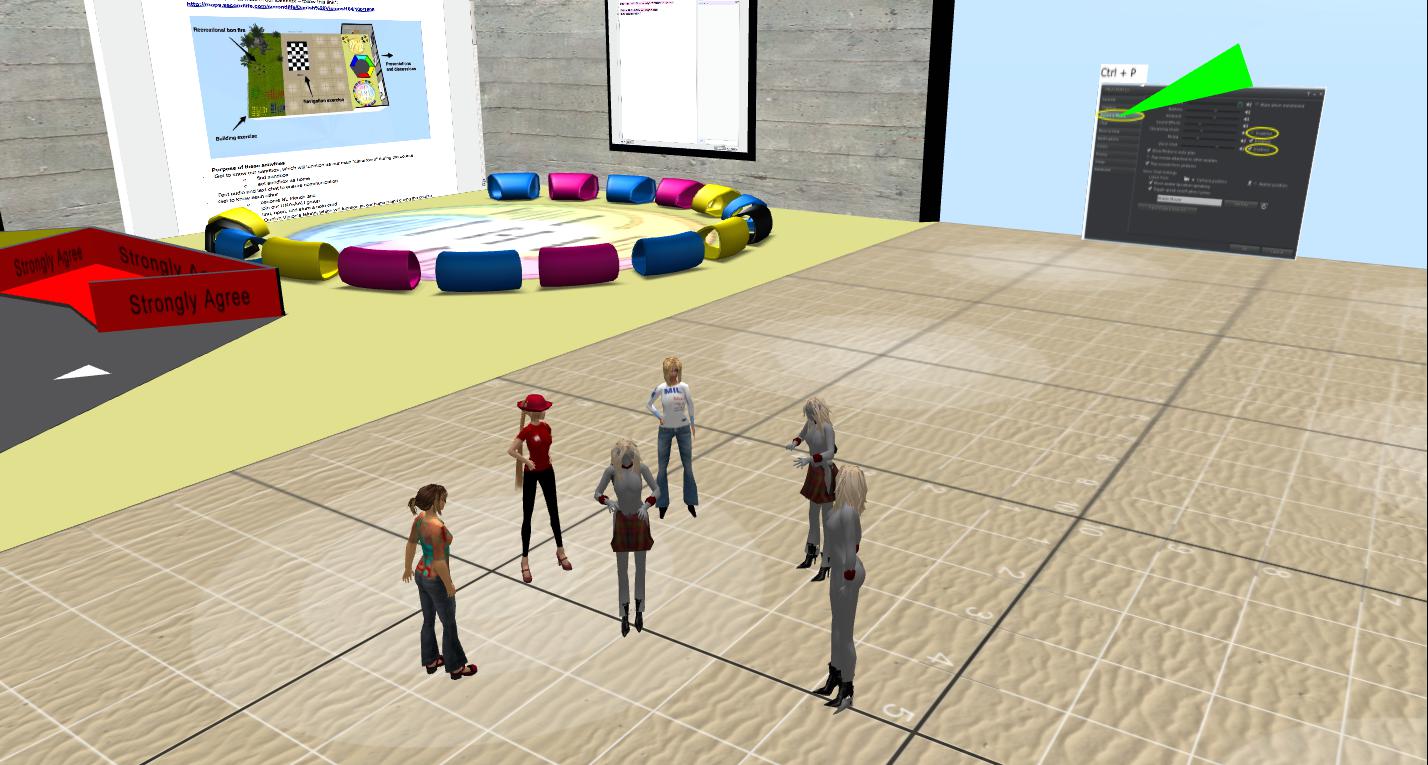
Terry explaining about the COI-model in the MIL09 class


Discussing different COI concepts in the MIL09 class

Anyways, after such a long time, it is great to finally see our paper published, and I want to thank Ross, Terry, and Brad for the collaboration – it was a very good experience :-)

Here’s the abstract of our paper:

Presence – or having a sense of active participation – in distance education has increased with the expanding use of and affordances of communications technologies. Virtual worlds have been on the forefront of popular and education technology in the last three years and innovative methods of teaching and learning are emerging in these contexts.  Using the recently validated community of inquiry (COI) instrument, this study focuses on students’ perceptions of teaching, social and cognitive presence in virtual world contexts. The authors examine whether the COI Instrument can effectively be applied to virtual world learning events. The results are exciting: in a diverse sample, virtual world learners perceive teaching presence, social presence and cognitive presence.

/Mariis

In-world kick-off session with technical challenges

Yesterday, my colleagues Inge Qunhua, Heilyn Abbot, and I were ready to kick-off the first in-world session in the UNA-AAU course. As part of the course, we have designed for two kick-off sessions in SL, before Heilyn and I go to Costa Rica and start the course with a 2-day f2f-workshop at the Universidad Nacional. As far as, we had understood it, our two Costa Rican colleagues, Ena & Wica did a f2f-session with the course participants last week where they created the SL-accounts and settled possible technical challenges. Therefore, the main purpose of the in-world kick-off session was to socialize (make friends, and join our group) and to familiarize the participants with the sandbox and the island where the majority of the course activities will take place. However, another important reason to have sessions before we go to Costa Rica, was to see how the participants would manage to get into/and navigate in SL from a technical point of view – how would the participants’ user experience turn out? In planning the course, we have been discussing the technical challenges that may occur, and we have been somewhat worried about this aspect – and sadly, we did experience many technical difficulties in yesterday’s session.

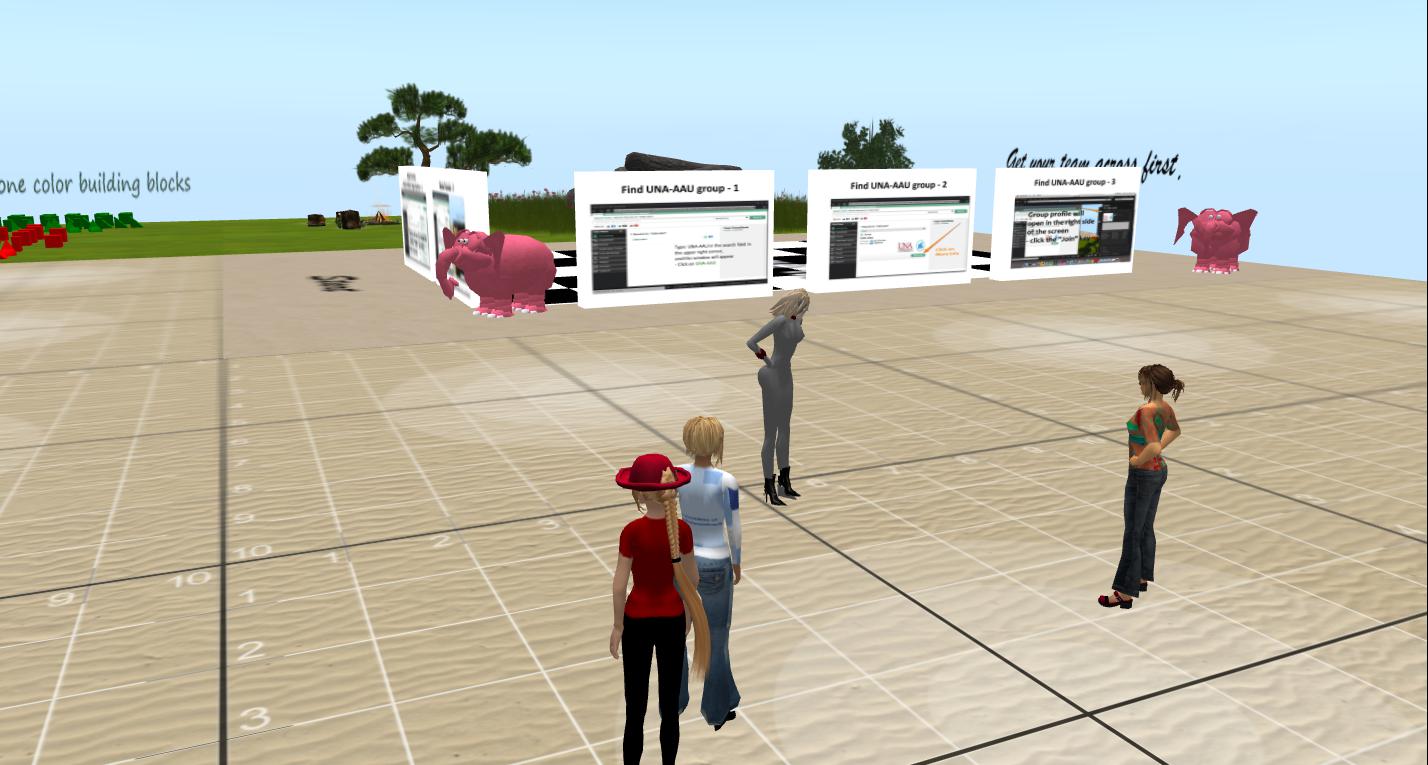
The first participant to turn up in the sandbox was our Costa Rican co-facilitator, Ena. However, as the picture below illustrates, Ena’s avatar did not rezz well, and in the text chat she managed to tell us that everything looked grey, and that she had no voice/audio.

Ena’s grey avatar in front of Heilyn, me, and Inge

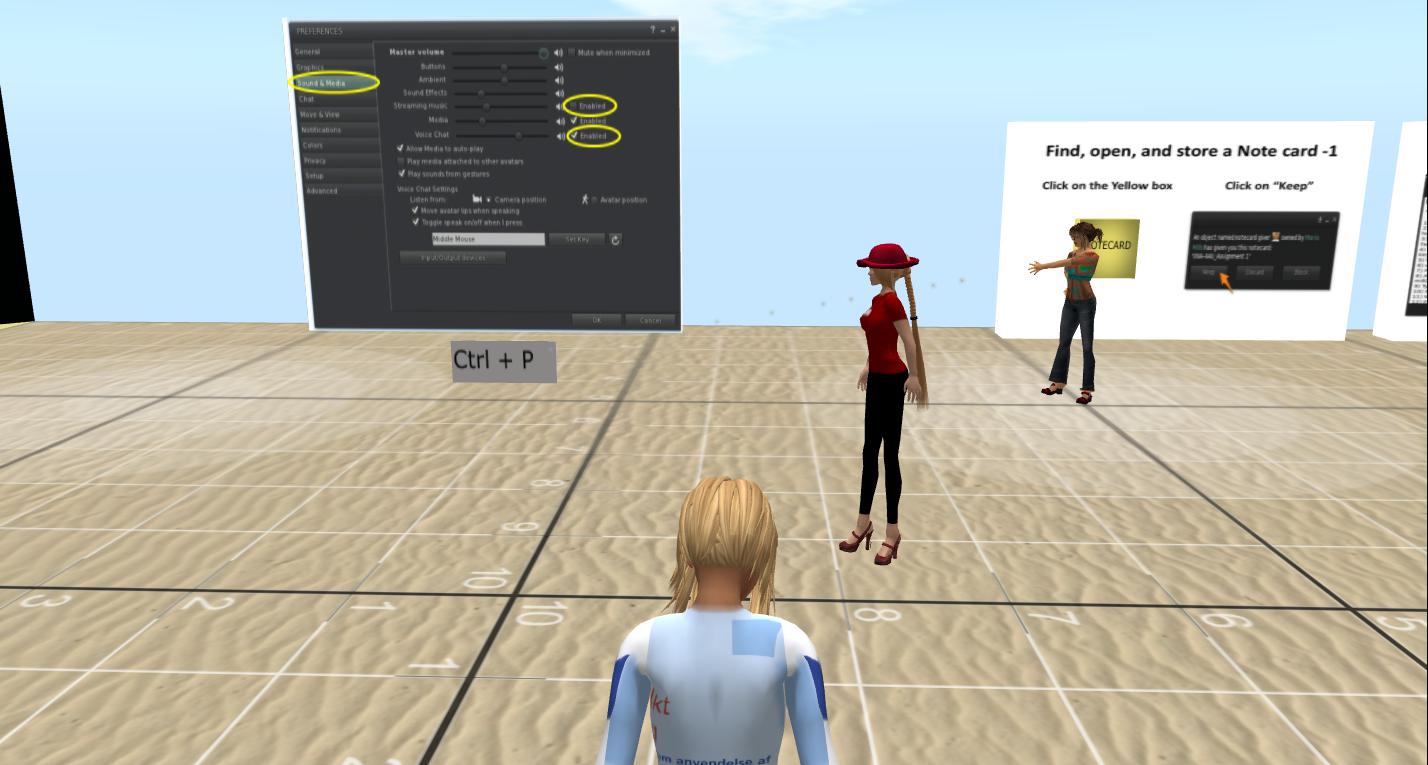
Technical difficulties in SL can occur for a variety of reasons one of which can be incorrect settings (e.g. for audio and graphics), so Inge quickly decided to put up a board explaining how to set the audio settings properly.

Inge sets up a board explaining audio settings on the fly

However, as Ena also had problem with an unrezzed (grey) environment, she couldn’t see this properly, so Inge ended up calling her on Skype. Meanwhile, Heilyn and I were waiting for more participants to arrive, but we soon realized that most of them apparently experienced technical difficulties. Two more participants did show, and we all got into a Skype call, and even though advice on how to set audio and graphics correctly helped the participants a bit, we did not manage to settle all the technical difficulties, and finally decided to cut the session short.

Our 3 Costa Rican participants – all dressed in grey :D

Our next kick-off session is planned for next week, and before then we hope to settle the technical problems, but we have also started to discuss alternative plans; a) we use Skype instead of the built-in SL-voice (and hope the problems with graphics can be solved locally), b) we use an alternative viewer (for some users this does seem to help in terms of graphics). None of these solutions are perfect, and if the problems stem from insufficient bandwidth, I’m not sure how we will solve it.  This UNA-AAU course is envisioned as a pilot-project where the main goal is to investigate if it will be possible to run bilateral courses between Aalborg University and Universidad Nacional through SL and Moodle in the future, and so we are already gaining important information about some of the possible challenges. I’m confident that we will solve the problems somehow, but I also can’t wait to actually go to Costa Rica to experience the challenges first-hand – some problems can simply be to difficult to solve on a distance …

/Mariis

Consequences of Walking the Walk

While we’re waiting for the top management of Google to clarify and elaborate on the surprising (1,2) and controversial statement from Google’s executive chairman, Mr. Schmidt, (paraphrased by Andy Carvin) on G+ primarily being an “identity service”, rather that a social network (3), I want to reflect a bit on what leaving G+ and FB has meant for me personally and professionally as an educator and researcher.

On August 2nd 2011, I chose to close my FB account. My leaving FB was greatly inspired by leaving G+  just a few days earlier. Even though FB and G+ are two very different services provided by two very different companies, there are also certain resemblances and my main arguments for leaving FB were similar to leaving G+. I left both services because I disagree on their ToS. Besides concerns regarding intellectual property, neither system allows its customers to use pseudonyms, but insists on enforcing a “real name” policy. I realize, that I’m a very privileged person, because I’m currently not in need of using a pseudonym, but I have chosen to do so in many online services (ironically not on FB and G+), and I understand and respect other people’s need and choice to use pseudonyms. In short, I chose to leave FB and G+ in protest and out of solidarity. And yes, I know that in some parts of the world, solidarity is a intimidating concept, but to me it is one of the most important human virtues and a cornerstone of Democracy (4). The decision to leave did not come easy, but I did so “eyes wide open” understanding there would be consequences.

In an excellent post on why she chose to leave G+, Gwyneth Llewelyn, a fellow SL-resident who uses a pseudonym, explains why some users of social networks feel more or less forced to participate (5) – in this case FB:

I just joined because, well, nobody who is serious about social networking and online communities can afford not to be on Facebook, even if they don’t use it much.

I can easily relate to that. I was an active user of FB for 3 years. However, unlike many others, I didn’t use it for private reasons, but mainly as a platform to connect with colleagues and students. Having been involved in online and distance education since 2003 on a professional level, connecting f2f is rarely an option, and social networks are simply more appealing than most educational LMSs. On a personal level, I don’t miss FB, and I guess I’ve come to realize that I’m just not that (kind of) social.  However, on a more professional level I’m most certainly missing out. I was recently invited to participate in a research workshop, and as part of this participants were encouraged to discuss workshop topics prior to the actual event – I guess to enable people to get acquainted and give the organizers a better idea of what participants would find valuable. Great idea, except it is intended to take place in a FB group. And this of course leads back to the quote from Gwyneth, given the popularity of FB (although I don’t buy the whole 750 mio. unique, real name user stat), it is not surprising that organizers of any events tend to think “everybody is there, so lets utilize that to reach as many as possible”. I would have made the same assumption not so long ago.

Fortunately, FB is only  a social network (as opposed to G+ – I’ll return to that shortly), and besides not having access to more or less relevant information, so far the most significant professional consequence has to do with 3rd party services that exclusively use FB-login for authentication. An example of this could be Kitely, a virtual world service where I had a presence as part of my research. I never really used it though, mainly because it didn’t make sense to me to use my “wallet” name in that context, and I never understood why a service clearly aimed at (SL) avatar-users would require this kind of authentication. Nonetheless, these example illustrate the kind of problems I most likely will experience more of in the future …


Source: Botgirl Questi (6)

Despite the fact that I only spent two weeks on G+, I did see a great potential in terms of social networking (also in an educational setting), and though I don’t miss it, I do feel left out, when connections refer to it. As earlier mentioned, I chose to leave, so yes, you could say that it is my “own fault” (as someone told me). Solidarity is difficult to explain to privileged people with no empathy, so I’m not even going to try. Instead, I’ll focus on a more practical and selfish reason to opt out. One of the things that really surprised me about Google by my time of leaving was the way it treated its customers, the “guilty, until proven innocent” approach, which really is quite the opposite of what we in the Western part of the world are used to (7). G+ users who were suspected of violating the ToS were simply suspended without warning. Later on, Google renounced on that practice and now gives a 4-day “grace period” (8). But here is the chilling part; when suspended and if banned you are at risk of loosing access to all of your Google services, yes all!


Source

In my work as a researcher and educator, I have been using quite a few of Google’s services; docs, picasa, reader, gmail to name a few. When I witnessed how Google enforced its policy, I decided that a network, where people can flag each other with no apparent proof (it is only up to the accused to prove him-/herself innocent), really wasn’t worth the risk – especially not a network, where a lot of the people I normally connect with, are excluded. Judging from conversations in the social media sphere, a great deal of people doesn’t understand the “fuss about names and Google in general”, and there are a lot of Schmidt’y comments such as “love it or leave it”. I wish it were just that simple. Bonnie Nadri has written an excellent post explaining “those who say “they don’t get it” … (Google, G+, etc)”what this really is all about (9).  It’s not only about names and whether or not you can participate in a given network – it’s about fundamental human rights, intellectual property, surveillance and much, much more. All things, that not only affect “people with strange names”, but all of us.

So how has not being on G+ affected me? Not so much on a personal level. The people I truly care about, I connect with elsewhere. However, from a professional point of view there are several consequences. I teach and research Information and Communication Technology used in various fields and subject areas. This fall, I’ll be teaching 5 different classes, both on- and off-campus. I had planned to use several of Google’s services in all of those, but now I’m looking for alternatives. I’m not going to ban Google’s services in my classes, it is not really my place to do so, but on the other hand I’m no longer going to endorse its products, and I will use this controversy to spark (!) discussion and reflection on some of the issues raised above. I’m quite sure it will be possible to teach without Google, but it is frustrating, because I actually liked its services a lot. Many of my colleagues use gdocs as preferred collaborative tool, so I’m not quite ready to leave all of Google – yet. G+ is still, as has been said many times by its defenders, a product in beta, and there will be changes, but I doubt that it will cave in on the name/privacy issue (10). Precisely because it still is in beta, and hereby limited by an invitation-only policy, we have yet to see the true impact it’ll have in the field of social media. The good thing that can come from this is that the debate (although still fairly limited to geeks and tech-savvy people) has the potential to raise awareness about some very important issues – and this is also why I’ve chosen to blog about it.

I talked the talk, but have yet to discover fully what it means to walk the walk …

/Mariis

Notes
(1) This expression of Google's view on freedom of expression, privacy, and anonymity from 2007 is a good example of why so many users believed the "do no evil" motto and trusted Google with their information.
(2) On the other hand, if we had payed closer attention to Mr. Schmidt, such as in these  All Things Digital interviews just prior to the launch of G+, there is nothing surprising about Google's actions.
(3) Botgirl located this interview with Mr. Smidth, where he confirms the part about G+ as "identity service".
(4) In this video series Tony Benn discusses the origin of  "Democracy as one of the Big Ideas That Changed The World" - especially in part 5 Benn highlights the influence of the Internet.
(5) On a related note a newly released study from Pew Research Centre shows that 65% of adult Americans use social networking sites.
(6) Although I'm not shedding any tears over this (I have two kitties!), I really appreciate Botgirl's satirical, clever, and creative inputs - her blog, flickr, vimeo, and aggregation of #nymwars stories.
(7) Lauren Weinstein wrote a very good and informative post on this back in July.
(8) This talk between Stilgherrian and Skud gives a good overview of the nymwar, the name issues, and Google. Stilgherrian has had his G+ supsended because his mononym (but legal name) doesn't comply to the ToS, and Skud has also been suspended, and she's a former Google employee.
(9) Nadri has covered the nymwar in several posts on her blog and offers good advice to those who may wish to leave Google's services.
(10) Pete Cashmore offers a perspective on why Google  will never change its mind.

Uh, a final note to the reader who sent me a message complaining that my English isn't perfect. I know. If you took the time to carefully read my profile, you'd know that I'm not a native speaker. I'm, however exercising my freedom of expression, and perhaps you should appreciate the fact that I'm trying to write in a language that you too understand - instead of being offended. #justthinkin'

Nym vs. Schmidt


Source 

Agent Schmidt: Why, Mr. Nym? Why do you do it? Why get up? Why keep fighting? Do you believe you’re fighting for something? For more that your survival? Can you tell me what it is? Do you even know? Is it freedom? Or truth? Perhaps peace? Yes? No? Could it be for love? Illusions, Mr. Nym. Vagaries of perception. The temporary constructs of a feeble human intellect trying desperately to justify an existence that is without meaning or purpose. And all of them as artificial as the Identity Service itself, although only a human mind could invent something as insipid as love. You must be able to see it, Mr. Nym. You must know it by now. You can’t win. It’s pointless to keep fighting. Why, Mr. Nym? Why? Why do you persist?

Nym: Because I choose to

/Mariis

Original quote from moviefanatic.com