G+ – and minus

Despite officially being on vacation, I’ve been trying out some of the tech’s on my “to-explore-list”, most notably Google’s G+ service. I signed in to G+ on July 13th, but two weeks later, I decided to close my account. Since some of the people I had in my circles are also people I know from Facebook, I decided to post a short notice on Facebook just to let them know that I’d left the G+ service. When asked why, these were some of my immediate reasons:

I disagree on the terms of service, especially the part that excludes people in need of pseudonyms, and I’m shocked by the way, Google treats its customers. I had hoped G+ could replace FB/Twitter, but a service that excludes a large part of Internet users, incl. my personal network (and not only avatars), is of no use to me. G+ has been an eye-opener for me in terms intellectual property and cloud computing, and I’ll write a post about it since I think it has implications in an educational and democratic perspective …

Now, Internet law, ToS, intellectual property, etc. are not topics I normally deal with, so this post is simply an account of my personal experience as a “regular” user/customer of Google services. As so many other tech-oriented educators, I enjoy exploring new technologies in terms of educational potential, and this professional interest was if fact my initial reason to start on G+. I was especially excited about the possibility to “circle” connections allowing me to control communication, the prospect of being able to create synchronous “hangouts”, create “sparks”, and the integration with other Google services seemed like a very convenient solution. Despite my current hesitation towards G+, I still believe it is a service with huge educational potential – this doc explores some of these potentials.

Having done research in Second Life (SL) since March 2007, I’ve come to know and respect SL users as tech-savvy, early adopters and so of course my SL connections were some of the first people I added to my circles. In hindsight, it is no surprise that it was through my SL connections, my avatar friends that I first came to hear about the pseudonymity controversy. Not until recently has it been possible to sign up for SL by using your own name, consequently all SL users are used to using pseudonyms, many (myself included) use these pseudonyms in other Internet services, and in fact many SL users are only known by their pseudonym/avatar names. However, Google decided for a non-pseudonym (albeit unclear) policy, and shortly after I entered G+, I started noticing reports of SL/pseudonym-users being excluded from the service. From my research in virtual worlds, I’m fully aware that the mere idea of having a “virtual identity” that somehow differs form a “real identity” is something that provokes the ignorant and often causes controversy, and I honestly don’t think this non-pseudonym problem had gained much attention had it not affected many other users besides avatars. But it did/it does, and soon the controversy hit other media and G+ itself. I’m not going to repeat the controversy, but will link to this excellent post by Kee Hinckley, who elaborates on the issue, the pros and cons, and links to some of the articles written on the subject.

As stated in my own quote above, I was shocked by the way, Google treats its customers. I don’t usually use words like “shocked” when reflecting on professional matters, but it is the truth. I admit that up until now I’ve been incredibly naïve about ToS and intellectual property, I also admit that I often have not taken the time to thoroughly read ToS (not only on Google), but simply have accepted these in a “well, what else can I do” (stupid, stupid!) manner.  And so, I was shocked reading Thomas Monopoly’s story. Followed by a brief automated statement by Google saying that it had “perceived a violation”, Google decided to close all of Monopoly’s services with Google. As it later turned out, Monopoly (as he explains here) had in fact violated the Google ToS unintentionally by posting a series of pictures on The Evolution of Sex (as part of an art project) in which one was flagged as child pornography by Google’s automated systems. It is not for me to question the violation, and it is of course Google’s right to enforce its policy. I am, however, questioning Google’s procedure. The Monopoly case had nothing to do with the pseudonymity controversy, but it revealed how Google handles its business and its customers. The “guilty, until proven innocent” approach, is also the way Google handles pseudonymity issues – e.g. this, this, and this case. The  last case is especially grotesque since this G+ user actually used his real names. Again, I’m not questioning Google’s legal rights, but from a moral point of view, I do find its way of enforcing its rules and regulations very dubious – Jyri Engeström has written an excellent comment on this – in G+ !

Here I’m only referring to a few examples in the Google controversy, but to sum up seeing part of my network being excluded combined with an unclear and sometimes unwarranted procedure, I decided to close my account. I did not use my pseudonym in G+, and I did not intend to violate Google’s ToS. But I lost my confidence in Google. Up until now, I’ve been a satisfied user of several of Google’s services, but now I’ve started to export my content to other providers – not that I have any immediate intentions of leaving my other Google services, I like them and I am a creature of habit, but just in case … and this leads me to the educational perspective on all of this.

For the last couple of years, Personal Learning Environments (PLEs)/Networks (PLNs) have been concepts explored by many tech-oriented educators who have a wish to try and tear down the walls of education and especially traditional Virtual Learning Environments (VLEs)/Learning Management Systems (LMS’) in order to open up education to the rest of the world, and Cloud Computing has been a central concept in this work. I entered G+ thinking that maybe here Google had come up with an interesting solution that could supplement our efforts in this area. However, the returning problem of using (free) hosted services is that of property, and ever so often, I hear system administrators express reluctance towards moving our activities into the “Cloud”. In this Google controversy, I’ve seen the “well, what did you expect – it is a free service” argument in several comments. Well, frankly I do expect even a free service provider to treat its customers right. I would also argue that the term “free” is debatable; we the customers “pay” with our content/our behavior. If the free service providers didn’t make any money on us, they wouldn’t be doing it. Again, this is not my area of expertise, I just call it as I see it, but I must admit that this Google experience has made me very conscious of the pitfalls of moving our content and practices out of our safe, but closed and proprietary VLE. Sadly in this way, I also think the Google controversy can be a set-back in terms of loosening up the traditional educational boarders, and this will not only affect Google’s own services, but also those of other providers.

My final reflection on this combines the educational perspective with that of democratization. Some months ago, I wrote a post in relation to the “Purpose of Education” (Purpos/ed) initiative. In this post I referred to the Declaration of Human Rights which states that everyone has the right to education,  and in my perspective this must include rights to information and the freedom of expression. Incidentally, the UN Human Rights Committee, only this week released a general comment stating that the right to freedom of expression outweighs all other rights.

Previously, and probably naively, I’ve always considered Google to be an important player in the democratization of information, but based on my current experience with G+, I’m wondering what role Google actually sees itself playing, I’m honestly surprised by Google, and I admit, I expected a different approach, when first we heard of Google wanting to launch an alternative to Facebook. Even though my faith in Google has been shattered, I’ve not completely given up (not that I think it cares, but maybe it should), and I do recognize that G+ has been in beta. However, being in beta does not mean “do evil, and sort it out afterwards” – it means “do no evil, to begin with”. I’m truly hoping Google will listen to its customers, and learn. If nothing else, I hope Google recognizes that the controversy and the many reactions by and large reflect that people care – care about Google, and more importantly care about people.

/Mariis

#GRCviz2011 – selected resources on visualization

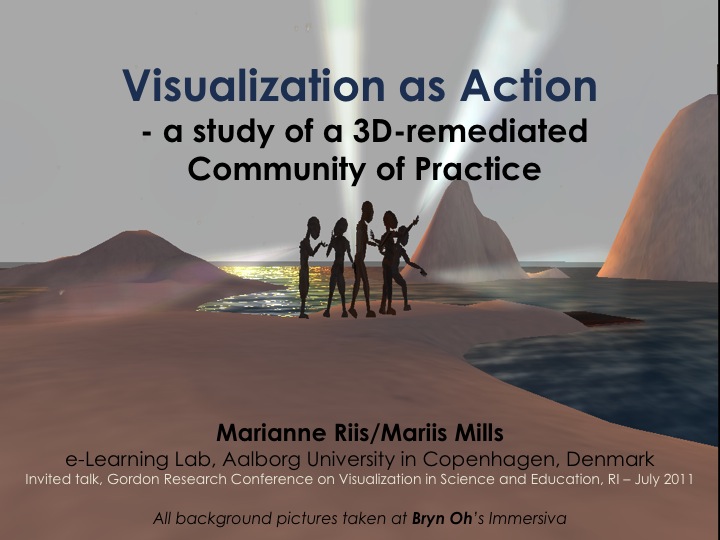
At the Gordon Research conference on Visualization in Science and Education, I was invited to talk about some of the findings from my research in SL.

For unknown reasons slideshare changes the colours and parts of the format, so here’s a pdf-version MariisTalk-GRCviz11. Judging from the feedback, my talk went very well, and I got some highly useful questions, comments, and suggestions. Since the deadline for my dissertation is in September, I’ll not be able to incorporate new ideas, but I did get a lot of inspiration for future research in SL. Even though this blog so far has focused primarily on SL, I do teach other subjects, and based on the other talks from the conference, I also got lots of inspiration for new directions in other areas both in terms of theory, methods, and tools. Below I’ve listed some selected resources – all focusing on bringing forward different types of visualizations in education.

The Mars Expedition Strategy Challenge is a research project on “Immersive Reality Challenge to Explore Strategies for Human Spaceflight Beyond Low-Earth Orbit”. The Mars Expedition Strategy Challenge learning simulation is private. However, FVWC reviewers may contact SL residents Apollo Segall, Spinoza Quinnell or Lyr Lobo to request a guided tour during the evenings.

Medical Illustrator, Graham Johnson‘s youtube channel displays some amazing visualizations, such as the one below on muscle anatomy.

Further, Johnson’s website offers lots of resources, incl. tutorials and plugins for creation of complex visualizations in ePMV.

Virulent is a new game for iPads on virus infections and the way our immune system fights them off – developed by Wisconsin Institutes for Discovery.

Cell Press also has a youtube channel with so-called video abstracts.

GigaPan is a site where users can upload, share, and explore gigapixel panoramas – best way to describe it is: Wauw! With the possibility to annotate, we were shown some very interesting potential educational uses. Further, the GigaPan Time Machine is even more impressive.

Cartoonist, Larry Gonick creates comic books, which according to some of the conference participants had helped them learn the basics of especially chemistry and genetics.

The Best Illusions of the Year website offers a lot of intriguing videos of different kinds of illusions. In a similar vein, the video below on attention caused many laughs and lots of puzzlement – how attentive are you, really?


Kongregate was mentioned as an excellent site to find free online games and connect with a community.

“How NOT to lie with visualization” (Rogowitz & Treinish,1996)  is an article recommended by several of the conference participants, and so is another article by the same authors “Data visualization: the end of the rainbow” (Rogowitz & Treinish, 1998).

Continuing the challenges in visualization, “How to lie with maps” was also recommended. In this book, the author, Mark Monmonier, explains the methods cartographers must use to distort reality in representing a complex, three-dimensional world on a flat sheet or screen, and how they exclude information and geographic features in order to create a readable and understandable map.


Cynthia A. Brewer’s website Color Brewer 2.0 also offers advice.


The Explaining Climate Change website offers a set of peer-reviewed, interactive, web-based materials to help learners visualize and understand the underlying science of climate change.

NARC’s Color Tool is designed to provide the designer with views of the perceptual relationships among the possible color choices. It improves on previous tools by more clearly representing the constraints imposed by the physical display and the structure of human color vision. 

The National Academy Press has published an interesting review of available research on learning science through interaction with digital simulations and games. The book considers the potential of digital games and simulations to contribute to learning science in schools, in informal out-of-school settings, and everyday life, and the book also identifies the areas in which more research and research-based development is needed to fully capitalize on this potential. Get a free copy here.

Another book, Visible Learning by John Hattie, was also recommended and looks like a must-read.

The final resource, I want to point too is actually not directly linked to the conference, but still deals very much with visualization. Whenever I travel internationally, I have a habit of buying a hard copy of Wired magazine, and the August 2011 edition features an article on Khan Academy.


The article gives a very good overview of the Kahn Academy, it’s history, activities, supporters, and opponents. Even though the “skill and drill” approach to teaching and learning is far from my own approach, I do think it can be useful for certain topics and in certain contexts, but in terms of reforming education, I’d hope for a broader strategy incl. more social constructivist methods.

From a personal point of view, the best part of the conference was to get the opportunity to spend extended time with two of my favorite SL friends, Chimera and Spiral. I’ve had the great fortune of meeting Chimera several times f2f, but it was the first (and hopefully not last) time I met Spiral RL :-)

/Mariis

… and yes the format of this post is horrific, but Code is King … and sticks to autocracy :-(

UPDATE

One of my Danish SL friends, Charlotta Jenkins, just directed my attention to the Montage tool, which enables you to curate self-chosen topics, so here’s one on Visualization in Science and Education 2011.

Reality – the worst g/Game ever?

Many of the presentations at the Visualization in Science and Education conference that I’m currently attending have evolved around games, simulations, and virtual worlds, and in one of today’s talks the presenter showed us this picture:


Picture from “Motivate Us Not”

In this particular talk, the “problem” with reality was linked to the complexity of the world’s many challenges, e.g.  in terms of risks we’re facing – which evidently can be quite overwhelming and most likely will cause some people to withdraw from the “real” world, and ultimately leave it to others to try and meet these challenges. However, the picture also pointed to a theme that has been recurring throughout the conference, namely why we need virtual games, worlds etc. in the first place – why not stick to (the reality of) this world? If the skeptics at this conference leave with the impression that those of us in favor of such immersive/augmented technologies want to replace Reality, then I think we have failed (and note that was not the view of the presenter).

Both I, and the colleagues I know who use these technologies in education are not trying to replace, but rather to supplement and work with mixed realities in a re-situated perspective, drawing on the best affordances from each. In another talk, the presenter distinguished between the “game” understood as software, and the “Game” understood as the social context; the community, the practice, the artifacts, and the interactions surrounding the game. I found this to be an important distinction, which could be applied to my own work, and while as an educator I also have an inherent interest in the nature and development of the software (from an instructional POV), I do believe that the context is crucial – and probably could make the difference as to whether people would use these new types of technologies to escape or improve our reality … regardless of how we choose to define it. I’m not done thinking about this, but this morning’s talks provided really good food for thought, and proved that Reality isn’t such a bad Game after all ;-)

/Mariis

Off the record – #grcviz2011

I’m currently participating in a Gordon Research Conference, at Bryant University, Smithfield, RI, where I was invited to speak about my research in SL. This has been a great honor, and I’m truly enjoying my time here; meeting a lot of very clever, nice, cool, and fun people from all sorts of different disciplines, and the industry in a very international setting – all people who are engaged in using “Visualization in science and education“.


Unlike previous conferences I’ve participated in, GRC’s have a strict “off the record” policy, meaning that we are not allowed to disclose information from the talks, poster sessions, informal discussions etc. Being used to sharing all sorts of information through various social media, this really is a very different approach to knowledge presentation and dissemination. I’m honestly feeling somewhat ambivalent about this; I appreciate the need for a “space” where you can actually present unfinished/unpublished ideas. On the other hand, the conference has brought together so many interesting and talented people, who present such cool projects, that my immediate response normally would be to share this with my network. Since the list of speakers is public information, we have agreed that it will be ok just to share general information – and this some of us are doing via the hash tag #grcviz2011. Despite the fact that this makes the title of this post an oxymoron, it really is an amazing conference, where I’ve gained a lot of new insights and ideas!

This slideshow requires JavaScript.


The beautiful Bryant U 

Since the conference is cross disciplinary, I’ve once again been reminded just how different we approach research and justify knowledge, and in general perceive the phenomena we are investigating. Coming from a very strong qualitative research tradition, I’ve been puzzled and admittedly provoked by some of the more quantitative presentations I’ve seen – and I’m confident this works the other way round. This is, however, a very healthy thing, and if nothing else, I bring back a greater appreciation for mixed methods studies! And it has me thinking that we really need to research and come up with new and better ways of e.g. evaluating learning processes and their outcomes. In fact, I would say that I go home with more questions than answers, but again I think that is a very good thing … :-)

/Mariis