I’m now an official HUDslinger :-)

Looking at my 3 previous posts you may wonder what’s going on! On Fleep Tuque’s blog I found a great tip about the use of a bloghud in-world.


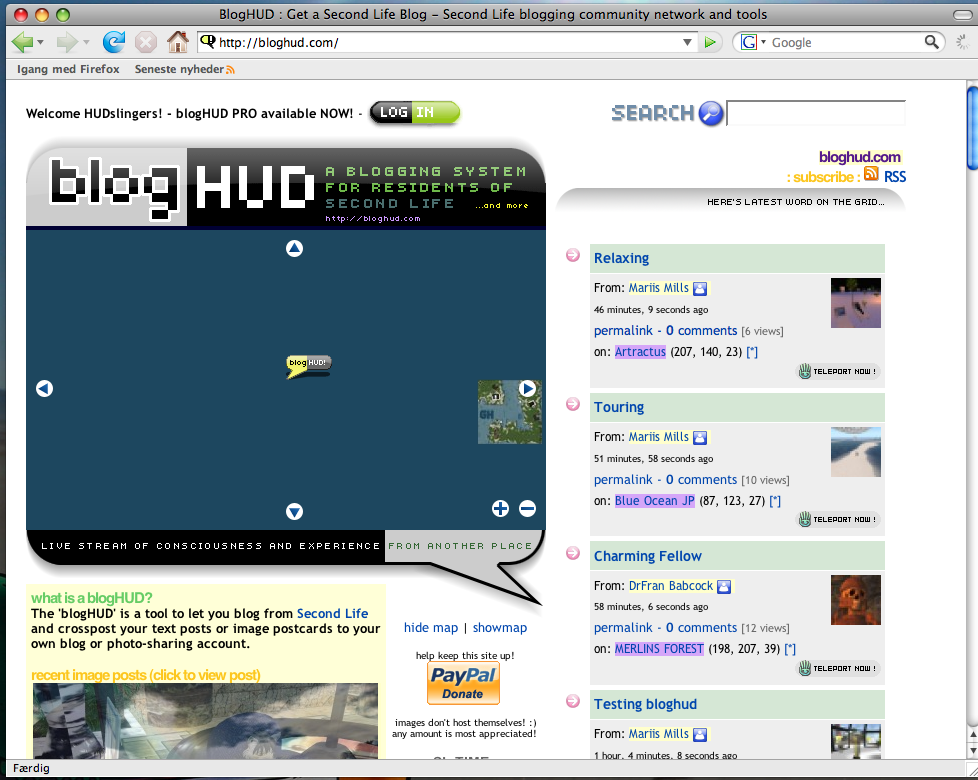
Bloghud.com

Wearing a bloghud enables you to send text messages or postcards, incl. text and Slurls from inside SL out to your blog(s) of choice.

As Fleep points out:

Many faculty are asking students to report on their experiences in Second Life, either by writing essays or blog posts, and it can be very tricky and time consuming to take a snapshot, save it to disk, re-size it and convert it to JPG, upload it to Flickr, and then create a blog post about whatever it was that you saw or experienced. If you also want to include a SLurl or link to the location, that’s another step that requires you to flip back into SL to copy and paste the SLurl, etc.

The BlogHUD does all of these steps for the user once it is setup and configured properly.


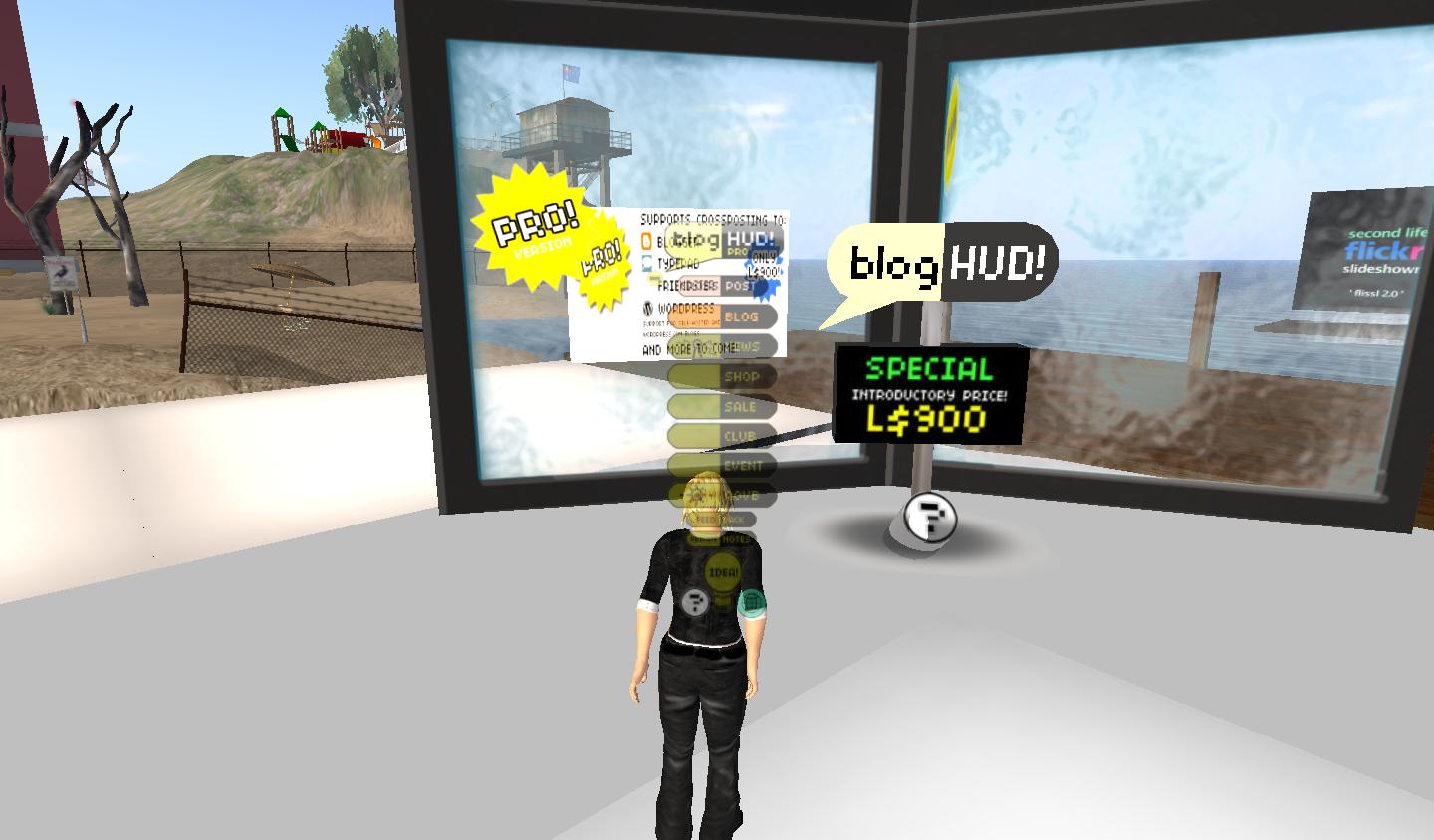
Mariis wearing the Hud – you can change the location of the Hud …

I’m amazed at how easy it is to use – you simply wear it, type /9 and then your text .. or longer text write a notecard. Simple, huh ?

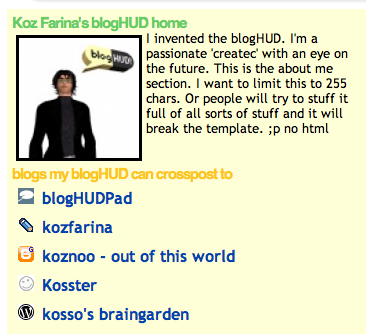
Thanks to Koz Farina for creating this great tool/toy :-)

And thanks to Fleep for this great tip – you can read her easy-to-follow instructions here

/Mariis

SL making headlines again

Once again the press criticizes SL – this time around it’s the Australian IT with an article entitled Second Life a virtual failure.

I don’t know if it still is silly season down under, but I hope so .. . Otherwise I’m troubled by the journalistic level. Not so much because of the content, but because of the presentation of the apparent facts.

The journalist refers to a qualitative study made by a postgraduate student at Queensland University, Kim MacKenzie. Her study focused on 20 international corporations, such as Intel, AOL and Coca Cola, that were conducting business in SL – most of which (doesn’t say how many) have closed their “sites” now.

MacKenzie is quoted for saying:

The actual Second Life setting is going to require either an adaptation or a new commercial virtual marketplace controlled by commercial parameters that you need for safe and secure business activity to happen on the internet (…) Once the right setting is there, it will explode.

And she concludes by saying, that the right commercial setting must be backed by an awareness campaign to get users on board.

At this point nothing in the article justifies the sensational headline, and even more surprising the article ends by referring to one of the first Australian companies entering SL, Telstra that has BigPond in-world. According to spokesman, Peter Habib BigPond’s Second Life site had hosted its own registration process and continues to experience growth, since it was set up in March 2007. And that’s it …

I wouldn’t term SL as neither a site nor as a virtual reality program, but that’s just a minor detail. What’s far more worrying is the press’ constant need to create headlines on false claims. This and other critical articles usually confirm, what many regular residents already know, namely that there has been a lack of imagination on the part of many SLusers, who simply haven’t had the strategy, the creativity, the skills and perhaps the patience to explore and utilize SL’s potential.

As many virtual world fans know, the esteemed technology research and advisory company, Gartner Inc. last year predicted that 80% of internet users would have a “second life” by 2011 (Not necessarily in Second Life). In May 2008 Gartner, Inc. did however renounce a bit on this by saying that 90 % of corporate virtual world projects will fail within 18 months – here is some food for thought from that article, which as well could apply for the educational sector;

Focusing on the technology rather than understanding user requirements is one of the key reasons for failure.

They need to realise that virtual worlds mark the transition from web pages to web places and a successful virtual presence starts with people, not physics.

A benefit of virtual worlds is the rich collaboration experience they offer by adding a real-time visual dimension via avatars, so interactions can include emotional information in the “conversations” between individuals, setting them apart from simpler networking applications. They also differentiate themselves from web-based interactions (which can be asynchronous) by requiring both parties to be present at the same time.

Companies need to start thinking what their virtual world strategy is, incorporate it into their internet strategy and merge their two-dimensional web pages to support a “3D web place”. Virtual world presence is not to replace the “2D world” but to supplement it.

/Mariis

CCK08 – connecting with 1200 others in an online course

Back from vacation I’ve been catching up on several blogs. Reading Fleep’s Deep Thoughts I was reminded of a very remarkable course given online by George Siemens and Stephen Downes on Connectivism & connective knowledge – CCK08. I’ve been hesitant in signing up for this 12 week course, because my calendar for the fall semester already is quite full. But … Today I signed up and here are the reasons why:

  • I teach learning theory, and Connectivism is in my opinion an increasingly important part of the general learning landscape (both theoretical and methodological) – especially when put in relation with new media/Web 2.0

  • I’ve been a devotee of both Siemens and Downes for quite some time now – and I think participating in a course facilitated by them will prove to be quite the experience :-)


·

  • As an online teacher I think it’s important, that I participate “on the other side” as a student once in a while – lots have happened especially on the tech side, since I last studied online in 2003.


  • Joining the course means joining a learning network, connecting with people from all over the world, who share the same interest – and this is actually one of the core principles of Connectivism!


  • I’m excited to see that Fleep and the Chilbo community will host and help facilitate a SL cohort for synchronous meetings – another great opportunity to use SL.


The course is free and it’s still possible to enroll – so connect :-)

/Mariis

“Women” rule SL

I just read a postcard from Jessica Shambora of CNN Fortune addressing the lack of women in the tech industry – a problem we also know here in Denmark. In this context Shambora has an interesting suggestion; women could turn to virtual worlds for guidance in gaining power. Based on a talk Second Life founder and chairman, Philip Rosedale is quoted for saying that

at secondlife.com, a 3-D online world created by its residents, women rule society in a way that parallels the Victorian age (as rulers of their households, women of that earlier era coordinated the social events where alliances were created between families, businesses, etc.).

And Rosedale continues saying that more men in SL choose to live as women than vice versa.

It would be quite interesting to see the data on which Rosedale is building these statements, and also if there’s a difference when cross-referencing with age, RL job, social status etc. And if the majority of users choose to have women-avatars, how can we know for sure that they (the women) are ruling SL?

Other than that, it’s my personal experience that especially virtual worlds and other social networking environments really do appeal to (RL) women and as such could facilitate more women both in tech industry and research :-)

/Mariis

3D Sweden in SL

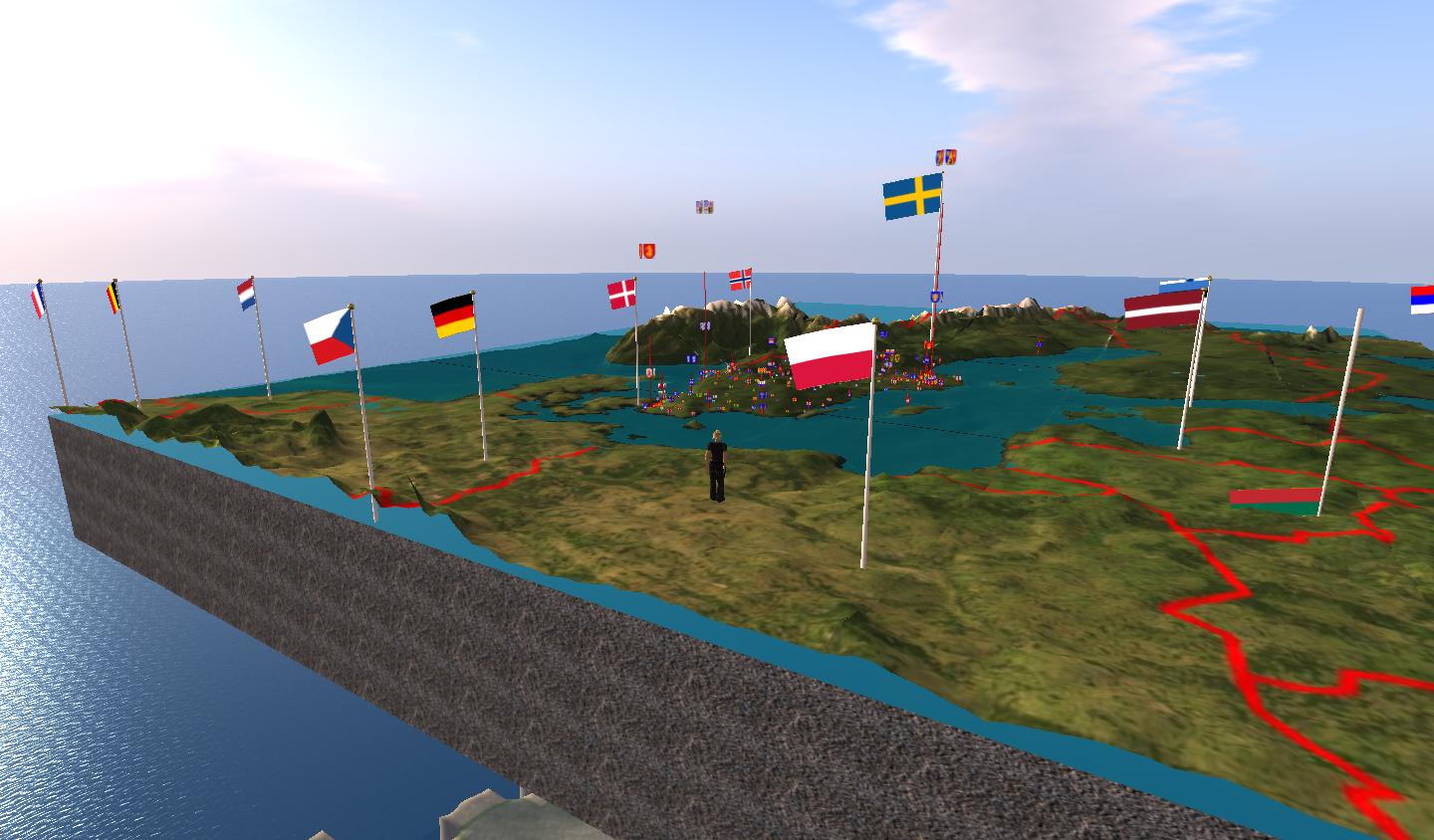
On Ogle Earth I read about an interesting project in SL, where an accurate map of Sweden had been made, so I decided to go see for myself ..

And wauw .. Sweden 3D Map is worth visiting!

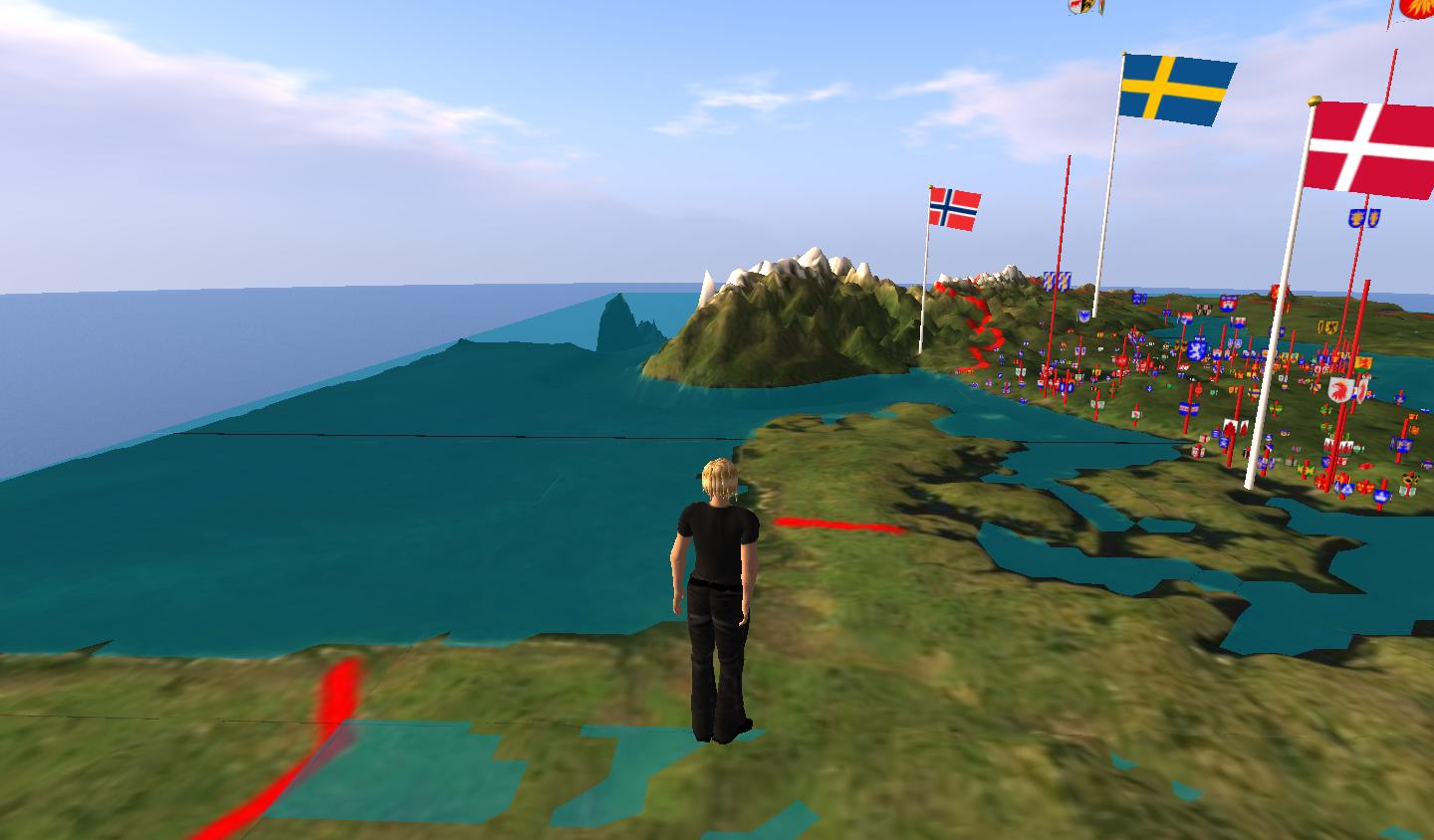
Here I stand in Germany looking at Scandinavia!

The creator is Magnuz Binder/Magnuz of Sweden an engineer, scientist, teacher, programmer, designer, artist and much more, from Stockholm, Sweden. And lukcky me! While I was walking around taking pictures Magnuz himself showed up, and I had the chance to ask him about the project …

Chatting with Magnuz of Sweden

Magnuz tells me that he spent about 50-60 hrs. building the map, and he continues:

But I’m still working on it. The neighboring country flags are new for today, as is the possibility to walk around here without stumbling on all those sculpted prims that forms the topography.

I aim at adding a search/browse and marker function for the municipalities/cities markers. I already added the capacity in the markers, but the interface isn’t done yet.

Plus, I hope to be able to add animated models of the major traffic routes, like railroads, roads, coastal carriers and airlines.

I ask Magnuz, how he expects people to use his map, and he answers:

Well, it could be one example of a tool in geography classes. I aim at building a small portfolio of interactive teaching aids here in SL, to give people some inspiration about what can be done.

I especially like the possibility to build “4D models”: 3D models where the watcher can slide the time ruler to see how things develop. I hope to be able to build some of those soon. Like cell division, evolution of buildings or cities, and such.
Magnuz has other ideas with educational puposes:

One idea I have is to build animations of reactions in enzymes. Only the active site then, since the whole molecule would cost too many prims. And of course the viewer would control the pace of the reaction, giving possibilities to stop or rewind it at interesting steps.

Magnuz also gave me some details on his scripting process, but since I don’t know anything about that, I suggest contacting Magnuz for further info on that topic ;-)

Magnuz has build other things in SL, e.g. a planetarium and it turns out that he’s quite interested in astronomy. You’ll find a newsletter about this on his website (click on Second Life).

I really was quite happy when leaving Magnuz – it’s just so great and satifying meeting people, who seriously try to use SL in both innovative and educational ways .. Yeah! I’ll be back to visit more of Magnuz’ creations :-)

/Mariis