First of all this title refers to me personally. Unfortunately both I and my family have been struck with serious illness, and I’ve had to prioritize between activities. However, now everything seems to work out for the better and I’m trying to get back on the blog :-)
Secondly, the title actually refers to SL. On Friday July 11th Danish National Media pronounced the death of Second Life in both an article and a TV-clip.
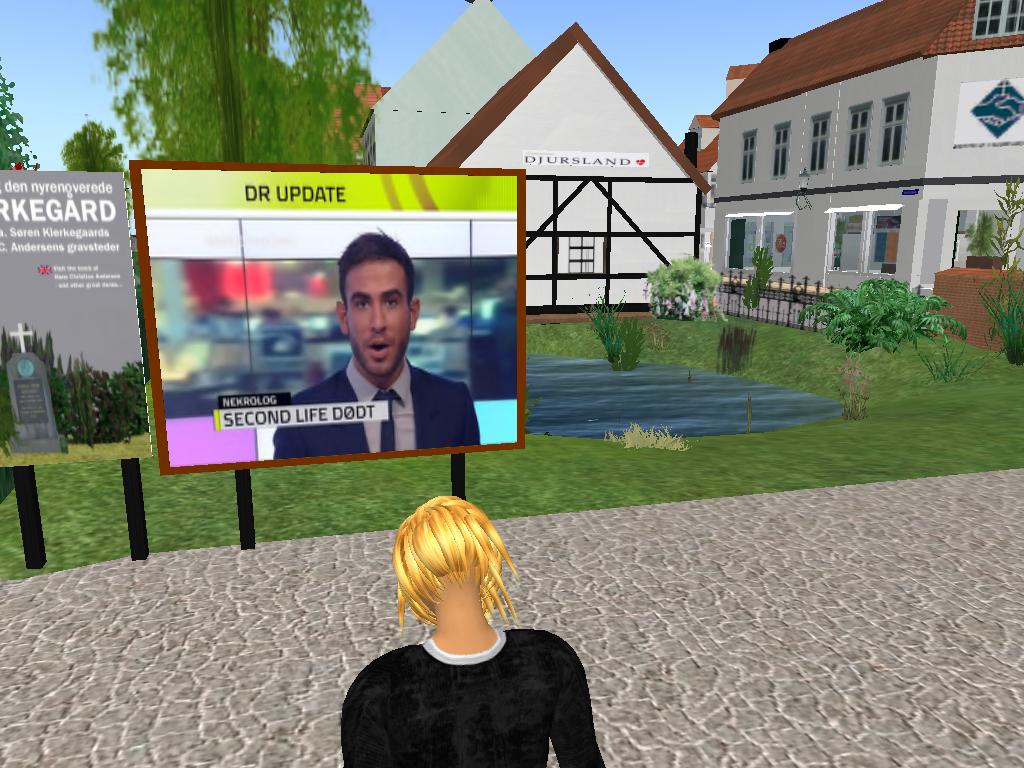
Bad news travel fast! (Poster at Wonderful Denmark)
These are the main arguments from the article;
1) According to chief editor, Jens Nielsen of the Danish online magazine ComeOn, SL is too far from reality and there’s no real use. Nielsen compares SL with Facebook, and states that we use the latter for creating networks, where as SL is too “cartoonish”.
2) According to PhD candidate Simon Ostenfeld Pedersen, Aarhus University SL hasn’t come up with anything really new, the added value of using SL instead of other media is unclear, and in general it’s boring to visit remediated places in SL. Pedersen concludes that the potentials of the media hasn’t been fully utilized and that’s SL’s problem.
3) According to Nordic Analytical Director of IDC, Per Andersen SL is dead seen from a business perspective, but something else will arise in the ashes of SL.
The journalist of the article, Jes Højen Nielsen, speculates that this might be Google’s “Lively”.
Well, a part from the fact that one should always be careful when interpreting people who have been interviewed by the press; I do have the following comments:
To me SL cannot be too far from reality – it is part of reality!
Avatar-mediated communication is just another way of communicating. According to Bolter & Grusin (1999) all types of mediation can be seen as remediation, and remediation can be carried out via 2 different strategies; 1) respectfully or 2) radically. In SL we find countless examples of both strategies. SL has been hugely criticized because of the many examples of respectful remediation – it’s boring and there’s no added value. I don’t think it’s that simple. Respectful remediation serves an important purpose of letting especially newbies feel at home, and in some instances respectful remediation is needed in order to role-play and test real-life situations, which for many reasons can’t be tested real-life.
Many of the above mentioned arguments against SL are seen from a business perspective, which isn’t my area of expertise. I do however think that some of the critique could apply for the educational area as well. But I don’t think that SL as a medium solely is to blame for the lack of what we may call radical remediation. It’s true that the learning curve in SL is quite steep, and I’m sure this has had the consequences that both many newbies have failed to return and also that many less technical oriented users have failed to exploit the full potentials of the media. As for the steep learning curve, it’s my impression that Linden Lab has eased the procedures for newbies and many new OI (also national) have arisen. But I still feel that the users (and not the media itself) have the main responsibility for the way SL is used.
It’s my impression that many new users both from the business and the educational area went into SL without any clear strategy of why, what, when and where. The motto of SL is “Your world – your imagination” – this means that it’s your own responsibility as a resident to at least co-create in-world. Nothing really happens in real life neither if you don’t initiate it yourself.
Facebook can be used for networking – well, so can SL. I personally find the networking part of SL to be one of the major strengths of SL. I’ve never been in an educational environment which made it so easy to connect and collaborate with colleagues from all over the world – it’s simply amazing :-)
It is however true that the popularity of Facebook is quite immense compared to SL, but so what? To me Facebook is just an extended way of sending e-mails – I really don’t find it that interesting, and I certainly do not see the same added value, as I do with SL when it comes to educational usage – especially distance education. Like many of my colleagues, I see SL as a sort of experimentarium where we can explore the many possibilities of 3D-mediated communication, creation and connectivity.
On a personal level I really don’t care what Danish National Media thinks of SL, but the constant negative press makes it so much harder to convince people of the actual potential of media like SL, and it is quite disrespectful to the +50.000 residents who meet, socialize, teach, learn, and try to do business in-world on a daily basis!
As a consequence some of my avi relations arranged a Ghost Party on Research Island Friday night, and avatar Heidi Ballinger, whom I had the pleasure of meeting in-person at The Metaverse-U conference in February, has started a lively debate on her blog about this. I’m confident the last lines about this haven’t been written ..
best
/Mariis
Bolter, J. & Grusin, R. (1999): Remediation – Understanding New Media. The MIT Press.
 Mariis' digitale refleksioner