
Check this out!
posted by Mariis Mills on Nooribeom using a blogHUD : [blogHUD permalink]
Evolution of Virtual Worlds visualized on Dipity
I’ve recently discovered a very neat and instructional visualization of the virtual worlds evolution created and edited in Dipity by a team of people.
In Dipity it’s possible to visualize in four different general ways:

Timeline
List
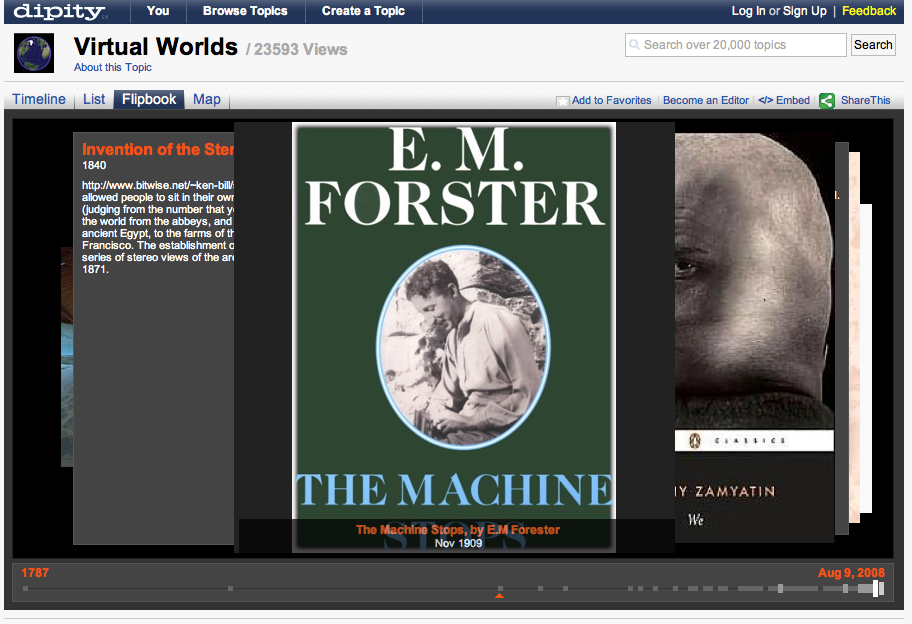
Flipbook

Map
And since May it’s also been possible to create a so called TimeTube – a Dipity MashUp wth You Tube. Pretty cool stuff!
I’m certain many students and teachers really will appreciate this kind of presentation tool :-)
/Mariis
Digital Identity discussion
I’ve had the opportunity to listen to John Clippinger (Harvard Law School), Kaliya Hamlin, (IdentityWoman/evangelist for open standards in user-centric digital identity) and Reid Hoffman (LinkedIn founder/chair) discussing issues on identity on It Conversations.

A brief summary of the discussion goes like this:
As our lives increasingly straddle the physical and the virtual worlds, the management of identity becomes increasingly crucial from both a business and a social standpoint. John Clippinger, Kaliya Hamlin, and Reid Hoffman examine how online identity can foster relationships and deepen value creation. They discuss OpenID, including how America Online has chosen to adopt it, and answer questions related to such issues as anonymity and restricting information.
OpenID and this whole “open access/open source-debate” is not really an issue relevant for my phd-project. My interest on identity will be from a more socio-philosophical perspective. But the discussion was worth listening in on anyways, and I did manage to take some notes on interesting points – all worth returning to. My private ponderings are in the brackets – a few times with references, so I don’t forget!
- New (social) networks means “new” people, since networks consists hereof
- Privacy – anonymity – compliance are keywords when speaking of “digital identity” (A much better concept than “online identity” because the latter suggests a – in many cases false – separation between on- and offline)
- The anonymity claim is all about having the choice – whether you exercise it or not isn’t the issue (Perhaps in some cases – when and why do we choose anonymity – is it ok for the teachers to interact with own students anonymously?)
- Identity-management is the new buzz word (Usually management is something that needs to be learned – how do we as educators go about this?)
- Top-down or Bottom-up identity?
- Data security – personal and corporate control are other keywords
- Is it possible to keep a stabile identity? (When and why – is stability always a goal? Does distributed identity necessarily mean loss of privacy?)
- How to authenticate identity? (Usually crucial in formal education, which may be the reason why it’s so difficult for formal education to simulate otherwise)
- From Place to Cloud – breaking away from silos (shifting metaphors to better understand new phenomena – e.g. Lakoff & Johnson)
- Work forms identity – shift work = shift identity (also note Third Place concept/Multiple Bodies concept)
- OpenID – identity provider?
- OpenID keywords are interoperability, openness, remix
- Consumers/users aggressively expect a simplified way to navigate on the internet (Usability continues to be an important issue)
- Social networking – micro-blogging in present tense – live stream of activities
- If you participate in a social network people don’t care who you are, but whether you’re a good actor in that particular community, and there may be very different standards for “good acting” in different communities. (In a learning context this could be both positive and negative, if students accept learning from others than their teachers. Luckily most of them do, but in a traditional academic setting verification of sources of information is still very much at play and may collide with this …)
I forgot how pleasant (and inspirational!) it is sometimes just to be on the receiving , listening end :-)
/Mariis
SL making headlines again
Once again the press criticizes SL – this time around it’s the Australian IT with an article entitled Second Life a virtual failure.

I don’t know if it still is silly season down under, but I hope so .. . Otherwise I’m troubled by the journalistic level. Not so much because of the content, but because of the presentation of the apparent facts.
The journalist refers to a qualitative study made by a postgraduate student at Queensland University, Kim MacKenzie. Her study focused on 20 international corporations, such as Intel, AOL and Coca Cola, that were conducting business in SL – most of which (doesn’t say how many) have closed their “sites” now.
MacKenzie is quoted for saying:
The actual Second Life setting is going to require either an adaptation or a new commercial virtual marketplace controlled by commercial parameters that you need for safe and secure business activity to happen on the internet (…) Once the right setting is there, it will explode.
And she concludes by saying, that the right commercial setting must be backed by an awareness campaign to get users on board.
At this point nothing in the article justifies the sensational headline, and even more surprising the article ends by referring to one of the first Australian companies entering SL, Telstra that has BigPond in-world. According to spokesman, Peter Habib BigPond’s Second Life site had hosted its own registration process and continues to experience growth, since it was set up in March 2007. And that’s it …
I wouldn’t term SL as neither a site nor as a virtual reality program, but that’s just a minor detail. What’s far more worrying is the press’ constant need to create headlines on false claims. This and other critical articles usually confirm, what many regular residents already know, namely that there has been a lack of imagination on the part of many SLusers, who simply haven’t had the strategy, the creativity, the skills and perhaps the patience to explore and utilize SL’s potential.
As many virtual world fans know, the esteemed technology research and advisory company, Gartner Inc. last year predicted that 80% of internet users would have a “second life” by 2011 (Not necessarily in Second Life). In May 2008 Gartner, Inc. did however renounce a bit on this by saying that 90 % of corporate virtual world projects will fail within 18 months – here is some food for thought from that article, which as well could apply for the educational sector;
Focusing on the technology rather than understanding user requirements is one of the key reasons for failure.
They need to realise that virtual worlds mark the transition from web pages to web places and a successful virtual presence starts with people, not physics.
A benefit of virtual worlds is the rich collaboration experience they offer by adding a real-time visual dimension via avatars, so interactions can include emotional information in the “conversations” between individuals, setting them apart from simpler networking applications. They also differentiate themselves from web-based interactions (which can be asynchronous) by requiring both parties to be present at the same time.
Companies need to start thinking what their virtual world strategy is, incorporate it into their internet strategy and merge their two-dimensional web pages to support a “3D web place”. Virtual world presence is not to replace the “2D world” but to supplement it.
/Mariis
Conference on Knowledge Media – January 2009
From my MIL colleague Christian Dalsgaard I learned about an interesting conference on “Knowledge Media” on the 19th and 20th of January 2009 at Aarhus University, Denmark. Christian and his colleagues from Center for It and Learning will be organizing this event, which has 4 main themes that will provide the focus for the conference:
- Knowledge sharing in a global perspective
- New learning environments: Web 2.0 and Social Software
- Knowledge media
- Between formal and informal learning
And so far they’ve announced these leading keynote-speakers:
- Terry Anderson, Athabasca University, Canada
- Friedrich Hesse, Knowledge Media Research Center, Tübingen, Germany
- Lars Qvortrup, School of Education, University of Aarhus, Denmark
- Jørgen Bang, Institute of Information and Media Studies, University of Aarhus, Denmark
You can read more about the conference here
/Mariis
 Mariis' digitale refleksioner